
As Moscow blocks a holiday ceasefire, Europe pledges weapons but hesitates on cash, satellite imagery challenges Russian claims, and Ukraine confronts another winter of war without guarantees.
The Day’s Reckoning
December 16, 2025 exposed the war’s hard contradictions in a single, unforgiving sweep. Moscow rejected a proposed Christmas truce on the blunt grounds that it would give Ukraine time to recover. Across Europe, defense ministers pledged record levels of weapons support—while in Brussels, ambassadors met again and still failed to agree on lending Ukraine frozen Russian assets it needs to survive. Russian state television released footage insisting a struck submarine was unharmed; satellite imagery quietly suggested otherwise.
Nothing resolved, yet everything moved. Diplomacy advanced without answers. Aid commitments grew alongside funding gaps. Information wars unfolded frame by frame, image against image. On the front lines, the fighting never paused. The day distilled the war’s central tension: Ukraine’s urgent, immediate needs colliding with an international response slowed by process, politics, and caution—while the battlefield remained indifferent to all of it.
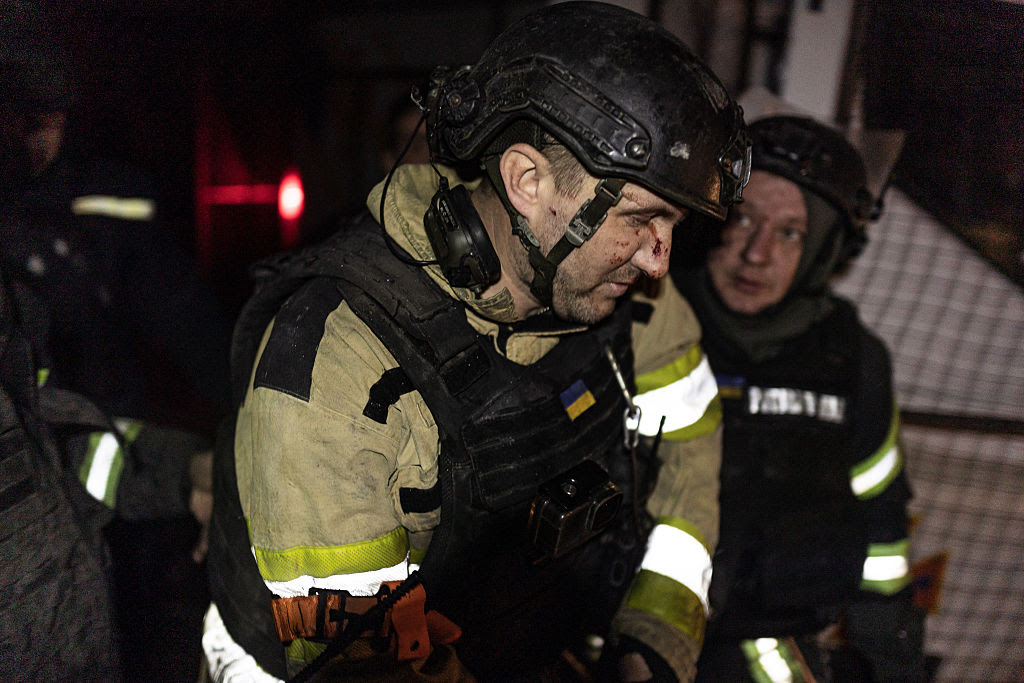
Ukrainian emergency responders carry a wounded firefighter to safety after a Russian drone strike hit their fire truck in Druzhkivka, eastern Ukraine—first responders turned casualties in a war that increasingly targets those who run toward the flames. (Diego Herrera Carcedo/Anadolu via Getty Images)
“No Pause for Mercy”: Moscow Slams the Door on Christmas
Dmitry Peskov did not dress the decision in sentiment. Standing before cameras, the Kremlin spokesperson explained why Russia rejected a Christmas truce with blunt clarity: a pause would help Ukraine recover. Ukrainian units could rest. Supplies could move. Lines could be reorganized. And that, Peskov made clear, was unacceptable.
Russia, he said, wanted peace—but only after achieving its objectives. In the same breath, he inverted the war itself, accusing Kyiv of waging aggression against a sovereign state, recasting invasion as victimhood. The language was familiar, the logic circular, the intent unmistakable.
The rejection landed as diplomatic efforts intensified elsewhere. Washington pushed for talks. President Volodymyr Zelensky spoke of safeguarding the quality of any peace. Meanwhile, Russian assaults surged across multiple fronts. The fighting did not slow; it tightened. Any lull, even a symbolic one, would have given Ukrainian defenders breathing room—and Moscow chose pressure instead.
The truce proposal had emerged as a confidence-building step, a narrow opening in a long winter of war. Peskov’s response closed it decisively. Moscow’s calculation was simple: rest favors the defender. Attrition favors the attacker. Grind, don’t pause.
History sharpened the cynicism. An Easter truce declared earlier in the year collapsed under nearly 3,000 recorded violations before its third day ended. Promised ceasefires had become tactical tools—observed when convenient, broken when useful.
Christmas, for the Kremlin, was never about silence on the battlefield. It was about maintaining momentum. And momentum, once again, mattered more than mercy.
“The Submarine That Wouldn’t Move”: When Satellites Challenged the Kremlin
By December 16, the argument was no longer just about explosions—it was about stillness. Had a Ukrainian underwater drone crippled a Russian submarine at Novorossiysk, or not? Moscow said no. The sky said maybe.
Russian state television moved first. Zvezda aired video of a submarine it claimed was untouched, its officers insisting that no ships had been damaged and that the Black Sea Fleet was operating as normal. Captain 1st Rank Alexei Rulev spoke calmly, projecting control, routine, continuity.
But analysts watched more closely than the edit allowed. The camera never showed the stern—the section nearest the reported blast. And above the harbor, satellites told a quieter story. Imagery taken the same day showed the submarine sitting exactly where it had been before the strike. No departure. No repositioning. Just a vessel that hadn’t moved.
Ukraine filled in the gap with numbers. Navy spokesperson Dmytro Pletenchuk said Russia now had only two submarines capable of launching Kalibr cruise missiles, down from three. If true, one boat was no longer operational—whether holed, crippled, or simply unable to sail.
The clash revealed how modern war unfolds in layers. Russia needed reassurance: its bases were safe, its fleet intact. Ukraine needed proof of reach—evidence that even Novorossiysk, chosen as a refuge after Sevastopol became vulnerable, was no sanctuary. And satellites—silent, indifferent—offered a version of truth that neither side could fully control.
If a Ukrainian drone could strike here, the implications stretched far beyond one hull. It meant nowhere in the Black Sea was truly secure. And sometimes, in war, the most telling evidence isn’t what explodes—but what never moves again.
“Promises, Ledgers, and a $15 Billion Hole”: Ramstein Counts the Cost of Survival
Denys Shmyhal didn’t speak in abstractions. At Ramstein 32, the Ukrainian defense minister laid out the war in numbers—figures that sounded hopeful at first, then heavier with every line. Billions pledged. Billions delivered. Billions still missing.
Nearly $10 billion had been committed in 2025 for weapons and Ukrainian defense production. For 2026, $45 billion of the $60 billion Ukraine needs from partners was already promised. The math paused there. Fifteen billion dollars remained unfunded, just as large-scale U.S. aid packages faded from the picture.
Europe stepped forward. Germany pledged €11.5 billion for air defense, drones, and artillery, promising AIM-9 Sidewinder missiles and pointing to Patriots and IRIS-T systems already delivered. Britain followed with £600 million—its largest single-year air defense commitment—financing thousands of interceptors and automated gun systems, with new Octopus drones soon rolling off production lines.
The list kept growing. Canada, the Netherlands, Denmark. Estonia and Latvia committing a quarter of their GDPs. Lithuania, Luxembourg, Norway, New Zealand. Poland shipping shells. Czechia funding hundreds of thousands more. Each country added a line item. Each pledge carried weight.
But beneath the parade of commitments, the pressure remained. Ukraine’s defense budget approaches $120 billion. Half must come from outside partners. Gaps between pledges and deliveries persist. Coordination strains under domestic politics and budget limits across Europe.
Ramstein proved something vital: Ukraine is not alone. It also revealed something uncomfortable. Survival now depends not just on solidarity, but on arithmetic—and on whether the remaining numbers can be found before time runs out.
“Money on the Table, Hands Tied”: Europe Stalls as Ukraine’s Clock Ticks
In Brussels, the lights stayed on late—but nothing moved. While defense ministers elsewhere pledged missiles and drones, European ambassadors gathered for a second night in two days and still failed to unlock the money Ukraine needs simply to survive.
Coreper met again on December 16, racing the calendar ahead of a leaders’ summit days away. The proposal was stark in scale and urgency: lend up to €210 billion in frozen Russian assets to Kyiv. Without it, Ukrainian coffers could run dry by spring 2026. The numbers were clear. The consequences, immediate.
Belgium stopped the room. Home to Euroclear, the institution holding most of the frozen assets, Brussels feared what came next. Prime Minister Bart de Wever warned of legal traps and financial exposure—what happens if assets are lent, then unfrozen? Who pays hundreds of billions if the legal ground shifts?
The European Commission bent, offering concessions. They weren’t enough. Another meeting was scheduled. Then another. Italy, Bulgaria, and Malta asked for alternatives. Czech Prime Minister Andrej Babiš questioned spending abroad when domestic needs pressed at home. Consensus thinned as urgency thickened.
Technically, the Commission could force the plan through with a qualified majority. Politically, Belgium mattered too much to bypass. Even after Europe agreed to immobilize the assets indefinitely—removing veto threats from Hungary and Slovakia—the core fear remained: liability without protection.
On paper, the loan made sense. Scholars largely agreed it was sound policy—Russia’s money, used to repair Russia’s damage. But Brussels revealed a familiar truth. Elegant solutions do not survive contact with political risk. And while Europe debated safeguards and exposure, Ukraine’s countdown continued, measured not in meetings, but in months.
“Justice in Marble Halls, War in the Streets”: The Hague Moves as Ukraine Waits
The setting was formal, almost serene. In The Hague, beneath flags and legal language, thirty-five countries gathered to sign a convention creating an International Claims Commission for Ukraine—a step toward holding Russia accountable for the wreckage it has left behind.
Foreign Minister Andriy Sybiha called it historic. Thirty-five states, plus the European Union, was a record. The commission would operate under the Council of Europe, building on groundwork laid in 2023 with the creation of the Register of Damage. That register, now based in Kyiv, had already begun collecting the human cost of the war—homes destroyed, lives uprooted. More than 80,000 claims were already filed, with dozens more categories set to open by the end of next year.
This was the second phase of justice: not just recording loss, but evaluating it—assigning responsibility, preparing the case for compensation. A third phase, the actual funding of reparations, remained unresolved. The expectation was clear: frozen Russian assets, or the interest they generate, would eventually pay the bill. But “eventually” hung heavily in the air.
The machinery worked as designed. Methodical. Precise. Patient.
And that patience was the problem.
As signatures dried in The Hague, Brussels remained deadlocked over whether to release money Ukraine needs to keep functioning into spring. Legal frameworks advanced while ammunition stocks tightened. Compensation mechanisms took shape while power stations absorbed drone strikes.
It wasn’t hypocrisy. Long-term justice matters. But the contrast was unavoidable. International law moves in years. War moves in nights. And on this day, Ukraine stood between the two—fighting in real time while accountability advanced at a measured, deliberate pace.
“Every Dollar Less, Every Shell Harder to Buy”: Oil Prices Tighten the Noose
While diplomats argued and soldiers traded fire, the markets rendered their own judgment. Russian oil slid to just over $40 a barrel—the lowest average price since the full-scale invasion began. No speeches. No vetoes. Just a number, quietly bleeding Moscow’s war chest.
The drop hit everywhere Russian crude leaves port—from the Baltic and Black seas to the far-eastern docks at Kozmino. In three months, prices had fallen 28 percent. Global benchmarks were sliding too, but Russia felt it harder. Energy pays for roughly a third of the Kremlin’s budget. When oil sinks, so does the margin for war.
The timing mattered. Less than two months earlier, Washington had sanctioned Rosneft and Lukoil, Russia’s two energy giants. The G7 price cap—once set at $60—had already been pushed lower by many of Ukraine’s partners. To keep tankers moving, Moscow offered discounts, leaning heavily on buyers like India and China.
But even discounts have limits. Revenues from fossil fuels in 2025 were projected to reach barely half of last year’s take—the weakest monthly levels since 2020. Europe had largely shut the door on Russian oil and planned a full phase-out by 2027. The Trump administration added pressure, slapping a new 25 percent tariff on Indian imports to curb reliance on Russian supply.
Whether new sanctions passed or not, the squeeze was already working. Buyers were fewer. Prices were thinner. And every dollar shaved off a barrel meant fewer rubles for missiles, drones, and mobilization bonuses.
On the battlefield, damage is loud. In the economy, it is silent—but relentless. And for Moscow, the math was turning colder by the day.
“Oil as a Weapon”: Congress Tests How Hard to Squeeze Moscow
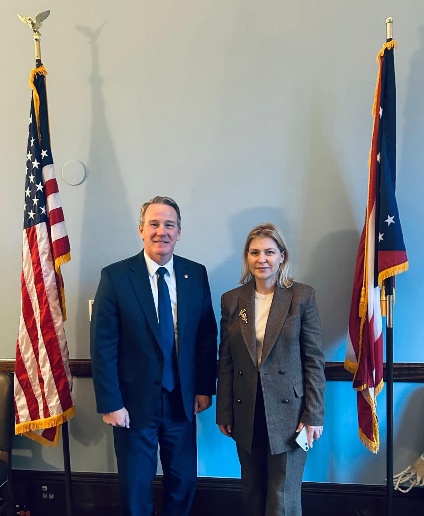
Ukraine’s Ambassador to the United States, Olha Stefanishyna, stands beside Senator Jon Husted, a Republican co-sponsor of the Decreasing Russian Oil Profits (DROP) Act—an image of rare bipartisan alignment as Washington debates how far to tighten the economic vise on Moscow’s war economy. (Olha Stefanishyna / Facebook)
In Washington, the message came wrapped in something rare: agreement. Four senators—two Republicans, two Democrats—stood on the same side of the ledger as they introduced the Decreasing Russia Oil Profits (DROP) Act. The target wasn’t symbolic. It was cash. Oil money. The fuel behind Russia’s war.
The bill would force President Trump’s hand. Within 90 days, any buyer, shipper, or middleman moving Russian oil could face U.S. sanctions—cut off from the American financial system entirely. The logic was blunt. If oil pays for the war, then oil must be made toxic.
Senator Dave McCormick said it plainly: anyone buying Russian crude is financing aggression. Ukraine’s ambassador, Olha Stefanishyna, stood beside Republican co-sponsor Jon Husted, calling the bill proof that pressure on Moscow still carried bipartisan weight—even in a divided capital.
The proposal carved out narrow exceptions. Buyers could avoid penalties by paying a per-barrel fee into a fund designated for Ukraine. Even compromise, here, was designed to bleed the same source.
But uncertainty hung over the moment. Trump had been cautious with sanctions despite pledging to pursue peace. His administration’s first Russia sanctions came only in October, hitting Rosneft and Lukoil—then softening the blow with waivers that kept Lukoil-branded stations operating abroad. Another bipartisan sanctions effort had already been diluted, granting the White House broad waiver authority and stalling in Congress.
The DROP Act was sharper. Less flexible. And that made its fate unclear.
Congress signaled appetite for escalation. The administration guarded its room to maneuver. Between them sat the same question confronting allies everywhere: how far to push economic pain—and whether Washington was ready to turn oil into a weapon as decisive as any missile.
“Who Owns the Streets?”: Kupyansk Fought in Bullets and Bandwidth
In Kupyansk, the fighting wasn’t confined to ruined buildings and frozen streets. It unfolded just as fiercely online—frame by frame, claim by claim—over who truly held the city.
Ukrainian commanders said roughly 200 Russian soldiers remained inside Kupyansk, their supply lines strangled by drone strikes and interdiction. Geolocated footage released that day showed Ukrainian forces pushing forward in central districts—areas once used by Russian troops for infiltration. On the ground, momentum appeared to be shifting.
Moscow answered not with maps, but with messaging. Russian state outlets declared control intact. Officials accused President Volodymyr Zelensky of staging a December 11 video filmed in the city, insisting the footage was fake. The goal was clear: erase Ukrainian advances by denying they existed.
Some Russian milbloggers echoed the line, circulating clips of two soldiers from the 121st Motorized Rifle Regiment walking in southern Kupyansk as supposed proof of Russian control. Units from the 68th Motorized Rifle Division were said to still be operating there.
But the narrative fractured. Other milbloggers—closer to the front—pushed back. They accused state media of hiding Ukrainian counterattacks behind sanitized official statements. One openly criticized the reliance on force-group press releases to mask deteriorating conditions on the ground.
The split exposed a deeper fault line. State media needed the image of control to support broader negotiating pressure—stories of Ukraine’s defenses “collapsing.” Milbloggers, seeing reality through drone feeds and frontline reports, knew the picture was messier.
In Kupyansk, territory wasn’t just seized with infantry and artillery. It was claimed through videos, denied through broadcasts, and contested in real time. And as the gap widened between propaganda and proof, credibility itself became another front in the battle.
“Through Fog and Fire”: Russia Pushes, Ukraine Bleeds Them for It
West of Pokrovsk, the assaults came harder than before. Ukraine’s 7th Air Assault Corps reported Russia’s fiercest push yet against the city’s western edge, while pressure tightened simultaneously on nearby Myrnohrad. This was not a single thrust—it was a grinding shove, pressing from every direction at once.
Russian troops surged toward the village of Hryshyne, less than ten kilometers away, trying to turn failed advances into momentum. Artillery and drones answered them, Ukrainian fire cutting across likely routes of approach. The Russian command, frustrated by its inability to fully seize Pokrovsk’s northwestern neighborhoods, committed fresh forces—three regiments of the elite 76th Airborne Division pulled from reserve. The cost was immediate. Casualties jumped by 30 percent in a single week, reaching 446 dead and wounded.
Yet the lines did not break.
Drone footage released that day showed Ukrainian units edging forward north of Udachne and inching ahead inside eastern Myrnohrad—territory once used by Russian infiltrators. In Myrnohrad itself, Russian troops pressed from the southeast, trying to climb deeper into the town. Near encirclement had become routine. Ukrainian rotations often ended not with relief, but with firefights.
Fog favored the attacker. Russian FPV and sleeper drones lined the roads, forcing Ukrainian troops to detour four to seven kilometers just to reach positions. Even so, Ukrainian interdiction pushed deep—10 to 15 kilometers behind Russian lines—straining supply routes manned largely by soldiers with just weeks of training.
That night, Ukrainian Special Operations Forces struck back, long-range FP-2 drones tearing into a Russian troop concentration near Pokrovsk. The advance continued. So did the resistance.
This was eastern Ukraine in winter: slow, lethal movement through smoke and fog, where every kilometer cost blood—and no side could afford to stop.
“A Front That Never Sleeps”: Pressure Everywhere, Breakthrough Nowhere
Beyond Pokrovsk and Myrnohrad, the war refused to narrow. On December 16, it spread outward in fragments—advances here, counterattacks there—forming a frontline that bent, shifted, and bled without ever fully giving way.
Near Kostyantynivka, Russian troops crept forward through fog and rubble. Small infiltration teams probed daily, sometimes riding motorcycles, sometimes slipping in on foot. Ukrainian commanders sensed the line had moved—not by kilometers, but by persistence. The edge of the battle was being nudged, quietly.
South of Dobropillya, Russian armor surged in a reinforced platoon-sized assault near Kucheriv Yar. The advance showed intent more than dominance, another push testing whether weight and speed could force a crack.
Around Siversk, the tempo quickened. What had been two or three attacks a day swelled to seven. Infantry assaults piled up, backed by artillery, drones, and air strikes—costly, grinding pressure meant to exhaust defenders rather than outmaneuver them.
Near Lyman, Russian units pressed the outskirts under cover of bad weather. Communication failures with foreign mercenaries exposed frictions inside the attacking force, yet sheer numbers kept the pressure on. Ukrainian drones still flew, even when the sky worked against them.
Farther north, near Vovchanski Khutory, Ukrainian forces stopped Russian motorized and motorcycle assaults cold. Engineering obstacles slowed the attackers just long enough for drones and artillery to finish the job.
Claims of Russian advances around Hulyaipole surfaced online, but confirmation lagged behind assertion. South of Novopavlivka, proof arrived instead—video showing Ukrainian defenders wrecking a mechanized assault, five armored vehicles burning in the fields.
This was the wider war in miniature. No decisive breakthrough. No collapse. Just constant motion, constant contact—pressure everywhere, relief nowhere.
“Darkness as a Weapon”: Winter Strikes Return
The drones came at night, as they always do. Russia launched another winter wave—69 Shahed and Gerbera drones lifting off from airfields and coastlines across Russia and occupied Crimea, fanning toward Ukraine’s cities and power lines.
Ukrainian air defenses worked through the darkness. Fifty-seven drones were shot down. Ten got through. It was enough.
Explosions struck seven locations, hitting homes, civilian sites, and energy infrastructure in Zaporizhia, Kharkiv, and Odesa regions. By morning, the cost was measured not only in craters but in silence. Ukrenergo reported power cuts for at least 427,000 customers in Donetsk Oblast and 278,000 more in Odesa. Additional outages rippled through Dnipropetrovsk and Mykolaiv. In Kharkiv, emergency shutdowns followed as crews raced to prevent wider collapse.
By day’s end, Ukrenergo warned that most of the country would move to hourly civilian blackouts and industrial restrictions the next day. Winter was tightening its grip, and electricity had once again become a frontline.
The strategy was no mystery. Moscow has long treated darkness as leverage—systematic strikes designed to exhaust civilians, freeze homes, and pressure Kyiv toward compromise. It failed last winter. It failed the winter before that.
Still, the drones kept coming.
The aim was not just to break transformers or trip breakers. It was to wear down endurance—to make survival itself feel like a negotiation. Ukraine endured again, adapting grid by grid, night by night. But every blackout carried the same message: this war is fought not only in trenches, but in living rooms, stairwells, and unlit streets.
“A Line Over the Water”: Turkey Steps In as the Black Sea Tightens
The Black Sea felt smaller. As attacks multiplied, Turkey moved to draw a line—one defined not by alliances, but by navigation lanes and national airspace.
President Recep Tayyip Erdoğan warned that reciprocal strikes now threatened maritime safety, cautioning that commercial and civilian shipping was being pulled into the war’s widening orbit. “Targeting civilian ships benefits no one,” he said in Ankara, carefully naming neither culprit nor incident. The message was deliberately balanced—and deliberately urgent.
Hours earlier, Turkey’s Defense Ministry had acted. An unidentified drone, described only as “out of control,” drifted toward Turkish territory over the Black Sea. F-16s were scrambled. The drone was destroyed over open water, away from population centers. Ankara offered no details—no origin, no type, no crash site. Just confirmation that the line had been enforced.
Turkey occupies a narrow, powerful position. It speaks to both Kyiv and Moscow. It controls the Bosporus and the Dardanelles—the gates to the Black Sea—and remains the only NATO state able to regulate naval access to the conflict zone. That leverage comes with risk.
Weeks earlier, Ankara had voiced concern over Ukrainian naval drone strikes against Russian shadow fleet tankers off Turkey’s coast. At the same time, Russia continues pounding Ukrainian ports with missiles and drones, repeatedly hitting civilian cargo vessels. Each strike tightens the knot.
For Turkey, the danger isn’t theoretical. A single misdirected drone, a single strike too close, could turn mediation into confrontation. December 16 was a reminder: as the war spills across water and sky, neutral corridors shrink—and someone must decide where the boundary holds.
“The War Comes Home”: Ukrainian Drones Light the Russian Rear
The explosions were far from the front—but not from the war. Overnight, Ukrainian drones struck deep into southern Russia, igniting an oil refinery in Slavyansk-on-Kuban and reminding Moscow that distance no longer guarantees safety.
Videos posted by residents showed flames tearing through the refinery complex, its silhouette glowing against the night sky. Slavyansk-on-Kuban sits in Krasnodar Krai, near the Azov and Black seas—territory long treated as logistical rear ground, far from the daily violence of Ukraine’s cities.
By morning, Russian officials shifted the focus. The regional operational headquarters reported damage to two high-voltage power lines, plunging more than 38,000 people into darkness. Thirteen thousand were still without electricity hours later. Two civilians were injured by falling drone debris. The refinery itself went unmentioned.
Moscow’s Defense Ministry claimed air defenses had shot down 31 Ukrainian drones over Krasnodar Krai. Kyiv stayed silent, as it often does after long-range strikes. Similar reports surfaced from Saratov Oblast, hundreds of kilometers from Ukraine’s border—another reminder of how wide the battlefield has grown.
The targets were not random. Ukraine has steadily expanded its reach against Russian energy and military infrastructure, aiming at the financial engine that keeps the invasion alive. Oil revenues pay for missiles, mobilization bonuses, and factories running at wartime tempo. Hitting refineries is not symbolic—it is strategic.
For Russian civilians, the blackout was temporary. For the Kremlin, the message was sharper. The war is no longer confined to maps marked “occupied territories.” It now flickers in refinery fires and darkened neighborhoods far from the front—proof that Ukraine’s response can travel the same long roads Russian drones have taken for years.
“Numbers With Names”: The War’s Quietest Violence
The toll arrived the way it always does—small, precise, devastating. Local authorities reported at least one person killed and sixteen others wounded across Ukraine. It sounded like a statistic. It wasn’t.
In Sumy Oblast, a 68-year-old man was killed near Velyka Pysarivka when a Russian FPV drone found him. Near Hlukhiv, another man survived a similar strike, wounded but alive. In frontline Donetsk Oblast, twelve civilians were injured in a single day, with Oleksiievo-Druzhkivka bearing the heaviest share of the damage.
In Zaporizhzhia, a Shahed drone struck a residential building in the city center. Three people were hurt there—not soldiers, not targets of opportunity, but residents whose only mistake was being home when the drone arrived.
Alongside these names and places came the larger ledger. Ukraine’s General Staff reported that Russian losses since February 2022 had reached roughly 1,190,620 troops, including 1,150 casualties in the past day alone. The equipment totals were staggering: more than 11,000 tanks destroyed, tens of thousands of armored vehicles and artillery systems lost, aircraft downed, ships sunk, drones expended by the tens of thousands.
These numbers tell one story: attrition without end.
But the civilian toll tells another. Each FPV strike, each Shahed impact, collapses the distance between battlefield and home. The war doesn’t always announce itself with offensives or breakthroughs. Sometimes it arrives as a single drone, a single explosion, a single line in a daily report.
And when the numbers are read aloud, they rarely capture what matters most—that every entry in the casualty count is a life interrupted, a family altered, a day that will never quite end.
The Day’s Meaning
December 16 revealed the war in sharp, unforgiving contrast. Promises were offered and refused. Evidence was released and contested. Weapons were pledged while money stalled. Across every domain—battlefield, diplomacy, information—the same pattern repeated: motion without resolution.
Moscow rejected a Christmas truce because rest would help Ukraine survive. European defense ministers announced record arms commitments while ambassadors in Brussels failed to unlock the funding Kyiv needs to reach spring. Russian television aired footage of a supposedly unharmed submarine; satellites showed it still frozen in place. In The Hague, thirty-five nations signed a convention for future reparations even as Ukrainian units fought on thin ammunition stocks.
The submarine became the day’s quiet symbol. Russia said it was fine. Ukraine said it was crippled. Satellites showed it hadn’t moved. Somewhere between denial and proof lay a narrow strip of verifiable truth—mirroring the wider war, where claims multiply faster than certainty.
On paper, Europe’s security guarantees looked solid. In practice, they meant little if Russia rejected them outright. Justice mechanisms advanced with care and ceremony, while immediate survival funding remained stuck in procedure. Weapons promises accumulated alongside unanswered questions about delivery timelines and battlefield impact.
The real issue wasn’t truces or tribunals or even submarines. It was whether Ukraine could endure another year of attrition while allies debated frameworks instead of outcomes.
Russian forces pressed forward near Kostyantynivka and Dobropillya. Ukrainian troops counterattacked in Kupyansk and held near Pokrovsk. Senators introduced sanctions bills. Oil prices slid. Meetings were scheduled. Nothing paused.
Some truths could be verified from orbit. Most could not. And so the war continued—not waiting for consensus, not slowed by paperwork—driven by endurance, cost, and the cold arithmetic of who could keep going longer.
On December 16, no one blinked.
So the fighting went on.