
Russian artillery has reached Kramatorsk’s doorstep for the first time in the full-scale war, signaling that Moscow may be preparing a long-anticipated push against Ukraine’s Donbas “Fortress Belt.” At the same time, Ukrainian Flamingo missiles triggered Russia’s widest nationwide air alert, proving Kyiv can now threaten targets more than 1,000 kilometers inside Russian territory. The next phase is taking shape on both sides of the line.
The Day’s Reckoning
The shell landed in Bilenke just after the guns crept within range.
Not a drone buzzing overhead. Not a glide bomb falling from altitude.
Tube artillery — the old, grinding kind.
For the first time in the full-scale war, Russian guns struck a suburb of Kramatorsk. Fourteen kilometers from the frontline. Within reach of what Ukrainian planners call the Fortress Belt: Kramatorsk, Slovyansk, Kostyantynivka, Druzhkivka — the defensive spine of Donetsk Oblast since 2014.
The blast did not level the city. It didn’t need to.
It announced proximity.
Hundreds of kilometers east, air-raid sirens wailed across 13 Russian regions. Eight heard the sound for the first time. Ukrainian FP-5 Flamingo cruise missiles flew toward places like Orenburg — more than 1,000 kilometers from Ukrainian-controlled territory — triggering Moscow’s widest missile alert of the war. Governors issued statements. Air defenses activated. Russia’s interior no longer felt interior.
The contrast defined the day.
In Donbas, Russia edged closer to the cities it has failed to seize for twelve years.
Deep inside Russia, Ukraine demonstrated it can now reach the industrial heartland that fuels the war.
Around the Zaporizhzhia Nuclear Power Plant, both sides paused long enough to repair a power line — a narrow truce in a conflict otherwise accelerating. In Pyongyang and Accra, the war’s manpower pipeline stretched visibly across continents.
February 27 was not about a breakthrough. It was about positioning.
The guns moved forward. The missiles flew east.
The next phase is taking shape.
The Guns Creep Closer: Kramatorsk Hears the War Move In
For nearly three years, Kramatorsk lived just beyond the reach of Russian tube artillery. Drones came. Missiles fell. But the heavy guns — the slow, grinding kind that signal proximity — stayed too far away.
On February 26 and 27, that changed.
Russian artillery struck Bilenke, a suburb northeast of Kramatorsk, barely 14 kilometers from the frontline. The impact was not catastrophic. It didn’t need to be. Tube artillery means distance has collapsed. It means the guns have moved.
Military analysts tracing Russian fire patterns saw the logic immediately. For months, Russian forces have waged a deliberate battlefield air interdiction campaign against what Ukrainian planners call the Fortress Belt — Kramatorsk, Slovyansk, Kostyantynivka. Drone strikes have targeted highways and supply arteries first. Geolocated footage published February 26 showed strikes along the H-20 highway linking Kostyantynivka and Slovyansk — textbook preparation, degrading logistics before a ground assault begins.
A Ukrainian servicemember operating in the Slovyansk direction confirmed what the maps already suggested: reinforcements are flowing into the sector. Equipment. Personnel. Weight.
The objective is unchanged from 2014. Take the cities Russia has never been able to seize by force.
Analysts caution that capturing the Fortress Belt would likely require a multi-year commitment of manpower and ammunition — resources Moscow has so far struggled to concentrate decisively. But artillery in Bilenke signals intent more clearly than any press statement.
The attempt is coming.
The question now is not whether Russia will push.
It is whether Ukraine can absorb the blow.
Sirens Over the Heartland: Ukraine’s Flamingo Forces Russia to Look East
At 3:47 p.m. Moscow time, the all-clear finally sounded.
Hours earlier, sirens had rippled across 13 Russian regions — from Rostov in the south to Sverdlovsk Oblast near the Ural foothills. For eight of those regions, it was the first time in the full-scale war they had heard a missile alert.
The cause was flying east.
Ukrainian FP-5 Flamingo cruise missiles triggered the widest air-raid alert Russia has declared since February 2022. Regional governors issued emergency statements. Air-defense systems activated across a vast arc of territory. In the Chuvash Republic, authorities claimed one missile was shot down and another had “lost its course.” Kyiv offered no comment. No confirmed strikes were reported.
But damage was never the point.
The Flamingo, produced by Ukraine’s Fire Point — the same company now testing a ballistic missile — carries a 1,000-kilogram warhead and claims a 3,000-kilometer range at a fraction of a Western Tomahawk’s cost. One week earlier, Flamingos struck the Votkinsk plant in Udmurtia, roughly 1,400 kilometers from Ukraine, where Russia builds its Iskander-M ballistic missiles.
Now the system appeared again, stretching Russian air defenses thin. Every battery positioned to shield Orenburg is one fewer guarding Kursk. Every unprecedented alert issued by a regional governor signals a new reality: Russia’s industrial heartland can no longer assume distance equals safety.
Orenburg Oblast lies more than 1,000 kilometers from Ukrainian-controlled territory.
A year ago, that felt like sanctuary.
On February 27, it felt like range.
Ukraine’s Ballistic Ambitions: The FP-7 Enters the Stage
The same week that Flamingo missiles triggered sirens across Russia, Fire Point published test footage of an entirely different weapon: the FP-7, a short-range ballistic missile capable of striking targets up to 200 kilometers away at speeds of 1,500 meters per second.
Where the Flamingo is a cruise missile — flying low and slow on a powered trajectory — the FP-7 climbs fast and falls faster. Based on a converted Soviet S-400 surface-to-air platform now adapted for surface-to-surface use, it carries a 150-kilogram warhead and can reach a target 200 kilometers away in roughly four minutes. At that speed, interception is exponentially harder.
Two hundred kilometers covers Belgorod, Bryansk, and the Russian military infrastructure clustered just across Ukraine’s northern border. It does not reach Moscow. But Fire Point is already developing the FP-9, expected to reach 855 kilometers when it enters development in 2026.
The test is a statement of intent. Since 2022, Zelensky has repeatedly argued that Ukraine must reduce its dependence on foreign weapons by building its own. The Flamingo is in serial production and has been used in combat. The FP-7 is in testing. The FP-9 is on the drawing board. Ukraine is building a missile program — not borrowing one.
The War Room Reset: Fedorov Rewires Ukraine’s Defense Machine
On January 14, Mykhailo Fedorov walked into the Defense Ministry with a résumé built on code, not camouflage. He had digitized Ukraine’s bureaucracy. He had helped build its drone industry from scratch. Now he was handed the war.
On February 27, he explained what that means.
The first change sounds bureaucratic. It isn’t. Every major Russian drone and missile strike now triggers a mandatory After Action Review — a NATO-derived system applied in real time. Interceptor placement. Breakthrough points. Missed trajectories. Every failure dissected. Every success studied. The conclusions feed directly back into operational adjustments.
“We then made decisions on what needed improvement,” Fedorov said.
That review culture led to something structural: a new Air Force command focused exclusively on short-range air defense. Its commander, Pavlo Yelizarov, did not rise through traditional air-defense ranks. He previously led one of Ukraine’s most innovative strike drone units. Now he directs the fight against Russia’s Shaheds from above — bringing battlefield improvisation into institutional command.
Then came the digital strike.
After Fedorov reached an agreement with Elon Musk to disable unauthorized Starlink terminals used by Russian forces, the ministry recorded an “elevenfold” drop in Russian livestreams directing operations. Command posts, unmanned ground vehicles, long-range drones — disrupted. The battlefield’s invisible wiring cut.
At brigade and corps level, “digital officers” are being embedded to push innovation downward, not just upward. The ministry, Fedorov insists, is no longer a procurement pipeline.
It is claiming strategic ownership of the war itself.
Fire in the Rear: Ukraine Targets the Fuel That Feeds Russia’s War
The drones came after dark.
On the night of February 26 to 27, Ukrainian forces launched two parallel strike campaigns against Russian military logistics — one just behind the frontline, another deep inside occupied territory.
Southwest of Druzhkivka, near Novotoretske and Koptieve, drones hit Russian fuel and lubricant depots six and nine kilometers behind the line of contact. Tanks run on diesel. Cut the fuel, and armored columns stop.
Farther south, flames rose over occupied Luhansk City. Ukrainian drones struck the Luhansk oil depot overnight; NASA satellite fire data confirmed blazes on both February 26 and 27. Ukraine’s General Staff and Unmanned Systems Forces claimed the strike.
Then Mariupol.
One hundred six kilometers from the frontline, Ukrainian drones hit a Russian fuel depot and destroyed a Pantsir-S1 air defense system at the Azovstal Steel Plant. A Russian base in Mariupol’s Prymorskyi district caught fire, wounding at least five Russian servicemembers and destroying five vehicles.
Near rear. Deep rear. Port city.
The pattern is deliberate: degrade Russian supply, degrade Russian air defense, do it repeatedly. Ukraine is thinning the logistics that sustain Russia’s offensive — not in a single blow, but night after night.
The Swarm and the Twelve Percent: Russia’s Night of Drones Over Ukraine
They launched from four directions at once — Bryansk and Oryol to the northeast, Shatalovo in Smolensk Oblast to the north, Primorsko-Akhtarsk on the Krasnodar coast, and occupied Crimea to the south.
One hundred eighty-seven Shahed, Gerbera, Italmas, and other attack drones lifted in coordinated waves.
Ukrainian air defenders shot down 165.
Twenty penetrated.
Fourteen locations were hit.
The targets followed Russia’s winter pattern: energy first. Ukrenergo reported outages across Kharkiv, Chernihiv, Sumy, Donetsk, Dnipropetrovsk, and Zaporizhzhia oblasts. Port, medical, residential, educational, and commercial infrastructure in Chernihiv, Odesa, and Kharkiv oblasts sustained damage.
On paper, the interception rate reads like success — 88 percent. In most wars, that would be exceptional.
But the arithmetic is merciless. Launch 187, and even 12 percent is enough. Enough to darken neighborhoods. Enough to keep generators humming through the night. Enough to remind civilians that protection is never total.
Russia does not need perfection. It needs persistence.
This is the gap Ukraine is trying to close. Defense Minister Fedorov’s new After Action Review system is built around that missing fraction — the trajectories that slipped through, the interceptors placed seconds too late, the blind spots in the radar arc.
Twelve percent.
In this war, that margin still burns.
The Line Too Dangerous to Cross: A Ceasefire at Zaporizhzhia
On February 27, the guns fell quiet around Europe’s largest nuclear plant.
Russia and Ukraine agreed — narrowly, locally — to stop firing so a damaged power line could be repaired.
The International Atomic Energy Agency announced the “local truce” at the Zaporizhzhia Nuclear Power Plant, occupied by Russia since the opening weeks of the full-scale invasion. Though its reactors are shut down, the facility still requires steady external electricity to keep cooling systems stable. A 330-kilovolt backup line needed urgent repair.
“Demining activities are ongoing to ensure safe access for the repair teams,” IAEA Director General Rafael Grossi said. The ceasefire was brokered through IAEA mediation and confirmed by the Russian proxy plant administration under Rosatom.
The agreement is technical and temporary. It does not signal broader diplomatic movement.
But Zaporizhzhia is not an ordinary battlefield. A reactor failure would not respect front lines or borders. Radiation does not negotiate.
So both sides paused.
In a war driven by escalation, that restraint carries meaning. Not reconciliation. Not breakthrough. A boundary.
For a few hours, the war stepped back from the reactor core.
The Autumn Deadline: Zelensky Names the Clock
On February 27, Volodymyr Zelensky stopped hinting and started counting.
“There is a chance,” he told Sky News. “It depends on these months… if we will have a chance to finish the war before autumn.” The deadline, he made clear, is November — the United States midterm elections.
The implication hangs in the air: Washington will push for a settlement before domestic politics harden. After that, leverage shifts. So the window is now.
Zelensky’s calculation is blunt. U.S. pressure is both risk and opportunity — the greatest external force that could narrow Ukraine’s position, and the only force strong enough to compel Moscow toward a deal. He is signaling flexibility within that window, but not surrender.
Kyrylo Budanov, head of Ukraine’s presidential intelligence directorate, was less measured. Territories are the “main issue,” he said. Everything else is secondary. No Korean-style division. Russia, he argued, will ultimately have to accept U.S.-backed security guarantees “whether it likes it or not.” Over twelve years of war, he said, Russia has grown economically, politically, and demographically weaker — even as its imperial ambition persists.
“We should create conditions under which Russia as an empire will disappear,” Budanov said.
To Western diplomats, that sounds maximalist. To Budanov, it is history speaking.
The clock Zelensky described is political, not military. But in this war, politics shapes ammunition, sanctions, and the endurance of alliances.
November is not just a date.
It is leverage.
Written in Paint and Dust: A Sergeant Answers for Donbas
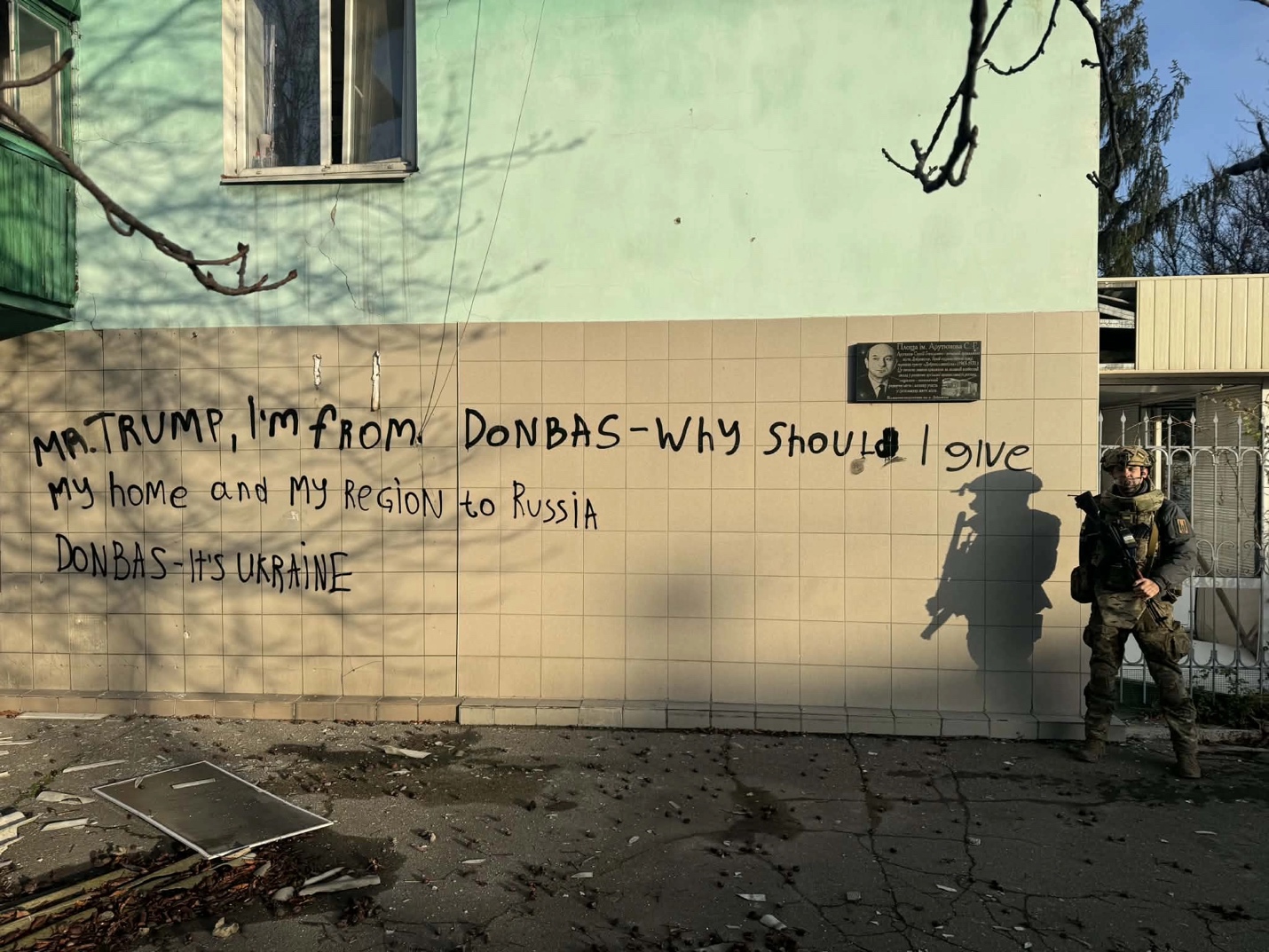
On a shattered wall in the Donetsk combat zone, Vitaliy Ovcharenko steadied his brush and wrote in large letters:
“Mr. Trump! I am from Donbas — why should I surrender my home and my region to Russia? Donbas is Ukraine.”
The photograph spread across Ukrainian social media within hours.
Ovcharenko is not a slogan. He is from Donetsk. In May 2014, he fled after watching Russian men arrive by bus convoys to destabilize a city they didn’t even know by street name. He fought through Debaltseve, Bakhmut, Chasiv Yar, and Lyman — his own hometown — carrying the war across places he once called home.
By 2026, he says, Russia’s offensive has slowed to a crawl while its losses have mounted. “The front in Donbas has barely shifted in six months.” He believes Moscow is now trying to claim through diplomacy what it cannot seize on the battlefield.
“They need successes,” Ovcharenko said. “And how? Only by sending more and more people forward.”
His earlier pessimism, he admits, has faded. Ukraine is now killing Russian soldiers faster than Russia can recruit replacements.
His message will not appear in any military briefing. It will not shape a communiqué.
But it answers the question beneath every negotiation proposal: who speaks for Donbas?
Ovcharenko’s answer is not theoretical.
It is written in paint on a bombed-out wall.
Flags in Pyongyang, Graves in Luhansk: The Price of Kim’s Pact
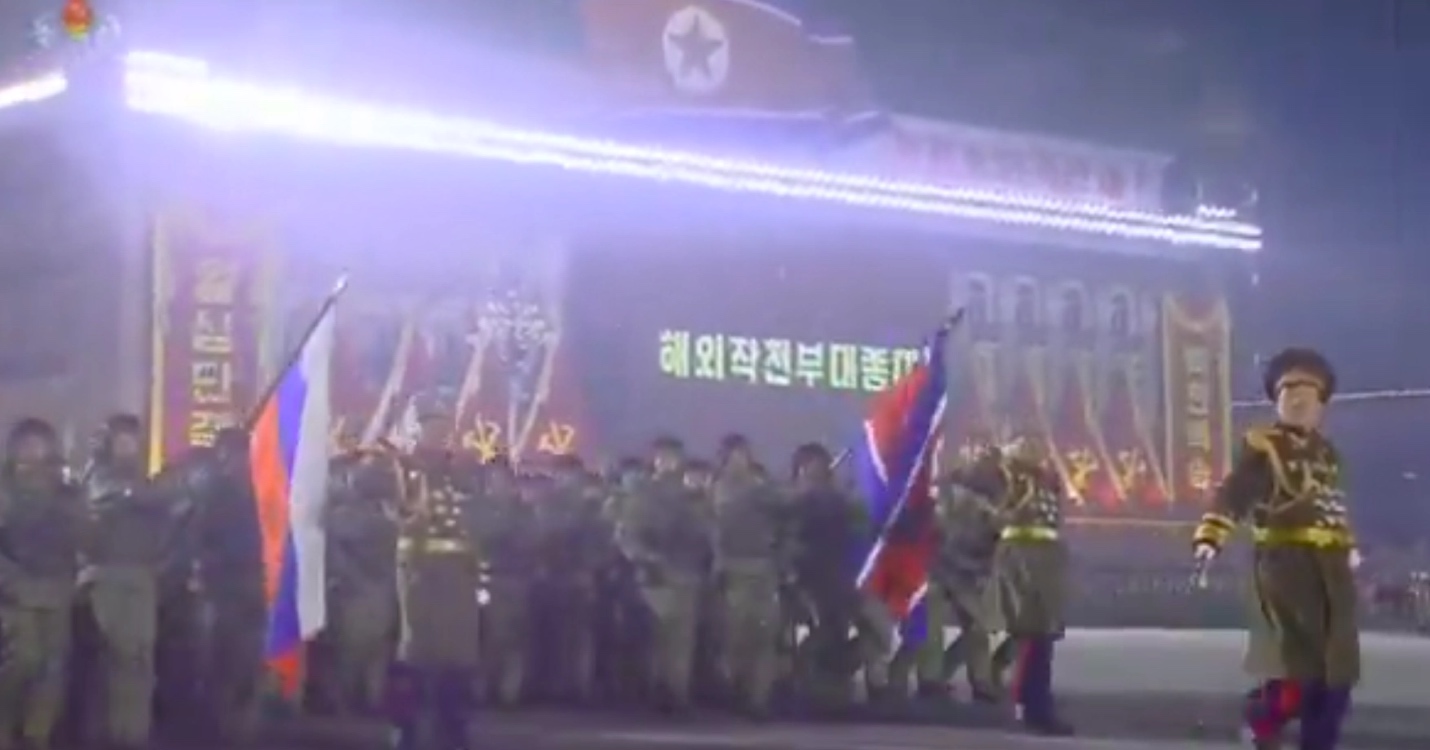
On February 25, North Korean special operations forces marched through Pyongyang under Russian tricolors, hailed as “Kursk veterans” during ceremonies for the Workers’ Party Congress. State media displayed what it described as Kim Jong Un’s handwritten order approving operational plans for the “liberation of Kursk.”
The parade was crisp. Choreographed. Celebratory.
Ukraine’s Foreign Ministry spokesman Heorhiy Tykhyi answered with numbers. “What is missing from this propaganda charade,” he wrote, “are at least 6,000 North Korean soldiers who did not march in Pyongyang that day. They croaked in an illegal war of aggression 8,000 kilometers away.”
President Zelensky, speaking separately to Kyodo News, estimated roughly 10,000 North Korean troops remain stationed in Russia. His concern is not only their presence, but their education. They are studying how Russia defends against fiber-optic FPV drones, long-range drone strikes, and missile systems. “They are training now in Russia because we are responding to Russian attacks,” Zelensky said. “At the very least, they could bring this knowledge home.”
Russian Culture Minister Olga Lyubimova attended the Pyongyang ceremony, which marked the first anniversary of the Russia–North Korea mutual defense pact.
This is no longer a simple exchange of shells for cash.
It is a military alliance. Troops deployed. Skills transferred. Lessons absorbed.
The parade showed unity.
The casualty figures showed cost.
From Accra to Luhansk: How Russia’s War Reaches Into Africa
On February 27, Ghana’s Foreign Minister Samuel Okudzeto Ablakwa delivered a number that cut across continents: at least 55 Ghanaians have been killed fighting for Russia in Ukraine. Since 2022, 272 Ghanaian citizens have been drawn into the war — recruited, he said, through networks promising jobs and training, then delivering men to front lines they barely understood.
“This is not our war,” Ablakwa said. “We cannot allow our youth to become human shields for others.” He traveled to Kyiv to meet President Zelensky and press for the release of two Ghanaian prisoners of war he called “victims of manipulation, of disinformation, of criminal trafficking networks.”
Ghana is not alone.
Kenya’s parliament was told that 1,000 Kenyans had been recruited after false employment promises; 89 were confirmed on the front line. Nigeria acknowledged two citizens killed by a drone strike in the Luhansk region, neither having received military training. Two South Africans were confirmed dead. Ukrainian officials say more than 1,780 citizens from 36 African countries have been identified in Russia’s ranks.
Recruitment extends inward as well. Ukrainian officials report Russia is drawing from at least 95 universities for its new Unmanned Systems Forces — promising safety in drone units while embedding contract clauses that allow deployment anywhere. The BBC Russian Service described coercive tactics, including propaganda screenings at a Novosibirsk college after students refused to volunteer.
In January 2026, Russia’s casualty rate exceeded its recruitment rate for the first time.
The search for soldiers now stretches from African villages to Russian lecture halls — because the domestic supply is thinning.
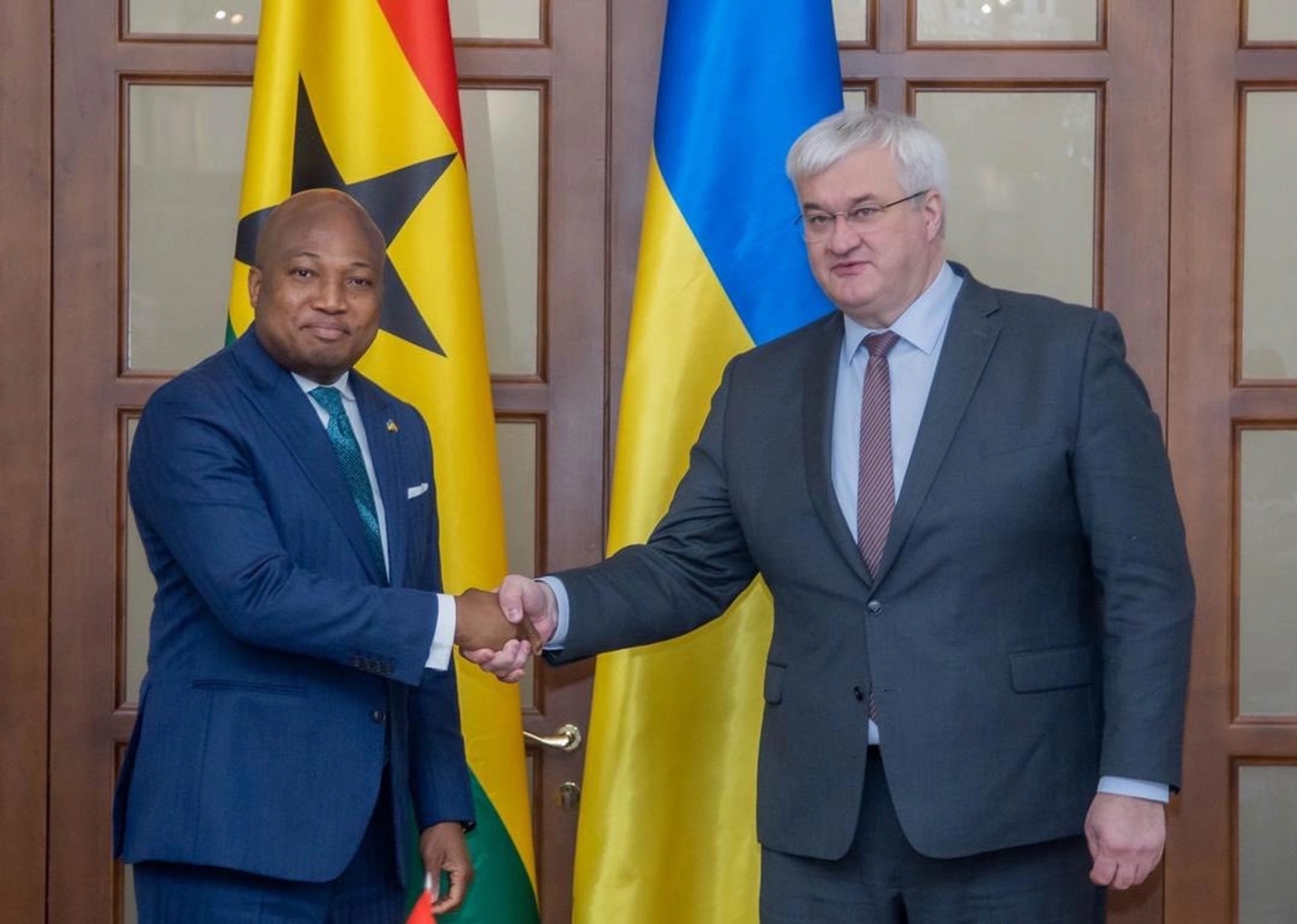
Ghana’s Foreign Affairs Minister Samuel Okudzeto Ablakwa with his Ukrainian counterpart Andrii Sybiha during his visit to Kyiv. (Photo by Samuel Okudzeto/Facebook)
From Cheerleader to Defendant: The Kremlin Tightens the Noose
On February 27, Russian authorities arrested Alexey Kostylev, founder and former editor-in-chief of the pro-war outlet Readovka. The charge: embezzling roughly one billion rubles — about $13 million — in Defense Ministry contracts.
The allegation is financial. The pattern is political.
Readovka began as a far-right platform with no deep Kremlin ties, then pivoted in 2022 into enthusiastic support for the war. It became the kind of independent pro-war voice Moscow tolerates — until independence becomes inconvenient. Russian opposition outlet Astra reported that the Defense Ministry cut funding to Readovka in March 2025 and that a Kremlin-linked figure assumed control at the same time. Kostylev, apparently, did not complete the transition from ally to subordinate.
The Institute for the Study of War has tracked what it describes as a sustained Kremlin effort to bring Russia’s milblogger sphere — the influential Telegram commentators who sometimes criticize military leadership — under tighter control. Those who resist co-optation face other tools. Fraud investigations. Courtrooms. Silence.
The arrest unfolds as analysts assess the Kremlin may be preparing domestically unpopular measures, potentially including forced reserve callups. Managing the information space before announcing such decisions is not accidental; it is procedural.
Independent pro-war voices once amplified the invasion. Now they are liabilities.
Kostylev’s detention is not an isolated corruption case.
It is one more turn in the tightening of Russia’s wartime narrative control.
A Drone Over Malmö: Russia Tests NATO in Peacetime
On February 25, the French aircraft carrier Charles de Gaulle sat docked in Malmö when a drone lifted off from the Russian signals intelligence ship Zhigulevsk in the Øresund Strait.
The ship was in Swedish territorial waters. The carrier was in port. The timing was not accidental.
A Swedish patrol boat observed the launch and activated countermeasures. The drone flew toward the carrier before being jammed roughly 13 kilometers away — about seven nautical miles, according to French military spokesman Colonel Guillaume Vernet. Swedish Defense Minister Pål Jonson confirmed the incident. The drone likely violated Swedish airspace.
No missiles were fired. No explosions followed.
But analysts describe this as “Phase Zero” — Russia’s campaign of harassment, reconnaissance, and psychological pressure against NATO that stays just below open conflict. In December 2025, unidentified drones overflew a French nuclear submarine base. Now a Russian intelligence vessel probes a French carrier in a Swedish harbor.
The signal is deliberate: Russia is watching. Mapping. Testing response times and electronic defenses. Every port call becomes data. Every radar sweep becomes a lesson.
Phase Zero is not dramatic. It does not make headlines like artillery barrages or missile strikes.
It is quieter.
It builds familiarity with targets in peacetime — in international waters, in the ports of neutral nations — assembling the infrastructure of a future conflict long before the first shot is fired.
The Phantom Push: Russia Fights for Perception in Sumy
While headlines tracked Flamingo missiles and artillery near Kramatorsk, a quieter contest unfolded along the forests and fields of northern Sumy Oblast.
On February 27, a Russian milblogger claimed Russian forces had entered Sopych, a border village northwest of Sumy City. Another asserted advances near Yunakivka to the northeast. Ukrainian Joint Forces spokesman Colonel Viktor Trehubov confirmed that Russian troops still hold Hrabovske, southeast of Sumy City, and are pressing toward Popivka and Pokrovka along the border. Attacks were recorded north of Sumy City near Oleksiivka and Varachyne, and northeast near Yunakivka and Novomykolaivka.
The movements are small. The messaging is not.
The Institute for the Study of War assesses that these cross-border probes in previously quiet sectors serve a cognitive purpose as much as a territorial one. Trigger alerts. Feed milblogger claims. Force Ukraine to react across a broader front. Create the impression — especially for Western audiences — that Ukrainian lines are fracturing everywhere at once.
The front is not collapsing.
But the narrative of collapse has strategic value. It tests political will in capitals already debating aid packages and election cycles.
Meanwhile, artillery from Russia’s 34th Motorized Rifle Brigade, part of the 49th Combined Arms Army, struck Ukrainian positions in Sumy Oblast. The shells are real. So are the patrols and border skirmishes.
So is the framing.
In Sumy, Russia fights for meters of ground — and for perceptions far beyond it.
The Slow Bleed: Where the War Grinds Without Headlines
Not every battlefield produces viral footage. Some simply grind.
On February 27, northeast of Velykyi Burluk, Russian forces continued offensive operations near Chuhunivka. A Russian milblogger claimed an advance near Dvorichanske to the southeast — unconfirmed.
In the Borova direction, Russian units attacked along four axes at once: north near Novoplatonivka and Bohuslavka; northeast near Kruhlyakivka; southeast near Chervonyi Stav and Novoyehorivka; south near Oleksandrivka. No confirmed advances followed.
South along the Dnipro River, the Kherson front remained largely static. Neither Ukrainian nor Russian sources reported ground movement that day. For months, it has been a frozen line, where drone operators trade strikes across the water. Russian operators from the 4th Military Base hit Ukrainian positions near Ponyativka, northeast of Kherson City. Pressure applied. Ground unchanged.
These sectors rarely shape headlines. They rarely shift maps.
But they drain.
Every assault repelled near Borova consumes ammunition that cannot reinforce Kramatorsk. Every defensive posture along Kherson fixes manpower that cannot be redeployed north. Russia’s method is not always breakthrough; it is saturation. Relentless contact across hundreds of kilometers denies Ukraine the ability to mass strength where the next decisive push may come.
The front does not collapse here.
It erodes.
And erosion, applied everywhere at once, is its own strategy.
The Pincer Taking Shape: Russia Narrows Its Aim at Orikhiv
In Zaporizhzhia’s Hulyaipole direction, the pattern has shifted.
Ukrainian military observer Kostyantyn Mashovets reported on February 27 that Russian command has abandoned its earlier broad-front pressure and is concentrating on a narrow breakthrough corridor.
The immediate targets are Verkhnya Tersa and Hulyaipilske, northwest of Hulyaipole. The larger objective, Mashovets assessed, is to drive toward the Omelnyk–Yehorivka–Chervona Krynytsya line and envelop Orikhiv from the east — linking with forces already pushing west of the city to form a pincer.
Geolocated footage indicates Russian forces likely advanced south of Hulyaipole, farther than previously assessed. Infiltration missions were recorded west of Pryluky and southeast of Zaliznychne. Elements of Russia’s 5th Combined Arms Army, Eastern Military District, are spearheading the effort, while the 7th Airborne Division continues operating across the broader Zaporizhzhia axis. Russian attacks were reported northeast of Orikhiv toward Hulyaipilske, east toward Charivne, northwest near Mahdalynivka and Lukyanivske, and west near Stepnohirsk.
But the maneuver has friction.
Ukrainian counterattacks on the northern flank have pushed Ukrainian forces to within 6.7 kilometers of the Hulyaipole–Velyka Novosilka Road, threatening Russian supply lines and forcing the 5th CAA to split focus between offense and flank defense.
Mashovets cautioned that even if Russian troops reach Orikhiv’s eastern outskirts, advances risk becoming disjointed from forces west of the city.
Concentration creates pressure.
Without coordination, it does not create encirclement.
Rationed Shells and Painted Lies: Inside a Front That Refuses to Break
On February 27, Russian forces attacked across nearly every active sector — and secured confirmed gains in almost none.
But two admissions from inside Russia’s own ranks exposed pressure beneath the surface.
A soldier from the 128th Motorized Rifle Brigade in Kharkiv Oblast messaged a milblogger tied to the Western Grouping of Forces. Ammunition is rationed, he said. Artillery rounds restricted. Tank shells limited. FPV drone supplies constrained. “There are times when we are unable to strike an advancing Ukrainian group.” The milblogger replied his formation faces the same shortages. The exchange, published openly, describes a military whose frontline troops view supply limits as operationally dangerous.
In Kupyansk, Russian milbloggers accused their own commanders of filing false advance reports to satisfy political leadership in Moscow. The distortion runs upward. On the ground, about 20 encircled Russian servicemembers remain trapped in apartment buildings inside the city.
Elsewhere, Ukrainian forces advanced in the Oleksandrivka direction — into Ternove, Berezove, and northeast of Krasnohirske — and confirmed the earlier liberation of Pryvillya and Zlahoda. A Ukrainian brigade commander said Russian units in late 2025 prioritized flag-raising infiltrations for propaganda over building real defenses. When Ukraine counterattacked, there were no strongpoints behind the flags.
In southwestern Kostyantynivka, white phosphorus struck — banned under Protocol III in civilian areas — followed immediately by a FAB-1500 glide bomb. About 2,000 civilians remain in the city.
The line bends.
It does not break.
What February 27 Revealed
Two preparations unfolded at once.
Russian artillery reached Bilenke. Reinforcements flowed toward Slovyansk. Drone strikes along the H-20 highway tightened pressure on the Fortress Belt. The movement is incremental, but the direction is unmistakable: Moscow is shaping conditions for another push in Donbas.
Ukraine shaped its reply the same day. Flamingo missiles triggered Russia’s widest air alert. The FP-7 ballistic missile entered testing. Fedorov reorganized air defense command and cut unauthorized Starlink links used by Russian units. Night strikes thinned fuel depots from Druzhkivka to Mariupol. Kyiv is building reach — industrial, digital, logistical — for a longer contest.
The war’s geography widened.
In Pyongyang, North Korean troops marched under Russian flags while thousands never returned. In Ghana, 55 families count the cost of recruitment networks that promised jobs and delivered war. In Donetsk, a sergeant painted a rejection of compromise on a shattered wall. In Malmö, a Russian intelligence ship probed a NATO carrier in port. In Vienna, diplomats negotiated a brief truce to repair a nuclear power line.
This is the shape of 2026: conventional offensives, industrial escalation, alliance consolidation, cognitive warfare — all unfolding simultaneously.
Zelensky’s political window before U.S. midterms is real. So is Moscow’s calculation that time can fracture Western will. Both sides are preparing for the possibility that diplomacy stalls.
Neither is behaving like a war about to end.
Day 1,464 did not deliver a breakthrough.
It clarified trajectories.
The guns moved closer. The missiles flew farther.
The margin for error shrank.
Prayer For Ukraine
1. For Strength on the Fortress Belt
Lord, as artillery edges closer to Kramatorsk and the defensive spine of Donbas, guard the soldiers holding that line. Give clarity to commanders, endurance to weary defenders, and protection to the civilians still living within range of those guns.
2. For Protection Under the Drone Swarms
Father, as waves of drones cross the night sky and energy infrastructure is struck, shield Ukraine’s cities. Strengthen air defenders closing the remaining gaps. Protect families in Kharkiv, Sumy, Donetsk, Zaporizhzhia, and every oblast facing darkness and fear.
3. For Wisdom in the Narrow Window
God of nations, grant President Zelensky and Ukraine’s leaders wisdom as they navigate the political window before the U.S. midterms. Guard them from pressure that would force unjust compromise and guide every diplomatic step toward a just and lasting peace.
4. For Justice Amid Exploitation
Lord, we lift up the African families grieving sons lost in a war that is not theirs. Expose trafficking and deception. Protect vulnerable young men from manipulation, whether in African villages or Russian universities.
5. For Restraint at Dangerous Edges
Father, we thank You for the fragile truce that allowed repairs at Zaporizhzhia. Prevent catastrophe. Restrain escalation near nuclear facilities, NATO borders, and civilian centers. Turn hearts away from reckless decisions that could widen this war.
Sustain Ukraine. Defend the innocent. Break the machinery of aggression. And bring this war to a just end.