
s diplomats talked in Miami, Russia used border raids, forced deportations, and a long-delayed town capture to sell a narrative of Ukrainian collapse that the battlefield itself did not support.
The Day’s Reckoning
Russian infantry moved at dawn into villages that had been quiet for months, crossing international borders where no offensive had existed. Not to seize ground. To be filmed. Cameras captured the crossings. Headlines followed. The spectacle traveled faster than the soldiers ever could.
In one of those villages, fewer than two hundred meters from Russia, fifty Ukrainian civilians were taken. Elderly men and women who had refused evacuation were detained, cut off from contact, and driven across the border. They vanished into Russia’s internal system while negotiators discussed peace frameworks thousands of kilometers away. No exchanges. No guarantees. Just absence.
Farther east, after forty-one months of fighting, Russian forces completed the seizure of Siversk. A town the size of three Central Parks. The Kremlin immediately declared it proof of Ukrainian collapse, a breakthrough at last, even as the advance that produced it remained measured in meters and paid for in years.
At the same time, diplomacy performed its own choreography. Ukrainian, American, and Russian officials met separately in Florida, each issuing carefully optimistic statements. Moscow’s envoy made clear that nothing short of full Ukrainian capitulation would be acceptable. In Washington, calls grew for escalation if Russia refused to bend. In Sweden, authorities detained a sanctioned Russian vessel. Pressure built in fragments, without convergence.
Across the front, the war continued as it had the day before. Slow. Grinding. Relentless. No collapse. No breakthrough.
This was day 1,397 of a conflict where appearances were weaponized, provocations substituted for progress, and the gap between what diplomats said and what the battlefield showed widened by the hour.
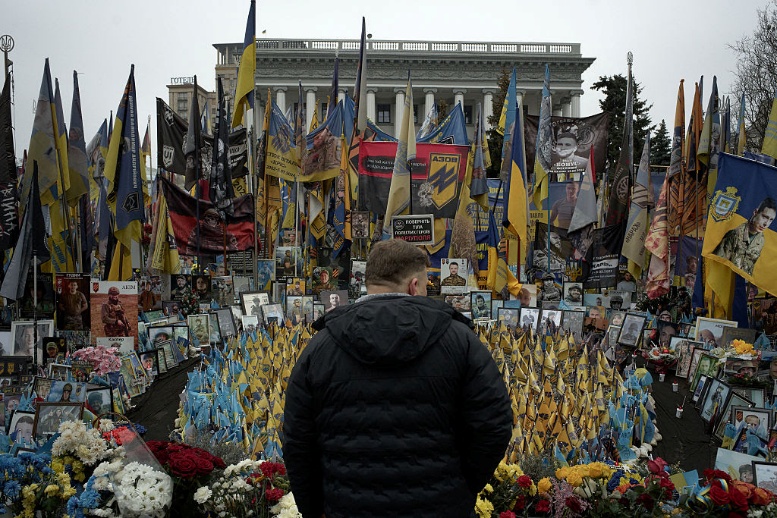
Maidan Nezalezhnosti, Kyiv: A man stands before rows of small flags marking fallen Azov Brigade soldiers, each one a life cut short and folded into Ukraine’s public memory. The square remains open, the losses unresolved. (Kostiantyn Liberov / Libkos / Getty Images)
Crossing for the Camera: When Soldiers Became the Message
They crossed the border like men who hadn’t learned the war they were fighting.
At dawn near Sotnytskyi Kozachok, about fifteen Russian infantrymen stepped out of Belgorod Oblast and into Kharkiv Oblast in tight lines, shoulder to shoulder, moving across open ground as if drones didn’t exist. Three years into a war defined by constant aerial surveillance, they advanced in a formation that practically begged to be seen.
And they were.
Ukrainian drone operators watched the group emerge, trackable from the first step. FPV cameras followed them as they crossed into the northern edge of the village, the footage clean and unmistakable. The strikes came quickly. The assault collapsed almost as soon as it began.
But the failure didn’t matter. The video did.
Two hundred kilometers west, the same logic played out under different conditions. Russian troops from the 34th Motorized Rifle Brigade slipped across the border into Hrabovske, Sumy Oblast—less than two hundred meters from Russia—using fog and darkness instead of daylight spectacle. The village had been quiet since its liberation in 2022, far from supply routes, far from decisive terrain.
Ukrainian forces pulled back from several positions to stabilize the area. Russian sources claimed additional gains nearby. On the map, the changes barely registered.
On screens abroad, they told a different story.
There was no buildup. No air interdiction. No artillery massing. No redeployment from priority fronts. None of the signals that had preceded every real Russian offensive of the past year. Elite units were still fighting and dying near Pokrovsk and Hulyaipole, not here. What crossed the border were second-line forces—enough to be filmed, not enough to break through.
Ukrainian officials called them what they were: local provocations.
But the narrative moved faster than the facts. A “new northern front.” A “forced Ukrainian withdrawal.” Talk of buffer zones revived. Pressure followed.
It was war staged for Western eyes, performed in villages most audiences would never find on a map.
Taken Across the Line: When Staying Became a Sentence
They were still there when the soldiers arrived.
About fifty people remained in Hrabovske—men and women who had refused evacuation again and again. Most were elderly. One woman was eighty-nine. They had survived Soviet rule, the chaos of the 1990s, Euromaidan, the war that began in 2014, the full-scale invasion, liberation—and now occupation returning to their doorstep. This was the village where they had lived their lives. Leaving had felt like surrender.
Russian forces detained them quickly. Phones taken. Communication cut. Held in poor conditions, with no contact with families or Ukrainian authorities. Then they were loaded up and driven across the border into Russia.
Ukrainian Ombudsman Dmytro Lubinets confirmed what had happened: forced deportation. A clear violation of the Fourth Geneva Convention, which forbids occupying powers from removing civilians across international borders. Another link in a chain that already stretched across the country—children sent to so-called re-education camps, adults taken for labor, communities erased to make return impossible.
Hrabovske’s mayor, Larysa Kremenza, confirmed the number. General Staff spokesperson Dmytro Lykhovii emphasized who they were: mostly elderly people who had chosen to stay. Ukrainian officials contacted the Russian Commissioner for Human Rights and the Red Cross immediately, demanding answers, locations, conditions.
None came.
The civilians vanished into Russia’s internal system—fifty more names added to the tens of thousands already taken. No timelines. No guarantees. No proof of life.
Afterward, armored vehicles began moving through Sumy Oblast border villages, evacuating residents who had once refused. The lesson had become impossible to ignore. Living near the border no longer meant enduring danger. It meant risking disappearance.
Lubinets called for mandatory evacuation laws, especially for children. It wasn’t policy ambition. It was admission.
In this war, staying home could now mean being taken from it forever.
Three Parks, Forty-One Months: The Price of a “Breakthrough”
When Russian forces finally finished taking Siversk, the celebration in Moscow came fast. State television declared Ukrainian defenses broken. Officials spoke of momentum, of the “Fortress Belt” cracking open, of Slovyansk now within reach.
The town on the ground told a quieter story.
Siversk covers about ten square kilometers—roughly three Central Parks. Before the war, fewer than 11,000 people lived there. To reach it, Russian forces spent forty-one months advancing twelve kilometers from Lysychansk, fighting for every tree line, every rise of ground, every ruined street.
Ukrainian military observer Kostyantyn Mashovets reported that Russian units completed the seizure only after pushing to the heights west and northwest of the town and reaching the chalk quarry beyond it. Additional gains followed north of Svyato-Pokrovske and southwest of Siversk itself. On maps, the arrows finally closed.
The cost hid between those lines.
Ukrainian defenders slowed the approach for months, forcing Russian units to fight their way block by block once they reached the town limits. Footage showed Russian troops inside Siversk weeks before its “fall,” suggesting it took more than a month to fully secure an area no larger than three parks once they were already inside it.
Beyond Siversk, the road to Slovyansk still runs through Lyman—thirty kilometers away and still contested. Based on the pace set here, reaching it would take years, not months, if Russian casualties remain even remotely sustainable.
None of that appeared in Kremlin narratives. Every meter gained became proof of imminent collapse. Time vanished. Losses vanished. Only inevitability remained.
Mashovets assessed that Russian forces—elements of the 144th Motorized Rifle Division northwest of Lyman and the 164th and 169th Brigades to the southeast—were executing a coherent plan: cut Ukrainian supply lines, reach the Siverskyi Donets near Ozerne, support assaults across the river.
The plan made sense. The execution was disciplined.
The result was measured in meters, bodies, and years.
The Miami Illusion: Handshakes Without Movement
From the outside, Miami looked like momentum.
Ukrainian Defense Council Secretary Rustem Umerov and Chief of the General Staff Andriy Hnatov sat across from U.S. Special Envoy Steve Witkoff and Jared Kushner. In other rooms, Russian Direct Investment Fund chief Kirill Dmitriev met separately with American officials. Papers changed hands. Peace plans were revised. Security guarantees, reconstruction funding, and timelines were discussed as if sequence alone might produce an outcome.
Publicly, the language stayed optimistic. Umerov described three days of talks as “productive and constructive.” Dmitriev echoed the word. President Zelensky spoke of working through details—frameworks for guarantees, U.S. commitments, economic recovery.
Then Moscow answered.
Kremlin aide Yuriy Ushakov dismissed the proposals outright, saying European and Ukrainian ideas did not “improve” the peace plan or “enhance the chances” of lasting peace. Russia, he said, would stick to what had been agreed in Anchorage. Translation: nothing had changed. Ukraine would still be expected to surrender territory Russia claimed—including land it didn’t occupy—accept permanent military limitations, reverse NATO’s course, and watch sanctions disappear.
The rejection came hours after Putin publicly denied any intention to compromise. Kremlin spokesman Dmitry Peskov followed by denying that serious trilateral talks were even under discussion, contradicting speculation swirling around Miami.
Zelensky had warned this might happen. He questioned whether a trilateral format would produce anything new and urged Washington to increase pressure instead. Events proved him right. The meetings generated statements, not shifts.
Earlier talks in Berlin had floated “Article 5-like” guarantees and reconstruction funding. They refined frameworks without answering the central question: what would compel Moscow to accept less than capitulation?
Senator Lindsey Graham offered one theory—escalation if Putin refused. Tomahawks. Oil tariffs. Terrorism designations. Ship seizures. But that logic assumed Russia was negotiating toward peace, not performing diplomacy to buy time.
Miami suggested the latter. Separate rooms. Polite language. No convergence.
It was diplomacy staged to look busy—movement without motion, negotiation without negotiation.
The Call That Changes Nothing: Paris Tests the Line Again
While diplomats shuffled between conference rooms in Miami, a quieter signal came from Moscow. Kremlin spokesman Dmitry Peskov announced that Vladimir Putin had “expressed readiness to engage in dialogue” with French President Emmanuel Macron. The phrase was deliberate. Measured. Familiar.
“If there is mutual political will,” Peskov said, “this can only be viewed positively.”
Paris responded within hours. The Élysée called Putin’s stated openness “welcome” and said France would decide “in the coming days” how to proceed. Officials stressed that any talks would happen in “full transparency” with President Zelensky and European partners—a reassurance offered almost before anyone had asked.
The need for reassurance was the point.
Macron had tried this path before. In the first year of the war, he spoke with Putin repeatedly, positioning himself as a bridge, a mediator who believed dialogue could restrain escalation. The calls produced no concessions. Russian forces kept advancing. Western unity absorbed the strain instead.
Now, nearly four years into the invasion, the same pattern flickered back to life. A hint of dialogue. Careful language. An opening framed as opportunity. The timing was not accidental. It arrived alongside stalled talks in Miami and growing international pressure to “find a way forward.”
But Moscow’s posture told its own story. Days earlier, Putin had mocked European leaders as “piglets” and declared Russia would achieve its war aims “unconditionally”—through talks or through force. For a leader issuing insults one day and invitations the next, the shift suggested not compromise, but maneuver.
The signal to Paris wasn’t about peace. It was about options.
Another channel opened. Another wedge tested. Another chance to see whether fatigue, fear, or division might succeed where tanks had stalled.
Whether France would hear dialogue—or recognize delay—was the question Moscow wanted answered.
“Appeasement Always Fails”: A Voice from Europe’s Memory
While envoys traded careful language in Miami and Moscow, Karl von Habsburg spoke without cushioning his words. In Chernivtsi, far from conference tables and communiqués, the grandson of Austria’s last emperor delivered a warning shaped by history rather than diplomacy.
“The only thing we can learn for the future is from history,” he said. Ignore it, and decisions become senseless. The idea that peace could be bought by surrendering “just a little bit of Ukraine,” he argued, was fantasy. Appeasement never works with a totalitarian state.
The reference was deliberate. Europe in the 1930s hovered in the room. Habsburg acknowledged that awareness of Ukraine’s fight had grown since 2023—but not enough. Western reactions to Russian hybrid warfare already spilling onto European soil, he said, still revealed denial rather than clarity.
From his vantage point, the danger extended well beyond Ukraine. A Russian attack on NATO states—the Baltics or Poland—or on non-NATO Moldova was, in his words, “absolutely realistic.” Moscow wasn’t hiding its ambitions. Russian doctrine and daily political broadcasts spoke openly about influence stretching to Lisbon. “They’re saying everything,” Habsburg noted. “We just don’t want to hear it.”
Information, he argued, was the real battlefield. Putin controlled the airwaves, shaping perception at home and abroad. Countering that meant breaking into Russia’s sealed media space—using technology to expose citizens to reality rather than curated myth.
Habsburg called himself a “professional optimist.” Criminal regimes, he said, eventually collapse. But optimism came with a warning: Putin’s grip endured because propaganda worked. Support—perhaps sixty percent—rested on controlled narratives, not consent.
His message cut to the heart of Western debate. Negotiate based on occupied maps, or recognize that any settlement short of full Ukrainian sovereignty would only invite the next war. To Habsburg, today’s diplomatic gestures looked less like peace—and more like rehearsal.
Two Truths in Washington: When Intelligence Became the Battlefield
As negotiators spoke softly in Miami, a sharper fight erupted online in Washington. U.S. Director of National Intelligence Tulsi Gabbard went public, posting a blunt assessment that cut against years of allied warnings. American intelligence, she said, did not believe Russia was capable of conquering and occupying Ukraine—much less threatening Europe.
“Deep State warmongers,” she wrote, were exaggerating the danger to sabotage President Trump’s push for peace.
Inside the intelligence community, the picture looked different.
Six officials familiar with U.S. intelligence assessments told Reuters that many analysts continued to warn of exactly the opposite: that Vladimir Putin still intended to subjugate Ukraine entirely and, if successful, press outward toward former Soviet territory. Those conclusions aligned with European and NATO intelligence services that had been watching Russian doctrine, force posture, and political rhetoric with growing alarm.
The disagreement wasn’t academic. It went to the heart of policy.
If Russia truly lacked the capacity to win militarily, negotiations that froze the war short of full Ukrainian sovereignty might make sense. But if Russia’s failures stemmed largely from Western weapons, money, and intelligence—support that could be withdrawn—then cutting aid early risked turning stalemate into defeat.
European allies had already chosen their answer. “The intelligence has always been that Putin wants more,” said Representative Mike Quigley, a member of the House Intelligence Committee. The Poles believed it. The Baltics believed it. They believed they were next.
The White House avoided specifics. An official declined to address intelligence disputes, insisting only that the president’s team had made “tremendous progress” toward ending the war—an assertion increasingly hard to square with stalled talks and steady fighting.
In the end, Gabbard’s claim existed in a closed loop. If aid continued and Russia stalled, it would appear correct. If aid faded and Russia advanced, the warnings she dismissed would be vindicated.
The assessment was no longer just analysis. It was a wager—one whose outcome would be written on the battlefield.
Stopped by Accident: How the Shadow Fleet Lost One Ship
The Adler didn’t meet a patrol. It lost its engine.
Off Sweden’s west coast, the Russian cargo ship went dead in the water and dropped anchor, drawing Swedish Customs and Coast Guard officers aboard. What began as a mechanical failure quickly became a detention. Authorities ordered the vessel held in place, barred from sailing without prosecutorial approval.
The reason was already known. The Adler and its owner, M Leasing LLC, were under U.S. and EU sanctions for suspected involvement in transporting North Korean ammunition to Russia for use in the war against Ukraine. Its immobilization sent the case to Sweden’s National Unit for International Organized Crime, where sanctions evasion meets criminal investigation.
In Swedish waters, the ship became evidence.
The detention exposed a weakness in Russia’s shadow fleet—a web of shell companies and flag-of-convenience vessels designed to keep oil and weapons moving despite Western restrictions. When enforcement aligned with circumstance, the system cracked. One engine failure was enough to halt a sanctions-evading supply line.
But the moment also underscored the scale of the challenge. Hundreds of similar vessels continued operating, technically legal, quietly essential. The Adler stopped. Most others did not.
Sanctions worked—once. The fleet endured.
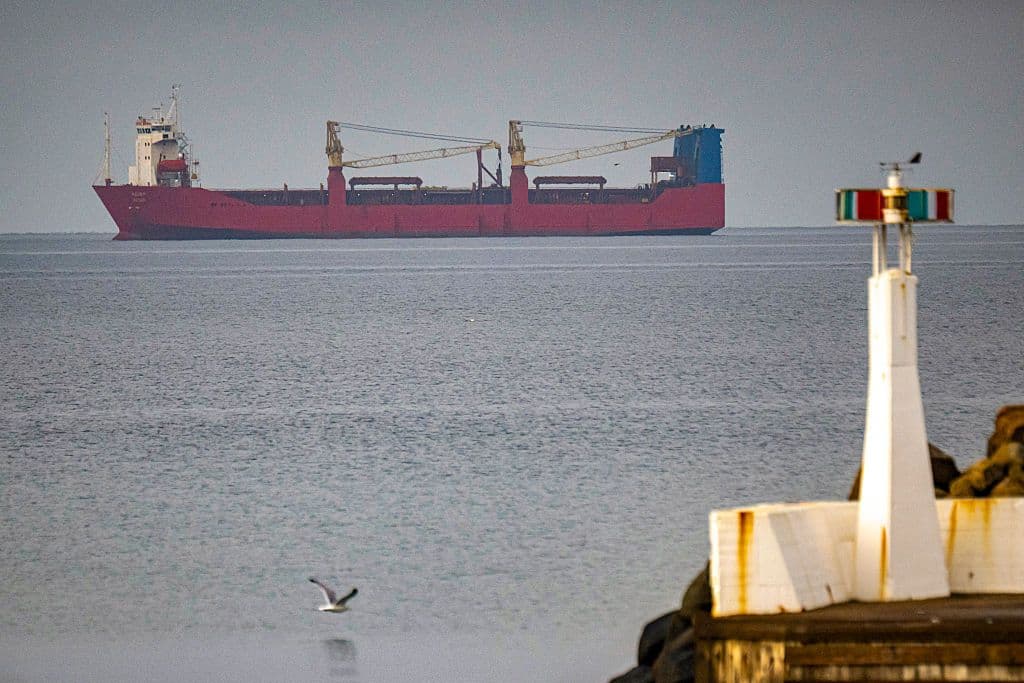
Swedish waters off Nyhamnsläge: The Russian cargo ship Adler sits immobilized after engine failure, its voyage halted by sanctions and scrutiny over alleged weapons transport for Moscow’s war. Even the sea has limits. (Johan Nilsson / TT News Agency / AFP via Getty Images)
Numbers That Don’t Fade: A Day Measured in Lives and Fire
While diplomats talked and provocations played to cameras, the war kept its own ledger.
On this day, Russian attacks killed at least four civilians and wounded at least nineteen more across Ukraine. The pattern was familiar. The damage was not.
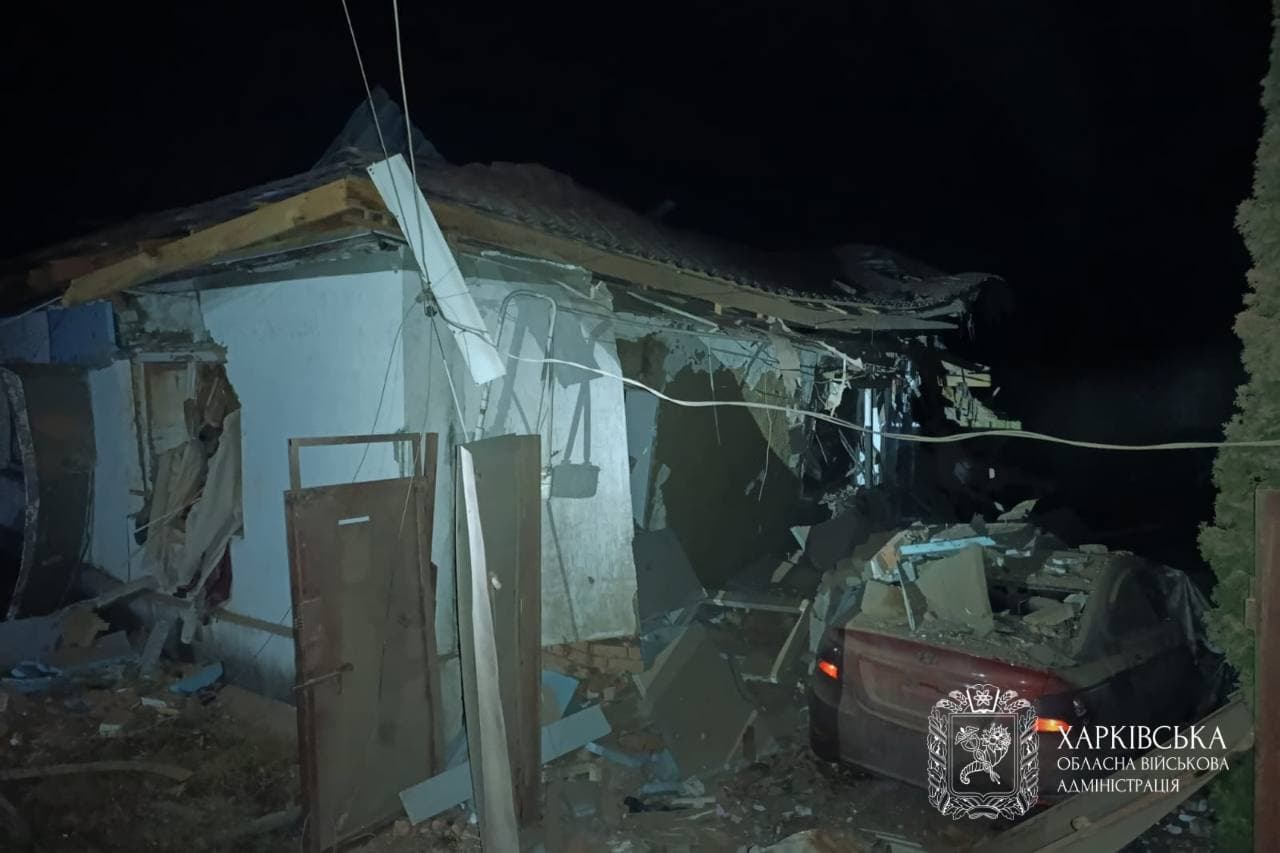
In Kharkiv Oblast, guided bombs and drones tore into neighborhoods. Two people were killed, two more injured. Seven private houses, an apartment building, and a recreation center were damaged. In Izium, a 42-year-old police officer and her 47-year-old husband died together when a strike hit their home. A 64-year-old woman survived with acute stress so severe she required medical care.
In Donetsk Oblast, one civilian was killed and four injured. Three administrative buildings and eleven houses were damaged. Zaporizhzhia Oblast recorded another death and four injuries, alongside damage to 33 homes, cars, and pieces of infrastructure.
Kherson Oblast counted seven wounded after strikes damaged multi-story buildings, private homes, an administrative structure, a gas pipeline, and a vehicle. In Odesa Oblast, Russia launched another large-scale assault on civilian infrastructure—ports, transport hubs, industrial sites—igniting fires and leaving heavy damage, though no casualties this time.
Distance offered no safety. In Rivne Oblast, far from the front, a strike hit civilian infrastructure and injured a worker. In southern Mykolaiv Oblast, guided bombs wounded one man and damaged a warehouse storing humanitarian aid.
President Zelensky summarized the scale: in one week, Russia launched roughly 1,300 attack drones, nearly 1,200 guided bombs, and nine missiles. Overnight alone, 97 drones came from four directions. Ukrainian air defenses downed 75. Nineteen hit eight locations.
These weren’t abstract figures. They were a system—designed to exhaust, disrupt, and remind civilians that normal life remains a moving target.
Street by Street: Pokrovsk and the Cost of Taking Ground Back
In Pokrovsk, the war narrowed to blocks, intersections, and burned-out buildings.
While Russian forces declared progress elsewhere, Ukrainian units pushed back on the town’s western edge, retaking small but meaningful stretches of ground through local counterattacks. Brigadier General Yevhen Lasiychuk, commander of Ukraine’s 7th Rapid Reaction Corps, said Russian troops had bogged down inside the city itself—caught in the slow, punishing logic of urban combat where defenders bleed attackers dry.
The losses showed it. Thousands of Russian servicemembers had been killed or wounded in recent months around Pokrovsk, casualties that reflected what happens when armor and manpower are forced into streets where drones, mines, and short sightlines favor those holding ground.
Geolocated footage confirmed the shift. Ukrainian soldiers were again operating along the M-30 highway on the town’s western outskirts—areas Russian sources had claimed were firmly under their control. The reversals suggested overreach, or positions taken too quickly to be held.
But nothing came free.
Ukraine’s General Staff released footage showing a new Russian adaptation: a coordinated swarm of roughly twenty FPV drones launched in rapid succession against a small group of Ukrainian troops. Not single strikes, but saturation—overwhelming defenses through volume, signaling another turn in the drone war.
Inside Pokrovsk, elements of Russia’s 76th Airborne Division and the 506th Motorized Rifle Regiment remained engaged, backed by artillery from the 268th Self-Propelled Artillery Regiment. Elite VDV units were being fed into the fight, underscoring how badly Moscow wanted the city, despite the cost.
Pressure continued from every direction—near Pokrovsk itself, northwest by Hryshyne, north near Rodynske, northeast toward Sukhetske, east in Myrnohrad, and southwest around Kotlyne, Udachne, and Molodetske.
Ukrainian counterattacks bent the line. The offensive kept grinding forward anyway.
When Missiles Keep Landing: Accountability Reaches the Command
The announcement came without ceremony.
After another wave of Russian strikes hit Odesa Oblast, President Volodymyr Zelensky said he was considering replacing the head of Ukraine’s Southern Air Command, Dmytro Karpenko. The message was direct, stripped of euphemism. “We are strengthening air defense,” Zelensky told reporters. “And we will also strengthen the command. We need to react in a timely manner—quickly.”
Odesa had become the pressure point. Repeated strikes on port infrastructure had plunged neighborhoods into darkness, shut off running water, and left residents measuring time in outages rather than days. Each successful hit carried more than physical damage. It chipped at confidence—proof that missiles were getting through.
Zelensky framed the decision as necessity, not blame. Protecting civilians, he said, came first. Protecting Odesa mattered as much as protecting any front-line position.
The move exposed the strain on Ukraine’s military leadership. Air defense sits at the intersection of battlefield survival and civilian endurance. When it works, cities function. When it fails, the war enters kitchens and stairwells. Successful Russian strikes suggested either shortages too severe to hide—or systems not being deployed fast enough, flexibly enough, or in the right places.
Replacing Karpenko would not solve the deeper problem. Ukraine does not have enough air defense systems to shield every power station, port, and neighborhood at once. Every commander in the south faces the same impossible math: what to protect, what to risk, what to leave exposed.
But wars do not pause for explanations. They demand visible response.
Missiles kept landing. So leadership changed.
Fire Beyond the Front: When the War Reached Russia’s Lifelines
The war didn’t stay near the trenches.
As diplomats talked in Miami and ground fighting dragged on across Ukraine, flames rose far inside Russia. Members of the Ukrainian partisan group Atesh said they struck a railway supply hub near Rostov-on-Don, setting fire to infrastructure in Bataysk that fed Russian forces fighting in Kherson, Zaporizhzhia, Donetsk—and Crimea.
The location mattered. Bataysk is not symbolic territory; it is plumbing. Trains moving through the hub carry ammunition, fuel, and equipment south. When the lines stop, planners scramble. Routes lengthen. Convoys slow. Targets multiply. Atesh has made that disruption its mission, hitting military sites in occupied Ukraine and striking logistics nodes deep inside Russia to stretch defenses thin.
Hours later, the fire spread south.
In Krasnodar Krai, Ukrainian drones struck infrastructure near Volna village in the Temryuk district. Wreckage from an intercepted UAV slammed into a pipeline terminal, igniting a blaze that burned across roughly 100 square meters. Russian officials said two piers and two docked ships were damaged. No casualties were reported.
The geography sharpened the message. Volna sits near the Crimean Bridge—the artery Moscow built after seizing Crimea in 2014. Every strike near it reminds Russian planners that distance no longer equals safety, and that supply lines feeding occupied territory can be threatened far from the front.
None of the strikes alone halted the war. That wasn’t the goal.
Each fire forced Russia to defend more ground, more routes, more infrastructure. Each act pulled attention away from the front and scattered it across a country built for control, not resilience.
The battlefield was no longer contained. It was spreading—by design.
The Day’s Meaning: When the Show Tried to Become the Story
Two wars unfolded at once.
In villages along the northern border, Russian soldiers crossed lines not to take ground but to be seen doing it. Cameras captured the movement. Headlines followed. Fifty civilians vanished into forced deportation as negotiators in Miami spoke of frameworks and timelines. After forty-one months, a town the size of three city parks fell—and was instantly repackaged as proof of Ukrainian collapse.
The performance worked because it targeted fear rather than facts.
In Sumy and Kharkiv oblasts, small, militarily insignificant incursions generated attention far beyond their value. The image of border crossings allowed Moscow to revive “buffer zone” rhetoric and amplify Western anxiety that the war was slipping out of control. Pressure built where the battlefield itself offered little evidence to support it.
The reality ran in parallel, unchanged. There was no preparation for major northern offensives. No redeployment from priority fronts. No air interdiction campaign. What moved across the border were provocations, not armies—designed to influence negotiators, not break defenses.
Miami mirrored the same split. Separate meetings produced polite language and incompatible positions. Moscow demanded capitulation. Kyiv refused surrender. Washington searched for frameworks neither side would accept. Europe worried about being pushed toward appeasement while guarding its own security.
The distance between words and events widened. Negotiators discussed implementation schedules while Russian advances crawled forward by meters. They debated security guarantees as civilians were dragged across borders. They spoke of rebuilding while drones kept striking ports in triple digits.
History pressed in. Karl von Habsburg’s warning echoed uncomfortably: appeasement does not tame totalitarian states. It invites them.
On day 1,397, the front lines were not collapsing. Russian progress remained slow and costly. Ukrainian defenses held under strain. But the information war—aimed at convincing Western capitals that resistance was futile—was advancing faster than any tank column.
The decisive question was no longer only what happened on the battlefield. It was whether performance would be mistaken for reality before the facts could assert themselves.