
Ukraine Daily Briefing | May 29, 2026 | Day 1,556 of the Full-Scale Invasion
Prepared by Dayana Bozhyk
A Russian Geran-2 drone struck a residential apartment building in Galati, Romania — 7 kilometers from the Ukrainian border and inside NATO territory — injuring two civilians, prompting Romania to close Russia’s consulate in Constanta, expel its consul, and discuss NATO Article 4 consultations. Ukraine liberated 46 square kilometers in the Oleksandrivka direction with Air Assault Forces. The Financial Times reported that Russia’s 2026 war budget is already overshot by $28 billion, with the deficit through four months at 2.5 percent of GDP. Weapons exhibition analysis revealed the Oreshnik is a 2017 missile built from pre-2016 components — not the cutting-edge weapon Moscow claimed. The UN blacklisted Russian armed forces for sexual violence against POWs and civilian detainees for the first time. Ukraine struck the Yaroslavl-3 pumping station, the Volgograd oil refinery, and the FSB’s 16th Center intelligence facility overnight.
THE DAY’S RECKONING
The threshold was crossed overnight May 28 to 29. Russian drones have violated Romanian airspace 28 times since February 2022. Fragments have landed on Romanian territory nearly 50 times. But on the night of May 28, a Russian Geran-2 drone entered Romanian airspace, altered its trajectory — likely due to Ukrainian air defense interception of a nearby drone over Reni, Odesa Oblast — and struck a residential apartment building in Galati, 7 kilometers from Ukraine’s border. Two civilians were injured. Their building was set on fire. This was the first time a Russian drone has directly injured civilians in a NATO member state.
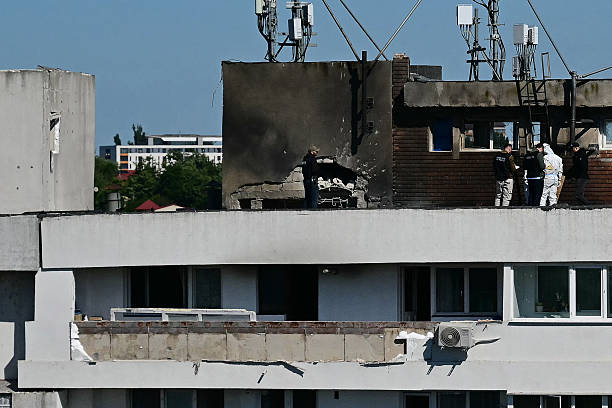
Police and forensic investigators stand on the rooftop as they examine the location of impact over a damaged apartment after a Russian drone struck an apartment building in Galati, eastern Romania. A Russian drone wounded two people as it struck an apartment building in NATO-member Romania, its defence ministry said. (Daniel Mihailescu / AFP via Getty Images)
Romania scrambled two F-16s and an IAR 330 helicopter. Four minutes passed between detection and impact. Romanian law prohibits firing into neighboring airspace; the debris risk from interception over a populated area was judged greater than the drone threat itself. None of the intercept options were available. The apartment was struck. Romanian President Dan declared Russia bears full responsibility. Foreign Minister Toiu called it “an unacceptable and blatant violation of our airspace.” Romania closed Russia’s Consulate General in Constanta, expelled the consul, and began discussions on invoking NATO Article 4 consultation.
Medvedev’s response on Telegram was to tell European governments to “shut your piehole.” He called European countries “direct participants” in the war and wrote that Europeans “shouldn’t be going to sleep expecting peaceful nights.” Putin denied Russian responsibility and insinuated the drone was Ukrainian, offering to examine the wreckage. ISW assessed this as a deliberate Kremlin tactic: deflect responsibility, blame Ukraine, test NATO’s response, and signal that further incidents are acceptable risk.
The rest of May 29 was no quieter. Ukraine liberated 46 square kilometers in the Oleksandrivka direction, with Novoselivka confirmed liberated and clearing operations ongoing across six settlements. Russia’s war budget was confirmed to be $28 billion over target for 2026, with Finance Minister Siluanov’s February warning to the government finally leaked to the FT. An exhibition in Kyiv showed journalists the Oreshnik’s components: manufactured in 2017, electronics from 2016, some parts from a Belarusian factory. Not a next-generation weapon. A modified Soviet design, deployed three times in this war as a demonstration of something Russia cannot actually aim with precision.

Ukrainian experts display foreign-made components found in Russian drones and missiles used in attacks against Ukraine in Kyiv. (President’s Office)
RUSSIA STRIKES A NATO APARTMENT BUILDING IN GALATI, ROMANIA
Romanian Defense Ministry officials confirmed on May 29 that a Russian Geran-2 drone entered Romanian airspace at 1:19 a.m. local time on May 29, traveled approximately 7 kilometers inside Romanian territory, and struck a multi-story residential apartment building in Galati on the Danube River. The drone’s full payload detonated upon impact. Debris recovered from the site was consistent with Shahed-type drone design. Two civilians were injured. A fire broke out in the building.
Romanian President Dan stated that 43 Russian drones were flying toward Romania from the east during the overnight attack. Ukrainian air defenses likely intercepted one drone above Reni, Odesa Oblast — just east of Galati along the Ukrainian-Romanian-Moldovan border triangle — altering its trajectory and redirecting it into Romanian territory. Romanian Acting Chief of Joint Staff Brigadier General Maxim explained the interception failure: Romanian law prohibits firing projectiles that could enter neighboring airspace; four minutes elapsed between detection and impact, insufficient for safe intercept; and the risk of debris over a populated area exceeded the drone’s expected damage. The jets and helicopter scrambled had the authority to shoot but no safe firing solution.
Romania’s diplomatic response was immediate and forceful: Russia’s Consulate General in Constanta was shuttered and its consul general declared persona non grata. Romania summoned Russia’s ambassador. Foreign Minister Toiu confirmed Romania is discussing the possible activation of NATO Article 4, the provision for consultations among member states over threats to the territory, independence, or security of any member. NATO Secretary General Rutte expressed full solidarity with Romania and stated the alliance would continue strengthening defenses against drone threats. EU Commission President von der Leyen said Russia’s war had “crossed yet another line.”
ISW’s structural assessment: this is the first Russian drone incursion into NATO territory that has directly injured civilians in a NATO member state. It follows Russia’s September 2025 intentional violations of Polish airspace with at least 19 drones. Whether this specific incident was intentional or a navigation error resulting from Ukrainian countermeasures, the pattern demonstrates that Putin has adopted a policy accepting the risk of Russian drones — and now civilian casualties — in NATO territory as an acceptable operational cost. ISW assessed that NATO may need to negotiate air defense cooperation agreements with Ukraine and Moldova specifically to address this structural threat, regardless of whether individual incidents are accidental.
KREMLIN’S RESPONSE: MEDVEDEV’S THREATS, PUTIN’S DENIAL, ISW’S ASSESSMENT
The Kremlin’s response to the Galati strike was two-pronged and coordinated. Putin stated at a press appearance that “no one can say for sure” whether the drone was Russian, cited prior incidents where drones in Finland, Poland, and Baltic states were initially blamed on Russia but “turned out to have nothing to do with Russian aircraft,” and offered to examine the wreckage himself — implying Ukraine was responsible. He stated that Russia has “never threatened and is not threatening European countries.”
Medvedev, on Telegram, was less diplomatic. He mocked what he called European outrage over a drone hitting “some residential building in Romania,” accused European nations of being direct war participants because they support Ukraine, and wrote that citizens of EU countries “shouldn’t be going to sleep expecting peaceful nights.” He concluded with an instruction for European governments to “shut your piehole.” He stated explicitly: “So they’d better get used to it. This won’t be the last time.”
ISW assessed these two responses as designed to serve the same function: deflect Russian responsibility, test how NATO responds both to the physical incident and to the rhetoric, and signal to European governments that continuing to support Ukraine carries consequences. Whether or not the Galati incident was intentional, the Kremlin’s messaging treats it as an operational asset. Russian State Duma deputies echoed the same lines, falsely accusing the West of escalating against Russia.
UKRAINE LIBERATES 46 SQUARE KILOMETERS IN OLEKSANDRIVKA DIRECTION; SIX SETTLEMENTS CLEARED
DeepState and Ukraine’s General Staff confirmed on May 29 that Ukrainian Air Assault Forces liberated the village of Novoselivka in Dnipropetrovsk Oblast and are conducting clearing operations in Voronne, Sichneve, Piddubne, Tovste, Novokhatske, and Zelenyi Hai — a cluster of settlements northeast of Oleksandrivka on the Dnipropetrovsk-Donetsk border. Total confirmed liberated area: at least 46 square kilometers. A senior Ukrainian officer confirmed the operation is led by the Air Assault Forces. The Kyiv Independent noted it cannot independently verify the full extent of gains in the operation’s early stages.
The terrain is flat and sparsely populated, captured by Russian forces in autumn 2025 when they exploited weaknesses in Ukrainian defenses to enter Dnipropetrovsk Oblast for the first time in the full-scale war. The operation mirrors the February 2026 counterattacks that liberated over 201 square kilometers in five days after Starlink access was cut for Russian forces. A U.S. intelligence assessment confirmed in May that the Starlink cutoff significantly disrupted Russian command-and-control and contributed to Ukraine regaining nearly 400 square kilometers earlier this year. The May 29 operation extends the southern counteroffensive arc that has been building since late April.
Separately, geolocated footage published on May 29 confirmed Ukrainian advances in western Kostyantynivka and in southern Illinivka south of Kostyantynivka. Ukrainian forces maintain positions in southern Mykolaivka northeast of Kostyantynivka and north of Illinivka in areas where Russia had claimed control. Russian infiltration missions in the Kostyantynivka urban area continue but have not succeeded in establishing permanent positions.
UKRAINE STRIKES YAROSLAVL-3, VOLGOGRAD REFINERY, AND FSB INTELLIGENCE CENTER
The Ukrainian General Staff confirmed overnight May 28 to 29 strikes against three significant Russian targets. At the Yaroslavl-3 pumping station in Yaroslavl Oblast, fires broke out in two oil tanks; geolocated footage confirmed smoke rising from the facility. At the Volgograd Oil Refinery in Volgograd Oblast, the strike damaged the AVT-1, AVT-3, AVT-5, and AVT-6 primary crude distillation units and secondary processing units. Volgograd Oblast Governor Bocharov acknowledged strikes on a synthetic fiber plant and chemical plant in Volzhsky and damage to fuel and energy facilities in the southern part of the oblast.
Ukraine’s SBU reported a separate strike on the FSB’s 16th Center in Temryutsky Raion, Krasnodar Krai. The 16th Center handles electronic intelligence — signals interception, communications monitoring, and electronic reconnaissance. The SBU stated the strike disabled key facilities of the center.
USF Commander Brovdi reported on May 29 that Ukrainian forces struck 17 Russian oil facilities from May 1 to 29, across Krasnodar and Perm Krais and Leningrad, Samara, Ryazan, Nizhny Novgorod, and Moscow oblasts. Over half of those facilities have halted operations or cannot operate following the strikes. Ukraine’s GUR confirmed that drone operators are maintaining fire control over sections of the M-14 highway between Berdyansk, Melitopol, and Dzhankoy. Zaporizhzhia Oblast Governor Fedorov stated the route has effectively stopped functioning as a Russian military logistics artery.
RUSSIA’S WAR BUDGET: $28 BILLION OVER TARGET, DEFICIT AT 2.5% OF GDP IN FOUR MONTHS
The Financial Times reported on May 29, based on a leaked February letter from Finance Minister Siluanov to the Russian government, that Russia’s military expenditures are expected to exceed the 2026 budget by 2 trillion rubles ($28 billion). Russia’s 2026 defense and security budget was set at 16.84 trillion rubles ($238 billion) — nearly 40 percent of total government spending. Russia initially projected a full-year budget deficit of 3.8 trillion rubles ($53 billion). In the first four months of 2026 alone, the deficit reached 5.9 trillion rubles ($82 billion) — 2.5 percent of GDP, the largest shortfall recorded since the start of the full-scale invasion.
Siluanov’s letter estimated the immediate funding gap from additional military spending at $28 billion, potentially expanding to $56 billion under negative scenarios through 2027–2028. To offset the pressure, he reportedly asked the government to freeze $40 billion in planned non-military spending in 2026. The document suggests required cuts could grow to $99 billion by 2028 if military expenditures continue their current trajectory. Alexandra Prokopenko, a former Russian Central Bank official, stated: “War spending is being prioritized over everything else.”
Additional context: Ukraine’s Foreign Intelligence Service reported that Russia’s banking sector non-performing assets have remained above the IMF’s 10 percent crisis threshold for a third consecutive month. The sector is masking defaults and restructuring bad corporate debt. Nearly half of Russian businesses identified severe payment delays from partners as their biggest threat heading into mid-2026. Oil revenues received a temporary boost from the Iran conflict driving prices above $100 per barrel — but the Financial Times noted this is unlikely to fully offset the growing war cost, particularly as Iran-U.S. negotiations raise the prospect of Hormuz reopening and prices declining.
ORESHNIK IS A 2017 WEAPON BUILT FROM PRE-2016 COMPONENTS; MINIMAL PRECISION
Ukrainian presidential sanctions commissioner Vlasiuk presented missile and drone components to journalists at a Kyiv exhibition on May 29, including an onboard computer and processor unit from the Oreshnik missile used in Russia’s January 2026 strike on Lviv Oblast. An expert identified as Petro stated that the missile was manufactured in 2017 and its electronic components all date to 2016, including some components manufactured at the Belarusian Integral plant — consistent with earlier reporting about Belarusian components in the May 24 Oreshnik.
Petro’s assessment of the weapon’s capability: “This missile is not a cutting-edge development.” Because it is designed as a strategic missile intended to carry a nuclear warhead, it uses inertial navigation rather than satellite guidance — meaning it is not precise. “The damage caused by the munitions packed into the missile’s warhead is almost none.” Vlasiuk acknowledged the weapon’s genuine threat: “This is a terrifying weapon. It’s a strategic ballistic missile. It’s a demonstration. Sane people don’t indulge in such demonstrations.” Despite its 2017 manufacture and imprecision, the Oreshnik cannot be jammed and is effectively impossible to intercept with current Ukrainian systems.
Other components displayed at the exhibition came from China, the United States, Germany, Switzerland, and Japan, demonstrating that despite years of sanctions, Russia continues to find Western-made components for its missile and drone systems. Vlasiuk stated: “Samples are proof that the work being done is not enough.”
UN BLACKLISTS RUSSIAN ARMED FORCES FOR SEXUAL VIOLENCE AGAINST POWS; FIRST EVER
The UN Secretary-General’s annual report on conflict-related sexual violence, released May 29, added Russian armed and security forces to its blacklist for the first time since the document was established. Investigators documented 310 verified cases of conflict-related sexual violence in Russian-occupied Ukrainian territory despite Russia’s restriction of access to international investigators. The vast majority of victims were men — prisoners of war and civilian detainees. The designation follows years of documentation by Ukraine, UN human rights organizations, and journalists of systematic sexual abuse in Russian detention facilities.
A UN commission of inquiry previously assessed in March 2024 that Russian torture of Ukrainian POWs was “widespread and systematic,” with testimony describing relentless treatment inflicting severe pain during prolonged detention. Russian UN Ambassador Nebenzya called the findings “unsubstantiated lies” and said Russia was preparing its own report on the treatment of Russian POWs by Ukraine. The same report also blacklisted Israeli armed and security forces for the first time over documented abuses against Palestinian detainees. Ukraine was not placed on the blacklist.
OVERNIGHT DRONE STRIKE: 232 DRONES, 217 DOWNED; MERCHANT SHIPS HIT; CASUALTIES IN SIX OBLASTS
Russian forces launched one Iskander-M/S-400 ballistic missile and 232 Shahed, Gerbera, Italmas, and Parodiya drones overnight May 28 to 29. Ukrainian air defenses downed 217 drones. The ballistic missile and 14 drones struck 14 locations; debris fell on seven more. Russian strikes damaged residential, energy, and civilian infrastructure in Kyiv, Kharkiv, Chernihiv, and Odesa oblasts. Ukrainian officials also reported Russian drones struck three foreign merchant ships in the Black Sea: a Vanuatu-flagged Turkish-owned dry cargo ship ANT, a Comoros-flagged vessel, and a Panama-flagged vessel, all traveling through the Ukrainian maritime corridor. Two injured crew members from the ANT were evacuated by Ukrainian Navy boats.
In Sumy Oblast, two people — a 65-year-old man and a 69-year-old woman — were killed in a Russian strike on a civilian vehicle; three others were injured. Russian forces carried out more than 80 attacks on 37 settlements in the oblast. In Kherson Oblast, 13 people including a child were injured across 32 targeted settlements. In Dnipropetrovsk Oblast, one person was injured in the Nikopol district. In Zaporizhzhia Oblast, four people were injured; Russian forces conducted 764 strikes on 44 settlements. In Kharkiv Oblast, three people were injured across the region. In Donetsk Oblast, one person was injured, with damage to residential buildings, a sports complex, and administrative buildings. In Chernihiv, a drone struck a school building in Semenivska community with no casualties.
UKRAINE’S MID-RANGE STRIKE CAMPAIGN: CRIMEA, DONETSK REAR, LUHANSK DEPOTS
Ukrainian forces struck a Russian ST-68 radar station in occupied Feodosia, Crimea, confirmed by geolocated footage. Ukrainian USF Commander Brovdi posted footage confirming a Pantsir-S1 air defense system struck near occupied Novofedorivka in Crimea. In occupied Donetsk Oblast, Ukrainian forces struck drone control points near Kalynove and Novohrodivka; material and technical warehouses near Mariupol, Novoselivka Druha, and Buhas; an ammunition depot near occupied Hrabove; and railway fuel tanks near occupied Makiivka. Geolocated footage confirmed strikes on a Russian fuel tanker along the T-05-07 road near Tretyaky and a Russian truck on the H-21 road near Zuhres. In occupied Zaporizhzhia Oblast, a Tor-M2 air defense system near occupied Berdyansk was struck, and GUR confirmed fire control over sections of the Berdyansk-Melitopol-Dzhankoy highway. In occupied Luhansk Oblast, a material and technical warehouse was struck near occupied Aidar.
RUSSIA’S PRIVATE AIR DEFENSE EXPANSION; OCCUPIED CRIMEA FUEL RATIONING; 17 OIL FACILITIES STRUCK
Russia’s MoD approved a mechanism allowing private companies to purchase large-caliber weapons, anti-aircraft artillery, radar systems, and mobile electronic warfare systems to defend their facilities against Ukrainian drone strikes, Russian business outlet RBK reported. Private enterprises can now equip their own mobile fire groups, staffed by reservists, BARS volunteers, and company employees. This represents a further shift of air defense costs from federal budget to regional governments and private enterprises — confirming that the scale of Ukraine’s deep strike campaign has outpaced federal air defense capacity.
In occupied Crimea, the Sevastopol occupation administration has imposed a limit of 20 liters of fuel per vehicle in response to gasoline and diesel shortages. Occupation fuel minister Voronkin dismissed the shortages as “technical issues” while stating Crimea “generally has sufficient fuel reserves, so people should not panic.” Russian OSINT sources linked the shortages directly to Ukrainian mid-range strikes on fuel transportation logistics. Russia imported 17,340 tons of Belarusian gasoline between May 1 and 22 — up from 300 tons in the same period of 2025 — to compensate. USF Commander Brovdi confirmed 17 Russian oil facilities struck in May, over half of which have halted or cannot operate.
HUNGARY’S €16.4 BILLION UNFROZEN; EU ACCESSION NEGOTIATIONS CONTINGENT ON MINORITY RIGHTS DEAL
European Commission President von der Leyen confirmed on May 29 that €10 billion of Hungary’s frozen EU funds will be unblocked subject to Magyar’s government implementing agreed reforms, with a further €6.4 billion to follow, unlocking Hungary’s full frozen total of €16.4 billion. The meeting also addressed Ukraine’s EU accession process: both von der Leyen and Hungarian Prime Minister Magyar stated there is “absolutely no link” between Hungary’s funding and Ukraine’s accession. However, Magyar confirmed he will not lift his veto on opening Ukraine’s first EU accession cluster until nine remaining bilateral issues on Hungarian minority rights in Transcarpathia are fully resolved. The EU is targeting on or just after June 16 for the accession cluster opening. Talks are ongoing and Suspilne reported nine of Hungary’s eleven demands have been negotiated.
UK AT OSCE: RUSSIAN VICTORY IS ‘INCREASINGLY IMPLAUSIBLE’; MAY THE DEADLIEST MONTH FOR CIVILIANS SINCE APRIL 2022
UK Ambassador Holland told the OSCE on May 29 that Russia’s rate of advance has slowed markedly in 2026 despite casualties remaining high, and that “Russia cannot win this war.” He accused the Kremlin of escalating attacks on civilians as battlefield progress stalls: “When Russia cannot achieve decisive results on the battlefield, it intensifies attacks on civilians.” He cited the May 24 attack — 600 drones and 90 missiles — as evidence. Holland stated: “A state confident of victory does not need to terrorise civilians. This behaviour betrays weakness, not strength.”
The UN Human Rights Monitoring Mission reported that at least 238 civilians were killed and 1,404 injured in Ukraine in April 2026, making it the deadliest month for civilians since July. Britain noted that nearly 200 civilians have been killed and more than 1,500 injured in May alone, potentially making May the deadliest month for civilians since April 2022.
ZELENSKY WARNS OF NEW LARGE-SCALE STRIKE; UPA NAMING ROW WITH POLAND; KELLOGG TO VISIT IN LATE SUMMER
Zelensky stated on May 29 that Ukrainian intelligence has information indicating Russia is preparing a new large-scale missile and drone assault on Ukrainian cities. He urged partners to speed up air defense deliveries and increase sanctions pressure. Center for Countering Disinformation Head Kovalenko urged Ukrainians to monitor air raid alerts closely in the coming days.
A diplomatic dispute opened with Poland after Zelensky signed a decree on May 26 naming an elite Special Operations Forces unit after the Heroes of the Ukrainian Insurgent Army. Poland’s new President Nawrocki stated he would seek to strip Zelensky of Poland’s Order of the White Eagle, calling the decision “a gift to Russian propaganda.” Ukraine’s Ambassador to Poland was summoned to Warsaw’s Foreign Ministry. Former President Walesa removed a Ukrainian flag pin from his lapel. Polish Prime Minister Tusk urged both sides not to let historical disputes damage current relations: “If we quarrel about the past, someone else will win the future.” Ukraine’s Foreign Ministry stated the honorary title was not intended to offend Poland and called for continued dialogue: “We cannot allow quarrels over the past to undermine our resistance to the common enemy.”
Former U.S. Presidential Envoy Kellogg announced plans to visit Kyiv at the end of summer for meetings on security guarantees, frontline operations, and a possible negotiation framework. The visit would be his first since U.S.-backed peace talks stalled. Trump’s spiritual adviser Burns, speaking at the Black Sea Security Forum in Odesa, said Trump told him the parties are “very, very close to a deal” and that stopping the killing is the prerequisite for diplomatic progress. Burns stated it is “very clear” to Republican conservatives that Putin “is someone you cannot do business with.”
UKRAINE-CANADA DRONE JOINT VENTURE; JAPAN JOINS PURL; RUSSIA’S OCCUPATION ATROCITIES
Ukraine’s Ministry of Defense and Canada announced a joint venture between Ukrainian firm Airlogix and Canada’s Sentinel Research and Development to manufacture specialized reconnaissance drones for the Armed Forces of Ukraine under the name Airlogix-Sentinel. Japan confirmed a $14.7 million contribution to NATO’s Prioritized Ukraine Requirements List, restricted to non-lethal equipment under Japan’s constitutional limits. Japan’s total support to Ukraine stands at approximately $15 billion with $3.5 billion more committed.
Russia continues deporting Ukrainian political prisoners to penal colonies deep inside Russia, including Crimean Tatar Lera Dzhemilova transferred to Penal Colony No. 28 in Volgograd Oblast after a 15-year treason sentence. Russian Prime Minister Mishustin allocated 155 million rubles for “University Shifts” in 2026 — a program that transfers Ukrainian teenagers from occupied oblasts to Russian universities to “expose them to Russian educational and cultural events.” The Mariupol occupation administration launched a large-scale eviction campaign, with official notices appearing on apartment buildings ordering residents to surrender their keys. Over 8,000 property seizure cases have been filed in occupied territory courts since March 2024, with evictions accelerating in April–May 2026. Russia institutionalized drone operator training for secondary school students in occupied Crimea: over 2,000 students enrolled since February 2026, with 200 selected for a full military drone operator pipeline.
A Russian drone struck an apartment building in a NATO country. Medvedev told Europe to get used to it. Romania expelled Russia’s consul. Ukraine liberated 46 square kilometers. Russia’s war budget is $28 billion over projection. The Oreshnik is a 2017 missile. The UN blacklisted Russian forces for sexual violence for the first time.
Two people were killed in a civilian car in Sumy Oblast. Thirteen people were injured in Kherson, including a child. Russia struck three merchant ships in the Black Sea. Ukraine struck the FSB’s signals intelligence center, a Volgograd refinery, and the Yaroslavl-3 pumping station. Ukrainian teenagers are being taken to Russian universities. Apartment buildings in Mariupol are receiving eviction notices.
Day 1,556. The war crossed NATO’s residential buildings. The Kremlin said: get used to it.
A PRAYER FOR UKRAINE
1. For the Two in Galati and the Two in Sumy
Lord, on the night of May 28, a Russian drone struck an apartment building in Galati, Romania, seven kilometers from Ukraine’s border, inside a NATO country. Two civilians were injured in their home. And in Sumy Oblast during the same day, a Russian strike found a civilian car and killed a 65-year-old man and a 69-year-old woman. They were traveling. These four people share nothing except that the same war found them on the same day on either side of an international border. The war has crossed NATO’s outer limit. It has been in Ukrainian civilian vehicles for years. Hold all four of them. And let the convergence of these two events — a NATO apartment and a Ukrainian car, the same night, the same weapon category — produce in NATO’s councils the sense of urgency that the thousands of previous Ukrainian civilian deaths should already have generated.
2. For the 310 Men in the UN Report
Father, the UN’s annual report on conflict-related sexual violence added Russia to its blacklist for the first time on May 29. Investigators documented 310 verified cases despite Russia blocking access to detention sites. The vast majority of victims were men — prisoners of war, civilian detainees, people held in Russian-controlled territory. They were not in the report as names. They were cases: numbers assigned to what was done to them. Each case number is a person who was in Russian custody and was subjected to what a UN commission previously described as relentless treatment inflicting severe pain during prolonged detention. We name them as men, without their names, because their names are being withheld from us by the same system that harmed them. Receive them. Restore what can be restored. And let the blacklisting not be the end of accountability but the beginning of it.
3. For the Air Assault Soldiers in Novoselivka
God of soldiers, Ukrainian Air Assault Forces liberated Novoselivka on May 29 and are clearing Voronne, Sichneve, Piddubne, Tovste, Novokhatske, and Zelenyi Hai. Forty-six square kilometers. This terrain was lost to Russia in autumn 2025 when the defenses broke. The same forces are taking it back now, in conditions where Russian drones saturate the advance zone and every vehicle on the road is a potential target. We do not know how many of them died in this operation or will die in the clearing phase. We know they are doing the thing that ISW’s assessment said was impossible twelve months ago: Ukrainian mechanized units advancing into territory Russian forces had fortified. Sustain them. Protect them in the clearing operations, which are the most dangerous part. And let what they are building — the 46 square kilometers, the six settlements, the population who will eventually return — hold.
4. For the Ukrainian Teenagers Being Taken to Russian Universities
Lord, Russian Prime Minister Mishustin allocated $2 million on May 19 for a program called University Shifts. The program takes Ukrainian teenagers from occupied Donetsk, Luhansk, Kherson, and Zaporizhzhia oblasts and sends them to Russian universities — in Samara, Tula, Volgograd, Perm — to attend classes, cultural events, and educational programs designed to build long-term ties between them and the Russian state. This is not education. This is the long-form version of what Russia does to children: take them from their country, immerse them in a different identity, and hope they return as something other than Ukrainian. We pray for the 2,300 teenagers targeted by this program in 2026. For the parents who may have had no real choice but to comply. For the Ukrainian teachers and civil society workers trying to maintain the connection to Ukrainian identity under occupation. And we pray that the ICC and every international accountability mechanism treats this program as the cultural deportation it is.
5. For Romania and the Alliance That Must Decide What This Means
God of justice, Romania summoned Russia’s ambassador, closed its consulate, expelled its consul, and began Article 4 discussions on May 29. It scrambled F-16s and a helicopter. It had four minutes and no safe firing solution. Two civilians were injured in their apartment. Medvedev told Europe to get used to it. We pray for Romania — for its president, who called this squarely what it is, for its foreign minister, for the residents of Galati who woke up to find their building on fire. And we pray that the NATO alliance finds in this moment the clarity it needs: that a policy accepting the risk of civilian casualties in member states as an acceptable operational cost is not a policy that can go unanswered with only diplomatic notes and expressions of solidarity. The tools for a different answer exist. The question is whether the will to use them exists too.