
September 28, 2026
Prepared by Diana Bozhyk
Russian drones struck Ukraine’s National Academy of Sciences and a medical facility in central Kyiv on Monday, killing two people and injuring 26, including three children, before fresh ballistic missiles hit the capital again hours later. European leaders from France to Norway condemned the strikes on scientific and civilian sites, while President Zelensky said Russian mobilization has already begun and Vladimir Putin signed a decree raising the army’s authorized size to 2.4 million personnel. Ukraine struck four Russian oil depots and two defense plants overnight, and footage from the Kupiansk area showed Russian troops forcing children, elderly residents, and a person on crutches through a pipeline as human shields during a retreat.
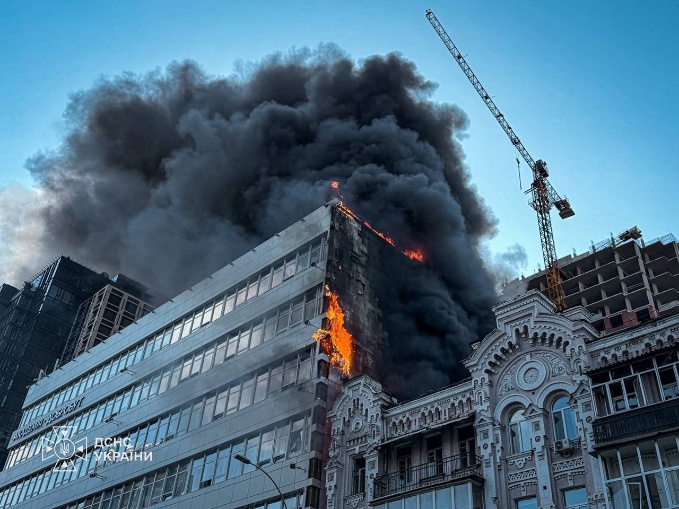
A Dobrobut medical center building on fire after a Russian strike on central Kyiv. (State Emergency Service)
THE DAY’S RECKONING
A Russian drone found Ukraine’s National Academy of Sciences today, a building that has survived war, occupation, and a Soviet missile strike on the same junction back in 2022. It burned anyway. A medical facility down the street lost seven staff to injury. By the time Kyiv’s mayor finished counting, two people were dead and twenty-six hurt, three of them children. Hours later, Russia fired ballistic missiles at the same city, as if to make sure nobody mistook the day’s violence for anything but deliberate.
Europe answered with condemnation from Paris to Oslo, each foreign ministry finding its own words for the same outrage. Putin answered differently: a decree raising Russia’s army toward 2.4 million troops, the fourth such expansion this year, arriving the same day Zelensky said mobilization has already quietly begun. Ukrainian drones reached four Russian oil depots and two defense plants overnight in reply. And in Kharkiv Oblast, soldiers who couldn’t fire because children stood in the line of sight watched Russian troops march an elderly man on crutches into a gas pipeline, hostages and cover in the same breath. Nothing today resolved. Everything today measured how much this war still asks of buildings, bodies, and the people forced to choose what not to shoot at.
RUSSIA STRIKES KYIV’S ACADEMY OF SCIENCES, THEN RETURNS WITH MISSILES
Russian drones struck multiple districts of Kyiv throughout Monday, killing two people and injuring 26, including three children, Mayor Vitali Klitschko said; eight of the wounded were hospitalized, one in serious condition. A drone hit a non-residential building belonging to Ukraine’s National Academy of Sciences in the historic city center, setting it ablaze; one victim died there, and rescuers later recovered a second body from the wreckage during emergency operations. A separate strike hit a seven-story building housing a Dobrobut medical facility, injuring seven people, six of them staff. Russia also struck the Darnytsia pharmaceutical plant, while fires and damage spread across the Shevchenkivskyi, Obolonskyi, Solomianskyi, Darnytskyi, and Podilskyi districts through the day, including a non-residential building hit more than once, vehicles set ablaze by a drone in a residential courtyard, and a business center struck in Sviatoshynskyi.
Hours after Monday’s barrage, fresh ballistic missiles hit Kyiv again in the early hours of Tuesday, with Ukraine’s Air Force warning “new ballistic missiles are heading towards Kyiv” as explosions rang out and air defenses activated around 1:20 a.m., launches tracked from Russia’s Kursk region. Ukraine’s Air Force said Russia used 124 drones during Monday’s attacks, 86 of them jet-powered, with 86 aerial targets destroyed or suppressed. “Every Russian terrorist attack results in casualties that could have been prevented had the pressure on Russia finally become total,” Zelensky said, calling for stronger international action against everyone who finances and produces Russia’s weapons.
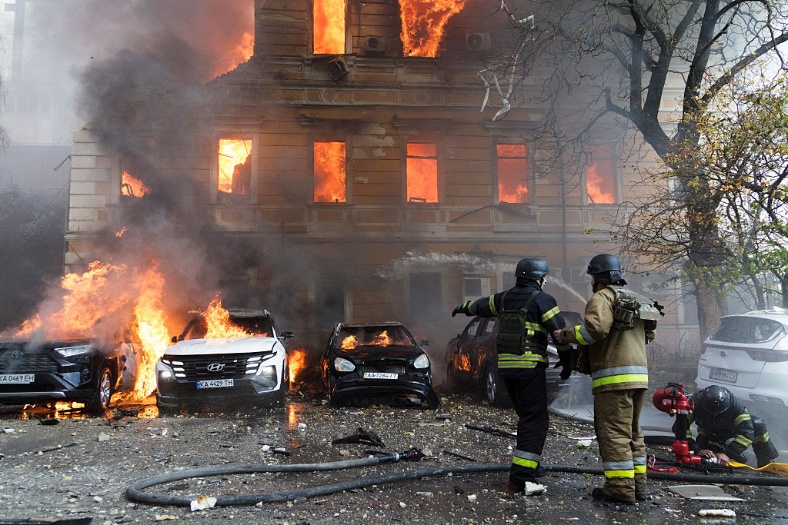
Rescuers pour water on burning cars and the National Academy of Sciences building, which is on fire after being hit by a Russian drone in Kyiv. (Kyrylo Chubotin/Ukrinform/NurPhoto via Getty Images)
EUROPE CONDEMNS THE ACADEMY STRIKE IN A CHORUS OF STATEMENTS
European governments issued a wave of condemnations after the strike on the National Academy of Sciences, which carried particular symbolic weight as the center of Ukraine’s scientific establishment. France’s embassy wrote that “schools, universities of Kyiv, and now the Academy of Sciences, struck in broad daylight, set ablaze, just steps from the Opera… By targeting civilians and knowledge, Russia is pursuing its escalation of terror.” Austrian Chancellor Christian Stocker called the attacks “absolutely appalling,” citing both the Academy and the Dobrobut clinic strike as “reprehensible and a violation of international law.” Norwegian Foreign Minister Espen Barth Eide said “scientists and staff should be able to work safely. Civilian institutions must not be targets of attacks.”
Spanish Foreign Minister José Manuel Albares condemned the “continued attacks by Russia against civilian targets… in clear violation of international humanitarian law.” Lithuanian Foreign Minister Kęstutis Budrys went further, linking the Kyiv strikes to Russian attacks near Ukraine’s Polish border and international-aid routes, calling them “a reckless act of escalation” and warning that “efforts to intimidate Ukraine and obstruct support are doomed to fail.” Zelensky told reporters emergency crews kept searching the Academy building for anyone still trapped, stressing it was only one of several civilian sites struck that day: “The world must understand that terrorists will keep going if they are not stopped here, in Ukraine… We are counting on the strength of Europe, America, and our other partners who can help protect lives.”
PUTIN RAISES THE ARMY TO 2.4 MILLION AS ZELENSKY WARNS MOBILIZATION HAS BEGUN
Vladimir Putin signed Decree No. 700 on Monday raising the authorized size of Russia’s armed forces to 2.4 million personnel, including 1.5 million active-duty troops, and instructed the government to allocate the federal funds the Defense Ministry needs to carry out the increase. It’s the fourth such decree this year: the authorized ceiling has grown by nearly 50,000 since March, from 2,391,770 to the new total, with an August decree already having set the figure at 2,426,130. The announcement came hours after Zelensky said Russia has already begun additional mobilization and is expanding its use of North Korean troops, citing new intelligence from Ukraine’s military intelligence agency HUR.
Zelensky said more than 8,000 North Korean personnel are currently in Russia, with preparations underway to deploy 10,000 more, and warned of up to 50,000 eventually planned. North Korea already supplies between 25 and 40 percent of Russia’s artillery shells, according to HUR, and has provided ballistic missiles used against Ukraine since December 2023, including one that killed a family of ten in Kryvyi Rih in July. Ukrainian intelligence has said Russia’s General Staff drew up plans in July to mobilize an additional 600,000 people — 300,000 in 2026 and another 300,000 in 2027 — even as Putin told Le Monde on September 3 that “there is no scenario that would require a mobilization,” a claim Medvedev later echoed.
UKRAINE STRIKES FOUR OIL DEPOTS AND TWO DEFENSE PLANTS
Ukraine’s Security Service said its Alpha Special Operations Center drones struck four oil depots in Russia’s Krasnodar Krai overnight: the Edelweiss-95 and Din-Yug-Oil depots near Novotytarivska, the Lukoil-Yugnefteprodukt depot near Pavlovska, and the Angelinska depot near Staronyzhestebliivska, sparking fires at all four sites. The SBU said the facilities support Russia’s fuel infrastructure and that disabling them complicates supply for Russian forces; Edelweiss-95 alone holds 4,500 cubic meters of fuel and has operated in the Russian market for 30 years.
Zelensky separately confirmed Ukrainian long-range strikes on defense plants in Russia’s Tula and Voronezh regions: “Last night, we deployed our long-range ‘sanctions’ against two defense plants.” He said Ukrainian forces also hit facilities in Kaluga and Oryol that Russia uses for drone attacks, conducted operations against Russian forces directly in Bryansk, and struck an unspecified target in the Black Sea. Russia’s Defense Ministry claimed it intercepted 254 Ukrainian drones overnight across a dozen regions and occupied Crimea; Voronezh’s governor reported four people, including three children, injured and a house and three garages destroyed, while Bryansk’s acting governor reported a railway bridge partially collapsed and 10 rail cars derailed. No injuries were reported in the railway incidents, Russian officials said. “Russia must stop the escalation,” Zelensky said, framing the deep strikes as a direct response to the day’s barrage on Kyiv rather than an escalation of Ukraine’s own initiative.
RUSSIAN SOLDIERS FORCE CIVILIANS THROUGH A PIPELINE AS HUMAN SHIELDS
Ukraine’s National Guard 2nd Khartiia Corps released drone footage showing Russian troops forcing nine civilians — including children, older residents, and a person on crutches — into a gas pipeline near Kupiansk while retreating from a Ukrainian counteroffensive on September 27. Men of fighting age in civilian clothes walked alongside the group; Khartiia believes they are Russian soldiers who removed their uniforms, though their identities couldn’t be confirmed from the footage. The corps said the group was taken from Kupiansk through the village of Holubivka to the Shebelinka-Ostrogozhsk pipeline, a route Russian forces have previously used to move troops toward the city.
Ukrainian troops said the civilians would have to travel more than 10 kilometers through the pipeline before emerging in a forest, from where they’d likely be taken to Russian-occupied territory; Russian forces reportedly filmed the group throughout the journey. Ukrainian soldiers who spotted the group didn’t fire because civilians were among them — a deliberate use of noncombatants to shield a military withdrawal, and a stark illustration of the tactics Russian forces are using as Ukraine’s counteroffensive continues pressuring positions in the sector. Using civilians as human shields constitutes a war crime under the Geneva Conventions, and Khartiia said it is preserving the footage as part of a broader documentation effort tracking similar incidents along the Kupiansk axis in recent weeks.
VUCIC RESIGNS, FOLLOWING PUTIN’S OWN PLAYBOOK
Serbian President Aleksandar Vucic formally submitted his resignation on Sunday after a phone call informing his longtime ally Vladimir Putin of the decision, signing off live on television and cutting his second term short by eight months. Vucic, first elected in 2017 and reelected in 2022, said he’s stepping down to campaign “as an ordinary citizen” ahead of the October 25 parliamentary election, intending to become prime minister if his Serbian Progressive Party wins. Bloomberg likened the maneuver to Putin’s own 2008 swap of the presidency for the premiership. Under Serbia’s constitution, a new presidential election must be held within 90 days, with party member Ana Brnabic serving as acting president until then.
The resignation follows nearly a year of student-led anti-government protests triggered by the collapse of a railway-station canopy in Novi Sad on November 1, 2024, which killed 16 people and became a lightning rod for grievances over government corruption. Vucic has spent his tenure balancing competing pressures: pursuing EU membership, maintaining close economic and political ties with Russia, and voicing support for Ukraine’s territorial sovereignty — a balancing act that will now fall to whoever succeeds him as president while he attempts his own pivot to the premiership.
MOSCOW OFFERS $20 MILLION FOR UKRAINE’S DRONE CHIEF
Soldiers told the Wall Street Journal that Russia is using criminal networks to try to track down Robert Brovdi, the commander of Ukraine’s Unmanned Systems Forces known by the callsign “Madyar,” reportedly offering as much as $20 million for information leading to his location. A Russian military court sentenced Brovdi to life in prison in absentia in March on a terrorism charge; his court-appointed lawyer argued prosecutors failed to prove his guilt. Brovdi has become one of the most publicly visible architects of Ukraine’s drone war, regularly posting confirmed strikes and operational updates, a profile that’s made him both a symbol of Ukraine’s technological edge and, evidently, a priority target for Russian intelligence services operating through non-state intermediaries.
The bounty underscores how personally Russia has come to view the war’s drone dimension, where Ukraine has repeatedly demonstrated capabilities — from the elimination of Russian commanders to strikes deep inside Russian territory — that trace back to the units Brovdi oversees. Using criminal networks rather than official channels to pursue a foreign military officer reflects a pattern Western intelligence agencies have documented elsewhere this year, as Russia increasingly outsources assassination and sabotage operations to intermediaries who provide deniability if an operation is exposed or fails.
ODESA HIGH-RISE HIT, A DRONE NEAR POLAND’S BORDER AGAIN
A jet-powered Shahed drone struck a residential high-rise in Odesa on Monday afternoon, destroying an apartment on the 12th floor and damaging facades, windows, and balconies from the first to the eleventh, according to regional officials. Four people were injured: a 56-year-old man and 37-year-old woman were hospitalized, while two young women aged 17 and 18 received treatment at the scene. A fire broke out in the building before crews brought it under control. Separately, a Russian drone strike near the Yahodyn border crossing with Poland forced a temporary evacuation of the crossing and prompted Poland to place aircraft and air defenses on alert — the second such strike near the crossing this month.
The renewed strike near Yahodyn follows a pattern that’s alarmed Polish officials for weeks: Russian strikes have repeatedly landed near the Ukraine-Poland border, including the September 13 attack that damaged a passenger train locomotive carrying Western officials, among them former US Ambassador Daniel Fried and former UK Prime Minister Boris Johnson. Ukrzaliznytsia said that strike may have been deliberate. Polish Prime Minister Donald Tusk convened ministers and intelligence chiefs afterward, warning Russia’s escalation is “becoming a reality” that could eventually reach Polish territory and that Poland and its NATO allies “must be ready to respond jointly if necessary.”
SWITZERLAND REJECTS WEAKENING ITS SUPPORT FOR UKRAINE
Swiss voters overwhelmingly rejected a referendum Sunday that would have tightened the country’s neutrality policy, with 70 percent voting against the proposal and majorities opposed in all 26 Swiss regions on a 47 percent turnout. The measure, backed by the national-conservative group Pro Schweiz and the right-wing Swiss People’s Party, would have restricted Bern to military cooperation only if Switzerland itself came under attack and limited it to sanctions passed by the UN — a change that would have curtailed Switzerland’s alignment with EU sanctions against Russia. The initiative had also received public backing from Moscow, according to Politico; the SVP said it won’t pursue the matter further, effectively closing the debate for the foreseeable future rather than promising a renewed attempt after further campaigning.
Switzerland has moved largely in step with the EU on Russia sanctions in recent years, banning Russian LNG imports in February and approving a new security strategy this month aimed at bolstering national defense against hybrid and standoff attacks. The referendum’s defeat keeps that alignment intact, joining Ireland and Austria — two other traditionally neutral European states — in maintaining sanctions and support for Kyiv despite pressure to retreat toward stricter neutrality as the war continues into its fifth year.
LAVROV DEMANDS TURKEY GUARANTEE ITS S-400S STAY AWAY FROM UKRAINE
Foreign Minister Sergei Lavrov said Russia is prepared to let Turkey transfer its Russian-made S-400 air-defense systems to a third country, but only if Ankara guarantees the systems won’t end up in Ukrainian hands. The statement responds to reports that Turkey has considered offloading the systems — originally purchased from Russia in a deal that strained Ankara’s relations with NATO and the US — as it modernizes its own air-defense posture. Lavrov’s conditional offer effectively asserts a Russian veto over where a sovereign NATO member can send equipment it already owns, a demand Turkey hasn’t publicly responded to.
The exchange illustrates the awkward position Turkey occupies as a NATO member that’s maintained working relationships with both Kyiv and Moscow throughout the war, buying Russian energy and hosting Black Sea grain negotiations while also supplying Ukraine with Bayraktar drones and other military equipment. Any transfer of the S-400 system carries genuine strategic weight: the systems remain incompatible with NATO’s integrated air-defense architecture, and Western officials have quietly hoped Ankara would eventually retire or repurpose them regardless of what Moscow prefers. Lavrov’s comments offered no indication Russia would actually block such a transfer outright, suggesting the statement functions more as a rhetorical marker of Moscow’s continued leverage than a genuine veto Turkey would be legally bound to respect.
THE EU PAYS UKRAINE €3 BILLION FOR A REFORM CRITICS CALL FAKE
The Council of the European Union approved disbursing €3 billion to Ukraine under the Ukraine Facility lending plan on September 24, including €386.3 million released specifically in exchange for a June law on judicial integrity declarations that anti-corruption watchdogs say actually weakens accountability. Judicial watchdog Dejure said the law eliminated 22 of 28 concrete questions judges previously had to answer — including whether they had conflicts of interest, ruled against Euromaidan protesters, or maintained a lifestyle consistent with their declared income — replacing them with vague questions judges can easily sidestep. “The bill removes the key asset disclosure section from the declaration,” Dejure said, calling it a step backward rather than reform.
Dejure head Mykhailo Zhernakov told the Kyiv Independent the EU’s decision sends a dangerous signal: “If you tell people, ‘Carry out the reform and you’ll get the money,’ but what you actually get is an anti-reform and you pay the money anyway, then you are only going to get more anti-reforms.” AutoMaidan head Kateryna Butko agreed the EU’s standard was too lenient: “I believe this law will not bring about effective cleansing of the judiciary. De facto nothing will change.” A European Commission spokesperson defended the disbursement, saying Ukraine met the “specific requirements agreed in the Ukraine Plan” even if it “does not amount to an assessment of the overall judicial integrity system.” Dejure separately noted Ukraine has delayed a required Supreme Court integrity audit for years, with no bill yet submitted to parliament despite a June deadline extension.
POLAND EASES THE RULES FOR SHOOTING DOWN INCOMING OBJECTS
Poland will change procedures governing when military aircraft and helicopters can engage objects entering from Russian territory, Deputy Defense Minister Cezary Tomczyk said Monday. Under the current peacetime rule, Polish pilots must fly close enough to visually confirm a target before firing; the new “positive identification” standard will let a radar reading alone authorize a pilot or operational commander to shoot down an object, allowing faster responses to drones or missiles entering Polish airspace from Russia’s direction. “Until now, we have not used such options, because they are usually reserved for a state of war or martial law,” Tomczyk said. “However, given the threat, and given that Poland today faces the possibility of drones entering our territory every day, we must introduce such changes.”
The change follows a string of incidents that have tested Polish air defenses this month: a Russian Mi-8 helicopter briefly crossed into Polish airspace near Braniewo on September 23, penetrating roughly 300 meters and remaining for 42 seconds before returning to Kaliningrad; Poland scrambled fighter jets and temporarily closed Lublin and Rzeszow-Jasionka airports on September 16 during a Russian drone attack on Ukraine. Polish officials say the accumulating incursions leave no realistic alternative to faster engagement authority, even at the cost of the caution visual identification was originally meant to provide.
UKRAINE PRIORITIZES DEFENSE SPENDING AS FUNDING RUNS SHORT
Prime Minister Serhii Koretskyi announced the government adopted a decision setting priority order for state expenditures, funding mainly defense, pensions, social payments, and public-sector salaries while postponing nonessential spending. “Under these conditions, we continue to adopt strict anti-crisis measures to ensure the most important priorities — defense needs and the welfare of our people,” Koretskyi said, noting part of the expected international funding hasn’t yet arrived due to unfulfilled partner commitments. Zelensky confirmed meeting with Koretskyi and Ukraine’s broader diplomatic team afterward, giving the government, Presidential Office, and Foreign Ministry a clear task: fully cover Ukraine’s existing defense financing needs.
“Everything that can be done together with partners, using partner funds — primarily concerning defense procurement — must be completed 100% by the end of the year,” Zelensky said. He said he expects decisive backing from lawmakers, adding that if the government meets its commitments by October 15 to secure needed financing, parliament must adhere to an equally clear schedule for approving it. Separately, Sweden’s defense minister urged fellow EU states to release 2027 loan funds early, calling for fairer burden-sharing since Nordic countries, Germany, and the Netherlands currently provide the most assistance while other members lag on bilateral aid.
UKRNAFTA BUILDS BOMB SHELTERS AT KYIV GAS STATIONS
Ukraine’s state oil company Ukrnafta is installing concrete shelters at 13 gas stations across Kyiv and Kyiv Oblast, prioritizing densely populated areas and locations near major roads, available to anyone nearby during an attack. “People’s safety is the main priority in conditions where Russia is systematically attacking civilian facilities that cities and communities depend on in their everyday lives,” CEO Bohdan Kukura said. The company has already installed gabion barriers at 25 facilities in the capital region; barriers at one Kyiv station withstood a Russian strike last week, helping contain the explosion and limit debris.
Ukrnafta previously used similar concrete shelters at frontline gas stations and is now extending the measure to Kyiv specifically as Russian strikes on the capital intensify. The company’s stations suspend operations during higher-level air-raid alerts, with staff and customers required to evacuate to safer locations. The shelter program adds a physical, if partial, defense to a fuel-retail network that’s absorbed repeated targeted strikes throughout the year, treating gas stations less as incidental casualties of broader barrages than as a category of civilian infrastructure Russia has deliberately, repeatedly chosen to hit. Kukura said the company plans to expand the concrete-shelter program further if the current installations prove effective, pending available funding and construction capacity heading into winter.
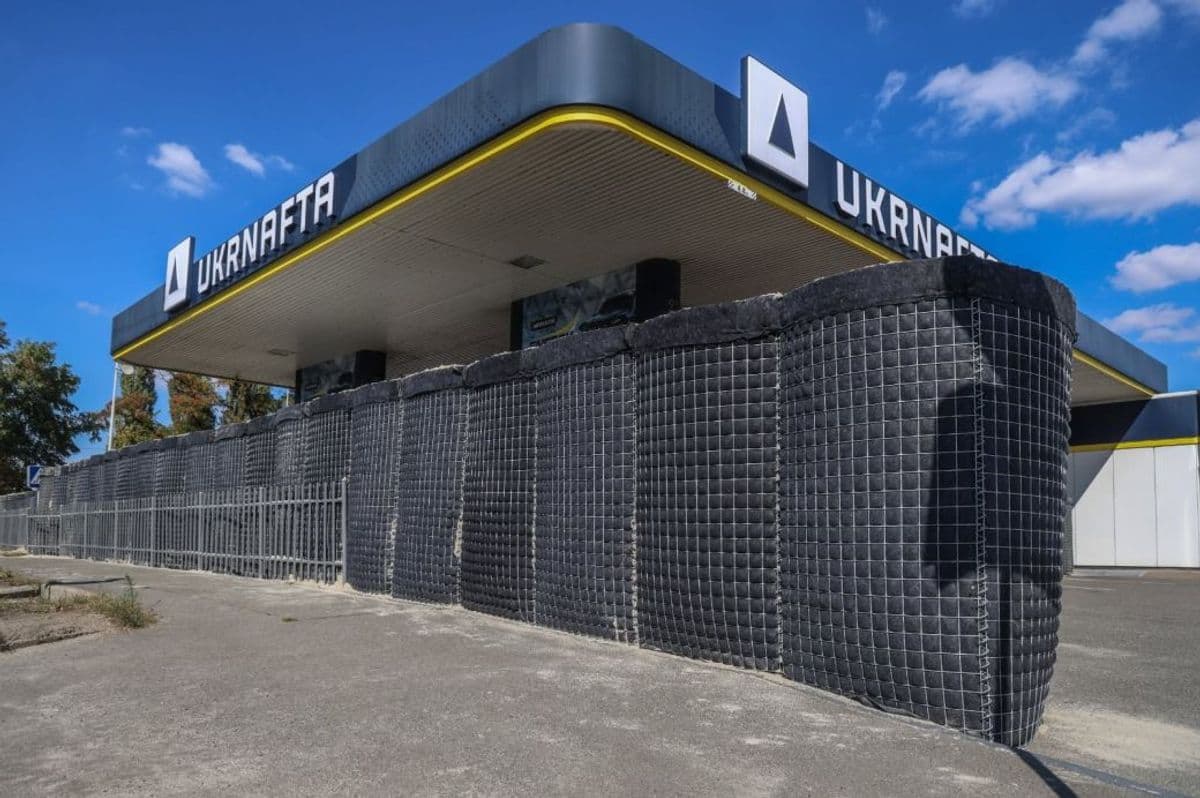
Gabion barriers installed at an Ukrnafta gas station in Ukraine as part of measures to protect fuel infrastructure from Russian attacks. (Ukrnafta)
ZELENSKY APPOINTS JUDGES ACCUSED OF PERSECUTING EUROMAIDAN ACTIVISTS
President Zelensky appointed Serhiy Kytsiuk and several other judges long accused of unlawfully persecuting EuroMaidan protesters, a decision judicial watchdog Dejure called a victory for Ukraine’s “corrupt judicial establishment” and a blow to Revolution of Dignity ideals. Kytsiuk was charged in 2015 with issuing unlawful rulings against protesters during the 2013-2014 uprising, including stripping a driver’s license from a man whose lawmaker friend testified in court that he, not the defendant, had been driving. Investigators found EuroMaidan cases had been manually assigned to Kytsiuk using his sister’s login credentials. Ukraine’s High Council of Justice declined to reappoint him for life in 2017, but the Supreme Court overturned that decision in 2019, and a Ukrainian court acquitted him in 2020 after a Constitutional Court ruling annulled criminal liability for unlawful rulings entirely.
“It would be no exaggeration to say that he and Judge Oksana Tsarevych are among the best-known judges associated with EuroMaidan cases,” former EuroMaidan lawyer Roman Maselko wrote, calling accountability for them “one of the key tests of whether the reform was actually working.” Dejure head Mykhailo Zhernakov told the Kyiv Independent that Ukrainian law technically requires the president to appoint judicial nominees automatically, but that principle conflicts with the constitutional integrity requirement Zelensky cited for seven years to justify not appointing exactly these nominees. “Now the president has abandoned that approach and is appointing judges in batches with little scrutiny,” Dejure said, warning Zelensky “will now bear political responsibility for the anti-Ukrainian rulings” the newly appointed judges may hand down.
PUTIN SEALS OFF OIL DATA AS RUSSIA PLANS A $591 BILLION MILITARY BUDGET
Putin signed a decree Monday restricting public access to data on Russian oil refineries and energy exports, covering processing volumes, product slates, pricing, buyers, transport routes, and storage locations, with dissemination banned unless a company discloses the information itself. Reuters reported the decree is intended to make Western sanctions enforcement harder, since researchers and governments rely on exactly this kind of export data to track Russian energy flows and identify evasion. Putin gave the government 10 days to specify which products the restrictions cover. The move follows Ukraine’s General Staff saying September 21 that long-range strikes have knocked out 45 percent of Russia’s total refining capacity, a figure the Kyiv Independent couldn’t independently verify but which Moscow’s own secrecy decree implicitly acknowledges as damaging enough to hide.
Separately, Russian budget documents reviewed by Reuters show Moscow plans to spend 50 trillion rubles — roughly $591 billion — on its military over the next three years, after spending 12.1 trillion rubles in 2026 alone, though the precise figure remains classified. Russia’s 2026 budget deficit has also grown to 3.2 percent of GDP, double the 1.6 percent estimated earlier this year. A draft budget is due from the Russian government by October 1. The spending surge lands alongside Putin’s army-expansion decree, which Russian state media specified sets personnel at 2,441,630, including 1,550,500 active-duty troops — exactly the kind of sustained fiscal commitment a genuinely temporary war effort wouldn’t require.
MEANWHILE, AT THE FRONT
Ukrainian forces recently advanced in the Chasiv Yar tactical area and the Oleksandrivka direction, while Russian forces advanced in eastern Novodmytrivka, southeast of Sumy City. Russian forces continued offensive operations in northern Kharkiv Oblast without confirmed advances; Russia’s Defense Ministry claimed forces seized Khrypuny, northeast of Kharkiv City, a claim Ukrainian sources haven’t confirmed. Ukrainian strikes continued constraining Russian oil-processing capacity: Ukraine’s Center for Countering Disinformation said strikes on the Perm and Novoshakhtynsk refineries forced both to cease operations entirely.
Updated satellite imagery published today showed Ukrainian strikes against the Azov Optical-Mechanical Plant in Rostov Oblast, roughly 200 kilometers from the front, damaged at least five production shops across six buildings, including the foundry, optics-production, assembly, electroplating, and mechanical-processing shops. The facility manufactures components for Russian cruise and ballistic missiles. A prominent Kremlin-affiliated military blogger acknowledged the front line is now “static” — a rare tacit admission of Russia’s near-zero net battlefield advances in recent months — while urging Moscow to intensify its long-range strike campaign instead, warning that expanding the strike arsenal is cheaper than a second mobilization from economic, military, and social perspectives alike. Separately, German Foreign Minister Wadephul told broadcaster ARD after his New York meeting with Lavrov that Russia has shown no willingness to negotiate constructively, undercutting any suggestion the encounter itself signaled a genuine diplomatic opening.
AN ACADEMY BURNING, AN ARMY GROWING, A PIPELINE FULL OF HOSTAGES
By nightfall, today’s threads pulled toward the same uneasy pattern this war keeps sustaining: institutions built to outlast generations reduced to rubble in an afternoon, while the machinery meant to keep producing that rubble only grows larger. A research academy burned. A president signed a decree adding hundreds of thousands more names to an army already spending 40,000 casualties a month for ground measured in meters.
Nine civilians walked through a pipeline today because Russian soldiers needed cover to retreat and had no better idea than to march an elderly man on crutches ahead of them. Four oil depots burned in Krasnodar Krai in answer. Serbia’s president signed away his own office to keep power in another form, and Switzerland’s voters quietly refused to hand Moscow the neutrality it was hoping for. Nothing today ended. Everything today measured how much further this war still reaches into buildings, borders, and the choices ordinary soldiers are forced to make under fire.
A PRAYER FOR UKRAINE
1. For the Two Lost at the Academy of Sciences
Lord, two people died today in a building meant to hold knowledge, not danger. We grieve a place built to outlast generations, burned in an afternoon. Receive them, comfort the twenty-six injured and their families, including three children now carrying wounds they never should have known, and protect every researcher and patient still working in buildings this war keeps proving are never truly safe.
2. For the Nine Forced Through a Pipeline
Father, we lift up the children, elders, and disabled residents marched through a pipeline today as human shields for a retreating army. We grieve dignity stolen in the name of someone else’s survival. Protect them on whatever road they’re forced down next, and give the soldiers who couldn’t fire because of them the peace of knowing restraint, this time, was itself a mercy.
3. For Every Nation Weighing Its Own Stake in This War
Lord of nations, we give thanks for the voices in Paris, Vienna, Oslo, and beyond who refused silence today, and for Swiss voters who chose solidarity over retreat rather than caving to pressure. Give more nations that same courage, and give Ukraine’s allies the follow-through to match their words with delivered support before winter narrows every remaining option even further.
4. For Wisdom in Rebuilding Institutions Worth Trusting
God of justice, we pray for Ukraine’s reformers working against entrenched resistance in courts and institutions meant to serve the public. Give them persistence when even well-meaning allies settle for less than genuine change, and give Ukraine’s own leaders the will to build a judiciary, and a government, worthy of the sacrifice made every day to defend it against a war it did not choose.
5. For Every Family Facing a Growing Army With Nothing But Endurance
God of strength, we pray for Ukraine as Russia’s army swells toward numbers meant to overwhelm rather than persuade. Give Ukrainian soldiers and civilians alike the endurance this growing threat demands, and give the world enough resolve to ensure that a larger army never simply becomes a longer war. Let quantity never triumph over the will of a people still choosing to stand.
In Your mercy, in Your justice, in Your time — bring this war to its end, and let the ending be worthy of what Ukraine has endured.