
As diplomats negotiated in Abu Dhabi, Russia launched a massive missile and drone barrage on Kyiv—laying bare a strategy of diplomacy by day and total war by night.
The Day’s Reckoning
The sirens began before dawn in Kyiv. Not the distant, fading kind—this time they overlapped, rose, cut out, returned. People already awake for the cold pulled on coats and moved toward metro entrances by muscle memory alone.
Eight hundred miles away, in Abu Dhabi, the room was quiet. Delegates leaned over polished tables. Translators whispered into headsets. Water glasses clinked softly as parameters and guarantees were discussed in air-conditioned calm.
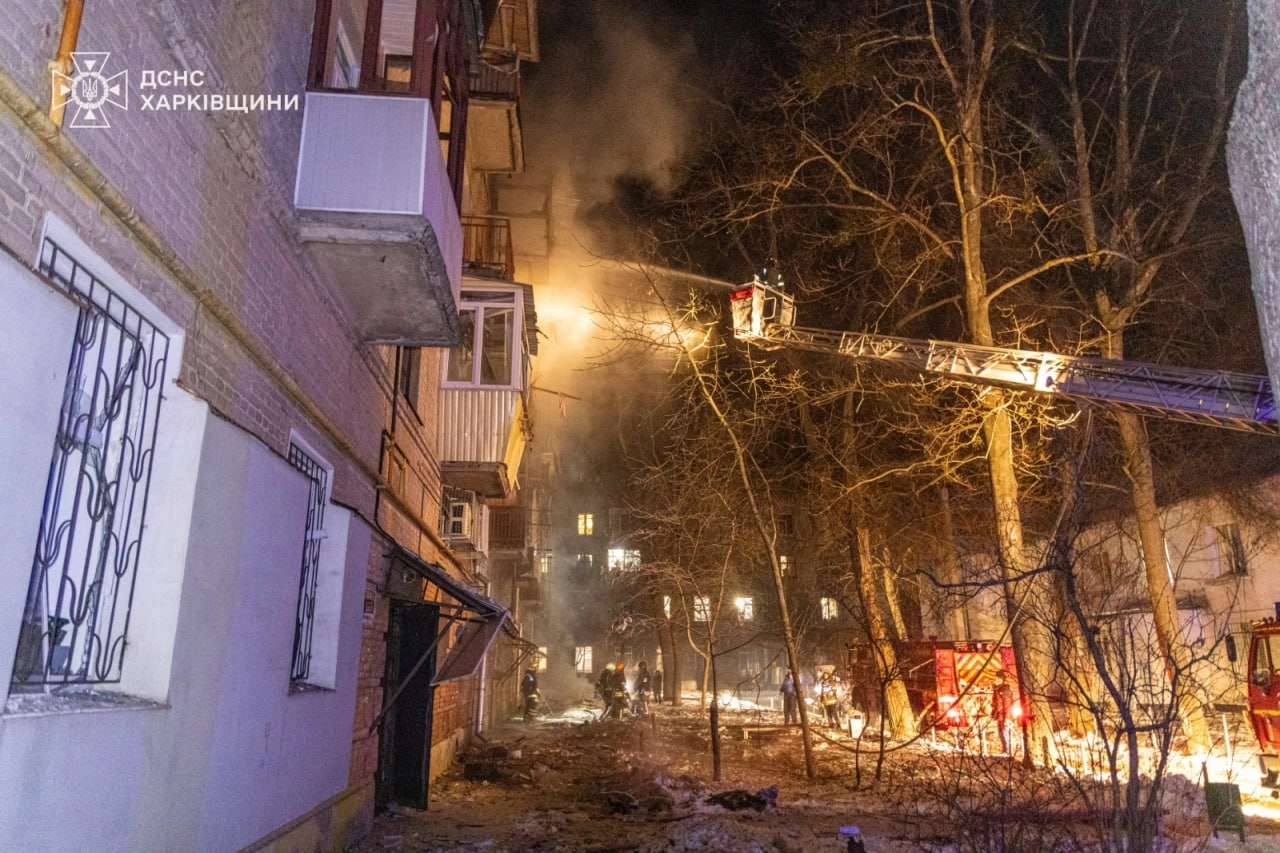
The first explosions hit while the talks were still underway. Shahed drones and missiles streaked into the capital and other cities, aimed at power plants, substations, anything that still kept lights on and radiators warm. A drone slammed into a chocolate factory. A man out for coffee walked into a cordoned street and a body under a sheet. Engineers raced back to buildings they had already repaired twice this month, knowing they would not finish before the next blackout.
This was not coincidence. It was choreography.
Hundreds of drones and missiles launched. Most were destroyed. Enough got through. One civilian killed in Kyiv. Dozens wounded in Kharkiv. More than a million people suddenly without electricity. Thousands of apartment buildings without heat as temperatures sat below zero.
Elsewhere, the same day carried different fires. An oil depot burned deep inside Russia. In the Far East, wounded soldiers were threatened into returning to the front. In Budapest, Hungary’s prime minister attacked Ukraine while clinging tighter to Russian oil.
Along the eastern front, the war did what it does every day. Villages were shelled. Positions changed hands by meters. In Chasiv Yar, buildings disappeared block by block. Near Pokrovsk, drones turned open ground into lethal space.
And still, the talks continued. Frameworks. Red lines. Another meeting, maybe next week.
Kyiv froze in the dark while diplomacy kept talking.
Kyiv Woke to Sirens, Not Sunlight
The sirens started before the sky had fully lightened, cutting through Kyiv’s winter dawn with a sound people no longer confuse with drills. Within minutes, explosions followed—deep, concussive thuds that rattled windows and sent families moving without conversation toward basements and metro stations they know by heart.
Far from Kyiv, diplomats gathered around polished tables in Abu Dhabi. While parameters and guarantees were discussed, missiles and drones were already airborne.
Mayor Vitali Klitschko’s message appeared on phones as the attack unfolded: Kyiv is under a massive enemy attack. Above the city, the scale became clear in fragments—ballistic missiles, cruise missiles, hypersonic weapons, and wave after wave of drones. The Ukrainian Air Force would later count them precisely. On the ground, precision mattered less than survival.
Air defenders fought through the morning, interceptors flashing across the sky. Most of the incoming weapons were destroyed. Not all. Two missiles and eighteen drones slipped through, striking a dozen sites. Four more vanished from radar, their destinations unknown.
In Holosiivskyi district, a Shahed drone struck a chocolate factory. Emergency crews found one dead, three wounded. By late morning, the factory reopened. The ovens came back on. Work resumed.
Hennadiy, fifty years old, walked up for his usual coffee and found police tape instead. He lives half a kilometer away. He heard the blast but didn’t know where it landed until he saw it. He stood there with his cup, taking it in, then went on with his day.
Across the city, damage forced metro closures over the Dnipro. Official notices cited “fencing damage.” Trains stopped running. People walked.
Beyond Kyiv, the night was worse. Power failed for hundreds of thousands in the capital and Chernihiv. In Kharkiv, drones and missiles tore into neighborhoods, injuring dozens and damaging scores of buildings. By morning, rolling blackouts stretched across most of the country.
Kyiv remained the main target. Winter made sure everyone felt it.
Cold Rooms, Dark Windows: When Winter Became a Weapon
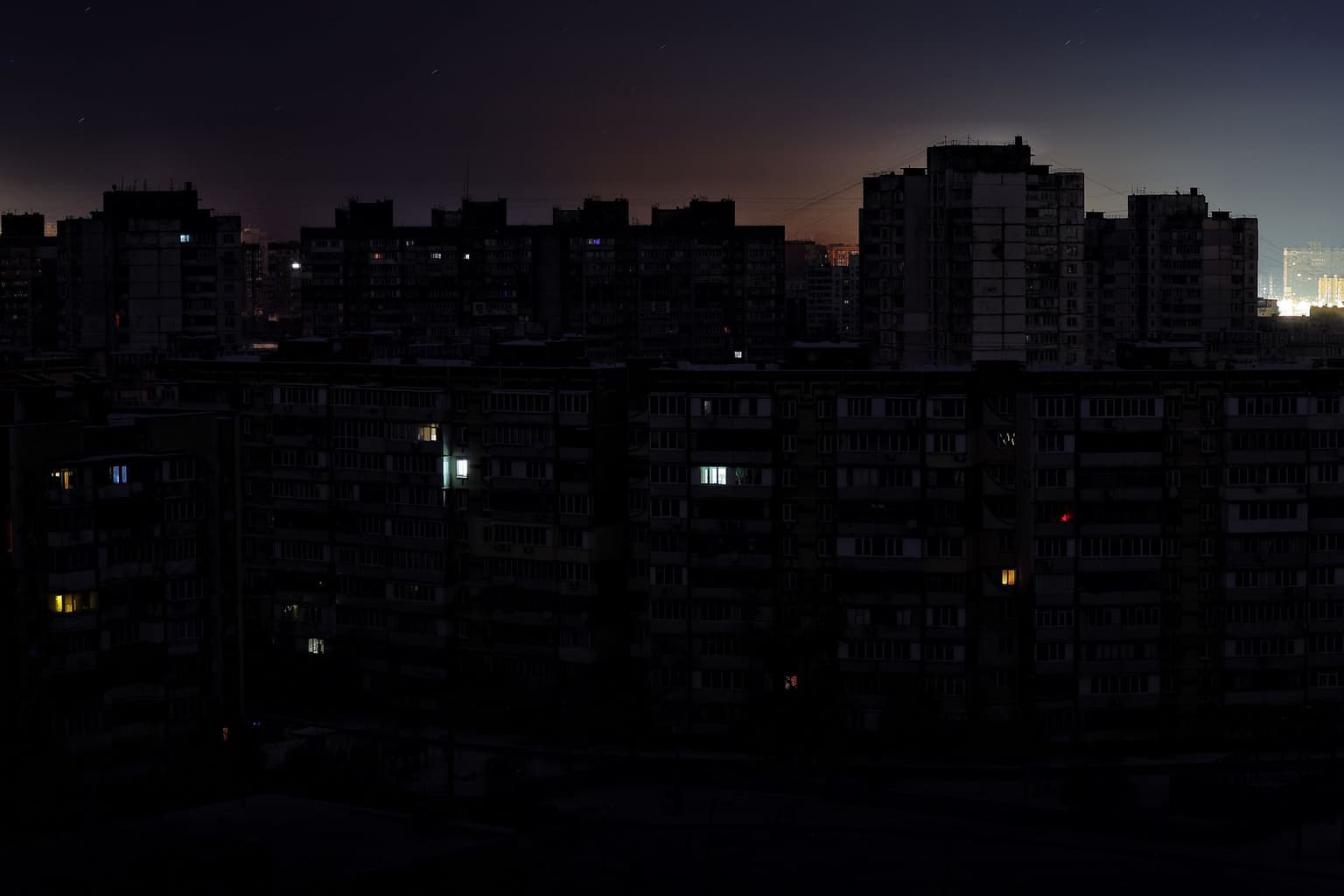
By morning, the numbers no longer felt abstract. Nearly six thousand apartment buildings in Kyiv—half the city—had gone cold. Radiators that had briefly warmed again the day before were silent once more. Just twenty-four hours earlier, energy crews had pushed that number below two thousand. Now they were starting over.
Mayor Vitali Klitschko didn’t hide the futility. These were buildings already repaired twice this month, reconnected after earlier attacks, only to be severed again. Fix the pipe. Restore the line. Watch it fail under the next strike. January 9. January 20. And now again.
Across the Dnipro, the situation tipped from bad to dangerous. Ukrenergo CEO Vitaliy Zaichenko warned that Kyiv’s left bank was running out of heat—and the strain was spreading west. What had been a neighborhood problem was becoming a citywide emergency. Elevators stalled. Stairwells filled with cold air. People layered coats indoors and waited for power to rotate back on.
This was not a single night’s damage. It was the visible result of a campaign months in the making. Russia had been dismantling Ukraine’s energy system piece by piece—power plants, substations, transmission lines—faster than crews could rebuild them. DTEK CEO Maksym Timchenko put numbers to the destruction: sixty to seventy percent of his company’s generating capacity gone. Tens of billions of dollars in repairs ahead.
Outside, temperatures sat well below freezing. Inside, electricity came in narrow windows—three or four hours at a time—before vanishing again. Enough to boil water. Not enough to live normally.
Western analysts describe the strategy clinically: fracture the grid, isolate regions, exhaust industry, grind civilians down. Ukrainians experience it differently. They experience it as cold floors, dark kitchens, and children sleeping in coats.
Winter was no longer a season. It was a tool.
Holding the Sky Together with Interceptors
The promise came quietly, almost out of place against the noise of explosions and sirens. On January 23, President Volodymyr Zelensky said that US President Donald Trump had agreed to supply Ukraine with additional PAC-3 interceptors for Patriot air defense systems—missiles designed to hunt ballistic threats in the final seconds before impact.
It was not a headline-grabbing announcement. It was a necessity.
Ukrainian air defenders have become exceptionally effective. Colonel Yuriy Ihnat, the Air Force’s spokesperson, has said as much: most incoming missiles and drones are destroyed. The problem is what slips through. On January 24, roughly ninety-five percent of Russia’s strike package was intercepted. That remaining five percent still shut down power plants, collapsed heating systems, and killed civilians. In modern aerial warfare, perfection is the only margin that matters.
Russian planners understand this arithmetic. They wait. They launch little for days. Then they unleash everything at once—ballistic missiles, cruise missiles, hypersonic weapons, drones—forcing Ukraine to expend interceptors faster than they can be replaced. Shahed drones arrive fitted with cluster warheads or delayed-detonation mines, turning even successful shootdowns into hazards. Others shift targets mid-flight, hunting weak points in real time.
Patriot systems matter because they can stop what few other defenses can: ballistic missiles that arrive too fast and too steep for lower-tier systems. But Patriots alone are not enough. Ukraine’s air defense survives as a layered ecosystem—high-end interceptors overhead, mobile fire groups on streets, interceptor drones in the air, fighter jets filling gaps.
Every missing piece shows. Every empty launcher invites the next wave.
The shield still holds. But it is thinning—and winter gives Russia time to test it again.
Peace Talks in a Soundproof Room
The conference room in Abu Dhabi was cool and quiet. For three hours, American, Ukrainian, and Russian diplomats sat beneath steady lights, parsing language about parameters, guarantees, and paths forward—questions that would decide whether millions lived under missiles or without them.
Outside that room, Kyiv was on fire.
President Volodymyr Zelensky stepped before cameras afterward and chose his words carefully. The talks were constructive, he said. Ukraine would be ready to meet again next week—if the others were willing. A source inside the Ukrainian delegation relayed that senior White House officials found the meeting productive. It was the language of diplomacy at its most cautious: hopeful enough to continue, vague enough to retreat.
Moscow did not wait.
Even before the meetings ended, the Kremlin began reshaping the story. Spokesman Dmitry Peskov resurrected the so-called “Anchorage formula,” invoking the deliberately opaque August 2025 US-Russian summit in Alaska. The ambiguity was the point. Russia has spent months insisting that understandings were reached that no one else recognizes, using the fog of that meeting as cover to stall, distort, and deny.
Then came the demands. The Russian Foreign Ministry insisted Ukraine must halt its alleged “persecution” of the Ukrainian Orthodox Church Moscow Patriarchate—an institution long controlled by the Kremlin and used as a tool of ideological pressure in occupied territory. Framed as addressing “root causes,” the demand revealed the real objective: preserving instruments of influence, not ending the war.
Finally, the accusation. Maria Zakharova blamed Ukraine for an alleged strike in occupied Kherson Oblast, claiming Kyiv was sabotaging negotiations. The timing followed a pattern. December 29. January 1. Now again. Each claim surfacing just in time to excuse Moscow from compromise.
The message was clear. While diplomats talked in Abu Dhabi, the Kremlin prepared its alibi. Peace was acceptable—only on Russia’s terms.
Fire Reached Where Russia Felt Safe
The fire in Penza did not go out overnight.
For a second day, flames burned through the Penzanefteprodukt oil depot deep inside Russian territory, black smoke rising from fuel tanks struck by Ukrainian drones on the night of January 22–23. Geolocated footage published January 24 showed firefighters still battling the blaze. Penza Oblast Governor Oleg Melnichenko confirmed the crews were still working—evidence of either the strike’s precision, the fuel’s volatility, or both.
Penza lies hundreds of miles from Ukraine’s border. That distance was the point.
As Russian missiles froze Ukrainian cities, Ukraine reached into Russia’s interior and touched the infrastructure that feeds its war. Oil depots do not burn symbolically. They burn because armies depend on fuel—trucks, aircraft, generators, supply lines.
Each hour the fire continued carried a message Moscow could not ignore: Ukraine’s endurance has reach. The costs of this war would not be paid in one direction only.
Meters Bought with Lives
Far from diplomacy and headlines, the eastern front moved the way it always does—slow, grinding, merciless. Men died for villages few could name, for streets already reduced to rubble, for positions measured not in kilometers but in meters. No breakthroughs. No pauses. Just attrition, day after day.
Where Drones Turned Assembly Points into Death Traps
On paper, Russian forces were still attacking in Kursk and northern Sumy. Russian channels said so. Maps were updated. Arrows pushed forward.
On the ground, Ukrainian soldiers saw something else.
A brigade operating in the Sumy direction reported that Russian commanders had pulled back from mass ground assaults and leaned instead on drones and artillery. The strikes came first—heavy, probing, constant—meant to cover the quiet gathering of assault groups behind the lines.
It didn’t work.
Ukrainian drones spotted the clusters almost as soon as they formed. Coordinates were passed. Fire followed. What Russian planners intended as staging areas became what the Ukrainian spokesperson called “kill zones”—places men entered and did not leave.
Russian milbloggers continued to describe “ongoing operations,” but the shift told the real story. Large formations no longer survived long enough to attack. In this war, gathering forces is an invitation to be seen. And being seen is often fatal.
Probes That Went Nowhere
The attacks came, but the map did not change.
On January 24, Russian forces pushed again in northern Kharkiv Oblast, testing lines and sending small units forward. Geolocated footage from the day before showed how one of those attempts ended—Ukrainian strikes hitting Russian positions in northwestern Symynivka after an infiltration effort collapsed. The terrain held. The line did not move. The probe produced only casualties.
Elsewhere, the pattern repeated. Russian units attacked northeast of Kharkiv City—near Starytsya, Prylipka, Vovchansk, and surrounding villages—then farther north toward Velykyi Burluk. Names accumulated. Results did not.
Each attempt cost men. None bought ground.
Pressure from Every Direction
Russian forces attacked Kupyansk from multiple axes on January 23 and 24—inside the city, east toward Petropavlivka, southeast near Pishchane, and south toward Kupyansk-Vuzlovyi—an effort to overwhelm defenders through simultaneous pressure. The fighting was heavy. The line held.
Searching the Line for a Crack
Along the Lyman–Siversk axis, the attacks came everywhere and nowhere at once.
On January 23 and 24, Russian forces struck near Lyman itself, then fanned out—north, east, and west—touching village after village around Novoselivka, Yarova, Drobysheve, Torske, Yampil, Dibrova, and outward toward Slovyansk and Siversk. The names piled up. The pattern mattered more than any single one.
This was not a push for breakthrough. It was a search.
Russian units tested Ukrainian defenses across a wide front, probing for softness, hoping one pressure point might yield where others held. None did. The line bent under strain but did not break, and the day ended as it began—with movement measured in effort, not ground gained.
Chasiv Yar, Eaten One Building at a Time
Chasiv Yar sits on high ground west of Bakhmut, and that elevation has turned the city into a prize—and a trap. Russian forces pressed it relentlessly, fighting block by block through streets already reduced to shells.
On January 24, geolocated footage confirmed what soldiers on the ground already knew: Russian units had pushed forward in the southeastern section of the Kanal neighborhood, seizing additional positions along the supply route Ukrainian forces rely on to sustain the city’s eastern defenses. Progress came slowly, measured in meters and ruins.
Official Ukrainian reports said defenders repelled twelve attacks near Chasiv Yar and nearby Yahidne. Both statements can be true. Urban combat here advances in fragments—an intersection taken, a building lost—without dramatic breakthroughs. Russian military bloggers claimed Ukrainian units were pulling back from eastern Chasiv Yar and that most of the eastern bank of the Siverskyi Donets–Donbas Canal was under Russian control. One estimated eighty percent of the Kanal neighborhood had fallen.
What mattered more was Kyiv’s acknowledgment. The Ukrainian military’s deputy commander for the Luhansk operational group confirmed Russian advances—a rare admission that underscored the ferocity of the fight. In Chasiv Yar, every apartment block becomes a bunker, every street a killing zone.
Russian sources claimed more than 150 Ukrainian soldiers and forty pieces of equipment were lost in a single day. The figures are likely inflated. The intensity behind them is not.
Russian bloggers now openly speculate about the next step: Siversk. If Chasiv Yar falls, its high ground would give Russian forces observation and fire control for the next city down the line. The battle here is not just about one ruined town. It is about what comes after.
Squeezed from Every Side—and Still Fighting Back
Pressure came from all directions around Kostyantynivka and Druzhkivka. On January 23 and 24, Russian forces struck inside Kostyantynivka itself, then fanned out—north, south, east, and west—testing approaches through surrounding villages and roads. The intent was encirclement by exhaustion, forcing defenders to respond everywhere at once.
But the line did not simply absorb the blows. A Russian milblogger reported Ukrainian forces counterattacked from Pavlivka toward Novopavlivka—a small movement, but a telling one. Even under sustained pressure, Ukrainian units retained the initiative to push back, not just hold.
Noise, Losses, and a Line That Didn’t Move
In the Dobropillya sector, Russian attacks continued on January 24, loud and costly—and ultimately pointless. Assaults pushed east of the city near Ivanivka, Toretske, and Novyi Donbas, then again toward Dorozhnie. Men and equipment went in. Nothing came back changed.
A Russian milblogger claimed progress in northern Toretske, but no geolocated footage supported it. The claim lingered in the gray zone where assertion substitutes for evidence. On the ground, the line held.
The fighting consumed time, ammunition, and lives. It bought no ground. Ukrainian defenses bent and absorbed the pressure, turning repeated attacks into attrition without reward.
Across Open Ground, Into the Kill Zone
Pokrovsk drew the weight of Russian attention again. On January 24, attacks came from nearly every direction—inside the city, from the northwest near Hryshyne, from the north around Rodynske and Bilytske, from the northeast toward Krasnyi Lyman, and from the southwest near Kotlyne and Udachne. Russian channels claimed advances west of Rodynske. No geolocated footage supported it.
Ukrainian commanders described a different battlefield.
Brigadier General Yevhen Lasiychuk said Ukrainian forces still held northern Pokrovsk, northern Myrnohrad, Svitle, and Rivne. More important than control of streets was control of space. Ukrainian units maintained fire control beyond the forward line, striking Russian forces before they could close with defenses.
Russian pressure was driven from above as much as below. Lasiychuk said Russian commanders imposed “unreasonable and arbitrary deadlines,” including an order to take Hryshyne by January 1. Deadlines did not change the terrain. The ground between Hryshyne and Pokrovsk lay open, exposed to drones that could track and strike any movement across it.
Russian units tried to adapt. A Ukrainian drone officer reported small infiltration teams on motorcycles and all-terrain vehicles, racing for gaps that might not exist. Speed helped them move. It did not hide them. Drones found the groups anyway.
Near Vasylivka, Russian reconnaissance units used FPV drones to strike Ukrainian positions, showing how precision warfare has spread down to small units. But the broader pattern held. The approaches to Pokrovsk remained exposed, watched, and lethal.
Attacks That Spent Themselves
Along the southern axes, Russian forces pushed forward—and went nowhere.
On January 23 and 24, attacks struck near Novopavlivka and south toward Filiya. The fighting was real. The result was not. No confirmed advances followed the effort. Positions held. The line stayed where it was.
The same pattern unfolded toward Oleksandrivka. Russian units continued offensive operations, probing northeast near Zelenyi Hai and Ivanivka. A Russian milblogger claimed gains east of Ivanivka, but no geolocated evidence supported the assertion. Whether exaggeration, optimism, or movements too small to measure, the claim did not alter the map.
Men moved. Ammunition burned. Time was spent.
Nothing shifted.
A Front Too Wide to Break
Across Zaporizhzhia, the fighting spread outward instead of forward.
On January 23 and 24, Russian forces struck around Hulyaipole from nearly every direction—north, south, east, and west—touching villages and roads in a wide arc. The intent was pressure through breadth, forcing Ukrainian units to answer threats everywhere at once. Russian milbloggers claimed Ukrainian counterattacks near Hulyaipole and nearby settlements, a sign the line was still active, contested, and resisting.
Farther west and south, the pattern repeated. Russian units attacked along multiple approaches around Orikhiv—east, southeast, south, and northwest—probing near Myrne, Bilohirya, Novodanylivka, Plavni, Stepnohirsk, and beyond. Another push reached toward Levadne. None produced confirmed advances.
The front was busy. It was loud. It was costly.
It did not move.
Zaporizhzhia remained a wide battlefield without a center of gravity—many attacks, no breakthrough, and a line that absorbed pressure without giving way.
Pressure That Never Lets Up
On January 24, Russian forces attacked again in the Kherson direction, including east of Kherson City near the Antonivskyi Bridge. The strikes maintained steady pressure across the Dnipro, even as Russia’s main effort remained focused farther east.
The Cracks Beneath the Advance
As Russian units pushed forward, another reality surfaced behind the lines: a military hollowed out by brutality and desperation, scouring itself for bodies to feed a war that no longer distinguishes between lawful orders and monstrous coercion.
Broken Bodies, Forced Back to War
The hospital in Ussuriysk was supposed to be a place of recovery. Instead, it became a holding pen.
Relatives of wounded Russian soldiers describe a system designed not to heal, but to coerce. Men missing limbs, unable to see clearly, or shattered by psychological trauma were told they were not invalids. They were told they were volunteers. The choice was simple: return to the front or face consequences.
Those consequences were deliberate. According to a collective complaint filed by families, the pressure never stopped—shouting in corridors, threats, humiliation, obscene language. Soldiers were jolted awake in the middle of the night, denied rest, denied safety, kept in a constant state of fear. It was not accidental cruelty. It was method.
Russian lawyer and human rights activist Maksim Chikhunov accused commanders of the Ussuriysk-based 60th Separate Motor Rifle Brigade of working with hospital officials to force wounded men back into service. The methods he described belonged to another century: beatings or threats of them, rape with metal objects, solitary confinement, men bound into fetal positions, medical care withheld, disability status revoked. Escape existed—but only for those who could pay bribes.
On January 12, Chikhunov released video testimony and complaint documents from soldiers linked to a unit based in Sergeevka, Primorskiy Krai. The materials pointed to the 60th Motor Rifle Regiment, possibly under the 143rd Motor Rifle Brigade of the 5th Guards Army.
The Conflict Intelligence Team documented one case among many. Anton Simonenko, wounded so badly he could not walk without a cane, was reassigned to frontline duty alongside twenty similarly unfit soldiers. When he refused on medical grounds, commanders declared his evaluation forged and sent him to an assault unit.
For men like Simonenko, “recruitment” meant something else entirely.
When Killing Became a Qualification
In the same brigade accused of torturing its wounded, another line was crossed—and erased.
In 2024, Astra media reported that Lieutenant Alexander Yemelyanov shot and killed 19-year-old conscript Artem Antonov. There was no trial. No reckoning. A military court simply canceled the homicide case so Yemelyanov could be reassigned to a frontline combat unit. The message traveled quickly through the ranks: killing was forgivable if the killer was willing to die in Ukraine.
This was not an isolated breakdown. Independent Russian outlets began reporting in April 2024 that at least twenty-seven conscientious objectors assigned to Ussuriysk-based units had been detained and beaten. The allegations lingered at the margins until lawsuits filed by Maksim Chikhunov forced them into the open.
What finally broke through was reporting by Ostrozho Novosti—a publication usually aligned with the Kremlin. Its late-2025 investigation detailed hazing, violence, and corruption inside the units, evidence so stark authorities could no longer ignore it. An official investigation followed, not because the system corrected itself, but because the rot had become impossible to conceal.
In this military, crime did not end a career. It redirected it—toward the front.
A Prisoner Speaks, and the System Shows Itself
The story came from a man already behind wire.
On January 16, the Ukrainian military channel Ne Zhdi Khoroshie Novosti published an interview with Andrey Shekhovtsev, a newly captured Russian prisoner of war. Identified by journalist Yury Butusov, Shekhovtsev said he served with the Ussuriysk-based 60th Separate Motor Rifle Brigade and was taken prisoner near Huliaipole in southern Zaporizhzhia.
His account described corruption so ordinary it barely needed explanation. Officers ordered him to “find” vodka and caviar for a party. When he refused, the demand turned into extortion: two million rubles, or reassignment to an assault unit. When he could not pay, the pressure turned personal. Unit leaders, he said, forced him to serve as a latrine—humiliation meant to break him into compliance.
It was not a moment of chaos. It was procedure.
When War Becomes Arithmetic
Ukraine’s new defense minister reduced the war to numbers—and did not flinch.
Mykhailo Fedorov told Kyiv media that Ukraine would pursue a strategy of attrition with a stark goal: kill or wound roughly forty percent more Russian soldiers each month than Russia can replace—about fifteen thousand men beyond Moscow’s recruiting capacity. It was not rhetoric. It was math.
The logic was unforgiving. If Ukrainian forces could sustain that margin month after month, Russia’s manpower advantage would eventually collapse under its own weight. The uncertainty lay elsewhere: whether Ukraine could maintain the pace, and whether Western support would last long enough for the numbers to catch up to reality.
The Kremlin insists there is no problem. Officials claim recruitment targets are met or exceeded and repeat the familiar assurance that conscripts are never sent to fight in Ukraine. On paper, the system works.
The evidence says otherwise.
The stories from Ussuriysk told of a military so short on bodies that wounded men were tortured back into service, homicide charges were erased to return killers to the front, and disability became an obstacle rather than a condition. The message embedded in those practices was unmistakable: Russia needs soldiers faster than it can afford to lose them.
Attrition is not abstract. It is measured in broken bodies, coerced returns, and units hollowed out from the inside. Fedorov’s strategy did not invent that reality. It aimed to accelerate it—until even denial could no longer fill the ranks.
Budapest Breaks Ranks as the War Burns On
While Ukraine fought through winter and fire, one European capital chose a different battle.
Speaking at a state ceremony on January 24, Hungarian Prime Minister Viktor Orban again turned his fire on Kyiv. He accused Ukraine of “constant attacks, insults, and blackmail,” insisting Hungary merely wanted good relations and respect. The charge flipped reality on its head—casting Ukraine’s pleas for survival as an assault on Hungarian sovereignty.
Kyiv did not soften its reply. A day earlier, Foreign Minister Andrii Sybiha addressed Budapest with rare bluntness. He urged Orban’s government not to fear Ukraine, but its own people—Hungarians, he said, weary of lies, corruption, and manufactured hostility. Hungary, Sybiha warned, did not deserve to find itself once again “on the wrong side of history,” aligned with the inhuman ideology of Putin’s regime.
The exchange laid bare a widening fault line inside Europe. Orban has consistently opposed Ukraine’s EU ambitions and resisted military and financial aid for Kyiv, earning Hungary a reputation as Moscow’s closest friend inside both NATO and the EU. The stance served Budapest’s narrow interests—and fractured European unity when it mattered most.
The obstruction went beyond words. As the EU moved to sever dependence on Russian energy, Hungary moved the other way. Russia now supplies roughly 86 percent of Hungary’s oil, up sharply since before the full-scale invasion. While Europe divested, Budapest deepened its reliance.
In November, Orban announced Hungary would sue the EU over its ban on Russian gas imports—a legal maneuver designed to preserve access to Moscow’s energy lifeline.
In a war defined by choices, Hungary made its own.
The Day’s Meaning
January 24, 2026 stripped away any remaining illusion about what “peace talks” mean in a war fought without limits. The day showed, unmistakably, that Moscow does not treat diplomacy and violence as alternatives. It treats them as synchronized instruments.
Missiles and drones do not launch themselves. They are planned, routed, timed, and authorized. Someone chose to unleash one of the heaviest strike packages of the winter on the same day Russian diplomats sat across from Ukrainian and American counterparts in Abu Dhabi. That decision was not accidental. It signaled contempt for both Ukraine and the process meant to restrain the war.
The campaign against energy infrastructure has crossed into siege warfare. Russia is no longer chasing battlefield advantage; it is trying to make normal life impossible. Heat, light, transit, and industry are targeted not because they win territory, but because a society cannot resist forever if winter itself becomes hostile. The adaptation of Shahed drones with mines and cluster munitions underscores the intent: even successful defenses must carry lingering danger.
Western responses matter, but they lag the mathematics of attrition. Patriot interceptors save lives, yet Russia can produce drones and missiles faster than Ukraine can replace interceptors. Without pressure on Russian production and logistics, defense alone remains reactive.
Behind the lines, the Ussuriysk revelations expose a system eating itself. Torture as recruitment. Murder erased for redeployment. Wounded men forced back into combat. This is not confidence; it is desperation. Yet desperation does not equal collapse. A state willing to sacrifice its own soldiers may endure longer than expected.
On the front, the picture is grim but not decisive. Russia advances in Chasiv Yar by blocks and bodies, while Ukrainian forces still hold fire control and counterattack locally. Progress exists. So does resistance.
The deeper question is what diplomacy accomplishes when it restrains nothing. Talks that allow strikes on civilians, energy grids, and cities become cover, not constraint. Each week of negotiation buys Moscow time: time to grind forward, to freeze homes, to test Western unity, to wait for politics to shift.
As night fell, Kyiv flickered between light and darkness. Soldiers waited in frozen positions. Diplomats scheduled future meetings. Strike planners prepared the next wave.
January 24 proved that survival is possible. It also proved that endurance, not illusion, will decide what comes next.
Prayer For Ukraine
- For protection of civilians and restoration of basic life
Pray for families enduring cold homes, blackouts, and shattered neighborhoods—that power, heat, and water would be restored, that civilians would be shielded from further attacks, and that no more lives would be lost to strikes aimed at breaking daily life rather than winning battles. - For strength and protection of Ukrainian defenders
Pray for soldiers holding frozen lines and contested cities—that they would have clarity, endurance, and protection in combat; that their defenses would hold; and that they would be spared unnecessary loss as they resist relentless pressure. - For wisdom and resolve among Ukraine’s leaders and allies
Pray for Ukrainian leadership to have discernment in war and diplomacy, and for allied nations to act with unity and courage—providing sustained support, air defense, and resources without delay or division. - For exposure and restraint of evil within the aggressor’s system
Pray that the cruelty, corruption, and abuse within the Russian military—torture, coercion, and the exploitation of the wounded—would be brought into the light, restrained, and ultimately stopped, and that those trapped within it would find protection and justice. - For an end to deception and a peace that preserves life and freedom
Pray that false diplomacy used as cover for violence would fail, that truth would prevail over manipulation, and that a just peace—one that secures Ukraine’s survival, dignity, and sovereignty—would come sooner than expected.