
On the fourth anniversary of Russia’s invasion, Kremlin insiders quietly admit the peace talks are a stalling tactic meant to buy time on the battlefield. As Ukraine strikes a missile factory 1,700 kilometers inside Russia and confirmed Russian deaths pass 200,000, diplomacy and destruction unfold side by side. The talks continue — but the war tells the truth.
The Day’s Reckoning
February 25, 2026. Day 1,462 of Russia’s full-scale war. Four years since the invasion that was meant to last seventy-two hours.
In Geneva, Rustem Umerov prepared to meet Steve Witkoff and Jared Kushner, sent by President Trump to explore a path toward ending the war. Inside Moscow’s political apparatus, however, sources were already telling Russian opposition journalists that the talks are not designed to end anything. Not this year. Not before the September 2026 State Duma elections. Possibly not for years. The negotiations, they said, are a tool — a way to block Ukraine from receiving Tomahawk missiles and to buy time for Russian forces to grind forward.
Seventeen hundred kilometers inside Russia, a Ukrainian FP-5 Flamingo cruise missile struck the Votkinsk Machine Building Plant, which produces ballistic missiles. Overnight, 115 Russian drones hit Ukrainian cities. In Zaporizhzhia, an eight-year-old boy was among eight wounded. In Kryvyi Rih, an 89-year-old man and an 82-year-old woman were injured when their high-rise caught fire.
At the United Nations, the General Assembly reaffirmed Ukraine’s sovereignty. The United States abstained. Hours later, Trump signed a G7 statement pledging “unwavering support.” Retired General Keith Kellogg posted his rebuke: “It is not a business deal — it is war.”
By afternoon, Ukraine’s Prosecutor General announced the arrest of two senior officers accused of stealing $320,000 meant to build aircraft shelters — the same airfields Russia targets regularly.
Four threads on one anniversary: negotiations exposed as leverage, 200,000 Russian dead confirmed by name, Ukrainian missiles reaching deeper into Russia than ever, and corruption uncovered at home. And across hundreds of kilometers of front line, the war continued without pause.
The Lie Behind the Handshake: Moscow’s “Peace” as Battlefield Strategy
They did not whisper under pressure. They volunteered it.
Sources close to Russia’s Foreign Ministry and the Kremlin’s domestic policy bloc spoke to the opposition outlet Verstka and described, calmly, the mechanics of deception. Russia’s negotiating position, one source said, “has not changed at all.” The country “must achieve” its war aims. Not scale them back. Not revise them. Achieve them.
Another insider laid out the immovable demands: Ukraine must legally recognize Russia’s illegal annexations. NATO troops must be banned from Ukrainian soil. These are not bargaining chips awaiting creative diplomacy. “They cannot be resolved,” the source said. Not obstacles. Walls.
Inside United Russia, two political strategists confirmed the party is drafting a “military agenda” for the September 2026 State Duma elections. No one “seriously expects” the war to end. They are not preparing peace messaging. They are preparing to campaign on war.
More revealing still is how the talks are described internally: a “tool.” Not a bridge. Not a process. A mechanism to prevent outcomes unfavorable to Moscow. One insider offered a blunt example. As long as Russia remains formally at the negotiating table, Ukraine will not receive US Tomahawk missiles. The theater of diplomacy has already bought time — and denied Kyiv a weapon capable of striking Russian infrastructure 2,500 kilometers away.
The Institute for the Study of War has assessed this pattern for months.
Now Kremlin operatives are saying it plainly.
The peace process is not a path out. It is part of the fight.
The Veto That Was Never Voted: How Fear Fractured Europe’s Security Pledge
The victory was quiet. Almost polite.
While diplomats spoke of deterrence and post-war guarantees, the British- and French-led Coalition of the Willing began to splinter. The alliance — designed to deploy troops as a stabilizing force in Ukraine after a settlement — is now divided from within. Diplomatic and defense sources told The Telegraph that some member states have privately conditioned troop deployments on receiving Russian permission.
Russian permission.
The Kremlin has warned repeatedly that foreign troops in Ukraine would be “legitimate targets.” That warning did not require missiles. It required repetition. One diplomatic source put it bluntly: European governments have “essentially handed Putin a veto” over their own coalition.
This is reflexive control in practice — shaping an adversary’s decisions so they align with Russian interests without overt coercion. Moscow did not need to escalate. It only needed to state its red lines until European planners internalized them as constraints.
Then came the nuclear rumor. Russia’s Foreign Intelligence Service claimed the UK and France are secretly supplying Ukraine with nuclear weapons. No evidence supports this. Still, Kremlin officials repeated it on the anniversary, and Dmitry Medvedev threatened tactical nuclear strikes against Ukraine, France, and the UK if such transfers occurred. The allegation does not need to be credible. It needs to be unsettling.
Zelensky, standing beside Norwegian Prime Minister Jonas Gahr Store, dismissed it sharply: when Russia fails militarily, it “starts looking for nuclear weapons on Ukrainian territory.” London called the claim untrue. Ukraine’s Foreign Ministry called it absurd.
But cohesion has weakened.
Security guarantees backed by deterrent forces are the foundation of any durable peace. If Moscow can nullify them before they are deployed, the settlement is not security.
It is an intermission.
Two Hundred Thousand Graves: The Toll Moscow Will Not Speak
By midday on the anniversary, the number stood at 200,186.
Mediazona — working with BBC’s Russian Service and a network of volunteers — confirmed each name the hard way: obituaries, civil death certificates, geolocated graves, unit rosters, funeral notices, cemetery records, social media posts. No estimates. No extrapolations. Every name verified.
“A conservative floor, not a ceiling,” the researchers said.
They mapped the dead across 26,600 cities, towns, and villages in all thirteen of Russia’s time zones. Not one region untouched. Alexey Zharkov, 35, from Syndassko, Russia’s northernmost Arctic settlement. Rustam Rustamov, 24, from Dagestan in the far south. Alexander Ninek, 19, from Uelen in Chukotka on the Bering Sea — nearly 7,000 kilometers from Ukraine, sixty kilometers from US territory.
The pattern is not random. Two-thirds of Russians live in cities. Two-thirds of the confirmed dead come from small towns and villages. Moscow and St. Petersburg remain “largely untouched,” the report notes — stark social stratification in who dies. Bashkiria leads in total losses with 7,700 verified dead. The highest per-capita toll falls on poorer regions: Tuva, Buryatia, Zabaykalsky Krai, Altai. In Chikoy, Buryatia, 10 of 525 residents have been confirmed killed.
“The war machine relies heavily on men from economically depressed areas,” the researchers concluded, where military contracts promise money — and risk.
Western analysts estimate total Russian casualties, killed and severely wounded, at 1.1 to 1.4 million. One model suggests one in twenty-five Russian men aged 18 to 49 has been killed or seriously wounded since February 2022.
The Kremlin’s last official count, issued in September 2022: 5,937 dead.
On the anniversary, TASS repeated claims that Ukraine has lost over one million soldiers — alongside tank and aircraft figures analysts say are four to six times the size of Ukraine’s military.
The names tell a different story.
Seventeen Hundred Kilometers: The Night Ukraine Reached the Urals
Votkinsk, Udmurtia — a machine-building plant in the foothills east of the Ural Mountains, more than 1,700 kilometers from Ukraine’s front line. For most of this war, distance protected it.
On the night of February 20–21, distance failed.
A Ukrainian FP-5 Flamingo cruise missile — designed and produced domestically — cut through that assumption and struck a galvanic and stamping shop inside the Votkinsk Machine Building Plant. Debris ignited a neighboring workshop. Video confirmed flames burning within the facility. A Ukrainian military source told the BBC that modifications to the missile’s warhead increased the strike’s effectiveness.
The target was not symbolic. Votkinsk manufactures ballistic missiles — the same class of weapons Russia fires at Ukrainian cities.
Zelensky confirmed the strike and widened the lens. Flamingo missiles have already hit targets up to 1,400 kilometers from launch points. Votkinsk marks the farthest confirmed reach: approximately 1,700 kilometers. Russian air defenses have intercepted some Flamingos. Some have missed. But all, Zelensky said, reached their intended objects. Production of the missile resumed after Russian strikes destroyed the original manufacturing line. Kyiv now plans to scale output if funding and components can be secured.
Each damaged workshop reduces missile output. Each strike forces Russia to defend territory it once considered immune.
This is no longer a campaign against fuel depots and rail hubs alone. Ukraine is reaching into the factories that build the weapons killing its civilians — deep inside Russian territory that once seemed untouchable.
Fire in the Hinterland: When the War Reached Russia’s Oil Arteries
The tanks burned first.
On the night of February 22–23, Ukrainian drones found the Kaleykino Oil Pumping Station near Almetyevsk in Russia’s Republic of Tatarstan. Two 50,000-metric-ton storage tanks erupted in flames. The fire was not confined to steel and smoke. Within hours, Transneft — Russia’s state-controlled pipeline monopoly — cut crude oil intake by roughly 250,000 barrels per day, primarily affecting shipments from Tatneft, one of the country’s major producers.
Reuters reported that the full extent of the damage remains unclear. But severe disruption could ripple through both the volume and the quality of Russian oil exports.
Two nights later, February 24–25, Ukrainian forces struck again — this time the PJSC Dorogobuzh chemical plant in Smolensk Oblast. The facility produces mineral fertilizers and industrial chemicals. Ukrainian anti-disinformation officials had previously identified it as a source of basic chemical components used in Russian defense explosives manufacturing. Footage showed fires spreading across the site.
Oil revenue funds the war. Chemical production feeds the ammunition chain.
These strikes are not random sabotage. They are pressure applied to Russia’s industrial core. Ukraine is forcing Moscow to stretch finite air defense systems across a vast hinterland — protecting refineries, pumping stations, chemical plants, and factories hundreds of kilometers from the front.
Every additional site under threat thins protection elsewhere.
And somewhere inside Russia’s industrial belt, factory managers now check the night sky and wonder whether their coordinates are next.
Twenty-One Months for Ruin: Pokrovsk Falls and Opens Nothing
The footage stopped on January 28.
After that, the silence told the story. The Institute for the Study of War now assesses that Russian forces have completed the capture of Pokrovsk — likely in the weeks that followed, without the triumphant spectacle Moscow had promised for a city its generals called pivotal for two years.
The assault began in February 2024, after the fall of Avdiivka. Twenty-one months of frontal attacks against a city of 60,000. Valery Gerasimov called it “crucial” to seizing all of Donetsk Oblast. In December, Putin declared it had “opened up” multiple directions of advance.
It has opened nothing.
Russian forces have not advanced significantly northwest or west of Pokrovsk since December 2025. Hryshyne — a village two kilometers beyond the city limits — remains untaken. The Fortress Belt anchored by Kramatorsk and Slovyansk still stands, fortified and intact, unthreatened by any imminent operational breakthrough. ISW’s conclusion is blunt: “Russia’s slow and costly seizure of Pokrovsk does not portend Russian advances elsewhere.”
The arithmetic is unforgiving. Twenty-one months for a small city. Then stagnation.
Fighting continues in the debris field. Ukrainian forces advanced in southeastern Bilytske north of the city. Russian units press near Hryshyne, Bilytske, Rodynske, and toward Serhiivka. A Ukrainian strike destroyed a Russian BM-21 Grad rocket launcher roughly 16 kilometers behind the line near occupied Myrolyubivka.
The banners may rise over broken concrete.
But the front has not cracked. It has hardened.
Pressure Without Breakthrough: An Army Advancing — and Losing Its Bearings
Across the front, the pattern is pressure without rupture.
East of Kostyantynivka and south of Illinivka, geolocated footage confirms Russian advances, with infiltrations into central Illinivka. Yet Ukrainian military analyst Kostyantyn Mashovets delivers a colder assessment: despite plans for a double envelopment of Druzhkivka and Kostyantynivka, Russian forces have made no significant progress in two weeks. Spring 2026 offers a two-to-three-month window to seize both cities and set conditions for a summer push toward Slovyansk and Kramatorsk. After six weeks of fighting, Russian troops sit only on Kostyantynivka’s southeastern outskirts.
The clock is running.
A Ukrainian brigade chief sergeant adds a modern twist: Ukrainian forces are blocking Russian Starlink terminals. The result — disorganized Russian command and control, reduced attack intensity. The battle for bandwidth now shapes the battle for ground.
Elsewhere, movement flickers but does not surge. Russian forces advanced northeast of Zapovidne near Dobropillya and west of Olenokostyantynivka in the Hulyaipole direction, while Ukrainian units counterattacked in Stepnohirsk and held firm near Orikhiv. In Oleksandrivka, Russian assaults have slowed, and a Ukrainian brigade spokesperson reports low morale among Russian troops.
In Sumy and Kharkiv oblasts, repeated Russian attacks yielded no confirmed gains. Ukraine’s Border Guard Service notes a tactical shift: fewer infantry waves, more drones and artillery. Infantry probes may resume later. In Kupyansk, attacks struck multiple points without advancing; Ukrainian forces counterattacked near Radkivka and Sobolivka.
Then the dysfunction. A Russian milblogger claims the 2nd Motorized Rifle Division ordered half its drone operators — including the entire 136th Reconnaissance Battalion — to map their own front lines because command lacks a clear picture of unit positions.
An army on offense that cannot locate itself is an army under strain.
Attacks continued near Lyman, toward Slovyansk, inside Novopavlivka, and in Kherson — without confirmed advances.
Momentum exists.
Breakthrough does not.
Blinded in Crimea: The Night Ukraine Cracked Russia’s Southern Shield
Before dawn west of Sofiivka, roughly 200 kilometers from the front line, Ukraine’s Special Operations Forces struck Russian air defense positions in occupied Crimea.
When the smoke cleared, one S-400 launcher was gone. Its 92N6E fire-control radar — the system’s brain — destroyed. A Pantsir-S1 air defense complex, the close-in guardian meant to shield the S-400 from drones and cruise missiles, eliminated alongside it.
Ukraine took out the shield — and the shield protecting the shield.
The S-400 Triumf is Russia’s premier long-range air defense system, capable of engaging aircraft, cruise missiles, and ballistic missiles at distances up to 400 kilometers. The 92N6E radar detects, tracks, and guides interceptors to their targets. Without it, launchers are inert metal. The Pantsir-S1 stands as the final layer of protection against low-flying threats. In a single operation, Ukraine dismantled the outer ring and the core.
Crimea’s air defenses anchor coverage over southern Ukraine and the Black Sea. Every destroyed system opens a gap. Every gap becomes a corridor.
The strike was not isolated. Overnight, Ukrainian forces also hit Russian command posts, ammunition depots, logistics hubs, and a repair base in occupied Ukrainian territory — including with US-supplied ATACMS missiles.
Air defense is about denial — denying the enemy the sky.
On this night, Crimea’s southern umbrella tore.
And somewhere in Russia’s southern command, new maps are being drawn to account for a hole that did not exist yesterday.
Four Cities Before Sunrise: Ballistic Missiles, 115 Drones, and Burning High-Rises
Just after 4:00 a.m., Kyiv shook awake.
Explosions cracked across the capital as Ukrainian air defenses engaged incoming targets. Tymur Tkachenko, head of the Kyiv City Military Administration, confirmed a combined attack of ballistic missiles and drones and urged residents to remain in shelters. Mayor Vitali Klitschko reported air defenses before warning of possible additional launches from Russian strategic aircraft.
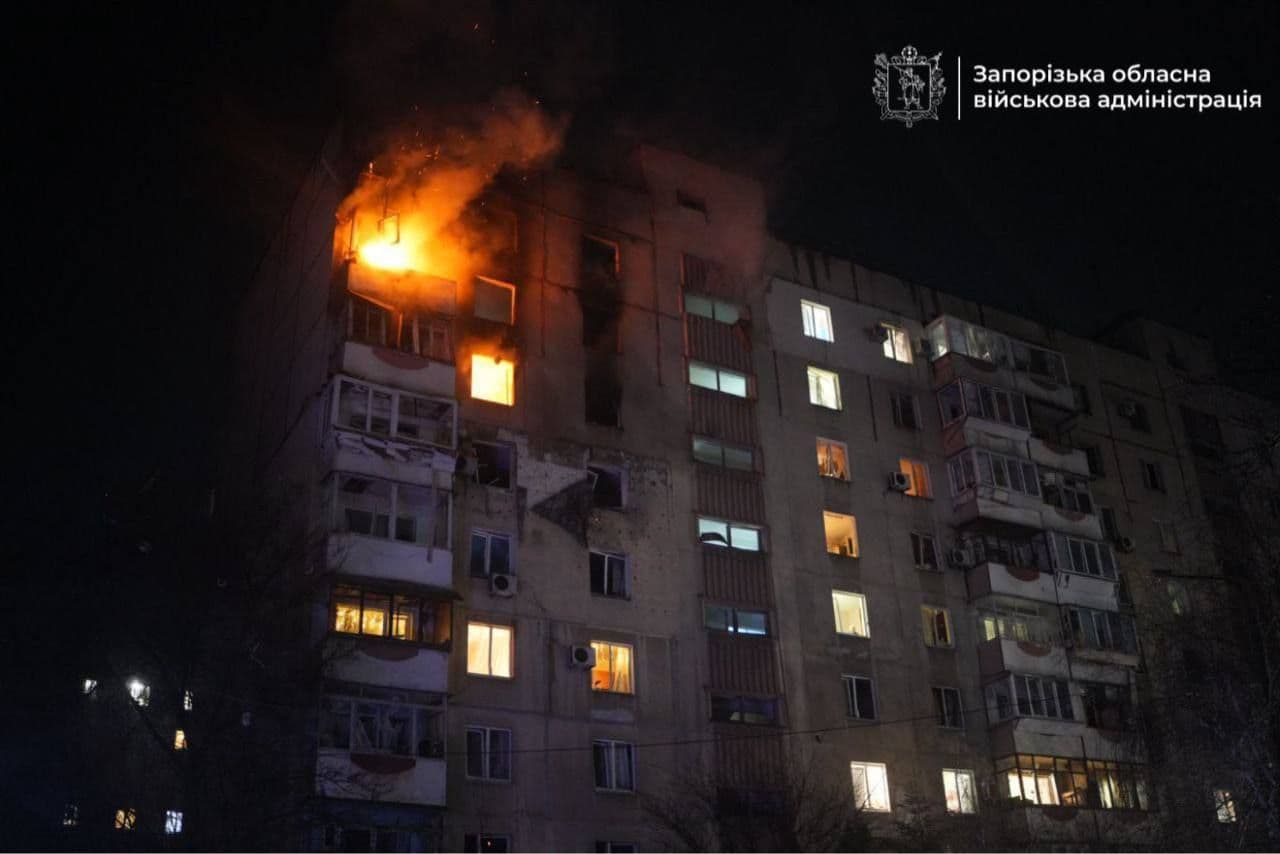
The aftermath of a Russian attack on a high-rise residential building in the city of Zaporizhzhia. (Zaporizhzhia Regional Military Administration)
When the alert finally lifted, fires burned at a private property in Holosiivskyi district and at a two-story residential house in Pecherskyi.
Kharkiv endured 17 drones and two missiles across Shevchenkivskyi, Kyivskyi, Saltivskyi, and Slobidskyi districts. A high-rise was damaged. At least 16 people were injured across Kharkiv Oblast, including residents of Rai-Olenivka. In Zaporizhzhia, eight were wounded — among them an eight-year-old boy. An apartment building caught fire, trapping one person temporarily. A shopping center and a private house were damaged. In Kryvyi Rih, an 89-year-old man and an 82-year-old woman were wounded when a high-rise was set ablaze.
The February 24–25 assault launched 115 drones — Shahed, Gerbera, Italmas, and others — from Bryansk, Kursk, and occupied Donetsk. Ukrainian air defenses downed 95. Eighteen struck 11 sites, hitting transport, energy, and civilian infrastructure in Mykolaiv, Kharkiv, and Chernihiv oblasts.
By day’s end: at least five killed and 18 wounded. Four killed and two wounded in Zaporizhzhia Oblast; one killed and 11 wounded in Kherson Oblast; three civilians wounded in Donetsk Oblast; one woman wounded in Sumy Oblast; one man wounded in Dnipropetrovsk Oblast.
Vitaliy Kim warned of a new shift: Shahed drones now launched in daylight, increasing the risk that falling debris kills civilians caught outside during alerts.
The sirens are no longer confined to night.
Stealing from the Runway: The Arrest That Shook Ukraine’s Air Defenses
Russian missiles hunt Ukrainian airfields.
This week, Ukrainian investigators hunted something else.
Prosecutor General Ruslan Kravchenko announced the detention of the Air Force’s Logistics Commander — identified by Ukrainian media as Andrii Ukrainets — and Volodymyr Kompanichenko, head of the SBU’s regional directorate in Zhytomyr Oblast. They were caught attempting to illegally transfer funds. $320,000 was seized on the spot.
The money was meant for shelters.
In May 2025, the state allocated more than $32 million to build prefabricated arch-structure shelters to protect aircraft still defending Ukraine’s skies. Inspections by the SBU’s Military Counterintelligence Department found the program riddled with violations: designs that failed safety standards, structures inadequate to shield planes, inflated costs. Despite the red flags, advance payments had already begun flowing. Investigators allege the Logistics Commander approached Kompanichenko to suppress the inspection findings and block further scrutiny.
“The embezzlement of funds allocated for national defense during wartime constitutes a direct threat to national security,” Kravchenko said. “Accountability will be inevitable, regardless of the positions held.” The SBU’s interim head called corruption in wartime “tantamount to treason.”
Zelensky ordered a purge. He said he directed officials to “cleanse” the SBU of personnel “whose interests are not aligned with Ukraine at all.” His message was blunt: “Everyone in public office must work for Ukraine and for the sake of Ukraine. There will be no other option.”
The Air Force “categorically condemns” the alleged crimes and pledges cooperation.
Western allies are watching financial flows closely. As Kyiv seeks expanded support, the exposure — and Zelensky’s response — carries political weight equal to the alleged theft itself.
Anniversary Diplomacy: The Vote That Split Washington from Itself
The chamber lit up green, red, and amber.
On the fourth anniversary of the invasion, the United Nations General Assembly voted on a resolution reaffirming Ukraine’s “sovereignty, independence, unity and territorial integrity within its internationally recognized borders.” The tally: 107 in favor. 12 against, including Russia. 51 abstentions.
The United States abstained.
US Deputy Ambassador Tammy Bruce said Washington welcomed the UN’s ceasefire appeal but argued the resolution contained language “likely to distract” from ongoing negotiations — without specifying which language or how. Separately, Washington pushed to remove paragraphs affirming Ukraine’s territorial integrity and adherence to international law. That effort failed.
Then came the rebuke from within Trump’s own circle.
Keith Kellogg — retired general and former special envoy for Ukraine and Russia — posted publicly: “A UN vote on a lasting peace in Ukraine and we abstained. Go figure. It is not a business deal — it is war.” He criticized the administration for failing to support language reaffirming Ukraine’s sovereignty and the UN Charter.
Hours later, the G7 — including Trump — issued a joint statement pledging “unwavering support for Ukraine.” Two messages, one afternoon.
From the podium, Ukraine’s Deputy Foreign Minister Mariana Betsa told delegates that despite US-led peace efforts backed by Europe, Russia shows no genuine willingness to stop its aggression.
Russia’s Deputy Ambassador responded that Kyiv should pursue diplomacy “rather than initiating yet another politicized vote.”
The hall returned to routine business.
But the abstention lingered.
The Call and the Chasm: Friendly Words, Frozen Positions
The call was described as warm.
Zelensky and Trump spoke by phone, with Steve Witkoff and Jared Kushner also on the line. According to unnamed sources cited by Axios, the tone was friendly, positive. Zelensky said he hopes the war can end this year. Trump said he wants it finished within a month.
Zelensky outlined the choreography ahead: bilateral talks in Geneva between Ukraine and the US team, followed by a broader trilateral round in early March with full negotiating teams, and eventually a leaders’ summit. “President Trump supports this sequence of steps,” Zelensky wrote. He thanked Washington for the PURL program, which allows Ukraine to purchase US missiles for air defense systems — calling this winter “the most difficult” and crediting those missiles with saving Ukrainian lives.
Then Moscow spoke.
Kremlin spokesman Dmitry Peskov said any summit between Putin and Zelensky should come only at the “final stage” of negotiations — after “very meticulous work at the expert level.” He questioned whether there was “any point” in a summit under Ukraine’s current position. Putin’s offer to host Zelensky in Moscow remains on the table, Peskov said. Kyiv has rejected it. Zelensky proposed neutral ground. The Kremlin rejected that.
The distance is not cosmetic.
Moscow demands formal Ukrainian recognition of Russia’s annexation of the entire Donbas and a ban on NATO troops in Ukraine. Kyiv demands a ceasefire along the current line, where it holds roughly a quarter of Donetsk Oblast and a foothold in Luhansk.
These are not bargaining stances.
They are rival end-states.
Geneva may host the meeting.
But the gap is the war itself.
Factories Beyond Reach: Ukraine Builds a War Machine Russia Cannot Bomb
While diplomats debated, production lines hummed.
Ukrspecsystems, Ukraine’s largest drone manufacturer, opened its first overseas facility in eastern England — a 200-million-pound investment producing Shark reconnaissance drones. Former Commander-in-Chief Valerii Zaluzhnyi, now ambassador to the UK, called it “an expansion of our joint capabilities and the creation of a second line of defense that guarantees continuity of production.”
The logic is simple. A factory in eastern England cannot be struck by a Russian missile. Every line moved abroad is a line Moscow cannot burn.
The expansion does not stop there. Four Ukrainian defense manufacturers signed joint production agreements worth up to 800 million euros with companies in Finland, Latvia, and Denmark, covering aerial and ground drone systems. Ukraine’s defense innovation platform Brave1 and France’s Defense Innovation Agency signed a letter of intent to co-fund Ukrainian and French defense startups.
Governments followed industry. Canada pledged two billion Canadian dollars in military assistance for 2026–2027, including 66 LAV 6 armored personnel carriers and 383 Senator armored cars. Estonia committed 11 million euros for Ukrainian air defense and ammunition. Lithuania transferred 30 missiles for RBS-70 man-portable air defense systems.
The pattern is redundancy by design.
Build at home when possible. Build abroad when necessary. Ensure that a missile strike on a Ukrainian factory does not silence production.
Russia can target buildings.
It cannot easily target geography.
And as the war grinds on, Ukraine is making sure its arsenal no longer lives in one place.
Troops for a Pipeline: Orban Turns Russian Oil Into a Campaign Front
Viktor Orban says he is sending soldiers.
Hungary’s prime minister announced the deployment of troops and equipment to guard key energy infrastructure, arguing that Ukraine is threatening Hungary’s energy system.
But the oil stopped flowing on January 27 — after Russian strikes damaged Ukrainian energy infrastructure linked to the Druzhba pipeline. Druzhba carries Russian crude to Hungary and Slovakia. Budapest and Bratislava accuse Kyiv of withholding transit as political leverage. Ukraine says the disruption stems from Russian attacks on the systems it uses to move that oil. Kyiv’s foreign minister has offered “several doable solutions.”
Orban has not responded.
Instead, Hungary halted diesel exports to Ukraine, blocked new EU sanctions against Russia, and moved to prevent a planned 90-billion-euro EU loan to Kyiv. EU ministers have tried — and failed — to persuade Hungary and Slovakia to reverse course.
April elections loom in Hungary. Opposition leader Peter Magyar is challenging Orban. In Kyiv, the portrayal of Ukraine as a threat to Hungarian energy security reads like domestic campaign theater.
Zelensky’s reply was sharp: “Russia has destroyed this oil pipeline several times already — and not only this one. So Orban should talk to Putin, perhaps about an energy ceasefire or something similar.”
Soldiers now guard infrastructure tied to Russian crude.
But the pipeline’s vulnerability did not begin in Kyiv.
Gunfire at the School Gate: A Suspect Arrested in the Portnov Killing
The shots rang out outside the American School in Madrid on May 21, 2025. Andriy Portnov — former senior official in Viktor Yanukovych’s pro-Kremlin administration — collapsed at the entrance.
Now Spanish National Police say they have arrested the suspected gunman.
Officers traveled to Heinsberg, Germany, working with Germany’s Federal Criminal Police under a European arrest warrant and investigation order. Authorities searched the suspect’s residence and identified him as the individual who fired the shots. His name has not been released.
Portnov once led the judiciary apparatus of Yanukovych’s government from 2010 to 2014. He fled after the EuroMaidan revolution, returned to Ukraine in 2019, and left again in 2022 following Russia’s full-scale invasion — despite the wartime travel ban on military-age men.
Ukraine’s SBU had investigated him for alleged involvement in facilitating Russia’s occupation of Crimea. A treason case opened in 2018 was later closed. In 2021, the United States sanctioned him on corruption grounds.
The arrest answers one question: who allegedly pulled the trigger.
It does not answer who ordered it. The motive remains unknown.
Outside a school far from the front, a killing tied to Ukraine’s political past remains unresolved.
Lines in the Fire: Budanov Draws Boundaries in a Brutal War
In a war where cities burn and drones hunt at night, Kyrylo Budanov spoke of restraint.
Ukraine’s military intelligence chief addressed something rarely said aloud in wartime: even this conflict has limits. Targeted strikes on hospitals, maternity wards, historical and cultural sites — and the killing of civilians, especially children — he said, fall beyond anything war can justify. “Despite the cruelty of war, I cannot understand who and under what circumstances can raise a weapon against a child or an elderly person who is physically unable to resist,” he said, calling such acts a “loss of human dignity.”
He extended that boundary to political leadership. Neither side, Budanov argued, should strike decision-making centers or the physical locations of national leaders — “whether we are talking about Kyiv or a Valdai situation.” The remark was widely understood as a reference to the lakeside complex northwest of Moscow associated with Vladimir Putin and reportedly linked to Alina Kabaeva.
The statement carried weight beyond morality. Budanov noted that adherence to basic rules of conduct matters especially now, amid fragile peace negotiations.
In a war defined by escalation, he was drawing a line.
Silencing the Feed: Moscow Moves to Strangle Telegram Before the Next Call-Up
The walls are moving closer.
Russia is laying the legal groundwork for a potential ban on Telegram — and shaping the story so the platform appears to have caused its own downfall. A senior member of the State Duma’s information policy committee said the FSB may propose labeling Telegram a “terrorist accomplice” within two to three months if it continues resisting Russian law. The FSB claims the platform is tied to more than 150,000 crimes, many allegedly linked to terrorism. Founder Pavel Durov says Russian authorities have opened a criminal case against him for aiding terrorism. State media are amplifying the charges.
At the same time, Moscow is tightening the screws on VPNs — the tools Russians use to bypass earlier bans. A court fined Google more than 22 million rubles (about $288,000) for distributing VPN services through Google Play. New laws prohibit advertising VPNs and classify VPN use as an aggravating factor in criminal cases.
The timing is not accidental.
The Institute for the Study of War assesses the censorship drive is meant to precede rolling involuntary reserve call-ups — measures likely to spark public anger. Telegram is where Russians learn their sons and brothers are dead, where protests are organized, where uncensored reporting circulates about the war’s reality.
If the state controls the platform, it controls the narrative.
And in a country preparing to ask more men to fight, control of the narrative is strategic terrain.
Anniversary Without Illusion: What Year Four Made Plain
On this anniversary, the masks slipped.
Kremlin insiders admitted the talks are a tactical weapon. Mediazona’s ledger passed 200,000 Russian dead confirmed by name in a country whose last official count was 5,937. A Ukrainian missile struck a ballistic missile factory 1,700 kilometers inside Russia even as Russian drones killed civilians in Zaporizhzhia and Kharkiv. Washington abstained at the UN and signed a G7 pledge of unwavering support the same afternoon. Two Ukrainian officers were arrested for stealing funds meant to shield the aircraft Russia targets.
These are not contradictions to resolve. They are the war’s texture — the distance between words and deeds; between Moscow’s maximalist demands and its capacity to achieve them; between Western rhetoric and the hard edges of policy — Tomahawks withheld, UN votes abstained.
Russia’s own sources now echo what ISW and Kyiv have argued: negotiations are delay. The battlefield is the lever. The Kremlin is testing the political stamina of Ukraine’s partners while inching forward along a line paid for by men from Buryatia, Tuva, and Bashkiria.
Pokrovsk fell after twenty-one months and opened nothing. The Fortress Belt holds. Ukraine’s missiles reach deeper than before. Production now runs in eastern England beyond Russian range. Armor and air defenses continue to arrive.
The outcome remains uncertain. What year four clarified is intent: Moscow negotiates for advantage, not peace. Strategy must begin there.
Day 1,462. The line held. The missiles fell. The names were counted. The talks went on.
Prayer For Ukraine
- Protection Under Fire
Lord, shield the cities struck before dawn — Kyiv, Kharkiv, Zaporizhzhia, Kryvyi Rih — and guard every child, every elderly couple, every family sheltering through sirens. Protect those who repair power lines, fight fires, and clear debris, and give rest to communities living under relentless alerts. - Integrity Within the Ranks
Expose corruption swiftly and root it out completely. Strengthen Ukraine’s leaders to act with courage and transparency so that every dollar meant to defend lives is used for that purpose alone. Let accountability build trust at home and with allies abroad. - Wisdom in Diplomacy
Grant discernment to negotiators in Geneva and beyond. Reveal delay tactics, steady Ukraine’s partners, and align rhetoric with real support. Turn every conversation toward a just peace that prevents this war from beginning again. - Restraint and Human Dignity
Harden hearts against targeting civilians and soften hearts toward the innocent. Uphold the lines that should never be crossed — hospitals, schools, children, the elderly — and let leaders on all sides honor the value of human life. - Endurance and Provision
Strengthen those on the front lines and those building the arsenal at home and abroad. Provide the armor, air defense, and resources needed to protect the nation. Sustain families in Buryatia, Tuva, Bashkiria, and across Ukraine who carry the human cost of this war.
Lord, sustain Ukraine. Break the cycle of violence. Establish a peace rooted in justice and truth.