
On the fourth anniversary of Russia’s invasion, Zelensky opens the wartime bunker, Europe rallies in Kyiv, and Moscow answers with nuclear threats and oil fires burning deep inside Russia.
The Day’s Reckoning
February 24, 2026.
Kyiv wakes before dawn to sirens. One hundred thirty-three Russian drones and an Iskander-M ballistic missile sweep toward the capital and other regions under cover of darkness. Air defenses rise to meet them.
Hours later, an overnight train from Poland pulls into the station. European leaders step onto the platform beneath gray skies and walk into a city Vladimir Putin once promised would fall in three days.
Four years ago, Russian armored columns drove toward this capital expecting a quick decapitation. Four years later, Ukraine has liberated roughly 365 square kilometers in just three months. Russia’s casualty rate has, for the first time, overtaken its recruitment rate. Inside Moscow, Putin addresses the FSB not with triumph, but with careful language preparing the ground for involuntary conscription.
And with nothing tangible to celebrate, Russia’s Foreign Intelligence Service releases a nuclear scare story — accusing Britain and France of secretly transferring nuclear weapons to Ukraine. The claim collapses under basic scrutiny. The distraction does not.
Across occupied territory, Ukrainian ATACMS strike Russian command posts and logistics hubs in the night. In Tatarstan, more than a thousand kilometers from the front, oil storage tanks burn at a key pumping station. In New York, the United States abstains from a UN General Assembly ceasefire vote, breaking ranks again with traditional allies.
In Moscow, Kremlin spokesman Dmitry Peskov concedes what propaganda cannot fully conceal: Russia has “not yet fulfilled all of its goals.”
Year five begins not with victory parades, but with sirens, smoke, and uneasy admissions.
The war goes on.
The Chair Where He Refused to Run
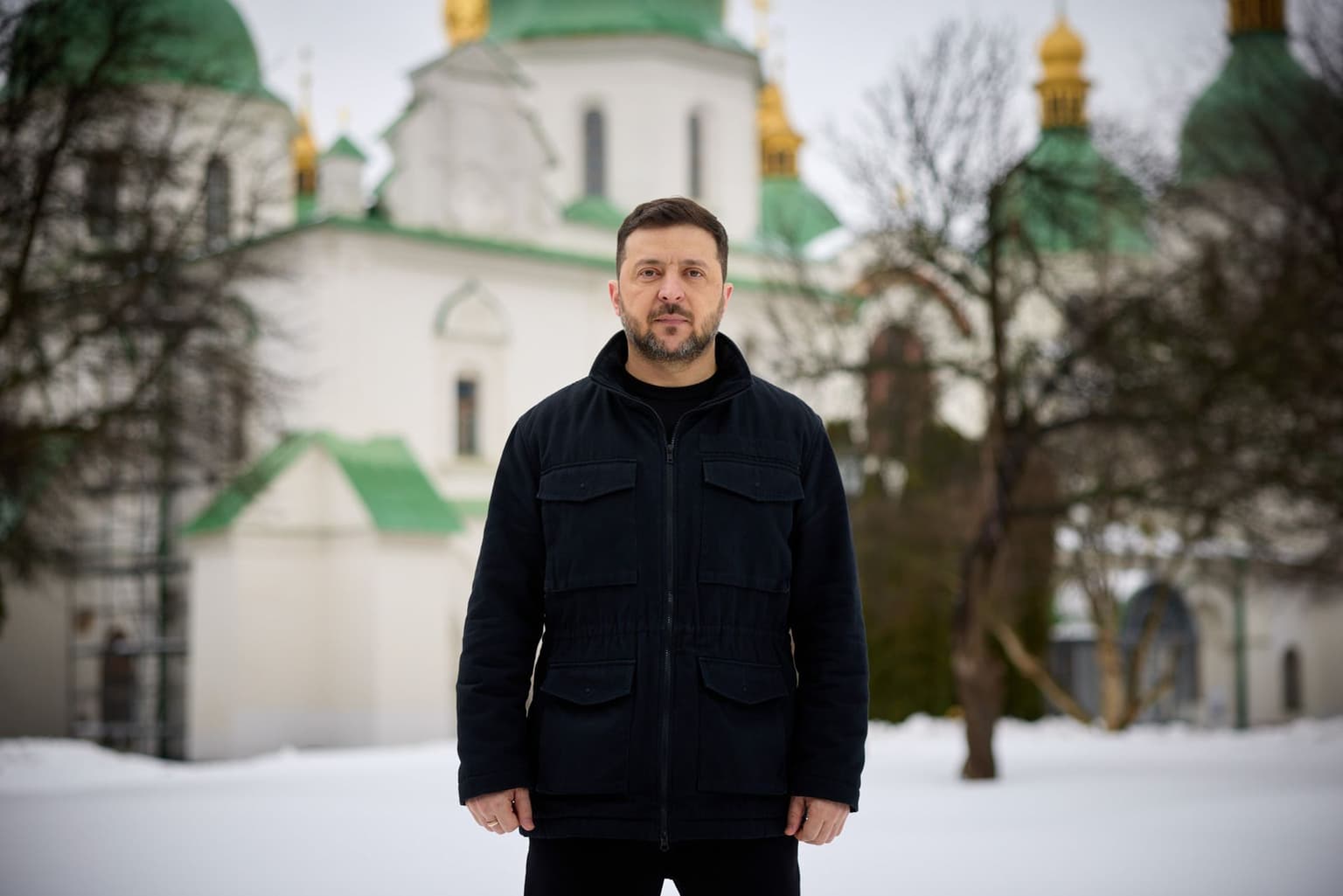
The bunker door opens.
Not in panic this time. Not to flee. But to remember.
Four years ago, beneath Bankova Street, Volodymyr Zelensky stood in these concrete corridors while Russian armored columns closed to within forty kilometers of Kyiv. The capital expected to fall in three days held its breath underground. The American president was on the line.
Zelensky walks back to the desk in the now-empty bunker, cameras following him into the tight, fluorescent-lit room where decisions were made hour by hour. He rests a hand on the wood.
“Here I spoke with President Biden,” he says. “And it was right here that I heard: Volodymyr, there is a threat. You need to leave Ukraine urgently.”
History remembers the reply.
“I need ammunition, not a ride.”
Here is where it was spoken.
He moves through the corridors, turning memory into testimony. He names the fallen — Da Vinci, Grenka, Juice, Zheka, Tykhyi, Nord, pilot Oleksandr Oksanchenko, sailor Vitalii Skakun — and thousands more whose call signs still echo at the front. He names the weapons Ukraine now builds itself: Sichen, Hor, Vampire, Palianytsia, Peklo, Ruta, Flamingo. A country that once pleaded for body armor now produces more than three million FPV drones a year.
Balakliya. Izyum. Kupyansk. Kherson. He speaks each liberation like a mile marker.
Then the appeal: he wants to return here one day with the President of the United States. Let him see the room. Let him see the war.
On negotiations he draws a line. Each round carries strict directives: do not nullify these years, do not devalue the courage, the dignity, the cost.
“Our eyes may be tired,” he says.
“But our backs are unbroken.”
Night Train Into a Defiant Capital

European Commission President Ursula von der Leyen arrives in Kyiv, Ukraine. (Andreas Stein/picture alliance via Getty Images)
The train eases into Kyiv before sunrise, brakes hissing against cold steel.
In wartime, those who matter arrive this way — overnight from the Polish border, no runway lights, no motorcade spectacle. Just a platform beneath gray skies.
Ursula von der Leyen steps down. Antonio Costa follows. Then the leaders of Denmark, Estonia, Finland, Iceland, Latvia, Lithuania, Croatia, Norway, and Sweden. Ukraine’s Foreign Minister Andrii Sybiha waits with a small yellow-and-blue bouquet — a splash of color against winter concrete.
Von der Leyen has made this journey ten times since the invasion began. She wears a light black coat. A sliver of blue and yellow shows beneath it. No bulletproof vest.
In April 2022, when she walked through Bucha and saw the bodies left in the streets, she wore armor. Today she does not. The message requires no translation: the front line has moved. Russia did not conquer Kyiv.
Costa remembers his own early visit in a flak jacket. Now he speaks without one. “The war is on the other side of Ukraine,” he says. “This proves Russia didn’t achieve its first goal — to control entirely Ukraine, to remove the government, to occupy all the territory.”
They gather for meetings of the Coalition of the Willing and the Ukraine-Nordic-Baltic summit — structures built for durability, designed to outlast any wavering across the Atlantic.
The platform empties. The train remains.
Europe has come not out of habit, but out of resolve.
Kyiv is still standing.
A Triple Failure, An Unfinished War
In Paris, Emmanuel Macron chose his words like a verdict.
Putin’s war, he said, is “a triple failure for Russia.” The alliance Moscow tried to fracture has hardened. The Europe it hoped to divide stands more united. The imperial ambition it sought to resurrect has revealed its fragility. More than 1.2 million Russian soldiers wounded or killed — the highest Russian combat losses since the Second World War.
“One day, Russians will realise the enormity of the crime committed in their name,” Macron said, pledging continued support and sanctions. “To those who think they can count on our fatigue: they are mistaken.”
In Moscow, Dmitry Peskov stepped before microphones at TASS and delivered something rarer than defiance.
“Not all of the goals of the special military operation have been achieved.”
It was meant as routine phrasing. It landed as admission.
Russia holds roughly one-fifth of Ukraine’s internationally recognized territory, most of it seized in the first weeks. It has not captured all four oblasts it illegally annexed. It has not dismantled Ukraine’s democracy. It has not halted NATO’s expansion. The words echoed harder than intended.
An AFP review of ISW data traced the fourth year in stark numbers: 4,524 square kilometers taken between February 2025 and February 24, 2026 — more than the previous two years combined, an expanse slightly larger than Rhode Island. Pokrovsk fell on December 1 after more than a year of encirclement. In June 2025, Russian troops crossed beyond Donetsk Oblast for the first time, operating across at least 230 square kilometers of Zaporizhzhia and Dnipropetrovsk.
Moscow now occupies just over 19 percent of Ukraine — about seven percent of it, including Crimea and parts of the Donbas, held even before February 2022.
Four years on, the map is scarred.
But unfinished.
The Nuclear Mirage: How Moscow Manufactured a Crisis
On the war’s fourth anniversary, Moscow detonated a story instead of a weapon.
Russia’s Foreign Intelligence Service announced that Britain and France were secretly preparing to transfer nuclear weapons to Ukraine — disguising them as a domestic Ukrainian development, assembled with covert European components and technologies. No evidence. Just accusation.
Russia’s Federation Council demanded the UN Security Council and the International Atomic Energy Agency investigate. Dmitry Peskov called the alleged plan a “flagrant violation of international law.”
The claim unraveled on contact with reality.
Britain does not possess standalone nuclear bombs; its deterrent relies on Trident II D5 missiles aboard Vanguard-class submarines. France fields submarine-launched M51 missiles and ASMPA cruise missiles carried by Rafale jets. Ukraine has no long-range strategic bombers capable of delivering such weapons. Ukraine’s Foreign Ministry labeled the allegation “absurd.” A UK defense official told the Kyiv Independent: “There is no truth in this. Four years into a war he thought he would win in a week, this is a desperate attempt by Putin to distract from his failures.”
The facts mattered less than the spectacle.
Dmitry Medvedev seized the moment. If the alleged transfer proceeded, he warned, Russia would use tactical nuclear weapons against Ukraine, France, and the UK — a move that would “radically change the situation” and could be “a direct path to world war.” State Duma Speaker Vyacheslav Volodin announced preparations for a formal appeal to the British and French parliaments. Paris replied with cutting brevity: “Five years into its three-day war, Russia would really prefer you focus on French and British nukes.”
ISW assessed the choreography clearly: divert attention from the anniversary, intimidate European security guarantors, and prepare the Russian public for future involuntary reserve callups by invoking an external nuclear threat.
The bomb was fake.
The messaging was not.
The Edge That Never Came: Why Moscow Still Cannot Win
Four years in, the map refuses to obey the Kremlin’s script.
ISW’s most comprehensive assessment of the war’s trajectory lands on the anniversary with a blunt conclusion: Russia has not secured victory, and it has not secured inevitability. Ukrainian forces have achieved their most significant territorial gains since the Kursk incursion of August 2024.
In mid-December 2025, Ukrainian troops pushed back in Kupyansk, retaking at least 183 square kilometers by Christmas and stabilizing control over the town. In February, limited counterattacks in the Oleksandrivka and Hulyaipole directions yielded a net gain of roughly 165 square kilometers. Combined, these operations mark Ukraine’s largest territorial recovery inside Ukraine itself since the 2023 counteroffensive.
The counterpunch disrupted Russian preparations for a Spring-Summer 2026 offensive. Ukrainian forces exploited brittle supply lines around Kupyansk, command-and-control breakdowns after Elon Musk and Ukraine’s Ministry of Defense blocked Russia’s illegal use of Starlink, and the Kremlin’s own decision to throttle Russian military use of Telegram — a platform soldiers depended on for battlefield communication, apparently without grasping the cost.
ISW tempers expectations. The counterattacks are unlikely to expand into a sweeping offensive. Russian forces will stabilize. But one line stands out: Russia has not secured a permanent edge that allows it to advance unchecked as the war drags on.
Behind the front, the pressure builds. For the first time, Russia’s casualty rate exceeds its recruitment rate. Labor shortages deepen. Inflation bites. Oil and gas revenues fall under sanctions. Forced mobilization looms.
Putin prepares the ground — nuclear disinformation, FSB rhetoric, tightening internet censorship.
The last partial callup in September 2022 nearly fractured domestic support.
He remembers.
Fire in the Dark: ATACMS Return and the Sky Fills with Drones
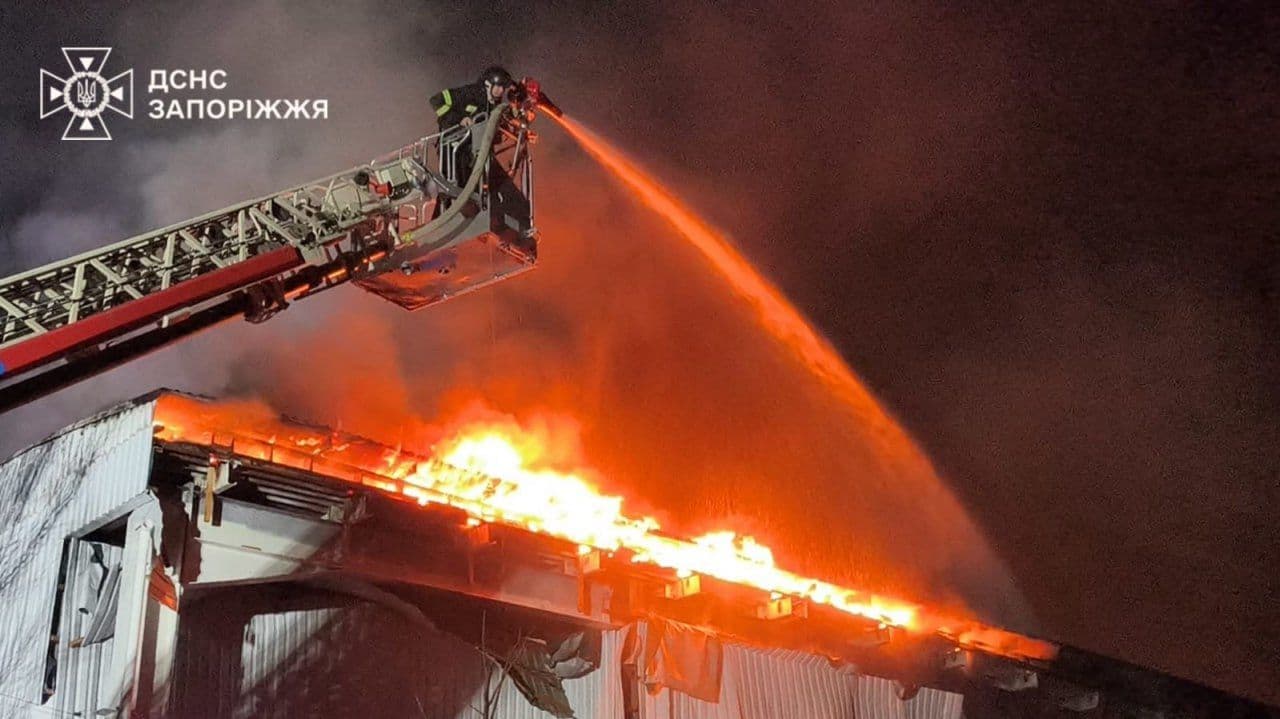
Firefighters battle a blaze in Zaporizhzhia caused by a Russian attack overnight on Feb. 24 (DSNS/Telegram)
While leaders marked the anniversary in daylight, the real conversation happened at night.
Ukrainian crews rolled out HIMARS launchers and reached into a dwindling ATACMS stockpile. The ballistic missiles arced toward occupied territory, striking Russian command posts, ammunition depots, and logistics hubs. Confirmed hits landed on an auxiliary command post of Russia’s 5th Army near Novopetrivka in occupied Donetsk Oblast; a Rubikon center logistics depot near Vasylivka in Zaporizhzhia Oblast; ammunition and supply depots in Pryazovske in occupied Donetsk; and a maintenance and repair facility near Yakymivka in Zaporizhzhia.
ATACMS — U.S.-supplied ballistic missiles fired from HIMARS with a range up to 300 kilometers — had not been confirmed in use since November 18. Their return was both strike and signal.
Russia answered with volume. One hundred thirty-three drones and one Iskander-M ballistic missile surged toward Ukrainian cities overnight. Air defenses shot down 111 drones. Nineteen drones and the missile still struck 16 locations.
By night’s end, three were dead and 28 injured. Zaporizhzhia Oblast: one killed, six wounded. Kherson Oblast: one killed, five wounded. Dnipropetrovsk Oblast: a 35-year-old man killed in Nikopol. Kharkiv Oblast: eleven injured, including two children. Donetsk Oblast: six more wounded in Kramatorsk and Mykolaivka. A Ukrainian Ministry of Defense drone and electronic warfare expert assessed Russia capable of producing roughly 60 Iskander ballistic missiles per month.
The Ukrainian Air Force marked the anniversary with its own ledger. In four years, Ukrainian forces have destroyed more than 140,000 Russian missiles and drones — including 86 Kh-47 Kinzhal hypersonic missiles, 709 Kalibr cruise missiles, 2,459 Kh-101 cruise missiles, 274 Iskander-M ballistic missiles, 44,700 Shahed drones, and 70,300 other drones.
The sky has become a statistic.
But the names beneath it are not.
Oil and Fire in Tatarstan: The Pipeline That Funds the War
More than a thousand kilometers from Ukraine’s border, flames climbed into the night sky over Tatarstan.
Two 50,000-metric-ton storage tanks burned at the Kaleykino oil pumping station after a drone strike launched by Ukraine’s State Security Service. The target was not symbolic. It was strategic. Kaleykino sits at the heart of Russia’s energy export system — a balancing node on the Druzhba pipeline, one of the world’s largest crude oil networks, carrying nearly two million barrels per day through Belarus and Ukraine toward Central Europe, including Hungary and Slovakia.
By morning, Russia’s state pipeline monopoly Transneft cut crude intake by 250,000 barrels per day. Industry sources told Reuters the disruption could affect both export volumes and oil quality. The full extent of the damage remained unclear.
Kyiv does not pretend these are random strikes. Oil finances missiles. Oil fuels tanks. Zelensky has called attacks on energy infrastructure “the sanctions that work the fastest.”
The fire spread beyond steel and storage tanks.
The Druzhba system has been offline since late January after a separate Russian strike. Hungary and Slovakia — the EU’s two most pro-Russian governments and the only members still importing Russian crude through Druzhba — accused Ukraine of delaying repairs. In response, they blocked the EU’s latest sanctions package and a planned 90 billion euro EU loan for Kyiv.
Foreign Minister Andrii Sybiha said Kyiv proposed “doable solutions” to resolve the dispute, suggesting Budapest is leveraging the crisis for domestic political competition. Zelensky was more direct: “Russia has destroyed this oil pipeline several times already. So Orban should talk to Putin, perhaps about an energy ceasefire.”
The tanks in Tatarstan smoldered.
So did Europe’s unity.
A City Goes Dark: Belgorod and the War Moscow Hides
Three hundred thousand people live in Belgorod, forty kilometers from Ukraine’s border.
For two months, the war has been knocking at their doors. December 15: a missile strike on the city’s main thermal plant. December 31: a massed drone raid on substations. January: two more strikes on heating facilities. February 4–9: nightly power grid attacks and rolling blackouts. February 18–19: another missile strike. And on the anniversary itself, Governor Vyacheslav Gladkov acknowledged a “massive” attack causing “serious damage to energy infrastructure.”
Overnight, Ukrainian drones and missiles struck the Frunzenskaya power substation and the Belgorod Combined Heat and Power Plant. By midnight, half the city sat in darkness. By morning, nearly all of Belgorod was blacked out except government buildings running on generators.
Eight multi-story apartment blocks were damaged. Two private homes. Thirty-eight cars. A social facility. Three commercial properties. Even the cupola of the Church of the Holy Martyrs was hit. Six people were injured. The independent local platform Pepel_Belgorod called it “one of the biggest attacks hitting Belgorod in the entire war.” Gladkov had already warned that roughly a quarter of the city’s buildings may need evacuation until at least April because heating systems can no longer function.
On national television, viewers saw something else.
State channels led with Defender of the Fatherland Day celebrations and the SVR’s nuclear allegations. Belgorod flickered briefly, if at all, framed as another attack “repelled” by air defenses. Gladkov urged residents to be “resilient and patriotic.”
He did not say when the lights would return.
Meters and Fog: The Front That Would Not Break
The anniversary changed nothing at the line of contact.
From Kupyansk to Kherson, Russian forces pressed forward — and in most sectors, gained little. In the Kupyansk direction they attacked inside and around the town, north near Kutkivka, east near Petropavlivka and Kucherivka, southeast near Pishchane and Hlushkivka. A Ukrainian brigade spokesperson said Russian troops now favor light vehicles — ATVs, motorcycles, MTLBs — instead of armored columns, while guided glide bombs and strike drones remain their deadliest tools.
In the Borova direction, assaults pushed east toward Shyikivka, south near Korovii Yar, southeast toward Novoserhiivka. No advance. A Kremlin-aligned milblogger conceded that Russian forces do not fully control the Oskil River bridgehead, contradicting official claims of broad control east of the river. Only isolated infiltration groups operate there. Velykyi Burluk saw no ground activity.
Near Slovyansk, geolocated footage confirmed Russian movement west of Siversk. Claims of taking Lypivka and Nykyforivka remain unverified. Around Kostyantynivka, FAB-3000 glide bombs struck along the H-20 highway, and a FAB-500 hit a bridge — part of the campaign to sever supply lines. In Chasiv Yar, tanks now serve as mobile firing platforms rather than assault columns. Russian forces tested a smartphone application linking Telegram to drone feeds, streaming footage to rear command posts.
Fog cloaked Russian attacks near Pokrovsk — toward Hryshyne, Bilytske, Rodynske, Kotlyne, Udachne. A senior Ukrainian officer said his troops adapted to fog assaults. In northern Sumy Oblast, Russian forces advanced near Pokrovka southeast of Sumy City, with the 106th Airborne Division and Rubikon drone center active. In Oleksandrivka and Hulyaipole, attacks brought no gains; Ukrainian counterattacks followed. Kherson saw limited assaults without advance.
Ukraine struck back. ATACMS hit a Buk-1 near occupied Svobodne about 85 kilometers from the front. Strikes hit manpower near Torske east of Lyman, and in Zaporizhzhia Oblast a Uragan MLRS and a Rubikon drone depot near occupied Vasylivka.
The front bent.
It did not break.
Abstained: Washington Steps Back at the UN
In the General Assembly hall, the board lit up.
Green. Red. Yellow.
On the fourth anniversary of the invasion, the United States pressed yellow.
The resolution before the chamber called for “an immediate, full, and unconditional ceasefire” and “a comprehensive, just, and lasting peace in line with international law.” Ukraine had drafted it carefully — stripping out language explicitly condemning Russia and welcoming American mediation efforts. It passed with 107 votes. Russia, Belarus, North Korea, and Iran voted no. The United States joined 51 abstentions, alongside China and India.
Before January 2025, that outcome would have been unthinkable.
U.S. deputy representative Tammy Bruce defended the decision, arguing the resolution’s wording could “distract” from ongoing peace talks. But the signal traveled faster than the explanation.
Keith Kellogg, former U.S. Special Envoy who resigned at the end of the Trump administration, fired back on X: “A U.N. vote on a lasting peace in Ukraine and we abstained. Go figure.” He continued: “Is not four years of war enough? Is not missing children, shelling of cities, and the killing of innocents enough? It is not a business deal — it is war.”
This marked the second consecutive year Washington broke ranks with traditional allies on Ukraine at the UN. Last year, the United States voted against a resolution explicitly condemning Russia as the aggressor.
In Kyiv, European leaders stood on train platforms and pledged endurance.
In New York, the most powerful country in the room chose not to choose.
The screen dimmed. The war did not.
Geneva Turns Again: A Meeting Date and a Quiet Warning
At the Yalta European Strategy conference, Special Envoy Steve Witkoff laid out the next stop on the peace-process carousel.
He said he and Jared Kushner would travel to Geneva on February 26 — talks with Iran, then a meeting with Ukraine’s National Security and Defense Council Secretary, Rustem Umerov. The Kremlin had not confirmed the timeline by day’s end. And the last Geneva round, held February 17–18, ended where so many of these efforts end: no breakthrough on territory, no ceasefire.
Witkoff said he and Trump believe the endgame should include a trilateral summit — Zelensky, Trump, and Putin in the same room. But he acknowledged the process has not reached that stage. The machinery is moving. The destination is still out of view.
In Washington, at a briefing marking the anniversary, Ukraine’s ambassador to the United States, Olha Stefanishyna, supplied the missing gravity. Peace talks have produced few results, she argued, because allies have not applied enough pressure to force Moscow to change course.
“Because of lack of sanctions, lack of pressure, lack of commitment in terms of military systems,” she said, “we were doing enough for Ukraine to survive, but we were not doing enough for Russia not to evolve.”
Then she described the warning that followed a Ukrainian strike on Novorossiysk in November. The attack damaged a major oil terminal linked to the Caspian Pipeline Consortium, where Chevron is a major shareholder. Afterward, the U.S. State Department issued Kyiv a formal diplomatic demarche, saying American economic interests had been violated.
Kyiv “took the note,” she said.
Armored Convoys and Empty Chairs: The Lines Hardening
In Ottawa, the numbers came first.
C$2 billion for Ukraine’s 2026–27 fiscal year. Four hundred armored vehicles — 66 Light Armored Vehicles from General Dynamics and 383 Senator armored personnel carriers. Defense Minister David McGuinty extended Operation UNIFIER for three more years, through 2029. Ottawa added sanctions on 21 individuals, 53 entities, and 100 vessels tied to Russia’s shadow fleet, and lowered the Russian crude price cap from $47.60 to $44.10 per barrel.
Support was not rhetorical. It was itemized.
In Brussels, NATO Secretary General Mark Rutte issued a warning stripped of ceremony. “A promise of help does not end the war,” he said. “Ukraine needs ammunition today and every day until the bloodshed stops.” Any lasting peace, he insisted, requires strong Ukrainian forces able to deter and defend, backed by security guarantees from Europe, Canada, and the United States.
In Geneva, the message was delivered differently — through absence.
At the UN Human Rights Council, Western delegations walked out as Russia’s Deputy Foreign Minister Dmitry Lyubinsky rose to speak. Rows of empty seats faced him. A similar boycott unfolded at the Conference on Disarmament. Moldova’s Foreign Minister, speaking for 44 countries, said it was “impossible to find words for the horror inflicted by Russia on Ukraine.” Iceland’s Foreign Minister called the deportation of Ukrainian children “among the most appalling crimes of Russia’s war.” Norway’s Foreign Minister summarized the mood: “Russia is violating every principle in the book.”
Armored vehicles roll east.
Chairs in Geneva sit empty.
The world is choosing.
Names Erased: The Children Taken and the Reckoning Demanded
On February 23, in Kyiv, the word justice was spoken in a room heavy with absence.
The Justice Conference gathered officials to talk about accountability, compensation, and return. But it was First Lady Olena Zelenska who made the crime impossible to abstract.
Russia has emptied orphanages in occupied territories, she said. Siblings separated. Children transferred into Russian foster families — sometimes into the homes of state officials. Names changed in registries. Phones confiscated. Punishment for speaking Ukrainian. Teenagers sent to militarized re-education camps. Boys who turn eighteen mobilized into the Russian army to fight against their own country.
“We know this from the testimonies of nearly two thousand children who have been returned,” Zelenska said. The real number, she warned, may reach into the tens of thousands — arguably the largest child abduction case in modern history.
The conference did not dwell only on horror. It turned to mechanisms.
A special tribunal for the crime of aggression. A damage register already holding more than 100,000 claims. A Compensation Commission that will require 25 ratifications to take effect; 36 states have signed its founding convention.
Deputy Presidential Office Head Iryna Mudra drew the line clearly: “If we fail to ensure real financial accountability of the aggressor state, the rules-based order will lose its meaning.”
Presidential Office Head Kyrylo Budanov sharpened it further: “Peace without accountability is merely a pause in hostilities, not a solution to the problem.”
The children’s names were changed.
The demand is that the law not be.
$588 Billion and Counting: The Price of Endurance
Four years of war reduce to a number: $588 billion.
That is the World Bank’s estimate for Ukraine’s reconstruction and recovery. Direct damage to housing, transport, and energy infrastructure alone has reached $195 billion.
Behind the steel and concrete are people.
More than 10.8 million Ukrainians — roughly a quarter of the population — need humanitarian assistance, including up to one million in Russian-occupied territories, according to the UN’s humanitarian coordinator. Last year, around five million received aid. The UN refugee agency counts 5.9 million Ukrainians abroad, 5.7 million in Europe. Inside the country, 3.7 million remain displaced. More than 60 percent of those abroad say they plan to return.
Return under what protection?
Zelensky told Germany’s Tagesschau that 80 percent of Ukraine’s territory lacks defense against Russian ballistic missiles. One Patriot system costs between $1.5 billion and $2 billion. Each Patriot missile costs $2 million to $3 million.
At a recent Ramstein-format meeting, partners confirmed $38 billion in military assistance for 2026 — funding for drones, artillery, air defense systems, and Patriot ammunition.
Zelensky said it plainly.
It is not enough.
Factories in the Crossfire: The Economy That Refuses to Fold
On the anniversary, the European Business Association released a survey of 76 member companies — a snapshot from factory floors and office corridors.
Three-quarters report they are fully operational. Another 24 percent work under restrictions caused by Russian attacks. Yet confidence has thinned. CEOs rating their company’s condition positively fell from 40 percent to 32 percent year over year. Those expecting deterioration in 2026 rose from 29 percent to 39 percent.
The obstacles have shifted with the war. Energy strikes now top the list at 82 percent. A shortage of qualified employees follows at 78 percent — a direct result of mobilization and displacement. Eighty-eight percent of surveyed firms have staff serving in the Ukrainian Armed Forces. For 51 percent, those mobilized include key specialists: engineers, IT professionals, specialized drivers.
The losses are real. One-fifth of companies report war-related damage exceeding $10 million, up from 16 percent last year.
But the ledger is not only red ink.
Sixty-seven percent say they have financial reserves to survive at least another year. Seventy-six percent plan to continue operating in Ukraine regardless of the military situation.
“After four years of full-scale war, business demonstrates a high level of resilience,” said EBA Executive Director Anna Derevyanko. “At the same time, we see more restrained forecasts this year — a clear reaction to prolonged security, energy, and economic challenges.”
Power grids flicker. Workers rotate to the front. Balance sheets absorb shock.
The economy bends.
It does not close its doors.
Close the Sky, Raise the Cost: Kyiv’s Three-Part Strategy
On the anniversary, Defense Minister Mykhailo Fedorov distilled Ukraine’s strategy into three directives.
Secure the skies. Halt Russian operations. Cut the oil that funds the war.
In a briefing and Telegram post, he argued Russia fights because it believes force and resources will carry it to victory. “The President has tasked the Ministry of Defense with reinforcing Ukraine’s defenses in a way that compels the enemy to make peace,” Fedorov said.
First: air defense. Ukraine aims to detect 100 percent of aerial threats in real time and intercept at least 95 percent of missiles and drones through a multilayered system.
Second: attrition. In Donetsk, he said, 156 Russian soldiers are lost per square kilometer. The goal is more than 200 eliminated occupiers per square kilometer.
Third: economics. Stronger sanctions enforcement and coordinated maritime operations against Russia’s shadow fleet. “The war continues because Russia still has money for missiles and drones. The source is oil.”
He pointed to the DELTA battlefield management system and the e-Points platform as tools that allow commanders to see faster and decide more precisely.
“The next step is to turn data into decisive power — to see more, think faster, and strike with greater precision.”
The strategy is blunt.
Close the sky. Raise the cost. Force the choice.
Flamingo’s Reach, Oreshnik’s Shadow
More than 1,300 kilometers from Ukraine’s border, the Votkinsk Machine Building Plant felt the reach of Ukraine’s domestically produced Flamingo cruise missile.
The response was swift. A Russian strike hit the manufacturer, Fire Point, temporarily halting production and killing a software engineer. Zelensky confirmed the disruption but said production has resumed and will increase. Fire Point reported that diversified logistics and distributed capacity allowed contracts to continue despite the destruction of two major workshops.
Zelensky also addressed Russia’s Oreshnik hypersonic missile system. “Russians are hiding the Oreshnik system. We understand why. At the moment, they have three systems on the territory of the Russian Federation,” he said.
Ukraine is preparing combined strike packages — drone waves first to exhaust air defenses, then missiles — mirroring Russian tactics.
“It is difficult to overcome air defenses, but we are working on it,” Zelensky said.
Long-range warfare now moves in cycles.
One side conceals hypersonic systems.
The other rebuilds and reaches again.
Thirty Dollars for a Signal: Treason in Izmail

In Izmail, betrayal was priced at $30.
Ukraine’s Security Service arrested two residents — a 36-year-old unemployed man and his 28-year-old partner — recruited through Telegram channels advertising “easy money.” Russian operatives offered $30 for each Starlink terminal registered for use by Russian troops. To expand, the pair planned to enlist people struggling with drug addiction to complete registrations at administrative service centers.
Investigators seized phones containing correspondence with Russian coordinators, payment details, and instructions on legalizing the equipment. Both now face high treason charges under martial law, carrying potential life sentences.
The arrests reveal the ongoing battle over Starlink access. After Ukraine’s Ministry of Defense and SpaceX worked to block Russian forces from using the service illegally — access that had enabled battlefield coordination, drone operations, and command communications — Moscow turned to civilian recruitment.
At the same time, the Kremlin throttled Russian military use of Telegram, prioritizing information control over operational needs. The decision contributed to communications breakdowns that facilitated Ukrainian counterattacks in February. Russian forces appear to have underestimated how dependent they were on the platform.
In Izmail, the war ran through registration forms and encrypted chats.
Thirty dollars bought a signal.
It may cost a lifetime.
Repeaters on Belarusian Soil: The End of Denial
In a February 23 interview with the Belarusian outlet Dzerkalo, Zelensky said Russia has deployed Shahed drone repeaters on Belarusian territory to coordinate strikes on Ukraine — stripping Minsk of plausible deniability.
“Now Belarus knows exactly what is happening on its territory,” he said. “It is no longer possible to say that the missiles were launched, and they had been here for a long time, and we do not control this.”
The repeaters allow Russian operators to adjust drone attacks mid-flight, refining strikes against Ukrainian civilians and energy infrastructure. Zelensky described them as new technology that has appeared in Belarus.
Ukraine has acted to remove them. “We did everything we could to ensure that three or four of them were no longer there,” he said.
Belarus has long portrayed itself as a passive staging ground.
Repeaters require installation and oversight.
The argument of ignorance grows thinner.
When the Lesson Exploded
On February 23 in Dnipro, a classroom became a crime scene.
During a demonstration of ammunition samples, a device detonated unexpectedly, injuring two children. Officials said their wounds were minor and their condition stable.
It was not an air raid. It was not a missile strike.
It was a lesson gone wrong.
The same day, a separate explosion damaged a police administrative building in Dnipro. Authorities indicated no link between the incidents and are considering criminal charges related to safety regulation violations.
The blast did not level the school.
It did something quieter.
It showed how thoroughly war has entered ordinary life — even the objects placed on a classroom desk.
Year Four: A War That Refused Every Script
Watch Zelensky walk through the bunker on Bankova Street, pausing at the chair where he refused to flee. Hear Medvedev threaten nuclear strikes over weapons that do not exist. See European leaders step onto Kyiv platforms without bulletproof vests while Washington abstains at the UN. Flames rise from oil tanks in Tatarstan. A milblogger concedes Russia does not fully control the Oskil bridgehead it claimed. Ukrainian executives report that 39 percent expect conditions to worsen — and 76 percent will keep operating anyway.
Four years in, the war has defied every forecast.
Putin did not seize Kyiv in three days. Ukraine did not collapse without American aid. Russia has not won its “special military operation.” Nor has Ukraine restored its borders. Moscow seized more ground in year four than in the previous two combined; Pokrovsk is now under Russian control.
The cost accumulates. The World Bank estimates $588 billion in damage. The UN counts 5.9 million refugees and 10.8 million people needing aid. The Air Force tallies 140,000 Russian missiles and drones destroyed. The EBA reports 88 percent of companies have employees at the front.
Peskov’s admission — “Not all of the goals…have been achieved” — may be the day’s clearest truth.
The question is no longer who predicted correctly.
It is whether Russia can be made to stop, and at what cost.
For the refugees, the displaced, the children renamed in Russian registries, the answer cannot wait.
Year five begins.
The drones still fly.
The bunker stands open.
The war endures.
Prayer For Ukraine
- For the Skies and the Frontline
Lord, protect those defending Ukraine’s cities and skies. Strengthen the soldiers holding fragile lines near Kupyansk, Pokrovsk, and along the Oskil River. Shield civilians from drones and missiles. Grant wisdom to commanders and courage to those who stand watch in the dark. - For the Children Taken and the Families Waiting
Father, remember the children whose names were changed and whose homes were stolen. Comfort the families who wait for their return. Expose every hidden registry, every deception, every chain of silence. Bring the lost home and restore what was taken. - For Justice and True Accountability
God of righteousness, let justice not be delayed or diluted. Establish real accountability for aggression and war crimes. May tribunals, compensation efforts, and international resolve stand firm so that peace is not merely a pause, but a just and lasting restoration. - For Leaders and Nations Choosing Their Course
Grant clarity and conviction to those in Europe, North America, and beyond. Where there is hesitation, give courage. Where there is division, bring unity. Let support for Ukraine remain steady, and let decisions be guided by truth rather than fatigue. - For the Weary and the Displaced
Sustain the 10.8 million who need aid, the 5.9 million living as refugees, and the millions rebuilding daily under strain. Provide warmth, work, and hope. Guard the hearts of those who feel forgotten.
Lord, uphold Ukraine in year five. Close the sky, restrain evil, restore the stolen, and bring this war to a just end. Amen.