
Nearly 300 strike drones—backed by ballistic and cruise missiles—turned Ukraine’s deep-freeze night into a hunt for heat and light, killing four workers at a Kharkiv postal terminal and leaving Odesa reeling as energy infrastructure across multiple regions took the hits.
The Day’s Reckoning
The night came with numbers first—nearly 300 strike drones, 18 ballistic missiles, seven cruise missiles—but Ukrainians met it as sound and pressure: the rising whine in the dark, the distant thud that makes windows flex, the sirens that force you out of bed and into hallways where breath turns visible. On January 13, as Kyiv sank to –16°C and Kharkiv to –15°C, Russia didn’t just attack Ukraine’s cities. It attacked warmth.
Across eight regions, power plants, substations, and generation facilities became targets again—because winter multiplies every hit. In summer a blackout is inconvenience; in January it is a countdown. Elevators stop. Water pumps fail. Pipes threaten to freeze. Apartments turn into cold storage, and the question becomes how long a building can hold heat it no longer receives.
In Kharkiv, the war found workers who weren’t carrying rifles. Missiles struck a postal terminal and killed four people doing ordinary jobs in an extraordinary time. In Odesa, fires broke out across a frozen city and five were injured as the night’s violence spilled into streets and stairwells. Even beyond Ukraine’s borders, the blast fragments reached outward—shrapnel damaging Poland’s consulate, a small but sharp reminder that this war keeps trying to broaden its consequences.
Three years and eleven months into a campaign Russia once expected to end in days, the strategy is no longer about a single decisive breakthrough. It is about systematic damage to the civilian spine of the country—electricity, heat, water, the infrastructure that keeps people alive when the air itself can kill. Russia is weaponizing winter: turning cold into an ally, darkness into pressure, survival into exhaustion.
Zelensky said Ukrainians support each other where Russia tries to destroy. They do. But the deeper truth is harder: some Kyiv buildings have gone days without heat, and every new strike tries to make endurance feel pointless.
January 13 was not only an attack. It was a test—of grids, of crews, of communities, and of how long a nation can keep living while someone keeps aiming at its ability to stay warm.
The Night the Sky Filled Up
By January 13, Russia wasn’t trying to be clever. It was trying to be too much.
Nearly 300 drones—mostly Shaheds—turned into a strategy all by themselves: throw so many targets into the air that air defense becomes a math problem you can’t always solve. You can shoot down plenty and still lose, because “plenty” isn’t “all.”
The attack came in waves. Around 1 a.m., ballistic missiles cut in from multiple directions toward Kyiv, the kind of strike that compresses time—seconds to react, seconds to decide where to shelter. After 4 a.m., the sky filled again: drones and cruise missiles, more explosions, the city kept awake by impact and siren and the long pause after each blast where everyone waits to hear if the next one is closer. Reporters across Kyiv described detonations stretching through the night into morning.
The targets told the story. Energy facilities took the hits—power plants, generation equipment, substations—technical words that translate into one human sentence: your apartment gets cold. A DTEK thermal power plant was struck directly, equipment seriously damaged, repairs becoming that familiar, grinding loop: fix what you can, brace for the next wave, start over.
And the pattern wasn’t random. Hit generation and substations together and you don’t just knock out one piece—you create cascading failure. A substation destroyed means electricity can’t move even if the plant survives. A plant damaged makes the grid’s surviving nodes pointless. Arithmetic damage becomes geometric disruption.
By morning, Kyiv felt it. Emergency power cuts rolled out. Irpin, Bucha, Hostomel—places that survived occupation early in the war—went dark again, this time under a different kind of siege. Residents reported water disruptions alongside electricity loss, and in –16°C cold, that pairing turns hardship into danger.
This was the swarm’s purpose: not one perfect strike, but enough strikes to make normal life impossible.
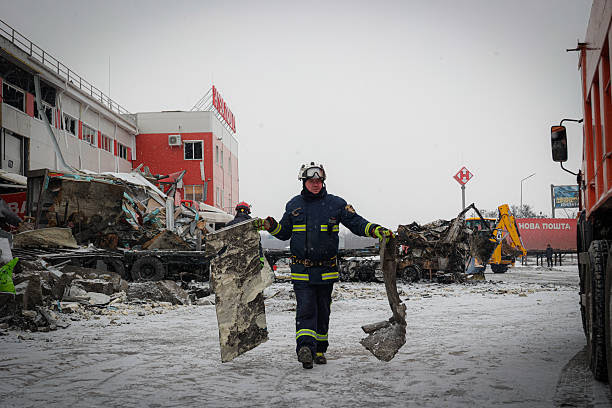
Ukrainian emergency workers at the site of a combined missile and drone attack on a logistics terminal of the private courier company Nova Poshta in the village of Korotych, Kharkiv Oblast. (Stringer/Anadolu via Getty Images)
The Night the Boxes Stopped Moving: The Kharkiv Four
Around midnight, the Nova Poshta terminal on Kharkiv’s outskirts was doing the quiet work that keeps a country stitched together—sorting parcels, scanning labels, moving ordinary things through an extraordinary war.
Then ballistic missiles struck.
Several hits slammed into the facility. One landed as a direct blow, collapsing the main building and igniting fires across roughly 500 square meters. Four employees were killed. Six were injured. Thirty people needed rescue, including two pulled from beneath the rubble where the structure had folded down like a trap.
They were postal workers—civilians whose job was to move packages and paperwork, the mundane commerce of survival. They weren’t in a trench or on a gun line. They were at work, in a place built for logistics, not mourning.
Outside, the temperature sat near –15°C. Rescue teams worked through the night anyway, lifting slabs, cutting twisted metal, calling into the wreckage and waiting for any sound that meant someone was still alive. In that cold, every minute costs more, but the search keeps going because the alternative is unthinkable.
For Kharkiv, the horror was familiar but never normal. The city has taken strikes since the invasion began, too close to the border to ever relax. Yet familiarity doesn’t blunt grief. It only sharpens the question each time: who will be missing when morning arrives?
Ice, Fire, and a Consulate Window Shattered
The sirens didn’t stop at the front. On January 13, the strikes pushed into central Ukraine too—Dnipropetrovsk hit in a massed nighttime attack that left two civilians injured, a blunt reminder that distance is no longer a shield.
In Odesa, the cold made everything worse. At –7°C, missiles turned ordinary buildings into torches: an unused residential block, a fitness center, a vocational lyceum, a nearby garage. Fire crews arrived to a city already frozen and had to fight flames on ice. Water from hoses glazed streets and steps in seconds. Equipment stiffened. Fingers numbed. Every movement slowed at the worst possible time.
Preliminary reports counted five injured. Fourteen people—one of them a child—needed emergency psychologists, because shock has its own injuries even when the body survives. Sixty-five rescuers and fourteen emergency vehicles fanned out across the city, chasing separate blazes through winter-dark streets.
By daylight, the damage read like a checklist of interrupted lives: facades and windows blown out on six apartment buildings, a kindergarten affected, two garages destroyed, nine vehicles ruined.
Then the war reached for something it is not supposed to touch. Shrapnel struck Poland’s consulate, damaging the building but injuring no staff. Warsaw’s spokesman, Maciej Wewiór, called it “another night of Russian terror” and praised the Polish foreign service team still working in Ukraine—because even diplomats now live by the same rule as everyone else: there is no protected place.
For Odesa, it wasn’t a single catastrophe. It was continuation—another night in a city repeatedly hit, where tens of thousands have already learned what it feels like to lose electricity, heat, and water, and then be asked to endure it again.
New Hands on the Wheel: Ukraine Rewires Its War Cabinet
In wartime, a cabinet reshuffle isn’t a press release—it’s a signal flare. Parliament moved to remove Defense Minister Denys Shmyhal with 265 votes, a blunt admission that Year Four is not the same war Ukraine started fighting. Tanks and artillery still matter, but the battlefield is now crowded with drones, jammed by electronic warfare, and decided by who can adapt fastest, not who has the biggest stockpile.
Shmyhal wasn’t shoved aside so much as redirected. He was shifted to first deputy prime minister and handed the Energy Ministry, because energy has become a front line of its own. When the grid is hit, everything else trembles with it—production stalls, communications stumble, coordination frays. In a winter war, electricity isn’t a convenience. It’s the nervous system.
The expected successor—Digital Transformation Minister Mykhailo Fedorov—points straight at Ukraine’s counterweight to Russia’s numbers: technology. Drones, digital command systems, rapid procurement, the quick improvisation that turns civilian innovation into battlefield advantage. At 34, Fedorov represents the war’s new leadership class: less parade-ground doctrine, more speed, software, and scale.
The reshuffle didn’t stop with defense. Parliament also dismissed SBU chief Vasyl Maliuk, even after earlier committee resistance. Zelensky praised him and signaled a continued role focused on the shadow war—special operations that reach deep into Russia, where distance no longer feels safe. And Kyrylo Budanov, the aggressive head of military intelligence, was moved into the center as head of the Presidential Office—placing the mindset of proactive, asymmetric pressure at the heart of government coordination.
Zelensky called it “fresh strength.” The subtext was sharper: Ukraine intends to evolve faster than Russia can learn.
The Factory That Fed the Drones—and the Night It Burned
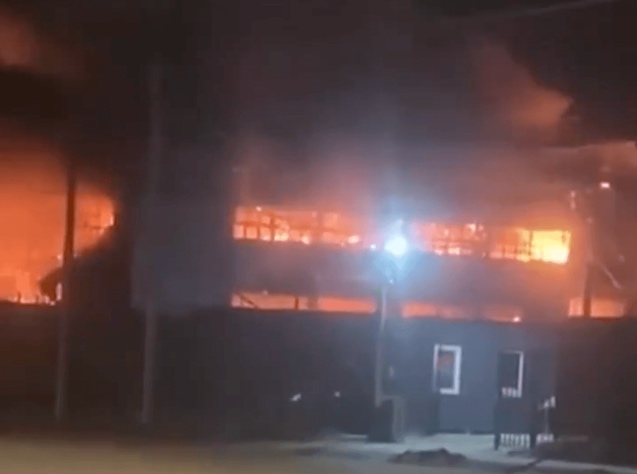
A screenshot from a video posted to social media purporting to show the Atlant Aero plant in Taganrog, Rostov Oblast, ablze overnight. (Exilenova/Telegram)
While Russian drones and missiles hunted Ukrainian cities, Ukraine sent its own message back across the border. On January 13, long-range drones reached Taganrog in Russia’s Rostov region and struck the Atlant Aero plant—one of the quiet places where the war is manufactured, not fought.
The Security Service of Ukraine said its Alpha special operators, working with Ukrainian Navy units, hit the production buildings. Locals reported loud blasts. Flames rose and held, the kind of fire that means something critical has been hit, not merely scorched.
Atlant Aero was not simply a workshop bolting wings onto airframes. It was a nerve center for “Orion” drones and for the systems that make unmanned weapons dangerous at scale: electronic warfare packages that jam signals, digital integration that links FPV drones and loitering munitions into coordinated strikes, and control interfaces that let operators manage more than one machine at a time. Break that chain and you don’t just destroy hardware—you blunt the sophistication of what Russia can field for weeks or months.
That is the logic of Ukraine’s deep-strike campaign. Kyiv cannot match Russia drone-for-drone in output, but it can force Russia to rebuild the places that give those drones their eyes and teeth. As the SBU put it, every halted production line is hundreds of drones that won’t fly over Ukrainian neighborhoods, won’t punch into roofs, won’t turn a winter night into a search for shelter.
The strike carried a second message too: distance no longer guarantees safety. The war Moscow tried to keep “over there” keeps reaching into Russia’s industrial heartland—and every night a plant burns, the circle of who feels vulnerable grows wider.
The UN Stage Where “Negotiation” Meant Surrender
In New York, the room was polished and procedural, the kind of place where language is supposed to slow violence. On January 13 at the UN Security Council, Russia’s ambassador Vasily Nebenzya used that room the way Moscow uses so many things now—as cover.
He spoke in the tone of a man offering “realism,” but the message was a threat: until the leadership in Kyiv “comes to its senses” and accepts Russia’s terms, Russia will “resolve the issue militarily.” And with every day Ukraine “wastes,” he warned, the terms will get worse. Negotiation wasn’t presented as a path to peace. It was presented as a countdown to capitulation.
Then came the familiar inversions. Russia, he claimed, does not target civilians—spoken on a day when nearly 300 drones and multiple missiles tore into Ukraine’s energy infrastructure and killed workers at a postal terminal. Ukraine was accused of striking Russia, as if Russia’s own missiles hadn’t been crossing borders for years. Civilian deaths, he suggested, were mostly the fault of Ukrainian air defense—an attempt to turn the act of protection into the act of killing.
He dismissed the idea of peacekeepers and security guarantees, warning they would be ineffective—because the real point was unspoken but clear: Russia alone intends to dictate Ukraine’s future security arrangements. Even the hint of NATO presence near Ukraine’s borders was treated as illegitimate, as if Ukraine’s sovereignty ends wherever Moscow says it does.
Ukraine’s envoy, Andriy Melnyk, answered with the day’s evidence: the strikes themselves. Russia’s continuing large-scale attacks, he argued, were the clearest proof that the Kremlin is not seeking an end. The destruction is the message—especially to Washington—because bombs have become part of bargaining.
The session ended the way these sessions often do: statements exchanged, positions unchanged. Russia demanded surrender and called it negotiation. Ukraine insisted on sovereignty. Allies watched, divided between resolve and fatigue.
And while diplomats performed, civilians kept paying for the script.
War Outside, Scandal Inside: Tymoshenko in the Crosshairs
While missiles were still falling and apartments were still going cold, Ukrainian politics lit up with a different kind of blast. On January 13, Yulia Tymoshenko—the Orange Revolution veteran and two-time prime minister—was pulled into a corruption scandal, accused of offering bribes to members of parliament in exchange for votes.
The announcement came from the country’s anti-corruption watchdogs: SAPO and NABU said they had uncovered a “parliamentary party leader” allegedly buying support for specific bills. Her name wasn’t in the first public framing, but law enforcement sources pointed to searches connected to Batkivshchyna, the party Tymoshenko leads. In a nation fighting for survival, it was the kind of headline that lands like a slap: the war does not pause politics, and politics does not pause the war.
Tymoshenko hit back hard. She said the accusations were absurd, unconnected to law or legality, and argued investigators found nothing—so they seized her work phones, parliamentary documents, and personal savings, all of it, she insisted, properly declared in her asset filings. Then she widened the claim into motive: maybe elections are closer than people think, and someone is “clearing out the competition.”
The irony was sharp enough to cut. Tymoshenko had recently supported a controversial effort to weaken Ukraine’s independent anti-corruption architecture—the same ecosystem now charging her with vote-buying. Zelensky signed that bill, then reversed course after protests and international pressure. Now, in the middle of a winter strike campaign, the agencies Ukraine fought to keep independent were testing their independence in the most public way possible.
The scene captures a country living two realities at once. One is the external battle—sirens, rubble, and the grinding work of staying alive. The other is internal—institutions, rivalries, prosecutions, and the long struggle to prove Ukraine is not only resisting invasion but also refusing the old habits that once hollowed it out.
Whether this is resilience or dysfunction depends on where you stand. But on January 13, the message was unmistakable: even with the sky on fire, Ukraine’s fight against corruption kept moving.
The Math of a Meatgrinder: Syrskyi Says Ukraine Is Bleeding Russia Dry
General Oleksandr Syrskyi’s January 13 message read like a commander putting hard numbers on a brutal truth: Russia tried to end the war in 2025 by force, and Ukraine stopped the breakthroughs—again and again—until Moscow had to postpone what it planned to finish.
He framed the year as a test Ukraine passed by turning defense into attrition. Russia flooded the front with an estimated 600,000 to 700,000 troops and still gained only 5,000 to 5,500 square kilometers—less than one percent of Ukraine’s territory. The cost, by Ukraine’s calculation, was at least 418,000 Russian soldiers killed or seriously wounded. Syrskyi translated that into a ratio that sounds almost impossible until you sit with it: roughly 76 casualties for every single square kilometer taken.
He pointed to drones as the engine of that carnage. The battlefield now hangs under a constant buzzing canopy—FPV drones, bombers, observers—most of them domestically produced, and together responsible, he claimed, for at least half of all Russian killed and wounded. What artillery once took minutes to find and strike, drones do in seconds. A single operator can watch a wide slice of land and turn a moving cluster of troops into a target with terrifying precision.
Syrskyi’s most provocative claim was that Ukraine is now wounding and killing Russian troops faster than the Kremlin can replace them. If Russia recruits 25,000 to 30,000 a month but loses more than 35,000, the front becomes a slow bleed—units refilled on paper but hollow in practice, each offensive leaving less strength for the next.
He offered only one glimpse of Ukraine’s own losses: AFU casualties, he said, fell 13% in 2025 compared to 2024—numbers guarded for obvious reasons.
Syrskyi remains controversial, criticized by some younger officers, yet Zelensky kept him through the reshuffle. And that continuity underscored the message behind the statistics: Ukraine believes time can still be turned into a weapon—so long as defense stays lethal, drones stay plentiful, and partners keep Ukraine supplied.
The Day’s Meaning: When Winter Becomes a Weapon—and Will Becomes the Shield
January 13 stripped the war down to its ugliest purpose. Nearly 300 drones and a mix of ballistic and cruise missiles weren’t about taking ground. They were about taking warmth. In a week when the air itself could kill—dark, bitter cold settling over Kyiv and Kharkiv—Russia turned winter into a partner, aiming for power plants, substations, and generation facilities the way an army once aimed for bridges and railheads. This was not battlefield necessity. It was strategy: make survival feel impossible.
The human cost landed in places that should never be targets. Four postal workers died at a logistics terminal in Kharkiv—people moving parcels, not weapons. Odesa burned in –7°C cold, and five were injured as firefighters fought flames on ice. Dnipropetrovsk was hit too, leaving two civilians wounded. Across multiple regions, thousands faced the quiet terror that follows a strike: heat fading from apartments, water failing, phones dying, children bundled under blankets while adults do the math of how long the building can hold what’s left. Even Poland’s consulate took shrapnel—another reminder that the blast radius of this war reaches beyond Ukraine’s border.
Russia’s diplomats matched the strikes with threats at the UN: accept our terms or watch them worsen. Ukraine answered in the only language that changes Moscow’s calculations—reach. Drones hit deep into Russia at a plant tied to drone and electronic warfare production, a signal that “safe rear areas” are becoming a myth. At home, Ukraine reshuffled leadership to fit the war it is actually fighting now—technology, drones, and energy security treated as front-line priorities. Even the messy work of democracy continued: anti-corruption agencies moved against a major political figure while the country was still under fire.
That collision is the day’s meaning. Russia is trying to break will by breaking systems—heat, power, water, and the sense that normal life can ever return. Ukraine is trying to outlast that cruelty with organized endurance: repair crews working frozen nights, air defenses stretching ammunition and reaction time, leaders reshaping institutions, and deep strikes aimed at reducing the next swarm before it ever launches.
This war has become a contest of exhaustion. Russia spends missiles, drones, and men. Ukraine spends infrastructure, sleep, and nerve. January 13 didn’t settle who runs out first—but it did prove something again: winter can be weaponized, but it still has to defeat a people who refuse to quit.
Prayer For Ukraine
- Pray for protection over civilians during these mass night attacks—especially families in high-rise apartments without heat or reliable power—and for the most vulnerable (children, elderly, disabled) to have warm shelter and immediate support.
- Pray for Ukraine’s emergency responders and utility crews working in freezing conditions: safety from follow-on strikes, strength for long nights, clear coordination, and rapid access to equipment and spare parts to restore heat, water, and electricity.
- Pray for Ukraine’s air defenders and front-line units to have wisdom and endurance—right decisions under pressure, enough interceptors and ammo, steady nerves, and the ability to hold ground without breaking.
- Pray for Ukraine’s leaders during this reshuffle and constant pressure: unity, courage, and discernment to prioritize what saves lives now (energy security, drones, procurement, logistics) while guarding the nation from internal corruption and division.
- Pray for sustained, reliable international support—air defense, funding for grid repair, weapons and training—and for global leaders to resist fatigue or intimidation, standing firm until Russia’s strategy of freezing Ukraine into surrender fails.