
As Putin’s commanders fabricate battlefield victories near Kupyansk, their own propaganda bloggers revolt, exposing a widening chasm between Kremlin fantasy and the brutal reality of a war grinding into its fourth winter.
The Day’s Reckoning
At the front near Kupyansk, Defense Minister Andrei Belousov listened as generals described captured towns that Ukrainian troops still held. Maps showed Russian advances that did not exist. The briefings were confident. The tone was triumphant. And inside Russia’s own information space, the illusion was already cracking.
Within hours, the Kremlin’s most loyal propaganda warriors turned on their commanders. Ultranationalist military bloggers—normally the loudest cheerleaders for the war—published video evidence contradicting official claims and accused senior officers of constructing a “parallel reality” that bore no resemblance to the battlefield. When even the propagandists stop playing along, something fundamental has shifted.
Across Europe, the war moved on in real time. In Kyiv, President Volodymyr Zelensky announced that a critical air-defense package had finally arrived as intelligence warned of new massive Russian strikes. King Charles marked Britain’s partnership with Ukraine by praising the country’s courage and resilience. Czech President Petr Pavel walked the capital’s streets promising continued military support. Finland pledged €98 million in weapons. Britain committed funds for emergency energy repairs and a new defense business center.
Inside Ukraine, the reckoning continued at home. A court ordered former prime minister Yuliia Tymoshenko to post 33 million hryvnias in bail in a high-profile corruption case. Energy Minister Denys Shmyhal told lawmakers that not a single power plant in the country had escaped Russian strikes. Officials packed for Washington, preparing for talks that could shape the next phase of the war.
And in the background, Washington floated a new idea: a Trump-led “Board of Peace” that might one day expand from Gaza to Ukraine.
One day. One war. Two realities colliding. And a widening gap between what Moscow claims—and what the world can see.
The Map That Lied: How Putin’s Generals Invented a Victory at Kupyansk
The briefing room near Kupyansk was supposed to deliver reassurance. Defense Minister Andrei Belousov arrived on January 16 expecting the familiar ritual—maps on the wall, confident voices, arrows pointing west. Instead, he was handed a storybook.
Colonel General Sergei Kuzovlev stood before his minister and recited a victory. Kucherivka. Podoly. Kurylivka. Taken. Secured. When Belousov pressed—was Kupyansk itself being cleared?—Kuzovlev did not hesitate. Russian troops, he said, controlled every district. Ukrainian counterattacks had failed.
Outside that room, the war told a different story.
Satellite images showed Ukrainian flags where Russian ones were supposed to be. Drone feeds traced Ukrainian patrols moving through neighborhoods Moscow claimed to own. Field reports placed Russian units pinned and bleeding on the approaches. The city Kuzovlev described as conquered was, in reality, slipping from Moscow’s grip.
Still, the generals kept talking. The slides kept coming. The claims hardened into doctrine.
This was not confusion. It was choreography.
An alternate battlefield was being staged for the Kremlin—one where Russia was advancing, where defeat was impossible, where negotiations should begin from a position of strength. A reality designed for television screens, for diplomats’ briefing folders, and perhaps for Putin himself.
For one morning, the illusion held.
Then the footage leaked. The maps were mocked. And the lie collapsed under its own weight.
When the Cheerleaders Turned: Russia’s Propaganda Army Revolts
For nearly four years, Russia’s military bloggers had played their part. They celebrated advances that barely moved the line. They mocked Ukrainian resistance. They amplified every Kremlin talking point with the fervor of true believers. Some operated with quiet official blessing. Some with direct support. Together, they built an audience of hundreds of thousands and helped sell the war at home.
Then January 16 arrived.
One by one, the propaganda warriors began dismantling their own command’s story about Kupyansk.
A Kremlin-affiliated milblogger went first. Video, he said, showed Ukrainian forces operating inside Kupyansk and Kupyansk-Vuzlovyi. Russian artillery was still shelling Podoly—a town Moscow had already declared captured. The Western Grouping of Forces, he wrote, was “in no hurry” to stop sending “embellished” reports up the chain. Belousov’s front-line briefing was his example.
Another blogger followed. The presentation to the defense minister, he said, existed in a “parallel reality.” It made no mention of Russian troops cut off inside Kupyansk. It ignored the small Russian units that reached the outskirts of Kupyansk-Vuzlovyi—only to be wiped out by Ukrainian fire.
Then came the detail that cut deepest.
Russian soldiers had been filming a flag-raising video in Kupyansk-Vuzlovyi. Proof of conquest. A clip for state television. Ukrainian forces struck while the camera was still rolling. “The final moments of the video will not be published anywhere,” the blogger wrote.
More voices joined in. Claims of total control were “not only inaccurate,” one said—they “did not even come close” to reality. Russia, he noted, had not controlled Kupyansk “for a single day.” Others warned that “beautiful reports” were producing disaster on the ground: losses in the hundreds, broken coordination, and brutal assaults ordered on the basis of lies.
When the men paid to cheer stop cheering, the war enters a new phase.
The War Inside the War: How Putin’s Generals Built a Battlefield That Doesn’t Exist
In Moscow’s war rooms, the maps tell a cleaner story than the one being written in blood outside Kupyansk.
The Russian military command did not stumble into false victories by accident. The fabrications were deliberate—cognitive warfare aimed not at Ukrainian trenches, but at negotiating tables in Washington and Europe. The message was simple: Russia is winning. Resistance is pointless. Accept Moscow’s terms now, or face worse later.
So the generals stood before cameras and briefed their superiors on towns they had never taken. Kucherivka. Podoly. Kurylivka. Lines on a map that moved west even when Russian units could not. Each claim was another brick in a psychological wall meant to box Ukraine into submission.
Kupyansk became the pressure point. A nerve center. Neuralgia, intelligence officers would call it. If the lie cracked there—if the world saw that Moscow’s story and the battlefield no longer matched—the entire narrative of Russian military strength would begin to unravel. Better, the generals decided, to stack fiction on top of fiction than to admit retreat.
But lies demand maintenance.
A false report creates expectations. Expectations demand results. When the results never arrive, another lie must replace the first. And so the cycle tightens. Briefings grow bolder. Claims grow larger. Reality grows more dangerous.
On the ground, Russian soldiers paid for the illusion.
Units reported secure zones that were anything but. Reinforcements never came because headquarters believed the city was already taken. Assault teams were ordered forward on the assumption that flanks were protected. They weren’t. Men advanced into kill zones built on paper victories.
The milbloggers saw it first. They watched assaults collapse that should never have been ordered. They counted bodies from operations based on fantasy. They listened to officers coordinate off maps that no longer matched the earth.
The “parallel reality” shown to Belousov was not just propaganda.
It was a second war—one that was getting Russian soldiers killed.
The Shield Arrives Just in Time: Ukraine Races the Next Wave of Russian Fire
The message from Kyiv came with urgency in every word.
On January 16, President Volodymyr Zelensky announced that a major air-defense package had finally reached Ukraine—just as several of the country’s surface-to-air missile systems were running dry. Some batteries, he revealed, were already “without missiles.” The shield was arriving not as reinforcement, but as rescue.
Each delivery, Zelensky said, now comes only after pleading and pressure. Air defense is no longer a routine logistics problem. It is a daily battle. Ukraine’s needs stretch far beyond the familiar Patriot systems. Every missile is counted. Every launcher is rationed. Every delay costs light, heat, and lives.
That night, Zelensky warned of what was coming next.
Intelligence services had intercepted preparations for new massive Russian strikes. The pattern was already clear. Since October, Russian forces had hunted Ukraine’s power grid with methodical precision: 11 hydroelectric plants, 45 combined heat-and-power plants, 49 thermal stations, 151 substations. One by one, they went dark.
Energy Minister Denys Shmyhal stood before lawmakers and said what no modern European country should ever have to say.
“There is not a single power plant in Ukraine that has not been hit.”
Six hundred and twelve deliberate strikes in one year. Daily bombardments. Thousands of megawatts erased. Dispatchers at Ukrenergo balancing a shattered grid hour by hour, imposing rolling limits to keep the system alive.
Yet it still holds.
Naftogaz and Ukrainian Railways were ordered to import electricity from abroad—enough to cover half of winter demand. Backup generators were rushed to hospitals, water stations, and command centers. Curfews were loosened so civilians could reach the glowing shelters known as Points of Invincibility.
Outside, the air raid sirens keep coming.
Inside, the lights stay on—just barely.
And somewhere overhead, the new missiles wait for the next wave.
Steel, Shells, and Heat: Europe Rushes to Hold Ukraine Through Another Winter
As Kyiv pleaded for missiles to keep the lights on, Europe answered with cargo.
On January 16, the pledges came in waves. From the Baltic to the Mediterranean, governments moved money, weapons, and machinery toward a country bracing for another season of Russian fire.
Finland went first. The Defense Ministry announced a €98 million military aid package—roughly $114 million—its contents sealed behind classification stamps. The sum alone spoke volumes. Finland shares a 1,300-kilometer border with Russia. It reads threat assessments not as theory, but as memory. The message from Helsinki was simple: Ukraine would not stand alone.
London followed with two moves aimed at the present and the future. Defense Secretary John Healy revealed plans for a British defense business center in Kyiv, opening in 2026 to help Ukrainian startups sell air-defense systems and drones to the world. Wartime improvisation, turned into long-term industry. Alongside it came £20 million—about $26.7 million—for emergency repairs to power plants and substations Russia had tried to erase.
From Rome came heat.
Deputy Prime Minister Oleksiy Kuleba announced that Italy would deliver roughly 80 industrial boilers, worth €1.85 million. Each unit—some the size of a shipping container—designed to replace centralized heating systems shattered by missiles. In towns where radiators had gone cold, these machines would bring steam back into pipes.
And in Kyiv, Czech President Petr Pavel stood beside President Zelensky and added firepower to the list. Prague would provide combat aircraft capable of downing drones and might send early-warning systems, including passive radars. The Czech shell initiative already accounted for about half the ammunition reaching Ukrainian guns.
“We will be able to provide roughly the same amount as before,” Pavel said. “Ukraine’s armed forces will not suffer shortages.”
Taken together, the shipments traced a map of necessity: missiles for the sky, shells for the trenches, boilers for frozen apartments, generators for hospitals.
Four winters into the war, Europe was no longer improvising.
It was building a lifeline.
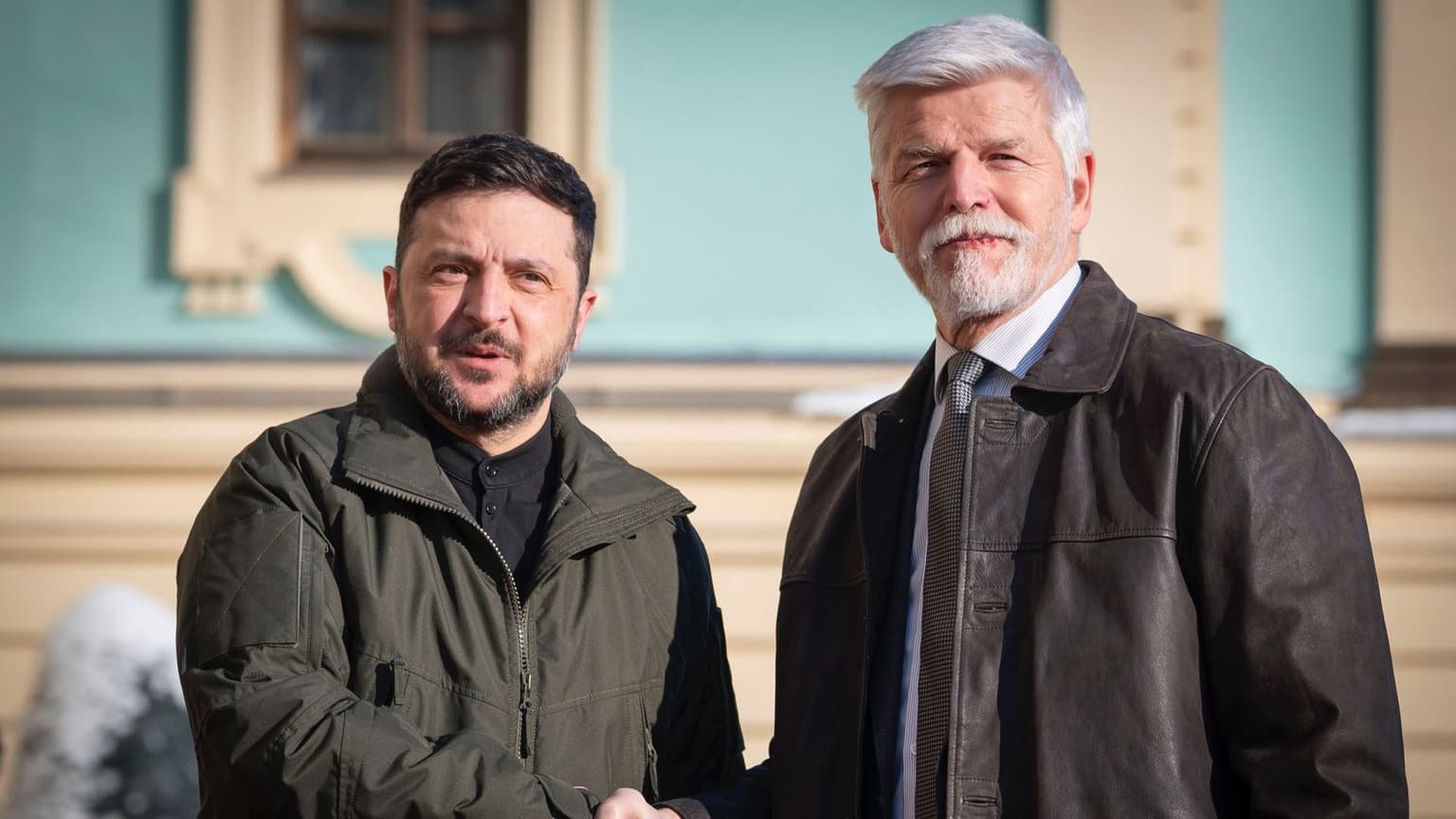
President Volodymyr Zelensky (left) and Czech President Petr Pavel shake hands during the latter’s visit to Kyiv, Ukraine. (Volodymyr Zelensky/X)
Words From a King, Footsteps in Kyiv: Europe Shows Up When Ukraine Needs It Most
On January 16, the voice of Britain crossed the Channel and the front lines.
From Buckingham Palace, King Charles marked the first anniversary of Britain’s century-long partnership agreement with Ukraine with a message that carried none of the usual diplomatic caution. He wrote of a nation showing “most valiant strength in the face of such appalling hardship and pain.” He called Ukraine an “extraordinary example to the world.” And he spoke not in abstractions, but in admiration.
“I am constantly impressed by the sheer bravery, courage and resilience shown by the Ukrainian people,” the King wrote. He said he prayed that the bond between the two countries would bring hope and moral support “at this most difficult time.” Ahead of the fourth anniversary of Russia’s full-scale invasion, he added what mattered most: his “profound hope that Ukraine can achieve a just and lasting peace that safeguards its security, sovereignty and prosperity.”
Prime Minister Keir Starmer shared the message and sharpened it into policy. What happens in Ukraine, he said, is not distant. It is about Britain’s own future—about freedom, democracy, and the rule of law.
In Kyiv, the words were met with action.
President Volodymyr Zelensky welcomed UK Deputy Prime Minister David Lammy and thanked him for Britain’s £20 million pledge to repair power stations shattered by daily missile strikes. “Every day we need this,” Zelensky said. “Every day.”
And then came the footsteps.
Czech President Petr Pavel arrived in Kyiv and walked to the Memorial Wall, where the faces of the fallen stare out from photographs. After meeting Zelensky, he spoke of peace—not as surrender, but as a hard road that only Ukraine could choose.
“There are painful compromises Ukraine may have to make,” Pavel said. “But only if they lead to a peace Ukraine can accept.”
Europe, he insisted, would not stand aside while others decided Ukraine’s future.
Not with words alone.
Not from a distance.
But here.
The Line in the Snow: When Britain Told Moscow “Not Yet”
The debate broke into the open on January 16, as Europe weighed whether to reopen a door Moscow had never truly closed.
In London, British Foreign Secretary Yvette Cooper drew a hard line. While French President Emmanuel Macron and Italian Prime Minister Giorgia Meloni floated the idea of re-engaging the Kremlin, Cooper rejected the notion with the bluntness of a country that had already watched one Russian peace promise collapse into war.
“I think what we need is evidence that Putin actually wants peace,” she said. “And at the moment, I’m still not seeing that.”
For Cooper, the sequence mattered. Pressure first. Weapons first. Support for Ukraine first. Negotiations only when Moscow proved it was serious.
Across Europe, the argument ran deeper than tone. Macron and Meloni feared that as Donald Trump spoke directly with Vladimir Putin, Europe itself was being edged out of decisions about Ukraine’s future. They wanted seats at the table. Voices in the room. Influence over whatever peace framework emerged.
Cooper’s camp answered with a warning. Talk too soon, they said, and Russia would read it as weakness. Offer dialogue without proof of intent, and the Kremlin would pocket legitimacy while continuing its war.
“What we’ve seen is the huge commitment to work being done by Ukraine, with the U.S. and supported by Europe to draw up plans for peace, including security guarantees,” Cooper said. The work was real. The risk of undercutting it was, too.
In Moscow, the response came quickly.
Kremlin spokesman Dmitry Peskov welcomed European interest in talks as a “positive evolution.” From Paris. From Rome. Even from Berlin, he said, there was growing recognition that stability required talking to Russia.
Translation: Europe was wavering. And wavering was useful.
The argument played out as Russian bombers and drones struck Ukrainian cities, deepening an energy crisis in freezing temperatures. Even then, the Kremlin insisted Ukraine was “running out of options,” that Kyiv’s room for maneuver was shrinking by the day.
In London, Cooper was unmoved.
Peace, she signaled, could wait.
Pressure could not.
The Suitcases for Washington: Ukraine Takes Its Case to Trump’s White House
The decision was made in Kyiv on January 16. The plane tickets were booked. The folders were sealed.
Ukraine was heading to Washington.
President Volodymyr Zelensky announced that a senior delegation would cross the Atlantic in the coming days for what may become the most consequential talks of the war’s next phase. At the head of the group: Rustem Umerov, secretary of the National Security and Defense Council; Kyrylo Budanov, the spymaster who has tracked Russia’s war from the shadows; and David Arakhamia, the parliamentary leader of Zelensky’s Servant of the People party.
Their destination was not just a city. It was a shifting political reality.
The trip came after U.S. President Donald Trump again accused Zelensky of stalling peace talks—even as Kyiv and Washington quietly advanced a 20-point peace framework behind closed doors. A White House official confirmed the Ukrainians would meet Trump’s special envoy, Steve Witkoff, and his adviser and son-in-law Jared Kushner.
Zelensky framed the mission with care.
“We need clarity,” he said, standing beside Czech President Petr Pavel in Kyiv. Clarity on the documents already drafted with Washington. Clarity on Russia’s response. Clarity on security guarantees that could define Ukraine’s survival.
The clock is ticking.
If negotiations move fast enough, Zelensky said, the papers could be ready for signature at next week’s World Economic Forum in Davos. There, Kyiv and Washington are expected to unveil an economic deal aimed at rebuilding a country scarred by four years of invasion.
The numbers alone tell the scale of what lies ahead.
Ukraine’s recovery, officials estimate, will cost $800 billion over a decade—four times the size of its prewar economy. Cities to rebuild. Power grids to replace. Factories to resurrect. A nation to stitch back together.
Now the delegation carries that future in their briefcases.
And Russia’s war in their shadows.
A New Table for an Old War: Trump Floats a “Board of Peace” for Ukraine
The idea surfaced quietly on January 16, slipping into diplomatic briefings like a trial balloon.
According to the Financial Times, American officials were exploring whether President Donald Trump’s proposed “Board of Peace” for Gaza might be expanded to other wars—Ukraine among them. A single structure. Multiple conflicts. One chair at the center.
Trump had already unveiled the Gaza version as the second phase of his plan for post-war reconstruction between Israel and Palestine. The board, chaired by Trump himself, would take temporary control of Gaza’s administration and rebuilding. Now the model was being tested for broader use.
That same day, Trump named the first members. Ajay Banga, president of the World Bank. Canadian Prime Minister Mark Carney. A list expected to be fully revealed next week in Davos. Also included: the men already shaping Ukraine-Russia talks—Special Envoys Steve Witkoff and Jared Kushner, and Secretary of State Marco Rubio.
Behind closed doors, officials described the concept as something more ambitious than a committee.
A substitute for the United Nations.
A parallel, unofficial body designed to manage conflicts beyond Gaza. A mechanism that bypasses traditional multilateral institutions and places American leadership at the center of postwar order.
For Ukraine, the details remain thin. But a senior Ukrainian official called the prospect of a Ukraine-focused Board of Peace an essential piece of any lasting settlement. The proposed structure, the official said, would include Ukrainian, European, Russian, and NATO representatives—an attempt to bind security guarantees, reconstruction, and diplomacy into one framework.
The design fits Trump’s worldview: deal-making over diplomacy, leverage over process, speed over consensus.
Whether it survives contact with reality is another matter.
Moscow has consistently rejected ceasefire proposals that involve European peacekeepers or leave Ukraine holding parts of Donbas. And any structure that sidelines the UN would provoke resistance across Europe.
For now, the board exists only as an idea.
But in a war where frameworks become futures, even ideas matter.
The Gavel in Wartime: Tymoshenko Faces the Court as Ukraine Polices Itself Under Fire
The courtroom doors closed on January 16, and the war did not pause.
Inside, Ukraine’s anti-corruption judges set bail for one of the country’s most famous political figures. Former prime minister Yuliia Tymoshenko was ordered to post more than 33 million hryvnias—about $760,000—in a bribery case that has become the most high-profile investigation in months.
The ruling came with conditions. Tymoshenko must appear whenever summoned. She must report any change of address. She is barred from leaving Kyiv Oblast or contacting certain lawmakers. Her passport is to be surrendered.
Tymoshenko stood before the bench and promised to fight. She said she would appeal. She called the case a political hit job—retribution for her views, not a reckoning for corruption.
Prosecutors told a different story.
The National Anti-Corruption Bureau said that after charging several lawmakers from President Volodymyr Zelensky’s party, Tymoshenko began discussions about regularly offering bribes to members of parliament in exchange for votes. The allegation is blunt: money for power, arranged on a schedule. Tymoshenko denies it and says the timing is tied to a looming election season.
Ukraine’s constitution bars elections during martial law—the state of emergency declared when Russia launched its full-scale invasion. Zelensky has said he would accept elections only if partners guarantee security and parliament rewrites the rules to make voting possible under fire.
Tymoshenko, who served as prime minister in 2005 and again from 2007 to 2010, leads the Batkivshchyna (Fatherland) party, which holds 25 seats in parliament. The case is the biggest since the Energoatom scandal—money laundering and embezzlement at the state nuclear firm that shocked the country.
Outside the courthouse, air-raid alerts still sound. Power plants are still targeted. Soldiers still hold the line.
Inside, the state keeps score.
In a nation fighting for survival, the message is stark: even icons answer to the law.
Meters for Blood: The Frontlines That Refused to Break
While diplomats argued and courts deliberated, the war itself kept grinding forward—slowly, brutally, and without mercy.
On January 16, Russian forces pushed in multiple directions. Nowhere did they break through. Everywhere, they paid.
North of Slovyansk, geolocated footage showed Russian units edging forward near Riznykivka. In eastern Zakitne, soldiers raised a flag during what looked like an infiltration raid. Moscow declared the village seized. On the ground, fighting continued. Ukrainian units had not withdrawn.
A senior Ukrainian NCO watching the sector described a sky thick with Russian reconnaissance drones—but little heavy equipment. Russian troops were gathering in Siversk, a lowland town that turns into a killing ground under Ukrainian fire.
Toward Pokrovsk, Russian forces advanced east of Rodynske. The footage was dated—no fresh snow on the ground—but the attacks continued. The defenses held.
In the Hulyaipole direction, Russian troops took Dobropillya. Other footage showed Ukrainian strikes near Pryluky and Svyatopetrivka, suggesting Varvarivka had already fallen earlier. The Russian Defense Ministry claimed another prize: Olenokostyantynivka, seized by the 394th Motorized Rifle Regiment.
Near Kramatorsk, Russian infiltrators slipped into Markove notes. They did not hold it. Ukrainian drones hunted them through falling snow. When some tried to run, Russian drones struck their own men. A captured POW later told interrogators his unit was poorly trained, ordered forward regardless of losses, freezing and exhausted.
Further south, weather stopped advances before Ukrainian guns could. Snow and wind stalled assaults near Novopavlivka. White uniforms stood out against the ground. FPV drones found their targets.
In Kursk, Ukrainian fiber-optic drones—flying 15 to 25 kilometers—stalked Russian infantry far behind the line. In Borova, Ukrainian troops still held Novoplatonivka despite Moscow’s claims.
And behind Russian lines, Ukrainian missiles found an ammunition depot in Prymorsk—92 kilometers from the front. At Zaporizhzhia Nuclear Power Plant, Russian forces staged equipment beside reactors. Firing points appeared on rooftops.
Everywhere the same pattern.
Infantry forward. Drones overhead. Bodies in the snow.
Meters gained.
And no breakthrough.
Drills in the Shadow of Moscow: Belarus Trains for Russia’s War
On January 16, the orders went out across Belarusian bases.
Snap readiness checks. Units on alert. Counter-drone defenses drilled and redrilled. The lessons, officials said, were coming straight from Russia’s war in Ukraine.
Security Council Secretary Lieutenant General Alexander Volfovich told reporters that President Alexander Lukashenko had instructed the armed forces to absorb the battlefield experience of the invasion next door. The priority: learning how to survive in a sky filled with drones.
Belarus, long tethered to Moscow, was now openly shaping its military around the realities of Russia’s war.
When asked about reports that Russia had not deployed its Oreshnik intermediate-range ballistic missiles to Belarus, Volfovich brushed the question aside. Agreements between Lukashenko and Vladimir Putin, he said, had been fulfilled “regardless of what Belarus’s opponents claim.” Translation: Minsk would say what Moscow needed said.
Behind the uniforms and exercises, another system was tightening into place.
That same day, Gennady Lepeshko, chairman of the National Security Committee of Belarus’s parliament, announced that Belarusian and Russian interior ministries were synchronizing their databases. The goal: a single, unified registry of “extremists” and “extremist web resources.”
One list. Two countries. No borders.
The integration reaches beyond soldiers and weapons. It reaches journalists. Activists. Opposition figures. Anyone the two governments decide is a threat.
Belarus is no longer just Russia’s staging ground.
It is becoming an extension of Russia’s security state—plugged into the same surveillance networks, bound by the same repression, trained for the same war.
The drills are real.
The databases are merging.
And Moscow’s shadow now falls directly across Minsk.
The Throttle Clicks Down: Russia Squeezes Telegram and the Last Open Windows
On January 16, the messages began to lag.
Across Russia, users opened Telegram and watched the spinning wheels. Chats loaded slowly. Channels stalled. The country’s most popular messaging app—used by an estimated 100 million people—felt suddenly heavier, as if someone had tightened a valve.
Moscow 24 traced the slowdown to Roskomnadzor, the federal agency that polices Russia’s media and telecommunications. An unnamed source confirmed what users already suspected: new restrictions were in place.
The timing fit a pattern. The Kremlin has spent the war years turning the internet into a controlled space—throttling Signal, Viber, WhatsApp, and YouTube; cutting mobile data in regions under the pretext of security and drone threats; and steadily training citizens to expect friction where there used to be flow.
This time, officials tried to soften the blow.
Andrey Svintsov, a deputy chair of the State Duma’s information policy committee, told state media there was no need to worry. Telegram, he said, “interacts quite effectively” with governments, including Russia. A full ban was unlikely.
But Russians have learned to read between the lines.
In authoritarian systems, digital control is not an accident—it is a method. Throttles replace blocks. Slowdowns replace shutdowns. The goal is not just to stop speech, but to exhaust it.
Alongside the squeeze, the Kremlin is building an alternative. A state-backed app—Max—has been crowned Russia’s “national messenger.” In parallel, engineers are wiring a “sovereign internet,” a network designed to operate apart from the global web if Moscow decides to pull the plug.
One ecosystem tightens.
Another rises.
And for millions who built their daily lives around Telegram—news, work, family, war updates—the lag on January 16 felt like a warning.
The line is still open.
For now.
The Ghost Tanker at the Gate: Germany Turns Back Russia’s Shadow Fleet
The course line bent just short of German waters.
On January 16, an oil tanker calling itself Arcusat approached the Baltic straits between Denmark and Sweden, its transponder pointing toward the Gulf of Finland. Then it slowed. Turned. And quietly reversed course toward Russia’s Arctic coast.
German federal police had forced it away.
According to Bloomberg, Berlin blocked the vessel from entering German territorial waters after discovering irregularities in its documentation and identity. The tanker, an Aframax-class oil carrier, had been sailing toward the narrow Baltic corridor before abruptly changing course under pressure from authorities.
On paper, Arcusat barely existed.
Open-source shipping databases listed the tanker as having “never existed.” The International Maritime Organization registry showed no matching record for its identification number. Some databases listed the ship under Tanzania’s flag. Others said Cameroon. It appeared briefly under a provisional name, then vanished from maritime records.
A ghost ship.
German officials treated it like one.
The tanker’s interception marked the first known case of a European country physically blocking a vessel linked to Russia’s shadow fleet — a covert armada of aging tankers used to bypass Western oil sanctions. These ships change names, flags, and ownership structures to keep Russian exports moving.
Until now, enforcement had been mostly symbolic.
This time, a ship was turned back.
In the cold waters of the Baltic, Europe drew a line.
The Day’s Meaning: When Reality Refuses to Stay Silent
January 16, 2026, did not bring a breakthrough on the battlefield. It brought something more dangerous for the Kremlin: exposure.
On that day, Russian generals stood before the defense minister and claimed cities they did not control. Their own propaganda corps—the ultranationalist milbloggers who had spent years selling the war to the Russian public—answered with footage, maps, and eyewitness accounts that dismantled the fiction in real time. The lie did not survive the day. It collapsed while it was still being spoken.
Across Europe, another tension played out. Aid convoys moved. Ammunition contracts expanded. Boilers, drones, missiles, and repair funds flowed east. At the same time, a fault line widened inside European diplomacy: some leaders pressing for renewed engagement with Moscow, others warning that talk without proof of intent would reward aggression. Unity held, but it strained.
In Ukraine, the war did not pause for politics. Courts summoned a former prime minister on corruption charges. Power crews patched shattered substations. Civilians waited in freezing apartments for the lights to come back on. The state kept fighting on every front at once—military, legal, economic, moral.
And in Washington, peace frameworks were sketched even as accusations flew and negotiations remained fragile. The architecture of a future settlement was being discussed while missiles continued to erase the present.
What made the day remarkable was not any single headline, but the way all of them collided.
Propaganda ran into proof. Diplomacy ran into distrust. Endurance ran into exhaustion.
The system on which Russia’s war depends—fabricated victories, coerced silence, obedient audiences—was beginning to crack under the weight of its own contradictions. Even its most loyal messengers could no longer pretend the front lines were where the Kremlin said they were.
On this day, nothing broke.
But everything bent.
The war did not change course. It revealed its fractures. And once reality begins speaking louder than power, it does not go quiet again.
Prayer For Ukraine
- For truth to prevail over propaganda
Pray that lies on the battlefield and in the halls of power would be exposed, that truth would break through deception, and that those making decisions would be forced to confront reality rather than cling to illusion. - For protection over Ukraine’s cities and energy workers
Pray for the men and women repairing power lines, substations, and heating systems under fire. Ask God to shield them from attack, strengthen their hands, and preserve warmth, light, and life through the winter. - For endurance among civilians and soldiers
Lift up families in freezing apartments, soldiers in snow-filled trenches, and medics working without rest. Pray for physical strength, mental resilience, and the quiet courage to endure another day. - For wisdom in diplomacy and leadership
Pray for President Zelensky, Ukraine’s delegation traveling to Washington, and leaders across Europe. Ask God to grant clarity, unity, and resolve so that negotiations do not reward aggression but protect Ukraine’s sovereignty and future. - For justice and integrity inside Ukraine
Pray that corruption would be rooted out even in wartime, that Ukraine would continue building a nation of law and accountability, and that integrity would remain a foundation for the peace to come.