
As Moscow resumes energy strikes and strategic bombers move into launch position, Ukraine’s cities endure deadly cold while diplomacy struggles to keep pace with a war accelerating faster than promises can hold.
The Day’s Reckoning
Kyiv woke into hard winter. Minus twenty degrees Celsius, falling further. In 244 residential buildings, radiators stayed cold for a third straight week. Families pulled on coats indoors, then walked through icy streets to warming tents where veterans stirred soup over portable burners and handed out heat by the ladle. The capital was not living normally. It was enduring.
This was the morning after an “energy truce.”
At the briefing, Deputy Energy Minister Artem Nekrasov said what the buildings already knew. The truce was over. Russian strikes on energy infrastructure had resumed. Power was out across parts of Kharkiv, Sumy, Dnipropetrovsk, and Cherkasy. More than 160 settlements in Odesa, Mykolaiv, and Kirovohrad remained dark. Kyiv slipped back into hourly outages—the kind of rationing that shrinks a city’s life to what still works between blackouts.
Overnight, radar told a second story. Tu-95MS strategic bombers lifted from Russia’s Far East and redeployed to Engels, Olenya, and Dyagilevo. Not drills. Preparation. Analysts translated the movement without euphemism: the risk of missile strikes in the coming week had gone up.
Elsewhere, the world moved in parallel. In Abu Dhabi, diplomats prepared talks meant to stop this cycle. In Luebeck, German police dismantled a sanctions-evasion network that fed Russian arms companies. In Kazakhstan, a 25-year-old IT specialist was deported and charged with treason for sending money to Ukraine.
Day 1,440. Promises collapsed. Bombers repositioned. And as diplomacy tried to catch up, the war kept its pace.
The Truce Dissolves: Nekrasov Confirms What the Frozen Buildings Already Knew
The numbers arrived before the words.
Across Ukraine, outages mapped themselves onto the cold. Kharkiv. Sumy. Dnipropetrovsk. Cherkasy. Regions already battered by weeks of damage slid back into darkness as temperatures fell to levels where exposed skin becomes a medical emergency. When Deputy Energy Minister Artem Nekrasov stepped to the podium, he only confirmed what the grid had already said: strikes had resumed. The truce was finished.
More than 160 settlements in Odesa, Mykolaiv, and Kirovohrad remained without electricity. Crews worked through the night, climbing poles and repairing lines in lethal cold—hands numbing, breath freezing—on infrastructure that could be hit again before the tools were packed away. In Kyiv, a city of more than three million, capacity shortages forced a return to hourly outages. “Once the situation stabilizes,” officials said, though nothing about the situation was stabilizing.
The capital braced for more. Shahed drones had already crossed Kyiv Oblast the day before. At warming points, residents queued for hot food and a chance to charge phones. Viktoriia Leshchenko put it without qualifiers: they do not keep their agreements. This war, she said, is fought with hunger and cold.
Monitoring groups tracked intensified drone activity across Cherkasy, Sumy, Zaporizhzhia, Kirovohrad, Dnipropetrovsk, and Poltava. Ukrenergo confirmed ongoing outages from earlier damage. The effects compounded. A January 31 cascade failure—linked to disrupted transmission lines between Romania and Moldova and between western and central Ukraine—had already shut down metros in Kyiv and Kharkiv. Nuclear plants ran below capacity.
Denys Sakva of Dragon Capital described the mechanics plainly. Cold drives demand up. Damaged equipment breaks under strain. Snow snaps lines. Trees fall. Repairs grow slower and more dangerous. The system tightens. Workers keep going.
The strikes do too.
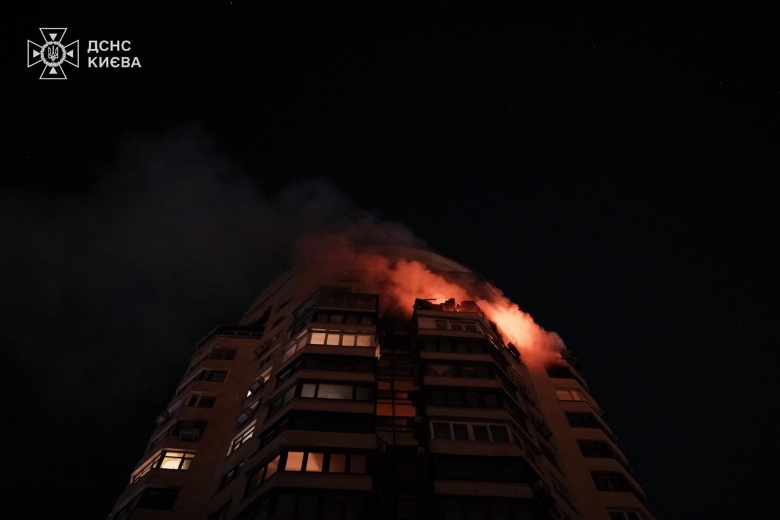
A fire burns at a high-rise apartment building in Kyiv amid a large-scale overnight Russian missile and drone attack on the capital. Moscow resumes its strikes on Kyiv following a short energy ceasefire — with temperatures in the capital expected to reach. (Ukraine’s State Emergency Service/Telegram).
Bombers Reposition: The Storm Analysts Were Waiting For
The change showed up first on radar screens.
Overnight, Tu-95MS strategic bombers lifted from Russia’s Far East and reappeared at forward airbases—Engels, Olenya, Dyagilevo. The movement recalibrated Ukrainian air-defense planning immediately. These aircraft were not part of drone swarms that could be jammed, confused, or forced down by cold. They were launch platforms for long-range cruise missiles, guided by satellite navigation and capable of striking any point in Ukraine from hundreds of kilometers away.
Analyst Nazarii Barchuk translated the shift without ceremony. With the bombers redeployed, the likelihood of missile attacks in the coming week had increased. This was not training. This was staging.
Winter complicated the picture, but only at the margins. Extreme cold degraded Shahed-type drones—icing, frozen electronics, forced lower flight paths. When temperatures plunged far enough, Ukrainian air defenses found those drones slightly easier to kill.
Cruise missiles did not share that weakness.
The Tu-95MS did not care about icing at low altitude or frozen circuitry. Their weapons flew high, fast, and with precision. The redeployment signaled a shift away from mass drone harassment toward missile strikes designed to overwhelm defenses outright.
That mattered because only one system could reliably stop ballistic and cruise missiles: Patriot. And Patriot interceptors were in critically short supply.
The bombers had moved. The math had changed.
The Ammunition Runs Out: How Empty Launchers Feel
The detail slipped out in an interview—and once said, could not be taken back.
Yurii Ihnat described air-defense launchers that were no longer full. NASAMS systems, designed to carry six missiles, sometimes held only two. One-third capacity. Enough to fight briefly. Not enough to absorb what Russia was throwing at them.
The tactic was deliberate. Russian forces concentrated attacks on a single region, launching drones and missiles simultaneously to overwhelm local defenses. Reloading took time. Under saturation, time ran out first. “Sometimes our anti-aircraft missile systems, such as NASAMS or IRIS-T, simply do not have time to reload during such massive attacks,” Ihnat said.
Only one system could reliably intercept ballistic missiles. Patriot. Russia was using ballistic missiles more often.
The logic narrowed fast.
Ukraine’s successful defense against a major strike the previous day had depended on missiles arriving just in time—deliveries landing a day before launchers would have gone empty. No buffer. No reserve. “There were moments when there was a serious shortage,” Ihnat confirmed. Even stopping most of an attack was not enough. “Even if 80 percent is shot down, the remaining 20 percent causes great damage.”
The intent, Ihnat said, was unmistakable. Make life unlivable. Especially in winter.
AFP’s January tally showed the scale. Russia launched 4,587 drones and missiles—4,452 drones, 135 missiles. Ukraine intercepted 83 percent. Seven hundred ninety-nine got through. That was enough to produce the worst energy outages of the war.
The defenses were still holding. But the ammunition feeding them was thinning.
171 Drones and One Iskander: The Night Overnight
The night unfolded the way Ukrainians had learned to expect it.
First came the ballistic launch. One Iskander-M fired from occupied Crimea. Then the drones—171 of them—rising from four directions almost at once. Shahed-type, Gerbera-type, others mixed into the swarm. Launch points traced a wide arc: Oryol and Kursk. Millerovo in Rostov Oblast. Primorsko-Akhtarsk in Krasnodar Krai. Occupied Donetsk City itself.
Ukrainian air defenses went to work. By morning, 157 strike drones had been destroyed. It was a strong interception rate. It was not enough.
The Iskander missile and twelve drones broke through and struck eight locations across seven oblasts—Chernihiv, Cherkasy, Dnipropetrovsk, Kharkiv, Kyiv, Sumy, and Zaporizhia. Residential buildings. Civilian sites. Industrial facilities. The pattern was wide, deliberate, and familiar.
One strike carried a different kind of logic. Russian forces hit a diesel train at a station in Zaporizhia Oblast. Not spectacular. Not headline-grabbing. Precisely chosen. Rail lines were Ukraine’s rear arteries, carrying fuel, equipment, and ammunition from the west toward the front. Hitting trains was battlefield air interdiction—quietly choking supply routes before ground forces tried to exploit the gaps.
Zelensky later noted that Russia had not focused specifically on energy infrastructure during this attack. The shift was tactical, not philosophical. Previous strikes had already done their work. Power systems remained damaged. Heating stayed unreliable. Cities were still rationing electricity by the hour.
The targeting changed. The pressure did not.
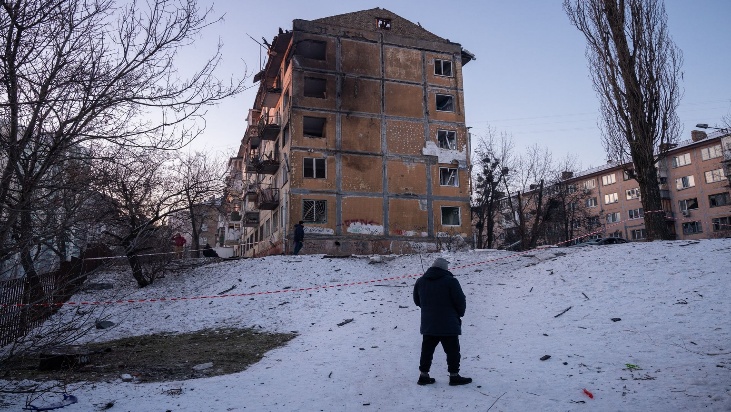
The aftermath of an overnight Russian drone and missile attack is seen in Kyiv, Ukraine. (Danylo Antoniuk / Anadolu via Getty Images)
The “White List” Goes Up: Ukraine Closes the Door on Starlink Drones
The decision had the feel of something already tested, already prepared, already overdue.
Defense Minister Mykhailo Fedorov announced that Ukraine was switching Starlink to a whitelist system. From that day on, only verified terminals would work. Everything else would go dark. Civilians would register through TsNAP service centers. Businesses would verify online through the Diia portal. Military units would register through DELTA, the battlefield management system. No fees. Minimal friction. Fedorov called it the only technical answer available.
The urgency was not theoretical. Russian forces had begun flying strike drones fitted with Starlink terminals. Low altitude. Resistant to electronic warfare. Controlled in real time from far behind the lines. The same satellite network keeping Ukrainian units connected was now guiding weapons back toward Ukrainian cities.
The political tension surfaced publicly. Polish Foreign Minister Radosław Sikorski posted evidence of Russian Starlink drones and asked Elon Musk why his system was being used to target Ukrainian civilians. Musk replied by calling him a “drooling imbecile.” The exchange stripped away the ambiguity. Starlink was a lifeline. It was also a vulnerability. Poland was paying roughly fifty million dollars a year to keep Ukraine connected.
Behind the scenes, the technical work had already begun. Fedorov’s adviser, Serhiy Beskrestnov, confirmed that SpaceX was implementing initial countermeasures at Ukraine’s request. In 2024, the company had insisted it did not supply Starlink to Russia. Battlefield reality had outpaced the statement. Russian operators were now flying Molniya-2 attack drones with Starlink terminals, capable of striking across Ukraine and reaching into neighboring countries when launched from occupied territory.
Musk brushed off Poland’s concerns, saying there was no substitute for Starlink. U.S. Secretary of State Marco Rubio added the blunt counterpoint: without it, Ukraine would have lost the war long ago.
The whitelist did not resolve the contradiction. It managed it. Politics could argue. Technology had to act.
Moscow Demands the Impossible: “Come to Us” on Our Terms
The message was delivered with practiced certainty.
If Volodymyr Zelensky and Vladimir Putin were to meet, the Kremlin said, it would happen in Moscow. Nowhere else. Kremlin spokesman Dmitry Peskov left no room for alternatives.
The demand was not logistical. It was symbolic. Zelensky had already rejected Moscow as a venue and countered with a public invitation to Kyiv. Putin’s aide, Yuri Ushakov, had floated the idea of “security guarantees” for a Moscow visit—an offer that, in context, carried little weight. Russia was not proposing talks. It was proposing a tableau.
Foreign Minister Andrii Sybiha told European Pravda that Zelensky was prepared for a direct meeting because unresolved issues required it: control of the Zaporizhzhia Nuclear Power Plant, territorial questions, matters no intermediary could settle. Ukraine, Sybiha said, was not avoiding dialogue. Russia was.
The venue demand served several purposes at once. It recast Zelensky as the obstacle if he refused. It placed the Ukrainian president on Russian soil, a psychological and symbolic reversal. It shifted the discussion away from substance and into theater.
And it reinforced a familiar narrative—that Ukraine was blocking peace—even as Russian missiles struck Ukrainian cities and drones burned Ukrainian infrastructure. The invitation was framed as diplomacy.
The terms made it something else.
Witkoff Heads to Abu Dhabi: The Talks That Everything Hinges On
The schedule was tight, intentional, and unforgiving.
Steve Witkoff, President Trump’s special envoy, was en route to Abu Dhabi for talks set for February 4–5. Before that, Israel. After that, Istanbul on February 6, where discussions would turn to Iran’s nuclear program. Each stop served a different pressure point. Together, they formed a single diplomatic arc.
Abu Dhabi sat at the center of it.
The talks were expected to circle two issues neither side liked to discuss plainly: a possible energy ceasefire and the future of Donbas. Moscow had long demanded that Ukraine cede all of Donetsk and Luhansk oblasts—including territory Russia had failed to take. The demand was maximalist. Kyiv had rejected it outright.
Zelensky spent the day meeting with his negotiating team—Kyrylo Budanov and Rustem Umerov. The preparation was visible. The stakes were not abstract. Control of territory. Control of infrastructure. Control of the terms under which the war might pause, or continue.
“We believe it is realistic to achieve a dignified and lasting peace,” Zelensky said, noting that work on security guarantees was complete and that the American side was expected to play a decisive role. Ukrainian delegations, he added, would also hold bilateral meetings with U.S. officials focused on recovery and economic cooperation—the scaffolding of a postwar future that still depended on the war’s outcome.
Zelensky said recent de-escalation steps were helping build public trust in the process.
The same day, the energy truce officially collapsed.
Diplomacy advanced on the calendar. Missiles returned to the grid. Trust rose and fell at the same time.
Trump Plays India Against Russia: The Oil Card
The announcement landed like a breakthrough. The details told a quieter story.
After a phone call with Indian Prime Minister Narendra Modi, Donald Trump posted that he was cutting U.S. tariffs on India from 25 percent to 18 percent—and claimed Modi had agreed to stop buying Russian oil. “This will help END THE WAR in Ukraine,” Trump wrote.
Modi confirmed the tariff reduction. He did not confirm any halt in Russian oil purchases. His public statement praised Trump’s leadership for “global peace, stability, and prosperity,” the kind of diplomatic phrasing that acknowledged the call without endorsing its boldest claim.
Trump went further, saying Modi had committed to buying more than $500 billion in U.S. energy, technology, and agricultural products. The context mattered. The year before, the Trump administration had imposed an extra 25 percent penalty on India specifically over its purchases of Russian oil. New Delhi had responded by staying officially neutral—maintaining ties with the West while deepening its energy trade with Moscow.
India, alongside China, had become one of Russia’s largest buyers of crude since sanctions pushed Moscow toward alternative markets. That revenue flowed directly into the war effort. If India truly stopped buying, the financial impact on Russia would be significant. If it did not, the episode would join a long list of announcements where headlines moved faster than shipping data.
Trump said Modi had made a similar promise in October. Whether that pledge changed India’s purchasing behavior was something only tanker movements and customs records could answer.
As always, the oil would tell the truth later.
The Germans Close the Door: Five Arrested in a Sanctions Evasion Network
The scale only became clear after the arrests.
German authorities detained five people and exposed a procurement network that had quietly kept Russia’s war industry supplied despite Western sanctions. Operating out of the Baltic port city of Luebeck, the group had organized roughly 16,000 shipments to Russia over several years. The value: at least thirty million euros. The recipients included no fewer than twenty-four sanctioned Russian arms companies. Prosecutors stated the conclusion plainly—the operation was “presumably operated by Russian state agencies.”
At the center was the managing director, identified as German-Russian dual citizen Nikita S., who had run the scheme since at least the start of Russia’s full-scale invasion. The mechanics were methodical. Shell companies in Luebeck. Fictitious customers inside and outside the European Union. A Russian recipient firm in which Nikita S. himself held a senior role. Sanctioned goods moved east. Paperwork made it look like ordinary trade.
The network was not small. Alongside Nikita S., authorities named German-Ukrainian citizen Artem I., German nationals Boris M. and Eugen R., and German-Russian dual citizen Daniel A. Five additional suspects remained at large. Raids struck Frankfurt, Nuremberg, and other cities. German customs worked in tandem with the BND, the country’s foreign intelligence service.
Four of the suspects were scheduled to appear before an investigating judge at the Federal Court of Justice, where decisions on pretrial detention would be made.
Sixteen thousand shipments. Thirty million euros. Arms companies fed materials that sanctions were meant to stop cold. The operation had run for years.
How many others like it still existed was the one question prosecutors did not answer—because they could not yet.
Kazakhstan Sends a Man Home to Treason: The Price of a Money Transfer
Oleksandr Kachkurkin was twenty-five. An IT specialist living in Almaty. He sent money to Ukraine—an act that, under Moscow’s law, qualifies as treason.
Kazakh police detained him on charges that existed only on paper. Jaywalking. Smoking a hookah indoors. Human rights defenders confirmed both violations were fabricated. Within hours, police petitioned a court to deport him for “disrespect for the laws and sovereignty” of Kazakhstan. A process that usually took weeks was completed the same day.
Kachkurkin was put on a plane to Russia. He was detained upon landing. A Moscow court said what the transfer meant: high treason. The potential sentence ranged from twelve to twenty years, up to life imprisonment.
The case was not an exception. The human rights project Perviy Otdel estimated that about ten percent of all treason, espionage, or “confidential cooperation with a foreign state” cases opened in 2025 stemmed from financial transfers to Ukraine. In Russia’s legal system, sending money to a country under attack had become a crime worthy of a life sentence.
The precedent was already written. In 2024, U.S.–Russian ballerina Ksenia Karelina was sentenced to twelve years for donating roughly fifty dollars to a Ukrainian charity. She was freed only through a prisoner exchange. Kachkurkin’s transfer was larger. The punishment would likely be harsher.
Human rights advocates sent inquiries to Kazakhstan’s Interior Ministry and Almaty’s Bostandyk District police. No answers came.
Kazakhstan had done what was required—quickly, efficiently, without pausing to ask what kind of justice deports a man for jaywalking and condemns him for treason somewhere else.
DTEK Strikes Again: The Mine After the Bus
The strike came a day after the mourning began.
Twelve miners had been killed on a service bus. Within hours of the region declaring a day of remembrance, Russian forces hit another DTEK facility—this time a coal mine in Dnipropetrovsk Oblast. Administrative buildings were damaged. No one was killed. In the context of the week, that counted as restraint.
The timing was not accidental. The mine attack followed the bus strike with the kind of persistence that miners’ leaders had been warning about for months. Mykhailo Volynets, chair of the Independent Trade Union of Miners of Ukraine, described a pattern that left little room for interpretation. Mines. Substations. Energy facilities. Mining territories themselves. The targets repeated. The intent did not change.
“There is not a day that goes by,” Volynets said, “without miners having to be lifted to the surface from de-energized mines in emergency conditions.”
This was not about a single bus or a single facility. It was pressure applied steadily, designed to exhaust systems and people at the same time. Workers descended into shafts knowing power could be cut at any moment. Crews returned to sites already hit, knowing they could be hit again before repairs were finished.
The numbers told the long story. At the start of 2014, Ukraine had 145 coal mines. Fourteen remained operational. The reduction was not an accident of time or economics. It was the cumulative effect of a campaign that treated energy production as a battlefield and civilian labor as expendable.
The mourning ended. The strikes continued.
Hungary Fights the EU in Court: The Energy Ban Nobody Wanted to Enforce
Hungary chose the courtroom.
On February 2, Budapest filed suit at the European Court of Justice, seeking to overturn the European Union’s planned ban on Russian energy imports. Foreign Minister Peter Szijjarto framed the move as a defense of sovereignty. Each member state, he argued, had the right to choose its own energy sources. Without Russian oil and gas, Hungary’s energy security—and low household prices—could not be guaranteed.
The legal mechanics mattered. The EU’s plan would end Russian gas purchases by 2027, with oil phased out on the same timeline under the REPowerEU strategy. But the measure had been introduced as a trade policy decision, not a sanctions regime. That distinction allowed it to pass by qualified majority, sidestepping the veto power of Hungary and Slovakia.
Both countries objected. Both were landlocked. Both relied heavily on Russian fossil fuels. Their challenge rested on a narrow claim: true sanctions required unanimity under EU treaties, and this, technically, was not a sanction.
The data exposed the contradiction underneath the law. Between 2021 and 2025, the EU cut Russian gas imports by roughly 75 percent and phased out most Russian oil. Yet Europe remained Moscow’s largest customer for pipeline gas and liquefied natural gas. Reuters reported that exports through TurkStream—the last pipeline still carrying Russian gas into Europe—rose 10.3 percent year on year in January.
Europe was disentangling itself from Russian energy. And at the same time, still buying it.
Hungary’s lawsuit did not create that tension. It simply forced the EU to acknowledge it.
Ukraine Designates the IRGC: The Shaheds Have Names
Zelensky used his evening address to draw a straight line.
Ukraine formally designated Iran’s Islamic Revolutionary Guard Corps as a terrorist organization. The decision aligned Kyiv with the European Union, which had taken the same step days earlier, and with the United States, where the designation had been in place for years. On January 30, the Security Service of Ukraine added the IRGC to the country’s official list.
The relevance was not abstract. The IRGC was the pipeline. Shahed strike drones—the ones that arrived nightly over Ukrainian cities, that hit maternity hospitals, service buses, and apartment blocks, that sometimes came in swarms of more than a hundred—were Iranian-built and supplied through structures tied to the Guard. “Ukraine has not forgotten any of the thousands of Shaheds that attack our cities and villages, our people,” Zelensky said.
This was not a symbolic label. It was a legal instrument. Terrorist designation unlocked sanctions regimes, asset freezes, and diplomatic pressure aimed directly at Tehran’s military-industrial cooperation with Moscow. The drones now had a name, and so did the organization behind them.
The timing mattered. Iran’s leadership was in the middle of a sweeping crackdown on anti-regime protests, repression believed to have killed thousands. The world watched Iranian violence at home while Iranian weapons fueled violence abroad.
Ukraine folded both realities into one decision. The Shaheds were not anonymous machines.
They came from somewhere.
FIFA’s Moral Blindness: 679 Children Who Will Never Play
The argument was framed as reconciliation.
FIFA president Gianni Infantino suggested that Russia’s ban from international football—especially youth competitions—should be lifted. The restriction, he said, had achieved nothing but “frustration and hatred.” Letting Russian boys and girls play in Europe could help.
Ukraine’s response took one sentence.
“Six hundred seventy-nine Ukrainian girls and boys will never be able to play football—Russia killed them,” Foreign Minister Andrii Sybiha wrote. Russia, he added, was still killing children while “moral degenerates” discussed lifting bans. Future generations would remember this moment the way history remembers the 1936 Olympics.
The exchange exposed a familiar fault line. Institutions far from the war zone spoke in abstractions—harmony, dialogue, healing—while those living the war spoke in names and numbers. FIFA suspended Russia in 2022. In 2023, it briefly allowed Russian under-17 teams back before reversing course under pressure. In December 2024, outrage followed a World Cup draw graphic that erased Crimea from Ukraine. An investigation later revealed FIFA pressing European clubs to pay transfer fees to Russia despite sanctions.
Neutrality, in practice, had not been neutral.
Many Russian athletes competing under “neutral” status had ties to the Kremlin or had publicly supported the invasion. At the same time, hundreds of Ukrainian athletes and coaches had been killed. Hundreds of sports facilities had been destroyed by missiles and drones.
Zelensky responded by sanctioning individuals and organizations linked to Russian sports ahead of the Milan Winter Olympics, forcing the question into the open: whether global sport would continue treating aggression as a public-relations problem.
The numbers answered it more clearly than any statement.
Lyman First, Slovyansk Later: Russia’s Timeline Is Slipping
On paper, the plan looked linear.
Ukrainian military observer Kostyantyn Mashovets reported that Russia’s Western Grouping of Forces intended to push from the Lyman direction toward the Slovyansk–Kramatorsk agglomeration, with Moscow hoping to begin the decisive phase in May or June 2026. The concept was straightforward. Take Lyman. Then move on Slovyansk.
The terrain made it anything but.
From Lyman, Russian forces would need to advance roughly fourteen kilometers to Slovyansk, crossing the Siverskyi Donets River under fire. The alternative—pushing thirty kilometers west from Siversk—was longer and equally exposed. Both options demanded maneuver capability, engineering capacity, and sustained momentum. Those were precisely the things Russian units in the area were struggling to generate.
The 20th Combined Arms Army had been fighting in the Lyman direction since at least September 2022. The 25th since October 2023. By Mashovets’ assessment, both formations were degraded. Meeting a spring 2026 timeline would require significant reinforcements. They were not coming. Available reserves were being burned in the Kupyansk direction, where Ukrainian counterattacks had already liberated most of the city and surrounding areas.
Russian forces reached Lyman in November 2025 after intensified operations. Since then, progress stalled. Months passed without tactically meaningful advances inside or around the settlement. Ukrainian defenses held. The slow crawl suggested a deeper problem: Russia had failed to fully suppress Ukrainian positions, undermining the offensive model that had delivered gains elsewhere, particularly near Pokrovsk and Hulyaipole.
For months, the Kremlin had sold a narrative to Western audiences—that breaking through Ukraine’s Fortress Belt, centered on Slovyansk and Kramatorsk, would be fast and inevitable.
Near Lyman, the ground told a different story.
What was supposed to take a season was beginning to look like a year. Or more.
Frozen Ground, Moving Lines: Where the War Pressed and Where It Broke
February 2 did not feel like a day of sweeping breakthroughs. It felt like pressure—applied unevenly, relentlessly, in the cold.
In Sumy Oblast, Russian assaults continued without confirmed gains. Villages with familiar names—Andriivka, Yablunivka, Yunakivka—absorbed attacks that went nowhere. A Russian milblogger admitted the cost: more than two hundred soldiers from the 22nd Motorized Rifle Regiment killed in weeks of failed attempts near Ryzhivka. Wounded left behind, according to complaints. Drones kept hunting above the snow.
Near Vovchansk in Kharkiv Oblast, a few meters changed hands. A marginal advance. A commander removed after ninety-eight days as units lost cohesion under his watch. Small moves, heavy consequences.
Kupyansk felt closer. Russian forces edged northeast of Pishchane and probed into the city itself, slipping inward before Ukrainian fire cut them down. The line held.
South toward Slovyansk, the war thinned to pairs and trios. Russian soldiers crossed fields and waterways on foot, on motorcycles, even inflatable boats, trying to reach the M-03 highway. They failed. Ukrainian logistics kept flowing.
Further south, near Pokrovsk and Myrnohrad, movement quickened. Russian troops advanced at the edges, clustering in the cold, trying to sever roads inside the town. Ukrainian defenders reported infantry attacking across open fields at minus twenty—men exposed, under-equipped, freezing as they advanced.
Elsewhere, flags appeared briefly in places like Prydorozhnie, photographs marking infiltrations that did not change control. Claims stacked up—Zelene seized, Nykyforivka taken—then unraveled under closer scrutiny.
In Zaporizhia, the ground stayed contested. In Kherson, the lines stayed still while drones did the killing.
Across the front, nothing collapsed. Nothing settled. The cold hardened the earth, and the war pressed on it—slowly, expensively, without relief.
Hitting the Nerve Centers: Ukraine Reaches Past the Front
The night did not belong only to defense.
Ukrainian strikes reached beyond the frozen front lines into the machinery that made Russian attacks possible. Near occupied Kurakhivka, about thirty-five kilometers from the line of contact, a Russian regimental command post was hit. A divisional headquarters followed. An ammunition depot in the same area burned. These were not symbolic targets. They were where attacks were timed, reserves moved, and assaults synchronized. When command posts went dark, momentum broke with them.
Further east, the focus narrowed. Near Uspenivka and around Hulyaipole, Ukrainian strikes destroyed drone control points—the quiet locations where Russian operators guided swarms through the night. These were the same systems increasingly paired with satellite links, built to resist jamming and extend reach. Shooting down drones was one battle. Eliminating the operators was another.
The logic was deliberate. Close satellite access at home. Destroy control nodes at the front. Break the system from both ends.
The strikes carried a message as clear as the explosions themselves. Ukraine still had depth. Still had choice. Still had reach.
While holding hundreds of kilometers of frontline, Ukrainian forces were reminding Moscow that this war did not move in only one direction—and that the nerve centers behind the front were not safe.
Belgorod Burns: Stary Oskol Under Attack
Explosions were reported overnight in Russia’s Belgorod Oblast — at least six loud blasts in the northern and northeastern areas of the city of Stary Oskol, with bright flashes visible in the sky.
Belgorod Governor Vyacheslav Gladkov claimed Ukrainian drones had attacked the city, igniting a fire at a residential area. He reported that an exploding drone had shattered windows in more than three apartment buildings. Two people had reportedly died in the attack.
Fire Across the Border: Stary Oskol Feels the War It Helped Launch
The night broke with sound first.
At least six explosions tore through the northern and northeastern districts of Stary Oskol in Russia’s Belgorod Oblast. Residents reported bright flashes cutting across the sky, followed by the deep thud of impacts that rattled windows and set off car alarms. Governor Vyacheslav Gladkov said drones struck the city, igniting a fire in a residential area. Shattered glass littered apartments. Two people were reported killed.
Ukraine made no statement.
Belgorod Oblast sits just across the border from Sumy, Kharkiv, and Luhansk—close enough that the war has always been audible. For months, it had functioned as a rear staging ground: launch sites, logistics hubs, and assembly areas feeding Russian attacks deeper into Ukraine. Missiles and drones crossed from there daily. This time, the direction reversed.
The strike fit a pattern Ukraine had been shaping carefully. Not random terror. Not spectacle. Pressure applied to the infrastructure that made the war possible—on the far side of the line Russia crossed every day to strike Ukrainian towns and cities.
In Stary Oskol, the war arrived without warning, without context, without the filters of television screens. For one night, at least, the distance collapsed.
The border did not protect the city. It only delayed the sound.
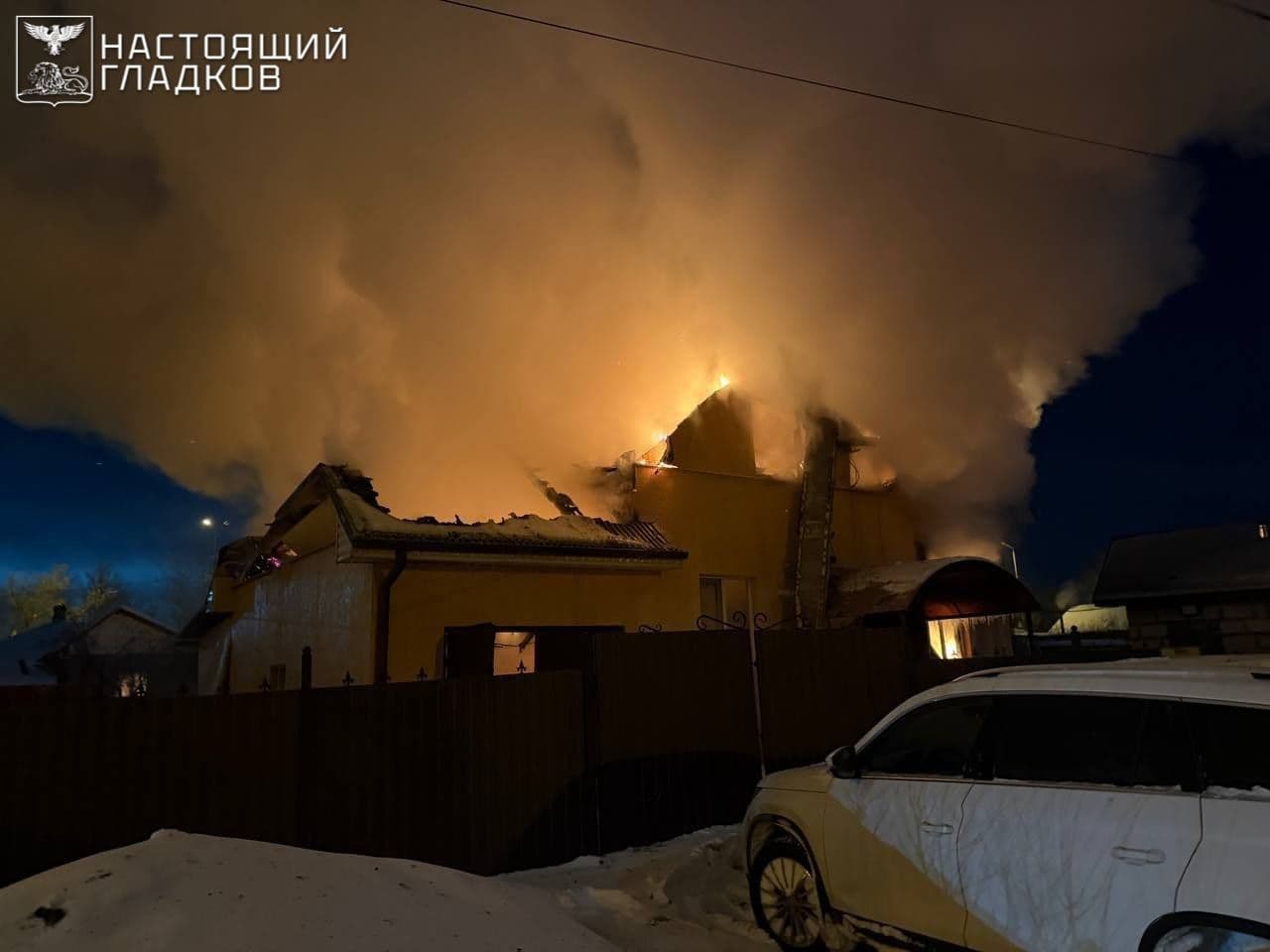
Fire and smoke rise from a home following an alleged overnight drone attack, in Stary Oskol, a city in Russia’s Belgorod Oblast. (Vyacheslav Gladkov / Telegram)
Silent Crossings: The Fourth Night the Sky Was Tested
The radar screens lit up again just after midnight.
Polish systems tracked “balloon-like objects” drifting into national airspace from Belarus—small, slow, almost absurd in isolation. It was the fourth incursion in five nights. Too frequent to ignore. Too deliberate to dismiss as coincidence.
Over the weekend, similar crossings had already forced Poland to temporarily close airspace along parts of its northern border. This time the incursion was smaller, Polish military officials noted, as if someone were adjusting the pressure rather than releasing it all at once. The objects were intercepted. Several individuals suspected of involvement were detained. Their names were not released.
The pattern stretched beyond Poland. Lithuania had endured even more frequent balloon crossings, enough to trigger a state of emergency in December. Officially, the objects were described as weather balloons used by smugglers to ferry cigarettes. Unofficially, Lithuanian officials pointed higher—to Alexander Lukashenko—accusing his regime of allowing, even encouraging, the practice as a form of hybrid pressure.
Belarus had played this game before. Migrants pushed toward borders. Intelligence probes. Manufactured crises designed to stay just below the threshold of open conflict.
Each balloon tested something. Detection. Response time. Political nerves. Together, they formed what NATO analysts called Phase Zero—the quiet conditioning that precedes something louder.
Nothing exploded. Nothing burned.
But the sky kept crossing the line.
Another Gate Slams Shut: Hyundai’s Quiet Exit From Russia
The deadline passed without ceremony.
Hyundai Motor let its option to reclaim its Russian factory expire in January, closing the door on a return that once seemed inevitable. Operations had been suspended in early 2022, days after the invasion began. Nearly three years later, the war was still there. The option was not.
In 2024, Hyundai sold its St. Petersburg plant to Russia’s AGR Automotive Group for 140,000 won—about ninety-seven dollars. The price was symbolic, almost dismissive, for a factory that had once anchored one of Russia’s largest foreign auto operations. Today, the cars rolling off its lines carry a different badge. Solaris. A rebranded echo of a Hyundai model once built for Russian roads. The engineering changed. The ownership changed. The brand was erased.
Hyundai told Reuters it would continue honoring warranties and customer service for vehicles already sold. A final gesture of continuity in a market that no longer offered any.
The loss was not isolated. Mazda had become the first foreign automaker to permanently forfeit Russian assets in November 2025. Hyundai was now the second. Renault, Mercedes-Benz, Volkswagen, Toyota—each had already walked away. Chinese manufacturers moved in to fill the space, reshaping the market as Western logos disappeared from showrooms.
What was happening was no longer a pause. It was a reset. Buyback clauses that once symbolized patience and hope expired quietly, one after another. With each deadline missed, Russia’s economic separation hardened into something lasting.
Hyundai did not make an announcement.
It simply did not come back.
The Day’s Meaning
The contradictions lined up in plain sight.
Tu-95MS bombers shifted into launch positions just as Artem Nekrasov confirmed the energy truce was finished. Dmitry Peskov demanded Zelensky travel to Moscow while Steve Witkoff packed for talks in Abu Dhabi. Mykhailo Fedorov announced a Starlink whitelist to stop Russian drones as Elon Musk publicly insulted Poland’s foreign minister. Diplomacy spoke softly. Hardware moved loudly.
The truce lasted only as long as it suited Moscow. When the calendar turned, the strikes returned. Within hours, energy infrastructure was under pressure again. Within a day, strategic bombers were forward-deployed. Kyiv’s heating crisis dragged on across hundreds of buildings. A cascading grid failure from the previous day shut down metro systems in both Kyiv and Kharkiv—cities separated by hundreds of kilometers. Nuclear plants ran below capacity. What diplomats promised and what Ukrainians experienced were no longer just misaligned. They were opposites.
Beyond Ukraine, the war bent systems far from the battlefield. Germany uncovered a network funneling sanctioned goods to Russian arms firms. Kazakhstan deported a young IT worker for sending money to Ukraine and delivered him to Moscow on treason charges. Hungary challenged the EU’s Russian energy ban in court. India may or may not have agreed to stop buying Russian oil. Each episode showed how the war threaded itself through courts, supply chains, and domestic politics thousands of kilometers from Donbas.
At the front, pressure mounted unevenly. Russian forces advanced in some sectors and stalled in others. Ukrainian strikes reached deep behind the lines. The Lyman timeline slipped. Myrnohrad was probed. The Fortress Belt held.
Cold hurt both sides. It hurt civilians most.
The talks were still days away. The bombers were already in position. Interceptors were thinning. And in Kyiv, 244 apartment buildings remained without heat as the temperature kept falling.
Prayer For Ukraine
• Pray for civilians enduring winter without heat or reliable power, especially families in Kyiv and other cities where apartments remain cold and daily life has become an act of endurance. Ask for protection, strength, and the preservation of life as temperatures continue to fall.
• Pray for Ukrainian defenders standing along the front lines and operating air defenses with thinning ammunition. Ask for wisdom, resilience, and timely provision as they face relentless pressure and make impossible decisions under fire.
• Pray for energy workers, emergency crews, and municipal responders repairing grids, heating systems, and infrastructure while under threat of renewed strikes. Ask for safety, stamina, and moments of mercy amid constant danger.
• Pray for justice and restraint beyond Ukraine’s borders—for those arrested, deported, or punished simply for acts of compassion or truth. Ask that governments and institutions choose moral clarity over convenience and fear.
• Pray for wisdom in upcoming diplomatic talks, that truth would not be buried under theater, and that decisions made far from the battlefield would prioritize human life over leverage, optics, or delay.