
In Lviv, a Shahed drone set a UNESCO World Heritage monastery ablaze in broad daylight — the first time the war reached the ancient city center. In Florida, American negotiators handed Ukraine an ultimatum: abandon Donbas or lose your mediator. In Crimea, Ukrainian intelligence operators hunted a hypersonic missile launcher in the dark and destroyed it before it could fire. Day 1,124 — when Russia launched the largest aerial assault of the war the same week Washington told Ukraine it might walk away.
The Day’s Reckoning
At 2:45 a.m., the air raid sirens started. They didn’t stop for fifteen hours.
Somewhere over occupied Crimea, a column of Russian Bastion-M launchers crept through darkness toward firing positions — carrying Zircon hypersonic missiles, headed for Ukrainian cities. Ukrainian intelligence was already watching. They struck the column before it reached its target. One launcher destroyed. Two Zircon missiles eliminated before they could fly.
It didn’t matter. Russia had hundreds more.
From Sunday at 6 p.m. through Monday evening, nearly 1,000 drones and missiles crossed into Ukraine — the largest aerial assault of the entire war. Eleven oblasts under attack simultaneously. Poland scrambled fighter jets to protect its own airspace. By mid-afternoon, Kyiv was effectively encircled, drones approaching from the south, east, and north at once.
The human ledger filled steadily. Four dead in the overnight wave alone. A monastery burning in Lviv’s UNESCO World Heritage center — a city that hadn’t considered itself a target. Two killed in Poltava. Two in Ivano-Frankivsk, near a maternity hospital. One in Vinnytsia. One in Kherson. A 12-year-old girl hospitalized in Zhytomyr. An 18-month-old hurt in Dnipro. A 61-year-old man killed on a commuter train eight miles from the Russian border because he refused to evacuate.
This was not improvised. Russia had been stockpiling drones for weeks — deliberately, patiently — waiting for the right moment. That moment came exactly two days after Ukrainian and American negotiators finished talks in Florida. Talks where Washington quietly told Kyiv to abandon Donbas. Or else.
Russia’s answer to diplomacy was 982 drones and missiles.
Day 1,124 — when the largest attack of the war arrived on the heels of an ultimatum nobody wanted to say out loud.
982 and Counting: Russia Breaks Its Own Record and Keeps Going
At 2:45 a.m., the alert hit Ukraine’s Air Force: ballistic missiles inbound. Minutes later, Poltava shook. Then Zaporizhzhia. The night sky lit up over two cities before most people had woken.
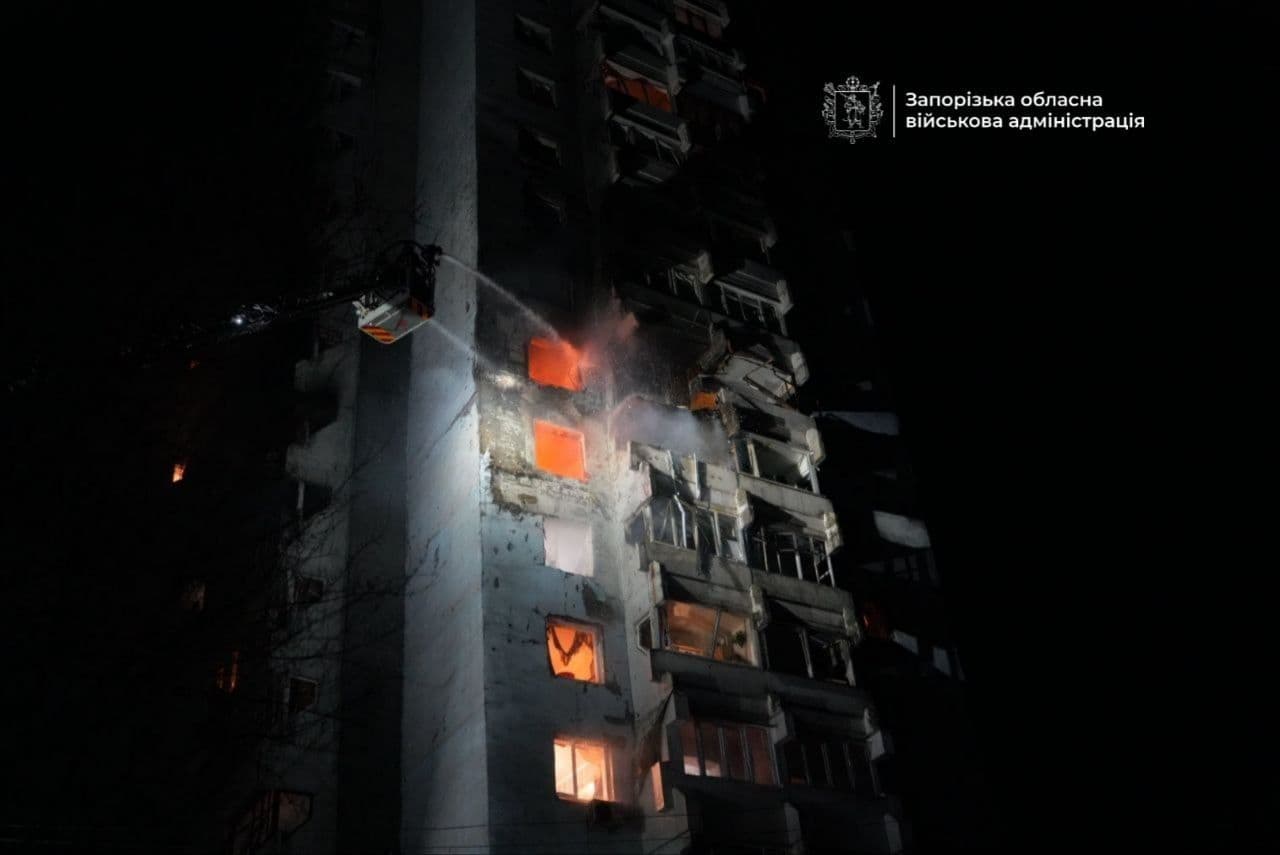
A fire burns at an apartment building in the aftermath of a Russian attack on the city of Zaporizhzhia. (Zaporizhzhia Oblast Military Administration/Telegram)
By 9 a.m., the overnight count was in: 392 Shahed, Gerbera, Italmas, and other strike drones. Thirty-four missiles — seven Iskander-M ballistics, 18 Kh-101 cruise missiles, five Iskander-K cruise missiles. Ukrainian air defenses clawed back 256 drones and 25 missiles. But the seven ballistic missiles aimed at Zaporizhzhia and Poltava? Gone. Through. No system existed to stop them.
Then Russia didn’t stop.
At 9 a.m., wave two began. Another 556 drones — no missiles this time, just swarms, launched in daylight, pushing further into Ukraine than the overnight strikes, many coming from the north. Ukrainian forces shot down 541. Poland scrambled fighter jets to guard its own airspace. Air raid alerts screamed in nearly every region of Ukraine simultaneously.
By mid-afternoon, Kyiv was encircled. Drones closing from the south. From the east. From the north. The same threat materialized simultaneously over Sumy, Chernihiv, Cherkasy, Vinnytsia, Kirovohrad, Kherson, Mykolaiv. There was no safe corner of the country.
Defense Ministry adviser Serhiy “Flash” Beskrestnov watched from his screen and wrote on Facebook mid-attack: “They are spreading attacks over time to find weak spots.” The logic was cold and clear — run Ukrainian air defenses for 24 straight hours, find the seams, push through them.
Russia had been planning strikes exceeding 1,000 vehicles since last fall. At 982, this was the closest they’d come.
They weren’t done trying.
“People Were Running as if It Was a Terrorist Attack”: The Day Ukraine Bled from Border to Border
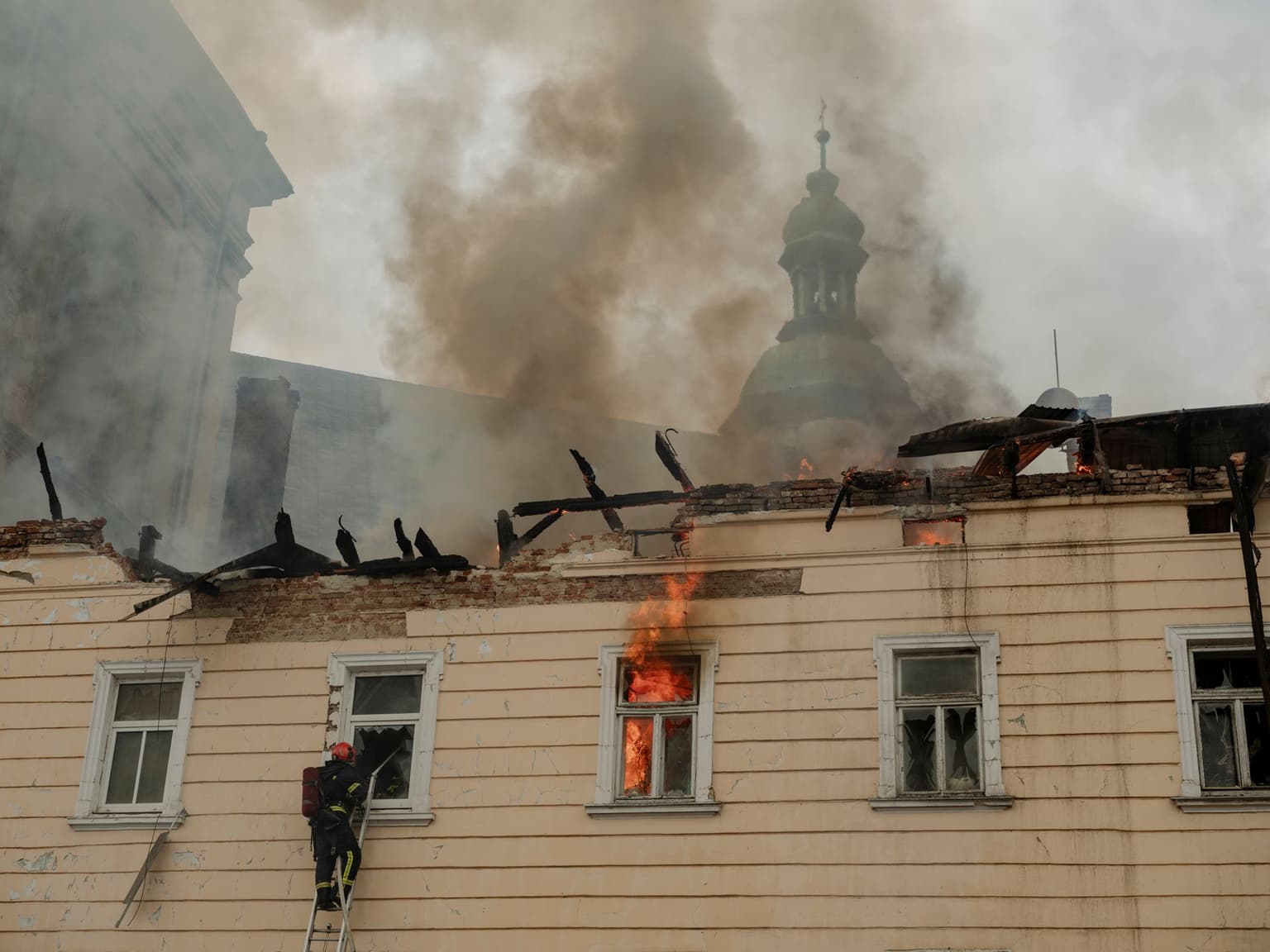
The aftermath of a Russian attack on Lviv. In a rare daytime assault, Russia launched more than 550 kamikaze drones across central and western Ukraine. (Sasha Maslov)
Yarema Semaniv was finishing his tea at a Lviv café when the explosions started. He was 500 meters from the nearest strike site. Around him, people bolted from the Danylo Halytsky monument in full panic.
“It was the first time I experienced something like that downtown,” he said later. “This is definitely something new.”
Lviv sits less than 100 kilometers from the EU border. Nearly a million displaced Ukrainians had fled there from the east, drawn by the assumption of safety. Ballistic missiles rarely reach it. So, residents had allowed themselves to believe the war lived elsewhere.
The Shaheds found them anyway — cheaper and slower than missiles, but nearly impossible to stop in swarms. Fires erupted in two districts. Thirty-two people were injured. One drone found the Bernardine Monastery on Soborna Square — a 16th-century complex at the heart of Lviv’s UNESCO World Heritage site. The flames spread through its buildings. Damage assessors were still working at nightfall. Ukraine’s Ministry of Culture began drafting a formal appeal to UNESCO. Since 2022: 1,707 cultural heritage sites damaged or destroyed. 513 gone completely.
Lviv was just where the cameras went. The toll ran the length of the country.
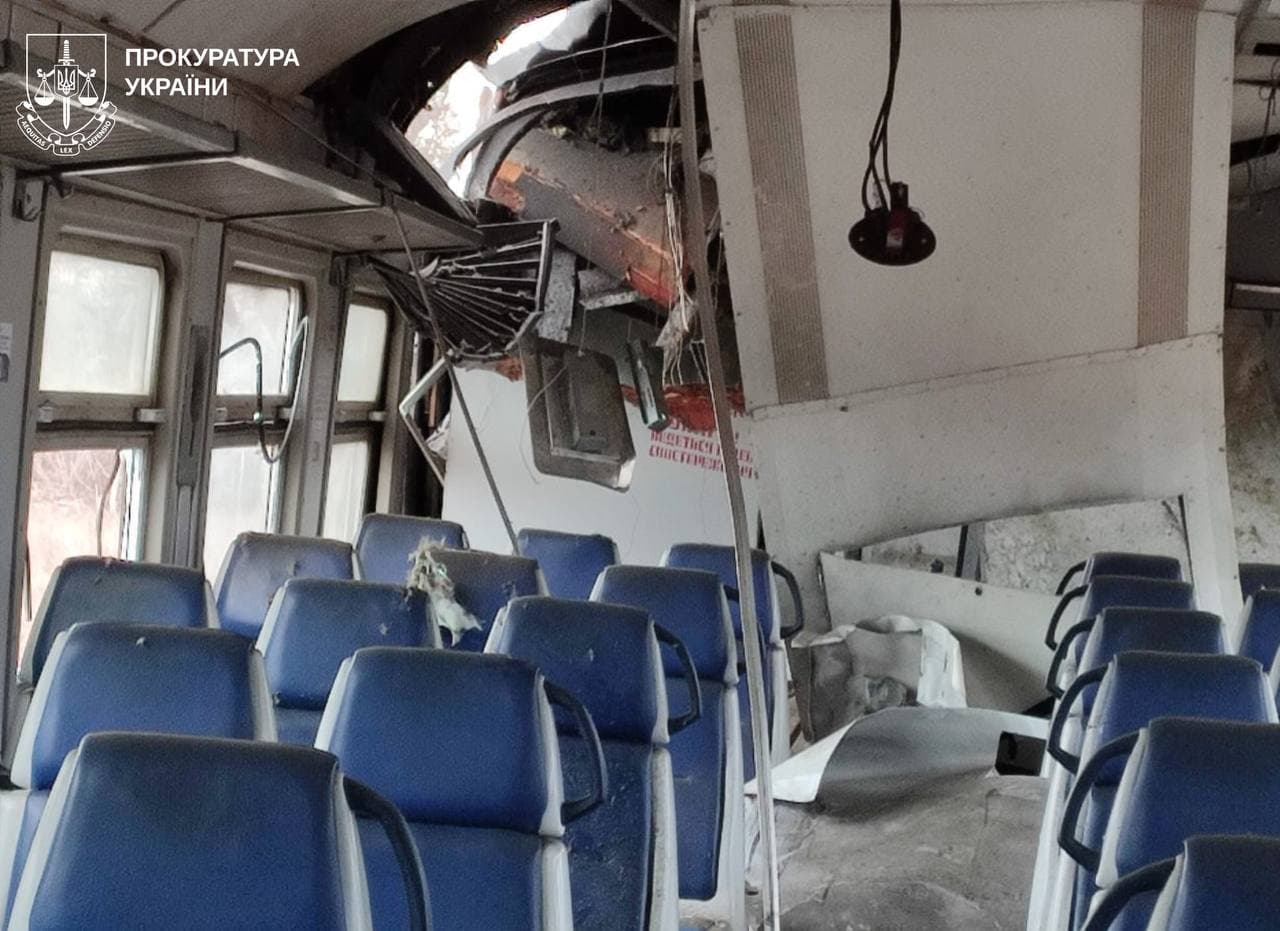
The aftermath of the attack on a passenger train in the Kharkiv Oblast. (The Kharkiv Regional Prosecutor’s Office / Telegram)
Poltava: two dead, eleven injured, a hotel and residential buildings burning. Zaporizhzhia: one dead, five injured, apartment blocks on fire. Ivano-Frankivsk: two dead, four injured including a six-year-old, a maternity hospital damaged. Vinnytsia: one dead, thirteen hurt. Dnipro: nine injured including an 18-month-old child. Kherson: one man killed in his home. Zhytomyr: a 12-year-old girl hospitalized after a strike hit her city center.
At 5:20 a.m., an FPV drone hit a commuter train eight miles from the Russian border. The crew had sounded the alarm. The passengers evacuated to the shelter at Slatyne station.
All except one. A 61-year-old man who refused to leave.
He was killed.
Ukrainian Railways asked passengers to please follow safety instructions. The trains, they said, would keep running.
Kill Shot in the Dark: Ukraine Destroys a Hypersonic Missile Before It Could Fly
Somewhere in occupied Crimea, after midnight, a column of Russian Bastion-M launchers moved slowly through the dark. No lights. No noise beyond engines. The crews were careful — they knew what they were carrying.
Zircon hypersonic cruise missiles. Weapons that travel so fast, so unpredictably, that Ukraine’s air defenses have rarely been able to touch them. Russia has fired them at civilian areas in the south and east with near impunity. Tonight, they were almost certainly part of the massive strike package already being prepared for launch against Ukraine.
Ukraine’s Main Military Intelligence Directorate was watching.
GUR operators from the Unmanned Systems Department tracked the column’s movement, identified the launchers, calculated the intercept. They struck before the column reached its firing position.
The results: one Bastion-M launcher destroyed. Two Zircon missiles eliminated on the ground before they could fly. A second launcher damaged. Seven Russian crew members killed or wounded. The GUR posted the geolocated strike footage.
This wasn’t luck, and it wasn’t the first time. On March 13 to 14, Ukrainian forces had destroyed an Iskander-M ballistic missile launcher in Crimea while it was preparing to fire. A pattern was forming — a systematic campaign to hunt Russian missile infrastructure on the peninsula before it could shoot: launchers, air defense assets, support equipment, radar installations.
The campaign demands patience. Finding a launcher moving in darkness, before it reaches its position, before it fires — that’s intelligence work measured in weeks, not hours.
Officials called the Zircon kill a testament to Ukraine’s maturing operational planning.
It also meant the strike package that hit Ukraine that night was smaller than Russia intended.
Not small. Smaller.
Burning the War Fund: Ukraine Hits Russia’s Oil Ports Two Nights Running
The morning satellite images told the story clearly. Five of Primorsk’s 18 storage tanks — each holding 50,000 tons of crude — had been torn open by Ukrainian drones the night before. Russia’s largest Baltic oil export terminal, which ships roughly 60 million tons annually, had gone quiet. Operations halted.
That was Monday morning.
Monday night, the drones came back.
This time the target was Ust-Luga, another major Baltic hub in the Leningrad region, a key chokepoint for crude oil and petroleum product exports. Fire broke out at the port. Regional Governor Alexander Drozdenko reported air defenses had shot down 56 drones over the region — but not enough. Emergency crews worked to extinguish the blaze. Pulkovo Airport in St. Petersburg temporarily suspended operations.
Ukraine didn’t claim responsibility. It rarely does for strikes on Russian territory.
It didn’t need to. The targeting logic wrote itself: Russia’s Baltic ports are the financial pipeline of the war. Every barrel of crude that moves through Primorsk and Ust-Luga generates the revenue that buys the drones, the missiles, the shells. Hit the ports, and Russia faces a choice — repair the infrastructure or defend it. Do both, and you do neither well.
Two ports. Two nights. The same category of target, struck in sequence.
This wasn’t opportunism. It was a campaign — aimed not at the front lines, but at the economic arteries keeping the front lines supplied. Every fire burning at a Baltic terminal is a question Moscow’s finance ministry has to answer: how long can the war fund itself when the fund keeps catching fire?
The Lights Went Out in Chisinau: How Russia’s War Reached an EU Neighbor
The drone didn’t cross into Moldova. It didn’t have to.
It crashed near the Isaccea–Vulcaneşti transmission line in southern Ukraine — and that was enough. The line went down. The electricity corridor linking Moldova to Romania and Western Europe severed in an instant. In Chisinau, the lights went out. Traffic systems failed. Border crossings switched to manual operation. A country that shares no border with Russia went dark because of Russia’s war.
By morning, Prime Minister Alexandru Munteanu had called an emergency cabinet meeting. The outcome: a 60-day state of emergency in the energy sector, fast-tracked to parliament the same day. “This is not a measure born of panic but of responsibility,” he said. Before the line could even be repaired, demining crews would have to clear the area — no timeline possible, no guarantee of when power would fully return. Residents were told to cut consumption during peak hours while supply rerouted through four backup interconnections with Romania.
This had happened before. In January, strikes on Ukraine’s grid knocked out the same corridor, triggering outages in both countries. The line was repaired. Then hit again.
President Maia Sandu didn’t reach for diplomatic language. “Russia alone bears responsibility,” she said.
Moldova’s Foreign Ministry called the attacks an assault on regional energy security. They were right — but the framing still understated it. This wasn’t spillover. It was the predictable consequence of a strategy that targets civilian infrastructure as a primary weapon. Moldova just happened to be downstream.
The war doesn’t need to cross a border to cross a border.
“You Need to Leave”: Washington Tells Ukraine to Surrender Donbas as Russia Prepares to Strike
Zelensky’s delegation flew home from Florida with a message they hadn’t wanted to hear.
According to sources close to the talks cited by Ukrainska Pravda, U.S. officials had spent two days pressing Kyiv to withdraw its forces from Donetsk Oblast as a precondition for any deal. The American position, sources said, traced back to whatever Trump and Putin agreed in Anchorage.
“No matter what we discuss, it always comes back to the Americans saying: ‘Leave Donbas, and we’ll build a paradise for you, as agreed in Alaska,'” one Ukrainian source said. “It goes in circles. We keep hearing the same thing: ‘You need to leave.'”
The warning attached to the demand was stark: no progress, and Washington walks — pivoting its attention to Iran and leaving Ukraine without its primary mediator.
Ukraine hasn’t moved. Kyiv’s position remains that freezing the current front line is the only realistic basis for a ceasefire — not surrendering territory it still controls. Russia’s position is the opposite: Ukraine must withdraw from all of Donetsk Oblast, including the portions Russia hasn’t managed to capture in twelve years of trying. On March 19, Kremlin spokesman Dmitry Peskov confirmed the trilateral talks were “on pause.” Ukraine’s Foreign Ministry called them delayed, not dead.
Zelensky was direct about what’s driving the paralysis: “The war against Iran is emboldening Russia.” He called for a three-way summit — himself, Trump, Putin — arguing only leadership-level talks could break the deadlock. One senior Ukrainian official added a quieter warning: without a European budget solution, money for social payments could run dry later this year even if the military remained funded.
Two days after the Florida talks ended, Russia launched 982 drones and missiles at Ukraine.
Kim Jong Un, fresh from a near-unanimous election result, personally assured Putin that North Korea’s support would continue.
The coalition sustaining Russia’s offensive keeps expanding. The one trying to stop it keeps fraying.
Blood for Meters: The Ground War Grinds On While the Sky Burns
The drones filled the headlines. Down on the ground, the war ran its usual brutal arithmetic.
Near Pokrovsk, a Ukrainian battalion commander watched Russian forces mass for another assault — infantry, motorcycles, transport vehicles spreading across 10 kilometers of open terrain. His forces killed 90 percent of the attackers.
The survivors regrouped. Then attacked again.
In the Kostyantynivka-Druzhkivka area, Ukraine was gaining. Geolocated footage confirmed Ukrainian forces likely liberated Minkivka, northeast of Kostyantynivka, and pushed forward in eastern and southeastern parts of the city and south of Illinivka. In another clip, Ukrainian troops cleared a Russian position southeast of Novopavlivka and walked out with two prisoners. Russia responded with nine KAB glide bomb strikes against Druzhkivka — one person killed, residential buildings burning — and a FAB-1500 dropped into central Kostyantynivka.
Advances and airstrikes. The exchange rate of this war.
Near Slovyansk, Ukrainian forces pushed into and north of Zakitne. In western Zaporizhzhia, troops filmed themselves clearing a Russian-held building in Prymorske and detaining more prisoners. Overnight, Ukrainian mid-range strikes reached 20 to 75 kilometers behind Russian lines — hitting troop concentrations in occupied Luhansk, Donetsk, and Zaporizhzhia oblasts.
In Sumy and Kharkiv, Russian forces attacked repeatedly and gained nothing. A Ukrainian spokesperson noted the new Russian reinforcements in Kharkiv were using identical infiltration tactics to their predecessors. They were sustaining identical casualties.
On the Dnipro’s left bank, the drone war ran at industrial scale. Russian forces fired 3,247 drones at Ukrainian marine positions in a single week — 460 per day. Ukrainian forces destroyed 90 percent of them.
In occupied Sevastopol, an explosion killed two people and injured eight in an apartment building. Russian authorities called it an accident.
“I’m Fine. Unlike the Hitman.”: Ukraine Kills a GRU Assassin and Rolls Up His Network
While Russian drones hunted targets from the air, a man from occupied Donetsk was moving through Ukrainian-controlled territory with a different kind of mission.
He had been trained at a Russian military base, smuggled across the front, and given a list. The plan was straightforward: find the targets, plant bombs under their cars or near their homes. If the explosion failed, shoot them at close range.
The targets were specific. Serhii Sternenko — advisor to Ukraine’s Defense Minister, prominent activist, a man who had already survived one assassination attempt last year. Ilya Bogdanov — a Russian-born fighter who had been defending Ukraine since 2014. Others.
Running the network from behind the scenes was a forensic expert from Poltava, recruited by Russia’s GRU. He collected surveillance data on the movements and addresses of military personnel and public figures, then relayed it to Russian handlers via messaging apps. When the network needed an explosive device for a planned mass-casualty bombing at a Kramatorsk restaurant frequented by Ukrainian soldiers, the device arrived by drone — dropped to a pre-designated location.
The SBU was watching.
During the operation, the hitman was shot dead resisting arrest. More than ten others were detained. Searches turned up firearms, ammunition, voice recorders, and surveillance cameras. The coordinator is in custody. All suspects face treason and terrorism charges — maximum penalty, life imprisonment.
Sternenko posted on Telegram within hours.
“Thanks to the SBU. I’m fine. Unlike the hitman. Russia should burn.”
Sixteen Satellites and a Very Long Way to Go: Russia’s Starlink Dream Hits Orbit, Three Months Late
On the evening of March 23, a Russian rocket carried 16 Rassvet communications satellites into low Earth orbit. Bureau 1440, the aerospace company behind the launch, announced it immediately — the first step toward Russia’s own version of Starlink, a sovereign broadband constellation that wouldn’t depend on Western infrastructure or Western permission.
Russian military bloggers celebrated. State media projected testing by 2026, full commercial service by 2027.
Then came the context.
Russian forces lost access to Starlink in Ukraine on February 1. The Rassvet launch was supposed to happen in December 2025. It arrived three months late. And at least one Russian military blogger — not a Ukrainian critic, a Russian one — called it “a complete failure,” arguing that Bureau 1440’s satellite production had collapsed behind schedule and that the company simply lacks the manufacturing capacity to build the constellation at the scale required.
Bureau 1440 says it plans to launch “hundreds” more satellites across dozens of future missions. Starlink operates over 7,000.
The gap is not small.
If Russia somehow closes it, the implications reach well beyond Ukraine. A functional non-Western satellite broadband service would give Moscow something to export — a way for aligned states to cut dependence on U.S.-controlled infrastructure. That’s a significant strategic prize.
For now: 16 satellites in orbit. Thousands needed. A December deadline missed by three months. A domestic blogger calling it a failure before the launch week is out.
The gap between Russian announcement and Russian capability has been one of the defining patterns of this war.
Sixteen satellites don’t change that pattern. Not yet.
$15 for a Russian Victory That Never Happened: Moscow’s War Game Heads to Steam
In the game’s final mission, a briefing informs the player that peace talks in Istanbul are going well. Russian forces have completed their objectives. It is time to withdraw — a gesture of goodwill.
The mission is called exactly that.
“Ukrainian Warfare: Gostomel Heroes” was built around a version of 2022 in which Russia’s airborne assault on Hostomel Airport was a brilliant success. Mission 1 takes 30 to 60 minutes. The player destroys Ukrainian forces and captures the airport without great difficulty.
In reality, roughly 300 Russian paratroopers lost between a quarter and a third of their number to Ukrainian anti-aircraft ambushes before they even landed. They were surrounded. A Ukrainian howitzer battalion — absent from the game — helped destroy most of them.
Irpin and Bucha are rendered in high-fidelity graphics. Simulated Ukrainian civilians stand in the streets while fires burn and artillery falls around them. They don’t panic. They don’t run. They can be killed — it costs victory points, nothing more. The game can always be completed successfully, regardless of how many civilians die.
The United Nations confirmed at least 73 civilians were murdered by Russian troops in those towns. Ukrainian authorities recovered 419 to 458 bodies showing signs of violent death.
The game launched on VK Play on February 24, 2026 — the four-year anniversary of the invasion. Its Steam release, priced at $15 for international markets, was scheduled for March 24 but delayed one week to avoid the Spring Sale. The demo hadn’t appeared either. Steam blocked access from Ukraine.
VPNs worked fine.
A Russian state-funded institute called it “an important step in patriotic gaming content.”
Ukrainian writers called it an instrument of fascist propaganda.
Both were describing the same game.
Pyongyang, Bishkek, and a Record Drone Attack: Russia’s Alliance Tightens on All Fronts
While Ukraine burned, Russia’s partners were making plans.
In Minsk, Belarusian Defense Minister Viktor Khrenin sat down with Kyrgyz Defense Minister Ruslan Mukambetov to discuss expanding military cooperation. One more handshake. One more thread in the network.
Separately, Alexander Lukashenko announced he would fly to Pyongyang on March 25.
The timing was not coincidental. Kim Jong Un had just personally guaranteed Putin that North Korea’s military backing would continue — delivered fresh off a near-unanimous electoral result that left no ambiguity about where Pyongyang stood. North Korean troops and munitions have already shaped Russia’s offensive capacity in measurable ways.
Step back and the 48-hour picture sharpens: Kim assures Putin of continued support. Belarus holds military talks with Kyrgyzstan. Russia launches the largest drone and missile assault of the war. Lukashenko books his flight to North Korea.
These weren’t separate events happening to coincide. They were a coalition demonstrating coordination — each partner playing its role while Russia struck Ukraine with a record barrage.
The alliance sustaining this war keeps adding threads. And every thread makes it harder to pull apart.
What This Day Means: The War’s Contradictions, Laid Bare
Two days after American negotiators told Ukraine to leave Donbas, Russia launched 982 drones and missiles.
That sequence was not coincidence. It was a message — from Moscow to Kyiv, to Washington, to anyone watching — about what Russian diplomacy actually looks like when conducted from a position of perceived advantage.
March 24th didn’t change the war. It clarified it.
Russia has real and growing strike capacity. Nearly 1,000 aerial vehicles in 24 hours. A sustained assault model designed to exhaust air defenses across an entire day. Shaheds finding Lviv in broad daylight for the first time. These aren’t theoretical capabilities anymore — they’re operational realities hitting maternity hospitals, monasteries, and commuter trains simultaneously.
Yet Ukraine destroyed a hypersonic launcher before it could fire. Halted Russia’s largest Baltic oil export terminal. Advanced in Kostyantynivka and Zaporizhzhia. Rolled up a GRU assassination network. The country being hit by the largest attack of the war was also the country conducting precision strikes on Crimea in the dark.
Both things are true. That’s the war.
The peace process is something else entirely. Washington’s ultimatum — abandon Donbas or lose your mediator — isn’t diplomacy. It’s pressure applied to the wrong party while the right party launches record barrages. Kyiv noticed. So did Moscow.
Sixteen satellites in orbit. A wargame selling Russia’s version of Bucha for fifteen dollars. Lukashenko flying to Pyongyang. The coalition sustaining this war keeps building while the one trying to end it keeps arguing.
Day 1,124. The fires in Lviv’s old city are out. The questions haven’t changed: how long can Ukraine’s air defenses hold against an enemy scaling up this fast? How long before Washington’s attention — split between Ukraine and Iran — runs out?
Nobody knew. The line held. The war ground forward.
Prayer For Ukraine
- Shield Over the Defenders on the Ground
Lord, today Ukrainian soldiers held the line across hundreds of kilometers — in Pokrovsk, in Kostyantynivka, in Zaporizhzhia, in Kherson — absorbing wave after wave with no relief in sight. We ask Your hand of protection over every soldier in a trench, every marine on the Dnipro’s left bank, every commander making life-and-death decisions in the dark. Where they are outnumbered, be their strength. Where they are exhausted, be their endurance. Let them know they are not forgotten.
- Comfort for the Wounded, the Grieving, and the Displaced
Father, today a 61-year-old man died alone on a commuter train because he refused to leave his seat. A 12-year-old girl was carried into a hospital in Zhytomyr. An 18-month-old child was hurt in Dnipro. Two people died near a maternity hospital in Ivano-Frankivsk. We bring each of them to You by name, known to You even when unknown to us. Comfort every family receiving unbearable news tonight. Hold the displaced million who fled to Lviv believing it was safe — and watched it burn today anyway.
- Wisdom for Leaders Navigating a Collapsing Peace
God of wisdom, the peace process frayed further today. Washington pressed Kyiv to surrender territory. Russia answered diplomacy with 982 drones and missiles. We pray for President Zelensky — for clarity, courage, and the discernment to navigate impossible demands without abandoning his people. We pray for leaders in Washington, in Brussels, in every capital where decisions about Ukraine’s future are being made. Grant them the wisdom to see through pressure and politics to what justice actually requires.
- Justice for the Deliberate Targeting of the Innocent
Lord of justice, today a 16th-century monastery burned in Lviv. A maternity hospital was damaged in Ivano-Frankivsk. Residential buildings collapsed in eight cities. Since 2022, Russia has damaged or destroyed 1,707 cultural heritage sites and killed thousands of civilians. We do not ask for revenge. We ask for accountability — that those who plan and execute deliberate strikes on civilian lives be brought to answer for what they have done. Let no crime go unseen by You, even when the world looks away.
- Endurance for a People Who Refuse to Break
Father, after the drones hit Lviv’s historic center today, residents walked back out within the hour. Shops reopened. Deliveries resumed. People returned to work. That is not numbness — it is defiance born of faith and love for their country. Sustain that spirit, Lord. Sustain Ukraine’s air defenders who shot down 797 of the nearly 1,000 weapons launched against them today. Sustain every volunteer, every medic, every mother keeping her family together under impossible conditions. And Lord — bring this war to an end. Bring justice to those who started it, healing to those who have suffered it, and lasting peace to a people who have earned it with everything they have.