
A day when the Kremlin’s largest bank acknowledged what months of denial had concealed, while 97 combat engagements raged in a single direction and mysterious drones probed European critical infrastructure.
The Day’s Reckoning
You’re standing in the operations center when the reports start flooding in from Pokrovsk. Day 1,356, and the maps on the wall have become meaningless—blue and red symbols overlapping in ways that defy traditional military logic. Your intelligence officer points to Rodynske on the screen: Ukrainian forces cleared it this morning, he says. Then another analyst interrupts with geolocated footage showing both Ukrainian and Russian troops advancing through the same town simultaneously, sometimes within blocks of each other.
You lean closer to the display, trying to make sense of the tactical geometry. The pocket around Pokrovsk has become a three-dimensional chess game where “front lines” mean nothing anymore. Your forces are counterattacking inside Pokrovsk itself while Russian assault waves press from the east and south. Fire control over your supply routes makes every convoy a deadly gamble.
The day’s statistics scroll across another screen: 265 combat engagements across the entire front. Your eyes catch on one number—97 concentrated in this single direction. More than a third of the entire war focused on this one collapsing pocket.
Then the strategic reports arrive from Moscow. Peskov reiterating Russia’s maximalist demands—complete capitulation or nothing. Sberbank’s CEO admitting in a closed meeting what everyone suspected: the economy is faltering, consumer loans shrinking. And from Belgium, drone footage over critical infrastructure, part of Russia’s Phase Zero campaign to destabilize Europe while you fight here.
You study the maps again, calculating time, resources, casualties. The question hangs unspoken in the room: can Russian manpower outlast your capacity to resist before their economy collapses? The arithmetic is grinding forward, but the answer remains hidden in the smoke.
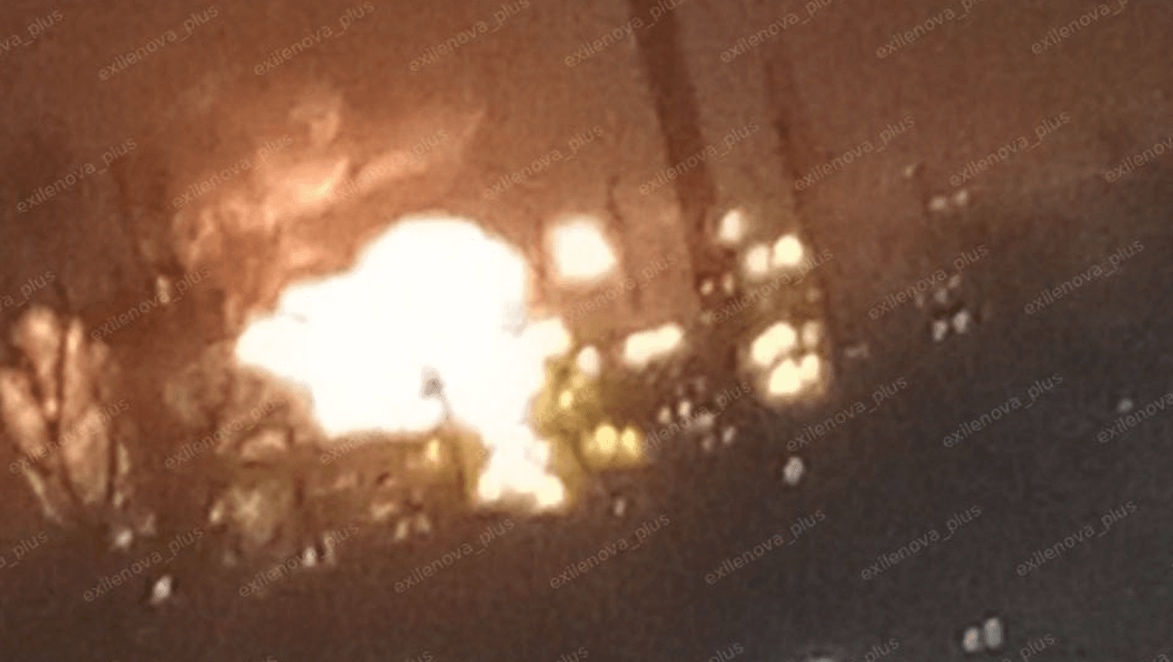
Fire erupts at a Saratov oil refinery—another Ukrainian strike reaching deep into Russian territory. (Exilenova+ / Telegram)
No Compromise: The Kremlin’s Ultimatum
You’re reading Peskov’s statement when the words stop you cold: Russia will only end the war when it achieves “the goals that it set initially.” You’ve heard this phrasing before, but now—on day 1,356—the deliberate vagueness feels like a blade sliding between your ribs.
You know what those “initial goals” mean. You were there in February 2022 when they announced them: removal of your government, installation of a Kremlin puppet, Ukraine’s promise never to join NATO, and NATO’s renunciation of its Open Door Policy. These aren’t negotiating positions. They’re demands for your complete surrender.
The Kremlin still frames it as defensive—eliminating the “root causes” of conflict, they call it. NATO expansion. Discrimination against Russian speakers. In Moscow’s narrative, they’re not the aggressor. You are. And any settlement leaving Ukraine independent and Western-oriented is, by their definition, unacceptable.
You glance at the battlefield reports on your desk. Ukrainian forces counterattacking effectively. Western aid still flowing despite Russian predictions of donor fatigue. Russian casualties at historically unprecedented levels. The Kremlin could leverage this military pressure for modest concessions that might tempt war-weary populations across Europe.
Instead, they’re doubling down. Demanding total victory.
You lean back, understanding what this reveals. Either the Kremlin believes time favors Russian victory despite the mounting casualties, or any settlement short of complete triumph represents unacceptable political defeat for Putin personally. The distinction matters for forecasting their next moves, but not for your immediate reality.
The conclusion is inescapable: no negotiated settlement is possible that leaves Ukraine sovereign. In Belgium, mysterious drones probe critical infrastructure. In Moscow, Peskov smiles and repeats the maximalist demands. The Kremlin isn’t negotiating about Ukraine’s future while simultaneously destabilizing Europe. They’re executing a comprehensive strategy, and compromise isn’t part of the plan.
The Fine Print No One Reads
You’re scrolling through the Kommersant report when your contact in Tatarstan sends a message: “They’re calling us up.” Nineteen federal subjects across Russia, all activating reservists under Putin’s November 5 law. The official story sounds reasonable enough—protecting critical infrastructure, combating sabotage groups, supporting counterterrorism operations in border regions.
You’ve seen this playbook before.
Your analyst pulls up the legislative text on screen. You read it carefully, searching for the clause that restricts deployment locations. It’s not there. Russian officials keep telling their citizens the reservists will only serve in their home regions, protecting local infrastructure. The contracts even contain that language. But you remember what happened to those soldiers who signed short-term contracts with specific expiration dates—forced to serve indefinitely when the Kremlin needed bodies.
You highlight the pattern emerging on your map. Tatarstan, Bashkortostan—regions Ukrainian forces have been hitting hard. They’re calling up reserves. But Moscow Oblast? Conspicuously absent from the list, despite Ukrainian strikes there. The Kremlin is concentrating its involuntary call-ups in central Russia, far from the capital, shielding politically important populations from the burden.
Your intelligence officer leans over your shoulder. “Infrastructure protection,” he says, his voice heavy with skepticism.
“Until it isn’t,” you reply.
You’ve watched Russian mobilization efforts before—disguised, minimized, concealed until the scale made hiding impossible. This feels identical. Build the reserve units now under the cover of domestic security. Train them. Organize them. Then, when casualties in Ukraine demand reinforcements, deploy them anyway. The contracts will be meaningless. The promises forgotten.
The question isn’t whether these reservists will fight in Ukraine. You circle the nineteen federal subjects on your map, calculating timelines. The question is when the Kremlin will deem their deployment necessary—and how many Tatars and Bashkirs will realize too late that the fine print meant nothing.
When the Loyalist Breaks
You’re monitoring the Kremlin meeting transcripts when Herman Gref’s words catch your eye: “very modest pace” and “challenging macroeconomic conditions.” Bureaucratic euphemisms, but coming from Gref—Putin’s loyal banker, the CEO of Sberbank, Russia’s financial backbone—they feel like a fault line cracking open.
You pull up Sberbank’s portfolios on your screen. Consumer loans shrinking. Growth projections for 2025 “worse than expected.” This is Russia’s largest bank, the one that touches nearly every Russian household and business. If Sberbank is stagnating, the entire economy is stagnating.
Your economic analyst walks over, reading over your shoulder. “He never admits weakness,” she says quietly.
“Until now,” you reply.
You’ve been tracking the Kremlin’s information campaign for months—the carefully curated narrative of an economy thriving despite Western sanctions, of Putin’s Russia standing strong. Every official statement projected strength. Every economic report minimized problems. And Gref has been part of that machinery, a loyal voice insisting everything was fine.
But in this closed-door meeting, he couldn’t maintain the fiction anymore.
You highlight the indicators cascading across your monitors: labor shortages as mobilization drains workers, inflation driven by supply constraints, interest rates rising to levels that strangle productive investment. Military production is consuming resources that would otherwise support civilian sectors. The war economy’s distortions are becoming impossible to manage.
The fact that Gref felt compelled to speak this truth directly to Putin tells you something has shifted. Either the deterioration has reached a point where denial became impossible, or the internal political dynamics demanded acknowledgment. Either way, the carefully constructed facade is crumbling.
You save the transcript and mark it priority. When a loyalist breaks, when euphemisms replace propaganda, when Sberbank admits “modest pace”—you’re watching the arithmetic of war intersect with economic reality. The question now is how long before the Kremlin can no longer hide what even their most faithful banker had to confess.
The Drones Over Doel
You’re watching the security camera footage from Liège Airport when air traffic control suddenly goes silent. November 9, evening. The timestamp shows drones hovering over the runway, and within minutes, all flights are grounded. A major European logistics hub—frozen.
Then the reports from Doel arrive. Five drones circling the nuclear power plant near Antwerp for an hour. An hour. You replay that in your mind. Sophisticated unmanned systems operating over defended airspace, and no one can stop them.
Belgian Defense Minister Francken’s statement from yesterday is still on your desk: Russia may be responsible. The official line stays carefully neutral, but you know what “may be responsible” means in diplomatic language. The Russian Embassy issued the predictable denial—no evidence of involvement—but you’ve been tracking this pattern for months.
You pull up the Phase Zero map on your screen. Red markers across Europe: aerial incursions, sabotage, espionage, maritime disruptions, arson. Not random. Not opportunistic. Systematic. The Russians are probing vulnerabilities, collecting intelligence, applying psychological pressure. Setting conditions for something larger.
The target selection tells you everything. Liège moves military cargo to Ukraine. Doel powers Belgian industry. Both demonstrate that Europe’s critical infrastructure remains vulnerable despite all the security measures. The message to your government is unmistakable: we can reach you whenever we want.
Your phone buzzes with alerts—similar drone incidents over military installations in three other NATO countries this week. You mark them on the map, watching the red dots multiply. Some incidents are reconnaissance. Others probe air defense responses. All of them generate headlines, fuel anxiety, force European governments to divert resources from supporting Ukraine to protecting their own infrastructure.
You lean back, seeing the strategic picture. NATO investigates each incident individually. No coordinated response emerges. The fragmentation itself might be the objective—demonstrating the alliance’s inability to counter hybrid threats while you fight the actual war in Ukraine.
The war isn’t staying in Ukraine. It’s spreading through Europe in drones and shadows, and you’re watching it happen in real-time.
Fifty Meters of Orange Fire
You’re monitoring the Black Sea when the security camera footage from Tuapse starts streaming in. 3:47 AM local time. The night-vision cameras catch them first—Ukrainian naval drones closing on the port where a tanker is loading crude oil for export.
Then the explosions erupt. Fifty meters high, orange flashes lighting the night sky like daybreak. You watch the blast wave ripple across the water, and apartment windows start recording from kilometers away. One camera angle shows the moment of impact at wharf 167—the pier where Russia loads smaller tankers with crude. Another shows fires still burning an hour later.
Your operations officer pulls up the official Russian response on the adjacent screen. Krasnodar Krai claims they neutralized four drones, minimal damage, one detonation knocked out some windows. No damage to major infrastructure. No injuries.
You replay the footage. Fifty-meter explosions. Fires burning at the oil terminal. A tanker tied up at the pier during the strike.
“They’re lying,” your officer says flatly.
“They always lie,” you reply, marking Tuapse on your map. Third time Ukrainian forces have hit this port in two months. The September raid damaged tankers. November 1st forced tankers to abandon the port entirely. Russia’s railroad company already banned shipments to Tuapse through November 13—and now this.
Your screen lights up with alerts from Rostov. Drones hitting the Likhovskaya railway switching station—critical infrastructure feeding Russian military logistics into southern Ukraine. Russian Defense Ministry claims all drones shot down. But Rostov residents are uploading videos with audio of low-altitude propeller drones and explosions echoing through the city.
You zoom out on your map. Fifty Ukrainian drones spotted overnight across southern and western Russia. Seven airports locked down—Rostov, Saratov, Penza, Samara, Tambov, Kaluga, Ufa. The deepest penetration reached Samara region: over 1,000 kilometers inside Russian territory.
You trace the expanding arc of Ukrainian strike capabilities with your finger on the screen. Months ago, hitting Crimea was ambitious. Now your forces are reaching deep into Russia’s interior, forcing them to defend vast swaths of their own country while trying to attack yours.
The orange flashes from Tuapse still burn on your monitor. Russia’s second-largest Black Sea oil terminal, struck while loading for export. The Russians can minimize all they want. But you’re watching their economy burn in real-time, fifty meters high.

The night sky lights up over Tuapse as Ukrainian naval drones find their mark at Russia’s second-largest Black Sea oil terminal. (Crimean Wind/Telegram)
Where the Map Means Nothing
You’re staring at the same settlement on two different screens, and both show advances—but in opposite directions. Rodynske. Your observer reports Ukrainian forces cleared it this morning, holding the northern shoulder of the Pokrovsk pocket. But the geolocated footage on your other monitor shows Russian troops advancing through the southern half of the same town.
Welcome to the new geometry of war, where “front lines” are a fiction.
Your tactical officer leans over the map table, tracing the pocket forming around Pokrovsk with his finger. Ukrainian forces are counterattacking inside the city itself while Russian assault waves press from the east and south simultaneously. North, south, east, west—threats from every direction, and your forces are responding to all of them at once.
“How many engagements today?” you ask.
“265 across the entire front,” he replies. “97 of them here.” He taps Pokrovsk. More than a third of the entire war concentrated in this single collapsing pocket.
You watch the reports streaming in. Russian forces attacking from a dozen different axes—probing, infiltrating, sometimes just raising flags for propaganda before withdrawing. The advances are measured in hundreds of meters, not kilometers. Each one costs them waves of troops. The casualties are catastrophic, but the waves keep coming.
Further south, Russian forces took Nove near Hulyaipole—one of the few settlements Moscow can actually announce capturing despite the enormous resources they’re burning. Elsewhere, the pattern repeats: attacks in Vovchansk, Lyman, Kupyansk. Drone operators working alongside conventional forces, creating layered threats your troops counter simultaneously.
You step back from the map, seeing the broader pattern. The Russians are concentrating overwhelming force in selected directions, accepting enormous casualties to achieve tactical advances, hoping to create operational breakthroughs. It’s working in places. Slowly. Bloodily.
But your forces keep counterattacking. Holding the shoulders of the Pokrovsk pocket. Stabilizing defensive lines under sustained assault. The question hanging over your map table isn’t about today’s engagements. It’s about whether Russian resources—human, material, economic—can sustain this intensity long enough to achieve decisive results.
Or whether they’ll bleed out first, grinding themselves to nothing against your defenses while Sberbank’s CEO admits their economy is faltering and their reserves get called up under false pretenses.
You look at Rodynske again on the map. Both sides advancing simultaneously. The arithmetic of attrition, playing out in real-time.
Corruption in the Powerlines: Ukraine Raids Energy Giant as Trump Welcomes Syria’s al-Sharaa
You watch President Trump welcome Syrian President al-Sharaa to the White House, announcing a 180-day suspension of Caesar Act sanctions on Syria’s energy sector. Another former Russian client state shifting toward Washington—exactly what you hoped Ukraine’s Maidan Revolution would achieve a decade ago.
But the photo on your screen creates an uncomfortable juxtaposition. While Trump extends diplomatic recognition to Syria’s new government, Ukraine’s National Anti-Corruption Bureau is conducting raids in Kyiv against the very energy infrastructure you’ve been funding to keep operational.
The allegations are staggering. Zakharenergozbut—Ukraine’s state energy company managing the grid you’ve watched Russia systematically destroy—allegedly ran corruption schemes controlling key enterprises including Energoatom, their nuclear power backbone. Wiretaps captured voices plotting to defraud contractors of over $100 million. One name jumps out: Andrii Derkach, the Russian operative who interfered in U.S. elections, now allegedly connected to Ukrainian energy corruption.
A transformer substation protection project was delayed while conspirators diverted 200 million hryvnias through “profitable deals.” Critical infrastructure protection—delayed for profit—while Russia launches seventy strikes on the facilities this corruption left vulnerable.
“Everyone who created schemes must receive a clear procedural response,” Zelensky said last night. “There must be verdicts.”
You close the briefing document. Trump welcomes al-Sharaa after Syria broke from Moscow. Ukraine is still fighting Moscow—on the battlefield and against the internal rot that undermines the fight. The billions in aid you’ve debated funding face sabotage from within the system you’re trying to save.
The Day’s Meaning: When Arithmetic Meets Will
You’re reading the analysis section of today’s briefing, and the numbers refuse to reconcile with the rhetoric. Three and a half years after Russia’s forces crossed into Ukraine expecting swift victory, the war has become an arithmetic problem—and the math isn’t working in anyone’s favor.
Consumer loans are collapsing Russia’s largest bank. Involuntary reserve call-ups disguise infrastructure paralysis. Maximum detention predictions for negotiated settlement keep getting pushed back. Each data point suggests the same conclusion: the Kremlin committed to prosecuting this war at any cost until Ukraine capitulated completely or Russia’s capacity to continue collapsed.
But Pokrovsk captures the contradiction. Enormous Russian forces committed enormous casualties to secure strategically meaningless positions while Ukrainian defenders counterattack within threatened settlements. The war descended into house-to-house fighting at scales that defied historical comparison outside the Second World War’s Eastern Front.
The strategic questions remain unanswered. Peskov’s admission that Russia’s original war aims revealed the Kremlin’s unwillingness to settle for anything less than complete victory—despite mounting evidence that such victory was becoming increasingly difficult to achieve. The disconnect between maximalist objectives and deteriorating capacity creates a reality where sustaining current operational tempo would face increasingly severe constraints while Ukrainian capacity to resist collapse under sustained pressure continues expanding.
Meanwhile, Belgium’s drone incidents reminded European audiences that the war extended beyond Ukraine’s borders through Russia’s systematic Phase Zero destabilization campaign. Critical infrastructure stretched thin. European cohesion and political will remained uncertain. The Kremlin fought on multiple fronts simultaneously, using tools and strategies that appeared designed to maintain pressure while seeking vulnerabilities.
The arithmetic suggested the war would continue far longer than early analysts expected. The grinding would continue, casualties would mount, and the question of when mathematics would finally overcome political will remained unanswered.