
In Moscow, Russia’s chief of staff pointed at a map and claimed twelve conquests that didn’t exist. In London, Zelensky signed a drone deal with Britain and told Parliament that 201 Ukrainian specialists were already hunting Shaheds across the Middle East. In the Urals, Shoigu admitted, no region of Russia could feel safe anymore — Day 1,482, when the Kremlin’s own officials couldn’t agree on whether they were winning or losing.
The Day’s Reckoning
Army General Valery Gerasimov stood before cameras at the Southern Grouping of Forces command on March 17, 2026, and pointed at his map. Twelve settlements seized in two weeks, he announced. Russian forces controlling over sixty percent of Kostyantynivka. Half of Lyman secured.
The observable reality behind him told a different story. Two settlements seized, not twelve. Troops operating in 7.85 percent of Kostyantynivka, not sixty. And Lyman — where a Ukrainian brigade spokesperson confirmed zero Russian presence — was the same claim Gerasimov had made on December 29, repackaged as fresh news. Even Russian milbloggers noticed, comparing the performance to the Kupyansk humiliation of December 2025.
Eight hundred kilometers east, his colleague Sergei Shoigu was undermining everything Gerasimov had just said. Ukrainian drone strikes against Russian infrastructure had quadrupled to 23,000 in 2025, Shoigu told the Security Council. The Ural region — defense industries, oil fields, transportation networks — sat in the “immediate threat zone.” No region of Russia, he admitted, could feel safe.
One senior official fabricating Russian advances. Another confessing Russian vulnerability. Same regime. Same afternoon.
In London, Zelensky was addressing the British Parliament, announcing 201 Ukrainian drone specialists already deployed across the Middle East and signing a defense cooperation declaration with Prime Minister Starmer. In the Gulf, those specialists were teaching American allies to shoot down the same Iranian Shaheds that had been killing Ukrainians for three years.
And in Moscow, Kremlin envoy Kirill Dmitriev posted on X that Europeans were “anti-Trump” for refusing to send warships against Iran — Russia’s own strategic partner — effectively shaming the world for not attacking the country that supplies Moscow with drones and satellite intelligence.
Day 1,482. The Kremlin’s own officials couldn’t agree on whether they were winning or losing. The frontlines answered for them.
Twelve Villages That Don’t Exist: Inside Gerasimov’s War Against Reality
Pull up the map Gerasimov was pointing at and check the villages yourself. Drobysheve, Yarova, Sosnove — all northwest of Lyman, all claimed as seized by the Western Grouping of Forces between March 1 and 14. Now check what satellite imagery, geolocated footage, and frontline reporting actually show: Russian forces operating in 24 percent of Drobysheve, half of Yarova, and none of Sosnove. Three villages claimed. Zero villages taken.
The pattern repeated across every grouping. The Southern Grouping supposedly seized Riznykivka, Kalenyky, and Holubivka. Reality: 57 percent presence in Riznykivka, zero in the other two. The Dnepr Grouping claimed Veselyanka. Zero percent. Twelve settlements seized in two weeks, Gerasimov announced. ISW counted two.
Then he went bigger. Russian forces had pushed twelve kilometers west of Siversk, he declared. Actual advance: 4.55 kilometers, with infiltrations reaching 7.7. He claimed 85 percent control of Novoosynove southeast of Kupyansk. No evidence of any Russian presence there at all.
The Lyman claim was the most audacious. Gerasimov recycled his December 29 assertion that Russian forces held over half the city — presenting three-month-old talking points as breaking news. A Ukrainian brigade spokesperson operating in the Lyman direction didn’t mince words: there was no Russian presence in Lyman whatsoever. ISW confirmed no observed Russian operations there since February 23.
Kostyantynivka: 60 percent controlled, Gerasimov said. Actual Russian operations: 7.85 percent. A Russian milblogger — not Ukrainian, Russian — accused him of repeating the Kupyansk disaster, where premature victory claims collapsed when Ukraine liberated the city in December 2025.
In eastern Zaporizhia, where Gerasimov claimed his forces were repelling all Ukrainian counterattacks, Ukrainian troops had quietly liberated over 400 square kilometers since late January. ISW noted identical exaggeration speeches in mid-January and February — monthly cognitive warfare briefings aimed at convincing the West that Ukraine’s lines were collapsing. They weren’t. Ukraine liberated more territory than Russia seized across the entire theater in February 2026.
1,500 Kilometers Deep: When Shoigu Admitted the Drones Could Reach Everywhere
Picture the Security Council chamber as Sergei Shoigu delivered the numbers. Not the inflated fantasies Gerasimov was selling down south — real numbers, drawn from damage assessments Russian officials had spent years burying. Ukrainian airstrikes against infrastructure across all Russian federal subjects: 23,000 in 2025. Four times the 6,200 recorded in 2024. And the reach was growing.
The Ural region — 1,500 kilometers from the Ukrainian border, home to strategic defense enterprises, energy facilities, chemical plants, and some of Russia’s largest oil and gas fields — now sat in what Shoigu called the “immediate danger zone.”
This was the same man who had spent his tenure as Defense Minister waving away Ukrainian long-range capabilities as insignificant. Now he was telling the Security Council that disabling Ural infrastructure “could not only cause significant economic damage but also disrupt major metropolitan areas and key supply chains, including those essential to supporting a special military operation.”
Read that sentence again. Russia’s own Security Council Secretary just admitted that Ukrainian drones could cripple the logistics sustaining his country’s war.
The candor wasn’t accidental. Shoigu was conditioning the information space — preparing Russians to accept that the war’s consequences reached every region, not just border areas near the front. The groundwork for expanded mobilization. The justification for internet shutdowns already spreading through Moscow and St. Petersburg. The explanation for sacrifices that hadn’t been announced yet.
While Gerasimov pointed at phantom conquests on his briefing map, Shoigu was quietly conceding that the enemy’s weapons could strike the industrial heartland keeping Russia’s army in the field. Same regime. Same afternoon. Two completely irreconcilable versions of how the war was going.
From Buckingham Palace to the Gulf: Zelensky Sells the Expertise Russia Helped Create
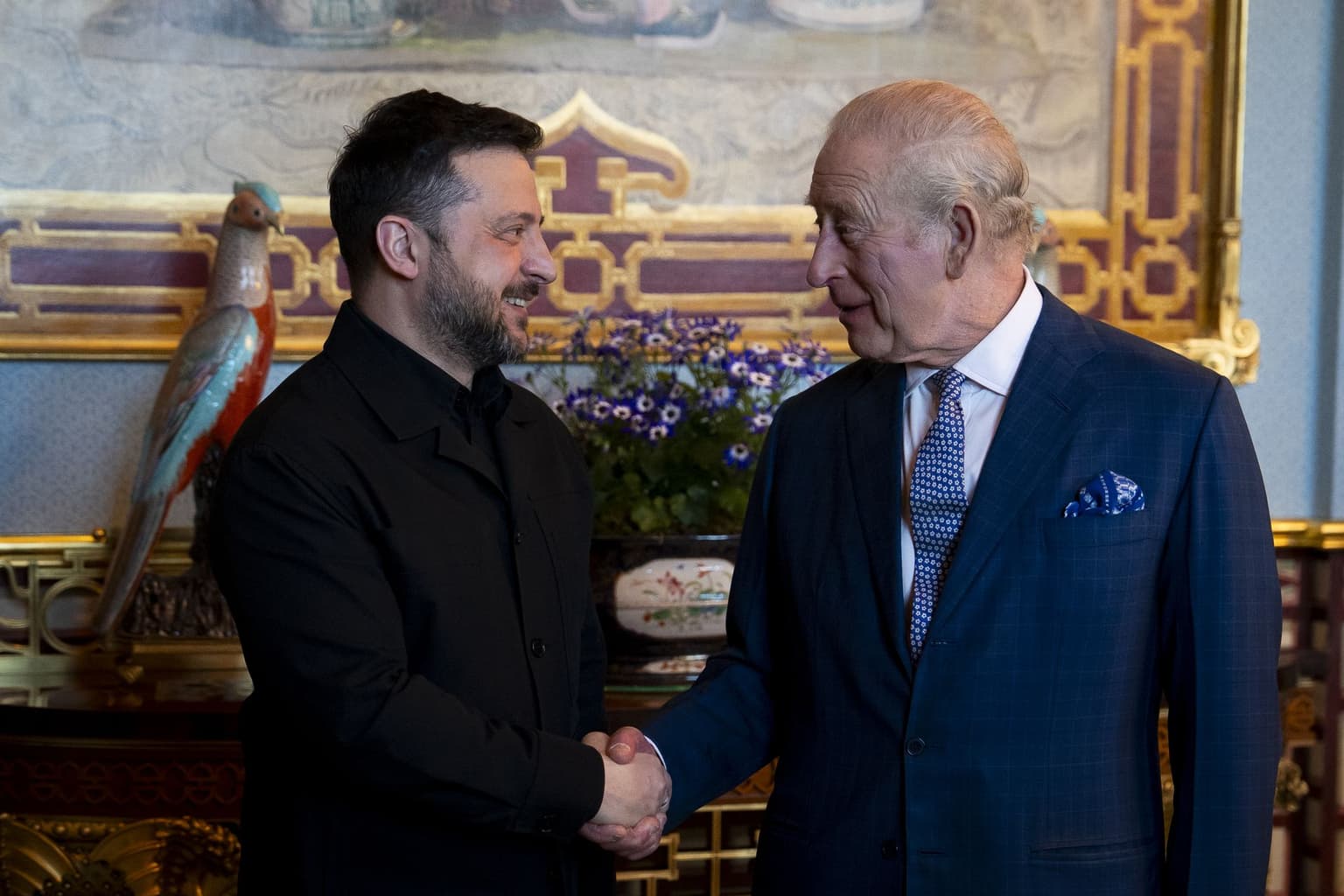
Zelensky’s London day began with King Charles III at Buckingham Palace and ended with ink drying on a Declaration on Deepening Cooperation in the Field of Security and the Defense Industry alongside Prime Minister Keir Starmer. Between those two moments, he reshaped how the world understood Ukraine’s value to its allies.
The centerpiece was artificial intelligence. Defense Minister Mykhailo Fedorov announced the A1 Defense AI Center, built with UK support, designed to feed three years of battlefield data into autonomous systems spanning drone warfare, mid-range strike, deep strike, and artillery. For the first time ever, Ukraine was sharing raw combat data with allies to train AI models for unmanned systems — neural networks within its Delta command-and-control platform learning to identify ground and aerial targets without human guidance.
Then Zelensky stepped before Parliament and delivered the number London wanted to hear: 201 Ukrainian specialists already deployed across the Middle East and Gulf region, countering the same Iranian-made Shaheds that had been slamming into Ukrainian apartment blocks since 2022. Another 34 were ready to deploy. Teams had reached the UAE, Qatar, and Saudi Arabia. More were en route to Kuwait.
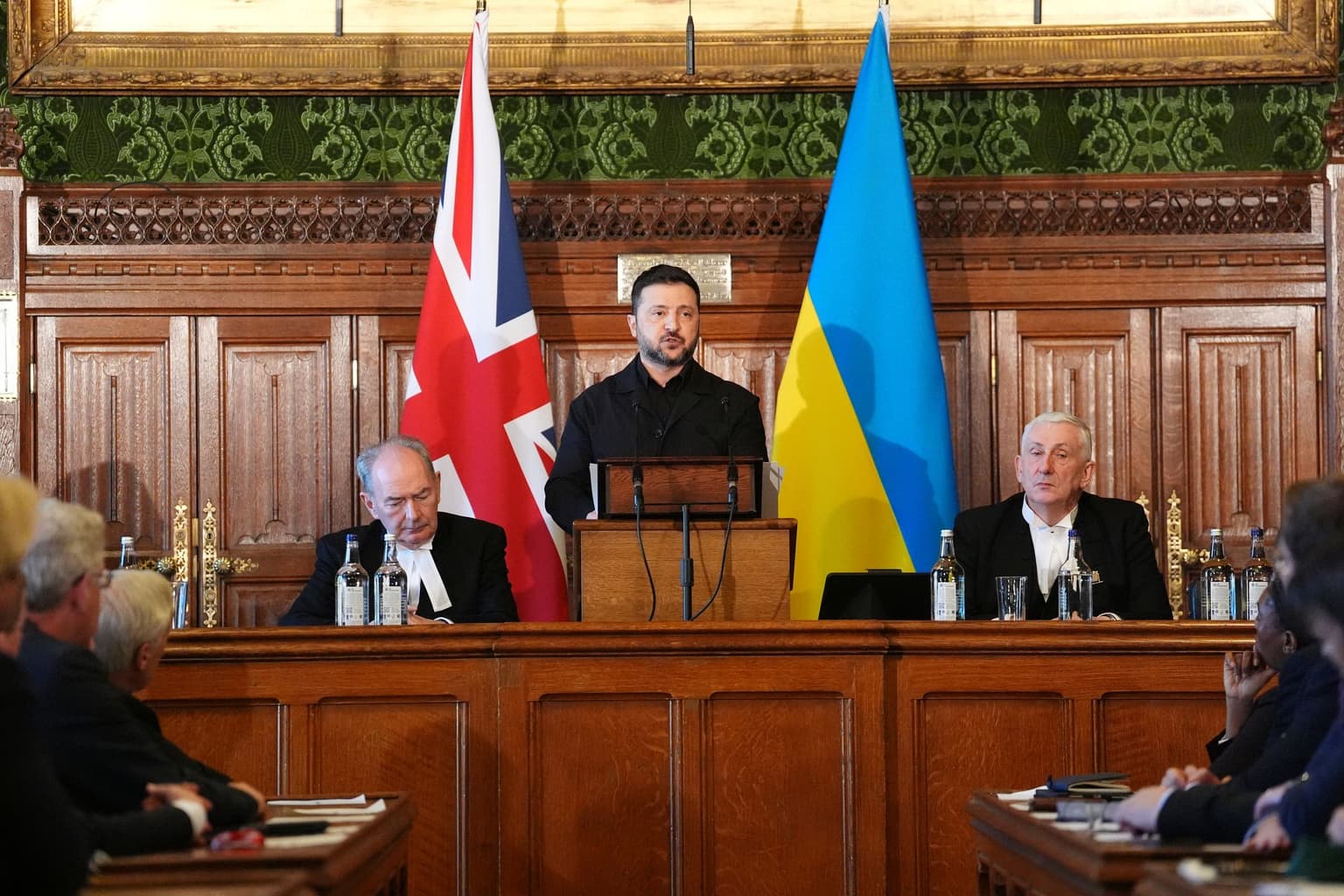
“These are military experts who know how to help, how to defend against such drones,” he told the chamber. The deployments followed requests from partners including Washington and formed the backbone of Kyiv’s proposed “drone deal” with the United States.
Trump had dismissed the offer four days earlier. “The last person we need help from is Zelensky. We know more about drones than anybody.” The drone deal remained “on the table.” The 201 specialists were already on the ground doing what Washington said it didn’t need.
A three-way meeting with Starmer and NATO Secretary General Mark Rutte capped the day, underscoring Britain’s role as a leading player in the Coalition of the Willing — over 30 countries building Kyiv’s post-war security guarantees while the war still raged.
“We Asked Them Not to Give Weapons. They Built Two Factories Instead.”
Zelensky sat across from The Jerusalem Post interviewer and dispensed with diplomacy. “They lied, of course,” he said of Tehran’s early assurances. Iranian officials had told Kyiv they’d supplied only 1,200 to 1,300 Shaheds to Russia. “But it was not true.”
Ukraine had warned Iran directly — told Tehran these drones would be used against civilians. Iran shipped them anyway. Then came the licenses for Russian domestic production. Then the technical assistance. Then two factories built on Russian soil with Iranian expertise. A feedback loop took shape: thousands of Shaheds slammed into Ukrainian cities, each wave generating data that refined the next generation of drones now appearing across the Middle East.
“Ukraine was kind of an experiment place for these drones,” Zelensky said. “You can’t get to a new version without using thousands of them. And they were used mostly not on the battlefield. Mostly, they use 99 percent of Shaheds to make practice on civilians.”
The Wall Street Journal filled in the other side of the exchange on March 17, reporting that Russia had been feeding Iran satellite imagery from Russian Aerospace Forces satellites and modified Shahed components designed to improve communication, navigation, and targeting — along with specific advice on launch altitudes and drone quantities. The technology was flowing both directions, confirmed by a senior European intelligence officer and a Middle Eastern diplomat.
Iran’s response to Ukraine’s growing counter-drone role in the Gulf was blunt. On March 14, Iranian politician Ebrahim Azizi declared Ukrainian territory “a legitimate target for Iran” under Article 51 of the UN Charter, threatening retaliation for Ukraine’s air defense support in the Middle East. Ukraine’s Foreign Ministry spokesperson Heorhii Tykhyi called the threat “absurd” — noting that “the Iranian regime has been supporting the murder of Ukrainians for years, by directly sharing drones and technology for Russian aggression against Ukraine.”
The Kremlin’s Envoy Just Shamed Europe for Not Bombing Russia’s Own Ally
Kirill Dmitriev — Putin’s designated interlocutor with Washington, born in Kyiv, now Russia’s envoy for economic affairs — opened his X app and typed himself into a contradiction so perfect it read like satire.
“The masks are off,” he posted. “UK and EU warmongers are showing how deeply anti-Trump they really are.”
The context: European leaders had declined Trump’s push to send warships to reopen the Strait of Hormuz during the Iran conflict. Trump had appealed to the UK, China, France, Japan, and South Korea to restore freedom of navigation through a corridor carrying roughly one-fifth of global oil trade. London and European allies were discussing possible measures. None had publicly committed.
Dmitriev’s response was to shame them for it.
The problem was that Russia had officially condemned US and Israeli strikes on Iran as unprovoked aggression. Iran was Moscow’s key strategic partner — the country supplying Shahed drones that Russian forces launched at Ukrainian cities nightly, the country receiving Russian satellite intelligence to target American forces, the country whose military cooperation sustained Russia’s offensive in Ukraine. Russia’s Foreign Ministry had issued formal condemnations. Russian state media called the strikes an atrocity.
And here was Russia’s own envoy, mocking European nations for refusing to join military operations against Tehran.
Reading between the lines: Dmitriev’s real audience was Trump, not Europe. The post was designed to curry favor with Washington by framing European reluctance as anti-American disloyalty. But the logical consequence of his argument — that responsible nations should help fight Iran — was a position Moscow could never openly endorse without abandoning the partner keeping its drone war alive.
The contradiction sat on the screen for anyone to read. Moscow apparently couldn’t resolve it. Dmitriev apparently didn’t notice it.
The Man Who Linked Moscow and Tehran: Israel Kills Ali Larijani
Ali Larijani had sat across from Vladimir Putin in Moscow on January 30, discussing bilateral cooperation while Iranian Shaheds struck Ukrainian cities and Russian satellite imagery guided Iranian attacks on American forces. On March 17, an Israeli airstrike killed him.
Larijani, 67, died alongside his son Morteza and Alireza Bayat, deputy secretary for security affairs at Iran’s Supreme National Security Council. Iranian state media confirmed the deaths after Israel’s defense minister claimed the strike earlier in the day.
The kill list of what Larijani had been reads like a map of Iranian power itself: former speaker of parliament, former secretary of the Supreme National Security Council, chief negotiator in nuclear talks with Washington, key architect of the violent crackdown on nationwide protests that killed thousands of civilians. A longtime confidant of Supreme Leader Ali Khamenei — until Khamenei himself was killed in the US-Israeli strikes of February 28. In the weeks since, Larijani had remained a central node connecting Tehran’s security apparatus to its foreign allies, including the Russian military partnership sustaining Moscow’s drone war against Ukraine.
The Israeli military announced a second strike the same day — destroying an aircraft used by Khamenei at Tehran’s Mehrabad Airport, one used for military procurement flights and coordination with allied states.
For Ukraine, the math was straightforward but incomplete. Every Israeli strike against Iran’s leadership eroded the network that had funneled thousands of Shaheds to Moscow, trained Russian operators, and helped build two drone factories on Russian soil. But the factories were already running. The licenses had already transferred. The technology had already crossed borders. Larijani was dead, but the infrastructure of cooperation he’d helped build continued producing the drones that fell on Ukrainian cities every night.
The App That Carried the War’s Truth Goes Dark
Pavel Durov hadn’t said a word. Not since the Kremlin throttled Telegram on February 9-10 had the platform’s founder made any public statement — not about the increasingly stringent restrictions choking his app since early February, not about the criminal case Russian authorities opened against him on February 24 on suspicion of aiding terrorism, not about the growing possibility that Russia might ban Telegram outright in the coming weeks.
Kremlin Spokesperson Dmitry Peskov added his own layer of silence on March 17, claiming he was unaware of any contact between the Russian government and Telegram management. The denial was implausible. The crackdown was systematic.
Internet shutdowns had spread across Russia’s two largest cities since early March. On March 17, St. Petersburg’s Committee on Information Technology announced that mobile internet outages might be imposed in parts of the city “for security reasons” — a phrase that had become the Kremlin’s all-purpose justification for going dark.
The connection to the war was direct. Telegram had carried the uncensored narrative of Russia’s invasion for four years — milblogger critiques of commanders like Gerasimov, battlefield footage contradicting official claims, civilian accounts of strikes and occupation. As the Kremlin faced increasingly difficult and unpopular decisions to sustain operations in Ukraine — expanded mobilization, deeper economic sacrifices, mounting casualties — controlling what Russians could read, share, and discuss wasn’t merely desirable. It was the prerequisite for everything that came next.
Durov’s silence left the question unanswered: had the founder of Russia’s most important communication platform been pressured into compliance, or was he simply calculating that saying nothing was safer than saying anything at all?
Aperol Spritz for War Criminals, Body Bags for Kenyans
Colonel General Aleksandr Chayko commanded Russian forces on the ground when troops entered Bucha, Hostomel, Irpin, and Borodyanka in the first weeks of the 2022 invasion. Hundreds of civilians were found dead after Ukrainian forces retook those towns — mass graves, bodies in the streets, evidence of executions. On March 17, the EU finally froze his assets and banned him from European travel, along with eight other Russian military officials. They joined roughly 2,600 individuals and entities already sanctioned.
Lithuanian Foreign Minister Kęstutis Budrys wanted more. He called on the EU to ban all Russian military personnel from the bloc entirely. “The European Union cannot allow war criminals to come to the EU, enjoy what we have here, sunny holidays and Aperol spritz in our capitals,” he told reporters. The issue remained politically sensitive — EU governments still differed on how broadly restrictions should apply — but the Baltic states and Eastern Europe were pushing hard.
Five thousand kilometers south, a different reckoning with Russia’s war was landing in Moscow. Kenya’s Foreign Minister Musalia Mudavadi arrived to confront what his own deputy had called Russia’s “unacceptable” use of Kenyans as “cannon fodder.” More than 1,000 Kenyan citizens had been recruited — lured with promises of well-paid civilian work, flown to Russia, then press-ganged into the army and sent to fight in Ukraine with minimal training.
Mudavadi came to demand repatriation. South Africa had extracted 15 of its own citizens from Donbas in late February. Now Kenya wanted its people back. The visits mapped a pattern: African nations discovering, one by one, that Russia’s manpower crisis had reached their citizens — and flying to Moscow to retrieve what was left of them.
Drafting the “Liberated”: How Russia Conscripts the People It Claims to Protect
Walk down a street in occupied Berdiansk and you might not make it home. Russia’s forced mobilization in Zaporizhia Oblast had escalated to street detentions and document checks — men grabbed on sidewalks, marched to military registration offices, and pressured into signing contracts with the Russian Defense Ministry. The tools of persuasion: psychological coercion and threats of criminal prosecution. At least 17 people conscripted this way in the past week alone, according to Ukraine’s National Resistance Center.
In occupied Donetsk, the methods turned surreal. Occupation authorities were seizing civilian vehicles under the guise of towing for parking violations. Car owners who tracked their vehicles via GPS discovered them not in impound lots but at the front lines — transferred directly to the Russian army. Those who tried to recover their cars were met with threats of “terrorism” or “treason” charges. Your sedan, conscripted. Your complaint, a criminal offense.
In Crimea, the system took its most organized form. Occupation authorities established “alternative” military service in rear positions, mandating lists of enterprises and positions subject to conscription, requiring employers to provide dormitory accommodations for conscripted workers. “In effect, Russia is creating a system of complete control over its mobilization resources,” the National Resistance Center reported. “Those who do not end up in the army will be forcibly conscripted into working for the occupying power’s state structures.”
The backdrop: Putin’s March 4 decree raising the regular army to 2,391,770 personnel, including 1,502,640 active-duty troops, and Russia’s shift from seasonal to year-round conscription in 2026. The Kremlin was sustaining its war without declaring full mobilization — by drafting the very Ukrainians it claimed to have liberated. The Geneva Convention on the Protection of Civilian Persons calls that a war crime.
9.4 Million Tourists by 2044: Moscow Plans Beach Resorts on a Battlefield
Pro-Kremlin publication Vedomosti laid out the blueprints as though the war had already ended and Russia had won. Nearly 114,000 Russian citizens relocated to occupied Ukrainian territories by 2045. Over 13 million square meters of housing. A hundred and forty kindergartens. Several dozen schools. A hundred medical facilities. Some 3,270 kilometers of roads and 430 kilometers of railways rebuilt. Airfields reconstructed. Marinas and piers constructed. And the crown jewel: tourism development along the Sea of Azov, aiming to attract 9.4 million visitors by 2044.
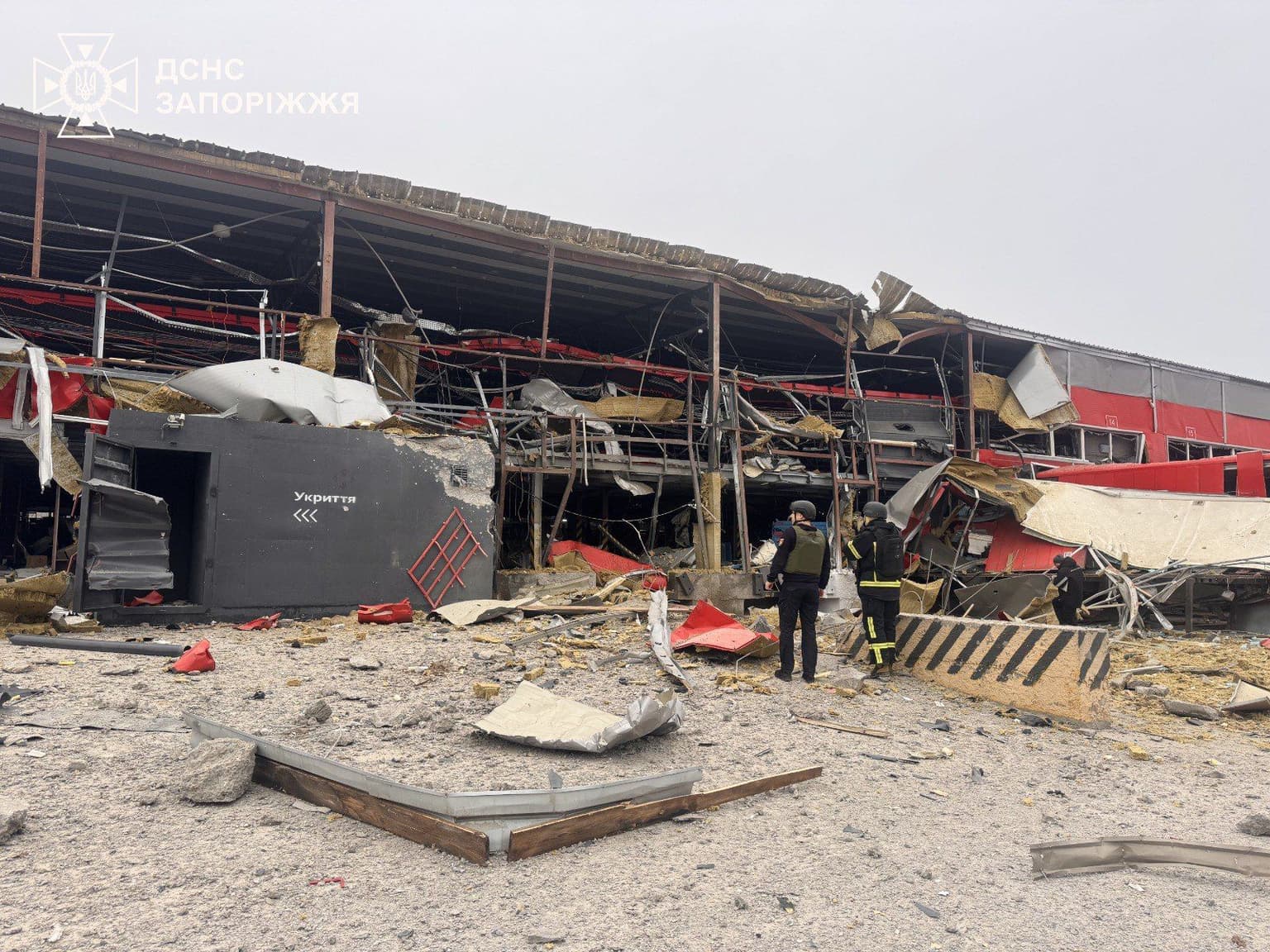
Russian forces attacked a postal terminal operated by Ukrainian company Nova Post in the city of Zaporizhzhia injuring at least six workers. (Ukraine’s Emergency Service)
Now picture what those territories actually look like. Russian forces used scorched-earth tactics across Donetsk, Luhansk, Zaporizhia, and Kherson oblasts — leveling homes, gutting critical infrastructure, leaving vast stretches without electricity or running water. The 116,000 square kilometers still under Russian occupation weren’t awaiting development. They were rubble fields under daily artillery fire.
Mariupol told the story in miniature. Fully occupied since May 2022, the city where Russian troops struck a drama theater sheltering civilians — killing roughly 600, injuring 400 — had seen its occupation administration demolish more than 360 already-destroyed apartment buildings. In their place: new apartments built under mortgage terms designed for Russian citizens, not the 18,000 original Mariupol residents who still had no homes. The theater itself reopened in December 2025, heavily promoted on state media, while the people who’d survived its bombing remained displaced.
The occupied territories where Moscow planned kindergartens and beach resorts sat near active front lines, absorbing daily strikes and hosting ongoing combat operations. Russia was drafting tourism brochures for land it hadn’t finished destroying.
Russia Bombs the Pipeline, Slovakia Blames Ukraine
The sequence of events deserved to be read slowly. In January, a Russian strike damaged a pumping station on the Druzhba pipeline in Ukraine’s Lviv region. The pipeline — which funnels Russian crude oil to Hungary and Slovakia — went offline. Then Slovakia and Hungary accused Ukraine of deliberately blocking supplies.
On March 17, Slovakia’s energy system operator made it official: a formal letter to Ukrenergo terminating their emergency energy assistance agreement, effective May. No reason given in the letter. Slovak Prime Minister Robert Fico had already stated the terms publicly in February — no help stabilizing Ukraine’s war-battered energy grid until crude oil transit resumed through the pipeline Russia had bombed.
Zelensky’s response came the same day in a letter to European Council President Antonio Costa and Commission President Ursula von der Leyen: Ukraine accepted the EU’s offer of technical support and funding to repair the Brody pumping station. Restoration estimate: one and a half months, absent further Russian attacks. He stressed Ukraine’s readiness to provide alternative routes of non-Russian crude to Central and Eastern Europe.
Hungary’s Foreign Minister Peter Szijjártó called the arrangement a “political game.” Viktor Orbán, facing a domestic election that could test his grip on power, had weaponized the pipeline dispute against Kyiv for weeks. Zelensky’s reply was surgical: Ukraine would work “with any Hungarian leader who is not Putin’s ally.”
Ukrenergo added a footnote that landed harder than any diplomatic exchange. Slovakia’s emergency energy assistance, the company noted, had been used “quite rarely and in very limited volumes.” The last time: January.
Translation: Slovakia was terminating an agreement it barely used, over a pipeline Russia broke, to punish a country Russia was bombing.
Blood for Meters: A Thousand Kilometers Where Nobody Breaks Through
The front line stretched across a thousand kilometers and told the same story in nearly every sector: Russian forces attacking, Ukrainian forces holding, nobody breaking through.
In northern Kharkiv Oblast, Russian troops pushed near Vovchansk, Vovchanski Khutory, and Starytsya and gained nothing. Northeast of the Oskil River, attacks toward Borova and Novoplatonivka produced the same result. Southeast of Dobropillya — Dorozhnie, Nove Shakhove — the same. In the Pokrovsk direction, the same.
But beneath the stalemate, the details told a more textured story. In central Kupyansk, roughly 20 Russian soldiers remained stranded — cut off from ground supplies, surviving on drone drops. The remnants of the advance Gerasimov had trumpeted as a triumph, now besieged men fed by quadcopters. A Ukrainian spokesperson confirmed they couldn’t reach the town’s administrative borders.
In the Kostyantynivka-Druzhkivka area, Russian forces threw both small infantry groups and mechanized assaults at Ukrainian positions without confirmed advances. Geolocated footage contradicted Russian claims of control in southwestern Kostyantynivka and Illinivka — Ukrainian forces were present in areas Moscow said it held.
Near Novopavlivka, geolocated footage captured a company-sized Russian assault rolling down the T-04-28 highway: 15 motorcycles, six ATVs, three Lada Nivas, one armored personnel carrier. An improvised column built from whatever still ran.
Ukrainian forces were gaining where Russia wasn’t. North of Novoivanivka in the Oleksandrivka direction, geolocated footage confirmed recent advances, with Russian forces unable to retake any lost ground. Ukrainian strikes hit a drone control point near Obratne and a communications node near occupied Manhush — 100 kilometers behind the front. In western Zaporizhia, Ukrainian troops pushed forward in Novodanylivka. Near Hulyaipole, Russian forces managed confirmed advances in Zaliznychne. Southwest of Kherson, Russian ground assaults near Bilohrudyi island gained nothing.
Artillery falling on Oleksandrivka, 27 kilometers west of Kramatorsk, pointed toward what came next — ISW assessed the shelling as preparation for Russia’s anticipated Spring-Summer 2026 offensive against Ukraine’s Fortress Belt. A Ukrainian brigade near Pokrovsk destroyed a BM-21 Grad MLRS eight kilometers from the front, systematically stripping Russian artillery from the near rear before that offensive could begin.
Zelensky addressed it in his evening broadcast. Ukrainian forces had “thwarted” a Russian offensive planned for March. The intensity was “not what the Russians had planned and what their command had promised the political leadership of Russia.”
Dressed Like Civilians for Two Months: A Russian Hero Confesses a War Crime on State TV
The interview aired on TASS like routine battlefield color. A non-commissioned officer from the Russian 506th Motorized Rifle Regiment, a decorated Hero of Russia named Vladislav Ivikeyev, described how elements of his unit had operated in the Ukrainian near rear. The method: they disguised themselves as local civilians. The duration: two months. The mission: reconnaissance behind Ukrainian lines, mapping positions and movements while posing as the occupied population.
Ivikeyev told the story to the Kremlin’s own newswire as though it were a tale of ingenuity — soldiers blending in, gathering intelligence, surviving behind enemy lines through cunning and endurance. What he was actually describing, in precise legal terms, was perfidy: combatants disguising themselves as civilians to gain military advantage, a violation of international humanitarian law and the Geneva Conventions that constitutes a war crime.
He appeared unaware of the distinction. TASS didn’t flag it. The interview ran without legal commentary or editorial caveat.
The confession carried implications beyond one unit’s operations near Pokrovsk. If Russian commanders were ordering soldiers to pose as civilians for extended reconnaissance missions, every genuine civilian in occupied and near-front territories became suspect — exposing non-combatants to heightened danger from both sides. The people Russia claimed to be protecting became human camouflage for the soldiers occupying their towns.
A Hero of Russia, decorated for valor, describing a war crime as a war story. On state media. Without anyone in the room recognizing what he’d just admitted.
Two A-50s on the Ground When the Drone Hit: The Night’s Strikes Across Two Countries
Somewhere inside the 123rd Aircraft Repair Plant in Staraya Russa, Novgorod Oblast, sat two A-50 airborne early warning and control aircraft — Russia’s flying radar stations, the eyes that coordinate air defense across entire sectors. Ukrainian aviation monitoring channels tracked them there. On the night of March 16-17, a Ukrainian drone found the plant. The footage surfaced hours later. If those A-50s were damaged or destroyed, Russia lost command-and-control capability that takes years and billions to replace.
The Labinsk oil depot in Krasnodar Krai was still burning from the March 15-16 strike, and the damage reports kept getting worse. Four Ukrainian drones had ignited nine gasoline tanks, nine diesel fuel tanks, and seven fuel tankers — almost the entire facility engulfed. Forty kilometers from the Ukrainian border in Bryansk Oblast, a Tor-M2U air defense system that was supposed to prevent exactly this kind of strike was itself destroyed.
Across occupied territories, Ukrainian forces dismantled Russian military infrastructure piece by piece overnight: an ammunition depot of the 58th Combined Arms Army in Terpinnya, a fuel warehouse in Melitopol, additional ammunition stores in Terpinnya and Stepne, Tor-M1 and Tor-M2 air defense systems in Luhansk and Zaporizhia oblasts, an S-300 radar station near Chervone in Donetsk, a drone training center near Henicheska Hirka, a Bastion coastal missile system concentration area and command post in Crimea, a disguised S-400 component near Shkilne, and a logistics depot at Khersones Air Base near Sevastopol.
Russia struck back with volume. 178 drones launched overnight — over 110 Shaheds among them — from Bryansk, Oryol, Kursk, Millerovo, Primorsko-Akhtarsk, and occupied Crimea. Ukrainian air defenses downed 154. Twenty-two got through, hitting 12 locations across Odesa, Chernihiv, Zaporizhia, and Kharkiv oblasts. Energy infrastructure, port facilities, commercial buildings, homes. Over 7,000 subscribers lost power in Odesa Oblast.
The human cost landed in specific places. A drone hit a grain truck in Sumy Oblast, killing a 40-year-old driver. In Zaporizhia city, a strike on a Nova Post terminal injured six employees. Across Donetsk Oblast, attacks on Oleksiievo-Druzhkivka, Oleksandrivka, and Mykolaivka killed five. Eleven dead across the country. Fifty-five wounded. The nightly arithmetic continued.
Annexation Without Tanks: Russia’s Courts Now Reach Into Belarus
The Russian State Duma ratified an agreement that required no soldiers, no referendums, and no territorial declarations — just legal text. The Russian-Belarusian agreement on mutual enforcement of court rulings, signed in December 2024 and ratified by Belarus in mid-2025, now had Moscow’s formal stamp.
The language was bureaucratic. The implications were not. Each state could now enforce the other’s civil and criminal court decisions. In practice, this meant Russian law enforcement gained jurisdiction inside Belarus — Russian criminal judgments executable on Belarusian soil, Russian civil rulings binding on Belarusian citizens.
This was how annexation worked when you didn’t want the international backlash of sending tanks across a border. One agreement at a time, each one eroding sovereignty so incrementally that no single step triggered alarm. The Union State framework — Russia and Belarus’s existing integration structure — provided the legal scaffolding. Each new ratification added another floor. Russian courts reaching into Belarus today. Russian conscription laws tomorrow?
No shots fired. No borders redrawn. Just a country slowly losing the ability to govern itself under its own laws.
Thirty-Five People in a Town That’s Seventy Percent Gone
Stepnohirsk sits near the Zaporizhia front line, close enough to hear the shelling that has destroyed almost 70 percent of its infrastructure. Thirty-five civilians remain. Not thirty-five hundred. Thirty-five — living in the remnants of a town that once functioned, enduring daily attacks, either unable to leave or refusing to abandon what’s left of home.
Stepnohirsk Military Administration Head Iryna Kondratyuk reported the number on March 17, covering both Stepnohirsk and neighboring Prymorske. Thirty-five people holding on in a place the war has nearly erased.
They were not alone in absorbing the day’s violence. In Kherson Oblast, Russian forces targeted 39 settlements including the regional center — one killed, nine injured, one of them a child. In Kharkiv, a strike on the regional center wounded three men aged 52, 54, and 61. In Mykolaiv Oblast, FPV drones hit civilians in Ochakiv and Kutsurub — a 69-year-old man and a 49-year-old woman hospitalized. In Dnipropetrovsk Oblast, attacks on the Synelnykove district killed two and injured eight on March 16; overnight, a 63-year-old woman and a 30-year-old woman were wounded in separate strikes. In Sumy, a drone killed a 40-year-old man driving a grain truck and a 48-year-old man riding a motorcycle.
Day 1,482’s ledger: eleven dead, fifty-five wounded, power cut across four oblasts, a postal terminal shattered, a grain truck burning on a rural road, and thirty-five people still living in a town that barely exists anymore.
What March 17th Revealed
The deepest contradiction of Day 1,482 wasn’t between Russia and Ukraine. It was inside the Kremlin itself — one senior official fabricating a collapsing Ukrainian front while another confessed the enemy’s drones could reach Russia’s industrial heartland. Gerasimov’s fiction and Shoigu’s admission couldn’t both be true. They served different audiences, and the regime needed both narratives simultaneously: victory for Western negotiators who might accept inflated territorial claims, vulnerability for Russian citizens being prepared for expanded mobilization and internet blackouts.
That internal fracture mattered more than any single battlefield development. If Russia’s own information architecture required two irreconcilable stories running in parallel, the coherence holding the war effort together was thinner than the frontline maps suggested.
Ukraine exploited every seam. Its forces held the line across a thousand kilometers, advanced in Oleksandrivka and western Zaporizhia, and began feeding battlefield data into AI systems designed to make its drone advantage permanent. Its specialists deployed to four countries to fight the weapons Iran had built to kill Ukrainians. Its long-range strikes burned oil depots, aircraft repair plants, and air defense systems across Russian territory and occupied Ukraine.
Russia answered with mass — 178 drones, forced conscription in occupied cities, Kenyans press-ganged into service, legal annexation of Belarus by bureaucratic increment, resort blueprints drawn over rubble. Volume substituting for coherence. Quantity where strategy should be.
The question hanging over Day 1,482 was whether contradictions at this scale could sustain a war or would eventually collapse under their own weight. Whether milbloggers calling out Gerasimov represented cracks in the information wall or noise the Kremlin could absorb. Whether Ukraine’s drone diplomacy would convert into the sustained support Kyiv needed or remain a showcase without follow-through.
Day 1,482. The Kremlin couldn’t agree on its own story. The war ground forward anyway.
Prayer For Ukraine
- Protection for the Defenders Holding a Thousand Kilometers
Lord, we lift to You the Ukrainian soldiers holding the line from Vovchansk to Kherson — the forces downing 1,500 Russian drones a week near Lyman, the brigade that destroyed the Grad rocket launcher near Pokrovsk, the troops advancing in Oleksandrivka where the enemy cannot retake what it has lost. Protect those who stand in the path of mechanized assaults built from motorcycles and Lada Nivas, who face perfidy from soldiers disguised as civilians, who endure daily what most will never comprehend. Shield them, Father, and sustain their courage.
- Comfort for Those Caught in the Daily Arithmetic of War
Father, we pray for the eleven killed and fifty-five wounded on this single day — for the 40-year-old grain truck driver in Sumy, for the six postal workers hit in Zaporizhia, for the child injured in Kherson, for the 69-year-old man and 49-year-old woman struck by drones in Mykolaiv. We pray for the thirty-five souls still living in the ruins of Stepnohirsk, where seventy percent of everything they knew has been destroyed. Bring comfort where medicine cannot reach and presence where loneliness threatens to overwhelm.
- Wisdom for Leaders Navigating Diplomacy and Deception
God of truth, grant wisdom to President Zelensky as he builds alliances in London and deploys expertise across the Middle East, to Prime Minister Starmer and NATO Secretary General Rutte as they shape the coalition Ukraine needs, and to all leaders confronted with Gerasimov’s fabricated maps and Shoigu’s real admissions. Give discernment to those who must see through manufactured narratives to the operational realities beneath. Let no decision be made on false intelligence or political convenience.
- Justice for the Conscripted and the Conquered
Righteous God, we cry out for justice — for the Ukrainians dragged from Berdiansk streets and coerced into fighting for their occupier, for the more than 1,000 Kenyans lured to Russia with promises of work and press-ganged into war, for the civilians in occupied Donetsk whose cars are seized and sent to the front. We ask for the exposure of war crimes confessed openly on state media, and for accountability that reaches those who ordered soldiers to pose as civilians. Let justice not be delayed until it loses its meaning.
- Endurance for a Nation That Refuses to Break
Lord, on Day 1,482 of this war, we ask You to sustain a nation that thwarts offensives its enemy promised would succeed, that shares its hard-won battlefield knowledge with allies, that trains artificial intelligence on combat data to defend its people, and that holds its lines while striking deeper into enemy territory than ever before. Sustain Ukraine’s endurance, Father. Bring justice to those who wage war through lies and cruelty. And bring this war to an end — not through exhaustion or surrender, but through a peace worthy of the sacrifice already given. Amen.