
Russia’s use of Starlink-guided strike drones marks a new technological phase of the war, even as Russian civilians absorb soaring prices and Europe struggles to cut the energy ties still financing Moscow’s campaign.
The Day’s Reckoning
The drone did not lose its signal.
It lifted from occupied territory and flew east of the frontlines, not tethered to radio links Ukrainian electronic warfare could sever, but riding a satellite path that bounced cleanly into orbit and back. Eighty-six kilometers later, it struck Dnipro. For the first time, a Russian strike drone guided through Starlink reached the city—technology built to connect the isolated now steering explosives into a major Ukrainian urban center.
Ukrainian drone specialist Serhiy “Flash” Beskrestnov confirmed what air-defense planners feared. Russian forces had begun fitting BM-35 strike drones with satellite communications. Electronic jamming—one of Ukraine’s hard-won advantages—had been bypassed. The same network Ukrainian units use to coordinate under fire was now neutral, indifferent, and deadly in Russian hands.
At the same moment, the cost of that technological leap was landing inside Russia’s own kitchens. Independent reporting showed essential goods rising far faster than official inflation admitted. A new 22 percent value-added tax quietly shifted billions from Russian households into the war economy. Prices climbed. Purchasing power shrank. Civilians paid while drones evolved.
Along the frozen front, nothing moved fast—but everything moved. Russian forces edged forward near Sumy, Kharkiv, Lyman, and Pokrovsk through small-group infiltration. Ukrainian units absorbed the pressure, trading ground sparingly while multiplying Russian losses. Over four hundred clashes in one sector alone underscored a war fought in meters, not breakthroughs.
Ukraine answered asymmetrically. Refineries burned in Krasnodar Krai. Warehouses detonated in occupied cities. Fuel, ammunition, and logistics disappeared from Russian planning tables.
And over it all hovered contradiction. Europe finalized a future ban on Russian gas—while Western shipping still carried billions in Russian energy revenue today.
This was the day’s truth: technology sprinting ahead, defenses scrambling behind, civilians paying on both sides, and a war advancing everywhere without resolving anywhere.
The Starlink Revolution: When Satellites Guide Munitions
The shift did not announce itself with a parade of new hardware. It revealed itself in silence—when a drone did not drop out of the sky.
Serhiy “Flash” Beskrestnov’s assessment made clear that the strike on Dnipro was not an isolated experiment but a signal of a new phase. Russian forces had begun integrating Starlink satellite terminals into BM-35 strike drones, changing how those weapons were controlled and how far they could reach. With a potential range of up to 500 kilometers, the BM-35 now sat in an unnerving middle ground: cheaper and more efficient than cruise missiles, far more capable than short-range tactical drones.
Until now, range had been a theoretical advantage. Ukrainian electronic warfare routinely severed radio-controlled drones, creating invisible walls where Russian operators lost contact and munitions fell harmlessly. Starlink erased those walls. Satellite links bypassed ground-based jamming entirely, keeping operators connected from launch to impact, regardless of what Ukrainian EW units threw into the spectrum.
Beskrestnov traced the capability to Russia’s Rubikon Center for Advanced Unmanned Technologies, which had already used BM-35s against cargo vessels near Odesa and even attempted strikes on high-value air defense systems. What worked at sea and near the front now worked deep inland.
For Ukrainian planners, the problem was not interception but scale. Point air defenses could still kill the drones. There simply were not enough of them to protect everything at once. Cities, power plants, logistics hubs—each Starlink-guided flight forced a choice.
Russia did not need a breakthrough. Dispersion was enough. Technology had widened the battlefield faster than defenses could follow, turning space itself into the newest vector of pressure.
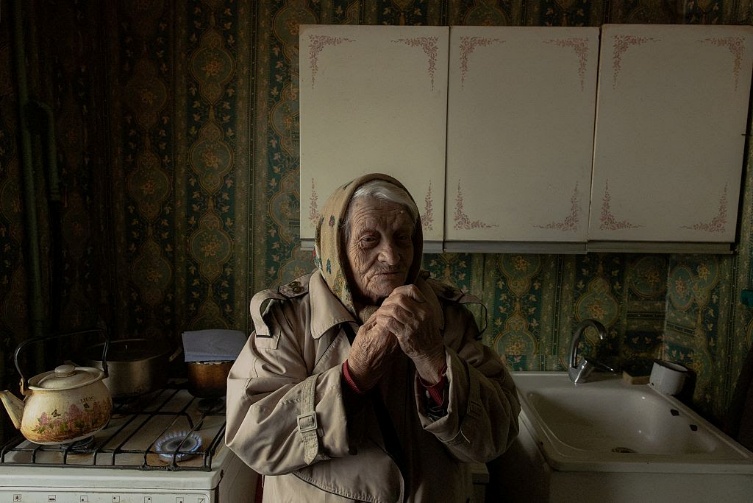
Yevheniia Yeremina, an 89-year-old pensioner, stands in her kitchen using a gas stove to warm her apartment, which has no electricity and heating, in Kyiv, following Russian missile and drone attacks on Ukrainian energy infrastructure. (Roman Pilipey / AFP via Getty Images)
Receipts of War: How Russia’s Checkout Lines Became the Frontline
The war announces itself quietly in Russia—on paper slips handed across grocery counters.
Since the Kremlin raised the value-added tax from 20 to 22 percent, prices have begun moving faster than the official numbers can contain. Independent outlets tracked the gap: in the first days of January, inflation barely registered, while essential goods climbed sharply higher. What the state called stability, shoppers experienced as erosion.
The math was simple and unforgiving. Every purchase carried the war inside it. Businesses passed the tax straight through. A basket that cost 100 rubles now edged toward 126. The result was not abstract economic pressure but smaller meals, postponed repairs, and a growing sense that money no longer stretched as far as it once did.
This squeeze did not start this year. Military spending and sanctions had already driven up fuel, utilities, alcohol, and cigarettes. Gasoline prices raced ahead of inflation. Everyday household items crept up by double digits. The tax hike merely tightened a vise already closing.
The war economy deepened the strain. Defense production came first. Banks shifted risk onto consumers. Labor shortages pushed wages higher on paper—only for inflation to strip those gains away before they reached family budgets.
In occupied Crimea, the distortion became brutal. Prices more than doubled. Transport, healthcare, housing, and education surged beyond reach, war and occupation feeding off each other.
Russia could endure this—for now. Mobilization masked decay. But every missile came at a civilian cost. Every tank replaced a school, a road, a hospital.
The bill was being paid in real time. Russians just hadn’t finished reading it yet.
Surrender by Spreadsheet: Moscow’s Demand Ukraine Give Up What Russia Can’t Take
The demand was delivered calmly, almost casually.
Russia’s lead negotiator, Kirill Dmitriev, accused President Volodymyr Zelensky of blocking peace by refusing territorial concessions. The phrasing suggested obstinance, delay, unnecessary stubbornness. But behind it sat a calculation so stark it stripped the language of any pretense.
Russian forces controlled roughly sixty percent of Donetsk Oblast. At their current pace, military analysts estimated they would need well into 2027 to seize the rest—if they could do it at all. Moscow was not negotiating from strength. It was negotiating from arithmetic. Hand over the land now, Dmitriev implied, or we will keep trying to take it later, no matter the cost.
The equation was simple. Ukraine could surrender territory Russia had failed to conquer, sparing Moscow casualties, time, and resources. Or Ukraine could refuse—and Russia would continue grinding forward until the numbers changed.
European officials heard the message clearly. Germany’s foreign minister, Johann Wadephul, described Russia’s position as rigid to the point of paralysis: absolute insistence on territory, zero flexibility elsewhere. Diplomacy, he noted, did not mean abandoning Ukraine or accepting demands built on force.
The Kremlin’s tactic followed a familiar script. Shift blame outward. Accuse the victim of obstruction. Present maximalist demands as reasonable compromise. Turn refusal to surrender into evidence of bad faith.
What Dmitriev’s words clarified was not a path to peace, but the terms of continued war. Talks were not about borders to be negotiated, but borders to be conceded. There was no middle ground between occupation and sovereignty, no halfway measure between giving up land and defending it.
The message was blunt. Capitulate now—or endure more destruction until someone breaks.
Missiles for Silence: Medvedev’s Nuclear Bargain to Freeze the War in Place
The warning arrived dressed as diplomacy.
In an interview with Kommersant, Dmitry Medvedev spoke calmly about arms control, about stability, about responsibility. The New START treaty, he noted, would expire on February 5, 2026. Russia, he said, was willing to respect its limits for another year—if the United States did the same. But there was a condition, delivered with deliberate clarity: first, Washington would need to “normalize bilateral relations” with Moscow.
Translation: stop pressing us on Ukraine.
The offer was not about peace. It was about distraction. Russia would talk missiles while tanks kept moving. It would discuss ceilings on warheads while continuing to redraw borders by force. Arms control, Medvedev suggested, could resume—but only if the war that made it urgent was politely set aside.
The threat hovered just beneath the surface. Without cooperation, Medvedev warned, strategic stability would unravel. Other nations might seek nuclear weapons. He invoked Russia’s newest systems—Burevestnik, Oreshnik, Poseidon—not as negotiation points, but as reminders. Moscow still held tools that could unsettle the world if ignored.
The strategy was familiar. Offer Washington something it had long valued: high-profile arms talks, symbolic restraint, the appearance of great-power responsibility. In return, demand silence—or accommodation—on Ukraine. Normalize relations first. Everything else could wait.
What Medvedev was testing was not treaty language, but resolve. Could arms control theater eclipse commitments to Ukrainian sovereignty? Could bilateral dialogue substitute for ending a war of aggression?
The price of the bargain was clear. Russia would keep fighting. Ukraine would be left to absorb the consequences. And the world would talk about missiles instead of invasion.
The question was whether Washington would accept the trade.
Six Ships from Glasgow: How Arctic Gas Keeps Russia’s War Machine Fueled
Follow the money far enough north, and it breaks through the ice.
Urgewald’s research traced a critical artery of Russia’s war economy not to Moscow or Beijing, but to Glasgow. In 2025, the shipping company Seapeak emerged as the single largest carrier of Russian Arctic LNG from the Yamal project, moving cargoes worth roughly £2.3 billion—revenue equivalent to tens of thousands of Shahed drones that later screamed into Ukrainian cities.
The mechanics were precise and indispensable. Seapeak operated six of the fifteen Arc7 ice-class tankers built specifically for Yamal—vessels capable of carving paths through frozen Arctic seas when ordinary tankers could not move. Without them, Russian gas would sit trapped behind winter ice. With them, it flowed steadily into European and global markets.
The scale mattered. Yamal LNG exported more than €7 billion worth of gas to Europe in 2025, supplying nearly fifteen percent of the EU’s LNG imports. The project was not sanctioned. The northern energy corridor remained open even as the southern battlefield burned.
Critics did not mince words. Urgewald’s Sebastian Rotters called the Arc7 fleet the “backbone” of Russia’s Arctic exports and urged immediate action against the ships themselves. Activist Svitlana Romanko made the link unavoidable: these vessels were not just moving fuel, but funneling cash directly into Russia’s budget—money converted into missiles, drones, and destruction.
The contradiction was stark. European governments pledged solidarity with Ukraine while European markets absorbed Russian gas delivered by Western companies. Each cargo warmed homes and powered factories—and quietly financed the war those same governments condemned.
Six ships sailing out of Glasgow became symbols of that dissonance: energy security chosen again and again over strategic coherence, even as the cost was paid elsewhere.
A Ban Deferred: Europe Cuts Russian Gas—But Not Yet
The decision landed with applause—and a clock.
After years of debate, the Council of the EU approved a phased ban on Russian liquefied natural gas and pipeline gas, formally committing Europe to break an energy dependence forged over decades. The vote closed one chapter of hesitation. It opened another of delay.
Under the plan, restrictions would begin within weeks, but the decisive break would come later. LNG imports would end in early 2027. Pipeline gas would follow that autumn. Member states were ordered to verify gas origins, file diversification plans by March 2026, and brace for penalties that could reach tens of millions of euros—or more—for violations.
Almost immediately, the fractures appeared. Hungary and Slovakia announced legal challenges, denouncing the move as a procedural trick to avoid unanimity. The language was diplomatic. The meaning was not. Russian gas, they signaled, would remain welcome.
The timing mattered more than the rhetoric. Even as Europe set an exit date, European companies were still moving billions of euros’ worth of Russian LNG. The eighteen-month gap between decision and enforcement created a final windfall window—time for Moscow to extract maximum revenue while Europe scrambled to line up alternatives.
Supporters framed the vote as a turning point. Cyprus’s energy minister hailed a stronger, more resilient market finally severing a dangerous dependency. Critics saw something colder. Sanctions campaigners pointed to Ukrainian families shivering through missile-damaged winters while Russian gas continued to heat European homes—and finance the strikes that darkened Kyiv’s skyline.
The choice, in the end, was both real and incomplete. Europe chose autonomy. It simply postponed paying for it.
Meters, Not Miles: How Winter Turned the Front Into a War of Attrition
The ground was frozen, but the fighting was not.
Along the Pokrovsk axis, Russian infantry moved in small groups—probing, slipping forward, retreating, then trying again. Commander-in-Chief Oleksandr Syrskyi counted more than 400 clashes in that sector in a single week. No sweeping assaults. No breakthroughs. Just constant pressure, measured in bodies and meters.
Ukraine’s response was deliberate. Syrskyi described the task plainly: destroy reserves, bleed offensive potential, force Russia to regenerate combat power faster than it could sustain. Drones replaced mass. Attrition replaced maneuver. Every Russian group that slipped forward was met, fixed, and dismantled before it could consolidate.
North of Sumy City, Russian forces seized Andriivka and tried pushing closer—seeking artillery range that would put the city under sustained fire. They failed. Ukrainian strikes hit manpower concentrations near Yunakivka before those units could execute their plans. Advance attempted. Advance interrupted.
Near Kharkiv, progress slowed to a crawl. Despite committing a combined arms army and three corps, Russian forces advanced only a few kilometers west of Vovchansk over three months. Effort exceeded return. Units were stretched across too many directions, a problem of overreach rather than manpower.
Around Lyman and Slovyansk, small Russian groups slipped into gaps, hoping to open the road toward the Slovyansk-Kramatorsk agglomeration. They did not last. Ukrainian commanders reported destroying infiltration teams at ratios as high as six-to-one.
Elsewhere, claims and counterclaims blurred into noise. Some villages changed hands earlier than acknowledged. Others never did. Footage showed strikes without consolidation, movement without control.
Then winter closed in. Snow slowed drones. Cold crippled vehicles. Infantry fought the elements as much as each other, abandoning exposed positions simply to survive.
This was the frontline now: advances counted in meters, frozen ground enforcing limits, and a war grinding forward without resolution.
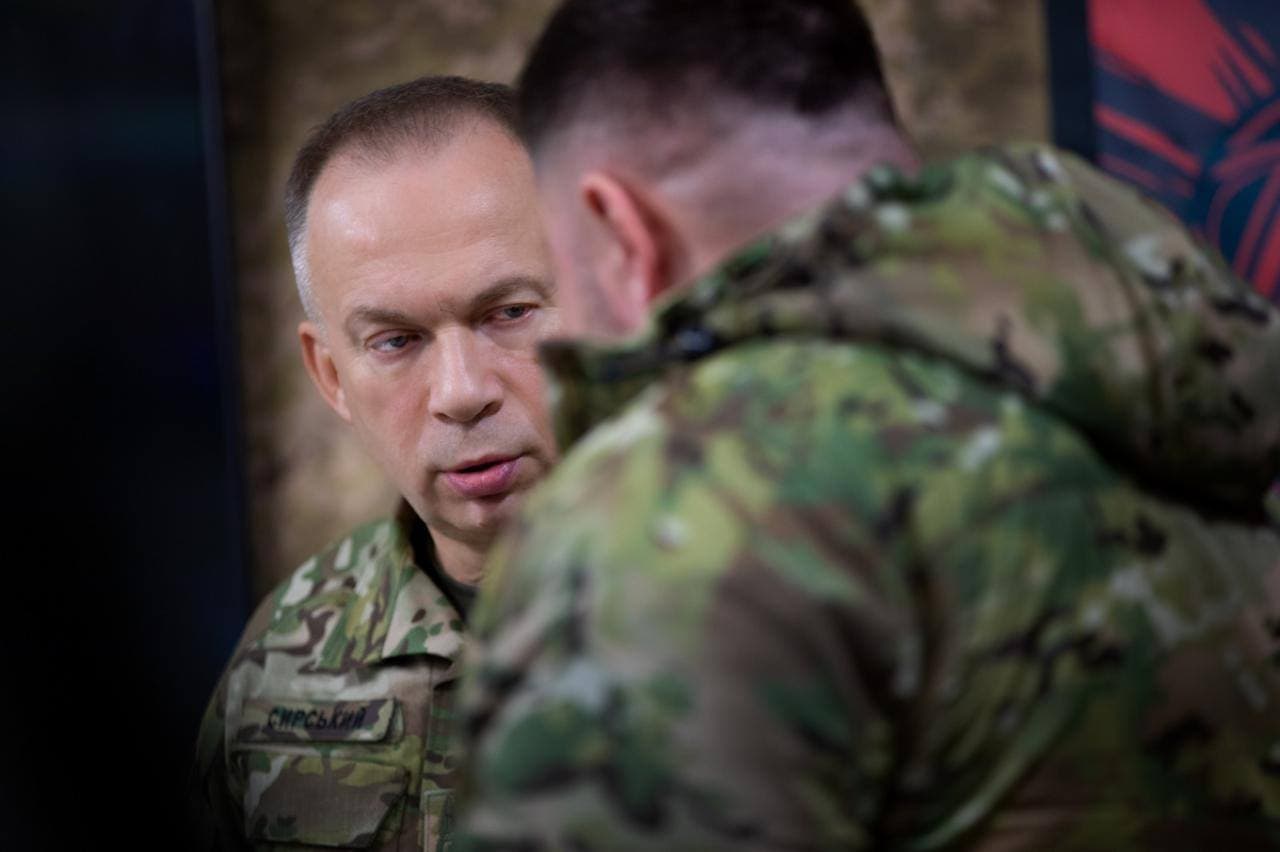
Oleksandr Syrskyi, Commander-in-Chief of Ukraine’s Armed Forces, photographer at a command point near Pokrovsk in Donetsk Oblast, in a photograph published on his official Facebook account. (CinC AF of Ukraine / Facebook)
Fuel, Ammunition, Silence: Ukraine’s Quiet War on Russia’s Lifelines
The strike came at night, far from the trenches.
Ukrainian drones crossed into Russia’s rear and hit the Slavyansk oil refinery in Slavyansk-on-Kuban, a facility that fed the machinery of war rather than the headlines. Ukrainian military officials reported damage to the plant’s primary processing units. Local Russian authorities confirmed the impact. Four million tons of annual capacity—roughly eleven thousand tons a day—suddenly became uncertain.
The effect was immediate, even if the fire was contained. Fuel not refined was fuel not moved. Every disrupted shipment forced Russian planners to reroute logistics, draw from reserves, or wait while repair crews worked under pressure. Modern armies run on fuel. Interrupt it, and everything slows.
The same night, Ukrainian strikes reached deeper into occupied territory. A military logistics warehouse in Donetsk City—nearly forty-five kilometers from the frontline—was hit, underscoring that distance alone no longer guaranteed safety. In Zaporizhia Oblast, warehouses near Solodkovodne were struck again, continuing a pattern of systematic pressure rather than symbolic retaliation.
Then came the quieter target. Near Velyka Novosilka, Ukrainian forces hit a Russian drone control point. No fireball. No dramatic footage. Just lost links, disrupted command chains, and operators forced to rebuild networks while operations stalled.
These attacks did not promise immediate collapse. They were not meant to. Ukraine could not halt every Russian advance. What it could do was make each one harder—more expensive, slower, less predictable.
Rear areas once assumed secure now required defense. Air defenses stretched thinner. Supplies scattered across more locations, each another vulnerability.
This was counterpressure by design: not a single decisive blow, but cumulative friction—fuel delayed, ammunition missing, signals cut—until the weight of small disruptions bent larger operations out of shape.
The Math of the Swarm: One Night, 138 Drones, No Perfect Defense
The warning lights filled the screens all at once.
Ukrainian Air Force operators watched the tracks bloom across their displays—138 drones lifting from multiple directions, converging in the dark. Shaheds. Gerberas. Nearly ninety Shaheds alone. They came from Kursk, Oryol, Bryansk. From Millerovo in Rostov Oblast. From Primorsko-Akhtarsk on the Black Sea. From occupied Donetsk City. Distance offered no protection. Geography meant nothing.
Air defenses went to work. Missiles launched. Guns tracked. Crews rotated through exhaustion and muscle memory. By morning, 110 drones were confirmed destroyed.
But twenty-one still made it through.
They struck eleven locations. Residential blocks. Energy sites. Civilian infrastructure across Chernihiv, Kharkiv, and Zaporizhia oblasts. In one place, falling debris caused damage even where interception succeeded. This was what “success” looked like under saturation attack.
The numbers told the story better than any statement. Eighty percent intercepted—and still homes were hit. Power was lost. Fires burned. Against swarms this large, perfection was impossible. The only question was whether defenses could blunt the damage enough to keep the system standing.
That, too, was the point of the attack. Russia was not seeking one decisive blow. It was testing endurance. Demonstrating that sanctions had not emptied its stockpiles. Proving that every night could carry risk, even far from the front.
One hundred ten drones downed. Twenty-one impacts. Eleven locations hit.
Another night where air defense crews saved dozens of lives—and went home knowing they could never save them all.
This was attrition from the air: not collapse, but exhaustion. Repair crews fixing what was broken, knowing they would be back again tomorrow.
The Day’s Meaning
This day exposed a war accelerating in opposite directions at once.
Technology surged ahead while defenses lagged behind. A Starlink-guided drone reached Dnipro, bypassing electronic warfare that once defined Ukraine’s edge. The lesson was not novelty but velocity: tools meant to connect now guided weapons, and adaptation lagged behind innovation. Ukraine could still intercept, but no longer everywhere, all at once.
Economics told a parallel story. Inside Russia, price spikes outpaced official inflation, siphoning civilian income into the war machine. Taxes rose. Purchasing power fell. In occupied Crimea, inflation became distortion. Yet outside Russia, European companies still moved billions in Russian energy—funding the same war that strained Russian households. Pressure was real, but unevenly applied.
On the battlefield, motion continued without resolution. Russian forces advanced in small increments, probing through infiltration rather than force. Ukrainian units absorbed the pressure, destroying reserves faster than they could be replaced. Four hundred clashes in a single sector signaled intensity without breakthrough—attrition replacing maneuver, winter enforcing limits on both sides.
Diplomacy clarified without converging. Moscow demanded territory it could not seize and framed refusal as obstruction. Arms control was offered as a substitute for ending the war, not a path toward it. Europe insisted on principles while postponing consequences, committing to future bans while present revenue still flowed east.
Everything connected. Nothing resolved.
The questions hardened rather than softened. Could Ukraine counter satellite-guided strikes before they reshaped the air war? Would civilian economic strain inside Russia ever outweigh the Kremlin’s tolerance for sacrifice? Could attrition degrade Russian combat power faster than it regenerated? Would Europe shorten the gap between decision and action?
No answers arrived. Only momentum.
Technology moved faster. Costs accumulated. Positions calcified.
The war did not pause. It recalibrated.
And tomorrow promised another adjustment—without relief, without resolution.
Prayer For Ukraine
• Pray for protection over civilians in cities targeted by drone swarms and long-range strikes, especially families sleeping without shelter from the night air or warning sirens.
• Pray for Ukrainian air defense crews, drone operators, and frontline soldiers facing exhaustion and impossible math, that they would have clarity, endurance, and mercy in moments where no perfect defense exists.
• Pray for wisdom and speed for those developing countermeasures to new technologies of war, that innovation would arrive in time to save lives rather than merely record losses.
• Pray for Russian civilians bearing economic pressure and distortion, that truth would cut through propaganda and that hardship would not harden hearts but awaken conscience.
• Pray for Europe and the wider international community, that moral clarity would overcome delay, and that decisions to cut war funding would move from future promises into present action.