
August 18, 2026
Prepared by Diana Bozhyk
A Russian Banderol strike killed at least ten civilians in the Kharkiv Oblast village of Pechenihy, even as new reporting revealed Moscow fired its own chief economist for warning that Russia’s war economy is stagnating and ordinary Russians are pulling billions from their bank accounts. Moldova’s president became the first European head of state to say plainly that Russia deliberately steers drones into NATO airspace, while a separate Russian jet-powered drone flew a record 560 miles into western Ukraine testing for gaps in the country’s air defenses. Zelensky formally nominated a new defense minister as Ukrainian drones struck Moscow itself overnight, and Russia’s own military intelligence chief admitted the Kremlin has no plans to sign a peace deal this year.
THE DAY’S RECKONING
Somewhere in a Moscow office, a bank’s chief economist told a room full of investors the truth about Russia’s war economy — that it’s stagnating, that ordinary Russians are running to withdraw their savings, that the numbers don’t support Putin’s theory that Russia can simply outlast everyone. Days later, he was fired. Not because he was wrong. Because he was right in public.
That’s the shape of today: truth quietly punished in Moscow, and violence openly delivered in Ukraine. Ten civilians dead in a Kharkiv Oblast village that had nothing to do with any front line. A drone flying 560 miles into Ukraine’s west, deliberately hunting for the seams in its air defenses. Moldova’s president finally saying out loud what everyone suspected — that some of these “stray” drones aren’t straying at all. And Ukraine, in the middle of all of it, launching one of its largest attacks yet on Moscow itself, striking a chemical plant, a power grid, a warehouse network, while quietly confirming a new defense minister to keep running the war on its end. Neither side blinked today. Both sides kept counting the cost.
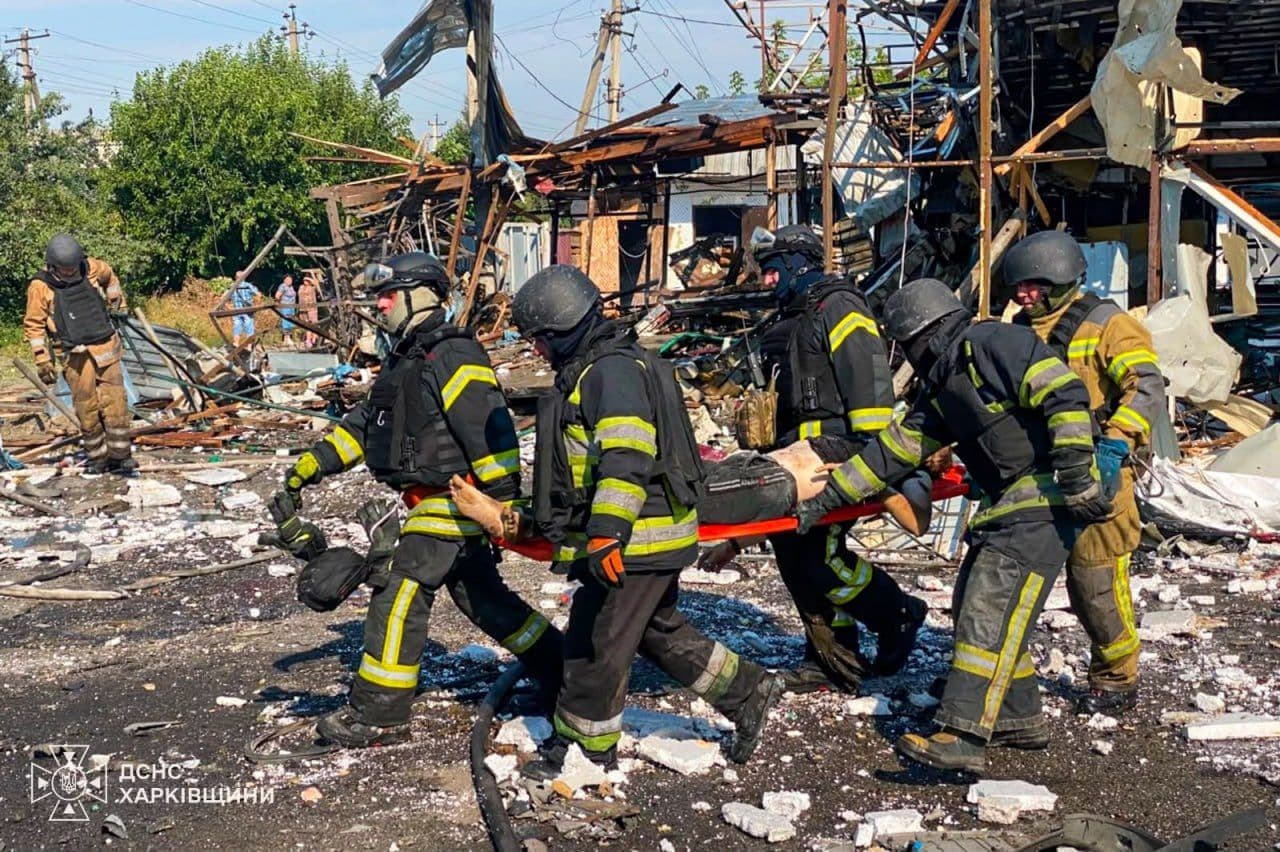
Aftermath of a Russian attack on Pechenihy in Kharkiv Oblast. (President Volodymyr Zelensky/Telegram)
RUSSIA’S ECONOMY CRACKS OPEN
For years, Vladimir Putin’s basic bet on this war has been that Russia can absorb the pain of a long, grinding conflict indefinitely. New reporting this week suggests even his own economists don’t fully believe that anymore — and one of them just lost his job for saying so.
Andrey Klepach, chief economist at Russia’s state development bank VEB, spent 12 years in the role and, before that, six years as a deputy minister of economic development under officials who now include Russia’s own defense minister. In May, he told a room of investors at a Moscow financial forum that Russia’s war economy is stagnating: high defense spending is crowding out civilian industry, a tight interest rate is choking investment, and Ukrainian strikes on ports, refineries, and logistics are acting as a real macroeconomic drag, with growth likely to flatline near zero this year. When independent Russian outlets reported his remarks in mid-August, VEB’s CEO fired him days later, reportedly after what a source described as a direct “call from above.”
The numbers back Klepach up. Russian businesses have already funneled roughly $4.5 billion in “voluntary” contributions to the federal budget this year — one and a half times last year’s total — after Putin personally leaned on business leaders to help ease the treasury’s burden. Meanwhile, the Washington Post reported that Russians withdrew a combined $15 billion from bank accounts between June and mid-August, with one senior Sberbank executive warning 2026’s withdrawals could nearly double those seen in 2022. None of this means Russia’s economy is about to collapse. It means Putin is now demanding more sacrifice from a public that’s starting to notice the bill, right before elections he can’t afford to have go badly.
MOLDOVA NAMES WHAT OTHERS WOULDN’T SAY
For months, European officials have described Russian drones crossing into their airspace with careful, deliberately ambiguous language — “likely accidental,” “under investigation,” “cause unclear.” Moldova’s president just dropped the pretense entirely.
Maia Sandu said plainly that Russia deliberately launches some of its drones into Moldovan and NATO airspace, explaining that her country’s authorities can actually distinguish, based on flight trajectory, between genuine navigation errors and deliberate incursions. It’s a significant break from the diplomatic caution most European leaders have maintained on this question, and it lines up with what independent researchers have long assessed: that these incursions likely serve a deliberate purpose, testing how neighboring countries detect and respond to violations before Russia potentially attempts something bolder.
The same day brought a separate, related warning. A Russian jet-powered Shahed-type drone flew nearly 560 miles from its launch point in occupied Crimea, threading through Mykolaiv, Vinnytsia, and Khmelnytskyi oblasts before reaching Dubno in Rivne — the farthest such strike ever recorded, and deep into territory Ukraine’s air defenses have historically treated as relatively safe. Monitoring analysts said the drone’s specific route, deliberately weaving around Ukraine’s major air-defense deployment zones, shows Russia is actively hunting for blind spots in the country’s coverage rather than flying toward a fixed target. With jet-powered drones’ range now nearly doubling what it was just months ago, analysts warned that virtually all of Ukraine, including its most remote western regions, now sits within reach.
UKRAINE GETS A NEW DEFENSE MINISTER NOMINEE
After more than a month without a permanent defense minister, President Zelensky formally submitted acting minister Yevhen Khmara’s candidacy to parliament for confirmation, with a vote possible as early as tomorrow. Khmara, a longtime SBU veteran who once commanded the agency’s Alpha Special Operations Center and led the 2022 operation to liberate Snake Island, has served as acting minister since mid-July, when Zelensky abruptly dismissed his predecessor, Mykhailo Fedorov, in a reshuffle that triggered months of ongoing public protests.
Fedorov himself broke a relative public silence the same day, releasing a video address that avoided directly relitigating his dismissal but made a pointed argument instead: that Ukraine needs a legal, realistic mechanism to hold elections even during wartime, rather than letting Russia effectively decide when Ukrainians next get to choose their government. “Democracy is not a peacetime luxury. Democracy is part of what we are fighting for today,” he said, pairing the argument with a broader call for government accountability — insisting that officials entrusted with public funds or authority owe citizens a clear account of what they’ve actually accomplished with it.
The timing wasn’t accidental. Fedorov’s remarks landed just hours after Khmara’s nomination became public, a pointed reminder that the political question his dismissal opened — about transparency, trust, and who gets to lead Ukraine’s defense ministry — hasn’t actually closed just because parliament is about to vote.
MEANWHILE, AT THE ACTUAL FRONT — THE NORTH AND EAST
Away from headline strikes, the ground war produced a rare mix: confirmed movement on both sides, in different directions, in the same general area.
Near Vovchansk, in Kharkiv Oblast, a source tracking Russia’s own military grouping openly acknowledged that Russian forces have actually lost more territory than they’ve gained in the area over the past month — directly contradicting official Russian claims of expansive gains there. Near Kupyansk and Borova, Ukrainian forces appear to have advanced modestly, with geolocated footage showing Russian troops striking Ukrainian positions in areas Ukraine didn’t previously hold, an indirect but reliable sign of a Ukrainian advance. Near Lyman, Ukrainian forces likely cleared Russian infiltrators from the town’s northern and central sections, with even a Russian military source acknowledging that Russian troops now remain only in the town’s southeastern edge, down from a wider foothold weeks earlier.
Around Kostyantynivka, the picture moved the other way: geolocated footage collected over the past two weeks indicates Russian forces have expanded their foothold across the town’s eastern and central areas, consolidating positions they’d previously only infiltrated. Nearby, Russian forces are reportedly hiding microphone-equipped “waiter” drones along roads around Kramatorsk, programmed to activate and strike only once they detect the sound of an approaching Ukrainian vehicle — a quiet, patient tactic aimed specifically at logistics convoys rather than combat units. Near Dobropillya, Russian infiltration attempts advanced into Krasnopodillya, while a nearby settlement, Krasnyi Kut, has reportedly been so thoroughly destroyed by weeks of Russian glide-bomb strikes that Russian infantry can no longer find intact cover among its own ruins.
MEANWHILE, AT THE ACTUAL FRONT — THE SOUTH
Further south, Russian claims of sweeping advances kept running into disputes from Russia’s own military bloggers, while Ukrainian officials ordered a serious evacuation.
Dnipropetrovsk Oblast’s regional head announced mandatory evacuations from 16 settlements in Synelnykivsky Raion, a stark, practical acknowledgment that Russian strikes and shelling have made continued civilian presence there unsafe regardless of whether the front line itself has moved. Near Hulyaipole, Russian forces continued offensive operations without confirmed advances, as Ukrainian counterattacks held the line — and even a Kremlin-aligned military blogger publicly disputed his own side’s claim of having seized the settlement of Novosoloshyne, noting Russian troops entered the area “some time ago” but still lack secure supply routes to actually hold it. Elsewhere in Zaporizhzhia Oblast, Russian sources claimed advances near Bilohirya and Mala Tokmachka that remain unconfirmed by independent monitors.
A grimly practical technological development emerged from the Kherson direction: Russian forces are reportedly deploying a new type of first-person-view drone rigged with a warhead specifically designed to sit motionless atop the anti-drone netting Ukrainian forces have strung over key highways, waiting until the netting shifts, a vehicle approaches, or a nearby magnetic field changes before detonating — a booby trap engineered to punish the very defensive measure meant to stop it. Ukraine, for its part, kept striking back across the region: hitting a Russian ammunition depot in Karlivka, a drone control station near Terny, and continuing intermediate-range strikes against Russian energy infrastructure in occupied Crimea, where Ukrainian drone strikes triggered power outages across the peninsula’s southern half overnight.
A MASSIVE DRONE ATTACK ON MOSCOW ITSELF
Overnight, Ukraine launched one of its largest drone attacks yet against Moscow and the surrounding region — a strike big enough that even Russian officials couldn’t fully agree on its scale. Moscow’s mayor said 197 drones were shot down over Moscow Oblast specifically; Russia’s Defense Ministry claimed a far larger figure of 791 drones downed across 13 regions nationwide, out of roughly 600 claimed launched at the Moscow region alone. None of these figures could be independently verified, but the pattern of damage reported across multiple, unrelated sources suggests a genuinely large-scale operation.
Fires were reported at a Wildberries logistics facility in Obukhovo, an aluminum plant, a home in Lyubertsy just outside Moscow, and the Severnoye Domodedovo warehouse complex — a site that, notably, was previously used to store radioactive materials before becoming a supermarket distribution hub. A Russian air-defense missile reportedly struck a residential building in Pavlovsky Posad, 42 miles outside Moscow, while ordinary residents in nearby towns filmed panicked scenes of explosions and fleeing traffic. Separately, drones struck the Karbolit chemical plant a second time this week, and Russia’s Mosoblenergo confirmed Ukrainian strikes knocked out a higher-level power grid node, cutting electricity to 109 transformer substations, roughly 5,000 customers, and 46 public facilities across two towns east of Moscow.
UKRAINE’S DEEP STRIKES, CONFIRMED
Two separate pieces of evidence surfaced today confirming just how much damage Ukraine’s long-range campaign has already done — including to a target central to Russia’s nuclear-capable bomber fleet.
New satellite imagery confirmed that Ukraine’s mid-August strike on the Progress Space Rocket Center in Samara — nearly 925 miles from the border — hit Building 106A not once but twice. That building is reportedly responsible for modernizing Russia’s Tu-95 strategic bombers, the aircraft Russia uses to launch some of the cruise missiles that regularly strike Ukrainian cities, meaning the strike’s value extends well beyond the satellite-manufacturing angle initially reported.
Separately, Bloomberg reported that an oil tanker carrying Russian-origin cargo loaded at the Novorossiysk terminal was struck in the Black Sea, with a maritime intelligence firm suggesting Ukrainian forces were likely responsible. The strike is notable because Ukraine had reportedly agreed months earlier to halt strikes on tankers using that specific terminal, provided the vessels weren’t carrying sanctioned Russian cargo — meaning this strike, if confirmed as Ukrainian, would represent enforcement of that carve-out rather than a violation of it. Separately, Russia’s embassy in London issued a pointed threat over British-made drones reportedly used in some of these deep-strike missions, warning of unspecified “consequences,” while UK officials reaffirmed their commitment to supporting Ukraine’s defense without confirming operational details.
TEN DEAD IN PECHENIHY
The deadliest single strike of the day landed on a village most people outside Ukraine have never heard of. Russian forces struck Pechenihy, a settlement in Kharkiv Oblast, with two Banderol loitering munitions early that morning, killing at least ten civilians and injuring eight more, according to regional officials. President Zelensky confirmed the strike hit residential areas of the town directly.
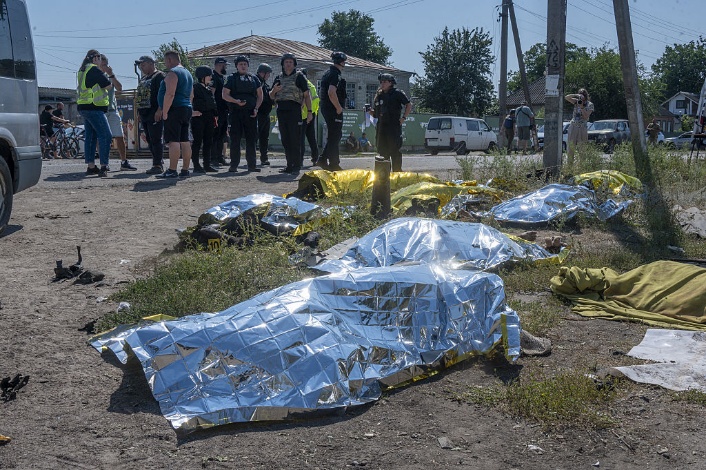
Rescue workers and residents clear the area after Russia fired two Banderol missiles at a cafe and a store in the village of Pechenihy in Kharkiv Oblast, killing 10 people. (Serhii Masin/Anadolu via Getty Images)
Pechenihy sits well behind the active front line, a fact that makes the strike’s civilian toll harder to explain as collateral damage from a legitimate military target and more consistent with a pattern Ukraine has documented repeatedly throughout the war: Russian strikes on ordinary residential areas that serve no clear military purpose beyond inflicting fear and loss. Local officials released footage of the aftermath showing a residential street reduced to rubble, structural damage extending well beyond the immediate impact site.
Ten people is a number easy to read past in a summary of the day’s events. It represents an entire slice of a small community, gone in a single morning, for reasons that will likely never be adequately explained by the side that fired the weapon. Emergency crews spent hours working through the wreckage, and regional officials said the final toll could still rise as search operations continued into the evening — a grim possibility that has, unfortunately, proven accurate in similar strikes elsewhere in Ukraine before.
147 DRONES OVERNIGHT, 76 MORE BY DAY
Russia didn’t let up after its overnight barrage. Overnight, Russian forces launched 147 Shahed-type, Gerbera-type, and jet-powered decoy drones from five separate directions inside Russia and occupied Crimea. Ukrainian forces intercepted 111; the rest struck 19 locations, with debris landing at three more, hitting civilian, industrial, and logistics infrastructure across six oblasts and causing power outages in six more regions.
Then, separately, Russia launched a second wave: 76 jet-powered Shahed-type drones between 7 a.m. and 6 p.m. — a daytime attack distinct from the overnight package, reflecting how normalized round-the-clock drone warfare has become. Ukrainian air defenses intercepted 70 of those, triggering nine separate air-raid alerts in Kyiv alone over the course of the day, with debris from intercepted drones falling in the capital’s Dniprovskyi district without causing fires, according to the mayor. As of the early evening, more than 20 jet-powered drones remained active in Ukrainian airspace, still being tracked.
The math is straightforward and exhausting in equal measure: Ukraine’s air-defense crews are increasingly fighting two full-scale drone waves in a single 24-hour period, not one. Officials say the shift toward jet-powered variants is deliberate and accelerating — Russia launched five times more jet-powered drones in July than in June, and on some days now, two-thirds of an entire day’s launches are jet-powered rather than the older, slower propeller-driven type. Each jet-powered drone forces defenders to make faster decisions with a narrower margin for error, since standard mobile fire teams using rifles or machine guns increasingly can’t react in time — meaning more of the burden falls on scarce fighter jets and surface-to-air systems better suited for slower, more traditional threats.
DTEK POWER PLANT GOES DARK
Russian forces struck one of Ukraine’s DTEK thermal power plants, damaging equipment severely enough that the facility has completely halted electricity generation, according to the company. DTEK, Ukraine’s largest private energy company, didn’t disclose which plant was hit or offer a timeline for restoring output.
The strike adds to a grim tally: DTEK’s thermal plants have now been targeted more than 230 times since the war’s start, with the company’s last major hit, in June, killing one employee. The timing carries extra weight given the approaching winter — Ukrainian officials have repeatedly warned that Russia is expected to intensify strikes on power and heating infrastructure as temperatures drop, a deliberate strategy aimed at breaking civilian morale and straining Ukraine’s grid at the moment it’s least able to absorb further damage.
Each plant taken offline doesn’t just mean lost capacity for today; it means a harder winter for however many households and businesses depended on that specific facility’s output, with repairs that can take weeks or months even when parts and expertise are available, which they increasingly aren’t under current sanctions. DTEK, as Ukraine’s largest private energy provider, has effectively become a recurring target precisely because of its scale — knocking out one of its plants ripples across a wider customer base than a single smaller municipal facility would. Ukrainian officials have begun compiling contingency plans, including lists of vulnerable residents who may need emergency relocation if outages stretch on, a quiet acknowledgment that this winter, like the last several, will likely test the country’s grid in ways no amount of advance planning can fully offset.
ARMING UKRAINE, DEFENDING EUROPE
Two parallel efforts advanced today, one aimed at getting Ukraine more weapons, the other at helping Europe defend against the kind that keep crossing its borders.
President Zelensky said Ukraine and Belgium are finalizing a new “Drone Deal” agreement, following talks with Belgian Deputy Prime Minister Maxime Prévot covering defense and diplomatic cooperation broadly. Zelensky praised Belgium for already disbursing over $1.3 billion in support this year and for backing Ukraine’s path toward EU membership, adding that Ukraine is prepared to share its own battlefield expertise in return — part of a growing pattern of similar drone-technology partnerships Ukraine has signed with the EU, Denmark, and other allies in recent months.
Meanwhile, Germany opened a new drone-defense research center in Cochstedt, roughly 25 miles south of Magdeburg, less than two weeks after an explosive-rigged drone was discovered near a Ukrainian cargo plane at Leipzig-Halle Airport — an incident US and German intelligence widely attribute to Russia. The facility, built around Germany’s existing national test center for unmanned systems, is designed to research and test counter-drone technology under realistic conditions. “We are significantly strengthening our ability to respond to hostile drones,” Germany’s interior minister said, a direct acknowledgment that European counter-drone infrastructure is racing to catch up with a threat that’s already arrived rather than one still theoretical.
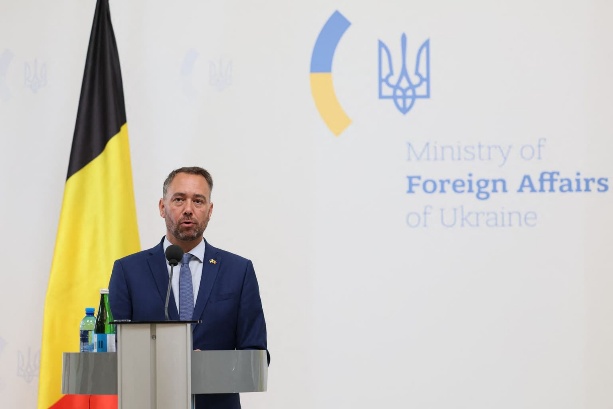
Belgian Foreign Minister Maxime Prevot pictured at a press moment during a visit to Kyiv. (Benoit Doppagne / BELGA MAG / Belga / AFP via Getty Images)
A HERO COMES HOME, FOR REAL THIS TIME
Ukraine formally reburied Yevhen Konovalets, founder of the Organization of Ukrainian Nationalists and a central figure in the country’s early-20th-century independence movement, at the National Military Memorial Cemetery outside Kyiv, with President Zelensky attending and delivering remarks. “Along with him, Ukraine has brought back a part of itself,” Zelensky said, calling Konovalets’s life “both heroic and tragic.”
Konovalets spent his life in exile organizing Ukraine’s independence movement before a Soviet agent posing as an ally assassinated him in Rotterdam in 1938 with a bomb hidden inside a box of chocolates. His remains were exhumed in the Netherlands on August 11 and returned to Ukraine on August 13; today’s ceremony completed that process with full state and military honors.
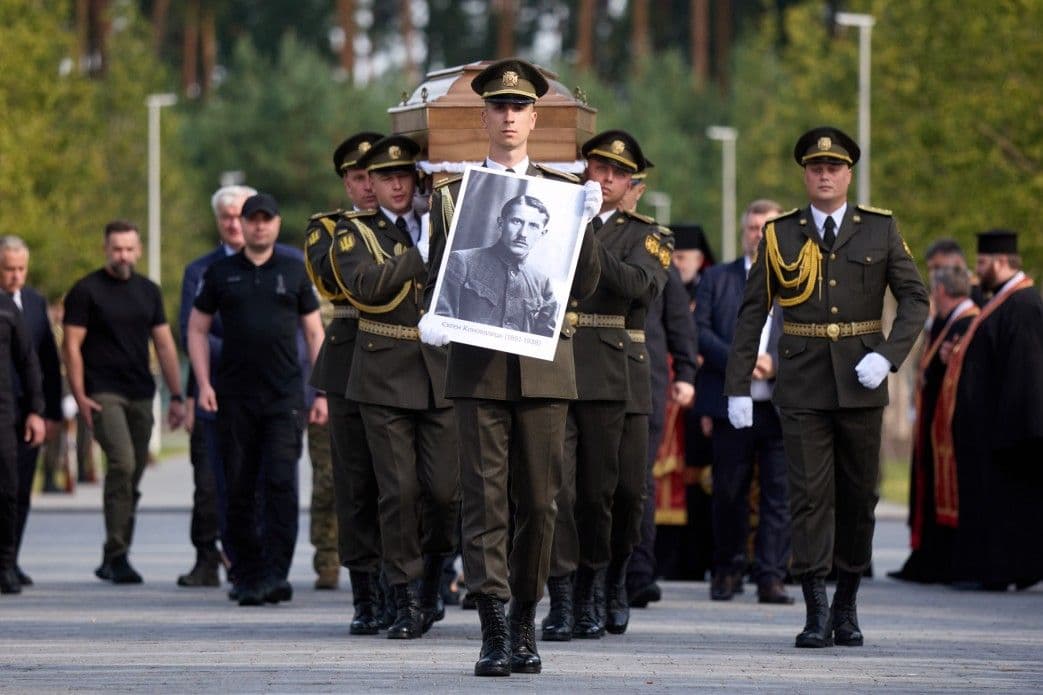
Twentieth-century military leader Yevhen Konovalets is reburied in Kyiv. (President’s Office)
Zelensky used the occasion to pledge that Ukraine will keep working to repatriate other historical figures buried abroad, part of a broader effort to establish a formal “National Pantheon” honoring the country’s past and present heroes — though officials involved say there’s no official list yet of who else might eventually be included. Konovalets’s repatriation followed a similar return earlier this year of Andriy Melnyk, another prominent 20th-century Ukrainian nationalist leader. For a country currently burying soldiers killed this week alongside a man killed 88 years ago, the ceremony offered something rare: a moment to honor loss on a timeline slower and more deliberate than the war currently allows, a reminder that Ukraine’s fight for independence has spanned generations far longer than the current invasion, and that its dead, however long ago they fell, still matter enough to bring home.
SPIES, DEALS, AND DEPARTURES
Three separate stories today touched on the murkier machinery running alongside the war: espionage, procurement, and the people caught navigating both.
Ukraine’s Security Service detained a man in Kharkiv Oblast accused of registering 27 Starlink satellite internet terminals in the frontline city of Izium for Russian military use — allegedly to help coordinate assault units and drone strikes. Investigators said the suspect, an unemployed displaced person from occupied Luhansk Oblast, was recruited online after searching for ways to earn money, and was later instructed to enlist local residents to register additional terminals under their own names, part of a broader pattern of Russia recruiting ordinary Ukrainians through financial incentives or coercion to get around Starlink’s verification restrictions. Separately, a German court in Stuttgart sentenced a 30-year-old Ukrainian man to 15 months for spying and preparing a sabotage operation involving GPS-tracked incendiary parcels, while acquitting two co-defendants in the same case — one more data point in a rising number of Russian-linked sabotage plots German and other European authorities have uncovered this year.
Meanwhile, Arsen Zhumadilov, head of Ukraine’s Defense Procurement Agency, is reportedly resigning effective September 1, according to Ukrainian media citing undisclosed sources. Zhumadilov was previously questioned as a witness in a major corruption investigation tied to a Zelensky associate, though he denied any wrongdoing; his departure comes amid a broader leadership reshuffle at the defense ministry that also includes Khmara’s nomination as permanent minister.
WHO’S PAYING FOR THE WAR
Behind the daily strikes sits a quieter set of financial and diplomatic relationships keeping both sides’ war machines running — and today brought new detail on several of them.
A sanctions-monitoring group reported that a single Greek shipping company, Dynagas, delivered $2.7 billion worth of Russian liquefied natural gas to EU customers in the first seven months of this year, accounting for roughly 22 percent of all Russian LNG reaching Europe — a business relationship EU leaders recently exempted from sanctions entirely. “It is beyond the pale that Europe is still paying billions for Russian LNG” while Ukraine endures an intense bombing campaign, one campaigner said, noting some EU countries, including Belgium, now source 100 percent of their LNG imports from Russia. Separately, NBC News reported that Russia has shipped ammunition, drone components, and explosive material to Iran via the Caspian Sea using more than two dozen vessels, deepening a military relationship that already sees Iranian-designed Shahed drones regularly killing Ukrainian civilians.
Ghana’s foreign minister, meanwhile, appealed directly to Moscow to stop what he called the “illegal recruitment” of Ghanaian citizens into Russia’s war, revealing that 62 Ghanaians have already been killed fighting for Russia and 15 remain missing. Russia’s foreign minister responded by claiming the recruits signed up voluntarily out of “solidarity” and financial interest — a claim that sits uneasily alongside repeated warnings from other African governments, including Botswana, about deceptive recruitment schemes targeting their citizens with promises of easy money and Russian citizenship.
RUSSIA’S OWN INTELLIGENCE CHIEF LAYS OUT THE NEXT FOUR YEARS
In an unusually candid interview, a senior Ukrainian military intelligence official offered a blunt forecast of Russia’s plans — one that leaves little room for optimism about a near-term end to the war.
Vadym Skibitsky, deputy chief of Ukraine’s HUR intelligence directorate, said flatly that Russia shows no sign of preparing to halt its war and won’t sign any peace agreement by the end of the year, with Putin still pursuing the full capture of Donetsk Oblast. Skibitsky said Russia’s monthly losses now consistently exceed its monthly recruitment — roughly 40,000 losses against 39,000 new contract signings in July alone — putting Moscow’s annual recruitment target of 409,000 contract soldiers increasingly out of reach without a fresh mobilization wave, something Skibitsky said HUR hasn’t ruled out occurring after September’s elections. He said Russia currently fields roughly 670,000 combat troops against Ukraine, with another 65,000 in reserve, but explicitly ruled out any near-term Russian offensive from the north toward Kyiv or Chernihiv, citing a clear absence of the troop buildup such an operation would require.
Skibitsky also confirmed Ukraine’s long-range strike campaign is inflicting real damage, noting that deep strikes on Russian infrastructure have become the second-biggest domestic concern among ordinary Russians, behind only living standards. He added that HUR assesses Russia is actively preparing for a potential conflict with NATO by 2030, focusing for now on hybrid tactics — drone incursions, disinformation campaigns, and support for pro-Moscow political movements — rather than direct confrontation, a strategy Skibitsky said has historically preceded larger military conflicts rather than substituted for them.
AN ECONOMIST FIRED, A VILLAGE MOURNING, A NOMINEE CONFIRMED
By nightfall, the day’s throughline was unmistakable: both sides are running out of ways to hide what’s actually happening. Russia fired the one economist willing to say its war economy is stagnating. Ukraine confirmed a new defense minister nominee while striking Moscow hard enough that officials couldn’t agree on how many drones even got through.
Ten people in Pechenihy will never see tomorrow. A drone flew 560 miles searching for a gap in Ukraine’s defenses and, this time, didn’t fully find one. And somewhere in Kyiv tonight, a family finally has a proper grave to visit for a great-grandfather who died in exile 88 years ago — a small, quiet victory in a war mostly defined by everything but victories. Nothing today ended anything. Everything today made the shape of what’s still coming a little harder to ignore.
A PRAYER FOR UKRAINE
1. For the Ten Lost in Pechenihy
Lord, ten people are dead tonight in a village far from any front line, killed by two weapons aimed at ordinary homes. We cannot explain a strike like this except to name it what it is: cruelty without military purpose. Receive each of them by name, comfort the eight who survived with injuries and the grief that follows, and let this village’s name be remembered as more than a line in tomorrow’s casualty count.
2. For the Displaced and the Desperate, Exploited by Both Sides
Father, we lift up the vulnerable people caught between survival and coercion — the displaced person recruited online into spying, the foreign worker promised easy money and sent to die in a war not his own. Protect those targeted for exploitation because they had nowhere else to turn. Give Ukraine’s investigators wisdom to find them before harm is done, and give the exploited a path back to safety and dignity.
3. For a Russian Economist Punished for Honesty
Lord of truth, we pray for those in Russia who still tell the truth, even at real personal cost — an economist fired for accurate numbers, ordinary citizens who quietly doubt what they’re told. Give truth-tellers protection we cannot see from here. Let honest numbers eventually outlast comfortable lies, however long that takes, and let it matter for the millions still paying the price of a war built on those lies.
4. For a Nation Choosing Both War and Democracy
God of nations, we pray for Ukraine’s continued commitment to self-governance even now, mid-war, mid-crisis, mid-uncertainty. Give wisdom to those confirming new leaders and reforming old systems under pressure no peacetime government ever faces. Let the accountability Ukrainians keep demanding of their own government be a strength this war cannot erode, and let democracy survive exactly the test it’s currently facing.
5. For the Slow, Uneven Work of Bringing People Home
God of memory, we pray for every effort to bring the lost home — a leader finally properly buried, soldiers’ remains still being identified, families still waiting for confirmation. Give patience to those doing this quiet, necessary work. And give the living reason to believe that even a war this long eventually returns what it took, one name, one grave, one family at a time.
In Your mercy, in Your justice, in Your time — bring this war to its end, and let the ending be worthy of what Ukraine has endured.