
As Trump and Putin Meet Without Achieving Ceasefire, Russian Strikes Kill Six Civilians While Ukrainian Forces Battle Infiltrating Infantry Across Multiple Fronts
Summary of the Day – August 15, 2025
The first face-to-face meeting between a U.S. president and Vladimir Putin in over four years concluded with no concrete progress toward ending the war in Ukraine. President Donald Trump’s three-hour summit with the Russian leader at Joint Base Elmendorf-Richardson in Alaska produced warm rhetoric but no ceasefire, no territorial agreements, and no timeline for peace. Putin secured a diplomatic victory simply by standing on American soil as an equal partner while Russian forces killed six Ukrainian civilians across five oblasts, battled Ukrainian forces near Pokrovsk, and suffered a massive explosion at a gunpowder factory that killed five and injured 100. The day underscored the gulf between diplomatic theater and battlefield reality, with Putin showing no moderation of his war aims while Russian forces maintained their offensive across the front line amid the highest civilian casualty toll since May 2022.
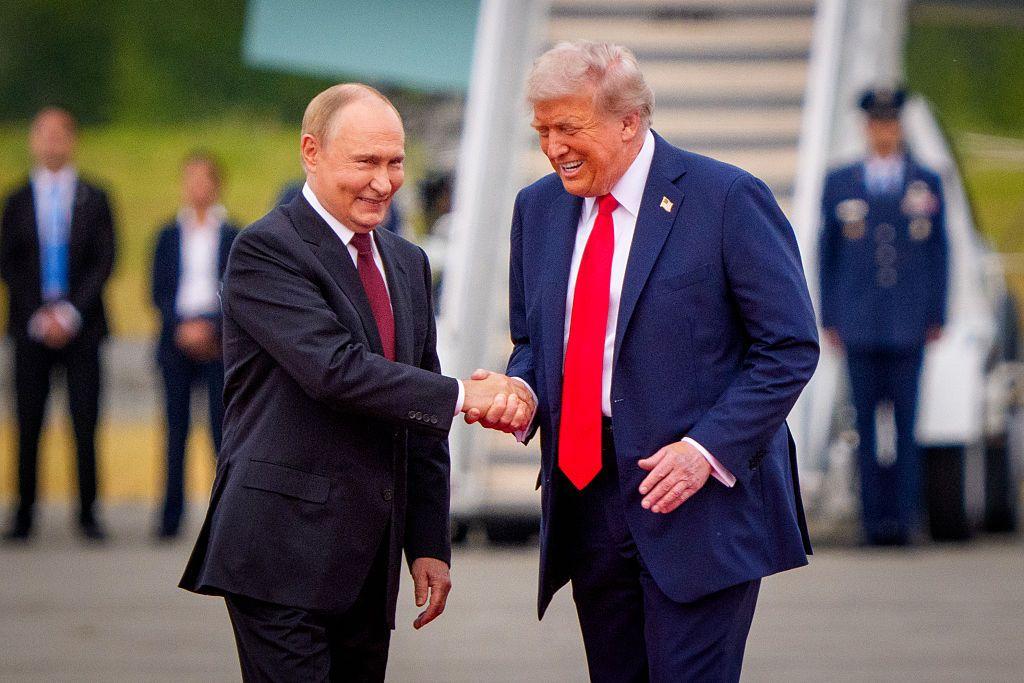
U.S. President Donald Trump greets Russian President Vladimir Putin in Anchorage, Alaska. (Andrew Harnik/Getty Images)
The Theater of Equals: Trump Rolls Out Red Carpet for War Criminal
The optics at Joint Base Elmendorf-Richardson told the story more clearly than any diplomatic communique. Trump personally welcomed Putin with a red carpet arrival, treating the Russian president as a respected head of state rather than a leader under International Criminal Court indictment for war crimes. The choreographed display included a “Pursuing Peace” banner that masked the profound divergence of goals between the two leaders.
Russian Foreign Minister Sergei Lavrov’s choice to wear a CCCP sweatshirt—the Cyrillic letters for USSR—sent its own unmistakable message. Veteran diplomat Richard Kauzlarich noted this was “a signal of the future,” not merely nostalgia for the past. The symbolism extended to Putin’s parting words, delivered in English: “Next time in Moscow,” an invitation that underscored his successful effort to break out of diplomatic isolation.
The meeting format itself evolved from an intended one-on-one discussion to a three-on-three format including Lavrov, Russian Presidential Aide Yuri Ushakov, Secretary of State Marco Rubio, and Middle East Special Envoy Steve Witkoff, though officials provided no explanation for the expansion. Leading Russian negotiator and Russian Direct Investment Fund CEO Kirill Dmitriev claimed the talks went “remarkably well” following the expanded discussions.
Trump and Putin left the press conference stage without taking any audience questions, and a luncheon planned for after the meeting was reportedly cancelled, suggesting underlying tensions despite the public displays of warmth.
Putin’s Unchanged War Aims: The Same Narrative Since 2021
In his portion of the joint press conference, Putin delivered a master class in information warfare, invoking the geographical proximity of Alaska and Russia while calling back to U.S.-Soviet military cooperation during World War II. He emphasized solving the “root causes” of the Ukraine war—which the Kremlin defines as NATO’s eastward expansion and Ukraine’s alleged discrimination against Russian-speakers.
These talking points represented a direct continuation of narratives Putin has employed since his July 2021 essay “On the Historic Unity of Russians and Ukrainians,” published less than a month after meeting with then-President Joe Biden in Geneva. In that essay, Putin questioned Ukraine’s territorial integrity and sovereignty, arguing that Ukraine was a “product of the Soviet era shaped on the lands of historical Russia.”
Putin again invoked the narrative that Russia and Ukraine share “the same roots” and described Ukraine as a “brotherly” nation, demonstrating that he has not moderated his views on Ukrainian sovereignty since 2021. His statements revealed continued commitment to the view that Ukraine’s existence as a state depends on its alignment with Russia.
Putin also accused European states of attempting to undermine the negotiation process, employing a standard Kremlin tactic to drive wedges between the United States, Europe, and Ukraine. The continuity between Putin’s statements at the Alaska summit and his previous declarations, including his February 2022 declaration of war, demonstrated that he remains committed to the view that Ukraine’s territorial integrity depends on Ukraine’s alignment with Russia.
Trump’s Defensive Optimism: A “10 Out of 10” Meeting That Achieved Nothing
Trump’s performance at the summit presented a study in contrasts with his usual confident demeanor. His remarks were unusually brief and, to many observers, defensive-sounding compared to Putin’s more confident presentation. Despite this, he later rated the meeting “a 10” on a scale of 1 to 10 in an interview with Fox News’s Sean Hannity.
“I think the meeting was a 10 in the sense that we got along great,” Trump told Hannity, emphasizing the “warm meeting” and claiming Putin “spoke very sincerely” about a desire to end the war. Trump said he and Putin had “made great progress” and “agreed on many points” but provided no details about what those points might be.
The president insisted “there’s no deal until there’s a deal” and that a final agreement hinged on “one or two significant items” that remained unresolved. He refused to elaborate on specifics, maintaining that an agreement on Ukraine was “ultimately up to them”—referring to Ukraine and NATO states. Trump reiterated his timeline that any bilateral economic agreements with Russia would come after the war is “over with.”
Trump’s most direct advice for Ukrainian President Volodymyr Zelensky was blunt: “Make a deal, you’ve got to make a deal. Russia’s a very big power, and they’re not.” This public pressure placed immense burden on Kyiv while offering no mention that Putin initiated the conflict in 2014 or intensified it in 2022.
Trump stated that he will inform Zelensky and NATO states about the conversation and that arrangements for a face-to-face meeting with Zelensky and Putin would soon be underway, with Trump likely participating in such talks. He expressed optimism about having a “pretty good chance of getting it done” while providing no specific timelines or terms.
The Belarus Connection: Lukashenko Enters the Diplomatic Dance
Hours before the Alaska summit, Trump held a telephone conversation with Belarusian President Alexander Lukashenko, a close Putin ally who has backed Russia’s invasion and allowed Russian forces to use Belarusian territory as a launchpad for attacks on Ukraine. Trump thanked Lukashenko for releasing 16 political prisoners and discussed the potential release of 1,300 additional prisoners.
According to Belarusian state media, Lukashenko invited Trump and his family to visit Belarus, and Trump agreed. The leaders also discussed bilateral relations and the war in Ukraine, representing a significant diplomatic opening for a leader who has ruled Belarus since 1994 while stamping out free media and political opposition.
The timing of this call—just hours before meeting Putin—suggested coordinated messaging between Moscow and Minsk ahead of the Alaska summit. According to Viasna, a Belarusian rights group, the country currently holds 1,186 political prisoners, many arrested following widespread protests in 2020 after Lukashenko claimed victory in an election marred by fraud allegations.
Lukashenko had recently met with U.S. Special Envoy to Ukraine General Keith Kellogg on June 21 and granted an interview with Time Magazine published on August 8, indicating ongoing diplomatic channels between Washington and Minsk.
War Continues Unabated: Russian Strikes Kill Six During “Peace” Talks
Even as Trump and Putin discussed cooperation in Alaska, Russian forces maintained their relentless assault on Ukrainian civilians and infrastructure. The Ukrainian Air Force reported that Russian forces launched 97 Shahed-type drones and decoys plus two Iskander-M ballistic missiles from multiple launch points including Voronezh and Bryansk oblasts, Kursk, Oryol, Primorsko-Akhtarsk in Krasnodar Krai, and Shatalovo in Smolensk Oblast during the night of August 14-15.
Ukrainian air defenses intercepted 63 Shahed-type and decoy drones over northern and eastern Ukraine, but 34 drones and the two Iskander-M missiles struck 13 locations throughout the country. Russian forces used drones to target frontline areas of Sumy, Kharkiv, Donetsk, and Chernihiv oblasts, and missiles to target Kharkiv and Chernihiv oblasts.
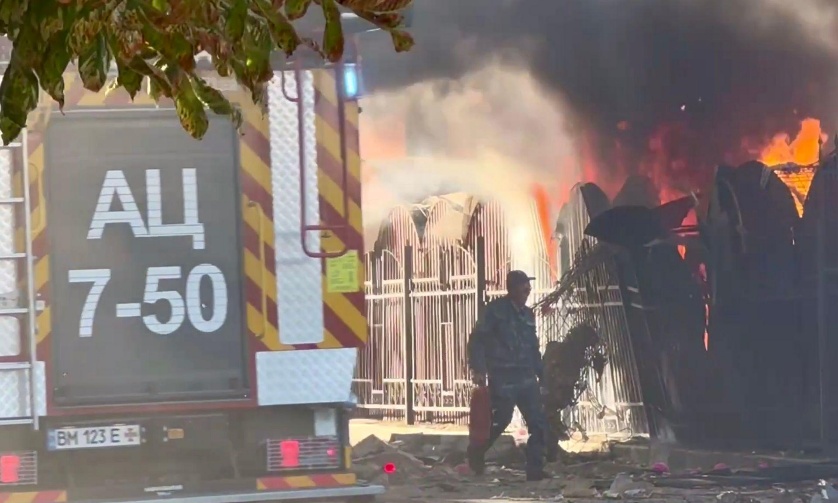
A Russian strike on central Sumy sparked a fire, hitting civilian infrastructure. (Oleh Hryhorov/Telegram)
Russian strikes killed at least six civilians and wounded at least 17, including a child, across multiple regions. In Dnipropetrovsk Oblast, the Iskander-M missiles hit cars in Dniprovskyi Raion, while a 55-year-old man was injured during strikes on the Synelnykove district. Multiple apartment buildings, houses, a school, an industrial facility, a fire station, and a pharmacy suffered damage across the region.
Donetsk Oblast saw particularly heavy casualties, with Russian attacks killing one person in Kostiantynivka and another in Virivka while wounding seven others. In Chernihiv Oblast, an Iskander-M missile struck an agricultural enterprise in Koryukivka Hromada, killing and wounding civilians.
Kharkiv Oblast suffered four fatalities: a 64-year-old man killed in Kozacha Lopan, a man and woman aged 69 in Nechvolodivka, and a 38-year-old man in Nova Kozacha. Two others were injured in the region.
In Kherson Oblast, Russian strikes killed one person and injured five, including a child. A multi-story building, 22 houses, farm buildings, gas pipelines, and a car were damaged. In Sumy Oblast, a 32-year-old man was injured during a drone attack against the Myropillia community, while Russian drones hit an ambulance and civilian car in Velykapyskarivka Hromada on August 15 morning, killing one civilian.
A separate Russian attack against Sumy City started a fire at a gas station and injured one civilian. Ukrainian officials also reported that a Russian drone hit the Sumy City Central Market on the evening of August 15, damaging retail outlets, an educational institution, and other buildings.
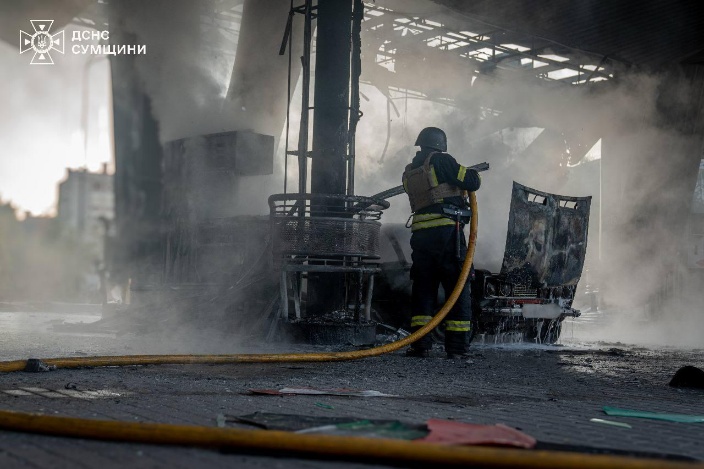
A firefighter putting out a fire after a Russian attack struck a gas station in Sumy, Ukraine. (State Emergency Service/Telegram)
A Russian milblogger acknowledged that Russian forces conducted drone strikes against Sumy, Kharkiv, and Chernihiv oblasts “on the eve of the [Alaska] meeting.” Trump acknowledged the timing while en route to Alaska, noting that Putin was “trying to set a stage” ahead of the summit and that the strikes would “hurt” Putin’s ability to make a deal.
The United Nations reported on August 13 that Russian air and drone strikes in July 2025 contributed to the highest total monthly casualty toll since May 2022, underscoring the escalating civilian cost of Russia’s continued offensive operations.
The Pokrovsk Penetration: Ukrainian Forces Battle Russian Infiltrators
Ukrainian forces continued operations to eliminate Russian infiltration groups that had penetrated defenses near the strategically critical city of Pokrovsk in Donetsk Oblast. The 7th Corps of Ukraine’s Airborne Assault Forces reported on August 15 that Ukrainian units had cleared Pokrovsk itself of Russian sabotage groups and individual saboteurs, claiming that Ukrainian units were operating inside the city and civilians could move about, though travel remained heavily restricted.
According to Ukrainian military observer Kostyantyn Mashovets, Russian forces used infiltration tactics involving small infantry groups totaling 300-350 personnel from elements of the Russian 5th, 110th, and 132nd separate motorized rifle brigades of the 51st Combined Arms Army (formerly 1st Donetsk People’s Republic Army Corps). These forces walked for approximately two weeks from bases in Russian-held Selidovo, slipping through gaps in Ukrainian lines to create a dangerous 10-kilometer-deep salient northeast of Dobropillya.
Ukrainian Dnipro Group of Forces Spokesperson Colonel Viktor Trehubov reported that Ukrainian forces had stabilized Russian penetration near Pokrovsk and Dobropillya, with reserve troops dispatched to contain and eliminate the infiltrating groups. Trehubov stated that Ukrainian forces continued to destroy Russian assault groups in the area and that Russian forces had been unable to redeploy additional troops to support the penetration.
The Russian military command attempted to consolidate the penetration by redeploying elements of the 114th Separate Motorized Rifle Brigade to near Nove Shakhove and Zapovidne. Russian commanders also requested up to two battalions with armored vehicles from the 8th Combined Arms Army, which operates primarily in the Toretsk direction, to support other elements of the 51st Combined Arms Army.
Elite Ukrainian units including the 1st Corps National Guard “Azov,” 93rd Mechanized Infantry Brigade “Kholodny Yar,” 4th National Guard Brigade “Rubizh,” and 1st Assault Battalion “Da Vinci” were engaged in counterattack operations. The Ukrainian Azov Corps claimed their units had killed 151 Russian soldiers, wounded 70, and captured eight prisoners in counterattacks in the Pokrovsk sector. Video recordings of six Russian prisoners of war captured by Azov fighters subsequently appeared on Ukrainian platforms.
Sergeant Vitaly P’ysetsky, a 93rd Brigade spokesman, reported that his unit had captured four Russian soldiers in counterattack operations and encountered only dismounted groups of Russian infantry carrying light weapons. Ukrainian forces cleared Russian groups from Pokrovsk, Hruzke, Rubizhne, Novovodyane, Petrivka, Vesele, and Zolotyi Kolodyaz, all northeast of Dobropillya.
A source affiliated with Ukrainian military intelligence reported that Ukrainian forces had partially stabilized the situation along the Vesele-Zolotyi Kolodyaz-Kucheriv Yar line northeast of Dobropillya. However, Mashovets reported that elements of the Russian 114th and 132nd separate motorized rifle brigades continued attempting to hold Dorozhnie and repel Ukrainian counterattacks in the Ivanivka-Zapovidne direction since August 13.
Ukrainian officials continued mandatory evacuations from settlements near the Russian penetration area. Donetsk Oblast Military Administration Head Vadym Filashkin announced evacuation of families with children from Druzhkivka and villages in Andriivka Hromada, noting that roughly 1,800 children lived in these settlements. The evacuation reflected increased Russian drone threats due to the advance near Dobropillya, as Russia’s use of drone strikes to generate battlefield air interdiction effects severely hindered Ukrainian evacuation efforts.
Ukrainian Strikes Deep in Russia: Energy Infrastructure Under Sustained Attack
Ukraine’s Special Operations Forces conducted multiple long-range strikes against Russian military and energy infrastructure on August 14-15, demonstrating Kyiv’s continued capability to project force deep into Russian territory despite ongoing diplomatic efforts.
Ukrainian forces struck the Rosneft Syzran Oil Refinery in Samara Oblast, one of Russia’s largest facilities that produces aviation kerosene for the Russian military. The attack caused explosions and fires at the plant, which lies approximately 800 kilometers from the Ukrainian border. Ukrainian Center for Countering Disinformation Head Lieutenant Andriy Kovalenko posted images showing smoke over the facility. Ukrainian forces had previously struck the same refinery in February 2025.
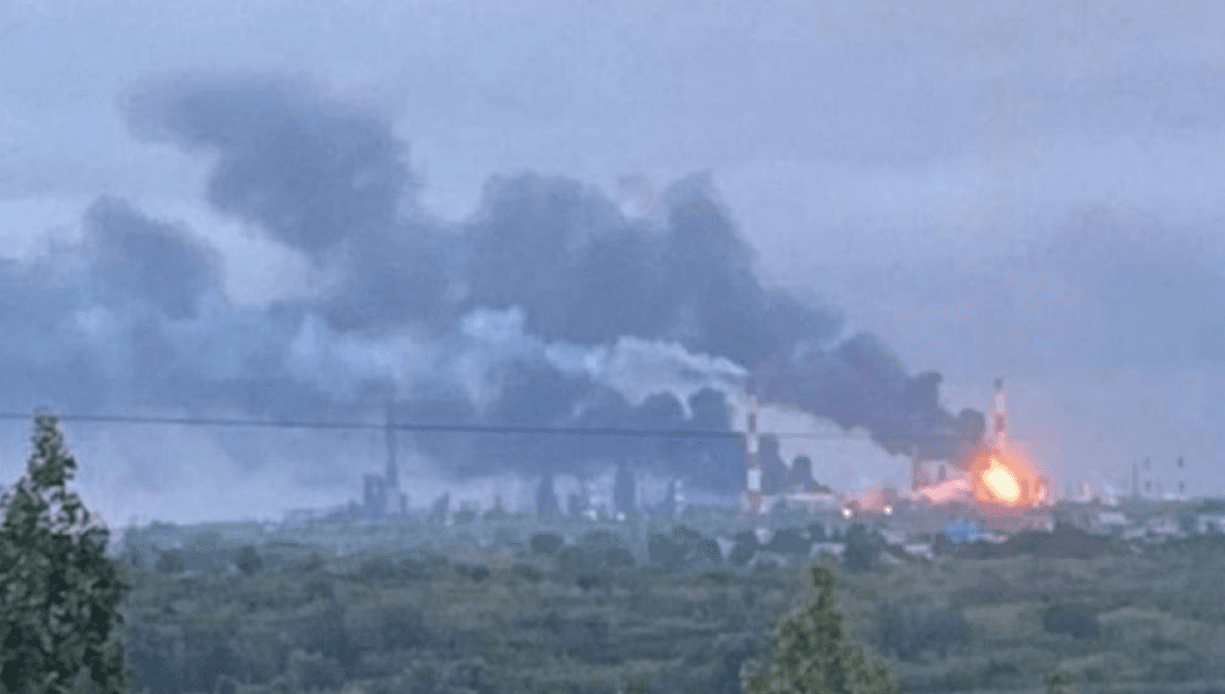
An oil refinery in Syzran, Samara Oblast, Russia on fire following a reported drone attack on the facility overnight. (Screenshot/Crimean Wind/Telegram)
In a particularly significant operation, Ukrainian forces hit the Russian port of Olya in Astrakhan Oblast, a key logistics hub for Iranian-made military supplies bound for Russia. The strike targeted the vessel Port Olya 4, which was reportedly carrying Shahed-type drone components and ammunition from Iran. The Ukrainian Special Operations Command reported that Ukrainian forces destroyed the Port Olya-4, while Astrakhan Oblast Governor Igor Babushkin claimed Russian air defenses downed Ukrainian drones and that debris damaged a ship.
Ukrainian forces also conducted a major strike against an oil refinery in Volgograd on the night of August 14, causing powerful fires at the facility. The refinery reportedly processes over 15 million metric tons of oil annually, amounting to 5.6% of Russia’s refining capacity.
Ukrainian forces struck the command post of Russia’s 132nd Separate Motorized Rifle Brigade in occupied Yenakiieve, Donetsk Oblast, with consequences still being determined. The Ukrainian military estimated that long-range strikes in 2025 have inflicted losses worth 4.11% of Russia’s annual GDP, approximately $74.1 billion.
Roughly 10% of Ukrainian attacks since January 1 struck targets more than 1,000 kilometers from the border, with 39% hitting targets between 500-1,000 kilometers away and 37% landing between 200-500 kilometers from Ukraine. Oil refineries were the most common targets at 42%, followed by warehouses at 37%, oil pumping stations at 10%, terminals and ports at 7%, and other facilities at 4%.
The sustained campaign against Russian energy infrastructure continued for the third consecutive day since August 12, with Ukrainian forces also targeting the Unecha oil pumping station, part of the Transneft Druzhba pipeline network, and an oil refinery in Russia’s Saratov Oblast.
Explosion at Russian Gunpowder Factory: Five Dead, 100 Injured
A massive explosion rocked the Elastik Gunpowder Factory in Ryazan Oblast on August 15, killing five workers and injuring 100 others. Ryazan Oblast Governor Pavel Malkov confirmed the “emergency situation” and declared a state of emergency in the municipality, while the Russian Investigative Committee opened an investigation into safety procedure violations.
Russian opposition outlet Baza reported the explosion, while Ukrainian Center for Countering Disinformation Head Lieutenant Andriy Kovalenko posted footage showing the explosion at the gunpowder plant, noting there were roughly 50 workers at the facility and stating that “something strange” had occurred. Ukrainian sources have not claimed responsibility for the incident, and the cause remains unclear.
The explosion occurred as Ukraine continued its sustained campaign against Russian military-industrial targets, though no direct connection to Ukrainian operations has been established.
Limited Fighting in Kursk Oblast: Russian Forces Struggle in Forested Terrain
Limited fighting continued in unspecified areas of Kursk Oblast on August 15, with Russian forces facing difficulties in forested environments. A Russian milblogger claimed Ukrainian forces counterattacked southwest of Tetkino along the Seim River shore.
A Russian milblogger affiliated with the Northern Grouping of Forces reported that elements of the Russian 51st Airborne Regiment of the 106th Airborne Division continued to face encirclement threats in an unspecified forest area, likely referring to the abandonment of regiment elements near Sadky on August 12. The milblogger claimed Ukrainian forces advanced on two flanks and from the rear, forcing hasty Russian retreats to unprepared positions.
Russian forces struggled with logistics and were unable to resolve supply problems with unmanned aerial vehicles in forested environments, while Ukrainian forces actively targeted the regiment elements with drones. Elements of the Russian Anvar Spetsnaz Detachment (possibly referring to the BARS-25 Anvar volunteer detachment) were reportedly working with elements of the 137th Airborne Regiment of the 106th Airborne Division in the Sumy direction.
A reported Ukrainian attack in Kursk on August 14 allegedly killed one person and injured 12 others, including a 15-year-old, when a drone hit an apartment building on Soyuznaya Street. The blast and fire allegedly damaged the top four floors and shattered windows in neighboring houses and a school, though Ukraine has not commented on the attack.
Northern Front: Russian Offensive Operations Continue Without Gains
Russian forces continued offensive operations in northern Sumy Oblast on August 15 but made no confirmed advances. Russian forces attacked north of Sumy City near Kindrativka and Novokostyantynivka and northeast of the city near Yunakivka and toward Sadky.
A Russian milblogger claimed, citing unnamed Ukrainian military analysts, that Russian forces had advanced into Novokostyantynivka near the international border and that the settlement had become a contested “gray zone.” Russian milbloggers also claimed Ukrainian forces counterattacked near Novokostyantynivka, Yablunivka northeast of Sumy City, Bezsalivka northwest of Sumy City, and Sadky.
The spokesperson of a Ukrainian brigade operating in northern Kharkiv Oblast stated that the intensity of Russian military activity in their area of responsibility had decreased compared to the first half of July 2025, particularly near Milove northeast of Velykyi Burlyk.
Eastern Front: Intensive Fighting Across Multiple Directions
Kharkiv Direction: Russian forces continued offensive operations in northern Kharkiv Oblast but did not advance. Attacks targeted areas northeast of Kharkiv City near Vovchansk, Hlyboke, Synelnykove, and on the south bank of the Vovcha River. Russian milbloggers claimed Ukrainian forces counterattacked near Synelnykove.
The spokesperson of a Ukrainian brigade operating in northern Kharkiv Oblast stated that Russian forces mostly used small infantry groups for assaults because Ukrainian strikes against Russian armored equipment had forced the Russian military command to pull Russian materiel, such as tanks and artillery systems, back to Russia.
Russian forces also attacked northeast of Velykyi Burluk near Ambarne but made no advances.
Kupyansk Direction: Russian forces continued offensive operations without advancing, attacking near Kupyansk itself; west of Kupyansk near Sobolivka; north near Radkivka and Holubivka; northeast near Kamyanka; and east near Petropavlivka. Elements of the Russian 352nd Motorized Rifle Regiment of the 11th Army Corps continued operating near Stepova Novoselivka southeast of Kupyansk.
Borova Direction: Russian forces continued operations without advancing, attacking near Borova itself; northeast near Zahryzove; and southeast near Hrekivka and Olhivka. Drone operators of the Russian Ivan Group of the 423rd Motorized Rifle Regiment of the 4th Tank Division were striking Ukrainian positions southwest of Lozova northeast of Borova.
Lyman Direction: Russian forces continued operations without confirmed advances, though Russian sources claimed advances toward Stavky north of Lyman and into western Zarichne east of Lyman. Attacks targeted northwest of Lyman near Serednie, Shandryholove, and Karpivka; north near Ridkodub; northeast near Kolodyazi and Myrne; east near Zarichne; and southeast toward Yampil and in the Serebryanske forest.
A Ukrainian brigade deputy commander reported that Russian forces were attempting to set conditions for mechanized assault by using engineering detachments to build river crossings across the Chornyi Zherebets River. Russian forces conducted motorcycle assaults in small fireteams of four to eight infantrymen using anti-heat vision cloaks and tents to evade detection while constantly reinforcing elements of the Russian 3rd and 20th combined arms armies with drone detachments.
Russian forces were increasing air strikes with guided glide bombs and other munitions plus drone strikes, suggesting intensifying offensive tempo. A Ukrainian brigade reported that Russian forces leveraged small infantry groups in day and night assaults, expecting some groups to reach assigned rally points in the Ukrainian near rear.
Order of battle included drone operators of the Russian 11th Tank Brigade of the 25th Combined Arms Army operating in the Serebryanske forest area, and drone operators of the 16th Spetsnaz Brigade operating in the Lyman direction.
Siversk Direction: Russian forces continued operations without advancing, attacking toward Siversk itself; northeast near Serebryanka and Hryhorivka; east near Verkhnokamyanske; southeast near Vyimka; south near Pereizne; and southwest near Fedorivka and Vasyukivka.
The Ukrainian Dnipro Grouping reported that Russian forces increased guided glide bomb strikes from eight to 22 in the past three days since August 12.
Chasiv Yar Direction: Russian forces continued operations without confirmed advances, though a Russian milblogger claimed advances in Mykolaivka just west of Chasiv Yar. Attacks targeted north of Chasiv Yar near Minkivka and Orikhovo-Vasylivka and south near Bila Hora.
Elements of the Russian 1065th Artillery Regiment of the 98th Airborne Division were reportedly striking Ukrainian positions near Mykolaivka.
Central Front: Ukrainian Advances Near Toretsk, Russian Gains Near Pokrovsk
Toretsk Direction: Ukrainian forces recently advanced northwest of Dyliivka north of Toretsk, according to geolocated footage published on August 14. Russian milbloggers claimed advances northwest of Poltavka, south of Rusyn Yar, and toward Sofiivka, all northwest of Toretsk.
Russian forces attacked near Toretsk itself; northwest including Oleksandro-Kalynove, Katerynivka, Yablunivka, Popiv Yar, Rusyn Yar, and Poltavka and toward Stepanivka and Pleshchiivka; and west near Shcherbynivka.
A Ukrainian brigade spokesperson reported that Russian forces had been fighting for Toretsk for more than one year and that the brigade had killed or wounded more than 50,000 Russian forces—roughly five divisions’ worth.
Order of battle included elements of the Russian 103rd Motorized Rifle Regiment of the 150th Motorized Rifle Division and 20th Motorized Rifle Division operating near Shcherbynivka and the Kleban Byk reservoir, while drone operators of the 98th Airborne Division struck Ukrainian logistics in the Kostyantynivka direction.
Pokrovsk Direction: Russian forces made confirmed advances west of Novoekonomichne northeast of Pokrovsk, according to geolocated footage published on August 15. Ukrainian military observer Mashovets reported that Ukrainian forces likely withdrew from Udachne southwest of Pokrovsk, with elements of the Russian 1437th Motorized Rifle Regiment, supported by the 15th Motorized Rifle Brigade of the 2nd Combined Arms Army, advancing from Udachne toward Zvirove.
Russian forces conducted operations near Pokrovsk itself; northeast near Volodymyrivka, Fedorivka, Novoekonomichne, Zapovidne, Mayak, Shakhove, Krasnyi Lyman, Zaytshok, and Vesele; north near Rodynske, Sukhetske, Zolotyi Kolodyaz, and Rubizhne; east near Promin, Myrolyubivka, and Mykolaivka and toward Balahan; southeast near Lysivka and Sukhyi Yar; and southwest near Zvirove, Udachne, and Kotlyne and toward Molodetske.
A Ukrainian drone battalion servicemember reported that Russian forces attacked during both day and night using tactics to accumulate small groups of one to two personnel for further attacks. A drone crew commander stated that Russian forces continued repeated highly attritional, infantry-led assaults against the same positions, while an aerial reconnaissance officer reported attacks in groups of two to six personnel.
Ukrainian forces were using “Hiyena” unmanned ground vehicles carrying 26 kilograms of explosives to attack Russian fortified positions or infantry in buildings.
Mashovets detailed the area responsibilities: the 2nd Combined Arms Army extended from southern Pokrovsk to Myrolyubivka; the 41st Combined Arms Army covered Kotlyne to north of Oleksiivka southeast of Novopavlivka; and the 51st Combined Arms Army operated from Myrolyubivka to Popiv Yar northeast of Pokrovsk and northwest of Toretsk.
Order of battle included elements of the Russian 1st Motorized Rifle Brigade fighting in the Surove-Bilytske direction, the 9th Motorized Rifle Brigade near Rodynske, and the 5th Motorized Rifle Brigade in southern Myrolyubivka. Drone operators of the Rubikon Center for Advanced Unmanned Technologies were striking Ukrainian forces in Pokrovsk and Rodynske.
Southern Front: Russian Advances Continue
Novopavlivka Direction: Russian forces continued operations without confirmed advances, though milbloggers claimed advances north and northwest of Andriivka-Klevtsove southeast of Novopavlivka. Attacks targeted Novopavlivka itself; southeast near Dachne and Novoukrainka; south toward Filiya; and southwest near Zelenyi Hai, Tovste, Zirka, Andriivka-Klevtsove, and Ivanivka.
Velykomykhailivka Direction: Russian forces made significant confirmed advances, with geolocated footage showing elements of the Russian 36th Motorized Rifle Brigade of the 29th Combined Arms Army raising a flag in western Oleksandrohrad east of Velykomykhailivka, indicating Russian seizure of both Oleksandrohrad and Voskresenka southeast of Oleksandrohrad.
Russian milbloggers claimed Russian forces also seized Vorone southeast of Velykomykhailivka and advanced west of Oleksandrohrad to the Dnipropetrovsk-Donetsk Oblast border area.
Russian forces attacked northeast near Myrne; east near Oleksandrohrad and Voskresenka and toward Novoselivka; and southeast near Maliivka and Zelene Pole and toward Zaporizke, Komyshuvakha, and Novoheorhiivka.
Order of battle included drone operators of the Russian 14th Spetsnaz Brigade striking Ukrainian forces near Vorone, Sichneve, and Sosnivka, while elements of the 11th Air Force and Air Defense Army conducted unguided glide bomb strikes against Ukrainian positions in Novoselivka.
Zaporizhia Front: Russian forces continued operations in both eastern and western Zaporizhia Oblast without confirmed advances. In eastern areas, attacks targeted Olhivske, Novodarivka, and Temyrivka northeast of Hulyaipole, with a Russian milblogger claiming advances into central Temyrivka.
Drone operators of the 38th Motorized Rifle Brigade of the 35th Combined Arms Army were striking Ukrainian positions in Poltavka northeast of Hulyaipole.
In western Zaporizhia Oblast, Russian forces conducted limited operations southeast of Orikhiv near Mala Tokmachka and west near Stepnohirsk and toward Prymorske. Russian milbloggers claimed advances on the southeastern side of Mala Tokmachka to interdict Ukrainian ground lines of communication between Orikhiv and Zaporizhzhia City, while Ukrainian forces allegedly counterattacked within Stepnohirsk.
Ukrainian Zaporizhia Oblast Head Ivan Fedorov reported that Russian forces struck a highway near Orikhiv with a first-person view drone, injuring one civilian.
Order of battle included drone operators of the 108th Airborne Regiment of the 7th Airborne Division striking Ukrainian positions near Plavni west of Orikhiv, and elements of the 70th Motorized Rifle Regiment of the 42nd Motorized Rifle Division operating near Mala Tokmachka.
Kherson Direction: Russian forces continued operations without advancing, attacking in the Kherson City direction including east near the Antonivsky road bridge and southeast near Bilohrudyi Island.
Order of battle included elements of the Russian 61st Naval Infantry Brigade operating on unspecified islands of the Dnipro River Delta, and drone operators of an unspecified airborne artillery brigade, likely the 52nd Airborne Artillery Brigade, striking Ukrainian forces on the west bank with Lancet loitering munitions.
The Starlink Controversy: Nearly Half of Terminals End Up in Occupied Territory
A troubling development emerged from a U.S. Office of Inspector General report revealing that nearly half of the active Starlink satellite terminals supplied to Ukraine have ended up in territories fully or partially occupied by Russia. The terminals were provided by USAID and Elon Musk’s SpaceX corporation to restore internet access during Russian attacks on energy infrastructure.
The report found that USAID failed to establish adequate safeguards for more than 5,000 terminals delivered to Ukraine’s government following Russia’s invasion. The agency purchased 1,508 terminals while SpaceX donated 3,667, but Ukrainian authorities distributed them without tracking or usage restrictions.
USAID’s initial draft agreement from April 11, 2022, would have prohibited military use of Starlink and required written assurances from all recipients. However, the final transfer documents signed in April 2022 omitted these conditions, relying on Ukrainian authorities to prevent misuse.
Ukrainian authorities may have been unaware of SpaceX’s location restrictions prohibiting terminal use in frontline Donetsk and Luhansk regions when they transferred 43 USAID-provided terminals to these areas between May and August 2022. Officials admitted they did not know where terminals were located or how they were being used until an inspection began in July 2024, calling monitoring “logistically impossible” during the war’s early stages when staff evacuated or sheltered.
Ukraine has used Starlink terminals to pilot drones, target artillery strikes, and coordinate battlefield communications, according to media reports. SpaceX restricted Ukraine from using Starlink for drone operations in early 2023 after learning about military applications. The Inspector General recommended USAID work with Ukrainian authorities and SpaceX to suspend service for at-risk terminals, though the agency said it would only address the 1,508 terminals it directly financed.
According to Reuters, Elon Musk ordered the deactivation of Starlink satellite coverage over part of Ukraine’s Kherson Oblast during a major counteroffensive in fall 2022. As of April 2025, Ukraine has received over 50,000 Starlink terminals from international partners, with Poland providing around 29,500 terminals as the largest single supplier.
European Disappointment: Allies Express Frustration with Summit Outcome
European officials reacted with disappointment and criticism following the Alaska summit’s failure to produce concrete progress toward peace. German diplomat Wolfgang Ischinger captured the prevailing sentiment: “Putin got his red carpet treatment with Trump, Trump got nothing. As was to be feared: no ceasefire, no peace. No real progress—clearly 1:0 for Putin—no new sanctions. For the Ukrainians: nothing. For Europe: deeply disappointing.”
Lithuanian Defense Minister Dovile Sakaliene characterized Putin’s cryptic warning for Ukraine and Europe not to “disrupt the emerging progress” as “gaslighting and veiled threats.” She noted that throughout the day of the summit, Russia continued to “bomb civilians in Ukraine.”
Czech Foreign Minister Jan Lipavsky welcomed Trump’s peacemaking efforts but cautioned against accepting Kremlin propaganda: “The problem is Russian imperialism, not Ukraine’s desire to live freely. If Putin were serious about peace talks, he would not have been attacking Ukraine all day today.”
French President Emmanuel Macron and President Zelensky agreed to meet following the Alaska summit, with the Elysee Palace describing their dialogue as “close and constant” though providing no specific date or location for their meeting. The agreement reportedly came after Macron and Zelensky exchanged messages in the hours before the Trump-Putin meeting.
US Intelligence Agencies Suspend European Cooperation
Some U.S. national security agencies have suspended cooperation with international partners in countering Russian sabotage and cyber operations, Reuters reported, citing undisclosed official sources. Under former President Biden, the National Security Council coordinated efforts of at least seven security agencies working with European partners to disrupt Russia’s escalating hybrid activities across Europe.
Since Trump took office on January 20, the National Security Council has reportedly ceased coordinating these efforts, and expected meetings with European partners have not taken place. The development has raised concerns in Europe that Washington might cut a peace deal unfavorable to its allies.
The suspension reflects broader uncertainty about U.S. commitment to European security as Trump pursues direct engagement with Putin while potentially reducing American involvement on the continent.
The Prisoner Exchange Imperative: Families Demand All-for-All Swap
As Trump and Putin met in Alaska, relatives and friends of Ukrainian prisoners of war gathered outside the U.S. Embassy in Kyiv, demanding an all-for-all prisoner exchange rather than territorial concessions. The protesters carried Ukrainian flags with photos of captured loved ones, making clear their demands for Trump to “replace the land swap with an all-for-all prisoner swap.”
Oksana Berezina, holding a photo of her missing husband Oleh who went missing in Kursk Oblast late last year, told reporters: “We want children to be with their parents and to grow up in peace. We want wives and mothers not to be left alone, not to be forced to search for their loved ones.”
Nina, whose son Dmytro was among approximately 2,000 Ukrainian troops who surrendered after 86 days defending Azovstal steel plant in Mariupol, has been waiting 1,180 days for his return. “My son turns 40 tomorrow—it is his birthday. But it is hard to accept that he has not been home for four years. He is still being tortured. My heart feels like it is breaking into pieces,” she said.
Since Russia’s full-scale invasion began, Ukraine has secured the release of over 6,400 people from Russian captivity, but thousands of Ukrainian soldiers and civilians remain imprisoned. Some have been held for more than a decade, dating back to Russia’s initial incursion in eastern Ukraine in 2014.
Former Azovstal defender Illia Illiashenko, who spent nearly a year in Russian captivity including at the notorious Olenivka prison and detention centers in Taganrog and Kamensk-Shakhtinsky, warned: “If the war freezes, Putin will start handing down fabricated sentences to those still in captivity, and I believe this will happen on an even larger scale.”
Illiashenko emphasized that Russia blatantly disregards international conventions, subjecting Ukrainian prisoners to humiliation and abuse while fabricating charges to extend imprisonment.
Navalnaya’s Appeal: Free Russian and Ukrainian Political Prisoners
Exiled Russian opposition figure Yulia Navalnaya urged presidents Putin and Trump to strike a deal to free Russian and Ukrainian political prisoners held captive by Moscow for speaking out against the war in Ukraine.
“Release Russian political activists and journalists, Ukrainian civilians, those who were imprisoned for anti-war statements and posts on social media,” Navalnaya, whose husband Alexei Navalny died in a Russian prison last year, said in a video message on social media hours before the two leaders met in Alaska.
Her appeal highlighted the broader scope of Russian repression, encompassing not only Ukrainian prisoners of war but also Russian citizens who have opposed the war and faced imprisonment for their dissent.
Putin’s Praise for North Korean “Heroes”: The Alliance Deepens
In a separate development highlighting Russia’s expanding partnerships, Putin hailed North Korean troops fighting in Ukraine as “heroic” in a letter to Kim Jong Un marking Korea’s liberation anniversary. Putin recalled how Soviet and North Korean forces fought together against Japan while praising the “heroic participation of the DPRK soldiers in liberating the territory of Kursk Region from the Ukrainian occupationists.”
The letter stated: “The bonds of militant friendship, goodwill and mutual aid which were consolidated in the days of the war long ago remain solid and reliable even today. This was fully proved by the heroic participation of the DPRK soldiers in liberating the territory of Kursk Region from the Ukrainian occupationists. The Russian people will keep forever the memories of their bravery and self-sacrifice.”
Putin added that the two countries would continue to “act jointly and effectively defend their sovereignty and make a significant contribution to establishing a just and multi-polarised world order.”
The letter accompanied a visit by a Russian delegation to Pyongyang, where State Duma Speaker Vyacheslav Volodin thanked Kim for sending “excellent soldiers” to Ukraine. Volodin’s delegation arrived Thursday and was received by a military honor guard for a visit marking “the 80th anniversary of Korea’s liberation.”
South Korean and Western intelligence agencies estimate that North Korea has sent more than 10,000 soldiers to Russia’s Kursk region, with around 600 killed and thousands more wounded fighting for Russia.
Kim mentioned a phone call with Putin two days before the Alaska summit, agreeing to expanded bilateral cooperation and “closer contact and communication between the state leaderships.” The timing suggested coordinated messaging between Moscow and Pyongyang ahead of the Trump-Putin meeting.
Moldova Advances While Ukraine Stalls: EU Membership Politics
The European Union is reportedly considering advancing Moldova’s membership bid ahead of Ukraine’s, potentially opening the first negotiating cluster with Moldova in early September. The move would boost pro-EU President Maia Sandu ahead of crucial parliamentary elections on September 28 while sending a signal to Russia about EU resolve.
Ukraine’s EU accession progress has been obstructed by Hungary’s Viktor Orban, despite both Ukraine and Moldova meeting requirements to open negotiations. An undisclosed Ukrainian diplomat expressed concern that advancing Moldova alone could send the wrong signal to Ukraine, especially amid discussions between the U.S. and Russia about Ukraine’s future.
Four left-wing and center-left parties in Moldova are uniting to form a pro-Russian electoral bloc for the upcoming vote. EU lawmaker Siegfried Muresan believes the decision would “send a signal to Russia” and counter Kremlin claims that Moldova’s accession bid is stalling.
The EU launched accession talks with both countries in June 2024, but none of the six thematic negotiating clusters has opened yet due to Hungarian opposition. Diplomats are exploring ways to show progress to Kyiv, such as access to the Horizon Europe research program or Erasmus student exchange scheme.
Without unanimous approval, Ukraine cannot move forward with its membership bid, while Moldova could potentially advance independently. The European Commission recommended launching accession talks with both countries in November 2023, and the European Council agreed in December.
Ukrainian Refugees Lose Legal Status in U.S.
Around 120,000 Ukrainian refugees living in the U.S. began losing their legal status on August 15 as the Trump administration allowed their protection program to lapse. The refugees had lived in the country since August 16, 2023, under the Uniting for Ukraine program devised by the Biden administration to allow Ukrainians to stay on humanitarian parole.
Under the program, Ukrainians received two-year renewable legal status allowing them to work and receive health insurance, provided they found U.S. sponsors. Trump suspended the program in January as part of broader immigration policy changes, exposing those covered to potential arrest and deportation.
Roughly 250,000 Ukrainians came to the U.S. under the program, but those who arrived before August 16, 2023, are covered by a separate protection program. While Trump signaled in July that Ukrainians who fled the war might be allowed to stay until it ends, his administration’s decision to let Biden’s program lapse created uncertainty for hundreds of thousands of refugees.
Without government intervention, the refugees will start losing their humanitarian protection on a rolling basis, potentially facing arrest and deportation despite fleeing Russia’s full-scale invasion.
Museum Demands Putin’s Arrest Upon Alaska Arrival
The Beka Museum at Rockefeller Center in New York sent a letter dated August 14 to U.S. Attorney General Pam Bondi requesting Putin’s arrest upon his arrival in Alaska, citing the International Criminal Court warrant against him for war crimes related to the forced deportation of Ukrainian children.
“A nation’s culture is its soul made visible. In Ukraine, that soul is under siege—especially in Russian-occupied territories—its monuments shattered, its children stolen, its songs silenced,” said museum director Shota Bagaturia. “To protect Ukrainian heritage is to stand guard over the memory and dignity of an entire people. If we fail to defend it, we do not just lose artifacts and buildings—we lose a living voice in the chorus of humanity.”
The museum also sent the letter to the White House, Alaska attorney general, and the military base hosting the talks. The letter urged immediate action, highlighting Putin’s role in systematic attacks on Ukrainian cultural heritage and the deportation of thousands of Ukrainian children to Russia.
The ICC issued arrest warrants for Putin and Russian official Maria Lvova-Belova over their role in Ukrainian children deportation in March 2023. While the U.S. is not an ICC member, the museum noted that such actions could be prosecuted under U.S. federal law, including the War Crimes statute and the 1954 Hague Convention protecting cultural property in armed conflict.
Pope Leo XIV Calls for Ceasefire Ahead of Summit
Pope Leo XIV called for a ceasefire in Ukraine ahead of the Trump-Putin talks, speaking to reporters outside the papal summer residence at Villa Barberini in Castel Gandolfo on August 13. “We must always seek a ceasefire. The violence, the many deaths, must stop. Let’s see how they can come to an agreement,” the Pope said.
“Because after all this time, what is the purpose of war? We must always seek dialogue, diplomatic efforts, not violence, not weapons.” The papal intervention reflected broader international hopes that the Alaska summit might produce concrete steps toward ending the conflict, though those hopes ultimately proved unfounded.
Kyiv and its European leaders have repeatedly called for an unconditional ceasefire as the first step toward negotiations, a proposal Moscow has rejected.
Russian Information Operations Target Summit
Telegram channels in Russian-occupied Ukraine disseminated claims about Ukraine planning major “provocations” ahead of the Alaska summit, according to analysis by Let’s Data provided to the Kyiv Independent. The messages portrayed Ukraine as willing to kill its own civilians for propaganda purposes and as uninterested in peace.
Russia’s Defense Ministry accused Ukraine of staging a “provocative” drone and missile strike on Chuhuiv, a Ukrainian town in Kharkiv Oblast, claiming Ukraine was sending foreign journalists to document the attack and blame Russia. Posts on channels like “Lysychansk, Kolybel Donbasa” claimed this week would be critical for Zelensky, suggesting he would attempt to derail Trump-Putin talks.
Several Telegram channels in Russian-occupied cities in Donetsk, Luhansk, and Kherson oblasts spread these accusations. Some channels claimed that possible provocations were prepared by “Britain and its partners.” The posts received over 35,000 views between August 11 and 12.
Ukrainian officials dismissed these claims as typical Russian tactics to create “information alibis” before attacking Ukrainian targets themselves. Alina Alekseeva, deputy head of Ukraine’s Center for Countering Disinformation, explained: “They create some kind of information newsbreak, preemptively accuse Ukraine of it, and then do it themselves. Ukraine has nothing to do with it. This is a Russian tactic before any negotiations.”
Television and social media are key instruments used to spread Russian propaganda and disinformation among residents of occupied territories. Russia has occupied Crimea and parts of Donetsk and Luhansk oblasts since 2014, and after the full-scale war began in 2022, advanced into Zaporizhzhia and Kherson oblasts.
Technical Teams to Meet in Riyadh: The Path Forward
National Security Advisor Mike Waltz announced that talks between Russian and American delegations will take place “in the coming days” in Riyadh, Saudi Arabia after discussions with Yuri Ushakov, a close adviser to Putin.
“We agreed our technical teams would meet in Riyadh to focus on implementing and expanding the partial ceasefire President Trump secured from Russia,” Waltz wrote on X. The Riyadh talks, led by Waltz and Secretary of State Marco Rubio, will build on previous U.S.-Russia meetings in the Saudi capital.
Steve Witkoff, Trump’s special envoy to the Middle East, expressed optimism that a full ceasefire could be reached “in a couple of weeks.” The technical discussions will reportedly focus on infrastructure, energy, and the security of shipping routes.
Zelensky outlined Ukraine’s participation: “From our side, there will definitely be military officials, engineers, and people who understand port infrastructure,” noting the focus would be on infrastructure, energy, and shipping route security.
The Legitimacy Prize: Putin’s Strategic Victory
The Alaska summit’s most significant outcome may have been unintended from Washington’s perspective. For Putin, simply meeting with the American president on U.S. soil represented a major diplomatic victory after years of isolation following Russia’s 2022 invasion.
The sight of the two leaders on seemingly equal footing sent a clear message that Russia was not a pariah nation but a global power worthy of direct engagement. Putin’s invitation for a future meeting “in Moscow” underscored his sense of renewed influence and legitimacy on the world stage.
The summit marked a dramatic break from the diplomatic isolation imposed by former President Biden, elevating Putin as a negotiator rather than treating him solely as an aggressor. The meeting represented Putin’s successful effort to break out of diplomatic isolation while demonstrating no moderation of his war aims or territorial demands.
Russian analysts and opposition figures have criticized the move for providing Putin with international legitimacy while Ukrainian voices remained excluded from the process. The summit appears to have served as a legitimizing exercise for Putin while suggesting a new chapter in the conflict where pursuit of peace is defined by players at the table rather than the nation left out.
Looking Ahead: The Prospect of Peace Remains Distant
As diplomatic efforts continue to gain momentum, the gulf between words and actions remains vast. The contradiction between Putin’s stated willingness to engage and the reality of continued Russian attacks underscores the challenges in reaching any lasting agreement, let alone a comprehensive peace deal.
With technical teams set to meet in Riyadh and Trump expressing optimism about progress “in a couple of weeks,” the coming days will be critical in determining whether diplomatic overtures can translate into meaningful progress on the ground. The fundamental challenge remains unchanged: Putin showed no indication of moderating his war aims or territorial demands, while Ukraine faces increasing pressure to accept territorial concessions despite having no voice in the Alaska discussions.
The gap between diplomatic rhetoric and battlefield reality continues to widen, with Russian forces maintaining their assault even as peace talks garnered international attention. The Alaska summit has established a dangerous precedent of legitimizing Putin’s position while excluding Ukrainian perspectives from determinations about Ukraine’s future.
For now, the phantom truce remains exactly that—a shadow of what could be, while the grim reality of war continues across Ukraine. The coming weeks will reveal whether this diplomatic gambit can translate into meaningful progress toward ending Europe’s largest conflict since World War II, or whether it merely provided Putin with a propaganda victory while Ukrainian civilians continue to die under Russian bombardment.