
Russia cancels its Navy Day celebration for the first time as nearly 100 Ukrainian drones strike deep into enemy territory, while battlefield momentum shifts in the Siversk direction amid renewed mechanized assaults
Summary of the Day – July 27, 2025
For the first time since 2017, Russia canceled its Navy Day parade in St. Petersburg—a stunning admission of vulnerability as Ukrainian drones penetrated deep into Russian territory, disrupting airports, railways, and military infrastructure across multiple regions. The symbolic humiliation came as Russian forces launched their largest mechanized assault in months near Siversk, deploying company-sized formations with tanks and armored vehicles in a dramatic tactical shift from the motorcycle-and-buggy warfare that has dominated recent fighting. Meanwhile, diplomatic tensions escalated as Moscow reiterated its maximalist demands for Ukrainian capitulation, even as Trump’s Secretary of State claimed the president was “losing patience” with Putin’s intransigence. The day’s violence claimed at least seven civilian lives, including three elderly women killed when a Russian drone obliterated their evacuation bus in Sumy Oblast.
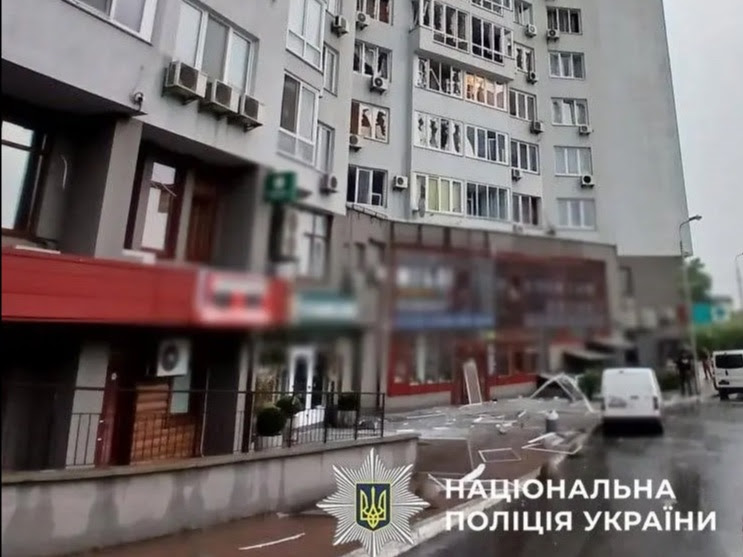
A residential building damaged following a Russian drone attack on Kyiv, Ukraine, overnight. (National Police / Telegram)
When Steel Meets Sky: Russia’s Navy Day Humiliation
The thunder of Ukrainian drones echoing across western Russia delivered a more potent message than any naval parade could have conveyed. For the first time since its inception in 2017, Russia’s annual Navy Day celebration in St. Petersburg was canceled entirely, with Kremlin spokesperson Dmitry Peskov citing “security reasons” as nearly 100 Ukrainian drones struck targets from Leningrad Oblast to Volgograd.
The British Defense Ministry called the cancellation “almost certain,” noting that it marked an unprecedented admission of Moscow’s inability to protect its own ceremonial events. Despite the humiliation, Vladimir Putin still traveled to St. Petersburg—a hollow gesture that underscored the gap between Kremlin propaganda and battlefield reality.
Ukrainian drones didn’t just disrupt a parade; they paralyzed critical infrastructure. At Pulkovo Airport, dozens of flights faced delays as air defense systems scrambled to intercept the aerial assault. Railway systems buckled under the pressure, with trains between southern resort towns and central Russian cities delayed by over two hours after drone debris severed power lines near Zhutovo Station.
The strikes reached deep into Russia’s heartland, with Volgograd Oblast’s electrical infrastructure suffering direct hits that plunged defense factories into darkness. Among the affected facilities were the Petrov, Kirov, and Erman plants—all critical nodes in Russia’s defense industrial base.
The Return of Steel: Russian Mechanized Warfare Resurfaces Near Siversk
In a dramatic reversal of recent tactical trends, Russian forces launched their largest mechanized assault since April 2025, deploying a reinforced company-sized formation northeast of Siversk with six tanks, three armored personnel carriers, six MT-LB armored fighting vehicles, and an armored recovery vehicle. The assault, documented in geolocated footage published on July 27, marked a significant departure from the motorcycle-and-buggy tactics that have characterized Russian offensive operations throughout Summer 2025.
The Ukrainian brigade that repelled the assault reported facing 80 pieces of armored and motorized vehicles—a concentration of firepower not seen in months. Russian forces supplemented their armored spearhead with 12 civilian vehicles, two buggies, and 41 motorcycles, creating a bizarre hybrid formation that reflected both desperation and tactical evolution.
This mechanized surge near Siversk represents more than tactical experimentation; it signals Russia’s attempt to test Ukrainian drone-based defenses with overwhelming metal. After months of hemorrhaging Soviet-era armor to Ukrainian FPV drones, Moscow appears willing to risk significant materiel losses to probe for weaknesses in Ukraine’s defensive networks.
The gambit places Russian forces within several kilometers of Siversk itself, a strategic prize that has eluded Moscow’s grasp since Summer 2024. With Russian sabotage and reconnaissance groups reportedly operating in the town’s eastern outskirts since late June, the mechanized assault may herald more concentrated attacks into the urban center.
The Diplomat’s Dilemma: Trump’s Patience Wears Thin as Moscow Doubles Down
Secretary of State Marco Rubio’s characterization of Donald Trump as “the ultimate closer” took on new urgency as he revealed the president’s growing frustration with Vladimir Putin’s diplomatic stonewalling. Despite Trump’s 50-day ultimatum threatening severe tariffs, Russia has only intensified its assault on Ukrainian cities while continuing to articulate maximalist demands that amount to complete Ukrainian capitulation.
“Despite having very good interactions with Vladimir Putin and phone calls, it never leads to anything,” Rubio told Fox News, describing Trump’s evolving calculation. “So, the time has come for some action.”
The diplomatic frustration reflects a fundamental miscalculation in Washington’s approach to Moscow. Trump’s timeline effectively grants Putin seven more weeks to continue his aerial terror campaign against Ukrainian civilians while making territorial gains along the front line. The proposed 100% tariffs, while symbolically significant, pale in comparison to the 500% rates proposed in bipartisan Congressional legislation.
Kremlin spokesperson Dmitry Peskov’s response on July 27 laid bare Russia’s unchanged war aims: NATO membership ban for Ukraine, large-scale demilitarization, constitutional recognition of four occupied oblasts as Russian territory, and “guarantees” for Russian language and culture. These demands, essentially unchanged since February 2022, underscore Moscow’s commitment to Ukrainian capitulation rather than negotiated settlement.
The Bus of Broken Dreams: Civilians Pay the Ultimate Price
The evacuation bus traveling near Yunakivka village in Sumy Oblast carried 39 passengers—residents who had been displaced from border communities but returned periodically to tend their homes and farms. At 4:30 p.m. local time, a Russian drone transformed their routine journey into a death sentence.
Three elderly women—ages 66, 74, and 78—died instantly when the drone struck their bus eight kilometers from the Russian border. Nineteen others suffered injuries of varying severity, with one woman clinging to life in critical condition. The precision of the attack, targeting a clearly marked civilian vehicle, exemplified Russia’s systematic campaign of terror against Ukrainian non-combatants.
“They were evacuated to Sumy but periodically visited their homes and farms in the border community,” Governor Oleh Hryhorov explained, his words heavy with the tragedy of displaced people caught between survival and the pull of home.
The attack followed a pattern established across multiple fronts: Russian forces specifically targeting evacuation routes, medical facilities, and civilian infrastructure to maximize psychological impact. The Sumy Oblast prosecutor’s office launched an investigation into war crimes, adding to the mounting evidence of systematic attacks on protected persons.
The Drone Commander’s Warning: When Leaders Become Targets
Ukraine’s top drone warfare commander, Robert “Madyar” Brovdi, issued a chilling revelation through his Telegram channel: Russia had attempted a coordinated strike targeting multiple Ukrainian drone unit leaders simultaneously. The attack, aimed at commanders from five of Ukraine’s strongest drone units—Phoenix, K-2, Madyar’s Birds, Raroh, and Achilles—represented a sophisticated intelligence operation designed to decapitate Ukraine’s drone warfare capabilities.
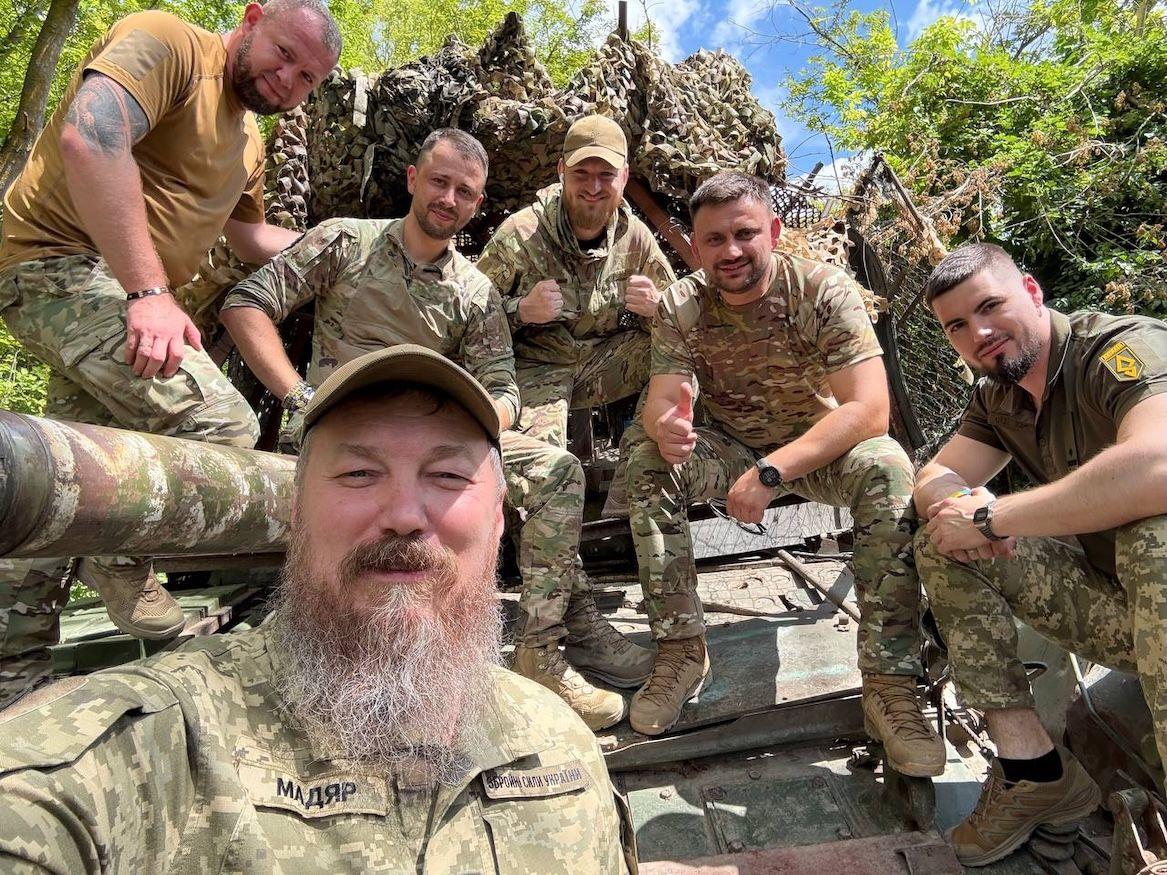
Commander Robert “Madyar” Brovdi (front), head of Ukraine’s Unmanned Systems Forces, poses with leaders of five elite drone units following a strategy meeting. (Robert “Madyar” Brovdi / Telegram)
“We assessed your attempt yesterday to hit all of us at once,” Brovdi wrote, his message combining tactical assessment with defiant mockery. The posting, laden with insults directed at Russian forces, masked a deeper strategic concern: Moscow’s growing focus on eliminating Ukraine’s drone leadership structure.
The attempted strike highlighted the central role of unmanned systems in Ukraine’s defense strategy. Since formalizing drone operations into the Unmanned Systems Forces in June 2024, Ukraine has created a parallel command structure that rivals traditional military hierarchies in importance. Brovdi’s appointment to lead the unified command group in 2025 made him a high-value target for Russian intelligence services.
Steel and Silicon: The New Arsenal Democracy
Ukraine’s drone warfare evolution reached a new milestone with the announcement of 33,000 AI-powered drone kits delivery by year’s end. The contract between the U.S. Defense Department and U.S.-German firm Auterion represents a tenfold increase over previous deliveries, marking Ukraine’s transformation into the global epicenter of autonomous warfare innovation.
Auterion CEO Lorenz Meier described the shipment as “unprecedented,” noting that the Skynode kits can convert manually operated drones into autonomous systems capable of tracking moving targets from one kilometer away while resisting electronic jamming. The Virginia-based company secured nearly $50 million in Defense Department contracts as part of broader U.S. security assistance.
The technological leap comes as Russia intensifies its own drone campaign, with Ukrainian military officials predicting enemy drone strikes could escalate to 1,000 per day. President Zelensky’s response—announcing domestic production of at least 1,000 interceptor drones daily—signals Ukraine’s commitment to matching Russia’s aerial terror with technological innovation.
The AI-powered systems represent more than tactical evolution; they embody the next phase of warfare where autonomous swarms communicate and coordinate in real-time while human operators retain targeting authority. As Meier noted, “What we are providing is leapfrogging what’s on the battlefield right now, which is to go to AI-based targeting and swarming.”
The Arsenal’s Empty Shelves: Russia’s Diminishing Stockpiles
New analysis from the Kyiv School of Economics Institute revealed the stark mathematics of Russia’s military consumption: Moscow has severely depleted its extensive Soviet-era weapons stockpiles, with shipments from storage facilities projected to fall from 242,000 tons in 2022 to just 119,000 tons in 2025.
“Russia is now sending less materiel for refurbishment and repair than we know the repair stations can handle,” noted KSE analyst Pavlo Shkurenko. “The better quality and easily-restored equipment would have been the first to be moved.”
The depletion has forced Russia into unprecedented dependence on Asian allies. North Korea now supplies 52% of explosive materials by weight, with shipments from Nakhodka port surging from zero pre-war to 250,000 tonnes in 2024. Iran contributes approximately 13,000 tons of explosive material, while China provides critical components for Russia’s defense industrial base.
This logistical reality explains Russia’s tactical evolution from massive mechanized assaults to the motorcycle-and-buggy warfare that characterized much of Summer 2025. The renewed use of armored vehicles near Siversk may represent either tactical experimentation or a calculated risk as Moscow tests Ukrainian defenses with its dwindling armor reserves.
Midnight Terror: Russian Strikes Paint Kyiv’s Sky Red
The pre-dawn darkness of July 28 erupted with explosions as Russian drones and missiles targeted multiple Ukrainian regions in a coordinated assault. Kyiv bore the brunt of the attack, with at least eight people injured, including a three-year-old child, when blast waves shattered windows from the 6th to 11th floors of a high-rise apartment building in Darnytskyi district.
The timing of the attack—mere days after the third round of peace talks in Istanbul—underscored Russia’s commitment to military pressure over diplomatic resolution. Air raid alerts screamed across the capital at 10:15 p.m. local time on July 27, with the first explosions heard thirty minutes later as Ukrainian air defenses engaged incoming threats.
Polish and NATO aircraft scrambled in response to the massive strike package, a routine precaution that highlighted the conflict’s regional implications. Telegram monitoring channels reported launches of Kinzhal hypersonic missiles toward Starokostiantyniv air base in Khmelnytskyi Oblast, suggesting Russia’s continued focus on degrading Ukrainian air capabilities.
The assault extended beyond the capital, with nine explosions reported in Kropyvnytskyi during overnight strikes. The breadth and intensity of the attacks demonstrated Russia’s capacity to maintain pressure across multiple fronts despite mounting equipment losses and international sanctions.
The Arsenal of Authoritarianism: China’s Silent Partnership
Secretary of State Rubio’s Fox News appearance laid bare the uncomfortable truth about Russia’s war sustainability: Beijing’s economic lifeline has enabled Putin’s military campaign far beyond Moscow’s indigenous capabilities. “There’s no way Putin could have sustained this war without Chinese support, particularly buying his oil,” Rubio declared, highlighting the triangular relationship between Russia, China, and Iran that sustains the conflict.
Chinese President Xi Jinping’s recent pledge to deepen strategic cooperation with Russia, hailing their partnership as “a model for a new type of international relations,” signals Beijing’s long-term commitment to supporting Moscow despite Western sanctions. Intelligence reports suggest China may be covertly supplying drone engines to help Russia bypass sanctions and ramp up production.
Ukrainian officials have documented Chinese components in Russian attack drones, evidence of Beijing’s indirect complicity in the daily terror campaign against Ukrainian civilians. The partnership extends beyond military hardware to economic sustenance, with Chinese oil purchases providing Moscow the financial resources necessary to sustain its war machine.
The Corruption Conundrum: Zelensky’s Reversal Under Pressure
European Commission President Ursula von der Leyen’s direct intervention forced President Zelensky into a rare public reversal on anti-corruption legislation. Following unprecedented wartime protests across Ukraine, Zelensky submitted a bill designed to restore independence to the National Anti-Corruption Bureau (NABU) and the Specialized Anti-Corruption Prosecutor’s Office (SAPO).
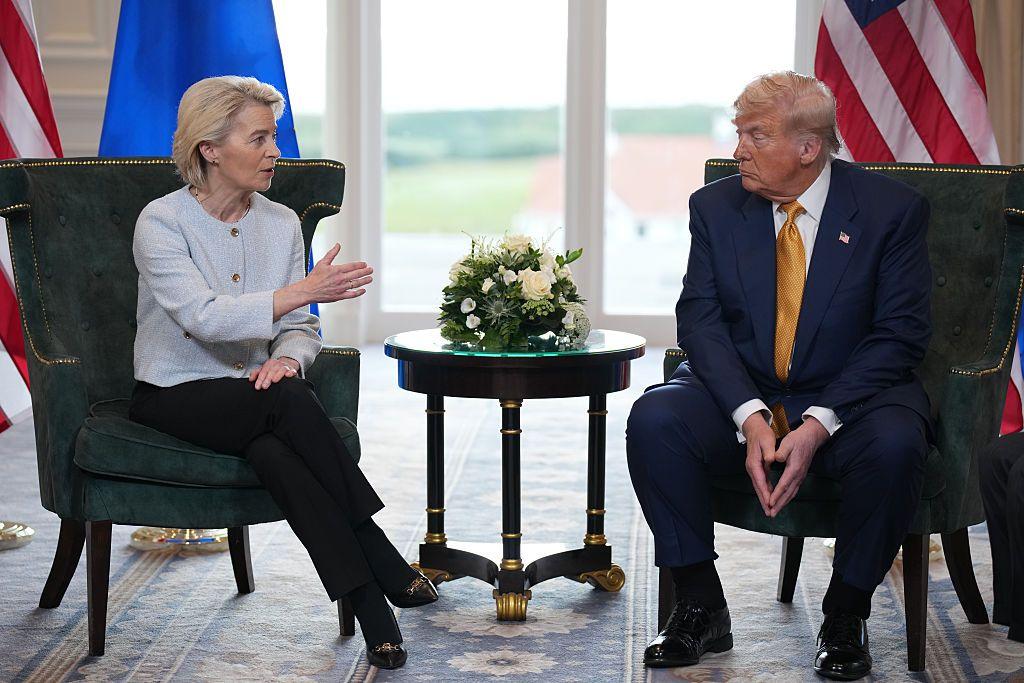
U.S. President Donald Trump and European Commission President Ursula von der Leyen announce a US-EU trade deal after a meeting at Trump Turnberry golf club, in Turnberry, Scotland. (Andrew Harnik/Getty Images)
“Ukraine has already achieved a lot on its European path. It must build on these solid foundations and preserve independent anti-corruption bodies, which are cornerstones of Ukraine’s rule of law,” von der Leyen declared in a public post following her call with Zelensky.
The president’s earlier attempt to strip these agencies of autonomy had prompted the first large-scale protests during the full-scale invasion, demonstrating that Ukrainian civil society remains vigilant even amid existential war. Zelensky’s acknowledgment that “there should have been a dialogue” regarding the proposed changes revealed the extent of his miscalculation.
The reversal came as NABU and SAPO had begun investigating individuals close to Zelensky’s inner circle, suggesting the timing was more than coincidental. The president’s commitment to adopt corrective legislation “as early as next week” represented a victory for Ukrainian democratic institutions under wartime pressure.
Trade Deals and Tariff Threats: The Economic Battlefield Expands
President Trump and European Commission President von der Leyen’s meeting at his Turnberry golf club produced a massive trade agreement that will reshape transatlantic commerce while reducing European dependence on Russian energy. The deal imposes a 15% tariff on most EU exports to the U.S.—down from Trump’s threatened 30%—while opening European markets to American goods at zero tariffs.
The economic dimensions dwarf pure trade considerations. The EU agreed to purchase $750 billion worth of U.S. energy over three years while investing an additional $600 billion in American markets. Von der Leyen emphasized that the energy purchases would help eliminate Russian LNG imports, stating, “We still have too much Russian LNG that is coming through the back door to our European Union.”
Trump’s announcement that EU member states would purchase “hundreds of billions of dollars worth of military equipment” highlighted the deal’s strategic implications. The agreement positions American industry to benefit from European rearmament while reducing Moscow’s economic leverage over its western neighbors.
The Pennsylvania Patriot: When Duty Transcends Borders
The Congressional recognition of Robert “Bobby” Edward Pietrangelo, the 23-year-old Pennsylvania volunteer who died fighting Russian forces near Pokrovsk, embodied the international dimension of Ukraine’s struggle. Representative Brian Fitzpatrick’s House floor eulogy honored a young man who answered Ukraine’s call when his own country’s military rejected him due to medical issues.
“Mom, it’s my duty. I must go,” Bobby told his mother Dana Fancher in their final conversation on January 2, his voice unwavering despite her pleas for him to return home. The exchange, brutal in its honesty, encapsulated the conviction that drove thousands of foreign volunteers to Ukraine’s battlefields.
Bobby’s path from combat medic to frontline fighter reflected Ukraine’s capacity to inspire sacrifice among those who had never seen its borders. His mother’s description of him as “fearless”—not without fear, but unafraid to face it—captured the essence of moral courage that sustains Ukraine’s resistance.
The young Eagle Scout’s death near Pokrovsk, where only two survivors emerged from his final engagement, underscored the human cost of the freedom he died defending. His story, from collecting World War II veteran autographs to joining Ukrainian military ranks, bridged American and Ukrainian struggles for democracy.
Sanctions Symphony: Ukraine Harmonizes with European Pressure
President Zelensky’s enactment of new sanctions targeting 45 Russian nationals and 50 companies marked Ukraine’s full alignment with the European Union’s 18th sanctions package. The decree, synchronizing Ukrainian restrictions with European measures, demonstrated Kyiv’s commitment to coordinated international pressure on Moscow’s war machine.
“As of now, all 18 sanctions packages are fully aligned and in effect in Ukraine,” Zelensky announced, noting that restrictions now extend to individuals and entities from Russia, China, Iran, and other countries affiliated with Moscow’s “shadow tanker fleet.”
The sanctions target Russia’s extraction of rare-earth and critical metals used in manufacturing electronics, engines, drones, and guidance systems—the technological sinews of modern warfare. More than 90 companies face asset freezes, trade restrictions, and transportation bans designed to choke off Moscow’s access to dual-use technologies.
The Kursk Counteroffensive: Ukraine Reclaims Border Territory
Ukrainian forces achieved a significant tactical victory in Sumy Oblast, liberating the village of Kindrativka in the Khotin community according to the Kursk Military Unit spokesperson. The operation, conducted by Defense Forces units operating as part of the Kursk Military Unit, marked a rare instance of Ukrainian territorial gains in the border region.
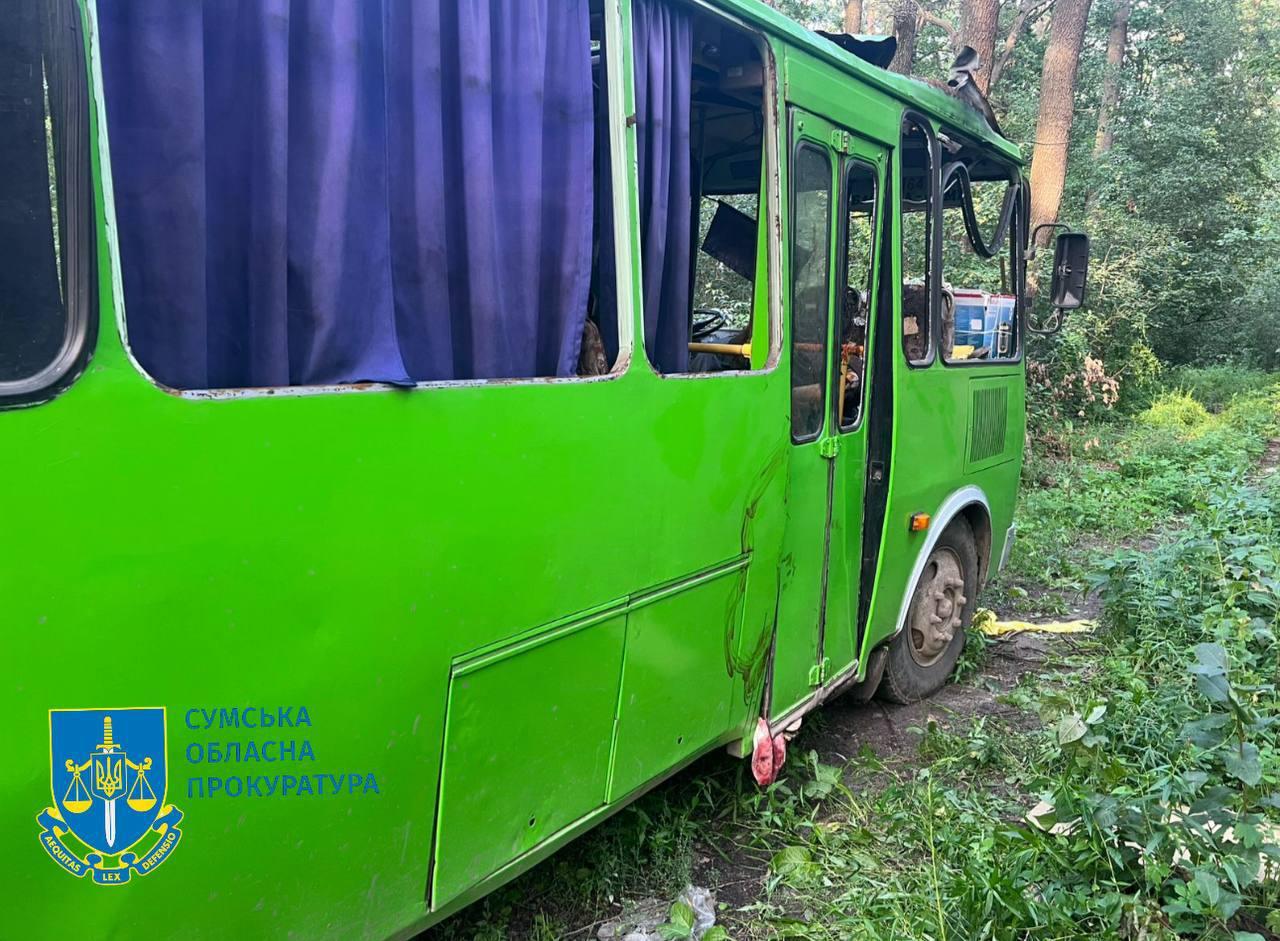
A bus hit by a Russian drone in the village of Ivolzhanske in Sumy Oblast. The attack killed at least three people. (Sumy Oblast Prosecutor’s Office/Telegram)
“Military units and subdivisions of the Ukrainian Defense Forces, which are part of the forces and resources of the Kursk Military Unit, as well as the forces and resources of the senior commander, have liberated the village of Kindrativka in the Sumy Region,” the spokesperson announced. “Stabilization measures are currently underway.”
The liberation came as Russian and Ukrainian forces continue trading territorial control along the volatile border region, with Russian milbloggers claiming Ukrainian counterattacks east of Tetkino and positions maintained in Ryzhivka and southern Novy Put.
The Death Toll Mounts: Weekend of Civilian Carnage
The weekend’s toll of civilian casualties painted a grim picture of Russia’s sustained terror campaign against non-combatants. Beyond the bus attack near Yunakivka, Russian forces killed at least seven civilians across multiple regions, demonstrating the breadth of Moscow’s targeting of civilian infrastructure.
In Dnipropetrovsk Oblast, a 66-year-old man died from Russian airstrikes while walking through a cemetery on Saturday—a scene that captured the war’s intrusion into even the most sacred civilian spaces. Sunday brought additional casualties when Russian forces launched more than 15 airstrikes around Nikopol district, injuring a 54-year-old man.
The industrial city of Illinivka in Donetsk Oblast bore witness to particularly devastating destruction when Russian forces dropped a 250-kilogram FAB-250 bomb on a civilian neighborhood. The precision weapon killed one resident and wounded three others, with the regional prosecutor’s office reporting that “private homes were at the epicenter of the strike.” Victims suffered traumatic brain injuries and broken bones, while the attack occurred during daylight hours at approximately 4 p.m.
Two additional deaths in the Kostiantynivka and Myrnohrad areas of Donetsk Oblast on Saturday brought the weekend’s civilian death toll to its tragic total, underscoring Russia’s systematic targeting of population centers far from active combat zones.
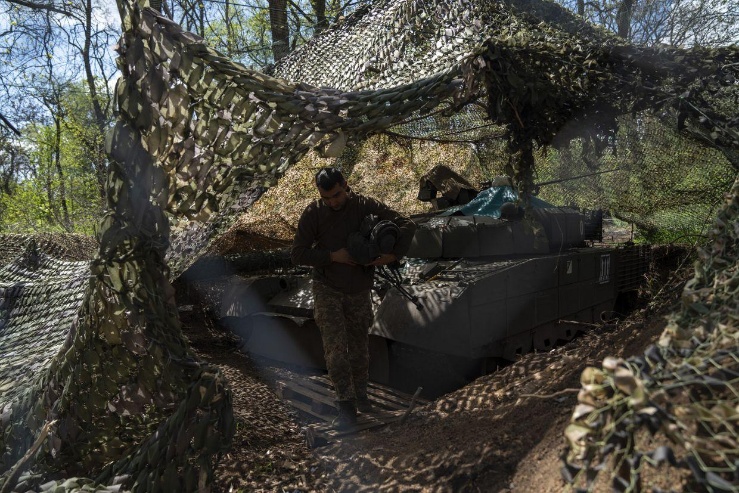
Ukrainian tank crew members service a captured T-80 tank following battles with Russian forces in the Kostiantynivka district, Donetsk Oblast, Ukraine. (Jose Colon / Anadolu via Getty Images)
Serbia’s Diplomatic Tightrope: Vučić Rejects Sanctions Despite EU Pressure
Serbian President Aleksandar Vučić definitively rejected imposing sanctions on Russia, contradicting recent comments by his European Integration Minister that suggested Belgrade might align with EU restrictions as membership negotiations progressed. Vučić’s declaration came in response to Minister Nemanja Starović’s interview with Austria’s APA news agency, where he suggested Serbia would consider sanctions once EU accession became imminent.
“We will continue with our policy, which was principled and which has proven to be correct so far, which no one liked, neither those in the West nor those in the East,” Vučić declared, calling Starović’s remarks “careless.” The Serbian president emphasized that his country’s refusal stems from economic necessity rather than political loyalty to Moscow.
The diplomatic tension reflects Serbia’s precarious position as an EU candidate since 2012 while maintaining economic ties with Russia. Vučić’s announcement in June that Serbia was suspending all arms exports followed Russian intelligence accusations that Belgrade was supplying weapons to Ukraine—claims the government denied despite Financial Times investigations suggesting Serbian ammunition reached both sides of the conflict.
The Staggering Cost: Russia’s Million-Man Loss
Ukraine’s Armed Forces General Staff reported that Russian casualties have reached a staggering 1,050,250 troops since the beginning of the full-scale invasion on February 24, 2022. The milestone, which includes 1,000 casualties suffered in the previous 24 hours alone, underscores the human cost of Putin’s war of aggression.
The equipment losses accompanying these casualties paint an equally devastating picture: 11,061 tanks, 23,064 armored fighting vehicles, 56,596 vehicles and fuel tanks, 30,826 artillery systems, and 48,393 drones destroyed or captured. The naval losses include 28 ships and boats plus one submarine—figures that provide context for Russia’s decision to cancel its Navy Day parade.
These numbers, while impossible to independently verify, align with Western intelligence assessments of Russia’s mounting personnel and equipment losses. The daily casualty rate of 1,000 troops suggests Russia’s offensive operations continue to exact an enormous price in human lives.
Looking Ahead: The Mathematics of Momentum
As July 27 drew to a close, the day’s events revealed the war’s evolving mathematics. Russia’s canceled Navy Day parade symbolized the Kremlin’s diminishing ability to project strength even within its own borders, while Ukrainian drones demonstrated growing capacity to strike deep into enemy territory. The renewed mechanized assaults near Siversk suggested Moscow’s willingness to expend precious armor reserves in pursuit of tactical gains, even as its overall stockpiles continue their inexorable decline.
The liberation of Kindrativka in Sumy Oblast offered a rare bright spot for Ukrainian forces, demonstrating their capacity for territorial gains despite Russia’s overwhelming numerical advantages. The diplomatic landscape remained frozen despite renewed peace talks, with Russia’s maximalist demands unchanged and Trump’s patience wearing thin.
The human cost continued mounting, from the bus attack in Sumy Oblast to the pre-dawn strikes on Kyiv, reminding the world that behind every tactical development lie individual tragedies and small acts of heroism. Serbia’s rejection of sanctions highlighted the international community’s continued divisions over supporting Ukraine’s resistance.
The arsenal of democracy continues its evolution, with AI-powered drones and international trade agreements replacing traditional military aid. As Ukraine prepares for the challenges ahead, the events of July 27 demonstrated both the war’s brutal persistence and the gradual shift in capabilities that may ultimately determine its outcome. The drones that silenced Russia’s naval parade may herald a new chapter in warfare itself—one where steel yields to silicon, and ceremonial power crumbles before technological innovation.