
As Trump Vows More Weapons While Pentagon Stockpiles Dwindle, Ukraine Faces Rising Casualties Amid Intensifying Russian Drone Campaign
Summary of the Day – July 8, 2025
The contradictions of American resolve crystallized into sharp focus as President Donald Trump simultaneously promised additional weapons to Ukraine while his Pentagon acknowledged having only 25% of the Patriot interceptors needed for U.S. defense plans. Against this backdrop of institutional scarcity, nine Ukrainian civilians died and 81 others were wounded in overnight Russian strikes – the latest casualties in Moscow’s relentless campaign of terror. Meanwhile, Russian drone production has tripled beyond planned volumes, aided by Chinese cooperation, even as Russian military bloggers complain their frontline units remain starved of equipment. The day’s events revealed a war economy where abundance and shortage coexist in unsettling proximity.
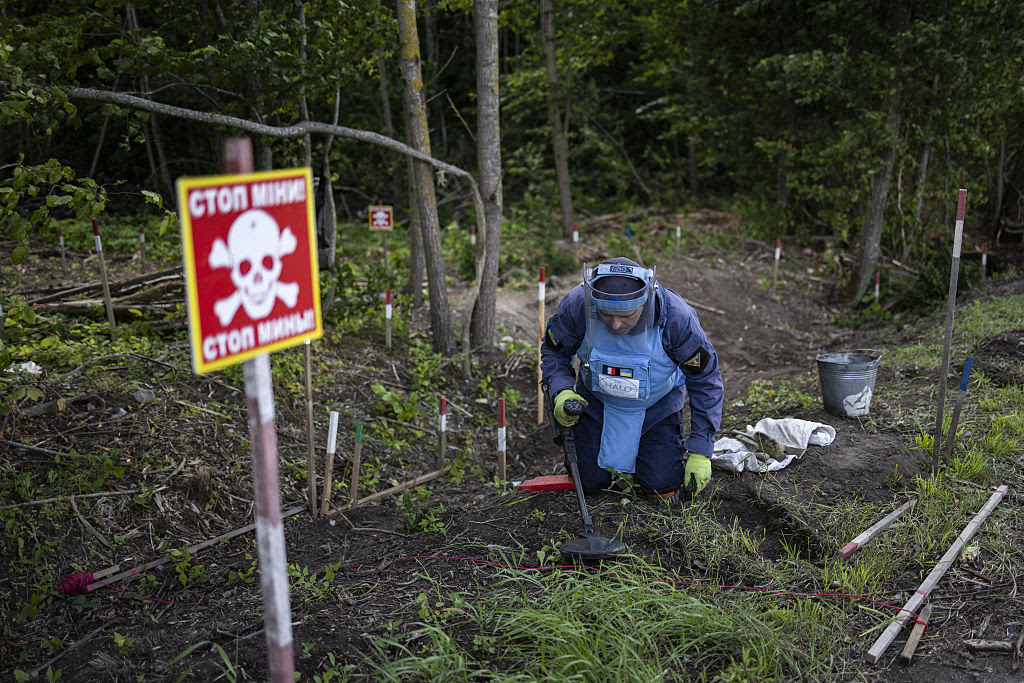
A team of deminers from the HALO Trust (a U.K. and U.S. organization dedicated to the removal of landmines) clear explosive ordnance on the outskirts of the village of Budy in Kharkiv Oblast, Ukraine. (Max Kishka/Anadolu via Getty Images)
The Weapons Pledge: Trump’s Promise Against Pentagon Reality
“We’re gonna send some more weapons we have to them, they have to be able to defend themselves, they’re getting hit very hard now,” Trump declared at the White House, flanked by Israeli and American officials. His words carried the weight of presidential authority, yet behind them lay a stark military reality: the United States possesses only about 25% of the Patriot missile interceptors it needs to meet Pentagon military plans.
The weapons freeze, implemented on July 2, had followed an internal review revealing critically low stockpiles of air defense systems. The depletion stemmed largely from recent U.S. operations in the Middle East, including the interception of Iranian missiles after strikes on the American Al Udeid airbase in Qatar. Pentagon officials familiar with the matter told the Guardian that the munitions tracker used to measure minimum supplies for U.S. war plans showed Patriot interceptor levels had fallen below acceptable thresholds.
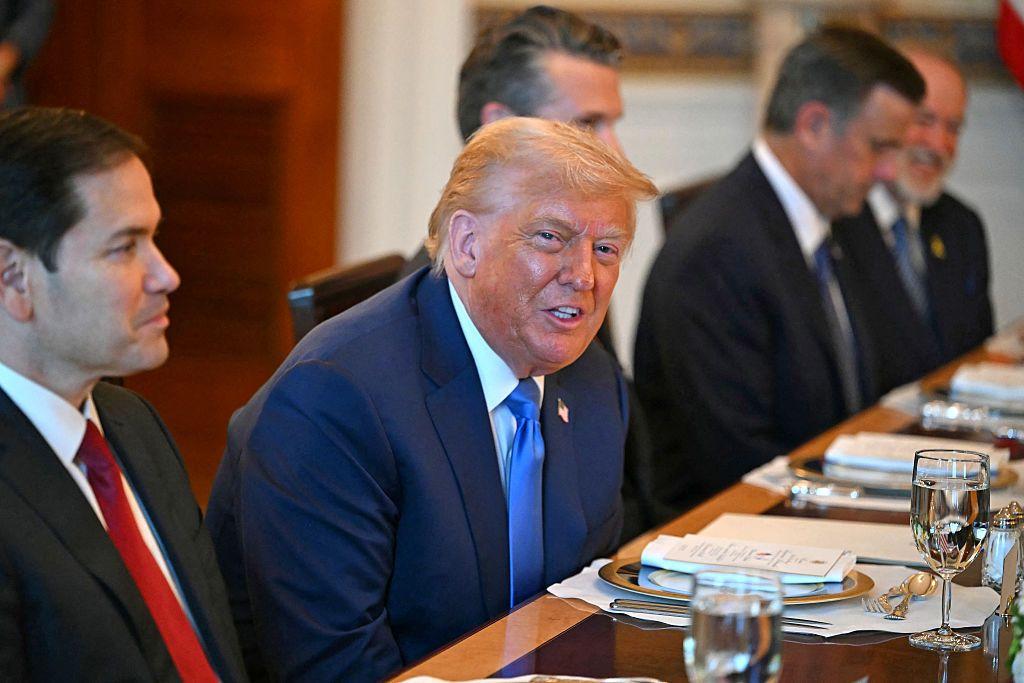
US President Donald Trump meets with unseen Israeli Prime Minister Benjamin Netanyahu at the Blue Room of the White House in Washington, D.C. (Andrew Caballero-Reynolds / AFP via Getty Images)
Yet Trump’s frustration with Vladimir Putin was unmistakable. “I’m very disappointed with the conversation I had today with President Putin,” he said, referring to their July 3 call. “I’m not happy with President Putin at all. I’m disappointed frankly that President Putin hasn’t stopped.”
Chief Pentagon Spokesperson Sean Parnell confirmed that additional defensive weapons would be sent “to ensure the Ukrainians can defend themselves while we work to secure a lasting peace.” The statement reflected the administration’s attempt to balance military readiness with diplomatic objectives – a precarious equilibrium that Ukraine’s defenders experience daily.
Trump also told reporters he was considering Russia sanctions legislation, saying the Senate’s Russia sanctions bill was “totally optional” for him to implement. “I’m looking at it very strongly,” Trump said, noting that Putin was sending “a lot of bullshit” and that his assurances had proven “meaningless.”
The Patriot Promise: Ten Interceptors and German Cooperation
According to Axios, Trump promised to send 10 Patriot interceptors to Ukraine and suggested that Germany sell one of its Patriot batteries to Ukraine, with the U.S. and European allies splitting the cost. The proposal emerged after German Chancellor Friedrich Merz called Trump to request the release of paused interceptors.
Defense Secretary Pete Hegseth has identified Patriot batteries in Germany and Greece that the U.S. could finance and send to Ukraine. The Wall Street Journal reported that Trump is considering sending Ukraine an additional complete Patriot air defense system, which would mark his administration’s first major weapons transfer to Kyiv.
The U.S. has provided Ukraine with three Patriot systems, while Germany has sent three and a group of European countries provided one. Not all systems are in use simultaneously due to maintenance issues, according to Pentagon officials.
The Human Cost: Nine Lives Lost in Russia’s Nightly Terror
Russian forces launched 54 drones overnight, including Iranian-designed Shahed-type attack drones, along with four S-300/400 guided missiles. Ukrainian air defenses intercepted 34 drones, while eight others likely served as radar-jamming decoys, but the remainder found their targets with devastating precision.
In Kharkiv Oblast, one person died and 40 others were injured, including three children, as the city of Kharkiv and seven other settlements came under attack. The strikes demonstrated Russia’s continued ability to terrorize civilian populations despite international condemnation and sanctions.
Zaporizhzhia Oblast bore the brunt of the assault, with 20 people injured and at least 64 houses and apartment buildings damaged. The systematic targeting of residential areas reflected Russia’s deliberate strategy of making daily life unbearable for Ukrainian civilians.
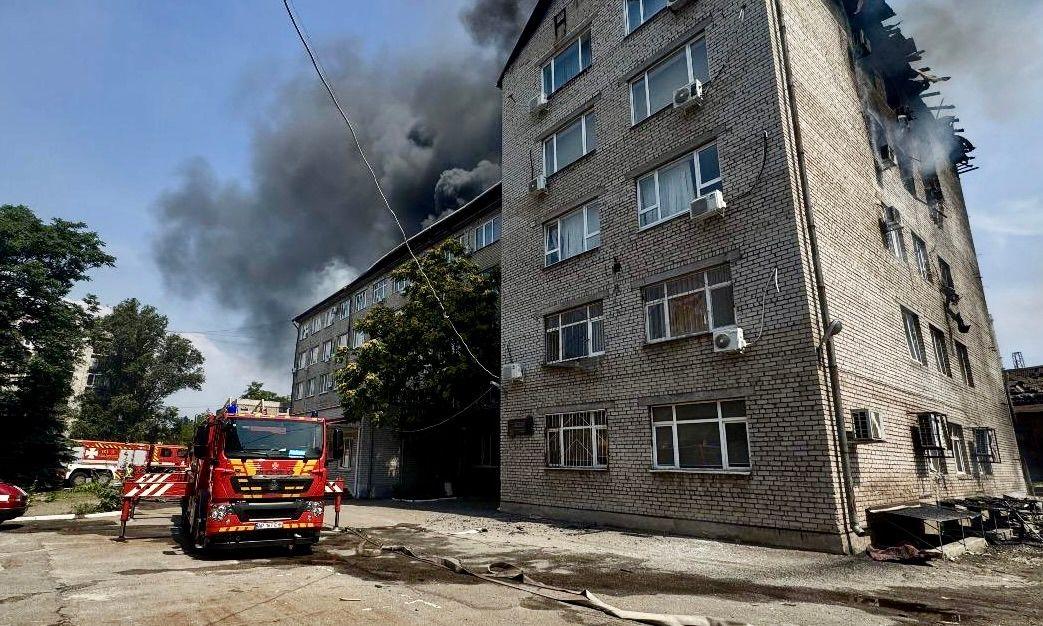
Firefighters extinguish the fire that erupted after a Russian attack against Ukraine’s Zaporizhzhia Oblast. (State Emergency Service / Telegram)
Donetsk Oblast witnessed three civilian deaths – two in Oleksiyevo-Druzhkivka and one in Novotroitske – while Sumy Oblast reported four killed and four wounded. In Kherson Oblast, one person was killed and four others injured, with Russian forces hitting residential areas and damaging two apartment buildings and 17 houses. Three people were injured in Dnipropetrovsk Oblast from FPV drone attacks.
The Kremlin’s Rhetoric Machine: Medvedev’s Calculated Aggression
Russian Security Council Deputy Chairperson Dmitry Medvedev responded to Trump’s weapons announcement with characteristic bombast, claiming that Russia should continue “business as usual” and would “push forward” to achieve its war goals and “reclaim its land.” The response illustrated the Kremlin’s reflexive control campaign designed to undermine Western support for Ukraine.
Medvedev’s statements are not merely the ravings of a has-been politician but part of a calculated Kremlin strategy. Putin leverages Medvedev to amplify inflammatory rhetoric designed to stoke panic among Western decision-makers and discourage aid to Ukraine. The provocative statements serve to make Putin appear more moderate by comparison while creating space for greater demands and larger threats.
The coordinated nature of Medvedev’s messaging reflects the Kremlin’s grip on Russia’s information space. Putin could censor these statements if he chose to, but their continuation suggests official approval and encouragement of this aggressive posture toward the West.
The Production Paradox: Russian Drone Surge Meets Distribution Failures
Russian Prime Minister Mikhail Mishustin claimed that Russia had “more than tripled its planned overall drone production volumes for 2025,” crediting the increase to state financial support for drone producers and civilian companies. The surge has enabled Russia’s increasingly large nightly strikes against Ukraine.
Ukraine-based intelligence organization Frontelligence Insight reported that Russian forces had launched 28,743 total Shahed variant drones since the beginning of the full-scale invasion, with 10 percent of this total – 2,736 drones – launched in June 2025 alone. The organization calculated that Russia produced an average of 60.5 Geran drones per day, or roughly 1,850 drones per month, between February and April 2025.
Ukrainian Commander-in-Chief General Oleksandr Syrskyi confirmed that Russian forces launched 1.6 times more missiles and drones against Ukraine in June 2025 than in May 2025, illustrating the escalating nature of the aerial campaign.
Yet this production surge has not translated into adequate frontline supplies, according to Russian military bloggers. A former Storm-Z instructor complained that the Russian military command prioritizes drone supplies to several specialized units while regular units receive far below their actual needs. Another blogger noted that the command supplies only 20 drones per month to non-specialized units, forcing them to rely on volunteer supplies.
The complaints suggest that Russia’s tendency toward centralization and bureaucratic ineptitude is creating obstacles in translating increased production into effective battlefield capabilities.
The Chinese Connection: Beijing’s Role in Russia’s Drone Renaissance
Documents analyzed by Bloomberg revealed the extensive Chinese involvement in Russia’s drone production capabilities. A Russian delegation visiting China in May 2023 established a joint venture with a Chinese university to form the Aero-HIT drone production facility in Khabarovsk, Khabarovsk Krai.
Aero-HIT submitted a 7.1-billion-ruble funding request to the Russian Ministry of Defense in June 2025, stating that the company had partnered with Chinese engineers since early 2023. The facility can reportedly produce up to 10,000 drones per month in 2025, with plans for further production increases.
Ukraine’s Main Military Intelligence Directorate reported that 60 to 65 percent of components in Russian-produced Geran-type drones are of Chinese origin. The Security Service of Ukraine discovered components manufactured at the Chinese Suzhou Ecod Precision Manufacturing Company in Russian Geran-type drones recovered in Kyiv.
President Volodymyr Zelensky responded by imposing sanctions on five Chinese-registered companies accused of supplying components found in Russian Shahed-type drones. The sanctions targeted Central Asia Silk Road International Trade, Suzhou Ecod Precision Manufacturing, Shenzhen Royo Technology, Shenzhen Jinduobang Technology, and Ningbo BLIN Machinery.
The Battlefield Balance: Ukrainian Advances in Sumy Meet Russian Gains in Donetsk
Ukrainian forces recently advanced in northern Sumy Oblast amid ongoing counterattacks, with geolocated footage indicating progress in northern and northeastern Kindrativka. Ukrainian military observer Kostyantyn Mashovets reported that Ukrainian forces advanced between Kindrativka and Kostyantynivka and entered Novomykolaivka.
Russian milbloggers claimed that Ukrainian forces seized central and northern Kindrativka and cut off Russian ground lines of communication along the C-191502 Novomykolaivka-Volodymyrivka road. The Russian military command deployed elements of the 40th Naval Infantry Brigade to support personnel retreating from the settlement.
Ukrainian Commander-in-Chief General Oleksandr Syrskyi reported that fighting remains intense in the North Slobozhansk direction and that Ukrainian forces are restoring positions while maintaining positions in Kursk and Belgorod oblasts.
In Donetsk Oblast, Russian forces continued their grinding offensive operations. Geolocated footage indicated that Russian forces advanced east of Bila Hora in the Chasiv Yar direction and northwest of Dyliivka in the Toretsk direction. The advances reflected Russia’s continued pressure on Ukrainian defensive lines despite significant casualties.
Russian forces conducted offensive operations across multiple directions, including near Pokrovsk, Novopavlivka, and Velyka Novosilka. In Zaporizhia Oblast, Russian milbloggers claimed advances in western, eastern, and central Kamyanske, though these claims remained unconfirmed.
The Contested Ground: Dachne Village Becomes Flashpoint
The village of Dachne in Dnipropetrovsk Oblast emerged as a new point of contention, with Russian forces claiming capture while Ukrainian officials insisted the settlement remained under Kyiv’s control. The disputed territory would mark the first village to be under Russian control in the industrial region.
Viktor Tregubov, spokesperson for Ukraine’s Khortytsia group of forces, stated that Dachne remained under Ukrainian control as of July 8, with the 37th Marine Brigade firmly holding the position. Russian troops were reportedly attempting to gain a foothold on the village’s outskirts, relying on fast-paced assaults along roads using motorcycles and light equipment.
The 37th brigade posted video footage showing soldiers raising a Ukrainian flag in Dachne, suggesting Ukrainian forces maintained at least partial control of the northern part of the village. The contested status reflects the fluid nature of frontline positions in active combat zones.
The Diplomatic Shuffle: Ambassador Replacement Signals Strategic Shift
Foreign Minister Andrii Sybiha confirmed that Ukraine’s current ambassador to the United States, Oksana Markarova, would be replaced as part of a broader diplomatic overhaul. The announcement came after Zelensky informed Markarova of her pending dismissal, with the president planning to replace approximately 20 heads of foreign institutions.
Markarova has served as Kyiv’s ambassador to Washington since April 2021, playing a central role in coordinating U.S. military and financial support during the early phases of Russia’s full-scale invasion. Her dismissal comes at a high-stakes moment in Ukraine-U.S. relations, as the Defense Department has paused shipments of critical weapons systems.
Multiple candidates are reportedly being considered for the position, including Prime Minister Denys Shmyhal, Deputy Prime Minister Olha Stefanishyna, Defense Minister Rustem Umerov, and Energy Minister Herman Halushchenko. The diplomatic reshuffle reflects Zelensky’s efforts to strengthen Ukraine’s international advocacy as the war enters its fourth year.
The Hospital Strike Investigation: Russian Officer Identified
Ukraine’s military intelligence identified Russian Armed Forces Major Denis Sheynov as allegedly involved in the July 2024 missile strike on Kyiv’s Okhmatdyt children’s hospital. The strike killed two adults and injured at least 34 people, directly hitting the country’s largest pediatric medical center while 627 children were receiving treatment.
Sheynov, head of the special engineering service of the 121st Heavy Bomber Aviation Regiment, was reportedly responsible for the technical preparation of the X-101 air-launched cruise missiles used in the attack. The 46-year-old officer from Saratov had previously served in Syria and received several medals from the Russian government.
Ukrainian authorities previously charged Russian Lieutenant General Sergey Kobylash in absentia for ordering the strike, which occurred at 10:45 a.m. after Kobylash gave the order at 9:15 a.m. The identification of specific officers involved in these attacks demonstrates Ukraine’s commitment to documenting war crimes for future prosecution.
The Demining Dilemma: Farmers Take Matters Into Their Own Hands
In the recaptured village of Kamyanka in eastern Ukraine, Larisa and Viktor Sysenko began demining their small farm themselves – with rakes. Their story illustrates the desperate reality facing Ukrainian farmers who cannot afford to wait for official demining teams to clear their land.
Ukraine’s agricultural territory has become what experts believe is the most mined land in the world, with one-fifth of the country’s total territory potentially contaminated by mines or explosives. The area roughly equals the size of England, containing an estimated 10 million explosive devices.
Swiss FSD demining teams found 54 mines in the Sysenkos’ field, including deadly PFM-1 anti-personnel mines known as “flower petal” or “butterfly” mines. These banned weapons blend horrifyingly well into fields and forests, detonating under the weight of a small child.
Farmers across Ukraine have adapted tractors to clear their land, unable to wait for the slow pace of official demining operations. The economic necessity of farming has forced civilians to take extraordinary risks, with many stepping on mines and suffering casualties.
The use of drones with artificial intelligence shows promise for accelerating demining operations, but the immediate need has pushed farmers to develop their own dangerous solutions. The Ukrainian government wants to clear 80 percent of its territory by 2033, but farmers cannot wait for bureaucratic timelines when their livelihoods depend on cultivation.
The Energy Sector: New Production Amid Infrastructure Destruction
Ukraine’s state energy giant Naftogaz commissioned a new exploration well producing 383,000 cubic meters of natural gas per day, a significant achievement given the country’s need for energy independence. The well was drilled and commissioned six weeks ahead of schedule as Ukraine works to boost domestic production amid Russian attacks on its energy infrastructure.
The new production comes as Ukraine’s gas storage situation has deteriorated significantly, with underground reserves falling to 6.02 billion cubic meters as of May 11-the lowest level in at least 11 years. The facilities are operating at just 19.4% capacity, with 2.79 billion cubic meters less gas available than the previous year.
To secure winter supplies, Naftogaz has signed contracts with Poland’s Orlen for delivery of 440 million cubic meters of U.S. liquefied natural gas. The diversification of energy sources reflects Ukraine’s strategic shift away from Russian energy dependence toward Western suppliers.
The Innovation Surge: Ukraine’s Drone Production Increases 900%
Ukraine’s drone production has increased by 900% over the past year, with monthly UAV output reportedly jumping from 20,000 in summer 2024 to over 200,000 currently. The dramatic increase demonstrates Ukraine’s rapid adaptation to the evolving nature of modern warfare.
Ukrainian drones are significantly cheaper than foreign analogs and extensively battle-tested across land, air, and sea. The industry has reached the capacity to produce up to 10 million UAVs annually, according to Deputy Defense Minister Oleksandr Kozenko.
Defense Minister Rustem Umerov disclosed that Ukraine’s defense industry is engaged in a long-term effort to counter kamikaze drones like the Shahed, with dozens of technological solutions already in combat use. One newly developed anti-Shahed system has shown unexpectedly high effectiveness, though details remain classified.
Ukrainian forces are now deploying interceptor drones and other classified systems through a continuous cycle of innovation, testing, and improvement. The surge in production has been driven by both domestic innovation and international support through initiatives like Brave1.
The Sanctions Synchronization: Ukraine Aligns with European Penalties
President Zelensky announced that Ukraine had synchronized its sanctions against Russia with the last three packages of economic penalties imposed by the European Union. The alignment brings Ukrainian penalties in line with the EU’s 15th, 16th, and 17th packages of sanctions against Russia.
The coordination reflects Ukraine’s strategic approach to maximize international pressure on Moscow through unified sanctions regimes. The 15th package targets individuals from Russia, Belarus, and China, including the Russian pilot Alexander Azarenkov, who was involved in the deadly attack on the Okhmatdyt children’s hospital.
The 16th package includes individuals from Russia, China, Turkey, and other nations, targeting the Voin Center military-patriotic education organization and Pivdennyi Flot LLC oil transport company. The 17th package designates firms from Russia, China, Turkey, and other countries, including the gold-mining company Petropavlovsk and the Chinese company Skywalker Technology Co. Ltd.
The Dutch Preparation: Rotterdam Port Readies for NATO Logistics
The port of Rotterdam began reserving space for NATO ships carrying military cargo and mapping out logistics routes for weapons transfers in anticipation of a potential war with Russia. The decision represents the first time the port will designate a special berth for military use, with part of the container terminal repurposed for safe ammunition transfers.
The logistical preparations reflect growing European concerns about Russian military capabilities and the need for enhanced defense readiness. Military supply logistics will be coordinated with the port of Antwerp in Belgium, demonstrating the integrated nature of European defense planning.
The developments underscore Europe’s increasing assumption of responsibility for continental defense as the U.S. focuses on global strategic competition. The port preparations represent a practical manifestation of NATO’s adaptation to the changed security environment.
The EU Budget Crisis: Covering Ukraine’s Funding Gap
The European Commission is discussing various options to cover Ukraine’s budget deficit for next year, which could range from $8 billion to $19 billion. The financial shortfall is linked to reduced U.S. support and the absence of prospects for a swift ceasefire that Europe had hoped for.
International partners have provided Ukraine with over $39 billion for its wartime economy so far this year, but the continuing conflict has created additional funding needs. Without support from Western partners, Kyiv would face a budget deficit of $19 billion in 2026, though even with additional international financing, a gap of at least $8 billion would remain.
Europe is considering providing military aid in the form of off-budget grants that would count toward NATO member countries’ national defense spending targets. The approach reflects the view that military support for Ukraine serves as a contribution to the defense of all of Europe.
The EU is expected to finalize its 18th package of sanctions against Russia this week, after facing opposition from Hungary and Slovakia. The package includes restrictions targeting Russia’s energy and banking sectors, as well as transactions linked to the Nord Stream pipeline project.
The Demographic Expansion: Putin Opens Military Service to Foreigners
Russian President Vladimir Putin signed a decree permitting foreigners to serve in the Russian army during periods of mobilization, expanding military recruitment efforts as Moscow struggles to maintain troop levels. The decree also allows qualified specialists who have reached the age limit to sign contracts with Russia’s security services.
The changes aim to strengthen recruitment as Russia tries to maintain the pace of troop replenishment without triggering another wave of unpopular conscription. Moscow currently recruits 30,000 to 40,000 individuals into its army each month, according to sources familiar with U.S. and EU intelligence.
The expansion of military service to foreigners represents a significant shift in Russian policy, reflecting the sustained personnel demands of the prolonged conflict. Putin’s partial mobilization decree from September 21, 2022, remains in force and has never been formally rescinded.
The Economic Pressure: Russian Oil Exports Decline
Russia’s crude oil shipments dropped to their lowest level since February, as refinery processing outpaced production growth and trimmed available export volumes. Seaborne crude flows averaged 3.12 million barrels per day over the four weeks to July 6, a 3% decline from the previous period.
The decline in oil exports comes as the European Union continues to tighten sanctions on Russia’s energy sector. Most of Russia’s oil continues to flow to Asia, with shipments to the region averaging 2.73 million barrels per day. The reduction in oil exports represents significant economic pressure on Russia’s war financing capabilities.
The Recovery Conference: Rome Prepares for Ukraine’s Future
President Zelensky will travel to Rome for the Ukraine Recovery Conference, aimed at securing long-term support for rebuilding Ukraine. The conference, to be held Thursday and Friday, will bring together leaders from 15 countries and hundreds of businesses to mobilize investments, particularly from the private sector.
The gathering represents a shift from addressing Ukraine’s immediate wartime needs toward planning for long-term reconstruction and recovery. The World Bank estimates that rebuilding Ukraine will cost $524 billion over the next 10 years – nearly three times the country’s projected GDP for 2024.
The conference will focus on energy and defense cooperation, with Ukraine hoping to expand cooperation in defense manufacturing. The involvement of more than 2,000 companies, including around 500 from Italy, demonstrates the scale of international business interest in Ukraine’s recovery.
The Mineral Deal Progress: U.S.-Ukraine Partnership Advances
Ukraine’s Economy Minister confirmed that the U.S. government-backed company TechMet is likely to bid on the Dobra lithium mine in central Ukraine, the pilot project under the landmark U.S.-Ukraine minerals deal. The mine represents the first concrete manifestation of the agreement signed over two months ago.
The deal covers all of Ukraine’s natural resources, including oil and gas, related infrastructure, and defense projects. Ukraine has presented at least eight projects for investment, with the DFC able to provide war risk insurance coverage that has been largely unavailable to foreign investors.
The minerals deal represents a significant strategic partnership between Washington and Kyiv, with the fund expected to become operational by the end of the year. The agreement demonstrates the Trump administration’s commitment to long-term economic engagement with Ukraine beyond immediate military assistance.
The Belarusian Integration: Minsk Seeks Full BRICS Membership
Belarusian Foreign Minister Maxim Ryzhenkov announced that Belarus intends to become a full member of BRICS after participating as a partner for the first time at the BRICS summit in Rio de Janeiro. The move represents further integration between Belarus and Russia’s geopolitical partners.
The announcement reflects Belarus’s continued alignment with Russia’s foreign policy objectives and its participation in alternative international frameworks. Belarus’s potential BRICS membership would strengthen the organization’s pro-Russian orientation and provide additional diplomatic support for Moscow’s positions.
The Naval Retreat: Russian Fleet Abandons Sevastopol Bay
Ukrainian partisan group Atesh reported that Striletska Bay near Sevastopol, once a key base for Russian warships in occupied Crimea, is now nearly empty and used primarily for mooring tugboats and small patrol craft. Russia now uses the bay mainly for maintenance work and rare anti-sabotage defense drills.

Striletska Bay in occupied Sevastopol is nearly empty, as most major vessels have been withdrawn from the area, according to a report published. (Atesh / telegram)
The remaining combat units are periodically rotated and redeployed in an apparent effort to avoid detection by Ukrainian reconnaissance. The degradation of the occupation fleet in Sevastopol reflects the success of Ukrainian attacks using naval drones, missiles, and long-range drones.
Ukraine has destroyed several Russian vessels, including the Caesar Kunikov landing ship, the Sergei Kotov patrol ship, and the Ivanovets missile corvette. The shrinking Russian presence in Sevastopol comes as Ukraine steps up drone attacks against other Black Sea Fleet locations.
The New Zealand Connection: Mayor’s Personal Mission
Former New Zealand Defense Minister Ron Mark completed another self-funded trip to Ukraine, maintaining his personal commitment to support the country despite his government’s official travel ban. Mark has become an unofficial contact point for New Zealanders serving in Ukraine, providing support that official channels cannot offer.
Mark’s presence in Ukraine represents the personal dimension of international support for Ukraine’s struggle. His visits to rehabilitation centers, meetings with medical professionals, and support for New Zealand volunteers demonstrate the human connections that transcend official diplomatic channels.
The former defense minister’s commitment illustrates how individual leaders can maintain support for Ukraine even when official government policy constrains formal assistance. His work with Ukrainian youth groups and veterans reflects the grassroots international solidarity that sustains Ukraine’s resistance.
The Torture’s Legacy: Former POW Dies After Release
Fifty-seven-year-old soldier Valery Zelensky died less than a month after his release from 39 months in Russian captivity, highlighting the long-term health consequences of torture and abuse in Russian detention facilities. Zelensky had been part of the landmark 1,000-for-1,000 prisoner exchange on May 25.
Medical reports listed extensive injuries, including a non-functioning shoulder and arm and signs of multiple organ failures. Zelensky’s daughter reported that doctors discovered his organs were severely damaged during surgery, leading to his death in intensive care.
The case represents the latest in a series of Ukrainian soldiers’ deaths after return from Russian captivity. The systematic torture of Ukrainian prisoners of war in Russian prisons has been documented by UN investigators as “widespread and systematic.”
The Literary Response: Poetry as Therapy and Resistance
Ukrainian medic and former POW Yuliia Paievska, known by her call sign “Taira,” published her debut poetry collection “Nazhyvo (Live),” capturing the brutal realities of war through literary expression. Paievska’s work represents the surge of wartime poetry emerging from Ukraine’s frontlines.
The collection draws from Paievska’s experiences as a volunteer medic in Mariupol, her three months in Russian captivity, and her continued service in the National Guard. Her poetry serves as both personal therapy and public testimony to the war’s human cost.
Paievska’s transformation from medic to poet reflects the broader cultural renaissance occurring amid Ukraine’s struggle for survival. Many Ukrainian soldiers are using poetry to process trauma and communicate the reality of their experiences to civilian populations.
Looking Forward: The Persistence of Paradox
As diplomatic efforts continue and weapons shipments resume, the fundamental contradictions of the current moment remain unresolved. American stockpiles strain under the dual demands of global commitments and Ukrainian assistance, while Russian production surges even as distribution failures plague frontline units.
The day’s events revealed a war economy where scarcity and abundance coexist, where diplomatic promises meet logistical realities, and where the human cost of conflict continues to mount regardless of high-level negotiations. Ukraine’s struggle for survival continues against this backdrop of competing imperatives and resource constraints.
The arsenal’s paradox – having both too little and too much, simultaneously – captures the essential challenge facing all parties in this prolonged conflict. As the war enters its fourth year, these contradictions will likely intensify rather than resolve, demanding ever more creative solutions from leaders navigating between military necessity and political possibility.