
As Alliance Leaders Pledge Historic Defense Spending, Putin’s Forces Murder 18 Civilians in Ballistic Missile Strike on Ukrainian Train Station
Summary of the Day – June 24, 2025
The stark moral divide between civilization and barbarism crystallized on June 24 as NATO leaders gathered in The Hague to announce historic defense spending commitments while Russian ballistic missiles simultaneously tore through a passenger train in Dnipro, killing 18 people and wounding nearly 300 others. Putin’s regime deliberately chose to massacre Ukrainian civilians on the opening day of the alliance summit, demonstrating Moscow’s contempt for diplomatic efforts. As Secretary-General Mark Rutte warned that Russia could rebuild sufficient military capacity to challenge NATO within five years, the carnage in Dnipro provided validation of his assessment. The day’s events—from Ukraine’s revelation of its capacity to produce 8 million drones annually to the confirmation of Trump-Zelensky talks—unfolded against the backdrop of mangled train cars and bloodied civilians, a reminder that while diplomats debated spending percentages, real people continued dying under Russian fire.
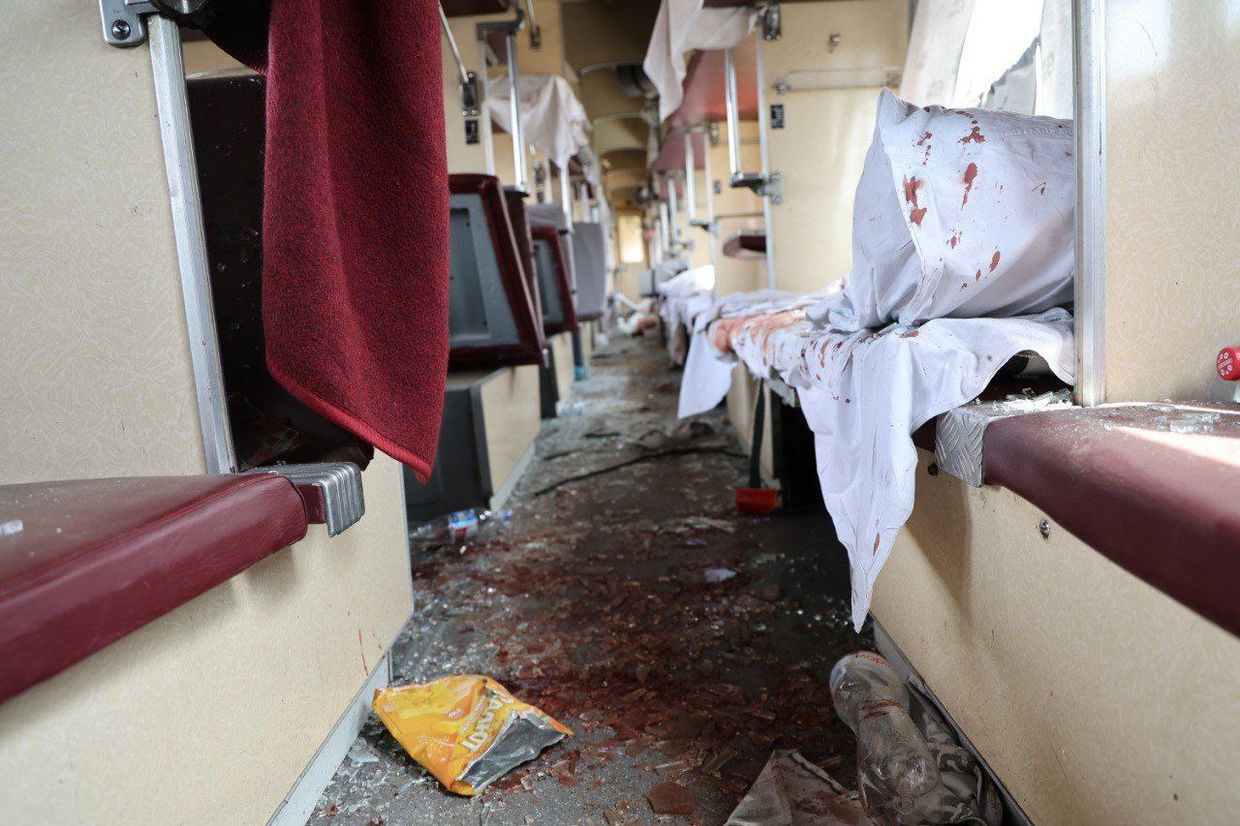
The aftermath of a Russian ballistic missile attack Dnipro, that damaged a passenger train (Serhii Lysak/Telegram).
Death Arrives by Ballistic Missile: The Dnipro Massacre
The morning of June 24 began with the screaming descent of Russian ballistic missiles over Dnipro, transforming what should have been an ordinary day into a scene of mass casualty horror. The attack struck with surgical precision at civilian infrastructure—a passenger train traveling from Odesa to Zaporizhzhia, educational facilities, residential buildings, and administrative structures across the city and nearby Samarske.
The final toll spoke to Russia’s systematic targeting of innocent life: 18 dead and 279 wounded, including 27 children whose only crime was existing in a nation Putin sought to erase. Among the casualties were passengers who had boarded trains believing in the basic human right to travel without fear of incineration, students whose educational institutions became graveyards, and families whose morning routines ended in hospital emergency rooms.
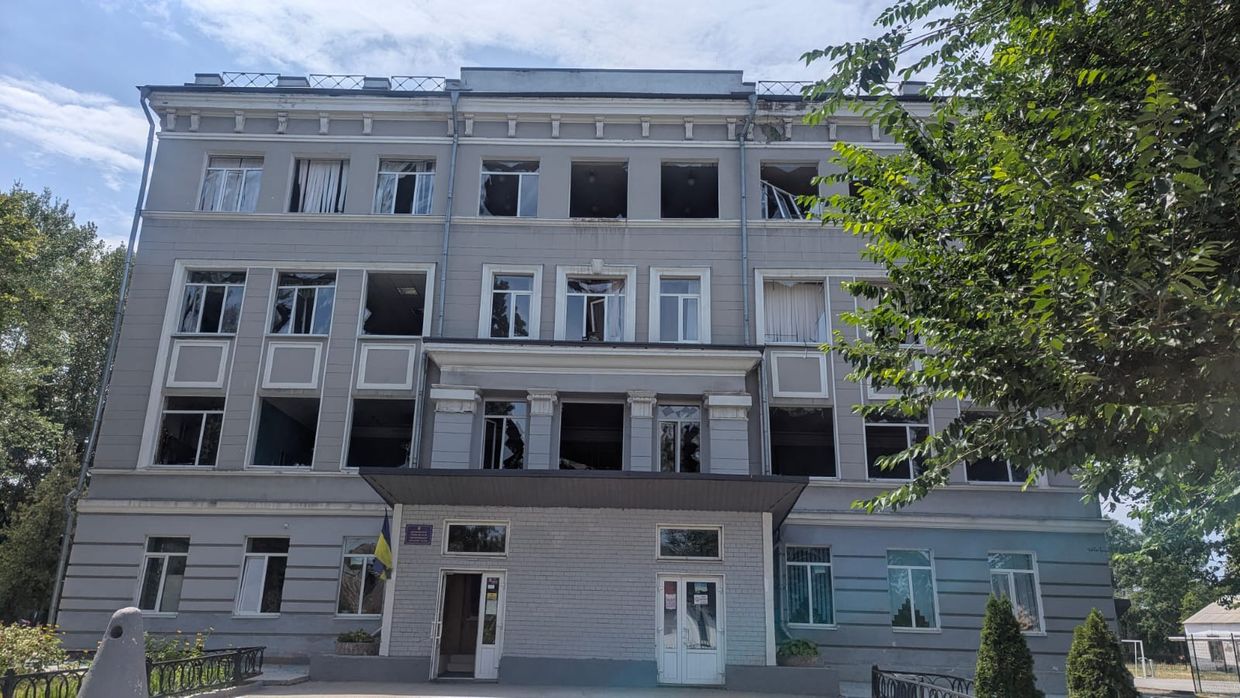
An school in Dnipro that was damaged in Russia’s ballistic missile attack. (Dnipro.media)
“Unfortunately, there are dead and wounded everywhere,” reported Dnipropetrovsk Oblast Governor Serhii Lysak, his words capturing the geographic spread of Russian malice across multiple locations. The attack ignited large fires that illuminated the destruction in hellish orange light, while nearly 100 victims remained hospitalized as the day ended—some fighting for lives that Russian missiles had tried to steal.
Ukraine’s national railway company, Ukrzaliznytsia, confirmed that the train strike caused multiple injuries among passengers and crew, though miraculously no railway workers were killed. The company quickly organized replacement transport to evacuate surviving passengers, demonstrating the resilience that had become Ukraine’s signature response to Russian terrorism.
The deliberate timing of the massacre—coinciding precisely with NATO’s summit opening—revealed Putin’s tactical use of civilian casualties as diplomatic messaging. While alliance leaders discussed defense spending in comfortable conference rooms, Ukrainian first responders pulled bodies from train wreckage and school rubble, the physical manifestation of the threats NATO gathered to address.
NATO’s Awakening: Five Percent and the Recognition of Existential Threat
NATO Secretary-General Mark Rutte’s assessment was unambiguous: Russia represents the alliance’s most significant and direct threat, supported by an axis of autocratic states that had transformed the global security landscape. Speaking to reporters on the summit’s opening day, Rutte declared that “Moscow continues to wage war against Ukraine, with support of North Korea, Iran, and China, as well as Belarus.”
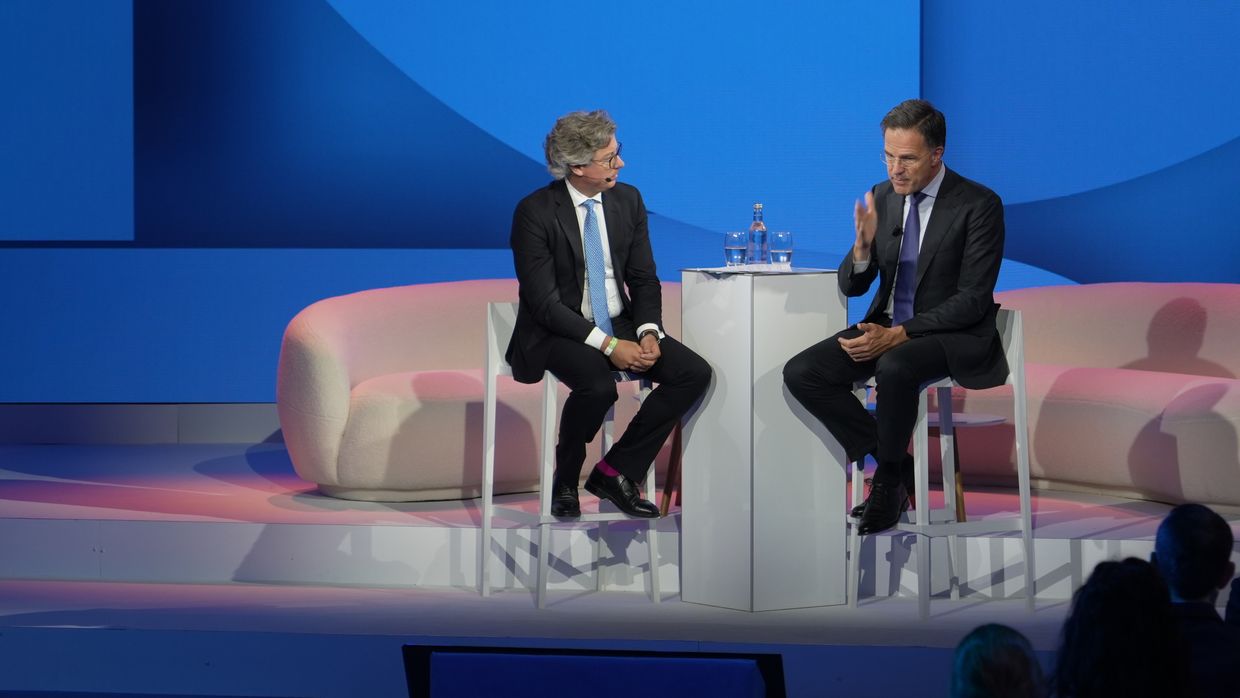
NATO Secretary General Mark Rutte (R) speaks with Benedikt Franke, vice chairman of the Munich Security Council, during the opening session at the NATO Public Forum on the first day of the NATO summit, in The Hague, the Netherlands. (Nick Allard/The Kyiv Independent)
The alliance’s response was equally direct: a historic commitment to spend five percent of GDP on defense, doubling the previous two percent target that only 23 members had achieved in 2024. Poland led the alliance with 4.12 percent, followed by Estonia at 3.43 percent and the United States at 3.38 percent, but the new benchmark demanded unprecedented peacetime military investment from all 32 members.
“This is a leap that is ambitious, historic, and fundamental to securing our future,” Rutte declared, outlining plans for massive increases in air defense systems, tanks, armored vehicles, and artillery production. The urgency reflected NATO’s assessment that Russia could rebuild sufficient military capacity to challenge the alliance within five years, making immediate action essential rather than aspirational.
The defense investment plan included specific provisions that allies would allocate 3.5 percent of GDP to core defense spending and 1.5 percent to broader security areas including cybersecurity and infrastructure protection. The plan would undergo review in 2029 with annual reporting requirements to ensure credibility and accountability.
Rutte emphasized the interconnected nature of global threats, rejecting the notion that NATO could focus on only one crisis at a time. “If you can only deal with one issue at a time, you should not be in politics or defense,” he stated, addressing concerns about divided attention between Ukraine, the Middle East, and Russian influence in Africa.
The Secretary-General revealed a stark statistic that illustrated the urgency: “The Russians are producing in three months what NATO produces in a year.” This production deficit underscored why the alliance pledged over 35 billion euros in military aid to Ukraine for the first half of 2025, up from 20 billion announced earlier.
Ukraine’s Industrial Revelation: Eight Million Drones and Unfunded Potential
President Volodymyr Zelensky’s address to the NATO Defense Industry Forum revealed both Ukraine’s remarkable transformation into a defense powerhouse and the critical funding gaps that limited its potential. Standing before alliance defense ministers, Zelensky announced that Ukraine possessed the capacity to produce over 8 million drones of various types annually—a staggering figure that represented one of the world’s largest unmanned systems manufacturing capabilities.
“Our defense production potential has surpassed $35 billion,” Zelensky declared, noting that this included nearly 1,000 types of military products. However, he emphasized a crucial limitation: “Around 40% of this potential lacks proper funding. For example, we can produce over 8 million drones of different types each year, but the financing allows for far fewer.”
The Ukrainian president’s presentation revealed how profoundly the war had transformed his nation’s industrial base. Ukraine had evolved from a country dependent on foreign military aid to a potential security provider for the entire alliance. Zelensky argued that Ukrainian defense capabilities were essential not only for defending Ukrainian territory but for strengthening NATO’s long-term security architecture.
“We must lead in the drone race, both in strike drones and interceptors,” Zelensky urged, calling for increased allied investment in joint weapons production. “All the weapons we produce become part of a new, stronger European defense and security system.”
The speech highlighted Ukraine’s unique position as both a battlefield laboratory for modern warfare and an emerging defense industrial hub. Ukrainian companies had rapidly developed technologies for aerial, naval, and ground drones while innovating in areas like electronic warfare, missile production, and air defense systems.
Zelensky also called on NATO members to dedicate at least 0.25 percent of GDP specifically to support Ukraine’s military needs, while thanking countries like Germany, Norway, Sweden, and the Netherlands for their elevated commitments. He warned that Russia was planning “new military operations on NATO territory” and emphasized that the war in Ukraine must be stopped to prevent broader European conflict.
The Trump-Zelensky Convergence: Confirmed Talks and Diplomatic Stakes
The White House confirmation that President Donald Trump would meet with President Zelensky during the NATO summit represented a critical diplomatic moment with implications far beyond the 48-hour gathering in The Hague. The meeting, scheduled for the “early afternoon” of June 25, would mark the third encounter between the leaders since Trump’s return to office and the first since their April meeting at Pope Francis’ funeral.
The confirmed agenda revealed the complex dynamics at play: discussions would focus on Ukraine’s “purchase of a defense package, a large part of which consists of air defense systems,” along with “sanctions against Russia, and a price cap on oil.” These topics highlighted the transactional nature of U.S.-Ukraine relations under Trump while acknowledging Ukraine’s desperate need for enhanced air defenses.
Trump’s earlier comments about Zelensky provided insight into the American president’s mindset: “I’ll say: ‘How are you?’ He’s (Zelensky) in a tough spot, he shouldn’t have been there at all.” The statement revealed both personal sympathy and implicit criticism of Ukrainian resistance to Russian aggression.
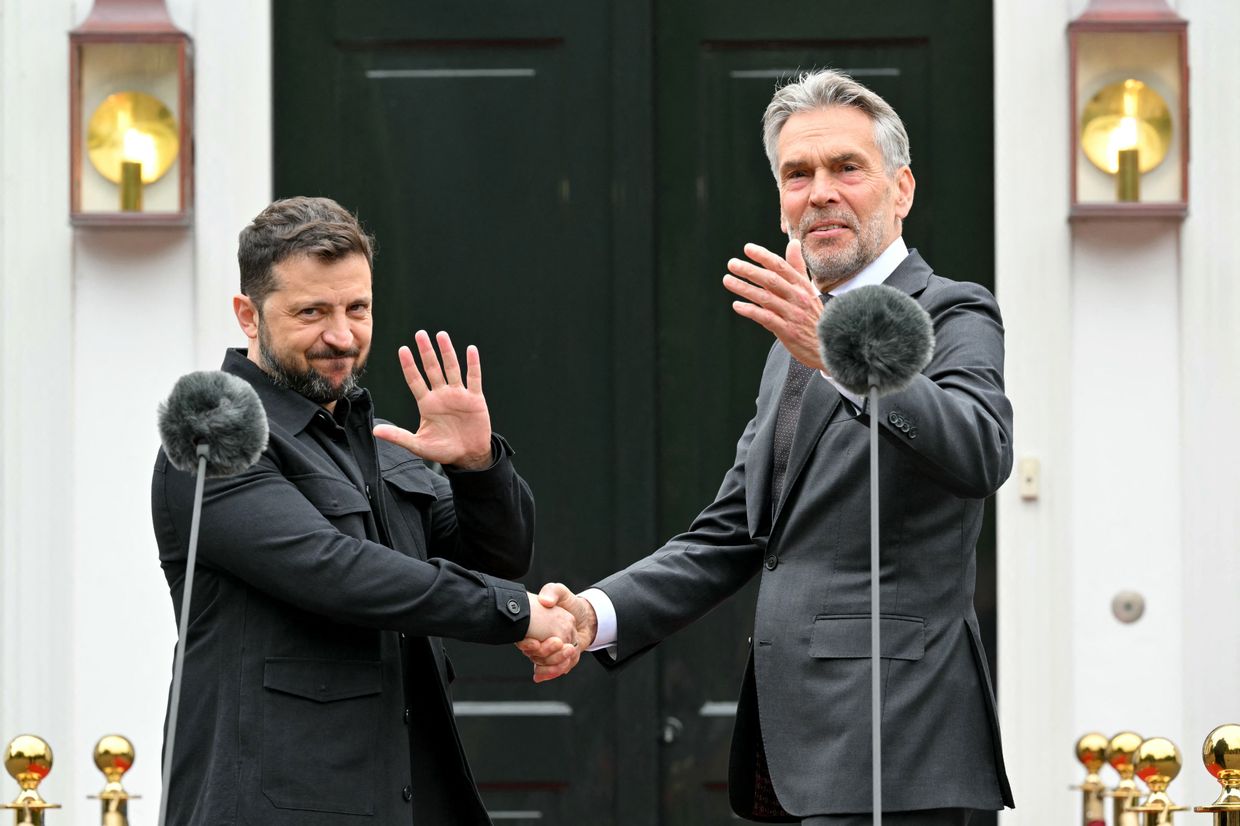
Netherlands’ outgoing Prime Minister Dick Schoof (R) shakes hand with Ukraine’s President Volodymyr Zelensky (L) upon his arrival at the Catshuis official residence before for a bilateral meeting on the sidelines of the two-day NATO’s Heads of State and Government summit in The Hague. (Nicolas Tucat/AFP via Getty Images)
The meeting’s significance extended beyond bilateral relations to encompass Trump’s complex relationship with NATO itself. Earlier, while departing for the summit, Trump had refused to give a clear commitment to NATO’s Article 5 collective defense clause, stating “It depends on your definition of Article 5” and adding “There’s numerous definitions of Article 5. You know that, right?”
Trump’s ambiguous stance on NATO’s foundational principle created additional pressure for the Zelensky meeting to produce concrete results. Ukrainian officials hoped to demonstrate their country’s value as both a strategic partner and a bulwark against Russian expansion that threatened NATO’s eastern flank.
The timing also coincided with Trump’s revelation that Putin had called him offering to help resolve the Iran-Israel conflict. “Vladimir called me up. He said, can I help you with Iran? I said, ‘no, I don’t need help with Iran. I need help with you,'” Trump told Fox News, indicating ongoing dialogue with the Russian president even as Russian missiles killed Ukrainian civilians.
European Defense Integration: Multiple Partnership Announcements
The NATO summit served as a catalyst for numerous bilateral and multilateral defense partnerships that demonstrated Europe’s accelerating integration with Ukraine’s military-industrial complex. These agreements represented more than aid packages—they constituted recognition of Ukraine as a permanent part of European defense architecture.
The United Kingdom announced a groundbreaking three-year drone production partnership with Ukraine, with Britain financing the procurement of Ukrainian-designed drones manufactured in British facilities. Defense Minister Rustem Umerov explained that “This will enable British defense companies to rapidly design and produce state-of-the-art drones on a large scale,” while ensuring that production would be shared between the countries after the war’s conclusion.
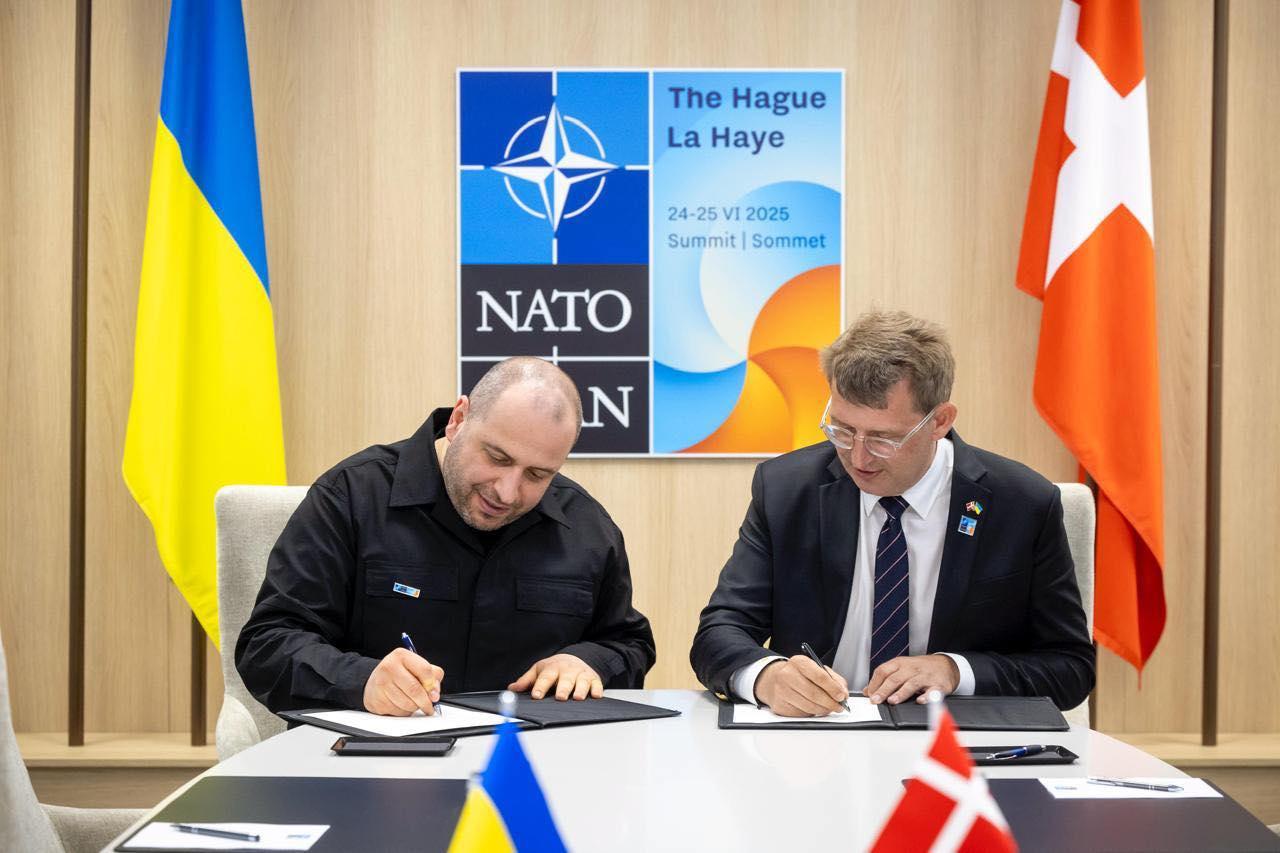
Defense Minister Rustem Umerov signed a Letter of Intent with his Danish counterpart Troels Lund Poulsen, in The Hague, the Netherlands. (Ukraine’s Defense Ministry)
The Netherlands revealed contracts worth 500 million euros to produce 600,000 drones with Ukrainian defense companies, complementing a 175 million euro military aid package that included 100 drone detection radars and 20 Ermine unmanned vehicles for casualty evacuation. The Dutch also committed 80 million euros to the international drone coalition, demonstrating sustained commitment to Ukrainian air power.
Denmark signed a Letter of Intent with Ukraine to launch Ukrainian defense production on Danish territory, allocating $47 million for the project with additional partner funding. The agreement would integrate Ukrainian enterprises into the European defense system while providing Danish forces access to Ukrainian technologies and battlefield experience.
NATO announced 37 million euros for Ukrainian satellite communications, including radio stations, trackers, and services, while European Commission President Ursula von der Leyen detailed the EU’s 50 billion euro “Safe” funding program that would allow members and partners to invest in Ukrainian defense industry.
These partnerships reflected a fundamental shift in European thinking about Ukraine—from aid recipient to security provider. As von der Leyen noted, “We are integrating our defense industries as if Ukraine was in the EU. This is good for Ukraine. And just as good for Europe, as Ukraine is now home to extraordinary innovation.”
The Votkinsk Revelation: How Sanctions Failed to Stop Russia’s Missile Arsenal
A comprehensive investigation revealed the systematic failure of international sanctions to prevent Russia’s strategic missile production expansion. The Votkinsk Plant—Russia’s primary manufacturer of intercontinental ballistic missiles and Iskander systems—had dramatically increased output through sophisticated sanctions evasion networks involving Chinese, Taiwanese, and Belarusian suppliers.
The findings were stark: Russia produced nearly three times more Iskander-M ballistic missiles in 2024 than in 2023—700 compared to 250. Ukrainian intelligence confirmed that Russia had stockpiled approximately 600 Iskander-M ballistic missiles and 300 Iskander-K cruise missiles, representing a two-year supply at current attack rates.
The investigation uncovered over $11 million in foreign machine tool contracts signed by Votkinsk in 2023, with equipment primarily sourced from China through Russian intermediaries. Companies like Zhangzhou Donggang Precision Machinery and WMT CNC Industrial had supplied critical manufacturing equipment that enabled the plant’s expansion, bypassing sanctions through complex supply chains.
The plant’s expansion included new facilities constructed in 2024, housing thousands of additional employees among the total workforce of over 12,000. Satellite imagery revealed construction of new workshops and production facilities designed to house imported machinery that enhanced both short-range and intercontinental missile production capabilities.
Perhaps most ominously, documents revealed that one month into the full-scale war, the Russian Defense Ministry had ordered Votkinsk to produce parts for Bulava intercontinental missiles capable of reaching the United States. The $13 million contract covered production from 2022 to 2024, indicating Russia’s immediate prioritization of nuclear delivery systems.
The systematic sanctions evasion highlighted fundamental weaknesses in Western enforcement mechanisms. Despite Votkinsk being officially blacklisted by the United States and allies, the plant had successfully acquired sophisticated manufacturing equipment that enhanced its capacity to produce weapons threatening both Ukraine and NATO territories.
European Opinion and the Limits of Solidarity
A new European Council on Foreign Relations poll revealed complex European attitudes toward potential U.S. policy shifts under Trump administration. Despite 155 days having passed since Trump’s self-imposed 100-day deadline to end the war, majorities across 12 European countries opposed following Washington’s lead if it pushed Ukraine to cede territories or lifted sanctions on Russia.
The survey found opposition even in countries with pro-Russian governments like Hungary, where more people opposed territorial concessions than supported them. Opposition was highest in Denmark, the United Kingdom, Poland, Spain, and Portugal, while lowest in Hungary, Romania, and Italy.
When asked about compulsory military service, France (62 percent), Germany (53 percent), and Poland (51 percent) showed strongest support, though notably not among 18-29 year-olds most likely to be called up. The age demographics revealed generational tensions about who would bear the costs of potential military mobilization.
The polling also showed Europeans becoming increasingly pessimistic about U.S. political stability under Trump, with large majorities in the United Kingdom (74 percent) and Germany (67 percent) believing the American political system was “broken.” These perceptions influenced European calculations about long-term reliance on U.S. security guarantees.
Motorcycle Warfare: Russia’s Tactical Innovation and Strategic Implications
Ukrainian military sources reported alarming developments in Russian tactical doctrine as Moscow’s forces increasingly relied on motorcycle assault units across the frontline. These formations represented adaptation to Ukraine’s successful interdiction of armored vehicles and reflected lessons learned from three years of high-intensity warfare.
According to Frontelligence Insight, Russian motorcyclists operated in squads of six to eight motorcycles with one or two riders each, totaling 6-16 personnel per unit. Each squad carried two to four portable electronic warfare systems and devices for detecting Ukrainian drones, indicating sophisticated integration of mobility and countermeasures.
The tactical evolution was significant because Russian forces no longer confined motorcycle attacks to roads but operated through open fields to bypass Ukrainian engineering barriers. The formations supported diversion, reconnaissance, infiltration, and flanking missions while also handling casualty evacuation and logistics support.
Ukrainian sources reported that Russian forces were training troops on motorcycles and all-terrain vehicles at improvised motocross tracks in Russia and occupied Ukraine. Training programs varied from 16 hours to over a month and included specialized drone evasion techniques, indicating institutional adoption rather than ad hoc adaptation.
Internal Russian Defense Ministry documents suggested plans to equip over half of Russia’s infantry forces with motorcycles, ATVs, and buggies, representing a fundamental shift toward lighter, more mobile formations. The implications extended beyond Ukraine as these tactical innovations could be applied in potential future conflicts against NATO forces.
Dual Citizenship Revolution: Ukraine Opens Doors to Foreign Partners
Ukraine’s parliament voted to lift the longstanding ban on dual citizenship, fulfilling President Zelensky’s 2019 promise to “grant Ukrainian citizenship to all who are ready to build a new, strong and successful Ukraine.” The historic decision represented more than bureaucratic reform—it constituted recognition of the foreigners who had chosen to defend Ukraine with their lives.
For individuals like Irish businessman Paul Niland, who had spent 23 years in Ukraine and founded Lifeline Ukraine to support war veterans, the change offered formal recognition of emotional and practical ties that had deepened through shared struggle. “Freedom, independence, building a better country for our children—if we share these goals and values, becoming Ukrainian is first and foremost a state of mind,” Niland explained.
However, the legislation revealed ongoing bureaucratic hurdles for some applicants. Journalist Larisa Kalik, who had fled Russian-occupied Transnistria in 2020, faced difficulties proving her grandfather’s Ukrainian birth despite possessing his birth certificate. The absence of digital records required potential court proceedings to establish ancestral claims, highlighting implementation challenges.
Foreign fighters faced particular complications despite their battlefield sacrifices. Veterans like “Anthony”—whose name was changed for security reasons—who had served 2.5 years in the International Legion, found themselves in legal limbo after leaving the organization before completing the three-year requirement for permanent residency.
“I killed the enemy in combat, risked my life many times. I did my job silently and not for attention. But I’m basically nothing in the eyes of the state right now,” Anthony explained, describing the disconnect between military service and bureaucratic recognition.
Justice Delayed: The Special Tribunal Agreement
The Council of Europe and Ukraine prepared to sign a landmark agreement establishing a special tribunal for the crime of Russian aggression, marking a milestone in international efforts to hold Putin and senior Russian officials accountable for launching the full-scale war.
Ukrainian Deputy Prime Minister Olha Stefanishyna emphasized that the tribunal would have jurisdiction over Putin, his prime minister, foreign minister, and other top officials. “It is not a matter of debate anymore, only a matter of time. Some will get into the hands of justice sooner, some later, but they will all be held accountable. There are no exceptions,” she declared.
The tribunal’s design explicitly rejected functional immunity for high-ranking officials, allowing prosecution even while they held office. The statute included provisions for conducting proceedings in absentia, acknowledging the practical challenges of securing defendants’ physical presence.
The tribunal would be authorized to cooperate with the International Criminal Court to ensure jurisdictional effectiveness and information sharing. While the ICC had already issued arrest warrants for Putin and Maria Lvova-Belova regarding Ukrainian children’s deportation, the special tribunal would focus exclusively on the crime of aggression.
Russia’s Military Doctrine Evolution: CSTO Integration and Motorcycle Warfare
Russia’s State Duma ratified a protocol allowing Collective Security Treaty Organization states to rapidly deploy troops to each other’s territories, reducing the decision-to-deployment timeline from 30 days to just one day. The protocol introduced a “command of formations” concept that would likely be Russian-dominated, representing the Kremlin’s systematic effort to subordinate former Soviet militaries under Russian command.
The development reflected Russia’s strategy to augment combat power through multinational formations while maintaining Moscow’s control over allied forces. Western assessments of Russia’s future military capacity would need to account for CSTO allies’ forces that Russia could deploy in future operations beyond its own armed forces.
Simultaneously, Russian forces expanded their use of motorcycle assault tactics across the Ukrainian frontline, representing a significant tactical evolution with implications for future conflicts. According to Ukrainian military sources, Russian motorcycle forces no longer attacked along roads but operated through open fields to bypass Ukrainian engineering barriers.
Frontelligence Insight reported that Russian motorcyclists operated in squads of six to eight motorcycles with 6-16 personnel total, equipped with portable electronic warfare systems and Ukrainian drone detection devices. The formations supported diversion, reconnaissance, infiltration, and flanking missions while handling casualty evacuation and logistics.
Internal Russian Defense Ministry documents revealed plans to equip over half of Russia’s infantry forces with motorcycles, ATVs, and buggies, indicating institutional adoption of these tactics for potential use beyond Ukraine. Training programs at improvised motocross tracks in Russia and occupied territories varied from 16 hours to over a month, including specialized drone evasion techniques.
Franco-German Unity Declaration: European Defense Commitment
French President Emmanuel Macron and German Chancellor Friedrich Merz published a joint Financial Times op-ed emphasizing Europe’s “unshakeable determination” to confront Russia’s “imperialist war.” The leaders declared that “the main source of instability for Europe comes from Russia,” which had waged war through invasions of Georgia, Crimea, Donbas, and Ukraine.
The op-ed represented a rare display of Franco-German unity on defense policy, with both leaders pledging to exceed the two percent GDP defense spending target. “France and Germany now spend more than 2 per cent of their GDP on defense and plan to go beyond that, with the aim, ultimately, of reaching 3.5 per cent in core defense spending and 1.5 per cent in broader expenses,” they wrote.
The leaders emphasized their countries’ military presence on NATO’s eastern flank as “framework nations” in Lithuania and Romania, with additional deployments in Poland, Estonia, and across the Baltic and Mediterranean seas. They stressed that nuclear deterrence would remain the alliance’s security cornerstone, with France’s independent strategic nuclear forces contributing significantly.
Frontline Dynamics: Russian Advances and Ukrainian Countermeasures
Despite diplomatic activities in The Hague, combat operations continued across multiple fronts with Russian forces making limited advances in several directions. Geolocated footage confirmed Russian seizure of Malynivka northeast of Pokrovsk and Novoserhiivka northeast of Novopavlivka, while Ukrainian forces advanced in western Yablunivka near Toretsk.
Russian forces conducted a likely raid north of Oleshky near the Antonivsky Road Bridge in the Kherson direction, while Ukrainian forces maintained positions in contested areas of northern Sumy Oblast. The fluid nature of frontline control reflected the tactical initiative shifts characteristic of the war’s current phase.
A Ukrainian servicemember reported that Russian motorcycle assault threats were increasing along the frontline, with forces using these formations to bypass Ukrainian defensive barriers through open terrain rather than road networks. The tactical adaptation demonstrated Russian learning from three years of high-intensity warfare.
Russian forces also continued suffering from reduced training periods, with some units deploying after only 14 days of preparation compared to 30-45 days earlier in the war. This training degradation reflected Moscow’s prioritization of quantity over quality to maintain offensive pressure despite mounting casualties.
Overnight Terror: The Prelude to Dnipro
The massacre in Dnipro represented the culmination of a broader Russian aerial campaign that had begun the previous night. Between June 23-24, Russian forces launched 97 Shahed and decoy drones from multiple directions, resulting in over 100 civilian casualties across Ukraine even before the Dnipro ballistic missile strike.
Ukrainian air defenses shot down 63 drones while electronic warfare systems suppressed 15 others, but the remaining weapons struck civilian areas in Dnipropetrovsk Oblast and other regions. The sustained campaign demonstrated Russia’s commitment to maintaining pressure on Ukrainian civilian infrastructure and morale.
The sequential attacks—first drones overnight, then ballistic missiles in the morning—represented a deliberate pattern designed to exhaust Ukrainian air defenses and maximize civilian casualties. The timing coincided with NATO summit preparations, suggesting coordination between military operations and diplomatic messaging.
Corporate Resilience: Ukrainian Businesses Adapt to Wartime Reality
Ukrainian enterprises continued demonstrating remarkable resilience in rebuilding after Russian attacks, relying on private resources and international partnerships rather than government compensation programs. The absence of state support reflected fiscal constraints and prioritization of military spending over business compensation.
Companies utilized available instruments including favorable loans under the government’s 5-7-9% program and emerging war risk insurance options through international financial institutions. However, coverage remained limited near front-line areas, forcing businesses to accept significant uninsured risks.
Business solidarity emerged as a crucial support mechanism, with suppliers offering payment deferrals and customers increasing orders to help damaged companies maintain operations. This organic support network demonstrated the Ukrainian business community’s commitment to mutual survival during wartime.
International Partnerships: Lithuania, Italy, and Multinational Cooperation
Lithuania signed a memorandum with Northrop Grumman and Norwegian Nammo to secure ammunition production capabilities, reflecting broader European efforts to build defense industrial capacity. The partnership would integrate Lithuania’s Giraite Armament Factory into international supply chains while providing 35mm ammunition production technology.
Italy pledged 1.5 million euros for humanitarian demining operations in Ukraine, supporting UNDP programs focused on clearing contaminated farmland. With approximately 137,000 square kilometers remaining potentially mined, international funding remained critical for accelerating clearance efforts that would enable agricultural restoration and civilian safety.
The demining challenge illustrated the war’s long-term consequences beyond active combat. Even with 112 certified demining operators and over 9,000 personnel deployed, the scale of contamination required sustained international commitment and technological innovation.
Energy Leadership Changes: Ukrenergo’s New Direction
Ukraine’s state-owned power grid operator Ukrenergo appointed Vitaliy Zaichenko as Chairman of the Management Board after a five-month delay caused by political infighting. Zaichenko, who had served as Chief Dispatcher since 2015, brought extensive experience managing Ukraine’s energy system during Russian attacks that had at one point halved electricity output.
The appointment followed the controversial dismissal of former CEO Volodymyr Kudrytskyi in September 2024, officially for unfinished defensive constructions but widely seen as politically motivated. The delay in selecting a replacement had reflected tensions between the Energy Ministry and independent board members over governance structures.
Evacuations and Geopolitical Implications: Ukraine’s Citizens Abroad
Ukraine’s military intelligence agency evacuated 31 Ukrainian citizens from Iran as tensions between Tehran and Israel reached dangerous levels. The operation, conducted through Azerbaijan and Moldova, rescued 14 children, 12 women, and five men who had felt “completely unprotected” during the Iranian-Israeli conflict.
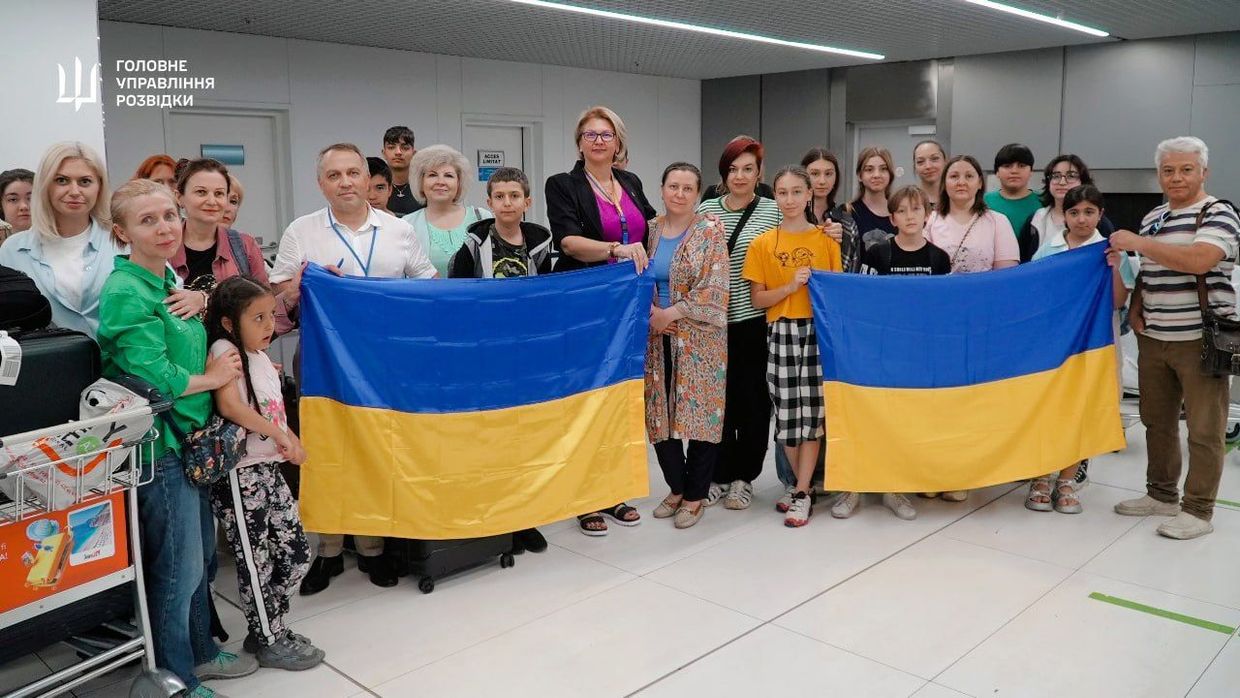
Ukraine’s military intelligence agency (HUR) and the Foreign Ministry evacuated 31 Ukrainian citizens from Iran, the agency announced. (Ukraine’s military intelligence agency (HUR) / Telegram)
The evacuation represented the final stage of joint operations by HUR and the Foreign Ministry to rescue Ukrainian citizens from high-risk areas. Earlier evacuations had brought 176 people from Israel, including 133 Ukrainian citizens, highlighting Ukraine’s commitment to protecting its diaspora even during wartime.
Artillery and Ammunition: The Production Gap Challenge
Investigation into Western ammunition production capabilities revealed why NATO struggled to match Russian output despite years of claimed ramp-ups. The core problem remained the offshoring of explosives production, particularly to China, which had created supply chain vulnerabilities exposed by the war.
BAE Systems emerged as a potential solution through innovative approaches to energetics production. Rather than building massive traditional facilities, the company planned distributed networks of shipping container-based production units that could manufacture RDX (hexogen) explosives in multiple locations throughout the United Kingdom.
The approach offered resilience advantages over centralized production while avoiding the environmental and political challenges of constructing large explosive manufacturing facilities. The distributed model could also provide templates for Ukrainian domestic production capabilities once security conditions permitted.
Looking Forward: The Convergence of Diplomacy and Destruction
The events of June 24 crystallized the fundamental dynamics shaping the war’s trajectory. While NATO leaders announced historic spending commitments and Ukraine revealed impressive defense industrial capabilities, Russian missiles continued killing civilians with impunity, demonstrating the gap between diplomatic intentions and battlefield realities.
The confirmation of Trump-Zelensky talks added uncertainty to an already complex diplomatic landscape. With Trump maintaining ambiguous positions on NATO commitments while acknowledging ongoing dialogue with Putin, the meeting’s outcomes could significantly influence both immediate military aid and long-term security arrangements.
Ukraine’s dual citizenship reform and special tribunal agreement represented important steps toward post-war integration and accountability, while the revelation of sanctions evasion at Votkinsk highlighted the urgent need for enhanced enforcement mechanisms. The day’s multiple partnership announcements showed Europe’s growing commitment to Ukrainian defense integration, even as polling revealed limits to public support for potential territorial concessions.
As NATO leaders prepared for their second day of discussions, the contrast between conference room deliberations and battlefield realities remained stark. The Dnipro massacre served as a bloody reminder that while diplomats debated percentage points and policy frameworks, Putin’s war machine continued its systematic campaign to terrorize Ukrainian civilians and destabilize European security.
The summit’s ultimate test would be whether the alliance’s historic spending commitments and partnership agreements could translate into tangible capabilities that deterred further Russian aggression while supporting Ukraine’s path to victory. With Russian forces adapting tactically and expanding strategically, time remained the most precious commodity for both Ukrainian survival and NATO preparation.