
As Trump’s envoy prepares for Moscow amid escalating tariff threats, Ukraine strikes Russian energy infrastructure while preparing the largest prisoner exchange of the war and confronting corruption in its defense procurement
Summary of the Day – August 3, 2025
The fourth day of August opened with Ukrainian drones illuminating the pre-dawn darkness over Russia’s resort playground of Sochi, setting ablaze an oil depot in Adler as flames consumed 2,000 cubic meters of fuel and suspended flights at the Olympic city’s airport. Meanwhile, diplomatic pressure reached a crescendo as President Trump announced his Middle East envoy Steve Witkoff would travel to Moscow within days—just before an August 8 deadline for Russia to accept a ceasefire or face sweeping secondary tariffs targeting its oil exports. In Kyiv, President Zelensky appointed Lieutenant General Anatoliy Kryvonozhko as Air Force commander after nearly a year of interim leadership, while announcing preparations for exchanging 1,200 prisoners of war with Russia. The day’s most sobering revelation came through anti-corruption agencies exposing a bribery scheme involving parliamentarians and military officials who systematically looted funds intended for drone procurement, underscoring the dual battles Ukraine faces—against Russian aggression abroad and corruption within.
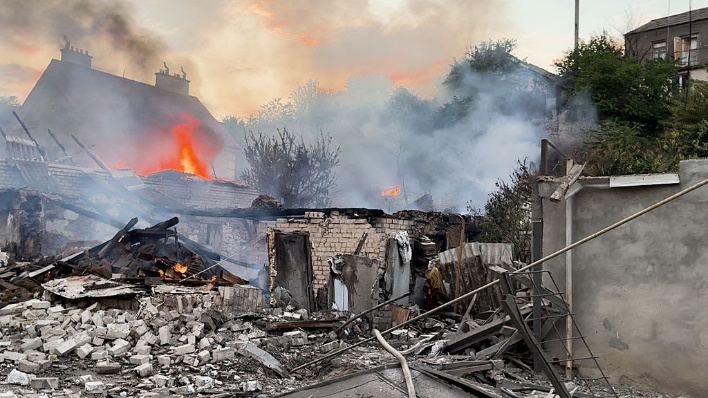
Fire breaks out after a Russian attack in Kherson, Ukraine. (Kherson Regional Military Administration/Anadolu via Getty Images)
Flames Over the Olympic City: Ukrainian Drones Light Up Russia’s Resort Paradise
The tranquil summer morning in Sochi shattered at dawn as Ukrainian drones descended upon the Rosneft Kubannefteprodukt Oil Depot in Adler, transforming Russia’s premier Black Sea resort into a theater of war. Over 120 firefighters rushed to battle the inferno that engulfed a massive fuel tank, while Sochi Airport—host to millions of vacationers seeking escape from Russia’s grinding conflict—suspended all flights “to ensure air safety.”
Governor Veniamin Kondratyev’s terse Telegram acknowledgment that a Ukrainian drone strike had caused the blaze spoke volumes about how Ukraine’s expanding reach now threatens even Russia’s most protected civilian spaces. The Crimean Wind Telegram channel reported that fuel restrictions at Sochi Airport forced departing flights to make additional landings at alternate airfields for refueling—a logistical nightmare that brought the war’s economic reality directly to Russian tourists.
The strike represented more than tactical success; it was a psychological blow against a city that symbolizes Russia’s pre-war normalcy. Sochi, which hosted the 2014 Winter Olympics in what now seems a different era, had rarely been touched by the conflict’s violence. The attack demonstrated Ukraine’s expanding operational reach into the Russian heartland, targeting critical energy infrastructure that feeds Moscow’s war machine while simultaneously disrupting civilian life.
Russian Telegram channel Crimean Wind reported that fuel restrictions at Sochi Airport forced departing flights to make additional landings at alternate airfields for refueling—a cascading logistical nightmare that brought the war’s economic reality directly to vacationing Russians. Meanwhile, a Ukrainian Telegram channel published photos purportedly showing another oil refinery ablaze in Kstovo, Nizhnyi Novgorod, though regional authorities claimed they had repelled the drone attack.
The Witkoff Gambit: Trump’s Envoy Heads to Moscow as Ultimatum Clock Ticks
With characteristic bluntness, President Trump announced that his special envoy Steve Witkoff would likely travel to Russia on Wednesday or Thursday, just days before his self-imposed August 8 deadline for Moscow to agree to a ceasefire or face punitive tariffs. “They would like to see him. They’ve asked that he meet, so we’ll see what happens,” Trump told reporters, his tone suggesting both opportunity and skepticism.
The timing carries profound significance. Witkoff’s mission comes as Trump’s patience with Vladimir Putin appears increasingly strained, six months into his second term. The proposed secondary tariffs would target countries continuing to import Russian oil and gas—a move that would dramatically affect major trading partners like China and India, potentially reshaping global energy markets.
“There’ll be sanctions, but they seem to be pretty good at avoiding sanctions,” Trump observed with grudging respect for Russian evasion tactics. “They’re wily characters, and they’re pretty good at avoiding sanctions, so we’ll see what happens.”
The president’s earlier deployment of nuclear submarines to “appropriate regions” following what he termed “highly provocative” statements from former Russian President Dmitry Medvedev has created a backdrop of military tension that gives Witkoff’s diplomatic mission added urgency. The submarine deployment, rarely disclosed by either Washington or Moscow, signals the seriousness of current tensions between the nuclear-armed rivals.
The stakes could not be higher: failure to reach agreement by Friday could trigger the most comprehensive sanctions regime imposed on Russia since the war began.
The Air Force Renaissance: Kryvonozhko Takes Command Amid Ambitious Transformation
After nearly a year of interim leadership, President Zelensky formally appointed Lieutenant General Anatoliy Kryvonozhko as commander of the Ukrainian Air Force, ending a period of uncertainty that began with the controversial firing of his predecessor following an F-16 crash. Kryvonozhko, who had served as acting head since last August, now faces the monumental task of implementing a 20-year aviation development strategy designed to integrate Ukrainian capabilities with NATO standards.
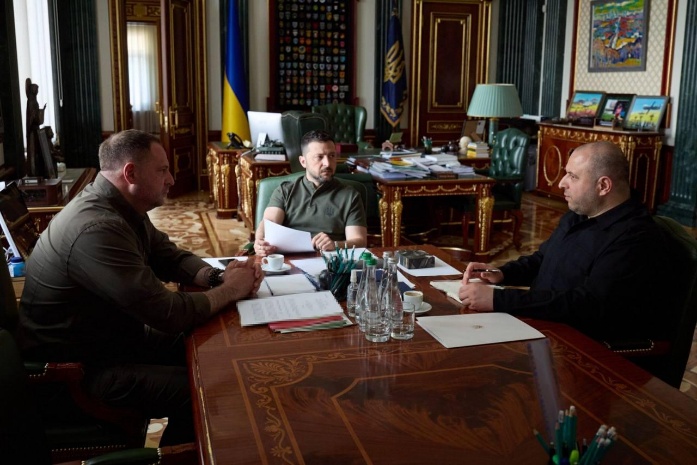
President Volodymyr Zelensky, joined by Presidential Office head Andriy Yermak (L), attend a briefing by National Security and Defense Council Secretary Rustem Umerov (R). (Zelensky/Telegram)
“The main goal of the transformation of Ukrainian aviation is to ensure that our country has a strong and modern aviation component within the Defense Forces—one that is a de facto part of NATO’s capabilities and among the strongest in Europe,” Zelensky declared, his words reflecting Ukraine’s determination to emerge from this conflict as a modern military power.
The appointment comes as Ukraine’s air capabilities have expanded dramatically, with Mirage jets now operational and the F-16 fleet continuing to grow. Kryvonozhko’s background directing the Central Air Command since 2015 positions him to navigate the complex integration of Western aircraft systems while maintaining operational effectiveness against Russian air defenses.
The 20-year strategy represents more than military planning; it embodies Ukraine’s vision of its post-war identity as a European military power capable of deterring future Russian aggression through air superiority.
The Great Exchange: 1,200 Lives Hanging in Diplomatic Balance
In a development that could represent the largest prisoner exchange of the war, President Zelensky announced that work continues on lists for swapping 1,200 prisoners of war with Russia. The agreement, reached during the third round of peace talks in Istanbul on July 23, represents a rare area of cooperation between the warring parties even as broader peace negotiations remain stalled.
“An agreement has been reached on the exchange of 1,200 individuals, and work on the lists is ongoing,” Zelensky reported following a briefing by National Security and Defense Council Secretary Rustem Umerov. The president added that Kyiv is working to “unblock the return of our civilians, verifying data on each individual by name.”
The exchange builds on the foundation established during the initial Istanbul talks in May, which produced the war’s largest prisoner swap to date—a “1,000-for-1,000” exchange. Since Russia’s full-scale invasion began, Ukraine has brought home 5,857 people from Russian captivity through various exchanges, each representing not just a diplomatic victory but the return of sons, daughters, fathers, and mothers to their families.
The meticulous verification process reflects the complexity of tracking individuals held across Russia’s vast prison system, where Ukrainian soldiers, civilians, and even children have disappeared into a bureaucratic maze designed to erase their identities.
The Colombian Sacrifice: Foreign Warriors Pay Ultimate Price in Ukrainian Trenches
Among the most poignant discoveries in Kyiv’s Maidan Nezalezhnosti lies a corner that tells a story of sacrifice transcending borders. Amid the sea of yellow and blue memorial flags, a distinct section bears the additional red stripe of Colombia, accompanied by photographs of young men whose Spanish nicknames—”Cobra,” “Cuervo” (Crow), “Bad-Boy”—speak to lives cut short far from home.
The Colombian presence in Ukraine’s armed forces represents both opportunity and tragedy. Former Colombian marine Castaño, who survived the notorious 59th Brigade that lost twelve Colombians on their first day of combat, described a system plagued by administrative chaos: “Lies. So many lies and falsified documents. We were sent to the front line without the right papers. A friend died recently, but without a missing stamp his contract was never activated.”
The widow who traveled alone from Medellín’s Comuna 13 to search for her husband Edwin Alexánder’s body embodies the human cost of these bureaucratic failures. Her husband died at 33, but without remains, she cannot process compensation claims—a cruel irony for a man who left one of Colombia’s poorest neighborhoods to secure his family’s future.
Twenty-one-year-old Danilo, a former cycling champion who joined the 4th Battalion of the 66th Brigade—an entirely Hispanic unit—represents the more positive aspects of Colombian service. “Many of my compatriots come chasing money but then run away the moment they grasp the reality of this war,” he observed. “Not me. I am firm and committed to Ukraine. I love this beautiful land.”
The large Colombian flag at Maidan lists eleven victims from the 59th Brigade alone, their callsigns—”Rolo,” “Paisano,” “Gato”—serving as monuments to sacrifice that transcends nationality. Their presence raises profound questions about Ukraine’s capacity to properly integrate and protect foreign volunteers while honoring their ultimate sacrifice.
The Corruption Cancer: Parliament Members and Officials Loot Drone Funds
Ukraine’s National Anti-Corruption Bureau and Specialized Anti-Corruption Prosecutor’s Office delivered a devastating blow to military procurement integrity by exposing a bribery scheme involving a member of parliament, regional officials, and National Guard personnel who systematically looted funds designated for drone and electronic warfare equipment.
The investigation revealed that MP Oleksii Kuznetsov of Zelensky’s Servant of the People party, former Luhansk governor Serhii Haidai, and other officials employed two primary schemes: inflating electronic warfare system contracts to receive 30% kickbacks and manipulating FPV drone procurement contracts. The scope of the corruption during 2024-2025 represents a betrayal of soldiers whose lives depend on reliable equipment.
“Those guilty of corruption crimes must be punished fairly, regardless of their status or position,” declared David Arakhimia, head of the Servant of the People faction, as he announced Kuznetsov’s dismissal from the party pending investigation. President Zelensky subsequently signed an order dismissing Haidai from his post as head of the Mukachevo district administration, demonstrating swift executive action against implicated officials.
The timing of this revelation, just days after parliament restored the independence of NABU and SAPO following public protests, underscores the critical importance of anti-corruption institutions in wartime. Every stolen hryvnia represents potential lives lost due to inadequate equipment, making corruption not merely a financial crime but a form of treason against soldiers in the trenches.
Shadow Fleet Sanctions: Zelensky Targets Russia’s Maritime Lifeline
President Zelensky signed a decree imposing sanctions on 94 individuals and five legal entities, primarily targeting captains of Russia’s “shadow fleet”—the aging, poorly insured tankers Moscow uses to evade international sanctions and continue oil exports. The sanctions, affecting citizens of Russia, Iran, Pakistan, Myanmar, China, Bangladesh, India, and Georgia, represent the first of three planned packages designed to cripple Russia’s sanctions evasion networks.
“Sanctions have been imposed on the captains of Russia’s shadow fleet, and we will synchronize all of this—all of these packages—with our partners to ensure the pressure is effective across most jurisdictions,” Zelensky announced in his evening address.
The shadow fleet has become Russia’s economic lifeline, enabling continued oil revenues that fund the war machine. By targeting the human operators of these vessels rather than just the ships themselves, Ukraine aims to create personal consequences for those enabling Russia’s sanctions evasion. The multinational nature of the sanctions list reflects the global scope of Russia’s deception, using foreign registrations and crews to obscure ownership and avoid Western restrictions.
India Under Fire: Trump Administration Escalates Pressure on Russian Oil Partners
Deputy Chief of Staff Stephen Miller delivered some of the Trump administration’s harshest criticism yet of India’s role in sustaining Russia’s war economy, accusing New Delhi of financing Moscow’s invasion through continued oil purchases. “What he [Trump] said very clearly is that it is not acceptable for India to continue financing this war by purchasing the oil from Russia,” Miller declared on Fox News.
The criticism accompanied the August 1 implementation of 25% tariffs on Indian imports—a dramatic escalation that took effect as Trump intensified pressure on countries supporting Russia’s war economy. Miller’s revelation that “India is basically tied with China in purchasing Russian oil” exposed the scale of New Delhi’s energy relationship with Moscow—a partnership that grew from 0.2% of India’s imports at the beginning of 2022 to a major component of its energy security.
Despite the pressure, Indian government officials told Reuters that the country intends to continue buying Russian oil, setting up a potential confrontation that could reshape U.S.-India relations. The standoff illustrates the complex web of relationships that Russia’s invasion has created, forcing traditional partners to choose between economic interests and geopolitical alignment.
German Welfare Debate: Bavaria Proposes Cutting Ukrainian Refugee Benefits
Bavarian Prime Minister Markus Soder called for ending citizen’s allowance payments to Ukrainian refugees, proposing that new arrivals instead receive reduced benefits under Germany’s Asylum Seekers Benefits Act. Soder argued that Germany is the only country providing Ukrainian refugees with benefits comparable to citizen’s allowance and claimed the generous support discouraged refugees from seeking employment despite their qualifications.
The proposal reflects growing political pressure in Germany, which hosts 1.2 million of Europe’s 5 million Ukrainian refugees. While a previous agreement between coalition parties already planned to reduce benefits for arrivals after April 1, 2025, Soder’s call to extend cuts to existing refugees represents a more dramatic shift in German policy.
The debate illustrates the mounting strain that sustained refugee support places on European societies, even as the war continues with no end in sight. For Ukrainian families who fled their homeland, the prospect of reduced support adds another layer of uncertainty to lives already disrupted by war.
Recruitment Center Violence: Civilians Attack Draft Officer in Mykolaiv
The tension surrounding Ukraine’s mobilization efforts erupted into violence in Buzke village, Mykolaiv Oblast, where unidentified civilians allegedly attacked a recruitment officer with bats and metal pipes. The confrontation left casualties among both servicemen and civilians after the officer fired a non-lethal weapon in self-defense.
The incident reflects the broader social tensions surrounding Ukraine’s mobilization drive, which has often been criticized for forced conscription and violations of civil rights. Recent protests in Vinnytsia, where demonstrators broke into a stadium to demand the release of detained men, illustrate the growing friction between military necessity and civil liberties.
These confrontations provide fodder for Russian propaganda campaigns designed to escalate social tensions and undermine Ukraine’s recruitment efforts. The targeting of recruitment centers by Russian missiles in June and July—striking offices in Kryvyi Rih, Poltava, Kremenchuk, Kharkiv, and Zaporizhzhia—demonstrates Moscow’s recognition that disrupting mobilization represents a strategic vulnerability.
Frontline Dynamics: Russian Advances Meet Ukrainian Resilience
Across multiple fronts, Russian forces continued their grinding offensive operations while Ukrainian forces maintained defensive positions and launched selective counterattacks. Geolocated footage confirmed Russian advances in central Novoukrainka south of Pokrovsk and in southern Torske east of Lyman, while Ukrainian forces advanced in southern Plavni west of Orikhiv in Zaporizhia Oblast.
The most intense fighting continued in the Pokrovsk direction, where Commander-in-Chief General Oleksandr Syrskyi identified the “most difficult situations” alongside Dobropillya and Novopavlivka. Russian sabotage groups attempted to infiltrate Pokrovsk itself, employing tactics of advancing in fireteams of two or three personnel before concentrating for larger assaults.
In the Sumy direction, Russian forces faced reported “serious difficulties,” with elements of the 51st Airborne Regiment allegedly refusing orders after failing to seize assigned objectives. The 1434th Akhmat-Chechnya Regiment similarly avoided attacks “out of fear of Ukrainian drones,” according to Russian military bloggers—a telling indication of Ukrainian drone warfare effectiveness.
Russian Defense Adaptations: Moscow Scrambles to Protect Strategic Assets
After years of successful Ukrainian strikes against Russian rear areas, Moscow appears to be implementing comprehensive protective measures for its strategic assets. Russian Aerospace Forces First Deputy Commander Lieutenant General Alexander Maksimtsev announced the development of a new generation of Voronezh early-warning radars designed to eliminate blind spots and provide complete coverage for critical facilities.
More significantly, Russian forces have launched a program to construct hardened aircraft shelters at air bases near the Ukraine border and in occupied territories, including Millerovo Air Base in Rostov Oblast, Khalino Air Base in Kursk Oblast, and Hvardiiske Air Base in occupied Crimea. Satellite imagery indicates construction began at fourteen military sites, with expansion following Ukraine’s June 1 Operation Spiderweb deep strikes.
The belated protective measures represent a tacit admission of Ukrainian strike effectiveness, coming after military bloggers repeatedly complained about Russian command failures to adapt to repeated successful attacks. The construction program suggests Russian recognition that the conflict’s duration requires fundamental changes to military infrastructure.
Moscow’s Expanding Drone Network: Occupied Donetsk Airport Becomes Launch Platform
Satellite imagery from July 2025 reveals Russia’s ambitious plan to transform the destroyed airport in northern occupied Donetsk City into a major drone launch facility. Ukrainian intelligence reports show Russian authorities have partially cleared runway fortifications and begun construction of fuel storage tanks, closed storage areas near the destroyed terminal, and manual drone control points.
The CyberBoroshno intelligence group assessed that Russian occupation authorities are developing infrastructure to launch Shahed-type strike drones, Gerbera-type decoy drones, and possibly Geran jet-powered drones from the facility. The strategic positioning closer to the frontline will significantly reduce reaction time for Ukrainian air defenses, creating a more immediate threat to Ukrainian positions and potentially NATO states if Russia continues to occupy Ukrainian territory.
The airport’s transformation from symbol of Ukrainian resistance—where defenders held out against Russian assault for months in 2014—to Russian drone base represents the strategic stakes of territorial control in this conflict.
European Sabotage Campaign: Russian Intelligence Services Reassess Tactics
New analysis from the International Institute for Strategic Studies reveals a complex pattern in Russian hybrid warfare operations across Europe, with suspected sabotage attacks escalating to 30 incidents in 2024 before declining to 11 between January and May 2025. The decreasing trend may reflect increased NATO presence in the Black Sea, Russia’s attempts to position itself as a good-faith negotiator during peace talks, or concerns about provoking NATO escalation.
US and European officials suggest the decline could stem from Putin’s desire to avoid antagonizing Trump early in his second term, reallocation of GRU resources to Ukraine operations, or Moscow’s efforts to tighten control over local proxies conducting attacks. However, intelligence experts warn that Russian services may be refining tactics and reassessing criminal networks rather than abandoning hybrid operations.
The sophisticated nature of these operations—targeting everything from military installations to civilian infrastructure—demonstrates Russia’s commitment to weakening NATO resolve through unconventional means while maintaining plausible deniability.
Mykolaiv Under Fire: Russian Missiles Target Southern Ukrainian City
Russian forces conducted a devastating missile strike against Mykolaiv overnight, injuring seven civilians and damaging homes and civilian infrastructure in the strategic southern city. Four people received medical treatment at the attack site, while two men aged 57 and 74 were hospitalized in moderate condition, and a 32-year-old man received outpatient care.
The attack on Mykolaiv, located 480 kilometers southwest of Kyiv, underscores the city’s continued vulnerability near the front lines. Emergency crews from Ukraine’s State Emergency Service deployed immediately to conduct rescue operations and extinguish fires caused by the strike—a grim routine that has defined life in Ukrainian cities throughout the conflict.
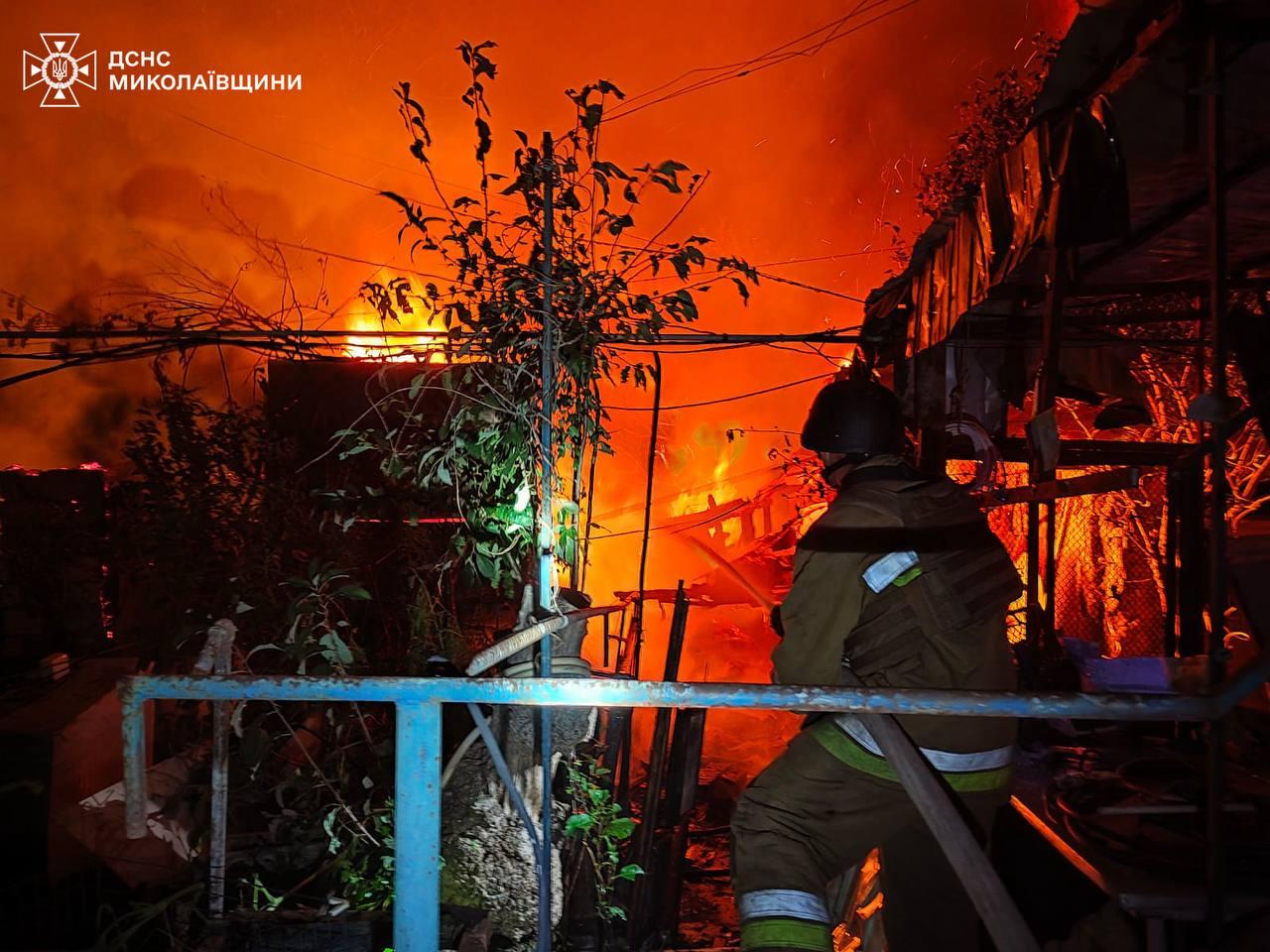
Aftermath of a Russian missile strike on Mykolaiv overnight. (State Emergency Service/Telegram)
The targeting of civilian areas reflects Russia’s continued strategy of attacking Ukrainian morale and infrastructure rather than focusing purely on military objectives, a tactic that has drawn repeated international condemnation but continues unabated.
Kherson’s Bridge of Sorrows: Repeated Russian Strikes Claim Civilian Life
Russian forces conducted repeat glide bomb strikes against a road bridge connecting Korabel Microraion to central Kherson City, following similar attacks the previous day. The August 3 assault claimed the life of one civilian and highlighted Russia’s deliberate targeting of civilian infrastructure with no military value.
Ukrainian Southern Defense Forces Spokesperson Colonel Vladyslav Voloshyn confirmed that no Russian forces are crossing the Dnipro River toward Kherson City, making the bridge strikes purely punitive rather than tactically necessary. “Russian forces struck a civilian target and there are no military facilities in the area,” Voloshyn stated, as Ukrainian authorities investigated the specific munitions used in the attacks.
The systematic targeting of the bridge represents Russia’s broader strategy of making civilian life unbearable in liberated Ukrainian territories, using precision weapons to terrorize populations rather than achieve military objectives. Each strike serves as a reminder to Kherson’s residents that their liberation remains precarious, subject to Russian artillery positioned across the river.
Russian and Chinese naval forces conducted joint artillery and anti-submarine drills in the Sea of Japan as part of the “Maritime Interaction-2025” exercise, demonstrating the deepening military cooperation between Moscow and Beijing. The exercises, involving Russian anti-submarine vessels, Chinese destroyers, and submarines from both countries, concluded on August 5 despite occurring amid heightened U.S.-Russia nuclear tensions.
The timing, just two days after Trump ordered nuclear submarines to “appropriate regions” in response to threats from former Russian President Dmitry Medvedev, underscored the complex three-way dynamic between the world’s major nuclear powers. While Russian authorities claimed the drills were pre-planned, their continuation amid diplomatic crisis signaled Beijing’s commitment to its “no limits” partnership with Moscow.
The naval cooperation extends beyond symbolic gestures, as China has become Russia’s critical economic lifeline through defense equipment supplies and massive oil purchases—relationships that now face potential disruption from Trump’s threatened secondary sanctions.
Looking Forward: The Week That Could Define Ukraine’s Future
As August unfolds, multiple critical timelines converge to create what may prove to be a defining moment in the conflict. Witkoff’s Moscow mission before Friday’s deadline could determine whether Trump’s tariff threats materialize into the most comprehensive sanctions regime yet imposed on Russia. The prisoner exchange preparations offer hope for 1,200 families while the corruption prosecutions test Ukraine’s commitment to wartime accountability.
The Colombian memorial flags at Maidan Nezalezhnosti serve as a reminder that this conflict’s costs extend far beyond Ukraine’s borders, drawing young men from South America’s favelas to die in Eastern European trenches for the promise of economic opportunity. Their sacrifice, alongside that of Ukrainian defenders, underscores the global stakes in a conflict that began as a regional invasion but has evolved into a fundamental contest over the international order.
Whether through diplomatic breakthrough or economic warfare escalation, the coming week will likely determine the trajectory of a war that has already reshaped European security, global energy markets, and the lives of millions. The flames over Sochi serve as a metaphor for a conflict that continues to spread its consequences far beyond the battlefield, touching resort cities and foreign volunteers, corruption schemes and prisoner exchanges, in an ever-widening circle of cause and effect that defines modern warfare’s total character.