
As Russia’s occupied territories face humanitarian collapse and Ukraine grapples with internal political turmoil, the war’s multiple fronts reveal a nation fighting battles on every conceivable front
Summary of the Day – July 24, 2025
The fourth year of Russia’s full-scale invasion unveiled stark contradictions that define Ukraine’s existential struggle. While Russian forces advanced methodically across eastern battlefields and Moscow expanded its military conscription capabilities for prolonged warfare, Ukraine confronted an unexpected internal crisis as thousands took to the streets in wartime’s first major protests against anti-corruption rollbacks. Meanwhile, the humanitarian catastrophe in Russian-occupied territories reached new depths as water systems collapsed entirely, forcing civilians into degrading survival conditions. Against this backdrop, international support materialized through new U.S. arms packages worth $652 million, even as diplomatic efforts in Istanbul yielded only Russia’s familiar pattern of obstruction and delay.
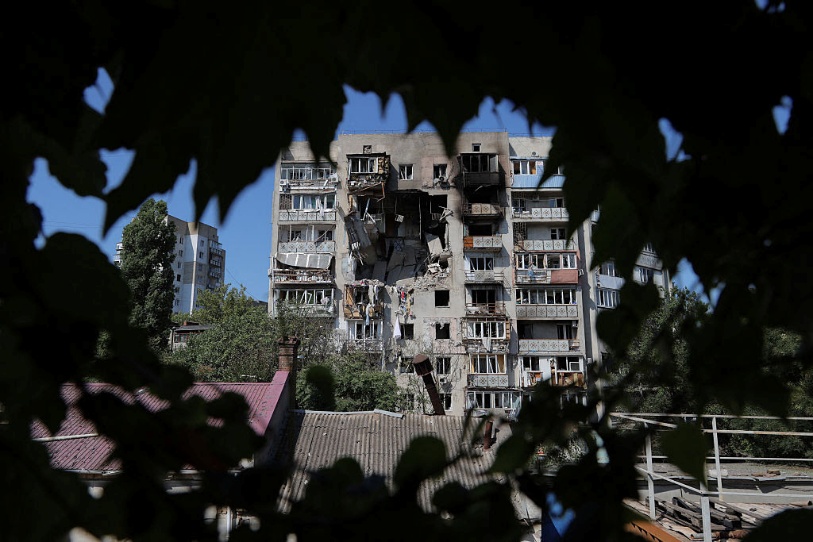
This photograph, taken, shows a damaged residential building following a drone attack in Odesa, amid the Russian invasion in Ukraine. (Oleksandr Gimanov / AFP via Getty Images)
Dying of Thirst: Russia’s Engineered Humanitarian Catastrophe
The most vivid testimony to Russian occupation’s brutality emerged not from battlefield reports, but from toilets in Donetsk. Ukrainian sources documented residents placing plastic bags in toilets and discarding them after use because water shortages have made flushing impossible—a degrading reality that former Ukrainian politician Oleg Tsyarov confirmed in occupied Crimea.
The Khanzhenkivske Reservoir on the Krynka River, the primary water source for occupied Donetsk Oblast, sits completely empty and dry. The Don-Donbas Canal aqueduct, supplying a third of the region’s water, has reached critically low levels. Russian newspaper Komsomolskaya Pravda reported that occupied Donetsk Oblast receives only 30 percent of its required water supply and teeters on the brink of total water system collapse.
Russian occupation officials, led by Donetsk People’s Republic Head Denis Pushilin, postured as crisis managers while systematically blaming Ukraine for the disaster. Pushilin claimed his administration would empty the Krynka River to fill reservoirs and install 166 additional water barrels in Donetsk City. Zaporizhia Oblast occupation head Yevgeny Balitsky promised pipeline repairs and increased water delivery volumes.
These claims ring hollow against the lived reality described by the Ukrainian Resistance Center: Russia destroyed existing water systems during its occupation and never constructed replacements, leaving vast areas receiving water for mere hours every three days. The crisis stems directly from Russian military actions and occupation policies, not Ukrainian resistance, yet Moscow’s propaganda machine continues manufacturing false narratives about Ukrainian “water blockades.”
The Russification Machine: Indoctrinating Ukraine’s Children
Beyond physical destruction, Russia’s occupation revealed systematic efforts to erase Ukrainian identity through educational manipulation and forced cultural assimilation. Russian authorities continued shipping Ukrainian children to summer camps and educational programs designed for indoctrination and Russification, with 250 children from occupied Melitopol already attending the Yunost camp in Arkhangelsk Oblast.
The Avangard military sports center in occupied Crimea received 300 children from Zaporizhia Oblast across five two-week shifts, directly supporting Russian militarization efforts through drone operation and combat training. The camp’s stated goal involves creating a “spirit of love for the motherland (Russia)” among Ukrainian attendees—a clear violation of international humanitarian law regarding occupied populations.
Educational cooptation accelerated with new history textbooks ordered for grades 5-9 in occupied Donetsk Oblast, presenting Kremlin-approved versions of Ukrainian history and promoting the false narrative that occupied areas represent “historically Russian territories.” Russian authors working at the federal level prepared additional textbooks on “Donbas and Novorossiya history” specifically targeting Ukrainian students.
Starting in the 2026-2027 school year, schools in occupied Ukraine will begin teaching “Spiritual and Moral Culture of Russia”—a comprehensive program designed to replace Ukrainian cultural education with Russian ideological instruction. The systematic educational overhaul represents long-term efforts to eliminate Ukrainian national consciousness among younger generations.
The Phantom Fleet: Russia’s Naval Retreat from the Black Sea
In stark contrast to Moscow’s grandiose “July Storm” naval exercises spanning 13 time zones, Russia’s Black Sea Fleet remained conspicuously absent from actual combat operations. While Pacific, Baltic, Barents, and Caspian fleets participated in expansive training drills involving 150 vessels and 15,000 personnel, the Black Sea Fleet’s surface ships and submarines stayed firmly moored in Novorossiysk harbor.
The fleet’s operational paralysis became evident as Ukrainian long-range drones struck Sochi and Adler without naval interference. Maxar satellite imagery from July 13 revealed 29 of the fleet’s 33 known operational warships tied up at wharves with minimal crew activity. The last confirmed major warship movement occurred on Monday, when a single Varshavyanka-class submarine launched four Kalibr cruise missiles—all subsequently shot down by Ukrainian air defenses.
Ukrainian strikes have devastated the fleet’s capabilities, forcing abandonment of the historic Sevastopol naval base and destroying approximately half the fleet’s tonnage. The loss includes submarines, landing assault ships, and the headquarters building during a meeting of senior officers. Navy spokesman Dmitro Pletenchuk confirmed no combat-ready vessels remain in Crimea, with the fleet reduced to patrol boats for defensive purposes.
The fleet’s retreat to Novorossiysk proved insufficient protection, as demonstrated by Ukrainian attacks on July 6 and the successful May 3 incident where a Ukrainian sea drone armed with anti-aircraft missiles shot down a $50 million Russian Su-30 fighter. The Black Sea Fleet’s transformation from regional power projection tool to harbor-bound liability represents one of Ukraine’s most significant strategic achievements.
Innovation Under Fire: Mobile F-16 Support Systems
Ukrainian ingenuity produced another battlefield innovation with the delivery of mobile F-16 fighter support systems, enabling operations from dispersed locations rather than vulnerable permanent airbases. The Come Back Alive foundation, working with Ukraine’s Office 61 and Ukrnafta funding, developed ten specialized vehicles costing 51.4 million hryvnias ($1.2 million).
The system includes two technical support team hubs capable of aircraft and aviation weapons maintenance, plus a mission planning complex housed in a German-made MAN truck with residential trailer. Each maintenance team operates four vehicles: workshop trucks for repairs and weapons testing, crane-equipped trucks for munitions handling, and personnel transport pickups.
The mobile capability addresses critical vulnerabilities facing Ukraine’s limited F-16 fleet, estimated around 80 aircraft pledged from multiple countries though delivery numbers remain classified. Russian targeting of airbases forced Ukrainian adoption of dispersed operations across western Ukraine, creating maintenance and operational support challenges that these mobile systems resolve.
The mission planning complex provides seven workstations for flight briefings and tactical coordination, while the residential module enables extended deployments to remote locations. This represents the first such mobile system designed specifically for F-16 operations outside permanent base infrastructure, demonstrating Ukrainian adaptation to asymmetric warfare requirements.
Behind closed doors in Moscow, Russian State Duma Defense Committee Chairperson Andrei Kartapolov introduced legislation that could fundamentally transform Russia’s ability to wage prolonged conflicts. The proposed bill would shift Russian military conscription from semi-annual cycles to year-round operations, eliminating bureaucratic bottlenecks that complicated the disastrous September 2022 partial mobilization.
The implications extend far beyond administrative efficiency. Under current systems, Russia’s military registration and enlistment centers operate only six months annually during spring and fall conscription periods. The proposed changes would maintain permanent bureaucratic infrastructure capable of processing large-scale mobilizations regardless of timing—a strategic shift with profound implications for NATO preparedness.
Kartapolov’s proposal coheres with broader Russian military expansion plans. President Vladimir Putin has ordered the Russian Armed Forces to reach 2.38 million personnel by 2025, supported by annual force increases of 137,000 in 2022, 170,000 in 2023, and 180,000 in 2024. The Kremlin has simultaneously lowered conscription ages, digitalized draft summonses, increased draft dodging penalties, and recruited prisoners and individuals with health issues.
The bureaucratic streamlining addresses Russia’s demonstrated mobilization failures while preparing for potential future conflicts with NATO. Western intelligence agencies assess that Russia could pose direct military threats to alliance members within five years, making Moscow’s administrative preparations particularly ominous.
Istanbul’s Theater of Broken Promises
The third round of bilateral negotiations in Istanbul lasted less than an hour and produced the predictable outcome: Russian obstruction disguised as diplomatic engagement. Ukrainian National Security and Defense Council Secretary Rustem Umerov outlined three concrete priorities: complete unconditional ceasefire, a four-leader summit before August’s end, and the return of all Ukrainian prisoners and illegally deported children.
Russia’s response revealed its negotiating approach: offer minimal temporary measures while rejecting substantive commitments. Russian Presidential Aide Vladimir Medinsky proposed 24-48 hour humanitarian ceasefires for body recovery and virtual working groups to discuss various issues—proposals designed to create the appearance of engagement without meaningful progress.
Moscow’s rejection of a presidential summit before achieving a permanent peace settlement continues its strategy of dictating negotiation terms and timing. The Kremlin refuses direct talks while demanding Ukraine accept territorial concessions as preconditions for any meaningful discussions.
The prisoner exchange component provided the only concrete outcome: Russia agreed to return prisoners held more than three years, seriously wounded individuals, and young people, facilitating an exchange of over 1,200 people. Ukraine and Russia conducted their ninth prisoner exchange on July 23, with each side returning 250 prisoners of war plus two wounded Russians—the largest such exchange since Istanbul agreements began in June.
Democracy Under Siege: Ukraine’s Internal Crisis
For the first time since Russia’s full-scale invasion began, thousands of Ukrainians defied wartime protest restrictions to demonstrate against their own government. The catalyst: President Volodymyr Zelensky’s signing of legislation that critics say effectively destroys the independence of Ukraine’s National Anti-Corruption Bureau (NABU) and Specialized Anti-Corruption Prosecutor’s Office (SAPO).
The controversial law grants the prosecutor general unprecedented powers over anti-corruption investigations, including authority to issue binding instructions to NABU, reassign cases, and close investigations at defense requests. Opposition lawmakers and civil society organizations characterized the changes as dismantling safeguards protecting these institutions from political interference.

President Volodymyr Zelensky poses with heads of Ukraine’s law enforcement and anti-corruption agencies following a high-level meeting in Kyiv, Ukraine. (Volodymyr Zelensky/Telegram)
Protesters filled central squares in Kyiv, Lviv, Dnipro, and Odesa chanting “Veto the law” and holding signs reading “12414 is the number of betrayal”—referring to the bill’s parliamentary registration number. The demonstrations represented Ukraine’s most significant internal political crisis since the war began, with participants describing the moment as a “point of no return” for Ukrainian democracy.
International reactions proved swift and severe. European Commission President Ursula von der Leyen raised “strong concerns” with Zelensky during direct communications. U.S. Republican Senator Lindsey Graham and Democratic Senator Jeanne Shaheen issued joint statements warning the law “undermines much of that progress” made since the 2014 Revolution of Dignity. The Organization for Economic Co-operation and Development warned Ukraine that attacks on anti-corruption agencies would negatively affect defense investments and reconstruction financing.
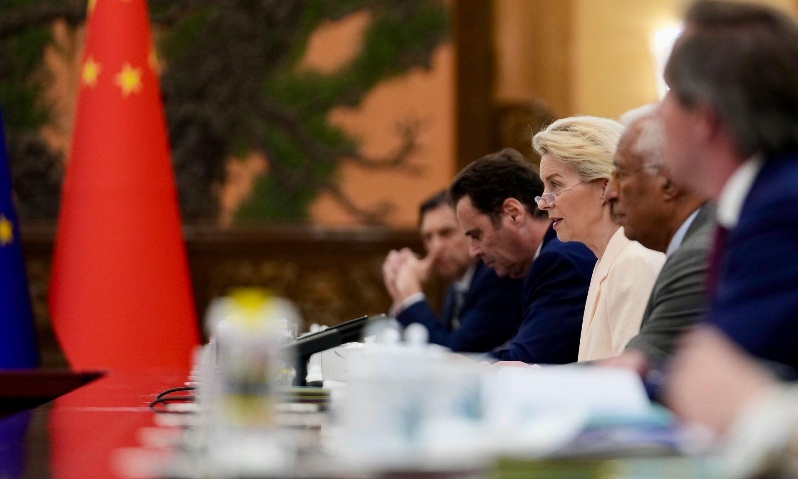
European Commission President Ursula von der Leyen, speaks during during EU-China summit in Beijing, China. (AP Photo/Mahesh Kumar A., Pool)
The crisis forced rapid government backtracking. Within 48 hours, Zelensky submitted new draft legislation aimed at restoring anti-corruption agency independence while maintaining safeguards against Russian influence. Parliamentary Speaker Ruslan Stefanchuk promised expedited review despite the legislature’s official recess until August’s end.
U.K. Prime Minister Keir Starmer proposed involving experts to help draft legislation safeguarding anti-corruption institution independence during his July 24 phone call with Zelensky. Starmer offered to engage experts useful for long-term cooperation, with both leaders agreeing to maintain contact on the issue. Zelensky also informed German Chancellor Friedrich Merz about the new draft law during their conversation the same day.
The Battlefield’s Grinding Reality: Russian Advances Across Multiple Fronts
Russian forces consolidated territorial gains across eastern Ukraine while demonstrating improved tactical coordination despite continued challenges. Fighting continued in Kursk Oblast as Russian forces conducted attacks across unspecified areas, with elements of the 1427th Motorized Rifle Regiment and 119th Airborne Regiment operating near Tetkino.
In northern Sumy Oblast, geolocated footage confirmed Russian advances south of Yablunivka, while unconfirmed reports suggested progress east of Sadky. However, Russian milbloggers complained that their own minefields, laid during Ukrainian withdrawals from Kursk Oblast, now constitute the primary cause of Russian casualties. Friendly fire incidents between elements of the 137th VDV Regiment and 810th Separate Naval Infantry Brigade further complicated Russian coordination efforts.
The Kupyansk direction witnessed confirmed Russian seizure of Radkivka following sustained ground attacks, with geolocated footage showing the likely capture of this strategic settlement north of Kupyansk. Russian forces maintained pressure across multiple axes while Ukrainian defenders conducted limited counterattacks near specified settlements.
In the Borova direction, Russian forces advanced southeast of Olhivka with geolocated footage confirming territorial gains. The Toretsk sector saw significant Russian progress as forces likely captured Yablunivka and advanced toward Oleksandro-Kalynove, with elements of the 33rd Motorized Rifle Regiment credited with seizing the settlement and raising flags in eastern areas.
The Pokrovsk direction remained heavily contested without confirmed Russian advances, though over 100,000 Russian troops continued operations according to Ukrainian Khortytsia Group spokesperson Colonel Viktor Trehubov. In the Novopavlivka direction, geolocated footage indicated Russian forces likely seized Dachne south of the settlement, marking continued pressure along this axis.
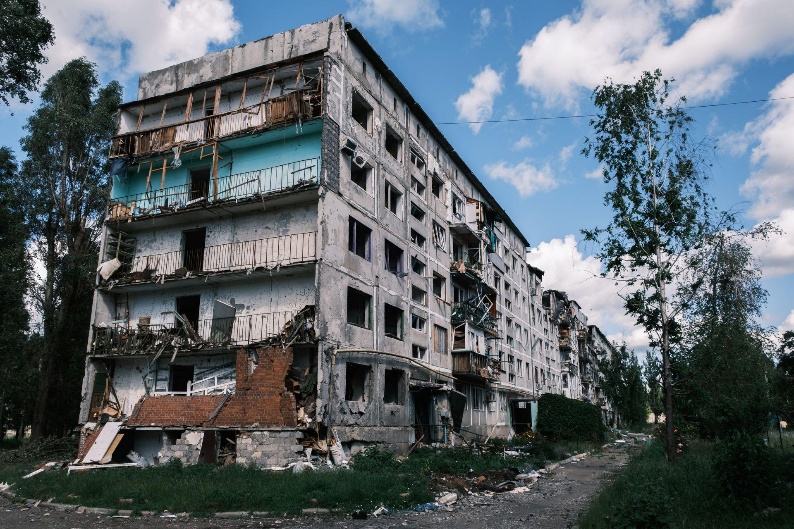
A ruined building in Pokrovsk, Donetsk Oblast. (Francis Farrell/The Kyiv Independent)
Russian forces adapted tactics in response to changing conditions. Ukrainian officers reported increased motorcycle usage due to fears of deploying armored vehicles, while Russian personnel moved in small groups of two to four along windbreaks for ground assaults. The tactical evolution reflected both Ukrainian defensive effectiveness and Russian attempts to minimize losses while maintaining offensive momentum.
Despite continued pressure, Russian forces made no confirmed advances in the Hulyaipole direction, though elements of the 1466th Motorized Rifle Regiment and 305th Artillery Brigade continued striking Ukrainian forces near Malynivka. In western Zaporizhia Oblast, Russian forces attacked southeast of Orikhiv near Mala Tokmachka and Bilohirya, and west of Orikhiv near Stepove, Shcherbaky, Kamyanske, and Plavni, without confirmed territorial gains.
The Kherson direction witnessed limited Russian ground attacks northeast of Kherson City toward Sadove and Prydniprovske, and southwest toward Dniprovske, though Russian forces failed to advance. Ukrainian Southern Defense Forces reported intensified Russian drone strikes against ground lines of communication running from Mykolaiv City to Kherson City, indicating continued efforts to disrupt Ukrainian logistics.
Terror from Above: New Russian Weapons Target Civilians
Russian forces unveiled potentially new weapons technology in devastating strikes against Kharkiv that killed at least four civilians and injured 41 others, including six children among the casualties. Two Russian glide bombs struck the Shevchenkivskyi district around 11:30 a.m., targeting a high-rise residential building and civilian enterprise with no military value.
The Kharkiv Oblast Prosecutor’s Office identified the weapons as UMPB-5 guided bombs—a new modification of the universal joint glide munition with approximately 100-kilometer range. These 250-kilogram bombs feature thicker metal casings than Russian D-30 glide bombs, potentially indicating improved penetration capabilities designed for urban warfare.
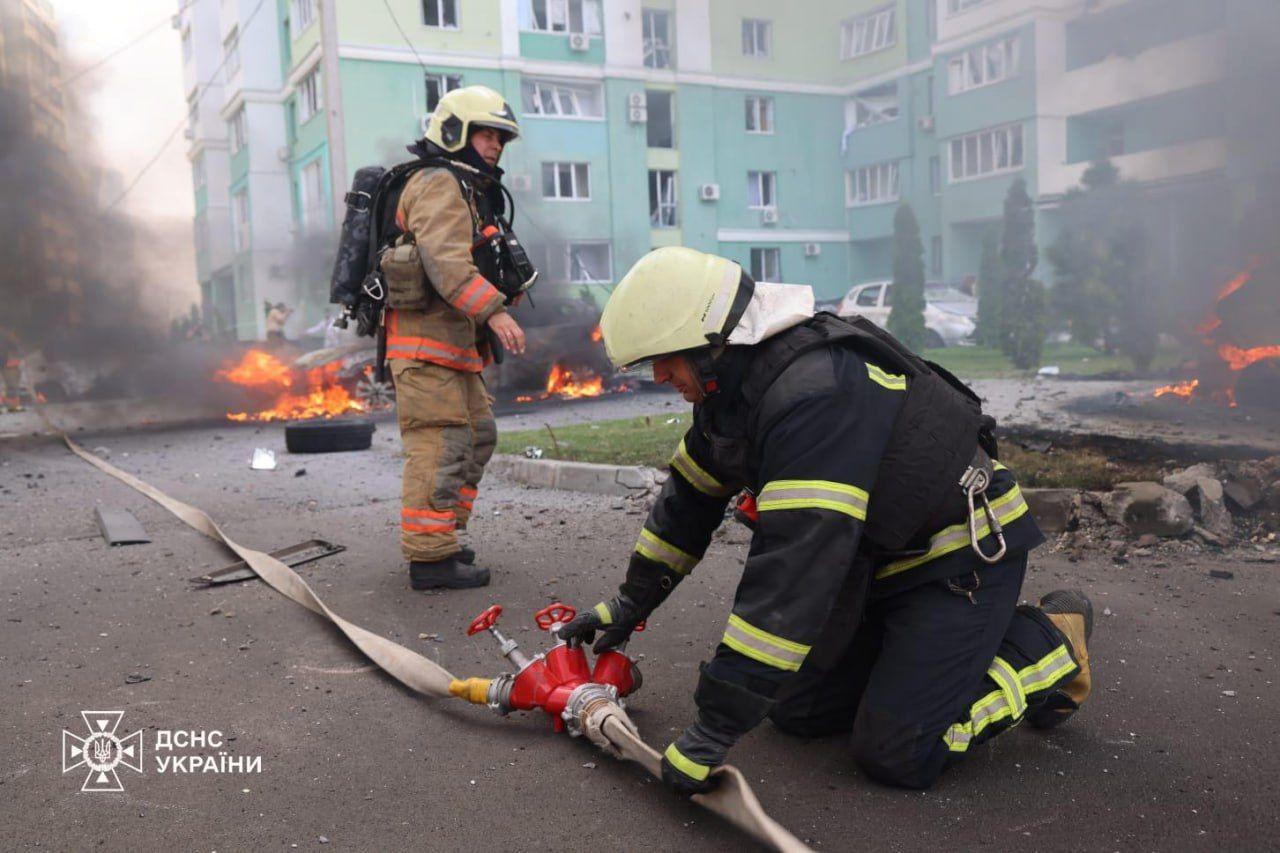
Russian forces struck the regional cennter of Kharkiv, Ukraine. (Ukraine’s Emergency Service)
Among the victims, a one-month-old infant suffered acute stress reaction while a 17-year-old boy and one-year-old girl remained hospitalized in moderate condition. The deliberate targeting of residential areas continued Russia’s systematic campaign against Ukrainian civilian infrastructure, designed to break popular resistance through terror.
Broader Russian strikes across Ukraine killed at least four civilians and injured 33 others over the past day, targeting Odesa, Kharkiv, Zaporizhzhia, Donetsk, and Cherkasy oblasts. Russian forces launched four Iskander-K cruise missiles and 103 Shahed drones from multiple launch points, though Ukrainian air defenses successfully intercepted one missile and 90 drones.
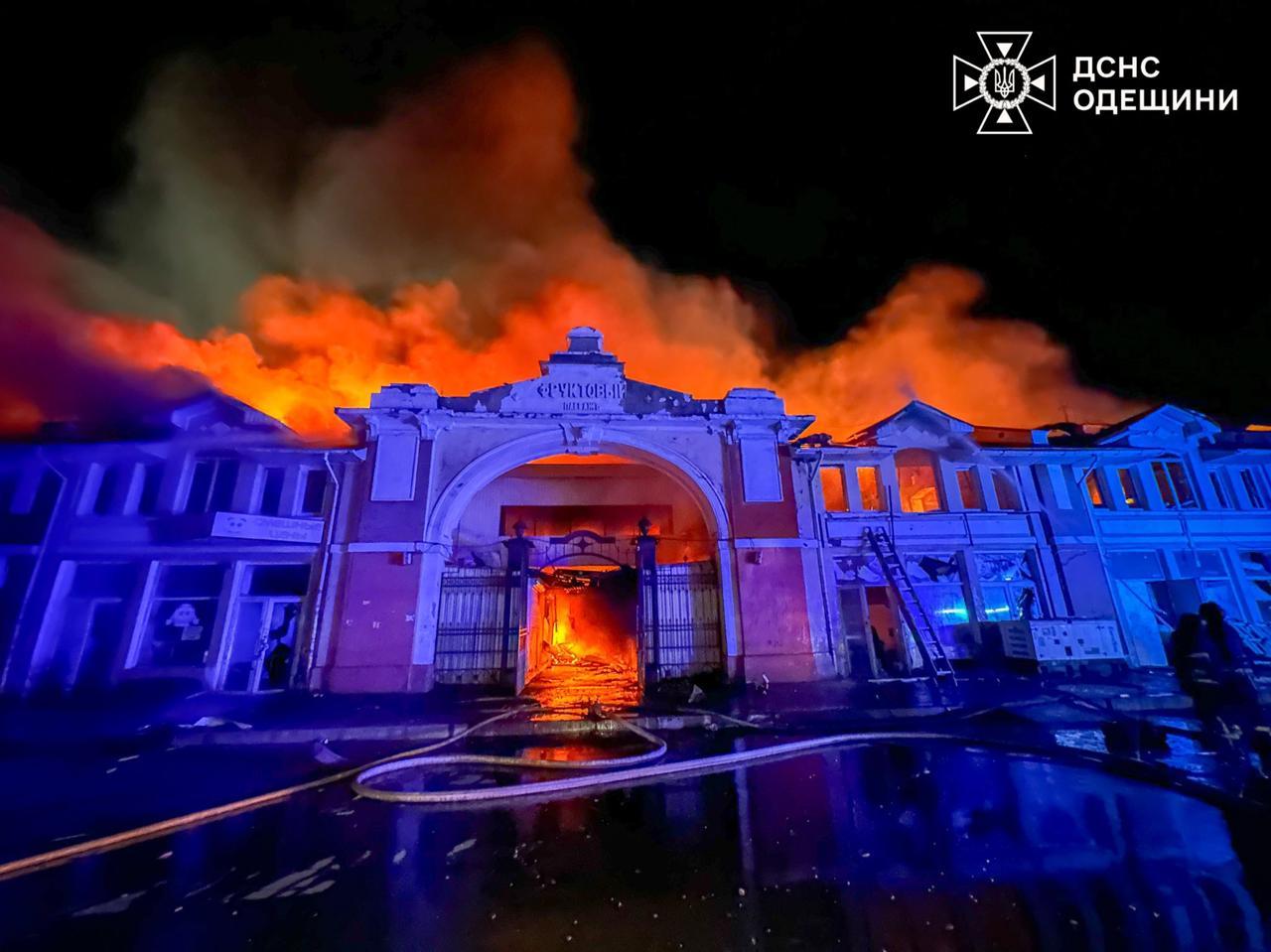
Russian forces attacked the city of Odesa, targeting Privoz, the city’s largest food market, located in its historic center, overnight. (Ukraine’s State Emergency Service)
Arsenal of Democracy: American Weapons, European Financing
The United States approved six military aid packages totaling $652 million over two days, marking a significant escalation in support levels. The July 23 packages worth $322 million included HAWK Phase III air defense systems and Bradley fighting vehicle maintenance equipment. The July 24 approvals added $330 million for M109 self-propelled howitzer maintenance and Patriot air defense system sustainment.
President Donald Trump announced a broader “win-win” agreement under which the European Union will fully fund purchases of U.S. weapons, with most arms expected to flow to Ukraine. The arrangement satisfies Trump’s “America First” principles by ensuring European financing of American defense production while providing Ukraine with necessary capabilities.
The aid packages emphasize sustainability and maintenance rather than providing new systems, reflecting recognition that Ukraine requires long-term support infrastructure for existing capabilities. The focus on air defense proves particularly crucial as Russia continues devastating strikes against civilian infrastructure and military positions.
U.S. and German agreements to deliver five additional Patriot air defense systems supplement existing deployments, with Washington having provided three batteries and Germany contributing three more, plus one from a European coalition.
False Narratives and Information Warfare: When Congress Spreads Kremlin Talking Points
U.S. Congresswoman Marjorie Taylor Greene provided Moscow an unexpected propaganda victory by falsely characterizing Ukrainian anti-corruption protests as opposition to President Zelensky over peace negotiations. Her viral X post claiming “Huge protests erupt in Kyiv against Ukrainian President Zelensky as he is a dictator and refuses to make a peace deal” garnered over 50,000 likes despite spreading complete fabrications about protest motivations.
Kyiv Independent reporters present at both protest evenings documented demonstrators exclusively focused on anti-corruption concerns, chanting “Veto the law” and displaying signs referencing bill number 12414. Protesters explicitly sought to preserve democratic institutions rather than criticize peace efforts, with many identifying as Zelensky voters disappointed by specific policy decisions.
Pro-Kremlin outlets, including EU-sanctioned EurAsia Daily and state-owned RIA Novosti, amplified Greene’s misinformation to support Russian narratives about Ukrainian internal discord. The incident demonstrated how domestic American political figures inadvertently serve Russian information warfare objectives, providing credible-seeming Western sources for Kremlin propaganda campaigns.
Ukrainian protesters expressed concern that such misinformation could undermine international support. As 32-year-old activist Orysia Khimiak noted: “I know that pro-Russian powers will use this case for their propaganda, and we risk losing support and aid from our allies.”
Cultural Resistance: Music Festival as Political Statement
The return of the ICKPA electronic music festival to Kyiv on July 25-27 represented cultural resistance against Russian imperial ambitions. Founded through Ukrainian-Georgian collaboration in 2021, the festival explicitly positioned itself as a political act, with organizers declaring that “to hold a festival in a place where cultural identity is under threat” constitutes “a response to imperialist rhetoric.”
The festival’s manifesto emphasized solidarity between Ukraine and Georgia—two nations united by shared resistance to Russian occupation, with Russia controlling 20 percent of Georgian territory since 2008 and Georgia experiencing growing Russian political influence through “foreign agents” legislation.
Over four years, ICKPA adopted nomadic form during the war, hosting events in Berlin, New York, and Prague to amplify Ukrainian artists internationally. The Kyiv return featured 34 Ukrainian and international DJs, including British artists Bruno Schmidt and Gwenan, Danish electronic artist Kasper Marott, and Ukrainian acts like Ana B, Domnitsa, and Fusion Jams collective.
Beyond music, ICKPA scheduled public discussions on “Politics of Resistance: Anticipation of the Future in Ukraine and Georgia,” bringing together artists, activists, and scholars to explore both nations’ futures amid war and destruction. The festival’s location remained classified until the final day for security reasons, reflecting the ongoing threat environment facing Ukrainian cultural events.
Electronic Warfare Escalation: Russia Tests NATO Boundaries
Russia deployed additional electronic warfare equipment near its border with Estonia, positioning jamming systems roughly 20 kilometers from NATO territory. Estonian Interior Minister Igor Taro confirmed the systems’ capability to jam communications, disrupt radar, and assert electromagnetic spectrum control—marking a concerning escalation in Russian hybrid warfare activities.
The deployment follows Estonia’s live-fire HIMARS tests over the Baltic Sea earlier this month, which Moscow characterized as provocative. Kremlin spokesperson Dmitry Peskov accused European coastal states of pursuing “aggressive policies” and vowed Russia would “firmly defend” its interests in the region.
The electronic warfare systems represent broader Russian efforts to intimidate Baltic NATO members while testing alliance resolve. Finland, Poland, and NATO officials have documented intensified Russian GPS jamming activities throughout 2024, particularly over the Baltic Sea region.
Drone Wars and Energy Targets: Ukraine Strikes Back
Ukrainian forces conducted successful drone strikes against Russian energy infrastructure in Krasnodar Krai overnight, hitting the Lukoil oil depot near Sirius and causing explosions at Sochi Airport. One person died and another was injured in the attacks, which Russian officials attempted to minimize by claiming drone debris rather than direct strikes caused damage.
The targeted Kavkazskaya oil pumping station represents critical Russian energy export infrastructure, connecting railroad terminals and the Kropotkinskaya pumping station within the Caspian Pipeline Consortium system capable of moving 6 million metric tons annually.
Meanwhile, Starlink experienced a global outage lasting approximately 2.5 hours, affecting Ukrainian military communications along the entire front line. Hundreds of thousands of Ukrainians depend on Starlink for internet access after Russian attacks damaged traditional networks, making the disruption particularly concerning for both civilian and military operations.
The Human Cost: Civilians Trapped in Active Combat Zones
Approximately 23,000 civilians, including 113 children, remain in active combat zones across Donetsk Oblast’s 18 designated danger communities. Most children—108 of 113—cluster in the Lyman urban territorial community, while five remain in Toretsk despite intensifying Russian assaults.
Pokrovsk, one of the war’s most contested battlegrounds, retains 1,380 residents plus 2,700 in surrounding communities despite Russian forces entering the city on July 22. Governor Oleh Filashkin described deteriorating conditions where humanitarian aid delivery becomes nearly impossible due to Russian artillery control over access roads and omnipresent drone surveillance.
The evacuation crisis reflects broader demographic challenges facing Ukraine. Since mandatory evacuations began in August 2022, authorities have relocated over 1.23 million people from government-controlled Donetsk Oblast areas, including 193,000 children and 46,000 disabled individuals. Yet 265,000 civilians remain in Ukrainian-controlled territory as Russian forces advance.
International Pressure and Chinese Complicity
European Commission President Ursula von der Leyen directly challenged China to leverage its influence over Putin for meaningful peace negotiations during her summit with Xi Jinping. Her comments followed reports that Beijing circumvents Western sanctions by shipping Chinese-made drone engines to Russian manufacturers, labeling them as “industrial refrigeration units” to avoid detection.
Three European security officials confirmed that Chinese company Beijing Xichao International Technology supplies L550E engines to Russian weapons-maker IEMZ Kupol, enabling production of over 6,000 Garpiya attack drones in 2025—tripling 2024 output. The drones, which Russia deploys approximately 500 monthly against Ukrainian targets, incorporate Chinese engines, control systems, and navigation equipment.
The revelation underscores China’s continued dual-use goods support for Russia’s military despite Western sanctions. Chinese Foreign Minister Wang Yi reportedly told EU officials that Beijing “cannot afford” for Russia to lose the war, though China’s foreign ministry denies knowledge of military-related exports.
War Crimes and Legal Accountability
The Netherlands and 40 OSCE member states formally requested an independent investigation into Russian torture and mistreatment of Ukrainian prisoners of war, invoking the organization’s Moscow Mechanism. The investigation would supplement growing evidence of Russian systematic abuse documented by the United Nations and human rights organizations.
Russian forces potentially committed additional war crimes through perfidy tactics in Kursk Oblast. Major General Apti Alaudinov, the Russian Military-Political Directorate Deputy Head, described using blue identification tape knowing Ukrainian forces employ similar markings, intentionally creating confusion about unit identity—a violation of Geneva Convention prohibitions against deceptive battlefield practices.
Economic Warfare: Russia’s Gasoline Export Restrictions
Russia prepared to implement expanded gasoline export restrictions affecting major oil companies, not just small resellers, as the government combats rising domestic fuel prices. The planned August-September ban exempts Eurasian Economic Union members and countries with intergovernmental fuel agreements but would significantly limit Russia’s energy export revenues.
Wholesale gasoline prices on St. Petersburg exchanges reached all-time highs, with Ai-95 grade hitting 76,293 rubles per metric ton. Russia’s gasoline exports increased 25 percent year-over-year during the first five months of 2025, reaching 2.51 million tons, making the restrictions economically significant for global energy markets.
The Oligarch’s Reckoning: Kolomoisky Case Advances
Ukrainian law enforcement completed its embezzlement investigation against oligarch Ihor Kolomoisky, moving the case toward trial after years of legal proceedings. Kolomoisky and five associates face charges for allegedly embezzling 9.2 billion hryvnias ($250 million) from PrivatBank through fraudulent bond repurchases and money laundering schemes.
The case represents Ukraine’s largest-ever corruption probe and demonstrates the anti-corruption infrastructure’s continued functionality despite recent political attacks. Kolomoisky, PrivatBank’s former owner and Ukraine’s wealthiest imprisoned businessman, orchestrated the alleged fraud while serving as Dnipropetrovsk Oblast governor in 2015.
The Digital Front: DDOS Attacks and Information Warfare
The Kyiv Independent suffered coordinated distributed denial-of-service attacks coinciding with its coverage of the anti-corruption law, highlighting Russian efforts to suppress independent journalism during critical political moments. The attacks demonstrated information warfare’s integration with political destabilization campaigns.
Russian propaganda outlets, including EU-sanctioned EurAsia Daily and RIA Novosti, amplified false claims by U.S. Congresswoman Marjorie Taylor Greene that Ukrainian protesters opposed Zelensky over peace negotiations rather than anti-corruption concerns. The misinformation campaign illustrates how domestic Ukrainian political tensions become weaponized in international information spaces.
Looking Forward: The Trajectory of Exhaustion
As July’s final week approached, multiple indicators suggested the war’s transition toward prolonged attrition rather than decisive breakthrough. Ukraine’s former Commander-in-Chief and current Ambassador to the U.K., Valerii Zaluzhnyi, delivered a stark assessment during an interview with LB.ua, warning the conflict could continue until 2034 without fundamental strategic changes.
Zaluzhnyi described Ukraine’s entry into a new, radically different warfare phase in 2024, characterized by Russia’s shift from direct assaults to attrition tactics targeting both military and civilians. “Right now, the front line exists mainly for killing,” he observed, noting that “tanks and soldiers have switched places” compared to 2022’s mechanized warfare.
The former top general emphasized Ukraine’s need to overhaul defense strategy and mobilization approaches to prevent Russia from exploiting demographic and economic vulnerabilities. His timeline assumes current strategic conditions persist without dramatic escalation or resolution, suggesting decade-long conflict absent major strategic shifts.
Russian conscription reforms prepare Moscow for decade-long military campaigns, while Ukraine’s internal democracy crisis, resolved through rapid government corrections, demonstrated civil society’s continued vitality despite wartime pressures. The anti-corruption protests proved Ukrainian citizens remain vigilant against authoritarian drift, even during existential conflict.
The humanitarian catastrophe in occupied territories revealed Russian occupation’s true character: systematic degradation of civilian life designed to break Ukrainian resistance through suffering. Water shortages, forced labor, and educational indoctrination represent comprehensive Russification campaigns targeting Ukrainian identity itself.
International support maintained momentum through expanded weapons deliveries and diplomatic pressure on China, yet the fundamental strategic deadlock persists. Russia’s rejection of meaningful negotiations while expanding military capabilities suggests Moscow’s commitment to achieving maximalist objectives through force rather than compromise.
The war’s fourth year finds Ukraine defending democracy on multiple fronts—against Russian military aggression, occupation policies destroying civilian life, and internal pressures threatening democratic institutions. Each front demands different responses, yet all remain interconnected elements of Ukraine’s broader struggle for survival as an independent, democratic state.