
When U.S. intelligence joined Ukraine’s drone campaign, the balance of modern warfare shifted from soldiers to satellites.
The Day’s Reckoning
On the 1,327th day, the war felt different in the bones. Not because of a new missile on a launch rail, but because American intelligence stopped watching and started shaping the sky. What the Financial Times revealed wasn’t a whisper—it was the click of a new gear: U.S. targeting data flowing into Ukraine’s long-range drone war, turning audacity into choreography. The same day, seven unmarked Russian soldiers ghosted along a sliver of road that slices through Russia into Estonia, a Cold War throwback staged on NATO’s doorstep. At the front, Russia pressed in the Pokrovsk sector while Ukrainian troops raised a flag over Mali Shcherbaky; overhead, 118 Russian drones swarmed, 103 fell, and the rest found steel and substations. Far behind the lines, Ukrainian drones punched the Smolensk Aviation Plant—the factory that feeds the missiles that hunt Ukrainian cities—while, in parallel, Trump and Zelensky spoke for the second time in two days about Tomahawks that could reach Siberia. A war that began with columns of armor has become a lattice of sensors, sanctions, and strikes stretching 1,400 kilometers into the enemy’s rear—while unmarked men test the edge of the alliance that promised the line would hold.
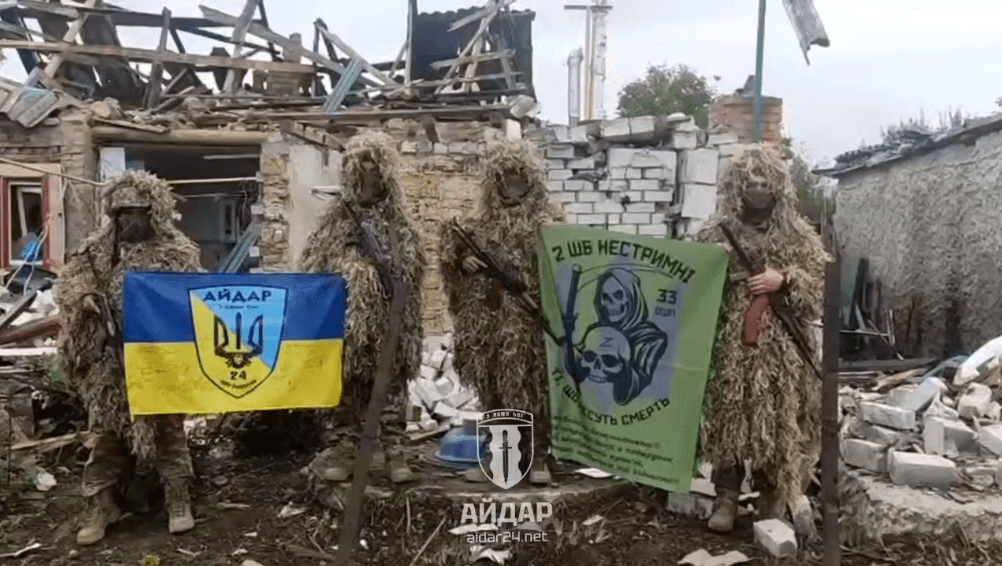
Footage purportedly showing Ukrainian soldiers in the village of Mali Shcherbaky in Zaporizhzhia Oblast. (Photo: Ukraine’s 24th Separate Assault Battalion Aidar / Telegram)
The Invisible Alliance
It began quietly, with a leak that landed like a detonation.
On October 12, the Financial Times revealed that American intelligence was no longer simply tracking Ukraine’s long-range strikes—it was helping to plan them. The disclosure pulled the curtain back on a four-month evolution that had turned courage and improvisation into precision and choreography.
Since midsummer, U.S. analysts had been supplying targeting data, flight paths, and timing windows for Ukraine’s drone assaults on Russia’s refineries—the steel heart of Moscow’s war economy. The shift had started after Trump’s tense July call with Zelensky, when frustration over Putin’s stonewalling gave way to decision: if negotiation failed, strike where it hurt most.
The results were written in smoke and numbers. Sixteen of Russia’s thirty-eight refineries had been hit since August. Gasoline lines snaked through provincial towns; diesel exports fell to their lowest point in five years. Each explosion deep inside Russia carried the invisible signature of American reconnaissance—satellites charting air defenses, signal intercepts mapping gaps, algorithms refining routes through the radar haze.
Officials described it as a “partnership at every stage,” but with Kyiv still choosing the final targets. The dance was delicate: enough U.S. involvement to sharpen every blow, not enough to claim ownership. And as Trump and Zelensky spoke by phone for the second day in a row—discussing Tomahawk missiles and air-defense corridors that could stretch across Siberia—the shape of the war itself had changed.
Ukraine no longer fought alone with courage and ingenuity. It now fought with American sight—a silent alliance of pixels and pulses guiding its steel wings toward the beating heart of the Kremlin’s economy.
The Little Green Men Return
They came out of the fog like a memory—seven Russian soldiers in unmarked uniforms, standing on a sliver of asphalt where Estonia briefly cuts through Russian land. No flags. No insignia. Just the quiet authority of men who wanted to be seen and not recognized.
It was October 10 when Estonia’s border guards spotted them near the tiny stretch of highway between Värska and Saatse—a Cold War relic where one kilometer of Estonian road passes through Russian territory. By the next morning, the road was sealed. No one crossed. No one needed to be told why.
Estonia’s South Prefecture Police chief, Meelis Saarepuu, reported the sighting on October 11, his tone measured but unmistakably tense. These were not ordinary border troops, he said. And every intelligence officer listening to the report understood the implication. Little green men—the same phrase whispered through Crimea in 2014—had returned.
When Estonian officials asked Moscow for an explanation, Russia offered the usual theater: routine patrols, nothing to see, no threat to anyone. But the uniforms without markings told their own story. These weren’t soldiers defending a border; they were testing one.
Foreign Minister Margus Tsahkna spoke carefully on October 12, saying Russia’s forces were behaving “more assertively and visibly than before.” He avoided the word provocation, knowing that overreaction could feed the Kremlin’s propaganda. Estonia, he said, would simply stop using the road altogether. There were other routes. Safer ones.
But the meaning wasn’t lost on anyone in Tallinn or Brussels. This was Russia’s Phase Zero—the psychological campaign that comes before a real one. The unmarked soldiers were part of a pattern: Russian aircraft had violated Estonian airspace twice in September, and now men without flags were walking its border.
For the Baltic nations—still haunted by the memory of Soviet occupation—this was more than intimidation. It was a message etched into the landscape itself: that no frontier, no treaty, no alliance was beyond reach.
Estonia’s calm response was both restraint and defiance. Close the road, keep the peace, but make it clear the line has been noticed—and will be remembered.
The Price of Fuel, the Cost of War
As American-guided drones struck deep into Russian territory, the Kremlin reached for a different kind of weapon—money.
That morning, Vladimir Putin signed a decree suspending restrictions on fuel subsidies, a quiet admission that Ukraine’s drone war was cutting into the heart of Russia’s economy. The measure, effective retroactively from October 1 through May 2026, ensured that refineries would keep selling fuel domestically even as production faltered and prices surged.
The system itself—known as the “fuel damper”—had once been a balancing act between profit and politics. Moscow paid oil companies to offset the difference between high export prices and the lower domestic rates Russians could afford, keeping gas cheap and public anger contained. But as Ukraine’s long-range strikes destroyed refineries from Ryazan to Bashkortostan, that equation collapsed.
By October, refinery output had fallen so sharply that the government’s 2025 payouts—716 billion rubles, about $8 billion—were less than half the previous year’s. Each new drone strike erased another slice of processing capacity, pushing wholesale prices higher and sending drivers into kilometer-long lines for fuel.
Putin’s decree tore away the old limits, allowing state subsidies to continue even when prices spiked 10 percent for gasoline or 20 percent for diesel. It was a desperate move to keep pumps flowing and tempers in check. Every ruble spent cushioning the public, though, was a ruble not spent on the army, the war chest, or the oligarch networks that held the regime together.
The timing was no coincidence. On the same day the Financial Times revealed America’s role in guiding Ukraine’s drone operations, the Kremlin scrambled to prove that its economy was still under control. But the picture was unmistakable: while U.S. satellites helped Ukraine navigate the skies, Russia’s president was rewriting his country’s fiscal rules to keep its engines running.
For ordinary Russians waiting in those lines, the decree was less a relief than a signal. The war that once felt distant had followed them home—into their cars, their paychecks, and their patience. Every drone that struck a refinery miles away carried the same message: the battlefield no longer stopped at the border.
The Tomahawk Shadow
In Washington, one sentence was enough to send Moscow’s pulse racing. “I might have to speak to Russia about the Tomahawks,” Trump told reporters. “Do they want them going in their direction? I don’t think so.”
The remark hung in the air—half threat, half negotiation. It was vintage Trump: a riddle of menace and diplomacy wrapped in the same breath. The weapon in question was no metaphor. The Tomahawk cruise missile, capable of flying more than 2,000 kilometers with pinpoint accuracy, could reach deep into Siberia. For Ukraine, it would mean the ability to strike the heart of Russia’s war machine; for Moscow, it would erase the illusion of safety that distance once provided.
Trump’s phrasing—maybe I’ll talk to him—was deliberate ambiguity, a pressure valve and a provocation. He had just spoken with Zelensky for the second time in two days, discussing air defense, sanctions, and the possibility of expanding Ukraine’s long-range strike capacity. Zelensky called the talks “very productive,” and even suggested that Trump’s methods reminded him of how the American president had pushed warring sides to a ceasefire in the Middle East.
“If he pressures Putin to stop the war, of course we’ll nominate him for the Nobel Peace Prize,” Zelensky told Fox News, half in jest, half in faith. But behind the charm, his message was desperate: Ukraine needed more than diplomacy. “We are thankful,” he said, “but it’s not enough. We spoke about Tomahawks and other things.”
The Kremlin’s reaction was immediate and nervous. Spokesman Dmitry Peskov called the discussion “a moment of extreme concern,” warning that Russia could not distinguish between nuclear and conventional versions of the missile. “Just imagine,” he said. “A long-range missile is flying toward us—what should Russia think?” Dmitry Medvedev went further, claiming it “could end badly for everyone—and first of all for Trump himself.”
Putin, ever the poker player, framed it as escalation beyond redemption. Providing Tomahawks, he said, would destroy the “positive trend” in U.S.-Russian relations. But the anxiety was obvious. The missiles symbolized something greater than hardware—they embodied the return of American unpredictability, the kind that the Kremlin could not script or control.
Zelensky understood that fear perfectly. In his nightly address, he said what Moscow already knew: “Russia fears that the Americans might provide us with Tomahawks. It means this kind of pressure could be effective in achieving peace.”
In a war fought with drones, data, and words, the Tomahawk became the new ghost on the horizon—not yet fired, not yet delivered, but already altering the shape of the battlefield.
The Soldiers No Money Can Buy
Across Russia’s recruiting offices, the posters still promise glory. But the desks behind them tell a different story—one of silence, empty chairs, and paperwork with no names to fill the lines.
Officials from enlistment centers described the same bleak pattern: the bonuses keep rising, but the volunteers have stopped coming. “Everyone who wanted to make money from the war has already signed up,” one recruiter admitted to the independent outlet Idel Realii. Now, the only applicants are men well past fighting age, their health records as battered as their resolve.
The sums are staggering. Regions like Khanty-Mansi now offer more than 3 million rubles—nearly $40,000—for a single signature. In Sverdlovsk, the same amount buys not pride but panic; each new incentive marks another month of failure. Despite the cash, recruiters say they’re scraping the bottom of the pool—signing men once rejected for chronic illnesses or age, men drawn not by patriotism but by debts, by hunger, by the faint hope of leaving their families something more than grief.
In Irkutsk Oblast, the questions recruiters hear aren’t about duty but about benefits—loan forgiveness, college spots for children, housing stipends if they die. Service has become a transaction, war reduced to a spreadsheet. Even the propaganda admits as much: “Get your millions before peace comes,” one campaign read in the lead-up to the Alaska summit, as if peace itself were a sale ending soon.
But peace is not coming, and most of the new recruits will never live long enough to spend their bonuses. The ads trumpet how much a soldier can earn in a year; they do not mention that few survive twelve months at the front. Commanders know it. Recruiters know it. The only thing uncertain is how long the money will hold the illusion together.
The math of the war has turned against Moscow. Every week brings new losses and fewer men willing to replace them. The Institute for the Study of War had warned months earlier that the Kremlin had exhausted its “financially motivated” population—those willing to trade risk for rubles. October’s reports confirmed it: Russia’s human reservoir is drying up.
Putin faces a choice he has spent two years avoiding—declare a new mobilization and risk open revolt or fight on with dwindling numbers and the ghosts of those who enlisted for cash and never came home.
Striking the Arsenal
The night sky over Smolensk glowed an unnatural orange. The fire burned high enough to be seen for kilometers—another refinery? No. This time, it was the Smolensk Aviation Plant, the heart of Russia’s precision-missile production, and the brain of the war that had pounded Ukrainian cities for nearly three years.
Geolocated footage posted hours later confirmed what local residents already knew: Ukraine had struck the plant itself. The explosions tore through assembly buildings where technicians once produced the Kh-59 and Kh-101—the same missiles that had flattened apartment blocks in Kyiv, Odesa, and Dnipro. The war had come full circle: the weapons built to destroy Ukraine were now being destroyed by Ukraine.
Militarnyi’s report traced the strike’s logic. The Kh-59, a tactical precision weapon, could hit targets nearly 300 kilometers away. The Kh-101, launched from bombers, could travel thousands. Each one lost to the flames in Smolensk meant fewer that could arc across Ukrainian skies in the months ahead.
This wasn’t improvisation; it was method. Weeks earlier, partisans had sabotaged a railway spur feeding the plant. Now came the main strike—timed with surgical precision, likely exploiting the same vulnerabilities revealed in September. Whether American intelligence played a role was unconfirmed, but the accuracy suggested it. The routes, the timing, the impact—all pointed to a hand that knew the terrain from above.
For Russia’s military planners, the meaning was chilling. The defense-industrial base that once seemed untouchable had become a battlefield. Refineries, drone depots, missile plants—all targets now, all burning. Each successful hit forced Moscow to stretch its air defenses thinner, pulling systems away from the front lines to guard its own heartland.
Ukraine had struck not just a factory, but a rhythm—the steady production of terror itself. And for the first time, it was Russia watching its own skies in fear.
The Grinding Front
Across the scarred plains near Pokrovsk, the war has slowed to a crawl measured in meters. Every tree line, every ruined farmhouse has become a trench of its own.
Russian forces pushed again from every direction—north, east, south, and west—claiming villages no one could verify and advances no one could see. Their channels on Telegram spoke of triumphs: Balahan captured, Rodynske breached, Pokrovsk’s railway station under Russian control. But the satellite images and the Ukrainian brigades on the ground told another story—one of attacks repelled, positions retaken, and front lines barely moved.
The assault near Volodymyrivka showed the pattern in miniature. Six tanks, forty armored carriers, hundreds of infantry, even motorcyclists leading the charge like a cavalry from another century. They came in waves, layered to overwhelm, but by nightfall the lines were almost exactly where they began. The cost was measured not in territory but in bodies and burned steel.
Farther north, near Kostyantynivka and Druzhkivka, Russian units tried infiltration instead of assault—sending small groups through ravines and villages, probing for weak points the way water finds cracks in a stone. But even there, progress was fleeting. Ukrainian observers reported that Russian field officers were falsifying reports to claim victories that didn’t exist, papering over failures for superiors who demanded success at any cost.
Naval infantry units once stationed near the Dnipro were now redeployed to this grinding front, their numbers thinning as fast as replacements arrived. Reinforcements shuffled between the Central and Eastern groupings, a desperate redistribution rather than a surge. The front near Volodymyrivka, Shakhove, and Novopavlivka flared and faded like a dying fire—bright, violent, then cold again.
Each attack seemed designed less to capture ground than to prove movement, to feed the illusion of momentum. But the illusion cost dearly. The Russian army was bleeding itself to stand still, and the ground it gained could barely hold the weight of the dead it took to seize it.
The Northern Front: When Allies Become Obstacles
In the forests north of Sumy, the Russian army fought itself.
By dawn, Oleksiivka had become a pocket of confusion—radio chatter tangled, units arriving unannounced, and artillery shells landing on friendly positions. A battalion from the 810th Separate Naval Infantry Brigade had been sent to reinforce the town, only to exchange fire with the 30th Motorized Rifle Regiment already entrenched there. No one had told them they were on the same side.
What began as an attempted breakthrough had turned into a battlefield of mistaken identities. The Northern Grouping’s own channels admitted it: command and control had collapsed. Reinforcements stumbled into the fight without coordination, maps outdated, frequencies mismatched. By the time the shooting stopped, Russian forces were blaming “enemy sabotage”—but the enemy was nowhere near.
The dysfunction spread outward like a contagion. In nearby Kostyantynivka, Russian troops fought without artillery support as Ukrainian counterattacks pressed in from three directions. Mortar crews meant to provide cover were stuck hours away, halted on a highway outside Sinyak—not by Ukrainian fire, but by their own supposed allies. North Korean personnel deployed to assist with logistics had blocked the road, unaware that their “security inspection” had paralyzed the Russian supply line they were meant to protect.
The irony was almost cinematic: Moscow’s imported allies had become obstacles, its reinforcements adversaries. What should have been a combined offensive looked instead like a series of collisions—brigades tripping over one another, ammunition trucks idling while front-line units begged for shells.
Meanwhile, Ukrainian forces struck precisely where the confusion was greatest. Drone reconnaissance identified the chokepoints on the E38 Rylsk–Lgov highway, Ukraine’s artillery disrupting the flow of Russian logistics that tried to snake through Kursk Oblast. Russian milbloggers admitted that resupply was “unstable,” an understatement for a front starved of fuel and coordination alike.
The northern offensive had promised momentum. What it delivered was entropy—a portrait of an army stretched too thin to function, reliant on foreign auxiliaries who couldn’t read its signals and commanders too isolated to fix the mess they’d created.
Every army fears its enemy. On the Sumy front, Russia was learning to fear itself.
The Counterstroke
In western Zaporizhzhia, a new flag rose over the ruins of Mali Shcherbaky—a yellow and blue signal that Ukraine could still go on the offensive when it chose to.
Soldiers from the 24th Separate Assault Battalion “Aidar” and the 33rd Separate Assault Regiment moved with quiet precision, clearing the village before announcing its liberation. Their video, released only after the operation was secure, showed the Ukrainian banner snapping in the autumn wind—a small flag, but a hard-won one.
Mali Shcherbaky had been in dispute for months, a gray zone shifting between control and occupation. Russian forces had pushed toward it in early summer, then dug in, assuming the front there had stabilized. They were wrong. Ukraine’s counterattack, likely planned days in advance, came not with spectacle but with discipline: strike, clear, consolidate, then speak.
Across the broader front, similar ripples appeared. To the north, near Kupyansk, geolocated footage confirmed Ukrainian units advancing west of Radkivka. South of Siversk, more footage showed movement east of Pereizne. These weren’t sweeping offensives—they were surgical corrections; each reclaiming ground Russia had taken at immense cost.
The contrast was stark. Russia threw battalions and armor at strongpoints to move a few hundred meters; Ukraine used small, coordinated groups to retake entire settlements. Where Moscow measured progress in casualties, Kyiv measured it in precision.
The liberation of Mali Shcherbaky wasn’t just a local victory—it was a message. Even under relentless bombardment, even with Russian pressure along every axis, Ukraine still held the initiative where it mattered: the freedom to choose when and where to strike.
Zaporizhzhia’s Chessboard
In the orchards and open fields of Zaporizhzhia, the war refused to settle. One village changed hands while another burned; tanks advanced through dust clouds only to vanish under drone fire minutes later. This was no longer a front of sweeping maneuvers but a chessboard of inches, every square contested, every move answered.
Ukrainian forces struck first blood, reclaiming Mali Shcherbaky southwest of Orikhiv—a deliberate, disciplined advance that stood in sharp contrast to the chaos unfolding farther east. Russian troops pushed toward Hulyaipole, probing through Novoyehorivka and Poltavka, claiming short-lived gains. But each kilometer won came at the price of shattered armor and downed drones.
A Russian analyst bragged that new “fiber optic–guided drones” were hitting Ukrainian supply vehicles near the Dnipropetrovsk border, immune to the jamming that had crippled so many of Moscow’s earlier systems. Yet the brag carried an admission: Russian drones were now on the defensive. Across the Stepnohirsk–Prymorske sector, even Kremlin-aligned bloggers conceded that Ukrainian operators dominated the skies. Russian assault units were advancing under surveillance so constant that every convoy movement drew immediate fire.
To regain control, Moscow deployed its rarest asset — the BARS-Sarmat drone warfare detachment, an elite experimental unit usually reserved for testing new technology. Their presence near Stepnohirsk signaled how important this patch of front had become: a proving ground not just for ground combat, but for the next phase of unmanned war.
Even so, the terrain told its own story. Prymorske’s southern outskirts became a no-man’s-land — a “gray zone,” as Russian sources put it — where neither army held authority for more than a few hours. And in the background, Russian commanders stripped quieter sectors like Kherson to reinforce this one, redistributing their paratroopers from the 11th Separate Airborne Brigade to hold what was left of Kamyanske. The more they shifted, the thinner the rest of the line became.
Zaporizhzhia had become the war in miniature: a battlefield of momentum and counter-momentum, where drones replaced artillery barrages, and control of the air — even a few hundred meters of it — mattered more than any line on a map.
The Kherson Stalemate
Along the lower Dnipro, the war has settled into silence and mud.
For months, the islands scattered across the delta have changed hands like drifting ice—taken, abandoned, retaken again. They offer no real ground to hold, no supply routes to sustain, only exposure and exhaustion. Yet both armies keep returning, unwilling to surrender even a fragment of the river’s edge.
Russian units launched another round of small assaults across the channels, trading fire with Ukrainian positions that shift as tides and artillery dictate. The fighting is less about conquest now than about presence—proof that each side still exists there, even if no one can truly stay.
On the western bank, the war took a crueler turn. Russian forces struck vehicles along the M14 highway, the main road linking Kherson and Mykolaiv, then seeded it with remote mines. Delivered by drones or artillery, the explosives buried themselves invisibly beneath the asphalt. To drive that road now is to gamble every kilometer—a gamble civilians must take daily for food, for medicine, for escape.
The tactic blurs the last distinction between military and civilian life. Trucks, ambulances, aid convoys—all targets now. The law calls it indiscriminate. The soldiers call it Tuesday.
In Kherson, the war has become less a battle of movement than of cruelty—measured not in territory gained, but in how long a road stays passable before the next mine detonates.
The Drone Onslaught
It began after midnight—a sound like a thousand bees over an empty city.
From Kursk to Crimea, from Millerovo to the Black Sea coast, Russia launched wave after wave of drones into the Ukrainian night. By dawn, 118 unmanned aircraft had crossed the border—the largest assault of its kind in weeks. Ukrainian radars lit up the sky. Searchlights tracked shadows. Mobile air defense crews fired until the barrels glowed red. One hundred and three drones were brought down. Fifteen made it through.
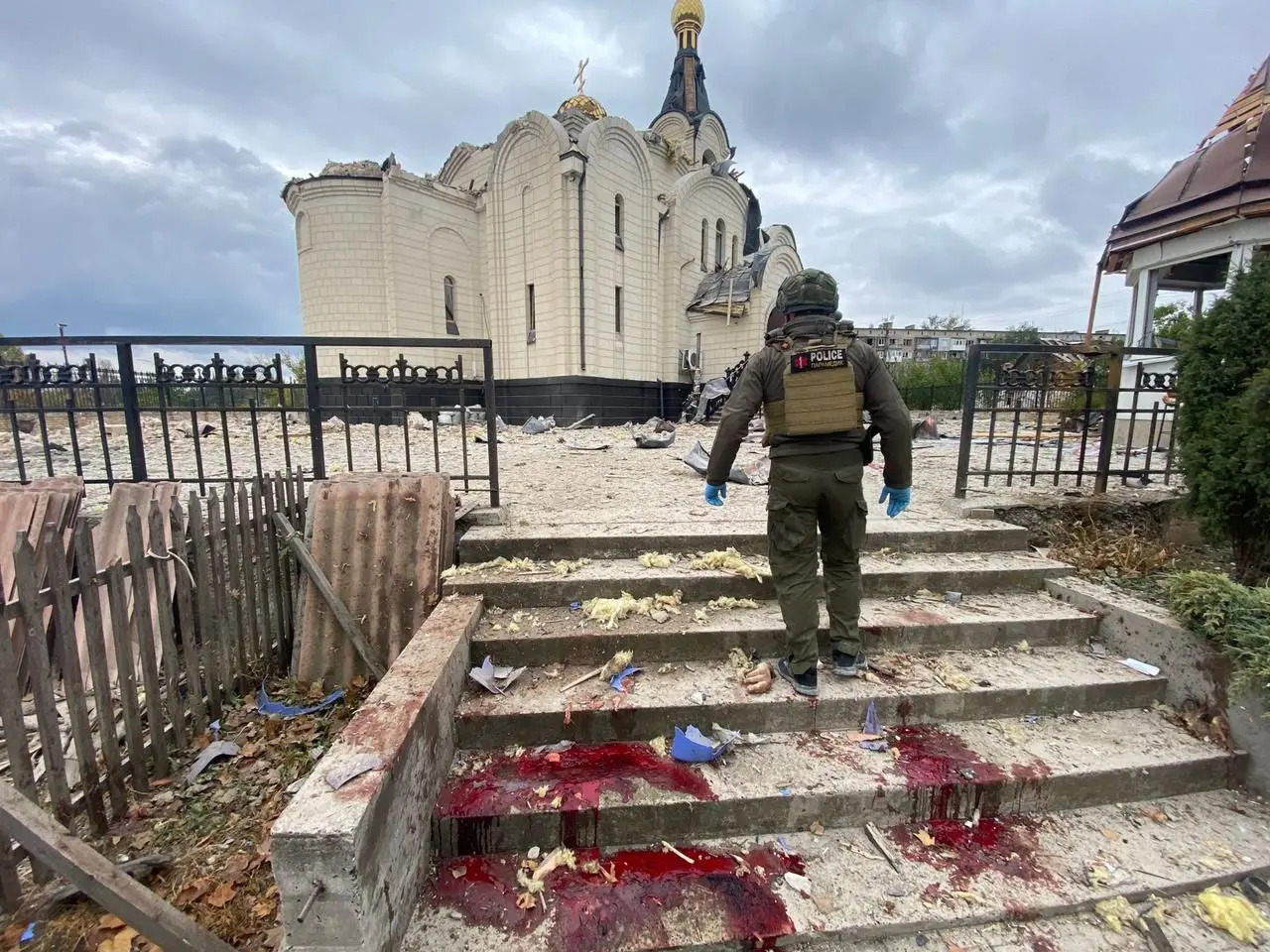
The aftermath of a Russian strike near the Church of Ioan Pochaivskyi in Kostiantynivka, Donetsk Oblast. (Photo: Vadym Filashkin / Telegram)
The survivors found their marks. Ten regions were hit—Chernihiv, Donetsk, Kharkiv, Kyiv, Odesa—each scarred before sunrise. In Kostiantynivka, an explosion tore through the courtyard of the Church of Ioan Pochaivsky as locals gathered nearby. Two people died instantly. Five more were pulled from the rubble. In Nikopol, a 23-year-old woman never saw the FPV drone that struck her home; her 63-year-old father survived with shrapnel wounds. In Kherson, thirty settlements were shelled in tandem, two more lives lost.
Everywhere, the pattern repeated—streets of glass and dust, homes without roofs, and the hum of generators replacing the grid. In Boryspil, outside Kyiv, a drone struck a DTEK electrical substation, injuring two engineers and cutting power to ten thousand homes. In Odesa and Chernihiv, strikes hit gas and power networks, proof that Russia’s winter strategy had begun early: starve the cities of heat before the snow arrives.
Zelensky’s figures were staggering. Since October 5, he said, Russia had unleashed more than 3,100 drones, 1,360 glide bombs, and 92 missiles—a storm designed not just to kill, but to exhaust. “That is precisely why no weakening of pressure can be allowed,” he warned. “Sanctions, tariffs, joint actions against those who buy Russian oil—everything must continue.”
The message was clear: the war had entered its aerial phase. Drones now filled the role once held by bombers—cheaper, endless, and unblinking. The sky itself had become the front line.
The Kramatorsk Evacuation
The order came quietly, like a rumor at first. Families. Children. Anyone who could leave, must leave.
For years, Kramatorsk had stood as the heart of Ukrainian defiance in Donetsk Oblast—a city that refused to fall even when everything around it did. Angela Bolonz, thirty-four, had raised her two daughters here, ages five and ten. They had grown up hearing distant artillery like weather—loud in winter, softer in spring. But when the drones began to hover over the rooftops, something changed. Explosions came without warning, and one night a car near their building burst into flames.
“When the evacuation was announced, people started leaving,” she said, clutching plastic bags filled with her family’s life. The fiber optic–guided drone that struck a vehicle downtown on October 5—the first such weapon to reach Kramatorsk—ended any illusion that distance meant safety.
Outside the city, the roads had become a gauntlet. On the route to Druzhkivka, ten kilometers south, drivers raced beneath anti-drone netting, headlights off, doors unlocked in case they needed to run. Soldiers repaired an armored vehicle by the roadside; its bumper had been blown off by another FPV drone. They worked in silence, under a sky that hummed.
Kramatorsk had become what soldiers called a “lethal zone”—a twenty-kilometer belt where any movement could draw fire. Winter was coming, and Russian drone operators were intensifying strikes before cold air shortened battery life. Medics in the city treated an endless stream of casualties: burns, shrapnel, and wounds that no longer shocked them. “Most are from FPVs,” said Sergiy, a thirty-four-year-old doctor, lighting a cigarette between cases. “One man’s leg completely necrotized.” Another soldier, bandaged and grinning through pain, muttered, “It hit us on the way back. Like everywhere—it’s tough. Very tough.”
Troop rotations had become their own form of combat. Men moved only on foot now, in ten-kilometer shifts, wrapped in thermal camouflage. Russian saboteurs posed as Ukrainian soldiers or as civilians, planting traps on country roads. “It’s discouraging when you’re fired upon while just trying to reach your position,” one soldier said.
By then, Russia controlled nearly eighty percent of Donetsk Oblast. Sloviansk issued its own evacuation orders soon after. Angela left her mother, brother, and mother-in-law behind—they refused to go. She took her daughters toward Zaporizhzhia, where her sister lived. That night, Russian drones struck the city. The sound followed her all the way there.
In Ukraine, even escape no longer meant survival—only motion, and the hope that the next morning would still come.
The Railway War
Across Ukraine, the trains still run — but every journey now begins with a prayer.
Since August, Russia has struck railway infrastructure nearly 300 times. Each explosion aims not just to cripple logistics, but to break the nation’s pulse — the railways that move soldiers, grain, generators, refugees, and aid. In wartime Ukraine, the rails are veins, carrying both life and loss.
Deputy Prime Minister Oleksii Kuleba said that every day the network is hit, every day it is repaired. “On average, we restore operations within four hours,” he reported — a staggering claim, and one that tells the story of a workforce that no longer flinches at impact. Mechanics crawl over craters, welders patch twisted track, dispatchers reroute trains through fields still smoldering. Then the sirens sound again.
Since the full-scale invasion began, 221 railway workers have been injured and 37 killed. Their names rarely make the news — they are the men and women in orange vests, shovels in hand, racing to restore switches and signals before the next wave hits. Their courage has kept an entire nation connected, even as missiles try to cut it apart.
The attacks grow crueler. On October 4, a double-tap drone strike hit a station in Sumy Oblast — one blast for the passengers, the second for the rescuers. Thirty people were wounded, including three children. One never made it out. The tactic was designed for maximum horror: to punish those who came to save.
Analyst Dmytro Zhmailo believes the railway war is no coincidence. It began to surge just as Ukraine secured new Western arms under the Prioritized Requirements List — the mechanism funding American weapons through NATO allies. Russia’s logic was simple: destroy the tracks, and you delay the weapons. Delay the weapons, and you delay victory.
Yet the trains still move. They carry evacuees out of Kramatorsk, generators to Odesa, ammunition to the east, and grain to the ports that still function. Each line restored is a small act of defiance. Each engineer climbing back into the cab after an air raid is a reminder that Ukraine’s endurance rides on steel wheels.
The war for the railways is not glamorous. It has no heroes with medals, no headlines of liberation. But without it, there would be no front, no cities left to defend, no nation left to connect.
The Zaporizhzhia Nuclear Gambit
For nearly three weeks, the largest nuclear plant in Europe has been running on borrowed time.
At Zaporizhzhia, the hum of diesel generators has replaced the steady pulse of Ukraine’s national grid. The power lines that once tethered the plant to the country’s heart were cut on September 23, when Russian forces struck a key transmission link — the same line that kept cooling systems alive. Since then, engineers have worked by flashlight in concrete tunnels, counting the hours of fuel left in the tanks.
Foreign Minister Andrii Sybiha called it what it was: an act of nuclear brinkmanship. “Not only is this an attempted theft of a peaceful Ukrainian nuclear facility,” he wrote, “it directly threatens a nuclear incident.” His accusation went beyond outrage. He claimed Russia was deliberately testing the plant’s integration into its own electrical network — an experiment that violated every safety protocol in existence.
The International Atomic Energy Agency confirmed that its team had heard shelling near the site. Each concussion in the distance carried the same unspoken fear: one wrong hit could plunge the plant into disaster. Moscow blamed Kyiv. Kyiv called it what it was — a provocation meant to blur the line between accident and sabotage.
Zaporizhzhia has been under Russian control since March 2022. The six reactors have been shut down for more than two years, yet they still need constant electricity to keep the cooling systems running. Diesel generators were never meant to power a nuclear facility indefinitely. Every day they run, the risk grows — a leak, a mechanical failure, a blackout, any of which could trigger catastrophe.
To Ukraine, the blackout was more than a technical danger — it was a political one. By cutting Zaporizhzhia off from the Ukrainian grid and reconnecting it to Russia’s network, the Kremlin was performing a quiet annexation by voltage. The wires themselves had become instruments of occupation.
A power line may seem a small thing to fight over in a war filled with drones and missiles. But if those lines stay dark, and the generators fail, it won’t be a battlefield that burns next — it will be Europe.
Lukashenko’s Theater: The Dictator’s Warning
The cameras rolled in Minsk, and Alexander Lukashenko slipped into his favorite role — the reasonable man surrounded by chaos. Sitting opposite Kremlin propagandist Pavel Zarubin, the Belarusian dictator rehearsed a performance that had become second nature: warn of Ukraine’s destruction, feign concern for peace, and repeat Moscow’s lines with the weary tone of a reluctant prophet.
“Russia is advancing on the front line,” he said gravely. “And I say this responsibly, because I observe this every day. It could lead to the disappearance of Ukraine as a state.”
It was the language of fatalism disguised as diplomacy — a speech meant to sound like wisdom but built on surrender. Zelensky, he insisted, needed to “sit down and negotiate,” to “act urgently,” to accept the inevitable. The problem, Lukashenko claimed, was not with Washington, nor with Moscow, nor even with Europe, but with Kyiv itself. “The issue is with Volodymyr Zelensky,” he said, as if Ukraine’s refusal to capitulate were the real obstacle to peace.
This was vintage Lukashenko: the victim-blaming mediator, offering a moral lecture while his country remained an accomplice to invasion. His warning that Western allies might “take part of Ukraine, as before the Great Patriotic War,” echoed the Kremlin’s most cynical propaganda — the myth that Russia’s aggression was a pre-emptive defense against imaginary Nazis.
“No one will bring happiness to Ukraine except the Slavic states,” he concluded, reciting the Kremlin’s creed of “brotherly unity” that had long masked its imperial ambition.
The performance came as Trump and Zelensky discussed Tomahawk missiles — a coincidence that looked anything but accidental. Lukashenko even tried to calm Moscow’s nerves over the issue, claiming that Trump’s threats were “a tactic,” not a promise. It was damage control, delivered from one autocrat’s loyal outpost.
The timing of the broadcast was telling. While Lukashenko preached reconciliation, his generals were conducting live combat readiness checks — moving armored vehicles, digging trenches, and simulating river crossings. Belarusian Security Council Secretary Alexander Volfovich proudly explained that the exercises incorporated lessons learned from Russia’s war in Ukraine: how to resist drones, counter sabotage groups, and adapt doctrine to new forms of warfare.
Even as Lukashenko warned of Ukraine’s “disappearance,” his own army was rehearsing how to fight one. His theater of concern ended where the engines started — with Belarus positioning itself not as a mediator, but as an apprentice studying for its next role on the battlefield.
The Deep Strikes Continue: Ufa Burns
The war reached Ufa before dawn.
A roar cut through the industrial hum of Bashkortostan’s capital, followed by the heavy concussion of fire. Flames rose from the Bashnafta-UNPZ oil refinery — one of Russia’s largest — painting the night sky red over the city’s smokestacks. The explosions came from 1,400 kilometers away from the front, yet they sounded like the front had come to them.
Ukraine’s Security Service had struck again — another long-range drone sent deep into Russian territory, another refinery feeding the Kremlin’s war machine reduced to smoke and twisted steel. The attack marked the third hit on Bashkortostan in a month, part of a campaign that has now reached 16 of Russia’s 38 refineries since August. The geography of the war was expanding, and with it, the illusion of safety that distance once provided.
Ufa’s refinery supplied fuel and lubricants to Russia’s military. By hitting it, Ukraine targeted not symbols but arteries — the logistical lifeblood of an army still burning thousands of liters of diesel every hour. The explosions were more than fire and noise; they were an answer to the missiles that had fallen on Kyiv, Kharkiv, and Odesa for two years running.
American intelligence had reportedly made these operations sharper, deadlier, and more precise. U.S. satellites and analysts had helped Ukrainian planners map routes, time flights, and navigate the radar blind spots of Russian air defenses. The result was a campaign that defied geography and expectation alike: drones once limited to border raids now crossed entire provinces unseen.
Authorities in Ufa shut down the airport and cut mobile internet, fearing panic. For the first time, ordinary Russians felt the war not as a headline or patriotic slogan, but as a tremor underfoot — a sense that nowhere was beyond reach. The sound of air-raid sirens in the Russian interior was no longer theoretical.
The logic behind Ukraine’s strikes was brutal in its simplicity. Every refinery burned meant less fuel for tanks, fewer rubles for artillery, more pressure on Putin’s illusion of control. The fires over Ufa were not just retaliation — they were strategy rendered in flame.
The Dutch Minehunter: Clearing Paths Through Deadly Waters
In a war of missiles and drones, the danger beneath the waves is easy to forget.
For months, the Black Sea has been seeded with mines — invisible killers drifting through trade routes once filled with grain ships and fishing boats. They are relics of a modern war fought with ancient terror: weapons that wait. Each one could detonate years after being placed, tearing apart a vessel that never saw it coming.
That is why the quiet announcement from Navy Commander Oleksii Neizhpapa carried such weight. The Netherlands had delivered the first of two Alkmaar-class minehunters to Ukraine — sleek, sonar-equipped vessels designed not for attack but for restoration, for clearing paths through deadly water. A second ship would follow by year’s end, its Ukrainian crew already in training.
The Alkmaar-class ships — a joint creation of the Netherlands, France, and Belgium — were built for patience and precision. Their sonar could trace the faint outlines of mines on the seabed; their remotely operated vehicles could disarm or destroy them with surgical care. In the minefields of the Black Sea, they would serve as both guardians and guides.
Since 2022, hundreds of mines have been scattered by Russian forces across key shipping lanes, transforming Ukraine’s maritime lifeline into a corridor of fear. Grain convoys to Africa and the Middle East sailed under constant risk, every voyage a gamble on survival. Commercial skippers navigated by rumor — “there was an explosion near Odesa,” “a mine broke free near Constanța” — as maritime insurers withdrew coverage and freighters hesitated to dock.
The Dutch decision to send minehunters was a commitment not just to Ukraine’s navy but to its economy — to the flow of grain that still feeds parts of the world. Clearing the sea lanes means reopening arteries that Russia has tried to choke with fear.
The ships themselves are not dramatic. They move slowly, listen more than they act, and hunt for silence rather than glory. Yet in this war, their purpose is as profound as any missile battery. They are reclaiming the sea — meter by meter, echo by echo — so that ships may one day sail freely again.
Glide Bombs and Extended Ranges: Russia’s Aviation Innovation
The roar came from a distance too great for return fire.
Russian pilots had found a way to strike without being seen. Reports from Russian military bloggers claimed that aircraft near Belgorod had launched glide bombs from nearly 100 kilometers away, hitting targets near Vovchansk in northern Kharkiv Oblast. If true, the strike represented a troubling leap forward — a 30-kilometer increase in stand-off range that pushed Russian bombers beyond the reach of most Ukrainian air defenses.
Glide bombs — simple iron gravity bombs retrofitted with fold-out wings and satellite guidance kits — have become one of Russia’s most feared weapons. Crude but effective, they turn old stockpiles into modern precision tools, allowing Su-34 and Su-35 aircraft to deliver heavy payloads without entering Ukraine’s missile envelope. Each carries the weight of a small apartment block, enough to flatten entire defensive positions or residential streets in a single hit.
The new range changes the geometry of the battlefield. Ukrainian surface-to-air systems must now cover wider arcs and deeper rear zones, forcing commanders to stretch already thin resources. For defenders around Vovchansk, it means no warning and no time — a glide bomb can arrive minutes after launch, riding silently on invisible wings until impact.
This arms race between adaptation and counter-adaptation has become one of the war’s defining rhythms. Each Ukrainian success in shooting down aircraft pushes Russian engineers to extend their reach. Each Russian innovation, in turn, drives Ukraine to deploy Patriots, IRIS-Ts, or NASAMS closer to the line, accepting greater risk to keep the skies contested.
The glide bomb’s evolution shows how even modest technical adjustments can reshape entire fronts. For Russian pilots, an extra 20 or 30 kilometers may mean the difference between life and death. For Ukrainian cities beneath the flight path, it means the opposite.
The Reckoning Ahead: The War Redefined
The war’s center of gravity is shifting — not by territory, but by intelligence, endurance, and adaptation.
American involvement has moved from restraint to orchestration. Intelligence partnership now defines the shape of Ukraine’s long-range war, blurring the line between advisor and participant. That shift will force Washington to manage escalation, not avoid it. Every successful Ukrainian strike deep inside Russia now carries a dual signature: Ukrainian ingenuity and American precision.
Russia’s capacity to absorb losses — in fuel, manpower, and credibility — is nearing its natural limit. Recruitment shortfalls point toward an unsustainable model: one that buys loyalty with cash rather than conviction. Sooner or later, Putin must choose between political instability at home or military paralysis abroad.
The unmarked soldiers near Estonia suggest that Moscow is already scripting its next act — testing NATO’s tolerance for ambiguity. What began in Crimea as covert invasion tactics has evolved into border theater meant to confuse allies and stretch their readiness. The lesson is clear: deterrence will depend less on promises than on presence.
Ukraine’s counterstrikes on Smolensk and Ufa revealed a new form of parity. The battlefield is no longer a fixed geography but a 1,400-kilometer contest of precision and nerve. As Ukraine extends its reach, Russia’s sense of sanctuary collapses — and with it, the myth of distance as defense.
The pattern that emerged on October 12 was unmistakable: every front of this war — military, economic, diplomatic, psychological — is entering transformation. The old assumptions no longer hold. Escalation now wears the face of adaptation, and the next phase will be defined not by who holds the ground, but by who learns fastest how to fight without boundaries.
The systematic Russian targeting of Ukrainian railway infrastructure—300 attacks since August—aimed to disrupt Western weapons deliveries approved under new NATO funding mechanisms. The 37 railway workers killed and 221 injured represented the human cost of maintaining logistics under constant attack.
The Zaporizhzhia Nuclear Plant’s isolation from Ukraine’s grid and Russia’s apparent testing of integration into Russian networks created risks that extended far beyond military considerations. Nuclear safety depended on reliable electricity, and diesel generators represented single points of failure that could lead to catastrophic accidents.
Lukashenko’s coordination with Kremlin messaging—blaming Zelensky for refusing negotiations while warning of Ukraine’s disappearance—demonstrated how Russia used proxy voices to amplify its propaganda. The Belarusian dictator’s military exercises incorporating lessons from Ukraine showed that neighboring nations were preparing for potential future conflicts based on observations from the current war.
The war that had begun with tank columns crossing borders had evolved into something far more complex—a conflict fought with drones and intelligence sharing, economic warfare and nuclear brinkmanship, unmarked soldiers and international diplomacy. Victory remained elusive for both sides, but the tools and tactics available to Ukraine were expanding while Russia’s recruitment pool and economic stability were contracting.
The question wasn’t whether the war would end, but whether Putin would recognize his deteriorating position before irreversible damage to Russia’s military, economy, and international standing made any negotiated settlement impossible. On October 12, that recognition remained absent—but the forces that might eventually produce it were gathering momentum across multiple dimensions simultaneously.