
When Putin threatened nuclear plants, Trump approved intelligence sharing, and Europe’s patience with Hungary finally snapped
The Story of a Single Day
October 2, 2025, was a day when threats traveled in multiple directions at once. In the Black Sea resort town of Sochi, Russian President Vladimir Putin stood before the Valdai Discussion Club and threatened to strike Ukrainian nuclear power plants—a chilling escalation that would have been unthinkable in conventional warfare. In Washington, President Donald Trump quietly approved sharing American intelligence with Ukraine for long-range strikes deep into Russia. In Copenhagen, German Chancellor Friedrich Merz openly rebuked Hungarian Prime Minister Viktor Orbán for disrupting European security discussions. And in Poland, authorities detained a Ukrainian diving instructor suspected of helping blow up the Nord Stream pipelines.
These weren’t isolated incidents but interconnected moves in a complex geopolitical chess game. Putin’s nuclear threats came as Moscow scrambled to downplay reports of American intelligence sharing. Trump’s approval represented a significant shift in U.S. policy, even as his administration maintained public ambiguity about supporting Ukraine. Merz’s confrontation with Orbán exposed deepening fractures within the European Union over how to respond to Russian aggression.
This was the 1,317th day of a war that had started with tanks and evolved into something far more complex—a conflict fought with drones and diplomats, intelligence sharing and infrastructure sabotage, nuclear threats and prisoner exchanges. On this single October day, all these elements converged.
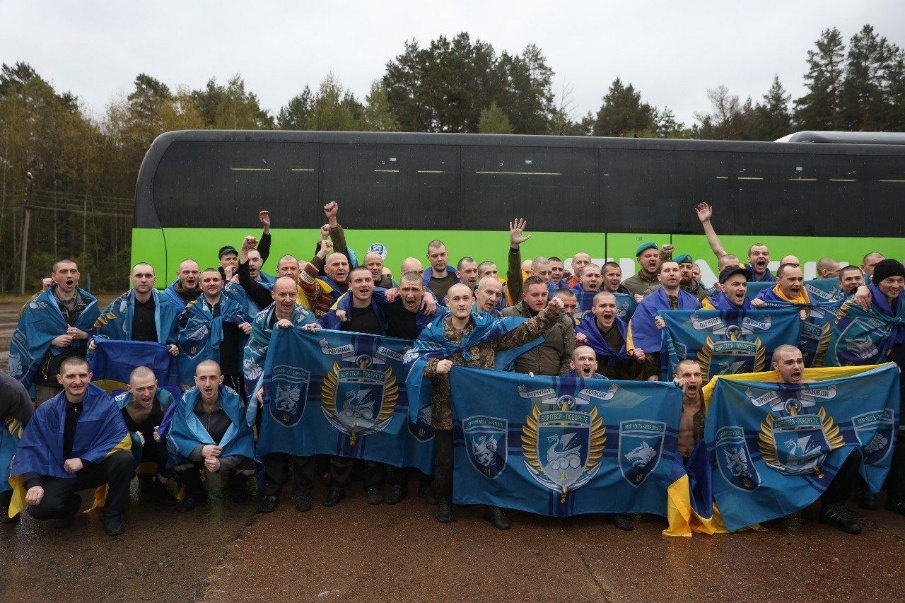
Ukrainians after their release from Russian captivity. (President Volodymyr Zelensky/Telegram)
The Nuclear Gambit: Putin’s Most Dangerous Threat Yet
Standing before an audience of Russian scholars, foreign officials, and Kremlin allies at the Valdai Discussion Club in Sochi, Putin delivered what may have been his most reckless threat since the war began. Ukraine’s nuclear power plants, he suggested, were legitimate targets for Russian strikes.
“They need to understand that if they keep playing with this dangerously, they still have operating nuclear power plants on their side,” Putin said, his tone measured despite the catastrophic implications of his words. “So what is stopping us from responding in kind? They should think about that.”
The Russian president framed this potential nuclear terrorism as a “mirror response” to what he claimed were Ukrainian attacks near the Zaporizhzhia Nuclear Power Plant—a facility Russia itself has occupied since March 2022. He offered no evidence for these accusations, but that wasn’t the point. The threat itself was the message.
Putin’s timing was deliberate. The Zaporizhzhia plant had been disconnected from Ukraine’s electricity grid for over a week, surviving on diesel generators after multiple blackouts. One generator had already failed. President Volodymyr Zelensky had described the situation as “critical” just two days earlier. Russian forces controlled the plant, Russian actions had created the emergency, and now Putin was threatening to replicate that crisis at Ukraine’s other nuclear facilities.
Foreign Minister Andrii Sybiha saw through the theater. Russia had deliberately cut power to Zaporizhzhia, he said, as Moscow prepared to reconnect the facility to its own energy system. “Every action taken by Russia is not just a lethal risk, but also paves the way toward a catastrophe,” Sybiha warned.
Europe’s largest nuclear power plant, operated by skeleton crews under Russian occupation, had become a pawn in Putin’s information war. His threat to target functioning Ukrainian nuclear facilities represented a new low—using the specter of nuclear catastrophe as a weapon of psychological warfare while the world watched helplessly.
The Valdai Club provided the perfect venue for this calculated escalation. For decades, the annual forum had served as a useful tool in the Kremlin’s efforts to influence Western policy. Foreign scholars and officials gathered alongside Russian academics, creating an illusion of intellectual exchange while Putin used the platform to broadcast threats wrapped in philosophical rhetoric. On October 2, that platform amplified one of the most dangerous ideas Putin had yet articulated: that nuclear power plants were fair game.
Intelligence War: Trump’s Quiet Approval
While Putin made threats in Sochi, The Wall Street Journal revealed what the Trump administration had been doing quietly: approving American intelligence sharing with Ukraine for long-range strikes against targets inside Russia.
According to unnamed U.S. officials, Trump had recently authorized intelligence agencies and the Pentagon to provide Ukraine with targeting information for attacks on Russian energy infrastructure. The approval extended to targets deep inside Russian territory, potentially including military facilities. The administration was also asking NATO allies to provide similar intelligence support.
This represented a significant policy shift, even if Trump’s public statements remained ambiguous. American intelligence—satellite imagery, communications intercepts, targeting data—would now help Ukrainian forces strike hundreds of miles inside Russia. The officials indicated that Washington was considering providing Tomahawk cruise missiles with ranges of roughly 500 miles, along with Barracuda missiles and other long-range systems.
Zelensky had pressed Trump for Tomahawks during a closed-door meeting at the United Nations General Assembly on September 23. The missiles had been on Ukraine’s wish list for years, included in Zelensky’s “Victory Plan” presented to then-President Joe Biden in October 2024. Now, less than two weeks after that UN meeting, Trump had apparently moved forward with at least part of Ukraine’s request.
The Kremlin’s response revealed Moscow’s anxiety about the decision. Spokesperson Dmitry Peskov immediately tried to downplay the significance, claiming that U.S. intelligence sharing with Ukraine was “not an innovation.” Russian State Duma Defense Committee Member Andrei Kolesnik echoed this line, insisting America had already been providing such intelligence all along.
The protests revealed what Moscow feared: that improved American targeting data would make Ukraine’s long-range strike campaign against Russian oil refineries even more effective. Those strikes had already spurred gasoline shortages across Russia. Enhanced intelligence would make Ukrainian drones and missiles far more lethal against the infrastructure funding Putin’s war machine.
Peskov’s additional claim that no weapon would be a “magic pill” for Ukraine rang hollow. If the intelligence sharing truly meant nothing, why was the Kremlin working so hard to minimize its importance?
The Exaggerator-in-Chief: Putin’s Kupyansk Fiction
Putin’s Valdai appearance wasn’t limited to nuclear threats and downplaying American intelligence. He also engaged in his favorite propaganda technique: grossly exaggerating Russian military success to create a narrative of inevitable victory.
Russian forces had seized two-thirds of Kupyansk, Putin claimed. The assertion was brazen in its dishonesty. Analysis of actual territorial control showed Russian forces had captured only 14 percent of the city as of October 2. Putin wasn’t slightly exaggerating—he was inflating Russian gains by a factor of nearly five.
This wasn’t a momentary slip but a continuation of longstanding Kremlin strategy. Chief of the General Staff Valery Gerasimov had claimed in late August that Russian forces controlled roughly 50 percent of Kupyansk—also a significant exaggeration. The pattern was clear: Moscow systematically inflated Russian territorial gains to support the narrative that Ukraine’s defeat was inevitable.
The Kremlin had been using quantitative data—square kilometers captured, villages seized, defensive positions taken—to create a false impression of rapid battlefield advances. Putin’s October 2 statements represented the latest iteration of this information operation. The goal wasn’t just to deceive the Russian public but to convince the United States, Europe, and Ukraine itself that Russia would inevitably achieve its war goals militarily, making continued Western support futile.
The reality on the ground told a different story. Russian forces were advancing in places, but by meters rather than miles. The human cost was staggering. Ukrainian Northern Group of Forces Spokesperson Vadym Mysnyk reported that Russian prisoners of war captured in Kupyansk claimed their commanders had ordered them to kill all civilian men and use women, children, and elderly residents as “human shields.” Russian forces were wearing civilian clothing in violation of the Geneva Convention. Bodies of killed Russian servicemembers went unrecovered unless the deceased held a rank above captain or their relatives paid the military command.
These were not the tactics of a confident, advancing army. They were the desperate measures of forces suffering catastrophic casualties while under orders to produce footage exaggerating their success.
Hybrid Warfare: The GRU’s European Operations
While Putin threatened and exaggerated in Sochi, Russian military intelligence was conducting active operations across NATO territory. Polish media, citing sources within the Internal Security Agency and General Prosecutor’s Office, revealed on October 2 that Russia’s GRU had orchestrated planned drone strikes within Poland, Germany, and Lithuania.
The operation’s sophistication was chilling. Polish security services had detained an alleged courier whom the GRU recruited via Telegram. The courier had been transporting explosives hidden in food product cans, drone parts, and SIM cards between Lithuania, Poland, and Germany. Lithuanian authorities discovered a cache of these explosive-filled cans in a cemetery in Kaunas. The GRU’s plan involved using drones to drop the explosive cans for strikes against unspecified targets.
The operation represented exactly the kind of hybrid warfare Russia had been escalating across Europe: drones violating airspace, sabotage operations against critical infrastructure, and false-flag attacks designed to create fear and sow discord within NATO. The choice of targets—Poland, Germany, Lithuania—wasn’t random. These were frontline NATO states that had been most vocal in supporting Ukraine and most vulnerable to Russian intimidation.
The investigation remained active, with Polish authorities still working to identify additional conspirators. The incomplete picture suggested the operation might have been even more extensive than currently known. Russian and Belarusian special forces had been conducting increasingly bold sabotage operations against NATO infrastructure, with Poland appearing particularly vulnerable given its role as a primary logistics corridor for Western military aid to Ukraine.
The timing was significant. Just days earlier, Polish forces had shot down Russian drones that violated Polish airspace during mass attacks on Ukraine. Romanian territory had been breached by Russian drones. Russian MiG-31 fighters had entered Estonian airspace. The GRU’s explosive-filled cans represented an escalation from reconnaissance and intimidation to preparing actual attacks on NATO soil.
Homecoming: The Latest Prisoner Exchange
Amid the threats and revelations, there was one moment of pure relief. Ukraine brought home 185 soldiers and 20 civilians from Russian captivity on October 2, the latest in a series of prisoner exchanges that represented the only concrete achievement from peace talks that had otherwise produced nothing.
The freed prisoners included soldiers captured during the battle for Mariupol, including defenders of the Azovstal steel plant who had held out for months against overwhelming Russian forces. Others had been captured at the Chornobyl Nuclear Power Plant in Kyiv Oblast. Most had been in Russian captivity since 2022, enduring years of imprisonment, abuse, and torture that violated international law.
The youngest freed prisoner was 26 years old. The oldest was 59. They returned home to a country that had continued fighting without them, to families who had waited years for this moment, to a war that showed no signs of ending.
“Since the start of the full-scale invasion, we have returned more than 7,000 of our people,” Zelensky announced. “We must bring everyone back. We work on this every day.”
Russia’s Defense Ministry confirmed releasing 185 Ukrainian prisoners in exchange for 185 Russian soldiers, plus the 20 civilians. The exchange followed agreements reached during bilateral negotiations in Istanbul in June—one of the few areas where Moscow and Kyiv could still cooperate despite the ongoing violence.
The prisoner swaps revealed an uncomfortable truth about modern warfare. Even as Russian forces wore civilian clothing in Kupyansk, violated the Geneva Convention, executed Ukrainian prisoners, and committed systematic torture, the two countries could still arrange exchanges. The exchanges weren’t humanitarian gestures but tactical necessities—both sides needed their soldiers back, and neither could afford to let captured personnel become permanent losses.
Over 2,500 Ukrainian prisoners of war remained in Russian captivity, according to Ukraine’s Interior Ministry. The Prosecutor General’s Office had documented at least 273 Ukrainian POWs executed by Russia while in custody. Every exchange brought some home, but thousands more waited in Russian prisons, their fate uncertain.
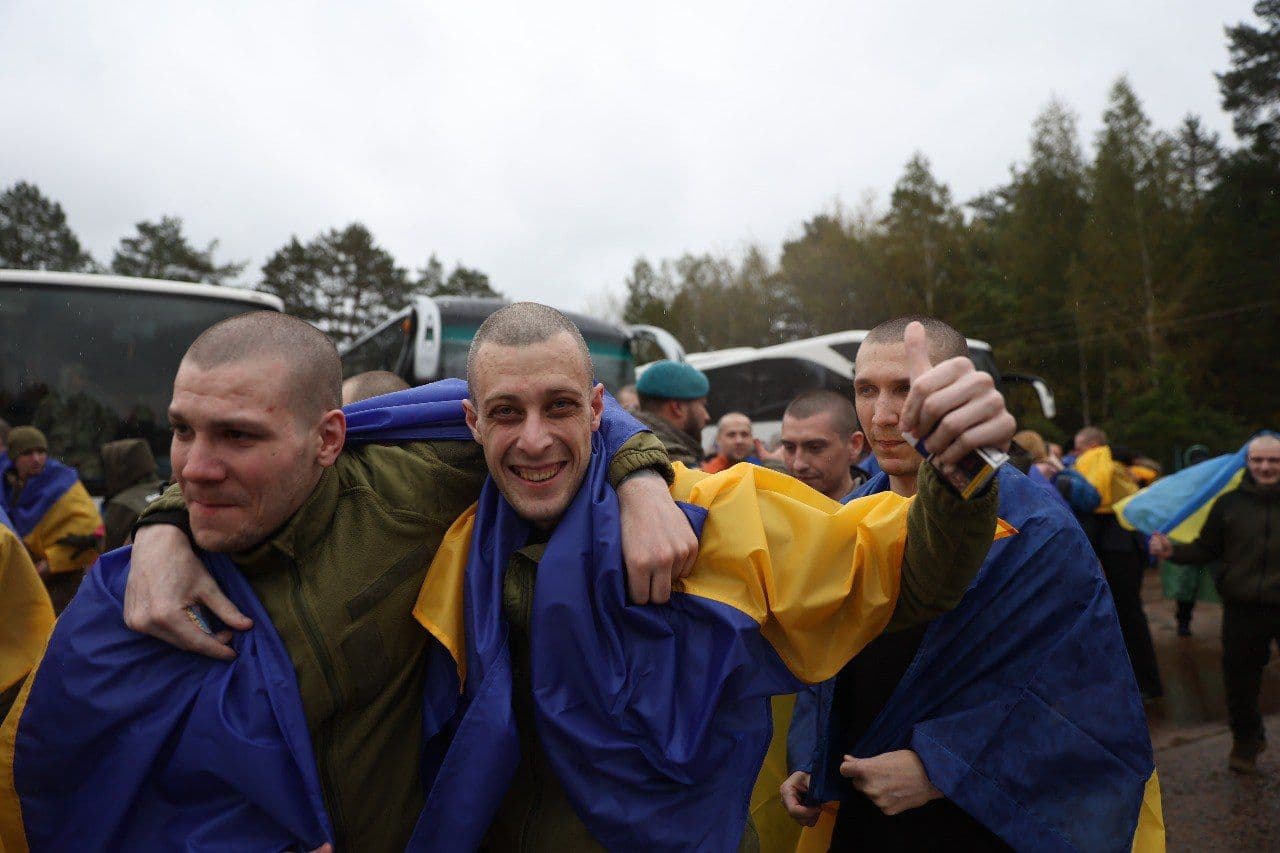
Ukrainians after their release from Russian captivity. (President Volodymyr Zelensky/Telegram)
The Battlefield Reality: Grinding Forward
While politicians made threats and exchanged prisoners, the actual war continued its grinding progression across multiple fronts. Russian forces advanced in some areas, Ukrainian forces in others, both sides paying in blood for meters of territory.
In northern Kharkiv Oblast, Russian forces pushed west of the Vovchansk Oil Extraction Plant, advancing through the northwestern part of the city. Ukrainian Northern Group Spokesperson Vadym Mysnyk reported that poorly trained Russian infantrymen continued daily assaults with simple objectives: seize a single building, claim an industrial zone, produce footage exaggerating their progress.
Near Lyman, both sides gained ground. Ukrainian forces advanced in northeastern Yampil while Russian forces pushed into other parts of the same village and into central Shandryholove. The see-saw battle for these small settlements illustrated the war’s essential character—constant movement producing minimal strategic gain.
Russian forces entered the Donetsk Metallurgical Plant north of Siversk, though it remained unclear whether they could hold the position. In the Pokrovsk direction, Russian troops advanced east of Balahan. Near Novopavlivka, they pushed into central Zelenyi Hai.
The most significant Ukrainian success came in the Dobropillya tactical area, where Ukrainian forces liberated Dorozhnie. Commander-in-Chief Oleksandr Syrskyi reported Ukrainian forces had established control over 2.2 square kilometers and conducted “shock and search” operations to clear three additional square kilometers. Ukrainian advances ranged from 100 to 1,400 meters in different areas. In total, Ukraine had now liberated 177.8 square kilometers and cleared 198.9 square kilometers in the Dobropillya tactical area.
Yet even these gains came with caveats. Russian forces continued infiltration attempts, using small infantry groups to probe Ukrainian defenses. Weather conditions—rain, fog, the approaching fall—degraded drone performance but hadn’t yet significantly altered Russian tactics. Ukrainian military observer Kostyantyn Mashovets reported that Russian forces had concentrated 80,000 to 90,000 personnel in the Lyman direction alone, roughly equivalent to Russian strength in the Pokrovsk direction.
The numbers told a story of a massive, grinding attritional war where neither side could achieve breakthrough but both continued sacrificing personnel for incremental gains.
The Night Sky: 86 Drones and Counting
As darkness fell on October 2, Russia launched another mass drone assault. Ukrainian Air Force reported 86 Shahed-type attack and decoy drones launched from Bryansk, Oryol, Primorsko-Akhtarsk, and Millerovo. Ukrainian air defenses intercepted 53, but 31 reached their targets across six locations.
The civilian toll was immediate and personal. Four people died. Twenty-five were injured. In Kharkiv Oblast, one dead and 15 wounded. In Donetsk Oblast, one killed and one injured. In Kherson Oblast, two more deaths and four injuries after strikes targeted critical infrastructure, damaging an apartment building and ten houses. One person injured in Odesa Oblast where railway infrastructure was hit, leaving 46,600 residents without electricity. Three injured in Sumy Oblast after 118 attacks on 43 settlements.
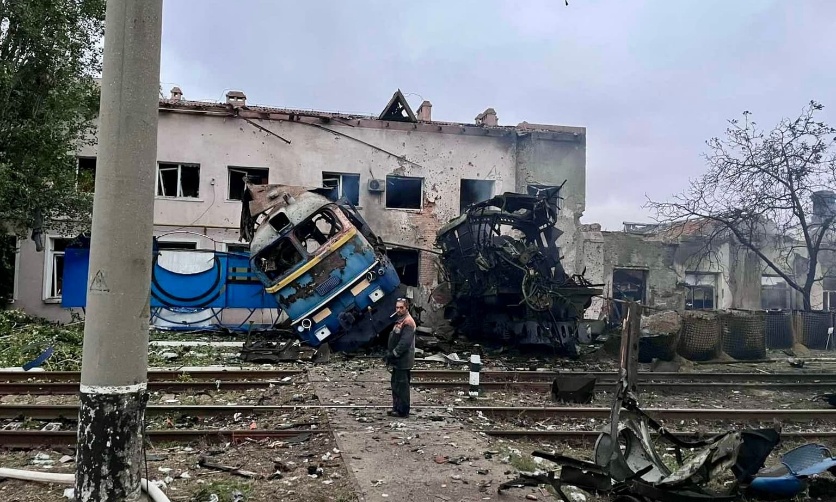
Russia targeted Ukraine’s railway infrastructure in its attack on Odesa Oblast overnight. (Oleksii Kuleba / Telegram)
Commander-in-Chief Syrskyi revealed the scale of Russia’s drone campaign: nearly 6,900 drones launched at Ukraine in September alone, including more than 3,600 Shaheds. Since the start of the full-scale invasion, Russia had launched almost 50,000 Shahed drones at Ukraine, killing more than 250 civilians in drone attacks.
The drone offensive represented asymmetric warfare at its most brutal. Each Shahed cost Russia a fraction of what a cruise missile did, allowing Moscow to launch hundreds per month despite production constraints. Ukrainian air defenses could shoot down many, but not all. The drones that got through hit residential buildings, energy infrastructure, railways—anything that might degrade Ukrainian civilian morale or military logistics.
Ukraine was fighting back with its own drone development. Defense Minister Denys Shmyhal said Kyiv would soon deploy at least 1,000 interceptor drones per day to repel Russian attacks. But that was future promise. On October 2, Ukrainian families sheltered in basements as Russian drones hunted for targets in the night sky.
Europe Fractures: Merz vs. Orbán
While Putin threatened and drones flew, Europe’s internal contradictions exploded into open conflict at an informal EU summit in Copenhagen. German Chancellor Friedrich Merz openly rebuked Hungarian Prime Minister Viktor Orbán for disrupting discussions on the EU’s security needs—a rare public display of the mounting frustration with Budapest’s obstruction.
The clash erupted during talks on the EU’s strategy to defend itself against Russian threats and support Ukraine. Orbán, Trump’s ally and Europe’s most Kremlin-friendly leader, had been blocking sanctions, obstructing aid to Ukraine, and opposing Kyiv’s EU accession. Now Merz had apparently decided that diplomatic patience had run its course.
The confrontation exposed the EU’s fundamental problem: Orbán held veto power over key decisions. Hungary continued buying Russian oil—€416 million worth in August alone, including €176 million in crude oil and €240 million in pipeline gas. Budapest was financing Putin’s war while claiming to pursue European security.
Polish Deputy Foreign Minister Władysław Teofil Bartoszewski made the contradiction explicit in his response to Orbán’s claim that Hungary wasn’t at war with Russia: “Dear Prime Minister, you are financing this war by purchasing Russian oil. This makes you one of only two prime ministers in Europe who are doing so. Please stop doing that—without money, the Russians will not be able to continue the war.”
The other prime minister Bartoszewski referenced was Slovakia’s Robert Fico, whose government also continued relying heavily on Russian fossil fuels and opposed extending EU sanctions. Hungary and Slovakia represented a Russian-aligned bloc within the EU, using their veto power to water down European responses to Moscow’s aggression.
At the summit, EU leaders stalled on a €140 billion Ukraine loan plan tied to frozen Russian assets. Belgium held firm in opposition. France and Luxembourg raised legal concerns. Several leaders backed the idea in principle but called for further legal and fiscal review—the kind of bureaucratic delays that had plagued European decision-making throughout the war.
Orbán’s post-summit statement captured his contrarian position: “They want to hand over EU funds to Ukraine. They are trying to accelerate Ukraine’s accession with all kinds of legal tricks. They want to finance arms deliveries. I will stand firmly by the Hungarian position, but this summit also proves that the coming months will be about the threat of war.”
Polish Prime Minister Donald Tusk cut through Orbán’s rhetoric: “It was Russia that had started the war against Ukraine. In such a time the only question is whose side are you on.”
The question hung in the air, unanswered by Budapest.
Zelensky’s Copenhagen Mission: Drones and Diplomacy
While European leaders argued, Zelensky arrived in Copenhagen for the European Political Community summit. His presence carried particular significance given Denmark’s recent security concerns—a series of mysterious drone sightings that had temporarily shut down airports and prompted joint counter-drone exercises with Ukrainian military specialists.
“Today, Europe is indeed facing this threat from drones and unmanned aerial vehicles,” Zelensky told journalists. “Ukraine has relevant experience due to the war. Of course, we will not stand aside.”
The offer represented a remarkable role reversal. Ukraine, the country under invasion, was now providing security expertise to wealthy European nations confronting Russian hybrid warfare. Ukrainian specialists who had spent years defending against Russian drone attacks were teaching Danish forces how to detect, track, and neutralize aerial threats.
Zelensky’s meetings in Copenhagen went beyond drones. He thanked Norwegian Prime Minister Jonas Gahr Støre for Norway’s continued support—$8.5 billion in aid in 2025 alone. He discussed strengthening air defense with German Chancellor Merz, including the supply of Patriot systems and the potential use of frozen Russian assets for Ukraine’s defense and reconstruction. He met with Danish Prime Minister Mette Frederiksen to coordinate responses to the drone threat.
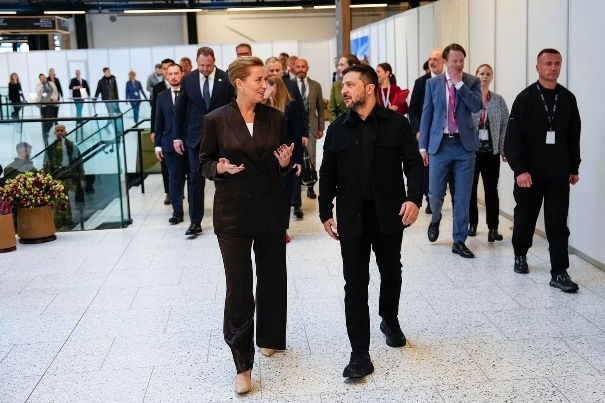
Denmark’s Prime Minister Mette Frederiksen (L) meets with President Volodymyr Zelensky (R) prior to a meeting of the European Political Community (EPC) Summit in Copenhagen. (Mads Claus Rasmussen/AFP via Getty Images)
The Copenhagen summit occurred as Ukraine completed bilateral screening for EU accession—a technical but significant step forward. Zelensky urged leaders to open the first negotiating cluster for Ukraine and Moldova, pushing forward with integration even as Russia tried to bomb Ukraine into submission.
The scene captured the war’s paradox: Ukraine fighting for survival while simultaneously helping Europe defend itself, seeking EU membership while its cities faced nightly bombardment, providing counter-drone training while its own territory remained under attack.
The Missile Problem: When Patriots Stop Working
The Ukrainian Air Force on October 1 reported troubling numbers: four Iskander-M ballistic missiles launched overnight had all reached their targets. Complete penetration. Zero interceptions.
The statistics reflected a growing crisis. Ukraine’s Patriot air defense systems—the only weapons capable of downing Russian ballistic missiles—were becoming less effective. The Financial Times published a report on October 2, citing current and former Ukrainian and Western officials, revealing that Russia had modified its missiles to evade Patriot interception.
The modifications focused on the Iskander-M and Kh-47M2 Kinzhal missiles. Both now followed normal trajectories before suddenly veering off course or diving steeply—maneuvers designed to confuse Patriot interceptors. Ukraine’s interception rate had collapsed from 37 percent in August to just 6 percent in September.
For Ukraine, this represented a fundamental vulnerability. Without effective ballistic missile defense, critical infrastructure—power plants, defense factories, command centers—became exposed to Russian strikes. The modified missiles could reach targets that had previously been protected, shifting the strategic balance in Russia’s favor.
The General Speaks: Hnatov’s Assessment
In a rare, wide-ranging interview published October 2, Major General Andriy Hnatov provided unusual candor about the Ukrainian military’s challenges and progress. As Chief of the Army General Staff since March, Hnatov represented the new generation of Ukrainian military leadership—younger officers with extensive combat experience replacing an older generation.
“If you compare the situation when I was a young officer and joined the army—what the communication was like, what the relationships were like—then I can tell you that we have finished a marathon,” Hnatov said. “I believe that now both the leadership and the units are quite open, and we speak openly about successes and failures.”
The honesty was striking. Hnatov acknowledged that negative situations arose periodically—enemy strikes causing casualties, crimes committed by servicemembers—and that pretending the armed forces were an ideal organization was naive. Many Ukrainian soldiers had been civilians until recently, engaged in various activities before putting on uniforms. They didn’t become ideal soldiers overnight.
The Ukrainian military numbered around 800,000 personnel, with about 600,000 deployed against Russian forces. Recruitment met quotas, allowing force strength maintenance. A relatively stable front had permitted increasing basic training from 30 to 51 days, followed by 14 additional days at receiving units.
Training priorities reflected frontline reality: marksmanship, first aid, field entrenchment, land navigation, weapons systems, electronic warfare, and defense against drones. “It is very important that a serviceman knows how and is not afraid to fight against air targets of various types,” Hnatov explained, “that he can correctly choose a position, equip it, camouflage himself.”
The military was fielding dedicated assault infantry units—a relatively recent development. These units, trained specifically for attacking defensive positions like trenches and fortified villages, required high physical and mental standards. The first sizable formations—regiments of around 1,000 men—had reached battlefields only in spring 2025, generally succeeding at assigned missions in Kursk and Donetsk regions.
Hnatov supported increased pay for high-risk specialties like assault infantry and commandos, with compensation linked to danger and complexity. An F-16 pilot who required extensive training and met stringent health requirements should earn more than personnel performing less complex tasks.
The interview revealed an organization learning to acknowledge imperfections while improving combat effectiveness—not the propaganda image of invincible defenders but the reality of an army adapting to the demands of modern warfare.
Airspace Shutdown: Munich’s Drone Mystery
Munich Airport suspended operations the evening of October 2 after reports of suspicious drone sightings in the area. German air traffic control restricted and then suspended flight operations shortly after 10 p.m. local time, grounding 17 flights and affecting nearly 3,000 passengers. Fifteen arriving flights were rerouted to Stuttgart, Nuremberg, Vienna, and Frankfurt.
The incident followed a series of mysterious drone sightings across European airspace in recent days. Oslo Airport and Copenhagen Airport had both been temporarily shut down as precautions. An unidentified drone had been observed flying over the Norwegian Equinor-operated Sleipner gas field in the North Sea on September 29, followed by another drone over Bronnoysund Airport the next day.
Germany itself had experienced multiple drone incidents. Police in Rostock reported sightings of large quadcopters near the seaport on September 29. Authorities in Schleswig-Holstein reported multiple drone sightings overnight on September 26. Der Spiegel reported on October 1 that those drones may have been surveilling critical infrastructure.
The pattern was unmistakable: unidentified drones appearing near airports, seaports, and critical infrastructure across NATO territory. The Munich closure added Germany’s busiest aviation hub to a growing list of European facilities disrupted by aerial intrusions of unknown origin.
Ukraine’s Foreign Ministry announced October 2 that it was severing diplomatic relations with Nicaragua, citing Managua’s recognition of Crimea and four partially occupied Ukrainian regions as part of Russia.
“Ukraine announces the severance of diplomatic relations with the Republic of Nicaragua,” the statement declared, condemning Nicaragua’s “unfriendly acts.”
Nicaragua had signaled support for Russia’s claims over Ukrainian territories earlier in 2025. The Central American nation had opened an honorary consulate in Simferopol, Crimea, in 2020, prompting Ukrainian parliamentary sanctions. Nicaraguan officials had signed trade and economic cooperation agreements with Russian-installed authorities in occupied Crimea.
Nicaragua regularly joined Belarus and North Korea in supporting Russia at the United Nations, voting against resolutions critical of the Kremlin. Managua’s formal recognition of Russia’s illegal annexations represented the next logical step in this alignment.
Foreign Minister Sybiha’s response captured Ukrainian frustration: “Ukraine will continue to react as harshly as possible in response to any attempts to encroach on its sovereignty and territorial integrity. We will not tolerate any encroachments on our statehood.”
The diplomatic rupture was largely symbolic—Ukraine and Nicaragua had minimal bilateral relations—but it reflected broader geopolitical alignments. Russia was building a coalition of pariah states willing to legitimize its territorial conquests in exchange for Moscow’s support on the international stage.
Moscow’s New Terminators: More Armor, Same Vulnerability
Uralvagonzavod, Russia’s tank manufacturing subsidiary, announced on October 2 that it had delivered the final consignment of upgraded Terminator BMP-T armored combat vehicles under its contract with Russia’s Ministry of Defense. The company released footage showing five new vehicles being moved on flatbed railcars.
The latest Terminators supposedly incorporated enhanced protection based on combat experience in Ukraine: additional explosive reactive armor, reinforced side protection, electronic warfare systems, and anti-drone measures. The footage showed vehicles fitted with front and rear mounted anti-drone mesh screens and metal spikes.
“UVZ designers are constantly working to improve the characteristics of the tank support vehicle, taking into account combat experience,” a spokesperson said. “The focus is mainly on enhancing protection.”
The Terminator was designed to support tanks and other armored vehicles in urban combat after Russian forces suffered catastrophic losses in Chechnya. Built using T-72, T-90, or T-14 Armata tank chassis, it mounted four anti-tank missile launchers, two 30mm autocannons, two grenade launchers, and a machine gun.
Yet the vehicle’s actual combat record in Ukraine told a different story than the manufacturer’s marketing. At least five Terminators had been destroyed or severely damaged by early 2025—a significant portion of those deployed. The vehicles proved particularly vulnerable to Ukrainian drones and artillery strikes. The additional armor and anti-drone screens represented Moscow’s attempt to fix problems that combat had brutally exposed.
The G7’s Warning: Oil Sanctions Coming
The G7 finance ministers issued a joint statement pledging to “maximize pressure” on Russia and target countries that continued increasing purchases of Russian oil. The move built on Trump’s earlier threat to impose sanctions if NATO members stopped buying Russian energy.
“We will target those who are continuing to increase their purchase of Russian oil since the invasion of Ukraine and those that are facilitating circumvention,” the statement read. Member states were working on “significant and coordinated measures” to reduce and eventually phase out remaining Russian hydrocarbon imports.
The ministers were “giving serious consideration” to imposing trade restrictions and sanctions on countries helping finance Moscow’s war through oil purchases. While the statement didn’t name specific countries, China and India were Russia’s top oil buyers.
Energy exports accounted for roughly one-third of Russia’s federal budget. Cutting off that revenue would directly impact Moscow’s warfighting capacity. Yet three years into the war, Russian oil still flowed freely to major economies, generating hundreds of billions in revenue.
The G7 statement represented incremental escalation rather than immediate action—a warning of future measures rather than sanctions imposed today. The question was whether warnings would translate into enforcement or remain diplomatic theater designed to appear tough while avoiding economic costs.
The Day’s Meaning: Threats Without Resolution
October 2, 2025, crystallized the war’s current phase. Putin threatened nuclear catastrophe while Trump quietly approved intelligence sharing. Russia modified missiles to evade Patriot defenses while Ukraine liberated villages meter by meter. European leaders quarreled in Copenhagen while Russian drones struck Ukrainian cities. Prisoners came home while thousands more remained in captivity.
The day revealed the war’s essential character three years in: grinding attrition punctuated by escalatory threats, tactical adaptations countering strategic stalemate, diplomatic ruptures alongside continued negotiations. Neither side could achieve breakthrough, but neither would accept defeat.
Putin’s nuclear threats represented desperation masked as strength—the threats of a leader whose conventional military couldn’t achieve victory but retained the power to threaten catastrophe. Trump’s intelligence sharing showed America’s continued involvement despite public ambiguity. Merz’s confrontation with Orbán exposed Europe’s internal contradictions. The prisoner exchange proved that even bitter enemies could cooperate when necessary.
The battlefield told the truest story. Ukrainian forces advanced in Dobropillya. Russian forces pushed forward near Kupyansk and Siversk. Both sides suffered casualties for meters of territory. Drones filled the night sky. Civilians died in their homes. Soldiers returned from captivity to a country still fighting.
The question wasn’t whether the war would end on October 2—it wouldn’t. The question was whether the accumulated weight of these daily developments would eventually shift the strategic balance. Putin’s threats, Trump’s approvals, European fractures, missile modifications, prisoner exchanges, and grinding advances—each represented small movements in a conflict that had long since moved beyond quick resolution.
The underground war of 2022 had become the attritional war of 2025. On this October day, that reality was inescapable.