
When Crimea burned, Russia dropped its mask, NATO mocked a broken submarine, and nuclear threats turned a long war into its most dangerous phase yet.
The Day’s Reckoning
October 13, 2025, dawned in fire and ended in fear. Over Crimea, the night sky turned orange as Ukrainian drones ignited vast oil depots, their flames rolling across the Black Sea like a warning flare. By evening, Moscow’s threats of nuclear reprisal were echoing through embassies and press briefings. In between those bookends of blaze and bluster, Russia’s great illusion finally cracked. The Kremlin admitted what the world had long known—that its “special military operation” was a war in all but name—and announced it would send reservists to Ukraine.
Across Europe, the echoes deepened. Germany’s intelligence chief declared that the continent was already “under fire,” describing a quiet war of sabotage, drones, and disinformation that no longer needed to wait for tanks. In Brussels, European diplomats met in a building still scarred by Russian missiles, pledging billions more in aid even as they warned that the Kremlin’s aggression threatened all of Europe. And in Slovenia, NATO’s new Secretary General turned laughter into a weapon, openly mocking a crippled Russian submarine as it limped home—a moment of ridicule that carried the sting of truth about Moscow’s fading power.
It was the 1,328th day of a war that no longer fit its opening script. The battlefield had stretched far beyond trenches and towns; drones now hunted 250 kilometers behind the lines, and the weapons once whispered about in Cold War novels had become bargaining chips in real diplomatic games. The day stripped away every pretense. Russia was digging in for a long war it could not afford, Europe was already fighting one it never wanted to name, and the space between what leaders said publicly and feared privately had never felt so wide.
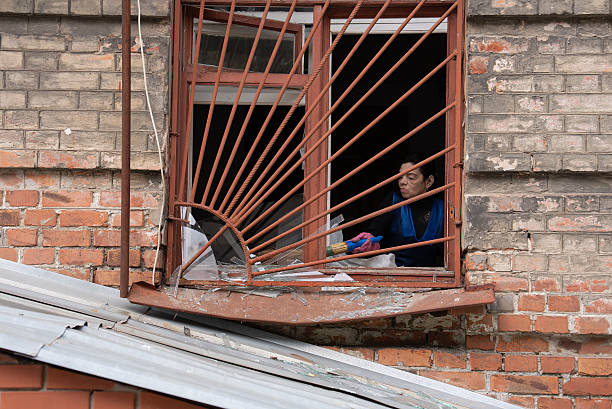
A university worker clears debris near a damaged building after a Russian drone strike in Kharkiv. At approximately 9:45 a.m., a Russian FPV drone struck central Kharkiv, hitting a university dormitory that housed displaced persons from Kupiansk. (Oleksandr Manchenko/Suspilne Ukraine via Getty Images)
Fire Over Feodosia: When Crimea Burned Again
The night sky over Feodosia turned the color of molten copper before dawn. From the cliffs above the Black Sea, residents could see the flames blooming over the harbor—Ukraine’s largest strike on Crimean oil infrastructure in months. Around midnight, waves of drones swept in low over the water, finding their marks with surgical precision. Within moments, at least five massive storage tanks at the Feodosia Offshore Oil Terminal were engulfed, sending columns of black smoke twisting above the occupied city.
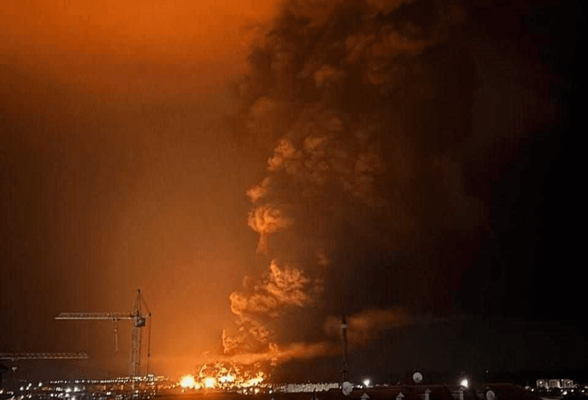
A fire burns at the Russian oil depot in Feodosia, occupied Crimea. (SBU)
By sunrise, the scale of destruction was clear. According to Ukraine’s Security Service, eleven fuel tanks were hit: eight packed with diesel—each holding between 5,000 and 10,000 metric tons—two filled with gasoline, and one empty. The fire wasn’t just devouring fuel; it was consuming Russia’s ability to sustain its army. Every liter that burned was a liter that wouldn’t move tanks, trucks, or aircraft across southern Ukraine.
The Feodosia terminal was no ordinary target. Sitting 250 kilometers from Ukrainian-controlled territory, it was Crimea’s largest oil storage hub, capable of holding 250,000 tons of fuel. Rail tankers, sea vessels, and trucks all converged there—a logistical heart pumping energy through the peninsula. Even temporary disruption sent shockwaves through Russia’s military supply chain.
The night’s strikes didn’t end with the depot. Two major substations also went dark: a 220-kilovolt site in Feodosia and a 330-kilovolt installation near Simferopol. The pattern was unmistakable—this was no random destruction but a deliberate attack on the power and fuel arteries that kept the occupation running.
Sergei Aksyonov, Moscow’s occupation chief in Crimea, confirmed the attack with his usual mix of bravado and denial. Drones had hit the oil depot and caused fires, he admitted—but “no casualties,” he claimed, downplaying what satellite images soon made impossible to hide. The silence between his lines said what Russia could not: Ukraine’s reach had grown long, its strikes more precise, and Crimea was no longer untouchable.
Moscow’s Defense Ministry boasted that air defenses shot down 103 drones overnight, forty of them over Crimea. Yet the fires told another story. If so many were intercepted, how had the depot burned for hours? Either Russian defenses were failing, or Ukraine had launched enough drones to overwhelm even strong interception rates. In truth, both were probably correct.
This was the second strike on Feodosia in a week—a deliberate return to the same target to ensure it stayed crippled. Ukraine’s strategy was clear now: not a single, spectacular blow, but steady, suffocating pressure. Each new strike forced Russia to spend more on defense and repair, less on attack. The message rising with the smoke over Crimea was unmistakable—Ukraine would keep coming back until the lights went out for good.
The Reservist Reality: When Peacetime Ended
It began quietly — a signature on a document in Moscow that ended one of the last remaining fictions of this war. The Kremlin approved a draft law that finally called things by their real names: reservists could now be sent to Ukraine. The “special military operation” had become, in legal terms, an open-ended war.
Inside the Duma, Defense Committee Chair Andrei Kartapolov tried to frame it as routine procedure, but his words betrayed the truth. The new law would allow Russia to deploy reservists “outside Russian territory” — including, he said pointedly, in Ukraine’s Sumy and Kharkiv oblasts. The phrasing revealed the lie at the heart of Moscow’s empire: claiming annexation while admitting it didn’t control the land.
The attached note to the legislation made the shift unmistakable. Reservists could now be used “during peacetime.” For three years, Russia had insisted that it wasn’t at war, that mobilization wasn’t necessary, that the conflict was limited and controlled. This law ended the pretense. The army was running out of men, and the Kremlin needed a mechanism to force more into uniform — without calling it mobilization.
For Putin, it was a political balancing act. He could avoid the unpopular mass call-up that had sent a million Russians fleeing in 2022 while still replenishing ranks drained by years of fighting. These “reservists” would receive up to two months of so-called training before being deployed straight to combat. It was mobilization in everything but name.
Across Russia, the implications rippled through kitchen conversations and factory floors. Anyone who had once served could now be summoned again. The illusion that the war might never reach them was gone. A conflict once sold as brief and bloodless had become a national obligation — and the men who thought their soldiering days were long behind them suddenly found themselves waiting for the knock on the door.
Europe Under Fire: Germany’s Wake-Up Call
The warning came not from the frontlines but from Berlin — quiet, precise, and unmistakably grim. Before a panel of lawmakers, German intelligence chief Martin Jäger set aside diplomatic restraint. “We can’t simply wait and assume a Russian attack won’t come before 2029,” he said. “We’re already under fire today.”
He wasn’t speaking in metaphors. Across Europe, the symptoms were already visible: drones over airports in Denmark, Norway, and Germany; cyberattacks slicing through energy grids and transport networks; mysterious explosions at depots and factories; disinformation seeping into elections. To Jäger, this wasn’t preparation for war — it was war, just waged in quieter, more corrosive ways.
Moscow’s methods were deliberate. It probed air defenses with drone incursions, measured response times, seeded panic through cyber sabotage, and weaponized lies to turn citizens against one another. It was confrontation by a thousand small cuts, calibrated to stay just below NATO’s red line for collective defense.
Poland now described itself as “in a state of war” in the digital realm. Russian aircraft were testing NATO skies with increasing frequency. Each act, taken alone, might seem manageable. Together, they formed a pattern — a slow-motion assault on Europe’s unity and confidence.
Jäger’s message landed like a cold draft through the Bundestag chamber. Those hoping a ceasefire in Ukraine might cool tensions were mistaken. If the guns ever went silent there, the freed Russian divisions would simply pivot westward. The war in Ukraine, he warned, was holding back a greater storm.
Putin, he said, was already conditioning the Russian people for something larger — a conflict that could expand beyond Ukraine’s borders. Europe, Jäger concluded, had to stop treating hybrid warfare as background noise. It was not the prelude to confrontation. It was the confrontation, and it had already begun.
Nuclear Poker: The Tomahawk Trap
The threat came wrapped in ambiguity, the kind of menace Russia has long preferred. Dmitry Medvedev—once president, now provocateur—warned that any launch of American Tomahawk missiles by Ukraine could trigger a nuclear response. His words were carefully shaped for maximum fear. “Russia,” he declared, “is unable to distinguish between Tomahawk missiles armed with nuclear or conventional payloads while they are in flight.” The message was simple: if one flies, no one is safe.
Kremlin spokesperson Dmitry Peskov soon echoed him, insisting that “US specialists would have to participate in Ukrainian Tomahawk strikes” and that “any expert is aware of the consequences.” It was a textbook example of reflexive control—creating dread through suggestion rather than direct threat. Russia wasn’t saying it would use nuclear weapons. It was saying it might, and that was enough to make headlines from Washington to Warsaw.
The shift in tone wasn’t accidental. For days, Moscow’s warnings about Tomahawks had sounded routine—boilerplate outrage over another Western weapon heading to Ukraine. But now, the Kremlin’s rhetoric had sharpened. The focus on nuclear ambiguity marked a new phase in its psychological campaign to stall US arms transfers.
The timing told its own story. Reports had just surfaced that American intelligence was already helping Ukraine plan deep strikes against Russian energy facilities—operations that hadn’t led to any “end of the world” scenario. The revelation made Moscow’s earlier warnings ring hollow. So, the Kremlin raised the stakes, betting that fear of nuclear escalation could still freeze Western resolve.
Peskov called it “a very dramatic moment,” warning that “tensions are escalating from all sides.” He wasn’t wrong about that—but the danger lay more in rhetoric than in readiness. The truth was that modern Tomahawks come in multiple versions, most incapable of carrying nuclear warheads at all. Their flight paths are trackable, their signatures known. Russia’s claim that it couldn’t tell one from another was technically flimsy, but politically useful.
And so, the nuclear poker game continued—Moscow bluffing with threats it couldn’t afford to play, Washington weighing each move as if the next card might bring catastrophe. It was less a standoff of weapons than of nerves, where perception itself had become the most dangerous weapon on the table.
Electoral Engineering: The Governor Sacrifice
The plan was as cold-blooded as it was effective. Independent outlet Meduza exposed the Kremlin’s newest tool for shaping the next election—not policy, not reform, but theater. Sources inside Putin’s political bloc described a strategy to fire unpopular governors before the September 2026 State Duma elections, not to fix problems, but to give voters the fleeting illusion of change.
“Dismissing governors works best right before elections,” one strategist admitted, “so people feel a short burst of positive emotion before voting.” It was manipulation dressed as management—engineered optimism timed to expire at the ballot box. In the Kremlin’s view, citizens weren’t participants in governance but instruments whose moods could be tuned like radio frequencies.
The timing wasn’t random. Across Russia, frustration was rising over higher taxes, inflation, small-business crackdowns, and the grinding war in Ukraine that most citizens were weary of but powerless to end. Local officials took the blame for daily misery—broken roads, failing transport, rising prices—while Moscow remained untouched. The coming purge would turn governors into lightning rods, absorbing public anger so that Putin’s administration could claim to be “listening.”
Behind closed doors, preparations were already underway. New appointees would need months to “learn how electoral resources work in their regions”—a phrase that revealed everything. These weren’t leaders being trained to serve their people but operators being taught how to manage votes, control media, and manufacture results.
The deeper truth was unsettling even to Kremlin insiders. The government knew Russians were exhausted—tired of war, tired of propaganda, tired of promises of negotiation that never came. But instead of ending the war or easing repression, Moscow opted for cosmetics. The governors would fall one by one, each dismissal a staged gesture of accountability, each replacement a mirage of renewal.
The message to the Russian people was clear: nothing would change, except the faces on the billboards pretending that it had.
Kallas in Kyiv: Money, Justice, and Generators
Kaja Kallas arrived in Kyiv with the cold wind of winter already pressing against the city’s broken windows. The EU’s top diplomat came bearing promises — hundreds of millions in aid, millions more for justice — yet even as she spoke, it was clear the gap between Europe’s generosity and Ukraine’s need was widening.
Her message was concrete: ten million euros to establish a special tribunal to prosecute Russia’s crime of aggression, six million for children stolen to Russia and victims of sexual violence, eight hundred million already committed to help Ukraine survive the winter, and another hundred million for generators, shelters, and warm clothing. Each number mattered; each carried hope. But in Kyiv, where Russian missiles had recently plunged entire neighborhoods into darkness, the figures felt smaller than the scale of the threat.
The visit came as Moscow renewed its winter campaign — targeting substations, transformers, and power plants with a precision meant to break not the grid, but the spirit. The new funding acknowledged this cruel calculus. Without massive European investment, Ukraine’s survival through the freezing months would depend not only on soldiers at the front, but on the engineers keeping the lights alive.
Kallas also came with a vision of justice that stretched beyond the battlefield. The tribunal she proposed would go after the architects of the war itself — not just those who carried out atrocities, but those who ordered them. It was, in effect, the first step toward a modern Nuremberg, a signal that aggression itself must have consequences.
At her side, Foreign Minister Andrii Sybiha turned the focus to weapons. He detailed NATO’s Prioritized Ukraine Requirements List — a program allowing nations to purchase U.S. arms for Ukraine. Six countries had already committed funds, seven more had signaled intent, and more than two billion dollars had flowed through the mechanism, including new Patriot and HIMARS systems. Germany, the Netherlands, Canada, Norway, Denmark, and Sweden had signed on, with the Baltic states and several smaller nations ready to follow.
Kallas’s optimism was sincere — “maybe time was once on Russia’s side,” she said, “but it’s shifting to Ukraine now.” Yet even as she spoke, her tone betrayed the tension at the heart of European diplomacy: the will to help versus the fear of going too far. Europe would fund generators and shelters, yes. But Ukraine needed tanks and long-range missiles. Europe would fund a tribunal for future justice. But justice, everyone knew, would wait until victory — and victory still depended on weapons not yet delivered.
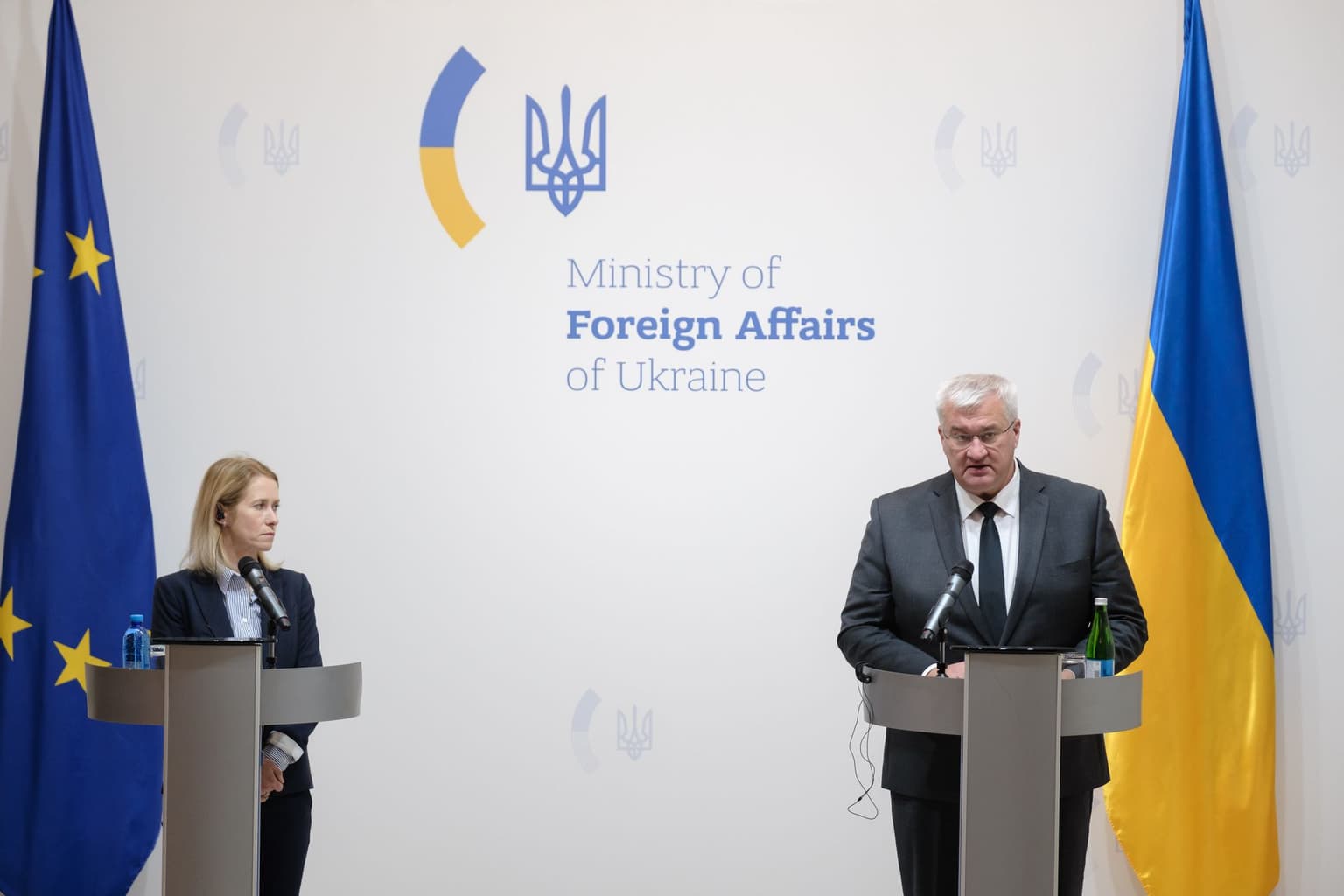
The EU High Representative for Foreign Affairs Kaja Kallas (left) and Ukraine’s Foreign Minister Andrii Sybiha (right) hold a joint press conference in Kyiv. (Vitalii Nosach/Global Images Ukraine via Getty Images)
The Submarine That Couldn’t: NATO’s Mocking Moment
It was the kind of jab that would have been unthinkable during the Cold War — and yet it came with laughter. Standing before an audience in Slovenia, NATO Secretary General Mark Rutte couldn’t resist turning Russia’s latest naval embarrassment into a punchline. “There’s a lone and broken Russian submarine limping home from patrol,” he said. “What a change from The Hunt for Red October. Today, it seems more like the hunt for the nearest mechanic.” The room erupted, but behind the humor lay a quiet message of dominance.
The submarine in question, the Novorossiysk, was supposed to be one of the pride vessels of Russia’s Black Sea Fleet — a diesel-electric attack sub armed with Kalibr cruise missiles and built to project power into the Mediterranean. Instead, it was limping through European waters under NATO’s watch, surfacing where it shouldn’t, unable to finish its mission. The Dutch navy shadowed it closely as it was towed home, the picture of failure broadcast across the alliance.
Moscow tried to save face. The Russian Black Sea Fleet claimed it was a “scheduled inter-fleet transit,” not an emergency. But no one believed it. NATO had tracked the submarine continuously, its condition obvious to every radar operator who saw its slow crawl toward port. This was no patrol — it was a breakdown at sea.
Rutte’s mockery struck deeper than a diplomatic slight. It was a declaration that NATO no longer feared Russia’s military mystique. The alliance knew where Russia’s ships sailed, when they faltered, and how badly they were maintained. In the age of satellites, signals intelligence, and relentless transparency, even a submerged navy could no longer hide its weakness.
For the Kremlin, the sting went beyond pride. The Novorossiysk carried the name “New Russia” — the very term Putin had resurrected to justify his claims over Ukrainian land. Now, that name drifted home under escort, its engines dead, its purpose humiliated. The symbolism was too sharp to miss: what was meant to project Russian power had become an emblem of its decay.
Belarusian Blood: The Hidden Toll
The report landed quietly, but its numbers spoke like a gunshot. The “I Want to Live” project revealed that at least 314 Belarusian citizens had been killed fighting alongside Russian forces — one in every four of the 1,338 Belarusians identified in Russian military units. The figure was partial, incomplete, but devastating. It confirmed what Minsk denied, and Moscow concealed: Belarus was bleeding for Putin’s war.
The toll had already surpassed Belarus’s losses in the decade-long Soviet–Afghan War, which claimed 723 lives. This time, in less than four years, the deaths came faster and deeper, each one tethering Belarus more tightly to a war it officially wasn’t fighting. The pattern was grimly mathematical. The average Belarusian recruit survived six and a half months after signing a Russian contract. The oldest casualty was sixty-three — dead just four months after enlistment. The youngest was eighteen, still listed as missing, his fate written between the lines.
Most had been assigned to the 150th Motorized Rifle Division — a formation infamous among soldiers as a meat grinder. Many others came from Russian prisons, drawn in by the same bargain that had fed Moscow’s war machine since the Wagner days: freedom for the desperate, money for the doomed. They died not as volunteers defending a cause, but as human currency traded for Moscow’s ambitions.
The report also uncovered something more unsettling: Belarusian special forces among the dead. Members of the elite 5th Separate Spetsnaz Brigade from Maryina Horka had quietly joined Russian combat units, a sign of military integration far deeper than Lukashenko admitted. Officially, Belarus remained “non-belligerent.” In truth, its soldiers were dying in Ukraine, its special forces buried alongside Russian troops, and its sovereignty eroding with every coffin flown home.
For Alexander Lukashenko, the findings raised a question he could not answer publicly: when your citizens fight and die in another nation’s war, whose side are you truly on? The data made the answer clear — Belarus’s independence existed now mostly on paper, while its people paid in blood for decisions made in the Kremlin.
The Korea Connection: Technology for Troops
The exchange was as stark as it was dangerous — soldiers for submarines. South Korea’s Defense Minister Ahn Gyu-back revealed that Russia had likely begun transferring submarine technology to North Korea, deepening a partnership that blurred the lines between two wars half a world apart. Pyongyang had already sent thousands of troops to fight in Russia’s Kursk region. Now, in return, Moscow was feeding Kim Jong-un the kind of technology that could shift the balance of power across the Pacific.
Ahn spoke carefully, mentioning only “various technologies” for submarine development. But his caution could not hide the implications. North Korea has long sought nuclear-powered vessels and submarine-launched ballistic missiles — weapons capable of threatening South Korea, Japan, and U.S. forces from beneath the sea. Even limited Russian assistance — blueprints, propulsion data, or missile integration — could shorten Pyongyang’s path to deploying a fleet that would haunt Asia’s waters for decades.
Whether those missiles had been tested yet remained unclear, but the uncertainty itself was chilling. Each month of Russian collaboration brought North Korea closer to a new kind of reach, one that could fire from the depths rather than from the pad.
The partnership was born of desperation on both sides. Moscow needed manpower — expendable bodies to throw into Ukraine’s killing fields without draining its own population. North Korea needed everything: food, fuel, foreign currency, and the validation of being courted by a major power. It was a grim barter — North Korean soldiers’ lives traded for Russian submarine secrets.
For Seoul and Tokyo, the stakes were existential. Every North Korean platoon deployed to Ukraine freed Russian troops to fight elsewhere, while every Russian data file shared with Pyongyang tightened the noose around the Pacific. The wars in Eastern Europe and East Asia were no longer separate stories — they were becoming chapters of the same unfolding confrontation.
Nuclear Theater: NATO’s Steadfast Message
In the skies over northern Europe, the message was impossible to miss. Seventy aircraft from fourteen nations rose into formation for NATO’s Steadfast Noon exercise — a routine drill, the alliance insisted, “not linked to current world events.” But in a week when Moscow was again waving the nuclear card over Tomahawk missiles, no one believed the timing was accidental.
F-35 fighters, surveillance planes, refueling tankers, and command aircraft crisscrossed the Netherlands and Denmark in a precise choreography of deterrence. No live nuclear weapons were used — and that was the point. NATO was demonstrating that it could train for the unthinkable while maintaining perfect control, the opposite of the reckless nuclear theater now emanating from Moscow.
About 2,000 personnel took part, with Dutch F-35s playing a central role. Volkel Air Base in the Netherlands served as the main hub, while Skrydstrup Air Base in Denmark supported operations. The Netherlands’ leadership was symbolic: its pilots had been integral to NATO air defenses since the start of the war and its government among the most vocal supporters of Ukraine.
Jim Stokes, NATO’s director of nuclear policy, emphasized transparency — a rare word in the world of nuclear deterrence. “We promote transparency when and where appropriate,” he said, “so that our populations and the wider world understand what we are doing.” The subtext was clear: NATO wanted stability, not panic, even as Russia’s rhetoric grew more erratic.
Mark Rutte framed it more bluntly. The exercise, he said, “sends a clear signal to any potential adversary that we will and can protect and defend all allies against all threats.” The line was aimed squarely at Moscow, which that same week claimed it couldn’t tell nuclear and conventional Tomahawks apart “in flight.”
The contrast could not have been sharper. While Russia conjured fear through threats and ambiguity, NATO was answering with discipline and demonstration — a reminder that true deterrence rests not in bluster, but in readiness.
Zelensky’s Washington Journey: Selling Security
For Volodymyr Zelensky, diplomacy has always been part performance, part endurance test — and his next act would unfold in Washington. The Ukrainian president confirmed he would soon meet Donald Trump at the White House, in what could become the most consequential conversation of the war. The stakes were measured not in protocol, but in missiles.
Trump had been publicly weighing the idea of sending Tomahawk cruise missiles to Ukraine, even as he hinted at pushing Putin toward negotiations. For Zelensky, that contradiction was both opportunity and danger. He needed to turn Trump’s instinct for deal-making into actual support without triggering fears of escalation.
“The phone calls were not enough to discuss all key topics,” Zelensky said, choosing his words carefully. Two recent conversations had covered air defense and long-range strike capabilities, but phone diplomacy could only go so far. He needed Trump in the room — where tone, persuasion, and persistence could do what press releases could not.
An advance delegation led by Prime Minister Yuliia Svyrydenko had already arrived to prepare what Kyiv was calling the Mega Deal — a sweeping proposal to acquire new air defense systems and HIMARS rockets through a mix of funding sources. Zelensky’s team framed it not as aid, but as business — a series of “mutually beneficial steps” designed to appeal to Trump’s transactional worldview.
Trump, when asked aboard Air Force One if he would host the meeting, offered his trademark casual affirmation: “I think so, yeah.” Behind the simplicity of that answer lay a decision that could alter Ukraine’s future. Would the United States provide weapons capable of reaching deep into Russia — or hold back in the name of avoiding escalation?
The Tomahawk question dominated the background. Trump wanted to know how Ukraine intended to use them. He didn’t want a broader war, but he did want to appear decisive — a balance that had frustrated U.S. allies before. Zelensky, for his part, needed to argue that giving Ukraine longer reach would shorten the conflict, not widen it. Tomahawks, he would say, were not escalation — they were leverage.
The Mega Deal offered creative pathways: financing through frozen Russian assets, NATO’s PURL procurement system, or direct purchase arrangements that avoided the optics of open-ended aid. Each option gave Trump political cover to act without appearing to give.
Trump’s own words only raised the temperature. He promised to “focus on Russia first” once he achieved peace in Gaza — a statement that made Ukraine’s appeal both urgent and precarious. Zelensky’s task was to convince a dealmaker that the surest peace was the one won from strength — and that every day without those weapons came at the cost of lives.
The Frontline Grind: Where Geography Is Measured in Meters
While diplomats debated missiles and nuclear brinkmanship, the war’s true face was etched in mud and blood — along a front where progress was measured not in kilometers, but in meters. Across the eastern battlefields, Russian forces pushed forward again, inch by inch, trading lives for ground in a war that had long since ceased to obey logic.
In Sumy Oblast, a Ukrainian reconnaissance scout described what soldiers now call “the kill zone” — the strip of land so saturated with drone and artillery fire that movement itself became an act of suicide. Russian infantry advanced in small, scattered groups, often without armor, sometimes riding hastily modified vehicles to close distance faster before being swallowed by explosions. Their heavy equipment was largely gone, consumed by three years of attrition that no new production could replenish. Yet they kept coming, sent forward to die so others might crawl a few meters farther.
That grim arithmetic defined the eastern front. The defenders still held better ground, but numbers told their own story — Russia’s command was willing to accept impossible casualty ratios for marginal gains, and over time, that persistence wore away positions like erosion wearing down stone.
Farther north, in Kharkiv, the war found a new angle of terror. A Russian first-person-view drone struck a school dormitory in the city’s central district — the first such attack to reach the heart of Kharkiv itself. Investigators concluded it had likely been carried in by a “mothership” drone, a larger craft that released the smaller kamikaze device near its target. The tactic extended Russia’s lethal reach beyond artillery range, forcing Ukrainian air defenses to confront a new, fast-evolving threat.
In Donetsk Oblast, the pattern remained brutally familiar. Russian troops pressed attacks near Lyman and Pokrovsk, hurling newly mobilized men — some captured only two weeks after being pulled from civilian life — into fortified Ukrainian lines. Their commanders mixed desperation with ritual: heavy armor in the background, infantry waves up front, and losses accepted as inevitability. Each advance gained a few dozen meters, then stalled in blood.
Still, Ukraine struck back. Verified footage showed Ukrainian units retaking ground in Shcherbynivka, south of Kostyantynivka, and liberating Shcherbaky west of Orikhiv in Zaporizhzhia Oblast. Ukrainian troops were also seen consolidating partial control of Stepove — territory Russian propagandists had already claimed as secured.
Yet the map barely shifted. In Zaporizhzhia, a single Russian missile obliterated a civilian car, killing two people — another reminder that in this war, even far from the trenches, life itself had become part of the casualty ledger.
Day after day, the pattern repeated: Russia attacking, Ukraine countering, both sides bleeding for ground so small it could be walked in seconds. For generals, the challenge was no longer victory, but endurance. For soldiers, it was survival in a landscape where every meter of soil was bought with the weight of human lives.
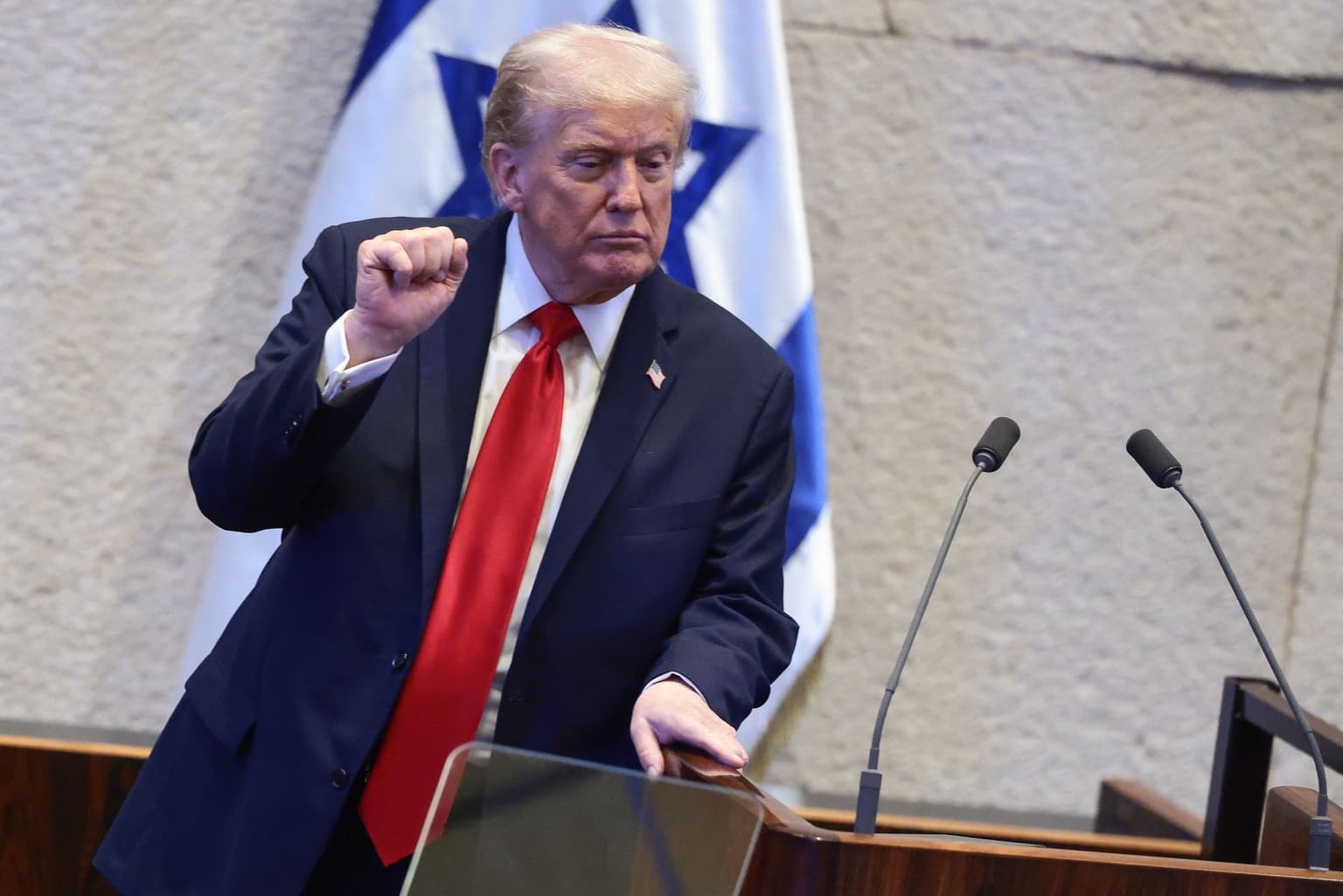
U.S. President Donald Trump delivers remarks to the Knesset, Israel’s parliament, in Jerusalem. (Evelyn Hockstein/Pool via Getty Images)
Trump’s Witkoff Revelation: The Undiplomatic Diplomat
Donald Trump’s address to Israel’s Knesset was meant to celebrate peace — instead, it offered a window into his unconventional style of diplomacy. With characteristic flair, Trump told lawmakers a story about his special envoy to Russia, real estate magnate Steve Witkoff — a story that, unintentionally, revealed just how improvisational his approach to Moscow really was.
“I set up a meeting for him to meet with President Putin, thinking it would be a 15- or 20-minute meeting,” Trump said, smiling at the memory. “Steve had no idea about Russia, had no idea about Putin too much, didn’t know too much about politics, wasn’t too interested.” The remark drew laughter from the chamber — but behind the humor was something deeper: a president openly admitting he had sent an untrained negotiator to meet one of the world’s most seasoned intelligence operatives.
Trump explained that Witkoff “was really good at real estate” and possessed “that quality I was looking for,” though he didn’t define what that was. He described his surprise when the meeting stretched to five hours, calling repeatedly to see if it had ended. “I said, ‘What the hell were you talking about for five hours?’” Trump recounted. “And he said, ‘Just a lot of interesting things.’” The audience laughed again, but the vagueness spoke volumes — no policy notes, no briefings, no details about what was discussed.
Trump insisted that Witkoff’s charm was his greatest asset. “Everybody loves him,” he said. “They love him on this side, they love him on the other side.” To Trump, being likable — even to Putin — mattered more than deep knowledge of NATO or Ukraine. “Most people I’d send in, the meeting would last five minutes,” he quipped.
But behind the anecdote lay a serious critique echoed by foreign policy observers. Witkoff, a property developer with no diplomatic background, had met with Putin several times — often without policy advisors present and sometimes using Kremlin translators. U.S. officials were left guessing what promises, if any, had been made. For a leader like Putin, trained to exploit uncertainty, such encounters were less diplomacy than opportunity.
Trump’s story came just as he declared that having achieved peace between Israel and Hamas, it was now “time to focus on Russia.” The irony was unavoidable: while Middle East negotiations had relied on experienced diplomats and structured talks, the Russia outreach appeared to hinge on personality — a private businessman chatting with an ex-KGB officer for hours about “interesting things.” What was meant as a lighthearted story had instead revealed the peril of diplomacy conducted by instinct rather than understanding.
The Day’s Reckoning: When Fictions Collapsed
By nightfall, the illusions had crumbled. Russia’s new reservist law admitted the obvious — this was war, not a “special operation.” Its nuclear bluster over Tomahawks signaled fear of what those weapons might mean. Even its plan to fire governors showed a regime trying to manage emotions, not victory.
In Kyiv, Kaja Kallas offered Europe’s best — hundreds of millions in aid, promises of justice — yet the gap between survival and victory remained wide. Generators would keep Ukraine alive, but only weapons could end the war.
Rutte’s mockery of a broken Russian submarine captured the day’s irony: Moscow’s military was decaying, yet still deadly. And far from the front, Belarusian and North Korean troops were dying for Russia, proof that the war had become global in reach if not in name.
Zelensky prepared to face Trump, hoping to turn interest into action. He would argue that stronger weapons could force peace faster — a delicate case to make before a man who valued instinct over expertise. Trump’s own tale of sending an untrained envoy to meet Putin underlined that improvisation still defined U.S. strategy.
The day ended as it began — with fire over Crimea, threats from Moscow, and aid that never quite matched need. Everyone admitted more than they intended: Russia that it was desperate, Europe that it was under fire, America that it was improvising. Only Ukraine, exhausted yet unbroken, stayed brutally honest — fighting on because stopping still meant dying.