
September 9, 2025: The morning Polish fighter jets opened fire on Russian drones, the war in Ukraine transformed from a regional conflict into something far more dangerous
On a gray Tuesday morning in September 2025, Maria Kowalski was brewing her morning coffee in Warsaw when air raid sirens began wailing across Poland’s capital. Within hours, Polish and Dutch F-35 fighters had shot down Russian military drones—the first time since World War II that NATO forces had directly engaged Russian military assets in combat.
Meanwhile, 800 kilometers to the east, 82-year-old Petro Marchenko stood in line at the post office in Yarova village, waiting to collect his monthly pension of 3,000 hryvnias—about $80. At precisely 11 a.m., a Russian missile ended his life and those of 23 other Ukrainian pensioners in what officials called “pure terrorism.”
This is the story of September 9, 2025—the day when two parallel dramas unfolded that would reshape the war in Ukraine and possibly the future of European security.
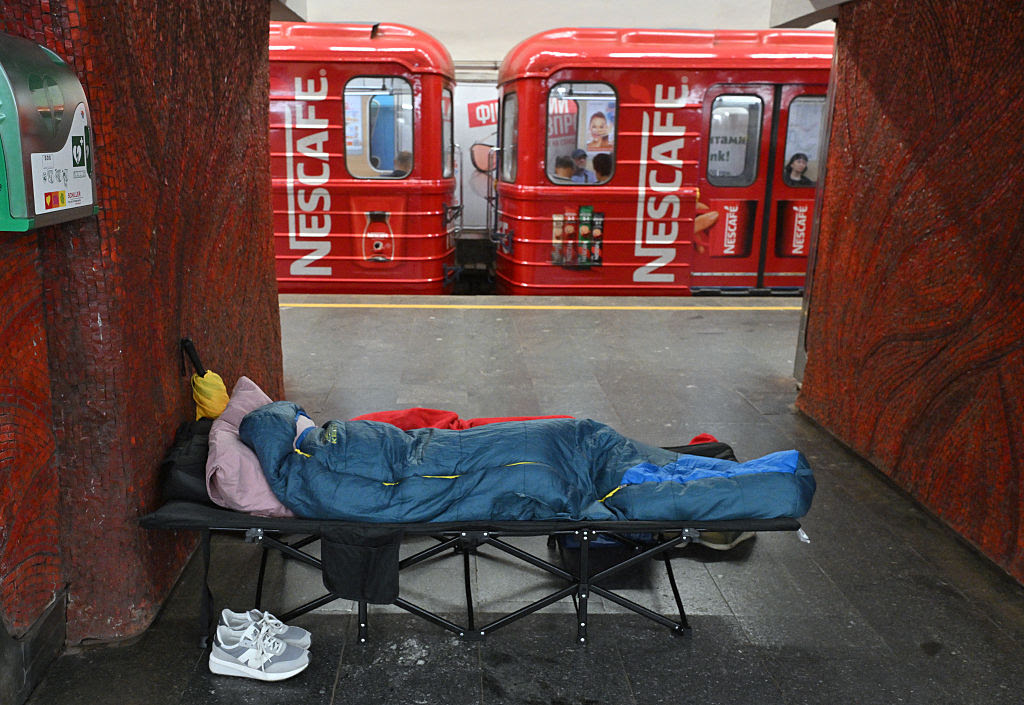
A person sleeps in a metro station in Kyiv during night mass Russian drone and missile strikes on Ukraine on Sept. 10, 2025. (Sergei Supinsky / AFP via Getty Images)
The Arithmetic of Death
To understand what happened that Tuesday, you need to grasp a chilling mathematical reality that had been evolving for months. Russian generals had cracked a code that American Civil War officers would have recognized: how to capture territory while spending fewer soldiers’ lives.
In the brutal spring of 2025, Russian forces were losing 99 men for every square kilometer they captured in Ukraine. By summer, they had cut that number to just 68. It might sound like an abstract improvement, but it represented a revolution in how Moscow fought its war.
The secret weapon wasn’t a new tank or missile—it was swarms of drones operated by a shadowy organization called the Rubikon Center. Imagine thousands of flying robots, controlled by operators sitting safely dozens of kilometers behind the front lines, methodically hunting Ukrainian positions like a deadly video game played for real.
Commander-in-Chief Oleksandr Syrskyi announced that day that Russia had lost 299,210 soldiers since January alone—nearly 300,000 human beings reduced to a statistic. Yet Moscow’s military machine was becoming more efficient at its grim work, a fact that terrified Ukrainian commanders who understood what it meant for the war’s trajectory.
The Pensioners’ Last Day
While military analysts studied casualty ratios in air-conditioned offices, real people were living and dying in ways that statistics cannot capture. In Yarova, a village so small it barely appears on most maps, elderly residents had developed a routine that Russian intelligence had been watching.
Every month, when pensions were distributed, the village’s senior citizens would gather at the local Ukrposhta office. They would chat about their grandchildren, complain about rising prices, and collect the modest payments that kept them alive. Maria Bondarenko, 78, always brought homemade cookies to share. Viktor Kovalenko, 85, told the same jokes about Soviet bureaucracy that had made his neighbors laugh for decades.
At 11 a.m. on September 9, a Russian precision-guided munition turned their monthly gathering into a massacre. The timing was no accident—Moscow’s forces had observed this pattern of civilian vulnerability and chosen to exploit it with surgical brutality.
“This is not a military operation—this is pure terrorism,” declared Donetsk Oblast Governor Vadym Filashkin, his voice breaking as he stood among bodies scattered around a destroyed postal van. The attack violated every principle of civilized warfare, deliberately targeting the most defenseless members of Ukrainian society at their most vulnerable moment.
The human cost was devastating: 24 dead, 19 wounded. But the psychological impact was the real target. Russian strategists understood that terrorizing civilians collecting survival payments would spread fear far beyond one small village.
When the Sky Exploded Over Poland
While Ukrainian families mourned their dead, 500 kilometers northwest, Polish radar operators were watching something unprecedented unfold on their screens. Waves of Russian drones, originally targeting Ukrainian cities, were penetrating deeper into Polish airspace than ever before.
At 4:30 a.m., the first alerts began flashing red at NATO’s Combined Air Operations Center. By dawn, 19 separate airspace violations had been detected—not the usual brief incursions that had occurred throughout the war, but sustained penetrations that reached 250 kilometers into Polish territory.
Prime Minister Donald Tusk faced a decision that would define his legacy: allow Russian military assets to operate freely over NATO territory or order the first direct military engagement between NATO and Russian forces since the Cold War ended.
He chose to fight back.
Polish F-16s and Dutch F-35s, operating under NATO command, opened fire on Russian drones in Polish airspace. Italian AWACS surveillance planes coordinated the hunt while tanker aircraft kept the fighters airborne. By 6:45 a.m., at least three Russian drones had been destroyed, their wreckage scattered across Polish fields.
In the village of Wyryki, 20 kilometers from the Ukrainian border, one drone crashed into Janusz Kowalski’s farmhouse, destroying his roof and the old Volkswagen parked outside. Kowalski, a 54-year-old potato farmer, became an accidental witness to history.
“I heard this terrible noise, like a giant wasp,” he later told reporters. “Then my roof exploded. I thought it was the end of the world.”
The Arsenal Awakens
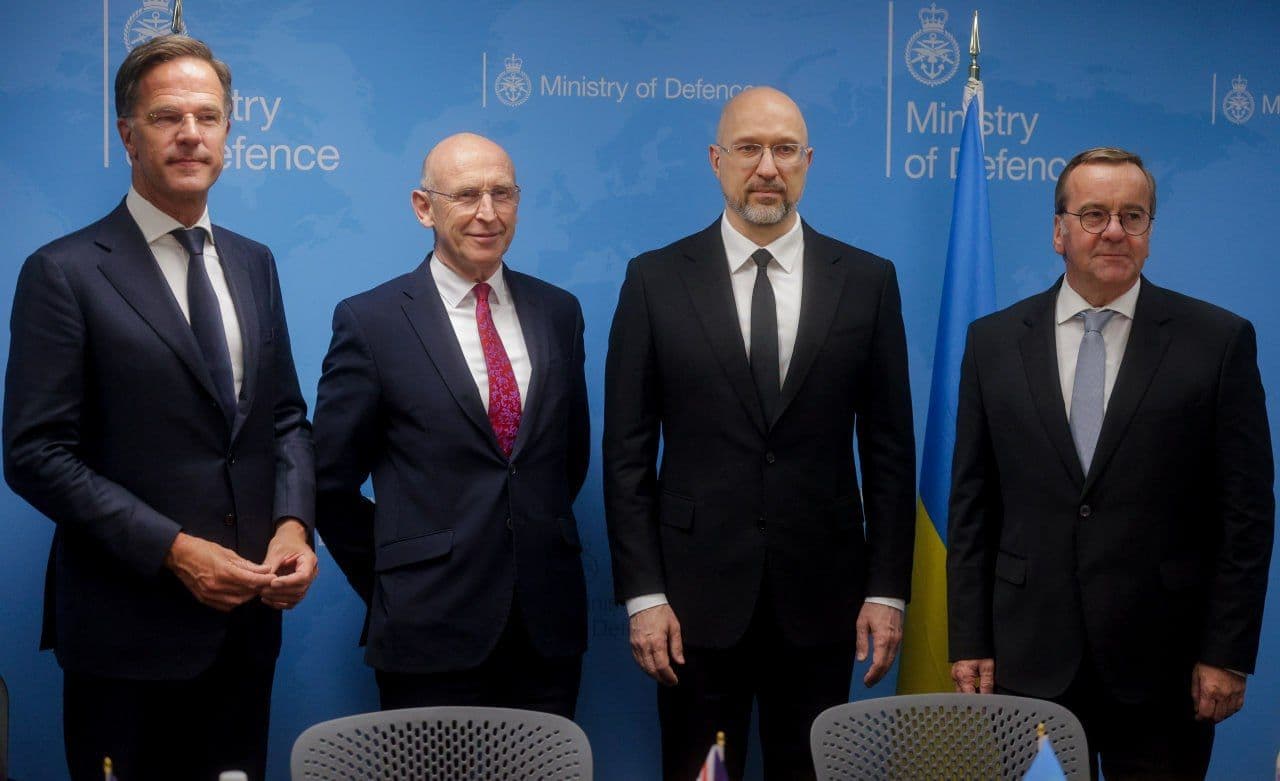
The same day NATO forces engaged Russian drones, defense ministers from across the Western world gathered in London for the 30th Ramstein meeting—a coordination session that would reshape Ukraine’s military capabilities.
British Defense Minister John Healey stood before his allies with an announcement that would have seemed impossible three years earlier: the United Kingdom would finance the production of thousands of long-range attack drones, manufactured on British soil and delivered to Ukraine within twelve months.
“Peace is achieved through strength,” Healey declared, unconsciously echoing Ronald Reagan’s Cold War doctrine. The room full of defense ministers understood they were witnessing the rebirth of the Western military-industrial complex, dormant since the Soviet Union’s collapse.
Germany’s contribution was even more dramatic. Defense Minister Boris Pistorius unveiled a €300 million program to supply Ukraine with several thousand long-range drones of various types. For a nation that had spent decades avoiding military leadership, Germany was suddenly becoming Europe’s arsenal of democracy.
The psychological impact was as important as the military one. After months of cautious, incremental support, Western powers were signaling their commitment to Ukrainian victory rather than mere survival.
Putin’s Deadline
Behind the scenes, according to Ukrainian President Volodymyr Zelensky, Vladimir Putin had delivered an ultimatum to the White House through special envoy Steve Witkoff: Russia would capture all of Ukraine’s eastern Donbas region by December 31, 2025.
The deadline revealed both Putin’s confidence and his desperation. Confident because his military machine had indeed become more efficient at seizing territory. Desperate because after nearly three years of war, Russia controlled less than one percent more Ukrainian territory than it had in November 2022.
“He says that in three to four months… he would take Donbas in two to three months, maximum four months,” Zelensky revealed in an ABC News interview. The Ukrainian president’s warning was stark: such an acceleration would cost “years and a million people,” or even “two or three million corpses.”
The mathematics were daunting even with Russia’s improved efficiency. Moscow would need to capture more territory in four months than it had seized in the previous ten months combined—a goal requiring either massive escalation or complete Ukrainian defensive collapse.
Fire in the Russian Heartland
While diplomats debated timelines, Ukrainian special forces were busy rewriting the rules of modern warfare. Across multiple Russian regions, explosions lit up the pre-dawn darkness as Ukraine’s drone campaign reached unprecedented scale and sophistication.
In Penza, 530 kilometers from the Ukrainian border, a major oil pipeline with 2-million-barrel daily capacity went offline after mysterious explosions. In Saratov Oblast, another pipeline serving Russian military forces suffered similar damage. Ukrainian intelligence sources claimed credit for three separate strikes that disabled critical energy infrastructure deep inside Russia.
The operations required extraordinary coordination and technological capability. Ukrainian drones were flying missions hundreds of kilometers into enemy territory, evading Russian air defenses, and striking precise targets with devastating effect. Each successful strike demonstrated Ukraine’s evolution from desperate defender to sophisticated military power.
Russian authorities attempted to conceal the attacks by announcing “planned exercises” at oil and gas facilities. “Remain calm and trust only verified sources of information,” officials urged citizens—a message Ukrainian intelligence sources mockingly noted was designed to hide the explosions’ true nature.
The Blind Leading the Blind
Perhaps no operation better demonstrated Ukraine’s technological sophistication than the destruction of two critical Russian radar installations in occupied Crimea. These weren’t random targets—they were the “eyes” of Russia’s air defense system, sophisticated installations worth tens of millions of dollars each.
Ukrainian special forces struck a 48Ya6-K1 Podlet low-altitude radar and an RLM-M module from the 55Zh6M Nebo-M air defense complex. The timing was perfect: the RLM-M module was destroyed while Russian personnel were abandoning their positions, suggesting Ukrainian intelligence had penetrated Russian communications.
Without functional radar, Russian missile and air defense batteries became effectively blind—unable to track incoming threats or coordinate defensive responses. The strikes represented systematic degradation of Russian capabilities that would enable more effective Ukrainian operations across the peninsula.
The Human Cost of Efficiency
While military planners celebrated tactical innovations, the human reality remained brutally simple. Oleksandr Syrskyi’s announcement that Russia had lost nearly 300,000 soldiers in 2025 alone represented nearly one million dead and wounded since the invasion began—a casualty rate that would have ended most wars in history.
Yet polling by Russia’s independent Levada Center revealed a disturbing truth: 78 percent of Russians still supported the war despite its enormous human cost. Even more remarkably, 58 percent acknowledged the war had affected their families directly, with 30 percent citing a loved one’s death.
The numbers revealed the success of Kremlin propaganda and social control. Moscow had managed to insulate its population, particularly in wealthy cities like Moscow and St. Petersburg, from feeling the war’s full impact while spreading narratives of inevitable victory.
The Veterans’ Return
Behind Russia’s public support for the war lurked a growing anxiety that reached the highest levels of the Kremlin. Sources close to Putin revealed that the Russian president was increasingly concerned about what would happen when hundreds of thousands of battle-hardened veterans returned to civilian life.
The fear was historically grounded. After the Soviet withdrawal from Afghanistan, demobilized veterans had played significant roles in the organized crime explosion that destabilized Russia throughout the 1990s. This time, the numbers were far larger and the veterans far more traumatized.
Army recruits were earning up to $62,000 in their first year of Ukrainian service—more than most Russian professionals made annually. Returning to civilian jobs paying a fraction of military wages could create massive social instability.
Already, disturbing patterns were emerging. Independent media reported that almost 500 Russian civilians had been victims of serious violence by war veterans, including 242 murders. Women were disproportionately affected, and ex-convicts were overrepresented among the perpetrators.
The Georgian’s Dilemma
Individual tragedies illuminated the war’s broader complexities. In Armenia, 29-year-old Giorgi Kinoiani sat in a jail cell, awaiting a decision that could determine whether he lived or died. The Georgian citizen had volunteered to fight for Ukraine after Russia’s invasion, joining the Georgian Legion in defense of democracy.
Now, after being arrested at the Armenian border, he faced potential extradition to Russia where he had been sentenced in absentia to seven years in prison for “mercenary activities.” His brother’s words captured the stakes: “In case of extradition, everybody knows what could happen. At the best there is a risk of inhumane treatment. I fear worse.”
Kinoiani’s case represented thousands of foreign volunteers who had risked everything to fight for Ukrainian freedom. Russia had designated the Georgian Legion a terrorist organization, while Georgia’s own security services had placed 300 Georgian fighters on their wanted lists.
The Energy Paradox
While Ukraine’s forces struck Russian pipelines, European leaders wrestled with their own contradictions. Hungary signed its largest-ever Western gas supply agreement with Shell—while explicitly refusing to reduce Russian energy imports that funded the war machine killing Ukrainian civilians.
“With this, are we going to be able to live without Russian gas? No,” declared Hungarian Foreign Minister Peter Szijjarto, embodying Europe’s ongoing moral compromise. Hungary remained the EU’s biggest buyer of Russian gas, importing 5 billion cubic meters annually through the TurkStream pipeline.
The Shell contract would deliver only 200 million cubic meters annually—a fraction of Hungary’s consumption that allowed Budapest to claim progress toward energy independence while maintaining its dependence on Russian revenues.
Trump’s Economic Weapon
In Washington, President Donald Trump was preparing his own escalation: a demand that the European Union impose 100 percent tariffs on China and India unless they stopped buying Russian oil and gas.
“Let’s all put on dramatic tariffs and keep the tariffs on until the Chinese agree to stop buying the oil,” Trump explained to officials during a September 9 meeting. “There really aren’t many other places that oil can go.”
The proposal represented economic warfare on a scale not seen since World War II, threatening to devastate global trade relationships in service of Ukrainian victory. Chinese President Xi Jinping and Indian Prime Minister Narendra Modi had just reaffirmed their ties with Putin, making Trump’s ultimatum a direct challenge to the emerging authoritarian axis.
The Spy Network Unravels
Across Eastern Europe, intelligence agencies scored a significant victory by dismantling a Belarusian espionage network that had operated freely across multiple NATO countries. Czech authorities expelled a Belarusian embassy employee after discovering the KGB-organized network had recruited agents from Moldova to Romania.
“We will not tolerate the abuse of diplomatic cover for intelligence activities,” the Czech Foreign Ministry declared, highlighting the broader shadow war being fought alongside the kinetic conflict in Ukraine.
The network’s exposure came as Belarus prepared to host Zapad-2025 military exercises with Russia, prompting Poland to close its border and Lithuania to reinforce frontier security. The exercises would involve 13,000 troops and include drills simulating nuclear weapons use—a reminder that the war’s stakes extended far beyond Ukraine’s borders.
The Invisible War
Perhaps the most chilling revelation came from Ukrainian investigators examining a Russian Iskander missile that struck Kyiv’s Cabinet of Ministers building during the record September 7 assault. The warhead had failed to detonate, providing unique insight into Russia’s supply chains despite international sanctions.
Presidential sanctions commissioner Vladyslav Vlasiuk revealed that the missile contained 35 U.S.-made components, along with parts from Japan, the UK, and Switzerland. Companies identified included Texas Instruments, Analog Devices, and Fujitsu—household names whose technology was being used to kill Ukrainian civilians.
“Compared to missiles from previous years, there are fewer components from Europe and the U.S., and more from Russia and Belarus,” Vlasiuk noted, describing Russia’s adaptation to sanctions through smuggling networks and shell companies.
The School Named for an Enemy
In perhaps the war’s strangest propaganda twist, a school in Russian-occupied Donetsk Oblast was named after Michael Gloss—the 21-year-old American son of a CIA official who had been killed fighting for Russia near Chasiv Yar.
Gloss’s story embodied the conflict’s complexity. The son of Juliane Gallina, deputy director for digital innovation at the CIA, he had initially supported Ukraine after Russia’s invasion. Yet somehow, he ended up recruited by Russian forces in Moscow, signing a Defense Ministry contract in 2023.
Russian President Putin had presented the Order of Lenin to U.S. envoy Steve Witkoff to be passed to Gallina in honor of her son’s service—a gesture of calculated provocation that raised uncomfortable questions about American security clearances and Russian recruitment networks.
Heroes in Hiding
Amid the day’s darkness came an extraordinary story of human resilience. Ukrainian Navy commander Oleksii Neizhpapa announced that his special forces had rescued four Ukrainian soldiers who had spent three years hiding in a hospital deep inside Russian-occupied territory.
The men had been wounded in battle in 2022 and remained concealed with help from sympathetic medical staff who shielded them from Russian troops. The rescue operation began after a Ukrainian marine released in a prisoner exchange revealed his twin brother was still alive and hiding.
“Our boys survived where there seemed to be no chance,” Neizhpapa wrote on Facebook. “This story is about resilience and faith.”
The operation was carried out by the Angels, a special forces unit formed specifically to rescue civilians and soldiers from behind enemy lines. According to Neizhpapa, the unit had rescued 88 people since its creation—each operation a testament to Ukrainian determination to leave no one behind.
The Mathematics of War
As September 9 ended, the war’s fundamental arithmetic remained unchanged despite tactical innovations. Russian forces were advancing more efficiently but at continued enormous human cost. Ukraine was striking deeper into Russian territory with increasing sophistication yet faced the prospect of accelerated Russian offensives.
The day’s most significant development might prove to be Poland’s direct engagement with Russian military assets, crossing a threshold that could reshape NATO’s role in the conflict. Whether this represented isolated incident management, or the beginning of broader Western military involvement remained unclear.
Putin’s reported year-end deadline for Donbas occupation created temporal pressure that could drive escalation beyond current levels. His military machine had indeed become more efficient, but the timeline required dramatic acceleration that would test even improved capabilities.
The war that began as Putin’s quick victory had evolved into a grinding contest of national wills, technological innovation, and human endurance. September 9 demonstrated that all parties were escalating their capabilities and reducing their restraints.
The next phase would determine whether diplomatic efforts could channel these dynamics toward negotiated resolution, or whether the momentum toward expanded confrontation would prove unstoppable. The pensioners of Yarova village, the Polish farmers finding drone wreckage in their fields, and the Ukrainian soldiers emerging from three years of hiding all represented different faces of a conflict that had already reshaped European security forever.
For average readers trying to understand this war, September 9 offered a clear lesson: the conflict that began with tanks rolling across the Ukrainian border had evolved into something far more complex and dangerous—a high-tech, multi-domain struggle that now directly involved NATO forces and threatened to reshape the global order.
The old world of clear boundaries and limited conflicts was ending. What came next would depend on decisions made in capital cities from Washington to Beijing, but felt most acutely in places like Yarova village, where elderly people simply wanted to collect their pensions in peace.