
As Russian Foreign Ministry Rejects Peace Timeline and Moscow’s Fuel Crisis Deepens, Ukrainian Forces Reclaim Territory While War Crimes Confessions Surface
Summary of the Day – August 23, 2025
The third week of August crystallized the fundamental impasse blocking peace negotiations, as Russia’s Foreign Ministry explicitly confirmed Vladimir Putin’s rejection of meeting Ukrainian President Volodymyr Zelensky on Donald Trump’s preferred timeline. While diplomatic channels appeared frozen, the battlefield told a different story: Ukrainian forces recaptured Zelenyi Hai in Donetsk Oblast and raised their flag over historically Ukrainian villages in Russia’s Kursk region on National Flag Day. Meanwhile, Russia’s fuel crisis reached alarming proportions with gasoline production plummeting 17.3 percent since January, and a chilling confession emerged from a Russian soldier who detailed executing five Ukrainian prisoners of war. As Trump issued a two-week ultimatum threatening “massive sanctions” and Moscow escalated its hybrid warfare against NATO states, the day’s events underscored that while leaders spoke of peace, the war’s intensity only deepened.
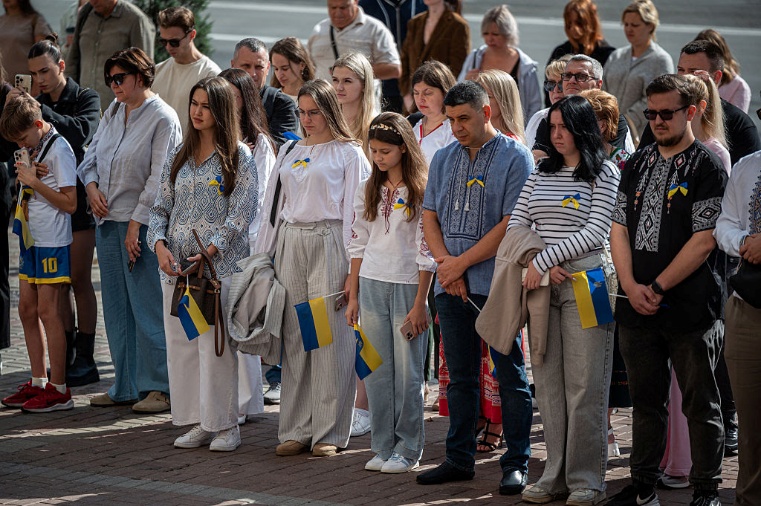
Ukrainians celebrate the Day of the National Flag of Ukraine in Kyiv. (Danylo Antoniuk/Anadolu via Getty Images)
The Kremlin’s Diplomatic Wall: Foreign Ministry Spells Out Putin’s Intransigence
Russia’s Ministry of Foreign Affairs delivered what amounted to a diplomatic declaration of war on peace efforts August 22, explicitly stating that Foreign Minister Sergey Lavrov’s statements undermining negotiations represent the Kremlin’s official position that is “distinguished by consistency” and unchanged since the August 15 Alaska Summit.
The Russian MFA reiterated Lavrov’s devastating August 20 and 21 assessments: any serious discussions about Western security guarantees for Ukraine that do not “take into account” Russia’s “legitimate concerns” are a “road to nowhere.” The ministry cited Russian demands from the 2022 Istanbul negotiations as containing “truly reliable” security guarantees—demands that would permanently ban Ukraine from NATO, severely limit Ukrainian military capabilities, and prohibit Western military assistance while imposing zero restrictions on Russian forces.
The Russian MFA emphasized that Lavrov’s “statements confirm the theses” about the war that Putin has “repeatedly voiced,” making clear that Putin himself sets foreign policy while Lavrov merely implements it. This represents an inadvertent admission of truth: Putin is the sole impediment to peace negotiations, maintaining his long-standing war aims that amount to Ukraine’s complete capitulation.
Trump’s Two-Week Clock: Presidential Patience Runs Thin
President Donald Trump’s frustration with peace negotiations boiled over August 22, as he declared himself “not satisfied with anything” related to the war and announced a decisive two-week window to determine next steps.
“We’re going to find out” Russian and Ukrainian positions about peace negotiations “over the next two weeks,” Trump stated, adding that he will decide whether to impose “massive sanctions, massive tariffs, both” or to “do nothing” during this critical period. For now, he will wait and “see what happens next.”
Trump’s anger was particularly evident regarding the August 21 Russian strike on the “Flex” US electronics manufacturing company in Mukachevo, Zakarpattia Oblast, which caused a massive fire and injured at least 19 employees. He told Putin directly that he is “not happy” about the attack on American facilities, suggesting the strike crossed a red line for the president who has generally sought accommodation with Moscow.
Blue and Yellow Over Ancient Lands: Flag Day Claims in Kursk
Ukrainian forces marked National Flag Day with profound symbolism, as drone operators from the “Rugby Team” battalion of the 129th Separate Heavy Mechanized Brigade raised the blue-and-yellow flag over two villages in Russia’s Kursk region—Hornal and Huyevo—both historically part of Ukrainian Slobozhanshchyna.
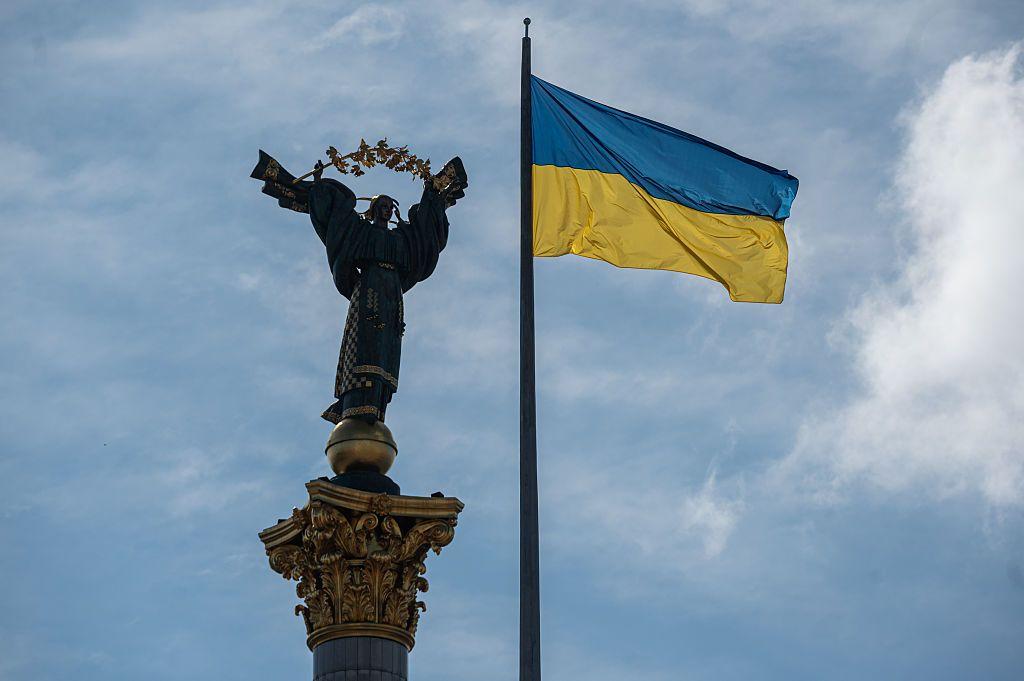
The flag of Ukraine is seen as relatives of Ukrainian soldiers who are considered missing attend a rally with the demand to facilitate the search process on the Day of the National Flag of Ukraine in Kyiv, Ukraine. (Danylo Antoniuk/Anadolu via Getty Images)
Hornal, located on the Psel River about 15 kilometers from the Ukrainian border and 102 kilometers southwest of Kursk, represents territory that predates modern political boundaries. Huyevo sits even closer at just 3.5 kilometers from the frontier. Both villages lie within the historical region of Slobozhanshchyna, which spans northeastern Ukraine and areas now within Russia’s Belgorod, Kursk, and Voronezh regions.
The flag-raising occurred as Ukraine maintains its foothold in Kursk Oblast, established through the surprise August 2024 cross-border incursion. While the operation failed to divert Russian attention from eastern Ukraine—Russian forces continue advancing in Donetsk Oblast toward Pokrovsk—the symbolic reclamation resonated powerfully on National Flag Day.
Victory Reclaimed: Marines Seize Zelenyi Hai
Ukrainian forces achieved a significant tactical success August 23 as troops from the 37th Separate Marine Brigade, coordinating with the 214th Separate Assault Battalion “Opfor,” recaptured the village of Zelenyi Hai in Donetsk Oblast’s Volnovakha district.
Located approximately 90 to 100 kilometers southwest of Russian-controlled Donetsk City, Zelenyi Hai was secured after intense fighting. Ukrainian forces continue defending the settlement against repeated Russian attempts to retake the position, demonstrating the tactical proficiency that allows Ukraine to maintain offensive capabilities even as Russia strengthens its negotiating position through territorial gains elsewhere.
Russia’s Fuel Catastrophe: Production Plummets as Refineries Burn
Russia teetered on the brink of gasoline crisis August 23, as Ukrainian long-range strikes, Western sanctions, and struggling refinery modernization converged to create a perfect storm for Moscow’s energy sector.
Russian business outlet Kommersant reported wholesale gasoline production down nearly 10 percent since January 2025, falling from 123,600 tons daily in January to just 102,200 tons currently—a devastating 17.3 percent decrease. National gasoline prices have surged accordingly: AI-92 gasoline rose 38 percent since early 2025, while AI-95 increased 49 percent.
Russian experts blame “unscheduled oil refinery shutdowns”—euphemism for Ukrainian drone strikes—lengthy repair periods requiring months to complete, and insufficient gasoline reserves. Authorities expect to conduct maintenance on up to 10 large refineries this fall, which will exacerbate shortages. The Kremlin extended temporary export bans through October 2025, revealing desperation to prevent domestic shortages.
Occupied territories face severe fuel shortages. Crimean occupation head Sergey Aksyonov admitted AI-95 gasoline shortages due to “logistical disruptions” as Ukrainian strikes target roadway transport. Zaporizhia Oblast occupation head Yevgeny Balitsky noted shortages of both AI-92 and AI-95 gasoline due to threats against fuel trains.
Electronic Warfare Escalation: NATO Under Digital Siege
Russia dramatically escalated its hybrid warfare campaign against NATO states, with European countries along Russia’s border reporting sharp increases in GPS jamming and communications interference threatening military and civilian operations.
Lithuania, Latvia, Estonia, and Finland sent formal complaints to the International Telecommunications Union about worsening radio-navigation interference. Statistics reveal the scope: 85 percent of Estonian flights experience signal disruption, while Lithuania saw a 22-fold increase in GPS jamming incidents since July 2024.
Satellite imagery shows Russia constructing a Circularly Disposed Antenna Array (CDAA) just 25 kilometers from Poland’s border near Chernyakhovsk, Kaliningrad Oblast. This military-grade system could monitor NATO communications across Eastern Europe and the Baltic Sea while supporting intelligence gathering and submarine communications.
The campaign extends beyond electronic warfare to physical infrastructure, affecting sea shipping and ground communication towers while expanding deeper into NATO territory. Russia likely uses electronic warfare innovations developed in Ukraine against Western allies.
Confessions of Murder: Russian Soldier Details POW Executions
Former Russian servicemember Ivan Okhlopkov provided chilling testimony confirming systematic execution of Ukrainian prisoners of war, describing his participation in killing five captured soldiers in May 2024.
The 31-year-old former Somalia Battalion member (9th Motorized Rifle Brigade) told Belarusian outlet Vot Tak how his platoon commander, callsign “Vedma” (“Witch”), ordered execution of Ukrainian POWs captured near Karlivka, Donetsk Oblast. Okhlopkov described removing Ukrainian armor, finding a concealed execution site, and shooting the prisoners from behind while they knelt.
The soldier, who was serving prison time for theft when he signed his military contract, showed no remorse and claimed not to remember details about his victims. He described how mortar shelling eventually destroyed the remains, leaving no evidence of the war crime. Okhlopkov deserted the army and currently hides in occupied Donetsk.
This confession confirms systematic Russian military commands to execute Ukrainian POWs, with 273 documented executions during the full-scale war according to Ukrainian prosecutors, half recorded in 2025 alone.
Pentagon’s Secret Veto: Hegseth Blocks Long-Range Strikes
Defense Secretary Pete Hegseth has quietly implemented a review process giving him authority to block Ukrainian long-range strikes inside Russia with American missiles, effectively preventing such operations for months.
The unannounced high-level Defense Department approval process has stopped use of Army Tactical Missile Systems (ATACMS) against Russian targets since late spring. The review mechanism, developed by policy undersecretary Elbridge Colby, extends to European weapons relying on U.S. intelligence and components, including British Storm Shadow missiles.
A color-coded rating system—red, yellow, green—assesses U.S. weapon stocks before approving transfers. On at least one occasion, Ukraine planned ATACMS strikes against Russian targets but was denied approval. Ukraine last received ATACMS in spring 2025, authorized by the previous administration.
Despite Trump’s August 21 statement that Ukraine has “no chance of winning” without attacking Russia and his criticism of Biden for only allowing Ukraine to “defend,” U.S. officials say this doesn’t signal policy change.
Security Architecture in Motion: Teams Work on Ukraine Guarantees
President Zelensky announced August 23 that developments on security guarantees will emerge “in the coming days,” following intensive discussions between Ukrainian, American, and European teams on post-war security architecture.
Secretary of State Marco Rubio and Presidential Office Chief Andriy Yermak led August 22 talks including national security advisers from the UK, France, Germany, Italy, and Finland, alongside NATO and European Commission representatives. Teams reportedly expect to finalize plans by next week’s end.
However, Russian Foreign Minister Sergey Lavrov declared security guarantees for Ukraine “cannot be discussed without Russia’s participation” and rejected European troop deployment as “foreign military intervention.” This opposition highlights the fundamental challenge: creating arrangements strong enough to deter Moscow while securing Russian agreement.
Beijing’s Peacekeeping Gambit: China Signals Troop Willingness
China signaled to EU diplomats its willingness to send peacekeeping forces to Ukraine in a ceasefire scenario, but only under United Nations authorization, adding complexity to post-war planning discussions.
EU reactions proved mixed. Some view Chinese participation as potentially making peacekeeping more acceptable to Russia, while others worry Beijing “primarily wants to spy on Ukraine” and would take “pro-Russian positions” during conflicts.
Approximately ten European allies express willingness to send troops as security guarantees. The UK, France, Lithuania, and Estonia publicly declared readiness for ground deployment, while the United States rules out its own troops but remains open to other arrangements.
Diplomatic Sparks: France Summons Italian Ambassador Over Ukraine Comments
France summoned Italy’s ambassador August 22 after Deputy Prime Minister Matteo Salvini crudely dismissed President Emmanuel Macron’s European troop deployment suggestions, using Milanese dialect meaning “get lost” and telling Macron to “put your helmet on, your jacket, your rifle and go to Ukraine.”
French diplomatic sources confirmed Italy’s envoy was reminded such remarks “ran counter to the climate of trust and historical relationship between our two countries,” particularly regarding “unwavering support for Ukraine.”
The incident highlights delicate balances European leaders must maintain between domestic political pressures and international solidarity. Ironically, Italian Prime Minister Giorgia Meloni has advanced her own Ukraine security proposal mirroring NATO’s Article 5, requiring 24-hour allied decisions on renewed Russian attacks.
Russian Forces Advance Near Toretsk and Pokrovsk
Russian forces made confirmed advances in multiple directions August 23, with geolocated footage showing progress in northern Oleksandro-Shultyne north of Toretsk, east of Katerynivka northwest of Toretsk, and north of Myrnohrad east of Pokrovsk.
Russian forces attacked near Toretsk itself, north toward Bila Hora, northwest near Kostyantynivka, Pleshchiivka, Poltavka, Katerynivka, Nelipivka, and Popiv Yar. Elements of the 103rd Motorized Rifle Regiment and 33rd Motorized Rifle Regiment continue operating around Kleban-Byk and in the Kostyantynivka direction.
Near Pokrovsk, Russian forces attacked the city itself, north near Nove Shakhove and Rodynske, northeast near Mayak and Krasnyi Lyman, east near Novoekonomichne, and southwest near Zvirove and Kotlyne. The 132nd Motorized Rifle Brigade received credit for seizing Pankivka northeast of Pokrovsk.
Russian forces continued offensive operations in the Kupyansk, Lyman, Siversk, and Chasiv Yar directions without confirmed advances, while maintaining attacks in northern Sumy Oblast and defending against Ukrainian operations in Kursk Oblast.
Kursk Operations: Russian Counterattacks Continue
Russian forces continued attacking in unspecified Kursk Oblast areas August 23 without advancing. A Russian milblogger affiliated with Northern Grouping Forces claimed Russian airborne and aerospace forces accumulate near Novyi Put southwest of Glushkovo for future operations.
Ukrainian forces maintained their positions established during the August 2024 cross-border operation, though the initial goal of diverting Russian attention from eastern Ukraine remains unachieved as Moscow continues prioritizing Donetsk Oblast advances.
Bucha War Criminals Die in Luhansk Explosion
Three Russian soldiers who participated in 2022 Bucha war crimes died August 22 in an explosion at Kalynove, Luhansk Oblast, according to Ukrainian military intelligence. The detonation occurred at a house where six Russian invaders stayed with military transport, destroying two pickup trucks with machine guns, a UAZ vehicle loaded with ammunition, and severely injuring two additional soldiers.
The Russians performed mobile air defense functions covering an enemy military repair base. Ukrainian intelligence implied pro-Ukrainian actors deliberately caused the explosion, representing targeted elimination of identified war criminals.
Aerial Campaign: 36 of 49 Russian Drones Intercepted
Russian forces launched 49 Shahed-type and decoy drones overnight August 22-23 from Kursk City, Shatalovo in Smolensk Oblast, Primosko-Akhtarsk in Krasnodar Krai, and Millerovo in Rostov Oblast. Ukrainian forces downed 36 drones over northern, eastern, and central Ukraine, while 13 struck seven locations in Donetsk, Dnipropetrovsk, and Sumy oblasts.

Damaged homes in Dnipropetrovsk Oblast as a result of Russian strikkes which killed one and injured another nine. (Serhii Lysak/Telegram)
Pilot Dies After Combat Mission
Major Serhii Bondar, a Ukrainian MiG-29 pilot, died during landing after completing a combat mission early August 23. The Air Force provided few details about circumstances, noting only that causes remain under investigation. Born in 1979, Bondar received state awards in June for “personal courage shown in protecting state sovereignty.”
Ukrainian Strikes Hit Moscow Region, Force Airport Closures
Moscow Mayor Sergei Sobyanin reported intercepting a drone headed toward the capital, with fragments examined and no casualties. Russia’s federal aviation agency suspended operations at airports in Izhevsk, Nizhny Novgorod, Samara, Penza, Tambov, and Ulyanovsk due to airspace safety concerns.
In St. Petersburg, two drones were downed in residential districts, damaging windows in the Ogni Zaliva complex. Russian authorities claimed intercepting 57 Ukrainian drones over several regions and the Black Sea, indicating the operation’s scale.
Dnipropetrovsk Casualties: One Dead, Nine Injured
Russian strikes killed one person and injured nine in Dnipropetrovsk Oblast’s Synelnykove district August 23. Russian KAB aerial bombs and drones damaged seven houses and a bus, causing fires later extinguished. The Nikopol district faced FPV drone and artillery attacks hitting a gas pipeline and power line.
Sanctions Target Putin’s Inner Circle
President Zelensky signed comprehensive sanctions decrees August 23, aligning with Canadian restrictions on 139 individuals and entities. Targets include Putin family members: former wife Lyudmila Ocheretnaya, her husband Artur Ocheretny, cousin Mikhail Putin, nephew Mikhail Shelomov, and ballet master Igor Zelensky.
Corporate targets include Arnest Group cosmetics, Baltika brewing, Unipro energy, and Oteko logistics companies. The second decree targets 28 foreign nationals assisting Russian occupation authorities in seized Ukrainian territories, imposing ten-year asset freezes, travel bans, and procurement prohibitions.
Colombian Veterans: The Forgotten Warriors of Ukraine’s Cause
At Lviv’s Superhumans Center, Colombian amputees who fought for Ukraine face bureaucratic obstacles and uncertain futures. “Loco,” who lost his leg near Karlovka, was dismissed from his unit just as he sought disability compensation. “Zeus,” a triple amputee, receives inferior mechanical prosthetics compared to Ukrainian veterans. “Coronel” returned to checkpoint duty after amputation, while “Arabe” became a TikTok sensation with 130,000 followers.
Colombian President Gustavo Petro’s government labels them “mercenaries,” with rumors of nationality-stripping legislation. These fighters sacrificed limbs for Ukrainian freedom but face systematic discrimination and abandonment by both their home country and Ukrainian bureaucracy.
Looking Ahead: The Collision Course Intensifies
As August 23 concluded, the fundamental contradiction driving current events remained starkly clear. Trump’s two-week ultimatum represents a crucial inflection point that could determine whether diplomatic efforts gain momentum or collapse under Russian intransigence. Putin’s explicit rejection of negotiations on Trump’s timeline, confirmed through Foreign Ministry statements, suggests Moscow believes it can achieve maximal objectives through military means.
The fuel crisis gripping Russia, expanding electronic warfare against NATO, continued civilian targeting, and war crimes confessions all indicate Moscow views this moment as requiring escalation rather than accommodation. Whether Trump’s threatened “massive sanctions and tariffs” materialize may determine the conflict’s trajectory in coming weeks.
For Ukraine, the challenge remains maintaining military effectiveness while building international coalitions for robust security guarantees. Symbolic victories in Kursk and Donetsk Oblast, expanding drone campaigns, and continued resistance strengthen Ukraine’s negotiating position should meaningful talks eventually emerge.
The diplomatic dance continues, but the war’s logic increasingly overrides the rhetoric of peace.