
The Day Europe Woke Up to War at Its Doorstep
September 11, 2025 – A Day That Changed Everything
Picture this: You’re a farmer in the Polish countryside, tending to your morning chores, when the sky above you suddenly fills with the whine of fighter jets and the distant thunder of explosions. Fragments of twisted metal rain down in your fields—not from some distant battlefield, but from Russian military drones that have just violated your country’s airspace. For the first time since World War II, foreign military aircraft have crossed Poland’s borders with hostile intent.
This wasn’t supposed to happen. Not in 2025. Not to a NATO country. But on the morning of September 11, nineteen Russian drones did exactly that, shattering the invisible line between Ukraine’s war and Europe’s peace. What followed was a cascade of events that would reshape how the world understood the conflict raging in Eastern Europe—and how dangerously close it had crept to everyone’s doorstep.
When the Impossible Became Inevitable
The drama began in the pre-dawn darkness of September 10. As most of Europe slept, Russian forces launched another of their now-routine massive strikes against Ukraine—415 Shahed drones, 42 cruise missiles, and an Iskander ballistic missile screaming across the night sky. But something went terribly wrong, or perhaps terribly right, depending on your perspective.
Instead of staying within Ukraine’s borders, nineteen of those drones kept flying west. They crossed the invisible line that had held sacred for nearly three years of war—the border between a nation at war and the NATO alliance that had sworn to defend itself.
Polish air traffic controllers watched their screens in disbelief as the blips representing Russian drones moved deeper into their airspace. Not just a kilometer or two—these weren’t navigation errors. The drones flew as far as Gdansk, 450 kilometers from the Ukrainian border, scattering debris across seven Polish provinces like deadly confetti.
At airbases across the region, sirens wailed. Polish F-16 Fighting Falcons screamed into the sky alongside Dutch F-35 Lightning IIs. For the first time in the war, NATO pilots were hunting Russian military targets over NATO territory. The unthinkable had become reality in the span of seven hours that would change European security forever.
The $400,000 Solution to a $10,000 Problem
What happened next would have been almost comedic if the stakes weren’t so deadly serious. NATO’s finest military technology—jets worth tens of millions of dollars, guided by AWACS surveillance planes and supported by aerial refueling tankers—was deployed against Russian drones that cost less than a decent used car.
The Gerbera drones that violated Polish airspace weren’t sophisticated killing machines. They were flying junkyards—plywood and foam held together with screws, carrying small warheads and powered by what amounted to souped-up lawnmower engines. Many were decoys designed not to kill but simply to overwhelm air defenses through sheer numbers.
Yet to stop them, NATO fired AIM-9 Sidewinder missiles costing $400,000 each. Picture that for a moment: nearly half a million dollars to stop a drone that Russia probably built for the cost of a decent motorcycle. It was like using a Ferrari to chase down a tricycle, except the tricycle was carrying explosives and heading toward your children’s playground.
“The most sophisticated anti-aircraft missiles should not be expended on low-cost, simple targets,” Polish defense analyst Rafal Lipka observed with masterful understatement. The mathematics were brutal: if Russia could build drones for $10,000 and NATO had to spend $400,000 to stop each one, who would run out of money first?
In the small Polish town of Wyryki, just 20 kilometers from the Ukrainian border, resident Urszula Zapszaluk watched debris from one of these encounters crash into her neighbor’s roof. “What I saw on TV seemed far away,” she told reporters. “But what happened yesterday—it’s indescribable. I no longer feel safe.”
The Student Becomes the Teacher
The most remarkable response to this crisis came not from NATO’s headquarters in Brussels, but from war-torn Kyiv. President Volodymyr Zelensky, whose country had been under aerial bombardment for three and a half years, offered to teach Poland how to defend itself.
“We offered our help because Patriots will not help Poland in their fight against Shaheds,” Zelensky explained with the weary patience of someone who had learned these lessons the hard way. “A missile that costs a million, no matter what it is, simply cannot shoot down drones that cost tens of thousands of dollars.”
It was an extraordinary moment in military history—the victim of aggression offering to train its would-be rescuers. While NATO had spent decades perfecting ways to fight a conventional war against expensive targets, Ukraine had been forced to innovate against swarms of cheap drones through brutal trial and error.
Within hours of the Polish incident, defense companies across Europe were flooded with inquiries for Ukrainian-designed interceptor drones—super-charged quadcopters that could chase down and destroy incoming threats for the price of a small car rather than a mansion.
“Russia has shown that they are not scared to attack NATO countries directly,” observed Bohdan Popov of Ukrainian advisory firm Triada Trade Partners as his phone rang with calls from Germany, Denmark, and the Baltic states. “So, NATO countries are now seeking a solution.”
The irony was profound: Europe’s most advanced militaries were scrambling to learn from a country they had been trying to help survive.
“Could Have Been a Mistake”: The President’s Perilous Words
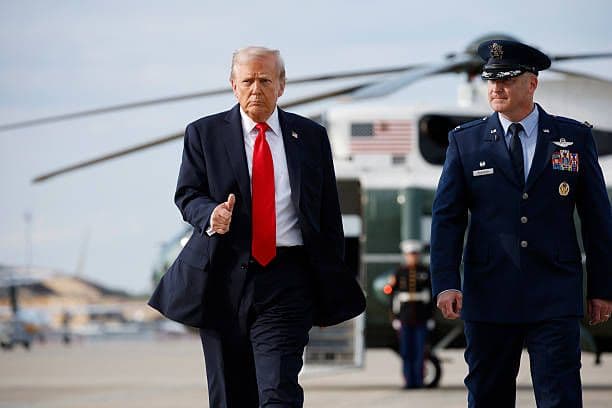
As Europe reeled from this unprecedented violation of NATO airspace, the world waited for America’s response. What they got was vintage Donald Trump—a shrug wrapped in uncertainty.
“It could have been a mistake,” the President told reporters with the casual tone of someone discussing a minor traffic accident rather than the first Russian attack on NATO territory since 1945. “But regardless, I’m not happy with anything to do with that whole situation.”
Polish Foreign Minister Radosław Sikorski’s response crackled across social media within minutes: “No, it wasn’t a mistake.” His video statement, delivered with the controlled fury of a man whose country had just been violated, laid out the facts with prosecutorial precision: “Poland’s airspace was breached 19 times by drones manufactured in Russia. The assessment of Polish and NATO air forces is that they did not veer off course but were deliberately targeted.”
The diplomatic earthquake that followed revealed dangerous fault lines in the Western alliance. While European leaders saw calculated Russian aggression designed to test NATO’s resolve, Trump’s reluctance to condemn Moscow created a leadership vacuum at the worst possible moment.
Even America’s allies began hedging their bets. Slovakia’s Foreign Minister Juraj Blanar said he wanted “to believe” the drones were bound for Ukraine and had simply gotten lost—a position that would have been laughable if it weren’t so dangerous.
Ukrainian Foreign Ministry spokesperson Heorhii Tykhyi delivered a response that would have made Cold War diplomats proud: “A large number of Russian drones entered Polish airspace—this is an empirical fact that does not require belief. Such a massive border violation could not have been accidental—it is fully deliberate escalation on Russia’s part.”
Ukraine’s Thunderous Reply: When the Victim Strikes Back
Ukraine’s response to the Polish crisis was swift and devastating. While diplomats argued about intentions and accidents, Ukrainian forces launched one of their largest drone attacks on Russian territory since the war began—221 unmanned aircraft screaming across the night sky toward Moscow, St. Petersburg, and strategic targets across the Russian heartland.
The scale was breathtaking. Drones hit oil facilities in Smolensk, setting them ablaze in spectacular fires captured on social media. At the Primorsk Port—Russia’s largest oil terminal on the Baltic Sea—vessels burned as Ukrainian drones found their targets with lethal precision. St. Petersburg’s main airport shut down as swarms of drones converged on Russia’s second-largest city, disrupting nearly 50 flights and sending residents diving for cover.
For Russians who had grown comfortable with their war being fought “over there,” the reality of conflict suddenly arrived at their doorsteps. Residents of Leningrad Oblast described it as one of the most massive strikes on their region since 2022, with fragments of intercepted drones crashing in towns with names that echoed imperial grandeur—Tosno, Vsevolozhsk, Pokrovskoye.
The message was unmistakable: if Russia wanted to escalate by attacking NATO territory, Ukraine could escalate too. The victim had become the aggressor, and the aggressor was learning what it felt like to cower under falling debris.
The Diplomatic Dance of Desperation
As air raid sirens wailed across two continents, diplomats rushed to manage a crisis that threatened to spiral beyond anyone’s control. Keith Kellogg, Trump’s special representative for Ukraine, found himself in Kyiv for the third time in recent months, discussing weapons deals worth $50 billion while explosions echoed in the distance.
The conversations had an almost surreal quality—American and Ukrainian officials calmly discussing drone purchases and Patriot missile financing while their screens showed real-time footage of Ukrainian drones striking Russian oil facilities and Russian debris littering Polish farmland.
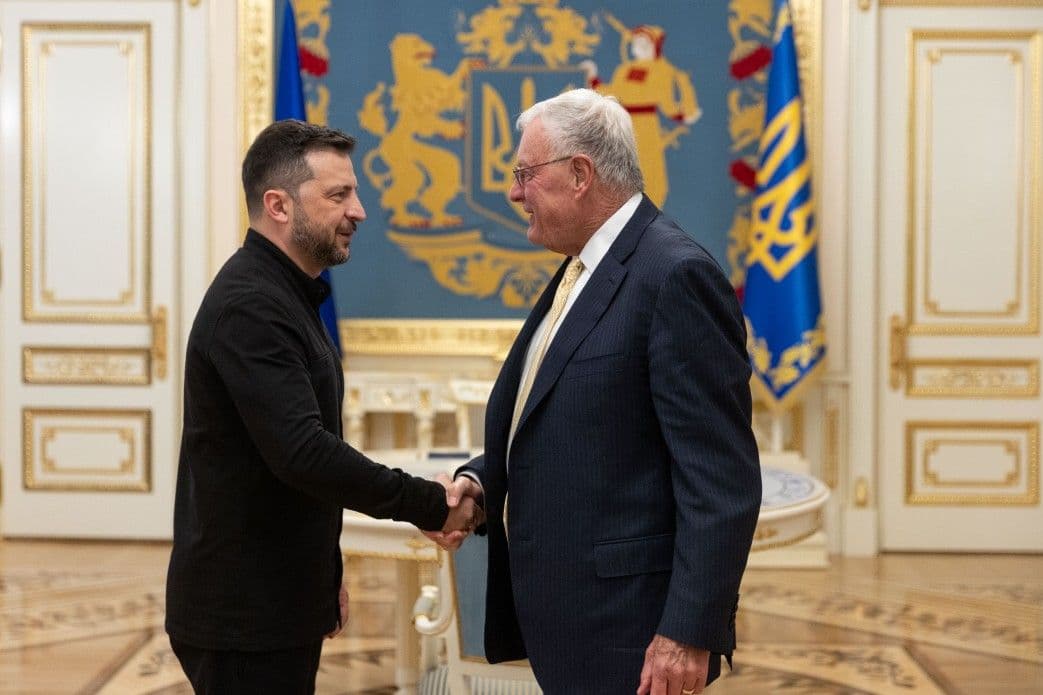
“Ukraine is counting on a positive response from the American side,” the official readout stated with diplomatic understatement, as both sides explored mechanisms to turn Ukraine’s drone expertise into American military advantage.
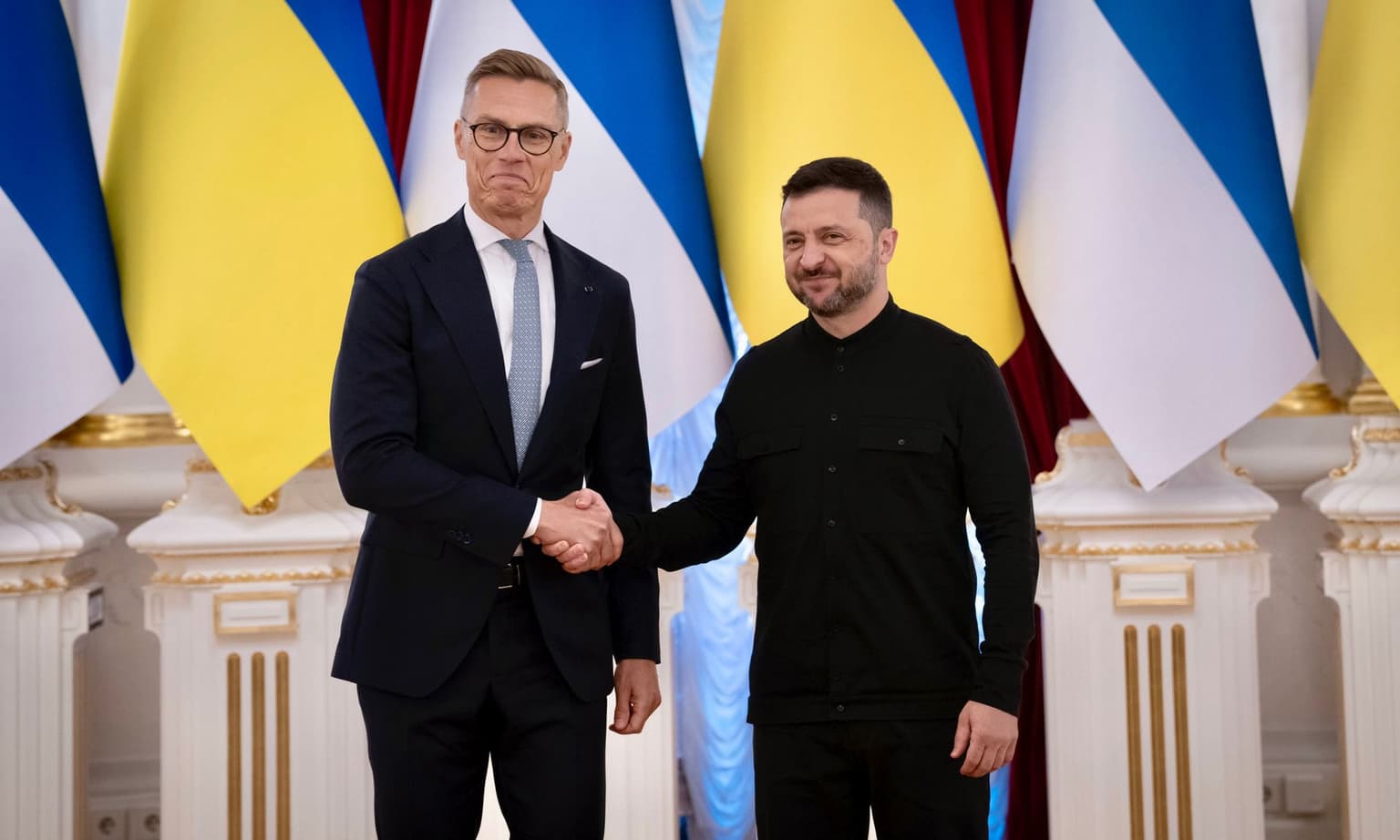
Finnish President Alexander Stubb arrived in Kyiv the same day, bringing the perspective of a NATO member that shared 1,300 kilometers of border with Russia. During their joint press conference, Zelensky delivered one of the most chilling warnings of the entire war:
“The scariest thing is that this attack resembles Crimea. Psychologically… Today, the same role in Polish territory was exposed by Russian drones. The most dangerous thing is when partners send signals that the main thing is not to provoke war.”
The parallel was devastating in its implications. In 2014, the world had watched Russia seize Crimea with “little green men”—unmarked soldiers who gave Moscow plausible deniability. Now, unmarked drones were probing NATO defenses, testing whether the West would respond to technological invasion the same way it had responded to human invasion—with strongly worded statements and strategic patience.
The Price of Freedom: When Bills Come Due
While drones fell from the sky, the grinding reality of wartime economics continued to extract its toll. Swedish Defense Minister Pal Jonson announced a commitment that would have been unimaginable just years earlier—$7.44 billion over two years to keep Ukraine fighting, Sweden’s 20th military aid package since the invasion began.
The numbers had long since lost their ability to shock through sheer scale, but they retained their power to humble. Eighteen more Archer artillery systems, long-range drones, coastal radar systems, cable ferries equipped with grenade launchers—the shopping list of a continent at war read like a catalog from humanity’s darkest impulses.
Across the Atlantic, the U.S. House of Representatives passed an $890 billion defense bill that included $400 million for Ukraine, though the amount seemed almost quaint compared to what was clearly needed. The International Monetary Fund had delivered sobering news: Ukraine’s financing needs could exceed current estimates by $10-20 billion over the next two years.
The mathematics of survival were becoming impossible to ignore. Ukraine was spending 75% of its state budget—$20.8 billion of $27.9 billion—just on defense in the first quarter of 2025. The country faced a $7.2 billion shortfall for the remainder of the year, even as Russian escalation demanded responses that exceeded every planning assumption.
Meanwhile, the Trump administration prepared to push G7 nations toward 50-100% tariffs on China and India for their continued purchases of Russian oil. “The president’s view is that the obvious approach here is, let’s all put on dramatic tariffs until the Chinese agree to stop buying the oil,” a senior official explained with the blunt pragmatism of someone who had run out of subtler options.
Nuclear Shadows and Childhood Nightmares
As if the immediate crisis weren’t terrifying enough, longer-term horrors continued to unfold in the war’s shadows. International Atomic Energy Agency Director General Rafael Grossi reported “deeply concerning” developments as Russian drones swarmed within three kilometers of the Khmelnytskyi and Rivne nuclear power plants.
“These were unusually large-scale military activities close to these two nuclear power plants, which should never happen,” Grossi warned, his diplomatic language barely concealing the magnitude of what nearly occurred. Twenty-two drones had been detected around facilities containing enough radioactive material to make Chernobyl look like a minor industrial accident.
Just 48 hours after the Polish violation, Russia and Belarus began their Zapad-2025 military exercises—13,000 soldiers practicing to fire nuclear-tipped ballistic missiles at European targets from Belarusian territory. Poland responded by deploying 40,000 troops to its border and closing it entirely, while the rest of Europe watched the largest nuclear drill in the region since the invasion began.
But perhaps the most chilling developments were happening far from battlefields and exercises. Russian organizations continued their systematic abduction of Ukrainian children, with new evidence revealing the industrial scale of forced relocations designed to erase Ukrainian identity forever.
Russian Education Minister Sergei Kravtsov casually announced that over 32,000 children from occupied areas had participated in Russian “summer programs”—a euphemism for Russification camps where Ukrainian children were stripped of their language, culture, and national identity. A Save Ukraine report based on testimonies from 200 children described systematic torture, sexual violence, and psychological abuse designed to turn Ukrainian children into Russian soldiers who might one day fight against their own homeland.
The numbers were staggering in their horror: 55% of surveyed children reported indoctrination, 10% suffered torture, 6% experienced sexual violence. This wasn’t collateral damage—it was industrial-scale child abuse disguised as education.
The Innovation of Desperation
Amid the diplomatic crisis and human horror, a quieter revolution was transforming warfare itself. Ukrainian Commander-in-Chief Oleksandr Syrskyi confirmed what military observers had suspected: Russia was copying Ukrainian innovations as fast as they could steal them.
“We are dealing with a direct technological race in which the advantage will go to those who not only modernize but also stay ahead,” Syrskyi wrote, describing a competition between survival and subjugation where intellectual property meant less than staying alive another day.
Ukrainian forces had struck more than 60,000 targets in August alone using drones that evolved from modified hobby aircraft to mass-produced military systems. The successful targeting of a Russian Project MPSV07 vessel worth $60 million—a sophisticated intelligence-gathering ship disabled by a Ukrainian drone that probably cost less than the ship’s coffee machine—exemplified this transformation.

DTEK, Ukraine’s largest private energy company, opened the largest battery storage system in Eastern Europe—200 megawatts capable of powering 600,000 homes for two hours. The $146 million investment represented more than military strategy; it was a bet on the future, a declaration that Ukraine would not only survive but emerge stronger from its ordeal.
“Despite the war, we invest in Ukraine’s recovery and growth,” declared DTEK owner Rinat Akhmetov, whose company had seen 90% of its thermal power plants damaged by Russian strikes yet continued building wind farms and battery systems that would power a post-war renaissance.
The Human Price of Headlines
Behind every strategic development and diplomatic maneuver, individual tragedies continued to accumulate with numbing regularity. Ukrainian pilot Oleksandr Borovyk, just 30 years old, was killed while flying a combat mission in the Zaporizhzhia sector—one name among thousands, each representing dreams cut short and families shattered.
Russian attacks killed at least three civilians and injured 25 others across Ukraine in a single day. A 16-year-old was injured when a Russian drone struck his motorcycle in Sumy Oblast. The Holy Resurrection Cathedral in Sumy—a symbol of the city and architectural landmark—was damaged by debris, its ancient stones scarred by humanity’s newest weapons.
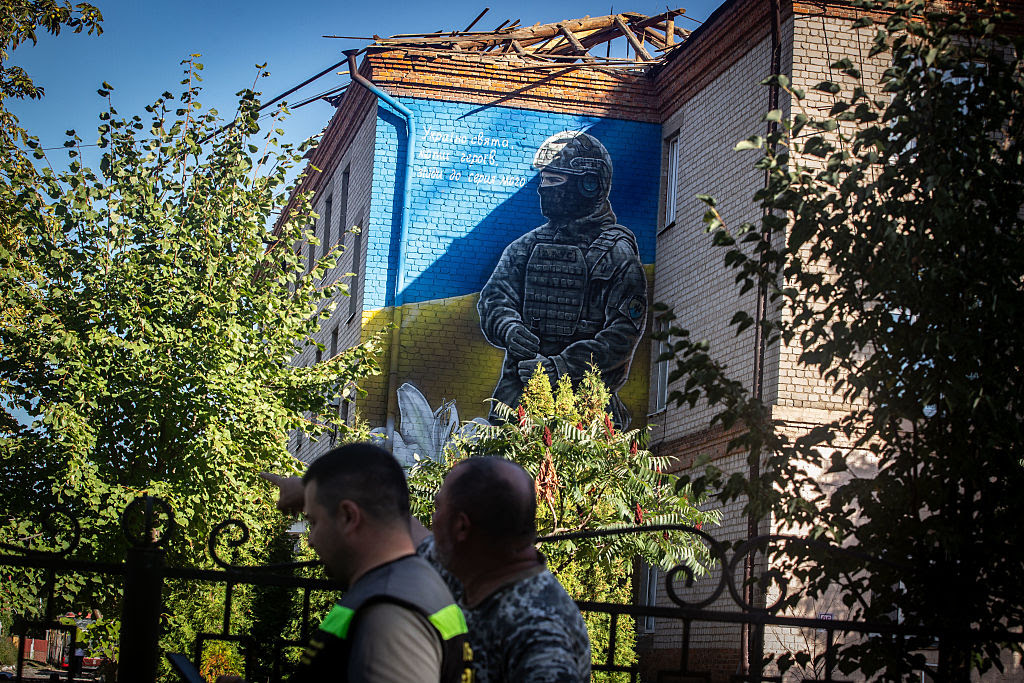
A mural of a Ukrainian soldier is on a wall of a vocational school in Sumy, recently attacked by Russian drones. (Francisco Richart Barbeira/NurPhoto via Getty Images)
Yet amid the darkness, unexpected light occasionally broke through. Belarus released 52 political prisoners in the largest such exchange under dictator Alexander Lukashenko’s regime, including journalists who had spent years in harsh conditions for the crime of reporting truth. Among them was Ihar Losik, sentenced to 15 years for founding a Telegram channel called “Belarus of the Brain”—a name that captured both the hope and tragedy of resistance in an age of authoritarianism.
The release coincided with American agreement to lift sanctions on Belavia, Belarus’s state airline, suggesting that even in the darkest times, human decency could sometimes find a way forward.
The New Reality Takes Shape
As September 11, 2025, drew to a close, Europe faced a fundamentally changed security environment. Poland imposed comprehensive airspace restrictions through December, while Latvia followed suit along its eastern border. Forty thousand Polish troops deployed toward Belarus as diplomatic niceties gave way to military necessity.
The front lines of the war, meanwhile, continued their relentless grind through Ukrainian towns with names that few outside the region could pronounce but that now carried the weight of history. Russian forces seized Serednie northwest of Lyman, advanced toward Zarichne and Stavky, pushed through fields north of Bila Hora and along roads that had once carried farmers to market but now carried the machinery of war.
Ukrainian forces achieved their own successes, reportedly regaining 14 square kilometers near Horikhove and pushing Russian forces back across administrative boundaries that had once seemed merely bureaucratic but now marked the difference between freedom and occupation.
Yet the tactical details, important as they were to the soldiers fighting and dying over each ruined building, paled before the strategic transformation that September 11 had wrought. The war was no longer contained within Ukraine’s borders—it had spilled into NATO territory, forced alliance members to scramble for Ukrainian expertise, and revealed dangerous gaps in Western preparedness for the kind of warfare that had become routine in Eastern Europe.
The Unfinished Symphony
As night fell over a continent transformed, the day’s events settled into the historical record like sediment in a riverbed—each layer telling part of a larger story still being written. The drone fragments scattered across Polish fields would be collected and analyzed, their secrets extracted and studied. The diplomatic cables would be filed and archived, the military assessments classified and stored away.
But the larger questions raised by September 11, 2025, remained unanswered. Had Russia deliberately tested NATO’s resolve, or had it simply miscalculated the range of its own weapons? Would Trump’s reluctance to condemn the violation encourage further escalation, or would quieter diplomatic channels prove more effective than public confrontation?
Most importantly, had Europe learned the lessons that Ukraine had been forced to master through three and a half years of survival, or would the continent continue to prepare for yesterday’s war while tomorrow’s drones circled overhead?
The answers would come, as they always did, through the accumulated weight of human decisions—some wise, some foolish, all carrying consequences that rippled far beyond their makers’ intentions. September 11, 2025, had ended, but the story it began was far from over. In war, as in life, every ending was simply the prelude to a new beginning, and every dawn brought fresh possibilities for both tragedy and triumph.
The drone crossing was complete. The sky above Europe would never be the same.