
As Trump Sets August 15 Alaska Summit, Moscow Demands Ukraine Abandon Its Fortress Belt and Cede Strategic Territories That Russian Forces Have Failed to Capture After Three Years of War
Summary of the Day – August 8, 2025
The diplomatic chess match between Washington and Moscow reached a crescendo as U.S. President Donald Trump announced a historic August 15 summit with Vladimir Putin in Alaska, following revelations that the Kremlin is demanding Ukraine surrender its most strategically vital unoccupied territories. Putin’s proposal, delivered through U.S. envoy Steve Witkoff, would force Ukraine to abandon its carefully constructed “fortress belt” in Donetsk Oblast—the defensive line that has successfully repelled Russian advances for over three years. As Trump speaks openly of “territory swapping” and warns Zelensky to “get ready to sign something,” the day’s events crystallized the stark choice facing Ukraine: surrender its strongest defensive positions for an uncertain peace, or continue fighting with potentially diminishing Western support.

People gather at Independence Square in Kyiv to attend the funeral ceremony of Ukrainian journalist Victoria Roshchyna who reported from occupied territories before her detention and death in Russian custody. (Andre Luis Alves/Anadolu via Getty Images)
The Fortress Belt Ultimatum: Putin Demands What His Army Cannot Take
The most consequential revelation of August 8 emerged from classified briefings revealing Putin’s ceasefire proposal transmitted through Steve Witkoff’s Moscow visit. The Russian president demands that Ukraine withdraw from the entirety of Donetsk Oblast—effectively surrendering the fortress belt that has anchored Ukrainian defenses since 2014.
This 50-kilometer defensive line, stretching from Slovyansk to Kostyantynivka along the H-20 highway, represents Ukraine’s 11-year investment in turning four major cities into an impregnable barrier. The fortress belt consists of Slovyansk and Kramatorsk forming the northern half, serving as significant logistics hubs, while Druzhkivka, Oleksiyevo-Druzhkivka, and Kostyantynivka comprise the southern portion.
Ukrainian forces first established these positions after retaking the cities from pro-Russian proxies in April 2014, maintaining control since July 2014. Ukraine has spent eleven years and billions of dollars in Western aid constructing fortifications that have proven tactically decisive against Russian assault.
The surrender would position Russian forces 82 kilometers further west in Ukraine and provide advantageous launching points for future offensives into Kharkiv and Dnipropetrovsk oblasts. Russian forces would gain positions roughly 20 kilometers from Izyum and could potentially threaten Kharkiv City using tactics similar to their 2022 approach.
Alaska Bound: Trump and Putin Set Historic Summit
Trump announced via Truth Social that he would meet Putin on August 15 in Alaska, marking the first face-to-face encounter between the leaders since Russia’s full-scale invasion began. Putin’s aide Yuri Ushakov confirmed Russian attendance while noting Moscow’s expectation for reciprocal Trump visits to Russia.
The summit location carries symbolic weight as American soil, but removed from Washington’s political theater. The choice surprised observers, as both parties had previously proposed more neutral settings, with Putin suggesting the UAE and reports of Trump considering Rome after discussions with Italian Prime Minister Giorgia Meloni.
Critical uncertainty remains over Ukrainian President Volodymyr Zelensky’s participation. Trump initially indicated Putin meeting Zelensky was a prerequisite, only to reverse course, telling reporters such conditions were unnecessary.
Territory Swapping: Trump’s Blunt Assessment of War’s End
Speaking alongside Armenian and Azerbaijani leaders after brokering their peace deal, Trump offered his most explicit assessment of Ukraine war resolution. “There will be some swapping of territories to the betterment of both,” he declared, adding that Zelensky would “have to get ready to sign something.”
The president’s language suggested a transactional approach treating Ukrainian sovereignty as negotiable currency. While Trump didn’t specify details, context pointed toward formal recognition of Russian control over Crimea and substantial portions of four partially occupied oblasts—Donetsk, Luhansk, Zaporizhzhia, and Kherson.
Bloomberg reported that Trump told European leaders and Zelensky that Putin is open to negotiations if land swaps are included, representing a fundamental shift from earlier U.S. positions demanding full Ukrainian territorial integrity.
The Two-Phase Russian Proposal: Maximizing Gains While Minimizing Commitments
European officials briefed on Putin’s proposal revealed a calculated two-phase structure. Phase one demands Ukrainian withdrawal from Donetsk Oblast and frontline freezing—rewarding Russian aggression with territorial conquest without military achievement.
Phase two envisions Trump and Putin crafting a final peace plan subsequently “negotiated” with Zelensky—reducing the Ukrainian president to ratifying decisions made by others. This sequencing deliberately leaves Ukraine with diminished leverage once ceasefire takes effect.
The Wall Street Journal reported that Putin’s proposal includes Russian agreement to halt offensives in Kherson and Zaporizhzhia oblasts, though it remains unclear whether this means freezing current lines or eventual withdrawal from occupied areas, including the Zaporizhzhia Nuclear Power Plant.
A Ukrainian official participating in Witkoff’s briefing call stated Kyiv was not opposed to proposals in principle but emphasized that ceasefire would be prerequisite for further steps.
U.S. and Russia Seek Territorial Agreement
Bloomberg reported that U.S. and Russian officials are working on a territorial agreement aimed at freezing conflict and establishing groundwork for ceasefire and technical negotiations toward final peace settlement. Putin demands Ukraine cede all of Donetsk and Luhansk oblasts plus Crimea.
The proposed deal would cement Moscow’s occupation of Ukrainian territories, with Russia currently controlling approximately 20% of Ukraine’s territory, including all of Crimea and large parts of four southeastern oblasts.
Sources indicated the terms remain fluid and could change, with uncertainty about whether Russia would relinquish any currently occupied territories. Washington is reportedly seeking support from Ukraine and European allies for the potential deal.
European Union Provides Reduced Financial Support
The EU Council approved 3.2 billion euros in Ukraine Facility aid—reduced from an originally planned 4.5 billion euros due to Kyiv’s failure to complete three of sixteen required reforms. The unfulfilled reforms concern decentralization, judicial appointments to the High Anti-Corruption Court, and Asset Recovery and Management Agency legislation.
The approved amount exceeded EU Commission ambassadors’ initial approval of 3.05 billion euros. Under partial payment policy, funds tied to unmet benchmarks may be disbursed later if reforms are completed within twelve months.
European Commission President Ursula von der Leyen previously announced intentions to allocate additional 100 billion euros for Ukraine from the 2028-2034 budget, doubling current Ukraine Facility funding.
Russian Forces Enter Dnipropetrovsk Oblast Near Dachne
The open-source monitoring group DeepState reported that Russian forces entered Dnipropetrovsk Oblast and advanced near the village of Dachne. However, Viktor Tregubov, spokesperson for Ukraine’s Dnipro group of forces, stated that intelligence and operational data showed no Russian presence in the area on August 8 morning.
DeepState reported Russian soldiers spotted on the opposite bank of the Vovcha River across from Dachne, with most of the settlement lying in a gray zone. Russian forces have not secured a foothold but are deploying small infantry units to maintain pressure.
The Russian Defense Ministry claimed to have seized Dachne in July, which would be the first village under Russian control in Dnipropetrovsk Oblast, though Ukrainian military denied the alleged capture. This represents potential expansion of the conflict into previously untouched regions.
Russia’s Mounting Financial Crisis
Trump imposed 50% tariffs on Indian imports responding to New Delhi’s Russian oil purchases, demonstrating Washington’s willingness to target third countries supporting Moscow’s war machine. The policy triggered immediate responses, with Russian oil companies redirecting shipments from India to China.
Chinese Foreign Ministry defended “legitimate and lawful” energy cooperation with Russia, stating Beijing would “continue to adopt reasonable energy security measures in accordance with national interests.” This response illustrated limits of secondary sanctions against major economies.
Russia’s federal budget deficit reached 4.9 trillion rubles (61.4 billion dollars) by July’s end, exceeding the government’s full-year target of 3.8 trillion rubles by more than 30%. The deficit jumped by 1.2 trillion rubles in July alone, primarily due to declining average oil prices.
July expenditures soared to 3.9 trillion rubles while revenues totaled only 2.7 trillion rubles. Oil and gas revenues fell 18.5% over the first seven months compared to the previous year, with the decline accelerating from 16.9% reported for the first half. Brent crude prices fell to 66.40 dollars per barrel, marking the largest weekly drop since June.
The Kremlin is reportedly planning to impose price caps on essential food products including vegetables, dairy, and poultry, according to pro-government outlet Kommersant, as military expenditures and high inflation strain the economy.
Economic Pressure Campaign: Targeting Russian Oil Revenues
Indian Prime Minister Narendra Modi held a call with Putin, describing it as “very good and detailed conversation” and reaffirming commitment to deepen India-Russia Strategic Partnership despite U.S. tariff threats.
Military Operations Across Multiple Fronts
Ukrainian forces advanced near Kupyansk and Toretsk while Russian forces advanced near Lyman, Toretsk, and Pokrovsk. Geolocated footage showed Ukrainian advances southwest of Radkivka north of Kupyansk, complicating Russian envelopment efforts.
In the Toretsk direction, Ukrainian forces advanced within Katerynivka and Shcherbynivka, while Russian forces advanced within central Rusyn Yar and seized Poltavka. Russian forces also advanced in eastern and central Pokrovsk, with Commander-in-Chief Oleksandr Syrskyi reporting over 110,000 Russian personnel operating in this direction sustaining massive casualties.
Ukrainian forces conducted 545 strikes on 14 towns and villages in Zaporizhzhia Oblast, while Russian forces continued operations in northern Sumy Oblast without confirmed advances. Fighting continued across Kharkiv, Luhansk, and southern fronts with mixed tactical results.
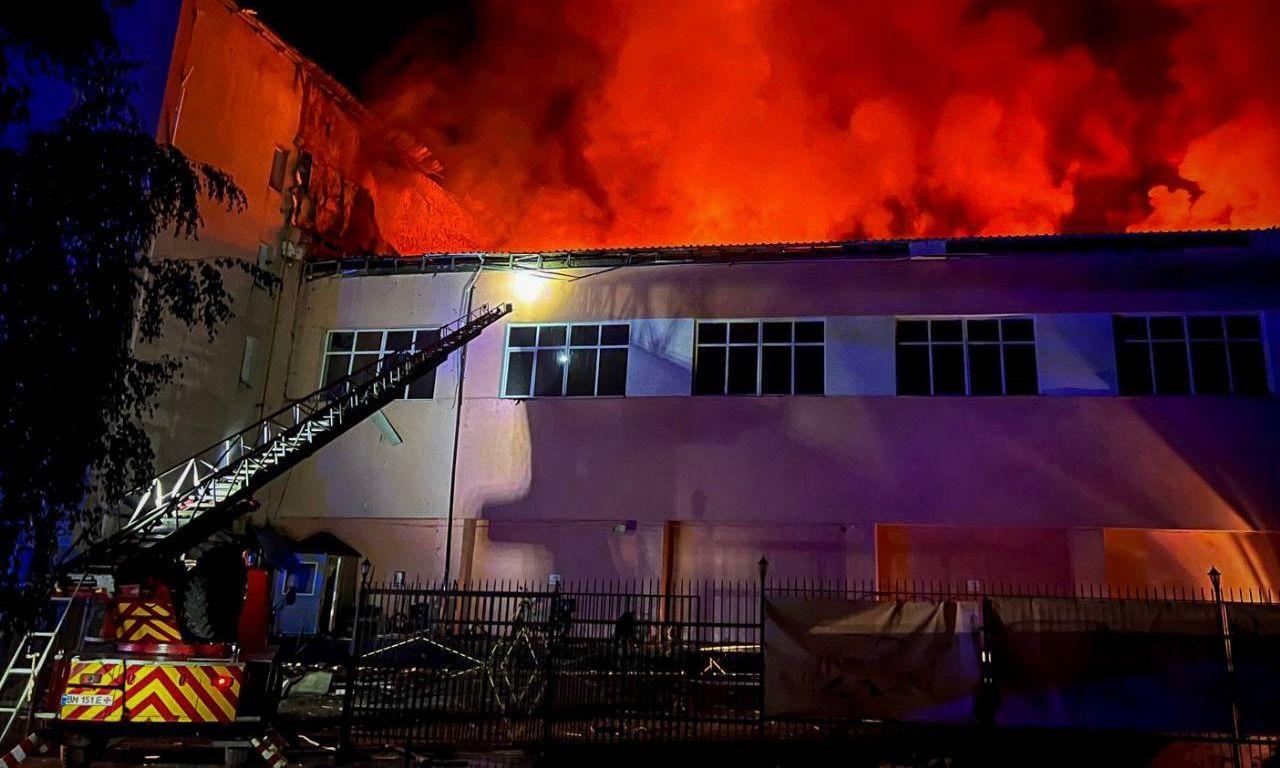
Firefighters extinguish the fire that erupted after a Russian attack against Ukraine’s Sumy Oblast. (State Emergency Service / Telegram)
Drone Warfare and Technological Developments
Ukrainian forces destroyed 82 of 108 Russian Shahed-type drones launched overnight on August 7-8, with 26 striking ten locations across Ukraine. Russian forces launched over 6,000 drones at Ukrainian cities during July 2025, increasing from approximately 4,500 in June.
Ukrainian drone manufacturer Tenebris developed new “Bayonet” interceptor drones specifically designed to counter Russian Shahed and Geran drones. The interceptors match Shahed speeds up to 250 kilometers per hour, operate at five-kilometer altitude with 40-kilometer range, and feature automatic takeoff/return capabilities with visual target locks independent of GPS or radio communication.
Ukrainian Commander-in-Chief Syrskyi reported Ukrainian unmanned systems struck over 23,000 Russian targets and killed over 5,000 Russian soldiers in July. First-person-view drones and night bombers were responsible for most hits, with Ukraine forming units equipped with robotic ground platforms.
Intelligence Operations and Special Activities
Ukrainian military intelligence (HUR) attacked Russia’s 90th Anti-Aircraft Missile Brigade in Afipsky, Krasnodar Krai. The operation killed at least 12 Russian soldiers and injured dozens more, also destroying Russian military equipment. The brigade had been involved in Russian assaults in Kherson and Zaporizhzhia oblasts.
Ukrainian drones struck and damaged the Afipskiy oil refinery in Krasnodar Krai. The region frequently serves as target for Ukrainian operations due to its military infrastructure supporting Russian air operations over the Black Sea.
Diplomatic Activities and International Relations
Putin held multiple international calls on August 8, briefing Chinese President Xi Jinping, Belarusian President Alexander Lukashenko, Uzbek President Shavkat Mirziyoyev, Kazakh President Kassym-Jomart Tokayev, and Indian Prime Minister Narendra Modi on his meeting with Witkoff and upcoming negotiations.
Xi reportedly welcomed dialogue between Washington and Moscow and reiterated Beijing’s support for resolution efforts. Lukashenko received updates on “negotiations and agreements” with the U.S., while Central Asian leaders discussed cooperation in trade and energy affairs.
Polish Prime Minister Donald Tusk, after speaking with Zelensky, suggested conflict freezing could happen “sooner rather than later,” reflecting both hope and apprehension about rapid diplomatic movement.
Armenia-Azerbaijan Peace Deal
Trump hosted Armenian Prime Minister Nikol Pashinyan and Azerbaijani President Ilham Aliyev for signing a joint peace declaration ending their decades-long conflict over Nagorno-Karabakh. The agreement includes transportation corridor creation between Azerbaijan and its Nakhchivan exclave, with U.S. leasing rights for private companies developing the transit corridor.
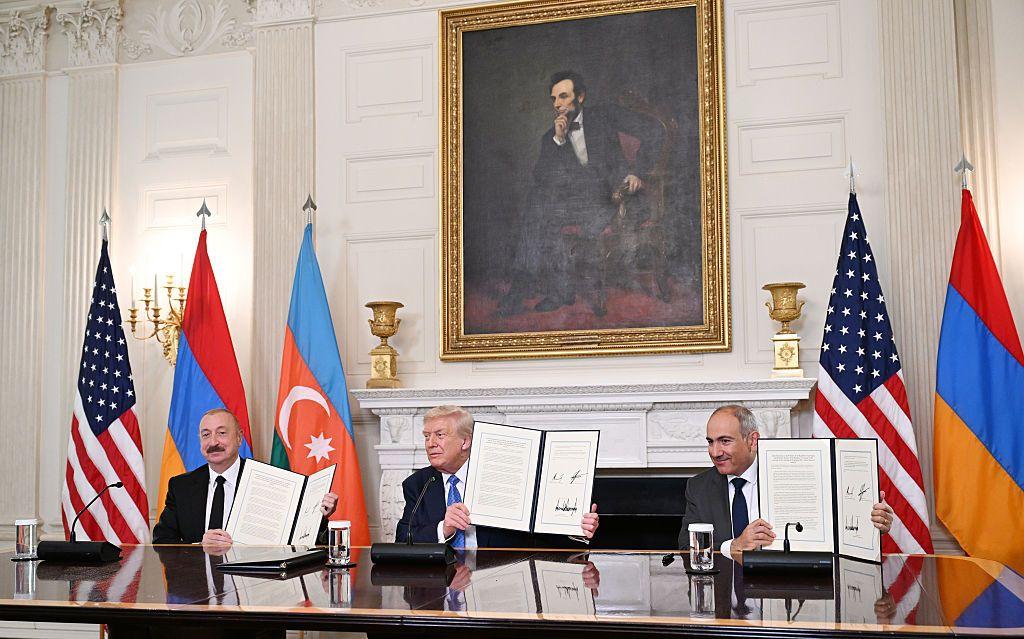
U.S. President Donald Trump (C), Azerbaijani President Ilham Aliyev (L), and Armenian Prime Minister Nikol Pashinyan (R) sign the “peace roadmap” joint declaration following their trilateral meeting at the White House in Washington, D.C., United States. (Azerbaijan Presidency/Anadolu via Getty Images)
Both leaders plan to nominate Trump for Nobel Peace Prize following the agreement. The successful mediation provided Trump with diplomatic momentum ahead of his planned Putin summit.
Russia Launches Adoption Catalogue of Ukrainian Children
Russia launched an online catalogue of Ukrainian children available for adoption, with listings sorted by eye and hair color, according to reports. The systematic cataloguing of Ukrainian minors represents another aspect of Russia’s broader campaign of forced deportations and cultural erasure.
The catalogue’s organization by physical characteristics echoes historical practices of treating children as commodities and raises serious concerns about violations of international law regarding the treatment of children in occupied territories. Ukrainian authorities have consistently documented Russian efforts to forcibly relocate Ukrainian children and erase their national identity.
Civilian Casualties and Infrastructure Attacks
At least three civilians were killed and 19 injured in Russian attacks across Ukraine over 24 hours. Attacks included strikes on hospitals, residential areas, and civilian infrastructure across multiple oblasts.
A farewell ceremony was held in Kyiv for journalist Viktoriia Roshchyna, who died in Russian captivity after torture in fall 2024. Her body was returned to Ukraine falsely labeled as “unidentified man,” with DNA testing confirming identity. Ukraine charged the head of Russia’s Detention Center No. 2 in Taganrog with organizing torture and death of Roshchyna and other Ukrainian detainees.

A funeral ceremony for Viktoriia Roshchyna in Kyiv, Ukraine. (Yana Prots/The Kyiv Independent)
German Engineers Resurrect “Destroyed” Patriot System
German civilian and Luftwaffe engineers successfully repaired a Patriot radar unit that American manufacturer Raytheon had declared irreparable after Russian attack damage. Major General Maik Keller, Deputy Commander of NATO Security Assistance and Training for Ukraine, reported that the German team worked sixteen hours daily from Monday to Saturday to overhaul the critical radar component.
The radar unit was transported back to Ukraine in July and by early August had been used successfully to intercept a Russian strike. The repair was conducted in workshops not specifically designed for Patriot maintenance, demonstrating German technical capability that exceeded manufacturer specifications.
With Ukraine possessing an estimated seven to eight operational Patriot systems at any time, the loss of even one radar unit represented a significant blow to air defense capabilities. German Defense Minister Denys Shmyhal announced that Washington approved foreign military sales worth over 200 million dollars for artillery support, transportation, and logistics, including 104 million dollars specifically for M777 howitzer support.
Pentagon Policy Changes Affecting Ukraine Aid
CNN reported that Pentagon Undersecretary Elbridge Colby’s July memo permits reclaiming weapons produced for Ukraine under U.S. Ukraine Security Assistance Initiative and returning them to U.S. stockpiles. While no weapons have been diverted yet, the provision could deprive Ukraine of billions of dollars worth of equipment scheduled for delivery.
The memo categorizes U.S. weapons into “red,” “yellow,” and “green” groups, with first two indicating shortages requiring additional approval before foreign transfer, including Patriot interceptor missiles. A U.S. Senate committee approved 800 million dollars for USAI as part of the Pentagon’s annual budget, though uncertainty remains whether weapons funded by that money will ultimately reach Ukraine.
Putin’s Award to CIA Official’s Family
Putin presented Order of Lenin award to U.S. envoy Witkoff for CIA Deputy Director Juliane Gallina, whose son Michael Gloss was killed fighting for Russia in Ukraine in 2024. The psychological tactic aimed to provoke questions about why relative of high-ranking U.S. intelligence official fought for Russian military.
Romania Investigates Potential Russian Oil Sabotage
Romanian authorities consider scenario that Russia intentionally contaminated Azeri oil destined for southern Romania refinery. The crude mixed with organic chloride threatened to corrode OMV Petrom’s Petrobrazi refinery infrastructure, potentially triggering national fuel crisis.
Contamination was detected at Turkey’s Ceyhan terminal, leading to cancelled crude shipment to Romania’s Constanta port. Some contaminated oil already reached Italy and Czechia in July.
UEFA Payments to Russian Football Clubs
Union of European Football Associations paid over 10.8 million euros in “solidarity” funds to Russian football clubs despite banning them from European competitions following invasion. Five Ukrainian clubs did not receive similar payments due to Swiss bank restrictions allegedly because they are located in “zone of military operations.”
Central African Republic-Russia Military Transition
Russia pressures Central African Republic to phase out Wagner mercenary group and replace with state-controlled Africa Corps. Moscow demands cash payments for security services, departing from previous arrangements involving compensation through natural resources.
CAR officials prefer Wagner, viewing it as more effective force with established local connections, and have offered to continue payments in gold, uranium, and iron ore rather than cash.
Looking Ahead: The Alaska Test
The August 15 Alaska summit will test whether personal diplomacy between Trump and Putin can bridge vast gaps between stated positions. Putin’s demand for Ukraine’s fortress belt represents maximalist ambitions potentially incompatible with sustainable peace.
Trump’s public discussion of “territory swapping” creates pressure on Zelensky to accept significant concessions, while presidential statements suggest diminishing patience with prolonged negotiations. The coming week will determine whether Alaska becomes site of historic breakthrough or waystation toward prolonged conflict.
For Ukraine, the choice appears stark: accept territorial losses for uncertain security guarantees, or continue fighting with potentially reduced Western support. Putin’s gambit—demanding through negotiation what his forces cannot achieve through combat—represents the ultimate test of whether aggression can be rewarded through diplomacy.