
As Russia Escalates Rhetoric Against NATO While Staging Military Exercises, Ukrainian Forces Strike Deep Into Enemy Territory and Military Leadership Undergoes Changes
Summary of the Day – September 15, 2025
September 15 witnessed Russian officials claiming “NATO is at war with Russia” while Ukrainian forces struck the massive Kirishi oil refinery over 800 kilometers from the border, sending global oil prices climbing. Russian and Belarusian forces continued their Zapad-2025 military exercises under U.S. military observation, practicing nuclear-capable missile deployments near NATO borders. Ukrainian forces cleared Russian troops from Pankivka village in Donetsk Oblast while facing continued infiltration attempts near Kupiansk. The day concluded with Russian strikes killing at least five civilians and injuring 56 others across Ukraine, including a late-evening attack on Zaporizhzhia that wounded a 4-year-old girl.
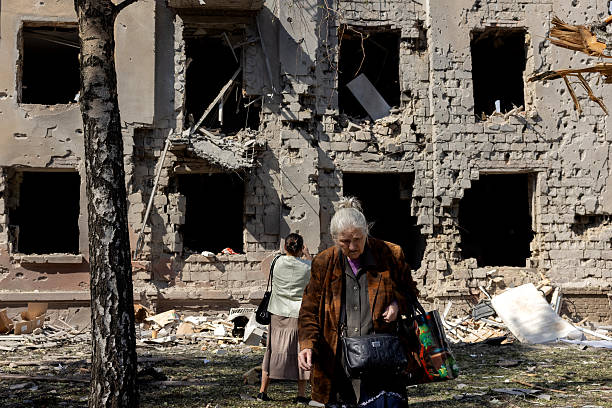
A woman carrying a bag walks near damaged residential buildings following Russian strikes in Kramatorsk, amid the Russian invasion of Ukraine. (Tetiana Dzhafarova/AFP via Getty Images)
Empty Bluster: Russia Claims NATO “At War” Despite Military Struggles
Kremlin Spokesperson Dmitry Peskov declared on September 15 that “NATO is at war with Russia,” claiming the alliance is “de facto involved in” the Ukraine conflict by providing military support. “NATO is at war with Russia; this is obvious and needs no proof,” Peskov stated during his briefing.
Russian Security Council Chairman Dmitry Medvedev warned that any NATO “no-fly zone” over Ukraine would “mean only one thing — a war between NATO and Russia.” Medvedev also threatened that Russia would “go after” EU states providing Ukraine with loans backed by Russian assets “in all possible international and national courts,” adding that “in some cases, [Russia will] bypass court procedure.”
Both officials condemned European efforts to seize frozen Russian assets, with Peskov warning that “such steps will not go unnoticed.”
The Theater of Strength: Zapad-2025 Under International Scrutiny
Russian and Belarusian forces continued their Zapad-2025 joint military exercises on September 15, with U.S. military representatives observing the drills. The exercises included concerning elements near NATO borders, with Russian forces practicing deployment of nuclear-capable Iskander-M ballistic missile systems in Kaliningrad Oblast, which directly borders Lithuania and Poland.
The Russian Northern Fleet’s nuclear-capable Arkhangelsk submarine practiced launching missile strikes against naval targets in the Barents Sea, which borders NATO member Norway. Russian Tu-22M3 long-range strategic bombers patrolled “the neutral waters of the Barents Sea” for four hours, according to the Russian Defense Ministry.
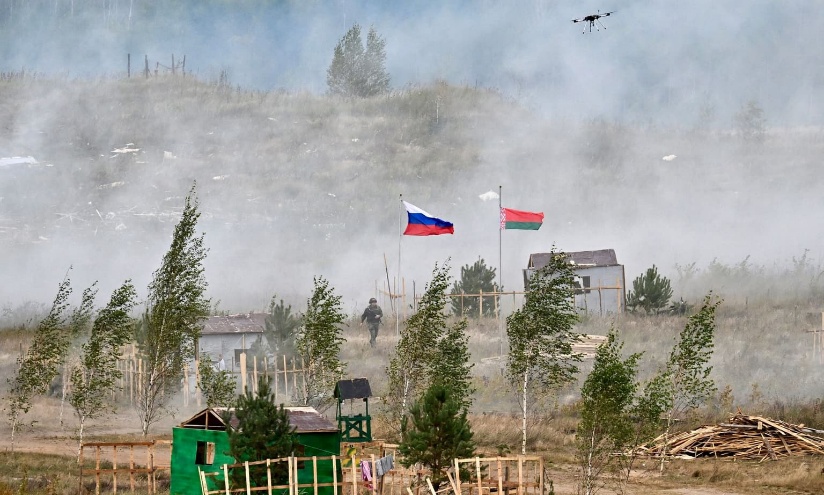
A serviceman takes part in the Zapad-2025 Russian-Belarusian military drills. (Olesya Kurpyayeva / AFP)
Russian forces also practiced maneuvering with light motor vehicles and all-terrain vehicles — tactics to evade drone strikes and enable rapid flanking attacks. The exercises allowed Russia to disseminate battlefield lessons and improve joint interoperability with Belarus under modern warfare conditions.
Representatives from 23 countries, including the United States, Hungary, and Turkey, observed the exercises, with Belarusian Defense Minister Viktor Khrenin telling observers: “We will show whatever is of interest for you. Whatever you want.”
Fire and Steel: Ukraine Strikes Deep Into Russian Territory
Ukrainian forces confirmed a devastating strike on the Kirishi oil refinery in Russia’s Leningrad Oblast overnight on September 14-15. The General Staff announced the attack on one of Russia’s largest refineries, which processes over 17 million tons of oil annually — representing 6.4% of the country’s total refining capacity.
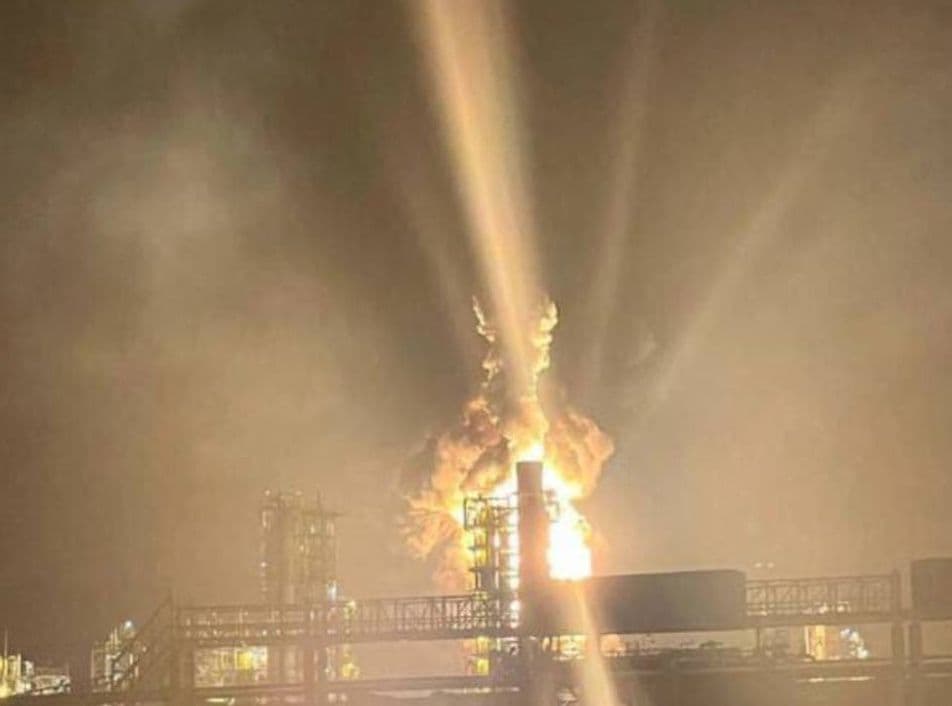
Fire erupts from the Kirishi oil refinery in Russia’s Leningrad Oblast after a reported Ukrainian drone strike. (Astra)
Russian Governor Alexander Drozdenko claimed air defense intercepted three drones in the Kirishi area, with wreckage igniting a fire at the refinery site that was subsequently extinguished. However, Reuters reported that industry sources confirmed the attack forced a production halt at a key processing unit accounting for nearly 40% of the plant’s capacity, with repairs expected to take a month.
The strike on the facility, located over 800 kilometers from the Ukrainian border, sent global oil prices climbing. Brent crude futures rose 0.5% to $67.35 per barrel, while U.S. West Texas Intermediate crude increased 0.6% to $63.05, with both benchmarks gaining over 1% for the week.
Video footage published by Russian opposition outlet Astra showed large blasts and flames rising from the refinery. The Kirishi facility is one of Russia’s top two oil refineries by volume and a subsidiary of Surgutneftegaz, processing approximately 355,000 barrels per day.
Reclaiming the Lost: Ukrainian Forces Liberate Pankivka
Ukrainian forces cleared Russian troops from the village of Pankivka in Donetsk Oblast’s Dobropillia sector, the National Guard’s 1st Azov Corps reported on September 15. The joint operation between Armed Forces units and National Guard troops reversed Russian gains made during their offensive push toward the strategic Dobropillia-Kramatorsk highway.
A Ukrainian military source confirmed that Ukrainian forces had “recently liberated Pankivka (east of Dobropillia),” while a Russian military blogger acknowledged Ukrainian seizure of the settlement but claimed it remained a contested “gray zone.”
Meanwhile, Russian forces continued reinforcing positions in the area, prompting Ukraine to deploy additional reserves to the sector overseen by the 1st Azov Corps. “Ukrainian defense forces are making every effort to halt the enemy’s advance and prevent a breach in the defenses,” the statement read.
The liberation marked the latest Ukrainian success in gradually pushing back Russian forces in the Dobropillia area, where the 1st Azov Corps has been conducting both defensive and offensive operations.
Infiltration and Deception: Russian War Crimes Near Kupiansk
Russian forces continued using perfidy tactics near Kupiansk in Kharkiv Oblast, with Ukrainian officials confirming that capturing the city remains Moscow’s primary goal in the region. Operational-strategic command “Dnipro” spokesperson Lieutenant Colonel Oleksiy Belsky stated that “the strategic goal of the Russians as of now is to retake Kupiansk.”
Russian sabotage groups were infiltrating Kupiansk using disguise tactics — wearing civilian clothes and presenting false documents — which constitute acts of perfidy under the Geneva Convention. A Russian military blogger acknowledged that Russian forces were resorting to these illegal tactics in the area.
Ukrainian forces maintained fire control over a gas pipeline that Russian forces recently used to move from occupied Lyman Pershyi to Radkivka on Kupiansk’s outskirts. Russian troops attempt nighttime infiltrations and hide in basements during the day, with the military blogger claiming that “almost all of Kupiansk is a contested gray zone.”
Belsky reported that Russian forces accumulate personnel on the northern outskirts but have not entered Kupiansk proper, using sabotage groups to probe defenses while conducting what amounts to a “counter-sabotage operation, combing the districts of Kupiansk.”
Battlefield Dynamics: Russian Advances and Ukrainian Resistance
Russian forces made confirmed advances in several sectors on September 15. Geolocated footage indicated Russian advances in central Kupiansk and southwest of Stepova Novoselivka in Kharkiv Oblast. In Zaporizhia Oblast, Russian forces seized the village of Olhivske northeast of Hulyaipole, with the Defense Ministry confirming elements of the 114th Motorized Rifle Regiment accomplished the capture.
In the Novopavlivka direction of Donetsk Oblast, geolocated footage showed Russian forces advancing southwest of Horikhove. However, Ukrainian forces also conducted offensive operations, with unconfirmed reports suggesting Ukrainian troops reached areas near Boikivka and Fedorivka in the Pokrovsk direction.
Russian forces continued attacks across multiple directions, including near Siversk, in the Kostyantynivka-Druzhkivka area, and around Pokrovsk, where over 50 daily assaults were reported. Ukrainian forces also faced Russian attacks in northern Sumy Oblast and continued defensive operations in the Lyman direction.
Air and Missile Campaign: Russian Strikes Target Civilian Infrastructure
Russian forces conducted a major missile and drone campaign against Ukraine on the night of September 14-15. The Ukrainian Air Force reported that Moscow launched three S-300 air defense missiles from Kursk and Belgorod oblasts, plus 84 Shahed-type, Gerbera-type, and other drones from multiple directions, including Kursk, Bryansk, Oryol, Millerovo in Rostov Oblast, and Primorsko-Akhtarsk in Krasnodar Krai.
Ukrainian air defenses shot down and suppressed 59 attack drones, but 25 strike drones and the three missiles struck 13 locations throughout Ukraine. Russian forces targeted railway infrastructure in Kharkiv Oblast and agricultural facilities in Sumy Oblast.
In a concerning escalation, Russian forces conducted a “double tap” strike in Chernihiv Oblast, first hitting an oil depot to cause a fire, then striking again at night while firefighters worked at the scene. Nizhyn Mayor Oleksandr Kodola reported that three firefighters were injured in the secondary strike designed to target emergency responders.
Civilian Casualties: The Human Cost of Russian Terrorism
At least five civilians were killed and 56 injured in Russian attacks across Ukraine over 24 hours ending September 15, regional authorities reported. The deadliest single incident occurred in Donetsk Oblast, where two people died and 33 were wounded, including 19 in Kramatorsk after Russia dropped an aerial bomb.
In Sumy Oblast, 12 people were injured while harvesting crops when a Russian missile struck a wheat field. Zaporizhzhia Oblast suffered two killed and two injured from 607 Russian strikes on 17 settlements, while Kherson Oblast reported one death and two injuries with seven houses and civilian infrastructure damaged.
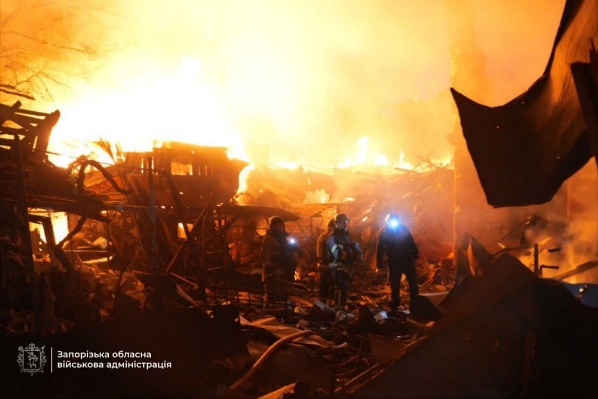
The aftermath of a Russian attack on Zaporizhzhia late which killed one person and injured nine others. (Zaporizhzhia Oblast Military Administration)
The day concluded with a devastating late-evening Russian attack on Zaporizhzhia that killed one person and injured nine others, including a 4-year-old girl. Regional Governor Ivan Fedorov reported at least 10 strikes targeting residential homes and non-residential buildings, with large fires erupting at homes and transport vehicles. The injured child was under medical supervision but her “life is not in danger,” officials confirmed.
Democratic Facade: Russian Elections Deliver Predetermined Results
Russian regional elections concluded September 14 with entirely predictable outcomes across 20 gubernatorial races and 11 regional parliamentary contests. All incumbent governors won their races — 19 from Putin’s United Russia party and one independent from A Just Russia Party whose candidacy Putin had previously approved. Victory margins ranged from 60% to over 80% of the vote.
Kremlin Spokesperson Dmitry Peskov claimed the results demonstrated Russian society’s “consolidation around [Vladimir] Putin and his team.” Security Council Chairman Dmitry Medvedev acknowledged “minimal” electoral violations but said authorities would “deal” with them.
Russia’s Central Election Commission reported 149,717 observers at polling stations, though independent observers have been barred since 2016. Acting Tambov Oblast Governor Yevgeny Pervyshov, a veteran of Russia’s “Time of Heroes” program, won with 74.3% while campaigning on his Ukraine war experience. Election officials confirmed that 1,616 Russian veterans ran for various government positions.
Cyber Warfare: Ukraine Targets Russian Election Infrastructure
Ukrainian military intelligence conducted a “cyber revenge” operation against Russia’s Central Election Commission on September 14, targeting voting systems in response to elections staged in occupied Ukrainian territories. A HUR source confirmed the denial-of-service attack hit CEC servers, Russia’s electronic voting platform, and the state digital services portal Gosuslugi.
Russian CEC chief Ella Pamfilova acknowledged a “major hacker attack” against commission resources, reporting internet outages at CEC headquarters. The HUR source claimed the attack successfully disrupted online voting, particularly in occupied regions including Sevastopol in illegally annexed Crimea, leaving many Russians unable to vote electronically in mayoral and gubernatorial races.
Military Leadership: Ukrainian Command Structure Changes
Commander-in-Chief Oleksandr Syrskyi dismissed two corps commanders — Volodymyr Silenko of the 17th Corps and Maksym Kituhin of the 20th Corps — according to military sources. Both were removed one to two weeks prior following battlefield losses in their areas of responsibility.
Silenko’s 17th Corps was responsible for the sector south of Zaporizhzhia, where Ukrainian forces lost control of Kamianske village and were partially driven from Plavni along the Dnipro River. Kituhin’s 20th Corps operated along the Donetsk-Dnipropetrovsk border, where Russian forces crossed into Dnipropetrovsk Oblast for the first time in August.
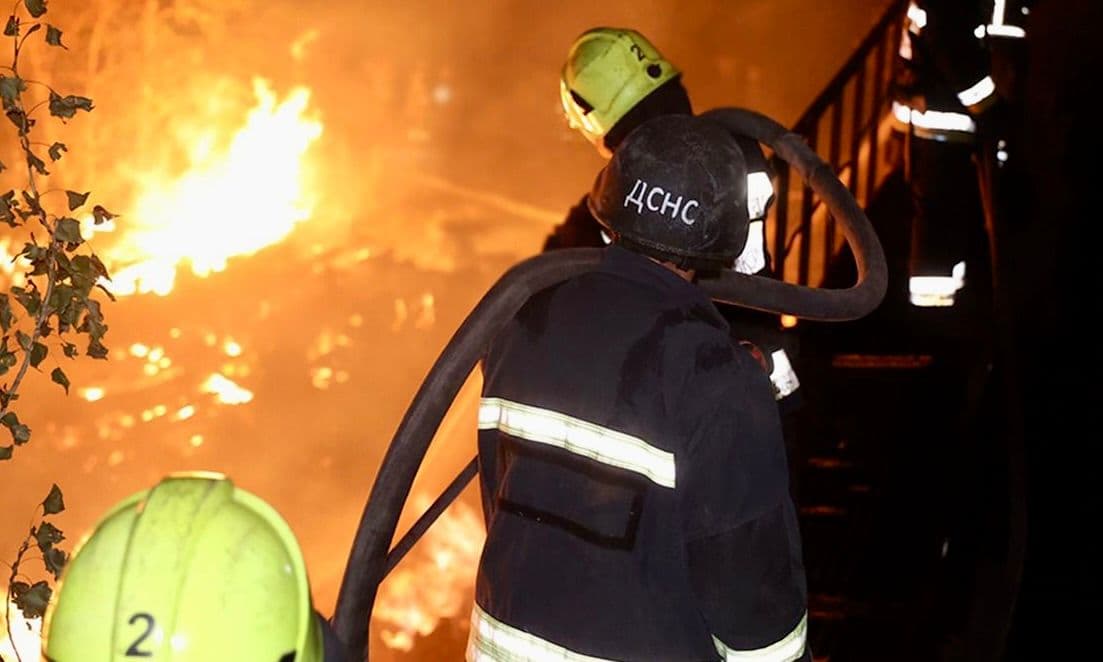
A Russian strike on Dnipropetrovsk Oblast sparked a fire, hitting civilian infrastructure. (State Emergency Service / Telegram)
These represent the first senior personnel changes since Ukraine announced its transition to a corps-based structure in February, aimed at introducing corps-level command above brigade level for enhanced coordination across larger units.
Innovation Under Fire: Ukraine’s Advanced Drone Development
Ukraine’s Brave1 defense innovation cluster completed final testing for new kamikaze drones with ranges exceeding 40 kilometers and resistance to Russian electronic warfare systems. Digital Transformation Minister Mykhailo Fedorov announced the systems would soon undergo combat testing.

Ukraine’s Brave1 defense innovation cluster is testing new kamikaze drones, as seen in a photo published. (Mykhailo Fedorov / Telegram)
“Kamikaze attack drones with a range of 40 kilometers, capable of overcoming electronic warfare, represent a new level of capability to attack the enemy,” Fedorov stated. The drones are designed to withstand Russian jamming and spoofing that have become primary defenses against Ukraine’s drone arsenal.
“Strike drones are becoming a cheap and practical solution for the front lines — they are affordable to manufacture and easily scalable,” Fedorov added, highlighting Ukraine’s continued innovation in unmanned systems that have transformed modern warfare.
Global Connectivity Crisis: Starlink Outage Affects Ukrainian Operations
Starlink satellite internet service suffered a global outage on September 15, disrupting communications for hospitals, schools, and military units across Ukraine. “Starlink is once again down across the entire front line,” reported Ukraine’s top drone warfare commander, Robert “Madyar” Brovdi.
The outage prompted tens of thousands of user complaints worldwide according to Downdetector. Nearly an hour later, Brovdi reported connectivity was “gradually restoring,” though full recovery was not officially confirmed by the company.
The disruption highlighted Ukraine’s critical dependence on the satellite service, which has replaced much of the country’s destroyed communications infrastructure since Russia’s invasion began in 2022.
Budget Planning: Ukraine Prepares for 2026 Defense Spending
Ukraine’s Cabinet of Ministers approved and submitted to parliament the draft State Budget for 2026, Prime Minister Yuliia Svyrydenko announced September 15. The budget projects total expenditures of Hr 4.8 trillion ($116.5 billion) with a deficit of 18.4% of GDP requiring Hr 2.079 trillion ($49 billion) in external financing.
Defense spending will receive Hr 2.8 trillion ($68.3 billion), an increase of Hr 168.6 billion ($4.1 billion) from 2025. The government allocated Hr 44.3 billion ($1.08 billion) specifically for domestic weapons production, including ammunition, missiles, air defense systems, aviation, and armored vehicles.
“The main priority of the budget is security and defense, our social stability,” Svyrydenko stated. Revenues are projected at Hr 2.826 trillion ($49 billion), representing a Hr 446.8 billion ($11 billion) increase from the previous year.
Diplomatic Appointments: New Ambassador Takes Post
Former Justice Minister Olha Stefanishyna began serving as Ukraine’s Ambassador to the United States on September 15, following her August 27 appointment by President Zelensky. “As I begin my mission as Ukraine’s Ambassador to the United States, I carry with me the courage and resilience of our people,” Stefanishyna wrote.

Olha Stefanishyna officially assumed the role of Ukraine’s ambassador to the United States. (Olha Stefanishyna / X)
She said her diplomatic mission began with a moment of silence honoring Ukraine’s fallen defenders, adding: “It is because of their sacrifice that we continue diplomacy — defending sovereignty, strengthening partnerships, and pursuing a just and lasting peace.”
Stefanishyna succeeds Oksana Markarova, who served since February 2021. Her key responsibilities include advancing defense-related agreements, including potential deals for U.S. purchases of Ukrainian-made drones.
European Integration: Agricultural Negotiations Advance
The European Union and Ukraine completed final screening meetings for Chapter 11 of EU accession negotiations, focused on “Agriculture and Rural Development,” Ukraine’s Economy Ministry announced September 15. Over three days, the Ukrainian delegation presented 28 thematic blocks covering agricultural reforms, digitalization, state support mechanisms, and market regulation.
The delegation reported on aligning Ukrainian legislation with EU law across five key areas: financial and administrative structures, agricultural markets, quality policy, organic production, and promotion of agricultural products. The European Commission provided a positive assessment of the materials presented.
Ukraine launched formal accession talks in June 2024, though none of the six negotiating clusters has opened yet. The country completed domestic procedures for the first cluster in May.
Security Incident: Warsaw Drone Raises Concerns
Poland’s State Protection Service neutralized a drone operating near government buildings in Warsaw, including the Belweder Palace presidential residence, Prime Minister Donald Tusk announced September 15. The incident resulted in two arrests — a 17-year-old Belarusian woman and a 21-year-old Ukrainian man, both legally residing in Poland.
State Protection Service Colonel Boguslaw Piorkowski confirmed no shots were fired, with the drone returning in emergency mode to its operators after detection. Security spokesman Jacek Dobrzynski suggested the incident might have resulted from “carelessness or ignorance” by the young suspects.
The incident occurred amid heightened security concerns following recent Russian drone violations of Polish airspace and ongoing Russia-Belarus military exercises near NATO borders.
Military Operations Continue: Russian Advances and Ukrainian Counterstrikes
Russian forces conducted offensive operations across multiple fronts on September 15 but made limited confirmed advances. In northern Sumy Oblast, Russian forces continued attacks but did not achieve verified territorial gains, while a Ukrainian regiment reported pushing Russian forces back from positions near Novokostyantynivka and Kostyantynivka north of Sumy City.
In the Siversk direction, Russian forces conducted operations around Dronivka, Serebryanka, Hryhorivka, Vyimka, and Fedorivka but did not advance. A Ukrainian drone platoon commander reported that small Russian groups continue infiltration attempts but have not entered Siversk proper.
Russian forces attacked in the Kostyantynivka-Druzhkivka area near Chasiv Yar, Stupochky, Predtechyne, and other settlements. Ukrainian military observer Kostyantyn Mashovets reported concentrations of Russian naval infantry brigades near Nova Poltavka and Malynivka in the rear area.
In the Pokrovsk direction, Russian forces conducted over 50 daily assaults with 100,000 to 110,000 personnel attacking along roughly 25 kilometers of frontline, according to Ukrainian officials. Russian attacks targeted areas near Rodynske, Sukhetske, Novoekonomichne, Myrnohrad, and multiple other settlements.
Continued Battlefield Dynamics: Multiple Front Operations
Russian forces advanced in the Velykomykhailivka direction, with unconfirmed claims of seizing Berezove southeast of Velykomykhailivka and advancing west of Ternove and south of Novomykolaivka. Operations continued near Andriivka-Klevtsove, Sichneve, Voskresenka, and other settlements.
In western Zaporizhia Oblast, Russian forces attacked near Prymorske, Stepnohirsk, Novoandriivka, Kamyanske, and Novodanylivka but did not advance. A Ukrainian brigade spokesperson reported that Russian forces attempt to quickly raise flags at positions before retreating, claiming territorial gains while Ukrainian forces typically eliminate the personnel involved.
Russian forces continued limited attacks in the Kherson direction without advancing, while also conducting operations in the Borova and Lyman directions. In the Lyman area, attacks targeted Shandryholove, Serednie, Derylove, Stavky, Kolodyazi, Torske, and positions in the Serebryanske forest area.
Looking Forward: September 15 Events Summary
September 15 featured Russian officials issuing threats against NATO members while Ukrainian forces demonstrated capabilities through deep strikes on enemy infrastructure and ground operations. Russian forces continued their Zapad-2025 exercises while attempting various tactical operations across Ukrainian fronts, with mixed results including confirmed advances in some areas and Ukrainian liberation of Pankivka village in Donetsk Oblast.