
As Ukrainian Air Defenses Face Record 379 Russian Attack Vehicles in Single Night, Zelensky Proposes New Peace Talks While Usyk Claims Victory at Wembley Stadium
Summary of the Day – July 19, 2025
The war’s aerial dimension reached devastating new heights as Russia unleashed its most massive combined attack since February 2022, launching 379 air attack vehicles against Ukrainian cities in a single night that left at least seven dead and over 30 wounded across multiple regions. The assault, featuring 344 Shahed-type drones alongside ballistic and cruise missiles, struck from Odesa’s burning residential towers to Pavlohrad’s shattered humanitarian hub, demonstrating Moscow’s escalating defiance of President Trump’s 50-day ultimatum. Yet even as Ukrainian cities burned, the war’s tide showed signs of shifting: Ukrainian drones struck Moscow for the fourth consecutive night, forcing airport closures and igniting fires in the Russian capital, while President Zelensky announced Ukraine’s readiness for new peace talks. The day concluded with national celebration as heavyweight champion Oleksandr Usyk defended his title at Wembley Stadium, dedicating his knockout victory to Ukrainian soldiers fighting on the front lines.

Ukraine’s Oleksandr Usyk and his team celebrate their victory over Britain’s Daniel Dubois in their undisputed world heavyweight boxing title bout at Wembley Stadium in London. (Adrian Dennis / AFP via Getty Images)
Record-Breaking Assault: Russia Launches 379 Attack Vehicles in Single Night
Russia conducted its largest combined missile and drone strike since the February 2022 invasion, launching 379 air attack vehicles against Ukrainian cities beginning at 7:30 p.m. on July 18. The unprecedented assault featured 344 Shahed-type strike UAVs and decoy drones launched from multiple directions across Russian territory, alongside 35 ballistic and cruise missiles targeting civilian infrastructure throughout Ukraine.
“Last night, our warriors from various units repelled another Russian attack. More than 300 strike drones and over 30 missiles of various types were launched against our cities,” President Volodymyr Zelensky posted on social media, noting that “target elimination is still ongoing—drones remain in the air.”
The Ukrainian Air Force detailed the assault’s composition: 12 Iskander-M/KN-23 ballistic missiles launched from Voronezh, Kursk, and Rostov oblasts and occupied Crimea; eight Iskander-K cruise missiles from Millerovo, Rostov Oblast; and 15 Kh-101 cruise missiles from Saratov Oblast airspace. The 344 Shahed-type drones and decoys originated from Bryansk, Kursk, Oryol, Millerovo, Shatalovo, and Primorsko-Akhtarsk.
Ukrainian air defenses demonstrated remarkable resilience, shooting down 208 enemy projectiles including 185 Shahed-type drones, seven Iskander-M/KN-23 ballistic missiles, seven Iskander-K cruise missiles, and nine Kh-101 cruise missiles. Additionally, seven cruise missiles and 129 decoy drones were neutralized by electronic warfare systems, though five missiles and 30 drones struck 12 locations across the country.
Odesa Under Fire: Residential Tower Burns as Black Sea Port Suffers Massive Attack
More than 20 enemy strike drones approached Odesa from multiple directions in a coordinated assault that killed at least one person and injured six others, including a child. The attack ignited a fire spanning the sixth through ninth floors of a nine-story residential building, requiring extensive rescue operations by emergency services and volunteers.
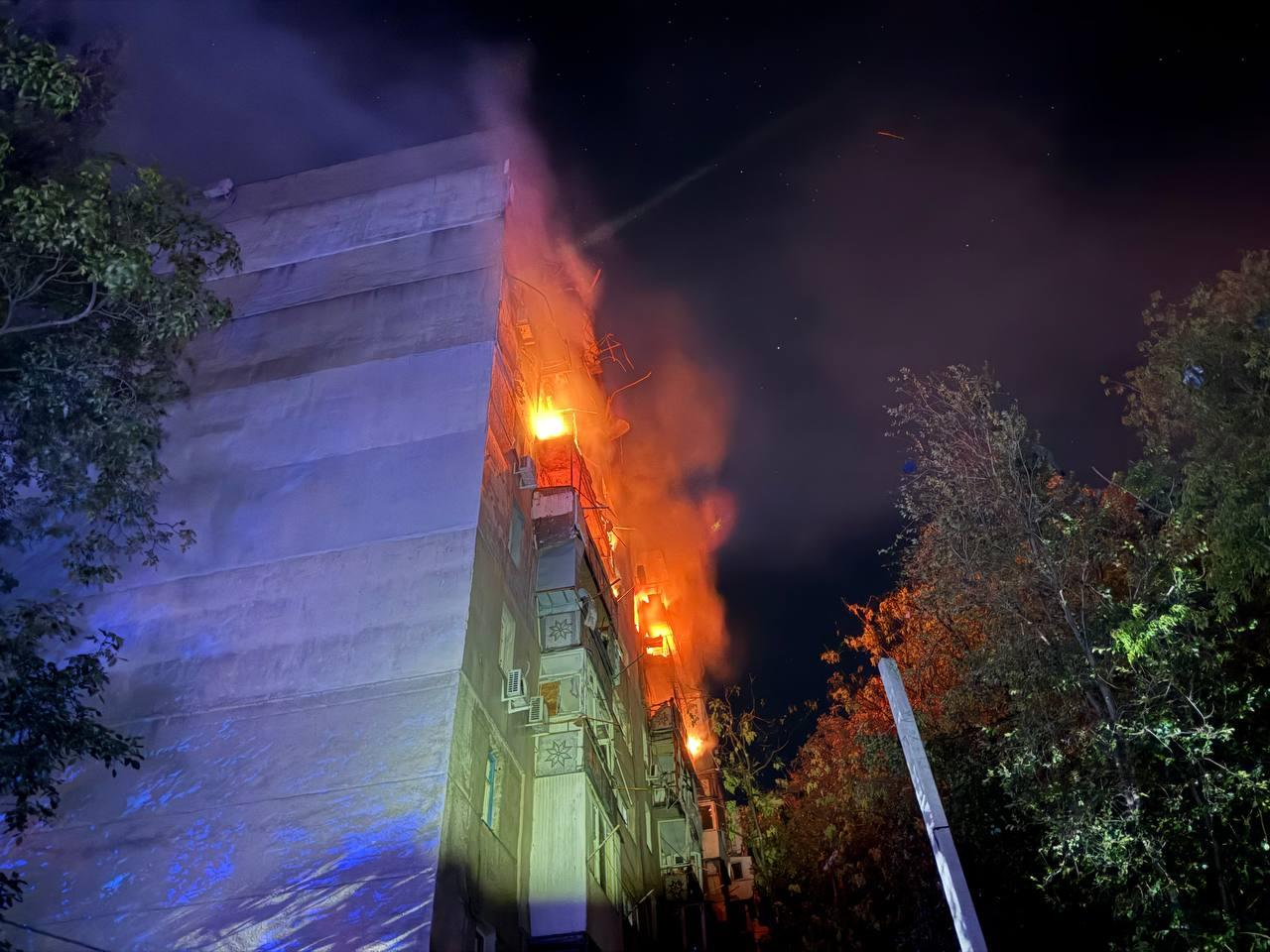
A fire engulfs a burning residential building following a Russian drone attack on Odesa overnight. (Hennadii Trukhanov/Telegram)
“Odesa was attacked by enemy strike drones—more than 20 UAVs approached the city from different directions,” Mayor Gennadiy Trukhanov wrote on Telegram, describing how “civilian infrastructure was damaged as a result of the attack.”
Emergency services rescued five people from burning apartments, but one rescued woman died from her injuries. The historic Black Sea port, known for its picturesque 19th-century architecture and UNESCO World Heritage status, has faced regular Russian strikes throughout the three-year war. Temporary shelter and relief were provided at a local daycare where operational headquarters deployed to coordinate the response.
The Odesa strike formed part of the broader 379-vehicle assault that targeted ten Ukrainian regions, demonstrating Russia’s continued focus on civilian infrastructure despite international condemnation and mounting sanctions pressure.
Pavlohrad’s Agony: Key Humanitarian Hub Suffers Most Massive Attack Since War’s Start
The industrial city of Pavlohrad in Dnipropetrovsk Oblast endured what Governor Serhii Lysak described as its “most massive attack” since the war began, with Russian missiles and drones striking the crucial humanitarian evacuation hub that serves displaced civilians fleeing front-line fighting.
“A hellish night and morning for Pavlohrad,” Lysak wrote on Telegram. “The most massive attack on the city. Explosion after explosion. Russian terrorists struck with missiles and drones.”
The assault damaged nine high-rise buildings, residential houses, and educational institutions, sparking fires throughout the city while police and aid workers responded to the destruction. Pavlohrad, formerly home to 100,000 residents, has become a critical transit point for refugees moving westward from areas threatened by Russian advances toward nearby Pokrovsk.
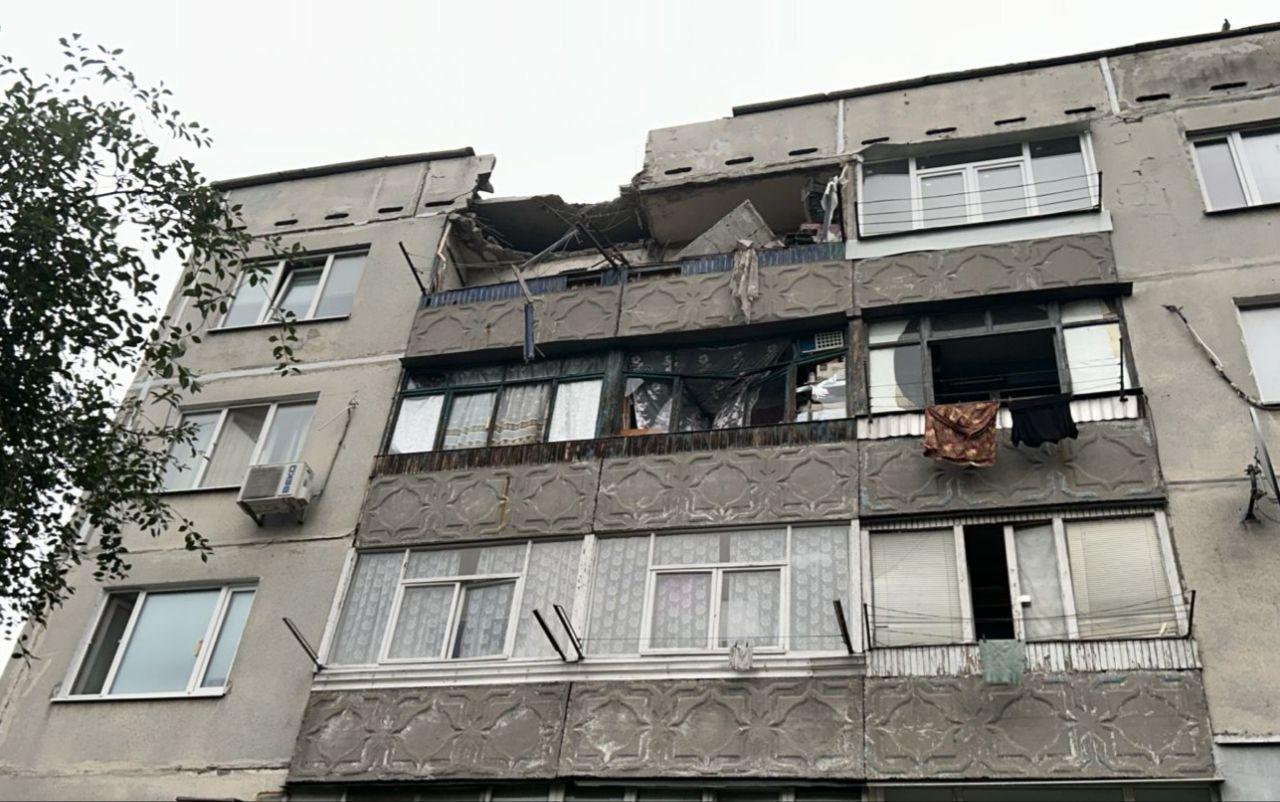
The aftermath of a Russian aerial attack on Pavlohrad, Dnipropetrovsk overnight. (Serhii Lysak/Telegram)
Located approximately 76 kilometers from the front lines, Pavlohrad represents a strategic target for Russian forces attempting to disrupt civilian evacuation routes and humanitarian operations. The city’s transformation into a refugee hub reflects the war’s expanding impact on civilian populations as Russian forces continue offensive operations in Dnipropetrovsk Oblast.
Moscow Burns: Fourth Consecutive Night of Ukrainian Drone Strikes Hits Russian Capital
Ukrainian drones targeted Moscow for the fourth consecutive night, with at least 21 drones launched toward the Russian capital since 6 p.m. local time on July 19. The sustained campaign forced temporary restrictions at all four Moscow airports, with arriving flights diverted to St. Petersburg as air defenses engaged the attacking drones.
Mayor Sergey Sobyanin reported emergency crews heading to scenes of downed drones, while Russian Telegram channels documented fires breaking out in Zelenograd, a satellite city 37 kilometers northwest of central Moscow. Videos posted on social media showed vehicles burning near residential buildings, with security camera footage revealing drone debris striking the upper floors of apartment complexes.
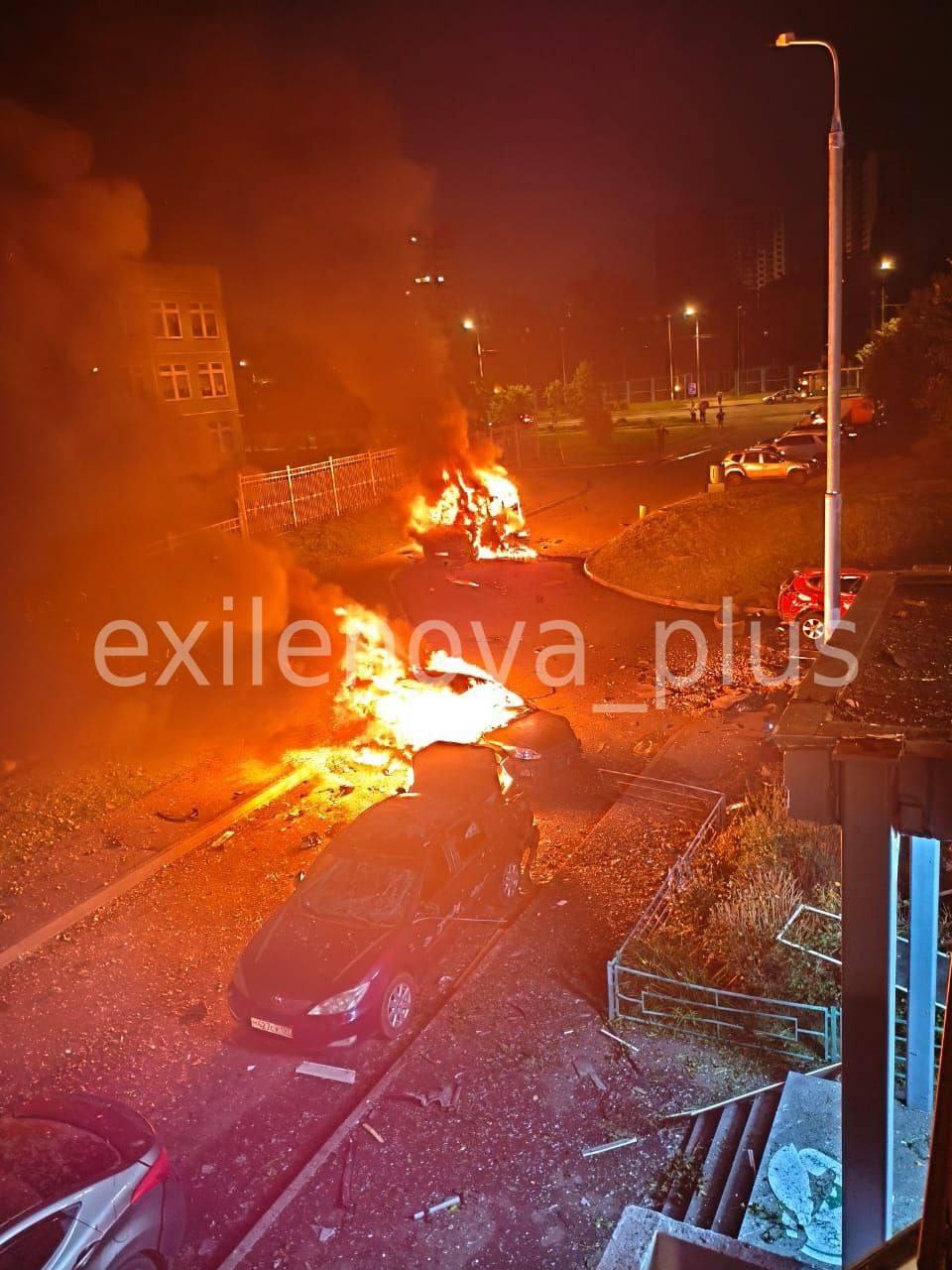
A purported image of vehicle fires in Moscow Oblast, amid a Ukrainian drone attack on the region. (Exilenova_plus/Telegram)
The Russian Defense Ministry claimed its air defenses shot down 93 Ukrainian drones, including 19 over Moscow Oblast and 16 en route to the region, with an additional eight drones allegedly intercepted during daylight hours on July 20. Flight restrictions remained in effect until approximately 4 a.m. local time before normal airport operations resumed.
The sustained attacks on Moscow demonstrate Ukraine’s growing capability to project force deep into Russian territory, potentially influencing both domestic Russian opinion and international diplomatic calculations about the war’s trajectory. The strikes coincide with President Trump’s 50-day ultimatum to Russia for peace negotiations.
Zelensky’s Diplomatic Gambit: Ukraine Proposes New Round of Peace Talks
President Zelensky announced that Ukraine has proposed a new round of peace talks with Russia for next week, with newly appointed National Security and Defense Council Secretary Rustem Umerov offering the Russian side a meeting. The proposal emphasizes Ukraine’s readiness for leadership-level dialogue while maintaining focus on prisoner exchanges and ceasefire arrangements.
“Dialogue with the Russian side on prisoner exchanges is ongoing—we are continuing to implement the agreements reached during the earlier meeting in Istanbul,” Zelensky stated in his nightly address. “Our team is currently working on another exchange.”
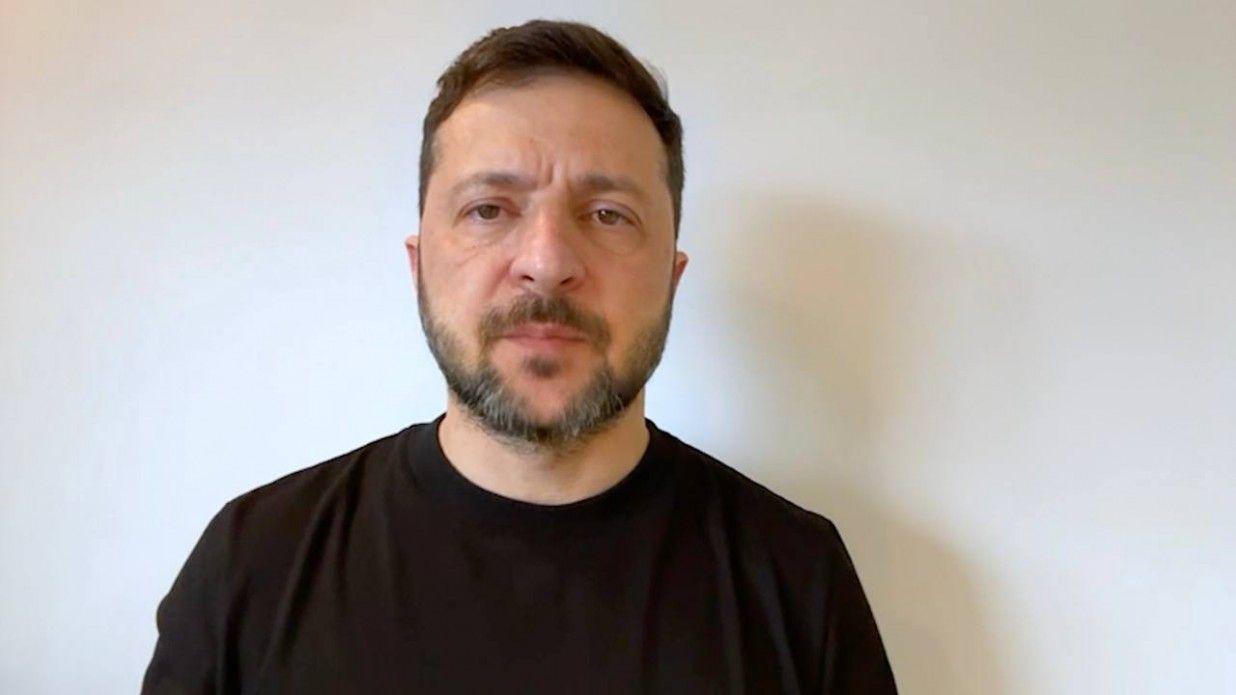
Zelensky delivers his nightly address. (President’s Office)
Zelensky stressed the urgency of accelerating negotiations, calling for immediate steps toward achieving a ceasefire. “Prisoner exchanges. Return of children. End to the killings. And a meeting at the level of leaders is needed to truly ensure peace—a really lasting one. Ukraine is ready for such a meeting.”
The announcement follows discussions between Turkish President Erdogan and Russian President Putin about resuming Ukraine-Russia talks in Istanbul. Previous bilateral meetings in May and June resulted in significant prisoner exchanges but failed to achieve meaningful ceasefire progress, with Russia rejecting Ukrainian proposals for extended truces.
Parliamentary Deliberations: Lawmakers Consider Easing Travel Restrictions for Young Men
The Verkhovna Rada is reviewing proposals to allow men aged 18 to 24 to travel abroad, potentially easing current wartime restrictions for those not subject to mobilization. Parliamentary Chairman Ruslan Stefanchuk announced the consideration of proposals from individual members and the Committee on National Security, Defense, and Intelligence.
“There are people aged 18 to 25 who are not subject to mobilization, but they cannot exercise their rights,” Stefanchuk explained. “We must find a mechanism to enable them to exercise their rights,” including pursuing education, work opportunities, or family reunification abroad.
Several liberalization proposals are under discussion, including establishing clear criteria and permitting specific categories of individuals to travel. Current martial law prohibits men aged 18 to 60 from leaving Ukraine without special exemptions such as university study abroad, humanitarian volunteering, or aid transportation duties.
The debate reflects growing pressure to balance military recruitment needs with fundamental rights for non-mobilized citizens. Lawmakers expect the committee to issue recommendations soon, though no final decision has been reached on comprehensive policy changes first discussed in 2023.
Geographic Sovereignty: Ukraine Standardizes Ukrainian Names for Foreign Places
Foreign Minister Andrii Sybiha announced a new initiative to standardize Ukrainian-language spellings of foreign geographic locations, returning names of Ukrainian origin to domestic usage. The Foreign Affairs Ministry will head the effort, which aims to promote Ukrainian spelling while respecting the country’s sovereign right to determine geographic terminology.
“This is about use in Ukraine. We do not impose anything on anyone,” Sybiha wrote on Facebook. “We will return names of Ukrainian origin to foreign geographical places in national use. After all, in Ukraine we say Berestya, not Brest. Bilhorod, not Belgorod.”
The initiative will include public debate and invitations for Ukrainians to suggest Ukrainian spellings for foreign places. The most popular public request involves referring to Russia as Moskoviia, a historical name used before 1721 when Moscow’s leadership conquered the lands of Kyivan Rus and adopted the term “Russia.”
Language has served as a cultural battleground throughout Ukrainian history, with Ukraine suffering linguistic suppression by Russian authorities over centuries. The standardization effort represents broader Ukrainian efforts to reclaim cultural identity and assert sovereignty over national terminology and geographic naming conventions.
Deportation Crisis: Ukraine Evacuates 43 Citizens Held at Russia-Georgia Border
Ukraine evacuated 43 citizens who had been deported from Russia and held in basement facilities along the Russia-Georgia border, according to Foreign Minister Sybiha. The deportees, primarily convicts lacking proper documentation, were transported through Moldova after being stranded without basic necessities including food, water, and sanitation.
“Russia is weaponizing the deportation of Ukrainian citizens through Georgia,” Sybiha wrote on social media. “We propose that Russia transport them directly to the Ukrainian border instead.”
Of 56 reported deportees held in a 17-bed transit facility since late June, 43 were successfully evacuated while Ukraine continues working with Georgian and Moldovan authorities to transport the remaining individuals. Rights groups warn that up to 800 Ukrainian citizens may face deportation in coming weeks, highlighting Russia’s systematic use of forced displacement as a warfare tactic.
Among the evacuated deportees was Andriy Kolomiyets, recognized as a political prisoner after serving 10 years in a Crimean penal colony on politically motivated charges related to his involvement in pro-Western Euromaidan protests. The case exemplifies Russia’s broader pattern of persecuting Ukrainian citizens for political activities.
Boxing Glory: Usyk Retains Heavyweight Title with Dominant Knockout Victory
Oleksandr Usyk retained his heavyweight championship with a spectacular fifth-round knockout of Daniel Dubois at Wembley Stadium, maintaining his undefeated professional record of 24 wins and no losses. The 38-year-old Ukrainian boxer from Crimea controlled the fight before delivering devastating blows that knocked down Dubois twice in the decisive round.

Oleksandr Usyk celebrates victory by knock out over Daniel Dubois at Wembley Stadium in London, England. (Richard Pelham/Getty Images)
“Glory to Ukraine!” Usyk proclaimed following his victory, dedicating the win “to all the people of the world” while expressing heartfelt gratitude to Ukrainian soldiers defending the homeland. President Zelensky congratulated the champion, saying, “Thank you for the strength, inspiration that you give to the whole country with each of your victories.”
Usyk became the undisputed heavyweight champion in 2024 with back-to-back victories and has now defended his title against Dubois for the second time since their 2023 meeting. The Olympic gold medalist from the 2012 London Games maintains an amateur record of 335 wins and 15 losses before turning professional in 2013.
Looking ahead, Usyk plans to “rest” while teasing a potential rematch with Tyson Fury. His victory provides Ukrainian morale a significant boost as the country continues defending against Russian aggression, with Usyk consistently using his platform to support Ukraine’s war effort.
Government Reorganization: Updated National Security Council Composition Announced
President Zelensky announced the updated composition of Ukraine’s National Security and Defense Council following the country’s comprehensive government reshuffle. While the council’s structure remains largely unchanged, key appointments reflect the administration’s focus on defense coordination and international partnerships.
Rustem Umerov, formerly defense minister, officially assumed the secretary position, replacing Oleksandr Lytvynenko, who is reportedly under consideration for an ambassadorial role in Serbia. Returning members include Prime Minister Yuliia Svyrydenko and new Defense Minister Denys Shmyhal, both previously serving on the council.
Oleksii Sobolev joined as a notable newcomer, recently appointed to lead a newly created agency combining the economy, ecology, and agriculture ministries. The council serves as Ukraine’s primary coordinating body for military, security, and foreign policy decisions amid the ongoing Russian invasion.
The reorganization reflects Zelensky’s efforts to streamline defense coordination while maintaining institutional continuity. Umerov’s appointment leverages his experience in international defense partnerships and peace negotiations, positioning him to oversee complex security challenges and diplomatic initiatives.
Defense Innovation Summit: Shmyhal and Fedorov Discuss Battlefield Technology Expansion
Newly appointed Defense Minister Denys Shmyhal met with Digital Transformation Minister Mykhailo Fedorov to discuss scaling up battlefield technologies that have proven effective in combat, particularly interceptor drone systems. The meeting focused on expanding successful anti-Shahed solutions and accelerating weapons production capabilities.
“This technology has made an incredible breakthrough, and the number of successfully downed Shaheds is growing rapidly every month,” Shmyhal stated. “It is important to find and quickly scale anti-Shahed solutions. This is the task set by the president.”
The officials addressed weapons production expansion and deployment of new systems capable of shifting front-line dynamics. Discussions included deregulation in drone transfer and decommissioning processes to ensure military units receive necessary equipment without bureaucratic delays.
Fedorov highlighted the development of the “Army of Drones: Bonus” program and improving decision-making based on high-quality data analysis. The collaboration reflects Zelensky’s mandate for new leadership to boost domestic weapons production amid Russia’s continued aggression and growing international demand for Ukrainian defense innovations.
German Warning: Russia Aims for Simultaneous Launch of 2,000 Drones
German Major General Christian Freuding warned that Russia aims to achieve the capability of launching 2,000 drones simultaneously against Ukraine, representing a massive escalation in aerial warfare capacity. Freuding, who heads the Ukraine task force at the German Defense Ministry, described the staggering figure as Moscow continues expanding drone production capabilities.
The warning aligns with Ukrainian Foreign Intelligence Service reports that Russia plans to produce 2 million first-person-view drones and 30,000 long-range and decoy drones in 2025. Russian drone attacks have already escalated dramatically, with June seeing a record 5,337 Shahed-type drones launched against Ukrainian targets.
“Ukraine can indirectly counter anticipated drone attacks by targeting production sites with long-range missiles,” Freuding explained, emphasizing the importance of striking Russian manufacturing capabilities. Ukraine regularly targets military production facilities but continues requesting additional long-range weaponry from Western allies.
The projection underscores the war’s technological evolution and Russia’s commitment to overwhelming Ukrainian air defenses through sheer numerical superiority. Ukrainian commanders have warned that Russian Shahed attacks could escalate to 1,000 per day, necessitating expanded air defense capabilities and production of interceptor systems.
Front Line Dynamics: Mixed Results Across Multiple Combat Sectors
Russian forces maintained offensive pressure across multiple fronts while achieving limited territorial gains amid continued Ukrainian resistance. In the Pokrovsk direction, Ukrainian forces demonstrated resilience by advancing in northern Mykolaivka while Russian forces claimed progress west of Novoekonomichne, reflecting the contested nature of this critical sector.
Commander-in-Chief Oleksandr Syrskyi reported that Russian forces focus primarily on Pokrovsk and Novopavlivka directions but Ukrainian defenders are holding despite intensified pressure. Russian forces continue attacking in small fire teams while unsuccessfully attempting to seize Pokrovsk, with Ukrainian forces repelling sabotage and reconnaissance groups attempting to penetrate the city.
In the Novopavlivka direction, Russian forces achieved confirmed advances in northeastern Voskresenka, though Ukrainian military sources reported tactical changes in Russian assault patterns. Enemy forces have reduced assault group sizes from four to six soldiers to fire teams of two to three soldiers, while shifting from motorcycle assaults to using motorcycles for ammunition transport.
Across other sectors including Chasiv Yar, Toretsk, and Velyka Novosilka, Russian forces maintained pressure without achieving significant territorial gains. Ukrainian counterattacks continued near Kindrativka and Oleksiivka in northern Sumy Oblast, while Russian attempts to establish buffer zones along the international border faced sustained resistance.
Civilian Infrastructure Under Siege: Critical Damage Across Ten Ukrainian Regions
The massive Russian assault affected ten Ukrainian regions, causing critical infrastructure damage that left thousands without electricity and disrupted essential services. Sumy Oblast suffered significant damage to critical infrastructure, leaving several thousand families without power, while strikes against Pavlohrad damaged vital infrastructure supporting humanitarian operations.
Emergency services across affected regions mobilized to address widespread damage, with rescue operations continuing in multiple locations. The coordinated nature of the attacks, targeting both military and civilian infrastructure, demonstrates Russia’s strategy of degrading Ukrainian resilience through comprehensive strikes against essential services.
The assault’s scale and geographic distribution reflect Russian attempts to overwhelm Ukrainian air defenses while maximizing psychological impact on civilian populations. Despite the massive scale of the attack, Ukrainian air defense systems achieved remarkable success rates, preventing catastrophic damage that could have resulted from 379 attacking vehicles reaching their targets.
The strikes occur amid intensifying Russian aerial campaigns that have made June 2025 the deadliest month for Ukrainian civilians in three years, with 232 killed and 1,343 injured according to UN monitoring data.
Transport Disruption: Ukrainian Drones Force Four-Hour Train Suspension in Rostov
Ukrainian drone attacks forced Russian authorities to suspend train operations for approximately four hours overnight in the southern Rostov region, which borders Ukraine and serves as a critical transportation hub. The suspension injured one railway worker and stranded many passengers, causing mass delays throughout the regional rail network.
The attack on transportation infrastructure demonstrates Ukraine’s expanding capability to disrupt Russian logistics networks that support military operations. Rostov Oblast has served as a staging area for Russian forces throughout the war, making its transportation systems legitimate military targets under international law.
Air traffic over the region has been halted since the war’s beginning three years ago, reflecting the area’s vulnerability to Ukrainian strikes. The railway disruption adds to mounting evidence that Ukraine’s long-range strike capabilities are increasingly affecting Russian rear-area operations and logistical support for front-line forces.
The incident highlights the war’s expanding geographic scope, with Ukrainian forces demonstrating ability to strike targets hundreds of kilometers from the front lines while maintaining pressure on Russian infrastructure critical to sustaining military operations.
Belarusian Mobilization Preparations: Lukashenko Expands Vehicle Seizure Authority
Belarusian President Alexander Lukashenko signed a decree on July 18 authorizing the government to seize any “means of transport” for military use during mobilization and wartime, significantly expanding state powers over civilian assets. The decree encompasses cars, trains, ships, small vessels, unmanned aerial vehicles, motorcycles, all-terrain vehicles, wheeled tractors, and heavy road-building equipment.
The expanded seizure authority applies to both state vehicles and privately leased vehicles, granting Belarusian authorities broad powers to requisition civilian transportation assets for military purposes. The decree reflects Belarus’s continued integration into Russian-favorable frameworks and preparation for potential escalation of its involvement in regional conflicts.
Lukashenko’s action demonstrates Belarus’s role as a critical Russian ally in supporting Moscow’s war effort, providing both territorial access and logistical support for Russian operations. The vehicle seizure decree suggests Belarusian preparations for expanded military mobilization that could support Russian forces or defend against potential threats to the regime.
The timing of the decree coincides with intensifying Russian pressure on multiple fronts and suggests coordinated preparation between Moscow and Minsk for potential escalation of military operations requiring enhanced transportation and logistics capabilities.
Drone Deal Confirmation: Ukrainian PM Confirms Trump-Zelensky Agreement
Ukrainian Prime Minister Yuliia Svyrydenko confirmed on July 18 that President Trump and President Zelensky have reached agreement on future U.S. investment in Ukrainian drone production and American purchases of Ukrainian drones. The confirmation validates Zelensky’s earlier description of a potential “mega-deal” that would transform defense cooperation between the two countries.
Svyrydenko stated that Defense Minister Denys Shmyhal will continue technical agreements with U.S. counterparts, with Ukraine and the United States planning to sign a formal “drone deal” while discussing potential U.S. production of Ukrainian drone designs. The arrangement represents unprecedented cooperation between Ukrainian and American defense sectors.
Ukrainian drone companies have developed innovative cycles responding to Russian adaptations over three and a half years of warfare, creating battle-tested technologies that Western allies recognize as superior to many existing systems. The deal would provide Ukraine access to American markets while offering the U.S. military proven drone technologies developed under combat conditions.
The agreement reflects growing recognition that Ukrainian defense innovations, particularly in unmanned systems, represent cutting-edge capabilities that traditional defense industries have struggled to match. Ukrainian drone manufacturers currently have capacity to produce 4 million drones annually, with potential for 8 million given sufficient international investment.
Tactical Evolution: Russian Forces Adapt Assault Patterns Across Multiple Fronts
Russian forces demonstrated tactical adaptations across multiple combat sectors, with military sources reporting significant changes in assault patterns and troop deployment strategies. In the Novopavlivka direction, Russian forces reduced assault group sizes from four to six soldiers to fire teams of two to three soldiers, while shifting from motorcycle-based assaults to using motorcycles primarily for ammunition transport.
Ukrainian military sources reported that Russian forces now walk 10 to 15 kilometers to frontline positions for assaults after motorcycle transport, suggesting adaptation to Ukrainian defensive measures targeting vehicle-based attacks. Despite suffering significant daily losses, Russian forces maintain rapid personnel replenishment and combat capability restoration.
In the Chasiv Yar direction, Russian forces have regularly changed tactics over the past year, transitioning from intense small infantry group assaults to vehicle-supported operations during favorable weather, then resuming small infantry group assaults occasionally using motorcycles. Ukrainian sources report that newly mobilized Russian personnel receive only 24 days of training before deployment.
The tactical evolution reflects Russian military adaptation to Ukrainian defensive capabilities while maintaining offensive pressure through personnel rotation and modified assault techniques. Russian forces continue using armored and motorized vehicles to support assaults in some sectors while adapting to electronic warfare and drone threats in others.
Command Focus: Syrskyi Reports Russian Concentration on Two Key Directions
Commander-in-Chief Oleksandr Syrskyi reported that Russian forces are primarily focusing attacks on the Pokrovsk and Novopavlivka directions, though Ukrainian forces are holding positions despite intensified pressure. Russian forces continue attacking in small fire teams while unsuccessfully attempting to seize Pokrovsk, with Ukrainian defenders repelling sabotage and reconnaissance groups.
Syrskyi’s assessment highlights the concentration of Russian offensive efforts in sectors threatening strategic Ukrainian positions and supply lines. The Pokrovsk direction represents a critical axis for Russian attempts to advance toward Dnipropetrovsk Oblast, while Novopavlivka operations aim to expand Russian control in contested areas.
Ukrainian forces demonstrated tactical flexibility by advancing in northern Mykolaivka in the Pokrovsk direction while Russian forces claimed progress west of Novoekonomichne, reflecting the dynamic nature of combat in these sectors. The mixed results suggest neither side has achieved decisive advantage despite concentrated efforts.
Military Operations Detail: Kursk Strikes and Multi-Front Combat Activities
Ukrainian drone operators from a specialized regiment successfully struck a Russian Tor air defense system in the Kursk direction on July 18, demonstrating continued Ukrainian capability to target high-value Russian military assets across the border. The strike represents part of ongoing Ukrainian operations in Russian territory aimed at degrading air defense capabilities and logistics networks.
Fighting continued across multiple sectors in Kursk Oblast on July 18 and 19, with Russian forces conducting attacks in unspecified areas while Ukrainian forces maintained pressure on Russian positions. The cross-border operations reflect the war’s expansion beyond Ukraine’s internationally recognized borders into Russian territory.
In northern Sumy Oblast, Russian forces attacked near Kindrativka while Ukrainian forces conducted counterattacks near Kindrativka and Oleksiivka. Elements of the Russian 155th Naval Infantry Brigade and 76th and 106th Airborne Divisions reportedly operate in the sector, indicating continued Russian commitment to establishing buffer zones along the international border.
Russian forces maintained assault operations in Kharkiv Oblast near Lyptsi, Vovchansk, and Starytsya without achieving confirmed advances, while unconfirmed claims suggest Russian progress in the Velykyi Burluk direction. The mixed results across multiple fronts indicate sustained combat intensity without decisive breakthroughs by either side.
Looking Ahead: Diplomatic Openings Amid Escalating Violence
As Russia launches its largest combined strike since the war’s beginning while Ukrainian drones maintain pressure on Moscow for four consecutive nights, the contradiction between escalating violence and diplomatic initiatives underscores the conflict’s complex dynamics. Zelensky’s proposal for new peace talks, coupled with continued prisoner exchange negotiations, suggests Ukrainian readiness to pursue diplomatic solutions even amid intensifying Russian aggression.
The record-breaking scale of Russian attacks—379 vehicles in a single night—demonstrates Moscow’s rejection of Trump’s 50-day ultimatum while revealing both Russian production capabilities and Ukrainian defensive resilience. With air defenses successfully engaging 208 of 379 attacking vehicles, Ukraine’s defensive systems proved remarkably effective despite facing unprecedented assault volumes.
The war’s trajectory appears increasingly defined by competing escalation dynamics: Russian efforts to overwhelm Ukrainian defenses through massive attacks versus Ukrainian capabilities to strike deep into Russian territory and maintain defensive effectiveness. As diplomatic talks loom and military pressure intensifies, the coming weeks will test whether dialogue can emerge from the current cycle of escalating violence.