
Russia unleashed its third-largest aerial assault of the war while diplomatic tensions escalated across Europe and Moldova faced its moment of truth at the ballot box
The Story of a Single Day
On September 28, 2025—the 1,314th day of the war—Ukraine reached a new threshold of terror. In the pre-dawn darkness, monitoring stations across Ukraine detected something extraordinary unfolding. Five Tu-95 strategic bombers lifted off from Olenya airfield in Russia’s far north at 1:45 a.m. Minutes later, MiG-31K fighters scrambled from other bases. By 3:52 a.m., more Tu-95s were airborne from Engels. The machinery of Russia’s aerial arsenal was mobilizing for something massive.
What followed over the next twelve hours would become the third-largest combined missile and drone assault of the entire war—643 projectiles hurled at a nation already exhausted by years of bombardment. A twelve-year-old girl would die crushed under concrete. A nurse and patient would perish at a cardiology institute. Polish diplomats would discover missile debris piercing their embassy roof. And across Europe, unidentified drones would appear over military installations, prompting questions about security and sovereignty.
This single day captured the war’s evolution into something far beyond its original boundaries—a conflict where aerial weapons crossed international borders with impunity, where elections in small nations became battlegrounds for great powers, and where the line between war and peace had dissolved into a gray zone of constant threat.
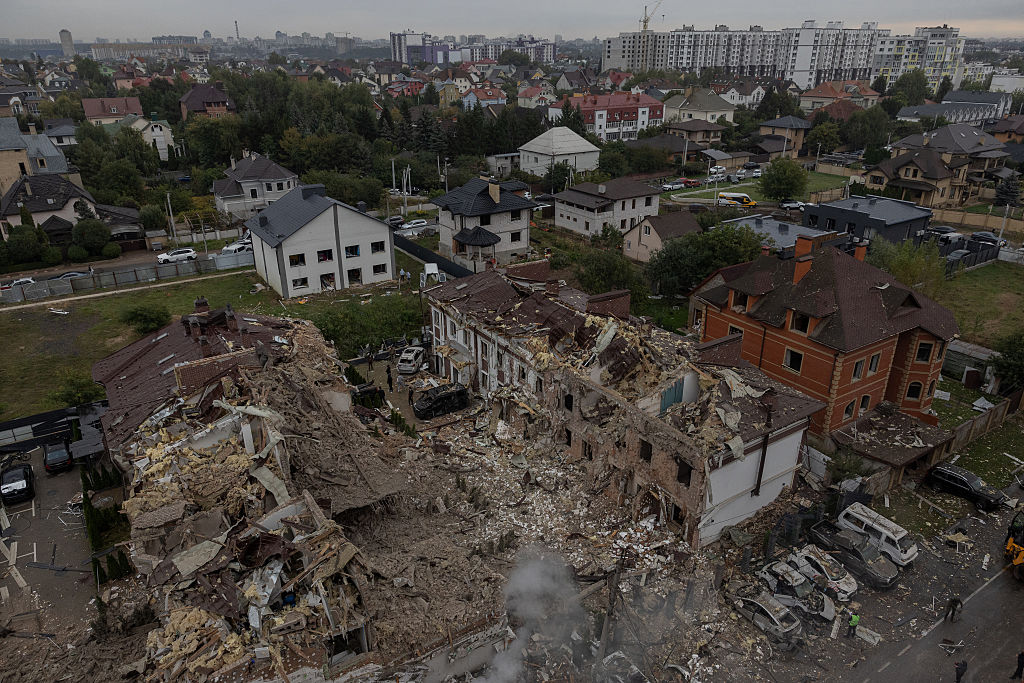
A general view shows destroyed residential buildings during a Russian air attack in Kyiv. An overnight Russian barrage on Kyiv killed at least four people, including a 12-year-old girl. (Roman Pilipey / AFP via Getty Images)
Twelve Hours of Thunder: The Assault Unfolds
The Ukrainian Air Force’s morning report on September 28 read like a catalog of Russia’s entire arsenal. Two Kh-47M2 Kinzhal aeroballistic missiles launched from Lipetsk Oblast. Thirty-eight Kh-101 cruise missiles from Saratov Oblast. Two Banderol drone-launched missiles from Kursk. Eight Kalibr cruise missiles from the Black Sea. And then came the swarm—593 Shahed-type, Gerbera-type, and other drones launched from multiple directions across Russia’s western regions.
The scale was staggering. Ukrainian air defenses responded with unprecedented intensity, downing 611 projectiles including 566 drones, both Banderol missiles, 35 Kh-101 cruise missiles, and all eight Kalibrs. But even the most sophisticated defense network cannot achieve perfection. Five missiles and 31 drones found their targets across sixteen Ukrainian locations, while debris from destroyed projectiles rained down on 25 others.
In Kyiv’s Solomianskyi district, residents heard the distinctive shriek of a diving drone at 4:37 a.m., followed immediately by explosion. Moments later, a five-story residential building erupted in flames. Black smoke billowed through the neighborhood as emergency crews raced toward the inferno. When they finally extinguished the blaze and searched through the rubble, they found a twelve-year-old girl crushed beneath a concrete slab—one of four deaths in the capital that morning.
The Cardiology Institute took a direct hit. A nurse and patient died in the attack, their lives ended not on a battlefield but in a place dedicated to healing hearts. Across seven districts of Kyiv, nearly twenty locations suffered damage. Mayor Vitali Klitschko stood amid the destruction, reporting fourteen injured in the capital alone, while another 28 people lay wounded in surrounding Kyiv Oblast, including three children.
The assault demonstrated a grim innovation in Russian tactics. In Konotop, city officials reported that Russian forces had adapted their drone strike methodology—circling Shahed-type drones over residential neighborhoods up to twelve times before striking, deliberately terrorizing residents rather than immediately attacking targets. It was psychological warfare integrated into kinetic operations, turning the drones’ distinctive buzzing engines into instruments of prolonged fear.
Over 2,500 civilians in Kyiv City lost gas service, and roughly 580 found themselves without electricity. Throughout the affected regions, more than 1,500 emergency responders and police officers worked across eleven oblasts. In Kyiv alone, crews operated at eight locations. Over 700 statements from citizens about damaged or destroyed property were recorded, with numbers continuing to rise throughout the day.
President Volodymyr Zelensky reported that Russian drones and missiles primarily struck civilian infrastructure in Kyiv City and Oblast and in Zaporizhia, Khmelnytskyi, Sumy, Mykolaiv, Chernihiv, and Odesa oblasts. The strikes lasted over twelve hours—a marathon of terror that forced millions into shelters while Russian projectiles methodically worked their way across Ukrainian skies.
The Southeastern Inferno: Zaporizhzhia Under Fire
While Kyiv endured its ordeal, the southeastern city of Zaporizhzhia faced its own catastrophe. Russian forces launched four separate waves of strikes throughout the night of September 28, employing an array of weapons including high-speed missiles and possibly multiple-launch rocket systems. At least eight missiles struck the regional capital, one smashing directly into a multi-story residential building.
The explosion triggered fires across multiple floors as residents scrambled to escape through smoke-filled stairwells. Emergency crews rescued dozens from the burning high-rise while firefighters battled blazes that had engulfed entire apartments. When the smoke finally cleared, the casualty count stood at 38 injured, including three children. Two of the children required hospitalization with serious injuries—one suffering from mine explosion wounds, another from carbon monoxide poisoning.
The attacks damaged nine private homes and fourteen high-rise buildings, along with a school and industrial facilities at a local enterprise. Regional Governor Ivan Fedorov reported that at least 30 residents of multi-story buildings had been injured, including three children. He surveyed the destruction and spoke with barely contained fury about the “dangerous night” that had transformed ordinary neighborhoods into war zones.
Regina Kharchenko, acting head of Zaporizhzhia City Council, captured the emotional devastation in stark terms: “Insidious tactics, an inhuman thirst for human suffering. Yesterday’s life still smolders in the windows—someone’s photographs, children’s toys, books. People have suffered, and the city is counting its wounds again.”
The assault on Zaporizhzhia represented more than military targeting—it demonstrated Russia’s willingness to strike deep into Ukrainian territory with overwhelming force against primarily civilian areas, underscoring what President Zelensky would later call “deliberate terror against ordinary cities.”
Across other Ukrainian regions, the strikes continued their destructive path. In Chernihiv, Dnipropetrovsk, Mykolaiv, Sumy, and Odesa oblasts, emergency services extinguished all fires. Robotic equipment was deployed to minimize risks to rescue workers. In total, Russian strikes damaged more than 100 civilian objects across Ukraine. The attack represented what Interior Minister Ihor Klymenko called “a protest against humanity, a public demonstration of hatred toward everything peaceful.”
Diplomatic Fallout: When Missiles Strike Embassies
Among the thousands of fragments and debris that fell across Ukraine that morning, one piece landed with particular diplomatic significance. A missile element or small-caliber rocket pierced through the roof of Poland’s embassy in Kyiv, crashing through the ceiling and landing in the embassy kitchen. Polish Foreign Ministry spokesperson Pawel Wronski told Polish outlet RMF24 that the damage was “not large,” with no casualties reported.
The incident marked another escalation in tensions between Russia and NATO countries. Polish fighter jets scrambled in response to the massive assault, closing airspace over Lublin and Rzeszow due to “unplanned military activity related to ensuring state security.” Poland’s Armed Forces Operational Command put air defense on high alert but reported no violations of Polish airspace during this particular assault.
Flight monitors reported that Poland closed the airspace over Lublin and Rzeszow due to “unplanned military activity related to ensuring state security.” The Polish embassy strike demonstrated that even the most protected diplomatic facilities remained vulnerable when hundreds of projectiles filled Ukrainian skies. It was a stark reminder that Russia’s assault recognized no special status for diplomatic properties, international law, or the conventions that traditionally governed warfare.
The Shadow War Over NATO Skies
While Ukraine absorbed the massive bombardment, reports emerged of unidentified drones operating within NATO airspace. The Danish Defense Command reported on September 28 that the Danish Armed Forces observed drones near multiple military facilities during the night. Multiple assets were deployed to monitor the situation, though the Defense Command offered no details about the drones’ number or origin and stated it would provide no further comment at this time.
The Danish Broadcasting Corporation reported drones being spotted near several military sites, including Karup Air Base, one of the country’s key air force facilities. The sightings underscored growing concerns about the security of NATO countries and the challenges they face in countering modern drone warfare.
The pattern suggested systematic probing of NATO’s defenses, testing response times and gathering intelligence on military installations. European officials maintained careful ambiguity about attributing blame, but the context was unmistakable. The accumulated incidents suggested a deliberate strategy—push boundaries, test resolve, and normalize violations of NATO airspace through repetition. Each drone sighting represented another test of NATO’s cohesion and willingness to enforce its own red lines.
Vance’s Frustration: When Russia Refuses to Talk
Against this backdrop of violence and violation, U.S. Vice President JD Vance stepped before cameras on September 28 to voice the Trump administration’s growing frustration with Moscow’s negotiating posture. His statement was blunt and revealing: Russia has “refused to sit down” in any bilateral meeting with Ukraine or trilateral meeting with Ukraine and the United States over recent weeks.
Vance’s assessment of the battlefield situation contained unusually candid criticism of Russia’s military performance. He stated that Russia’s economy is “in shambles,” that Russian forces are making “little, if any” gains on the battlefield, and that Moscow needs to “actually talk seriously about peace.” The “reality on the ground” has changed, Vance argued, with Russia killing and losing massive numbers of personnel without “much to show for it.”
The vice president confirmed that the administration was “looking at” providing Ukraine with Tomahawk cruise missiles—long-range weapons that could strike deep into Russian territory. “You asked this question about Tomahawks. It’s something the president is going to make the final determination on. What the president is going to do is what’s in the best interest for the United States of America,” Vance told Fox News. “I know we’re having conversations this very minute about the issue.”
But Vance’s comments also revealed American frustration with the entire negotiating dynamic. Russian Foreign Minister Sergei Lavrov reiterated on September 28 that Russia remained open to negotiations addressing the war’s “root causes”—Kremlin shorthand for demanding NATO withdrawal from Eastern Europe and Ukrainian capitulation to Russian territorial demands. Kremlin officials have consistently used “root causes” as code to reiterate Russia’s original war demands, which they have continuously asserted Russia will achieve either militarily or diplomatically.
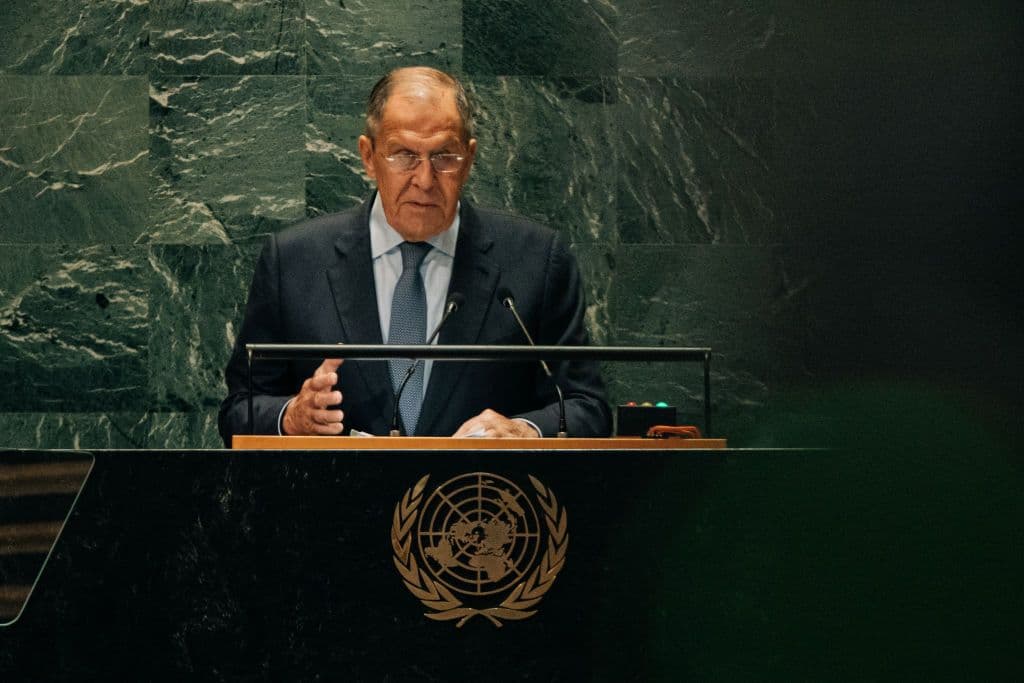
Sergey Lavrov, Russia’s foreign minister, speaks during the United Nations General Assembly (UNGA) in New York. (Jeenah Moon/Bloomberg via Getty Images)
Vance expressed the administration’s impatience clearly: “What we’ve seen over the last couple of weeks, the Russians have refused to sit down with any bilateral meetings with the Ukrainians. They’ve refused to sit down with any trilateral meetings where the president or some other member of the administration could sit down with the Russians and the Ukrainians.”
He added: “The Russians are not gaining a lot. This war is terrible for their economy, and they have to ask themselves how many more people are they going to have to lose and how many more people are they going to have to kill for very little military advantage. We hope the Russians actually wake up to reality on the ground.”
Lavrov’s Balkan Gambit: Threatening the Dayton Accords
While Vance criticized Russia’s refusal to negotiate on Ukraine, Lavrov was already opening another front in Moscow’s campaign to divide and distract Europe. Speaking on September 28, Lavrov announced that Russia’s upcoming United Nations Security Council presidency in October would be used to “review the implementation of the Dayton Accords”—the 1995 agreement that ended the Bosnian War.
Lavrov’s reasoning revealed the strategy’s cynical core. The Dayton Accords would likely “collapse,” he claimed, because they infringe on “the rights of the Serbian people.” He accused the West of “flagrant violations” and claimed that recognition of Kosovo’s independence constituted an attack on Serbian statehood. The accusations extended further: the West was attempting to “disintegrate Bosnia and Herzegovina’s statehood” and conducting attacks on “the vital interests of the Serbian people,” including Serbian Orthodoxy, in both Kosovo and Bosnia.
The timing was calculated. Russia maintains close relations with Republika Srpska, the Serbian political entity within Bosnia and Herzegovina. The Kremlin has previously leveraged its relationship with Republika Srpska to further influence the Balkans, sow divisions in Europe, and undermine the US-backed Dayton Accords to throw the Balkans into turmoil.
By threatening to use its UNSC presidency to undermine the Dayton Accords, Moscow was signaling its ability to destabilize an entirely different region just as Europe focused on Ukraine. If Western nations devoted resources and attention to preventing Balkan collapse, they would have less capacity to support Ukraine. If they ignored the Balkans, Russia could claim vindication for its narrative about Western hypocrisy.
The gambit demonstrated Russia’s strategic approach: open multiple fronts simultaneously, forcing adversaries to divide attention and resources, and exploit any signs of weakness or inconsistency in Western responses. The Dayton Accords threat represented information warfare, diplomatic maneuvering, and strategic positioning wrapped into a single provocative statement.
Moldova’s Moment of Truth: Democracy Under Siege
While missiles fell on Ukraine and diplomats traded accusations, the small nation of Moldova faced its own existential test. Parliamentary elections on September 28 would determine whether the country continued its path toward European Union membership or pivoted back toward Moscow’s orbit. President Maia Sandu’s warning as she cast her vote captured the stakes: “Moldova, our beloved home, is in danger and needs the help of each of you.”

Moldovan President Maia Sandu casts her ballot at the Petru Rares Theoretical High School, as she votes in the parliamentary election, in Chisinau. (Photo by Daniel Mihailescu/AFP via Getty Images)
The election unfolded under unprecedented pressure. Moldovan Prime Minister Dorin Recean reported on September 28 that large-scale cyberattacks targeted election infrastructure, including the Central Electoral Commission website and polling stations abroad. The attacks caused about 4,000 websites to go down, with one distributed denial of service attack coming from several countries simultaneously.
Moldova’s Information Technology and Cyber Security Service reported that cyberattacks targeted the country’s election infrastructure throughout the day. The targets included Moldova’s Central Electoral Commission website, government cloud service systems and process automation systems, as well as some voting stations abroad. Among the reported incidents were distributed denial-of-service attacks, including one orchestrated simultaneously from multiple countries, with over 16 million generated sessions designed to simulate real traffic and bypass protection systems. All attacks were detected and neutralized in real time without affecting the availability or integrity of electoral services, officials claimed.
The Moldovan Foreign Ministry reported bomb threats at polling stations in Belgium, Italy, Romania, the United States, and Spain. The ministry described these incidents as part of “the Russian Federation’s assault on the electoral process in the Republic of Moldova,” urging citizens to follow official guidance and continue voting despite the intimidation. State institutions were prepared for this scenario, with clear procedures established and cooperation with partners in other countries to ensure the electoral process was not affected.
Kremlin-linked Moldovan politicians moved swiftly to delegitimize the electoral process. Igor Dodon, a former president with close ties to Moscow, falsely claimed on September 28 that current President Sandu had discussed annulling the elections—a lie that Russian state media and milbloggers quickly amplified. Dodon called for peaceful protests outside parliament in Chisinau on the afternoon of September 29 to prevent Moldovan authorities from allegedly annulling votes.
A journalist with Moldovan outlet IPN reported that sources indicated the Patriotic bloc was calling for protests at 22:00 local time in Chisinau and attempting to bring demonstrators from Transnistria, the pro-Russian parastate in eastern Moldova. As of the day’s end, protests near the Moldovan Central Election Commission remained limited, with available footage showing only a few dozen demonstrators.
The Moldovan Police reported on September 28 that they had detained three people who were members of Transnistrian security forces. These individuals were coordinating, monitoring, and providing logistical support to groups preparing to provoke mass unrest in Moldova. Police found unspecified incendiary devices and flammable materials during the arrests.
As votes were counted, preliminary results showed Sandu’s pro-European Party of Action and Solidarity leading with over 46 percent against the Russia-friendly Patriotic Bloc’s 25 percent. The Central Electoral Commission reported that over 1.6 million people—52 percent of eligible voters—had cast ballots, including 278,000 Moldovans voting abroad.
The comprehensive nature of the interference operation—cyberattacks, bomb threats, illegal financing, trained provocateurs, and coordinated disinformation—revealed the scale of resources Moscow was willing to commit to pulling Moldova back into its sphere of influence. If the preliminary results held, they would represent a significant defeat for Moscow’s extensive meddling efforts.
The Grinding Front: Advances Measured in Meters
Amid the diplomatic maneuvering and aerial bombardment, the ground war continued its relentless progression. Russian forces achieved confirmed advances in two locations on September 28—modest gains that nevertheless represented weeks of brutal fighting and enormous casualties.
Near Lyman, geolocated footage published on September 28 showed Russian forces had recently advanced south of Zarichne. The spokesperson of a Ukrainian brigade operating in the area provided insight into the grim reality behind these territorial changes. Russian forces had been conducting infiltration missions into Zarichne for months, sending in five-soldier groups. Ukrainian drone strikes typically killed three, wounded one who survived, and left one lost or disoriented.
The spokesperson noted that Russian forces have not seized Zarichne but have been conducting infiltration missions into the settlement for months. The small number of Russian soldiers hiding within Zarichne and nearby Torske waited for drones to supply medication and provisions, but the Russian military command often prioritized sending Russian flags so soldiers could film propaganda videos claiming advances.
The spokesperson revealed that the Russian command frequently lied to its soldiers, falsely claiming that tanks were already operating within settlements or that positions had already been seized—only for soldiers to discover upon arrival that they were alone, surrounded, and waiting for supplies that might never come. The spokesperson stated that the Russian military command often lies to its soldiers, falsely claiming that Russian tanks are already operating within Torske and that Russian forces have already seized the settlement.
South of Novopavlivka, geolocated footage published on September 28 indicated that Russian forces had recently advanced south of Filiya. Ukrainian Dnipro Group of Forces Spokesperson Colonel Viktor Trehubov stated on September 28 that Russian forces in the Novopavlivka direction continued efforts to infiltrate and bypass Ukrainian defenses in small groups, trying to establish footholds in settlements along the Donetsk-Dnipropetrovsk Oblast border.
Trehubov noted that the open terrain in the area proved unfavorable for assaults and that Russian forces would struggle to find concealment in windbreaks as foliage began to fall. He observed a significant shift in Russian deployment patterns: elements were being redeployed from southern Ukraine to eastern fronts. Previously, the Russian command had drawn reinforcements from Russia itself or from third and fourth lines of defense in occupied territories. Trehubov assessed that this shift indicated Russia was suffering from a personnel shortage.
Elsewhere across the front on September 28, Russian forces launched attacks in multiple directions without achieving confirmed advances. Ukrainian forces recently maintained positions or advanced in northern Sumy Oblast, with geolocated footage indicating that Russian claims of seizing positions southeast of Andriivka were false. A Ukrainian brigade operating in Sumy Oblast reported that its electronic warfare specialists intercepted 2,310 Russian drones in September, with conventional first-person view drones accounting for roughly 70 percent of Russian drones in the area. The brigade stated that Russian forces are using fiber optic FPV drones but are facing limitations in training fiber optic drone operators.
Near Kharkiv, Russian forces attacked toward Lyptsi and near Vovchansk and Synelnykove on September 28 without advancing. In the Kupyansk direction, attacks on September 28 targeted Doroshivka, Kindrashivka, Kolodyazne, Petropavlivka, Stepova Novoselivka, and Pishchane. Near Siversk, Russian forces attacked the settlement itself and areas to its northwest, northeast, and southwest on September 28 without confirmed gains.
In the Pokrovsk direction, Russian forces attacked on September 28 near two dozen settlements but achieved no confirmed advances. A Ukrainian brigade spokesperson reported that Russian infantry continued attacking in small assault groups once or twice daily. The increasing range of Russian strike drones was expanding the “kill zone”—the area near the frontline where concentrated tactical strike and reconnaissance drones posed elevated risks to any equipment or personnel. The spokesperson noted that Russian forces also suffered from logistics problems and had to deliver supplies on foot in small groups to avoid Ukrainian drone detection.
A Ukrainian brigade spokesperson operating in the Toretsk direction reported that Russian forces had suffered almost 60,000 casualties in over fourteen months of fighting in that direction—a testament to the grinding nature of this war of attrition.
The cumulative picture revealed a front line where neither side could achieve decisive breakthrough but where Russia continued trading enormous casualties for meter-by-meter advances. The grinding nature of the conflict had created a war of attrition where tactical innovations—particularly in drone warfare—determined which side could sustain operations despite horrific losses.
Ukraine’s Counterstrike: Intelligence Operations and Artillery
While absorbing Russia’s massive aerial assault, Ukrainian forces demonstrated their own strike capabilities. Ukraine’s Main Intelligence Directorate reported on September 28 that its elements had set off an explosion at a Russian military base in occupied Melitopol, Zaporizhia Oblast. The GUR reported that it destroyed a vehicle and killed at least four Russian drone operators. The video provided by HUR showed the van exiting a facility but didn’t show the explosion.
The Melitopol operation demonstrated Ukraine’s continuing ability to conduct operations in occupied territories, disrupting Russian logistics and targeting critical military personnel. Drone operators had become particularly valuable targets—specialists trained in operating the reconnaissance and strike drones that dominated frontline operations.
Ukrainian HIMARS rockets reportedly struck a thermal power plant near the Russian city of Belgorod on September 28, Russian media channels reported. Power outages were reported across Belgorod Oblast following the attack on one of the substations. Belgorod Oblast Governor Vyacheslav Gladkov confirmed a strike on critical infrastructure and significant power outages, though no information on damage extent was available.
An open-source analyst reported on September 28 that satellite images confirmed Ukrainian forces had destroyed one An-26 transport aircraft and damaged one Be-12 maritime patrol aircraft in occupied Crimea. The analyst also noted that satellite imagery showed Ukrainian forces had destroyed one Mi-8 helicopter and damaged another at Simferopol Airport.
The Nuclear Shadow: ZNPP Without Power
A more ominous situation continued developing at the Zaporizhzhia Nuclear Power Plant. Ukrainian Foreign Minister Andriy Sybiga stated on September 28: “As a result of Russian actions, the Zaporizhzhia NPP has been without power for the fourth day.” Russia said the power plant had been receiving backup power supply, with the Moscow-backed operator of the station saying emergency diesel generators were providing power for the plant’s needs.
Greenpeace Ukraine reported on September 27 that satellite imagery showed damage to the last ZNPP power line two to five kilometers north of the distribution station, but crucially, there had been no shelling or strikes against the power line before it lost connection. This suggested that Russian forces had conducted sabotage against the line.
Russia’s Moscow-backed operator stated there were sufficient diesel reserves to operate for an extended period. Greenpeace Ukraine warned that emergency diesel generators were considered a last line of defense to be used only in extreme circumstances. The organization claimed Moscow could use the crisis to try and reconnect the plant to the temporary Russian-occupied grid of Ukraine.
The plant’s six reactors have been shut down since Moscow took over, but the plant needs power to maintain cooling and safety systems, which prevent reactors from melting—a danger that could set off a nuclear incident. Operating on generators for extended periods increased risks of mechanical failure or fuel depletion—scenarios that could trigger precisely the nuclear incident both sides claimed to want to avoid.
Zelensky’s Call: Shadow Fleet as Weapon Platform
President Zelensky condemned the assault in his evening address on September 28: “In the space of more than 12 hours, Russia launched a massive attack on Ukraine—brutal strikes, a deliberate and targeted terror against ordinary cities.” He reported the assault included nearly 500 strike drones and more than 40 missiles, including Kinzhal hypersonic weapons.
Zelensky noted that the attack was timed to coincide with the end of UN General Assembly week: “This cowardly attack effectively capped the week of the UN General Assembly, and it shows Russia’s true stance. Moscow wants to keep fighting and killing and deserves the harshest pressure from the world.”
The president made a striking allegation based on intelligence reports: Russia’s shadow fleet of oil tankers was being used to “launch and control” Russian drones over European cities. “It is especially important that the sanctions hit Russia’s energy trade and the entire infrastructure of the Russian tanker fleet painfully,” Zelensky said. “This is further evidence that the Baltic Sea and other seas should be closed to Russian tankers, at least for the shadow fleet.”
If confirmed, the allegation suggested Russia was weaponizing civilian shipping infrastructure, turning commercial vessels into mobile drone command centers that could operate with impunity in international waters. Zelensky called for strong steps from the United States and urged everyone who wanted peace to support efforts to stop Russian imports.
Zelensky also vowed that Ukraine would continue to strike back to deprive Russia of resources to fund the war: “We will continue to strike back to deprive Russia of these earning opportunities and to force it to diplomacy.” He urged the United States, Europe, the G7 and the G20 to take firm action.
Hungary and Slovakia: Energy Dependence as Vulnerability
On September 28, Hungarian Prime Minister Viktor Orban and Slovak Prime Minister Robert Fico renewed their criticism of European Union efforts to reduce dependence on Russian energy. Speaking at the 130th anniversary of the Maria Valeria Bridge linking their countries, both leaders defended their continued imports of Russian oil and gas.
Fico stated: “No one should tell us where to buy oil and gas from. Because under international law, it is a sovereign country that decides its energy mix.” He added: “I share the views of the prime minister of Hungary that the political ideological decision to cut off Europe entirely from Russian oil and gas will not only harm Hungary and Slovakia the most, but will significantly damage the entire European Union.”
Orban accused Brussels of becoming “a war project,” claiming: “Just like the old empires that ruled us, now the European Union has become a war project. Now, when Brussels talks about peace in Europe, it actually means war.”
Their statements came as the European Commission announced it was preparing to introduce tariffs on Russian oil imports still flowing into the EU via Hungary and Slovakia. The positions of both leaders illustrated how energy dependence could constrain national responses to Russian aggression, creating divisions within the alliance that Moscow could exploit.
Hungary and Slovakia remain among the few European countries still importing Russian oil and gas. Their leaders’ criticism underscored the challenges facing European unity on sanctions policy, with geographical and infrastructure constraints making transitions away from Russian supplies difficult for some member states.
Lavrov’s Diplomatic Theater: The Third Round
Russian Foreign Minister Sergei Lavrov claimed on September 28 that he had agreed with U.S. Secretary of State Marco Rubio to meet for a third round of talks. Lavrov claimed that the upcoming meeting with Rubio was intended to eliminate what he described as “irritants” in Washington-Moscow relations. The U.S. had not confirmed Lavrov’s claim over the upcoming meeting as of the day’s end, and Kremlin-controlled media Interfax Russia, which quoted Lavrov, did not specify the date.
The claim came amid an apparent shift in diplomatic dynamics, with both sides acknowledging the need for dialogue while maintaining fundamentally opposed positions on Ukraine’s future.
The Day’s True Measure: Terror as Policy
When the air raid sirens finally fell silent and emergency crews tallied the damage, the numbers painted a portrait of deliberate civilian targeting. At least four people killed, including a twelve-year-old girl. Over 70 injured across Ukraine. More than 100 civilian objects damaged. Nearly 20 locations in Kyiv alone bearing scars from Russian projectiles.
The psychological dimension of the assault extended beyond immediate casualties. In Konotop, officials reported Russian forces circling drones over neighborhoods up to twelve times before striking—deliberately prolonging terror rather than simply destroying targets. Across Ukraine, air raid alerts had blared for more than twelve hours, forcing millions into shelters while Russian projectiles methodically worked their way across Ukrainian skies.
This was terror as deliberate policy, calculated to exhaust populations, degrade morale, and demonstrate that no corner of Ukraine could find safety from Russian reach. The debris that fell on 25 locations beyond the 16 directly struck illustrated another dimension—even successful air defense created cascading damage as destroyed drones and missiles rained fragments across populated areas.
The twelve-year-old girl crushed under concrete in Kyiv’s Solomianskyi district became the day’s most haunting symbol—innocence destroyed by projectiles launched from thousands of kilometers away, her death a deliberate byproduct of Russia’s strategy of terrorizing civilian populations. The nurse and patient who died at the Cardiology Institute represented another dimension of the same cruelty: healing institutions transformed into targets, medical professionals killed while caring for the sick.
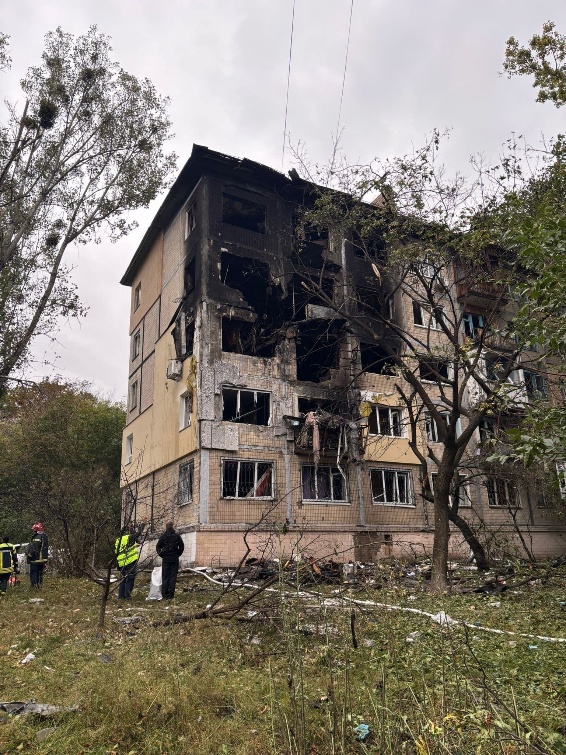
One of the attack sites from the latest Russian attack overnight. (Photo: Alex Cadier)
Interior Minister Ihor Klymenko reported that police were meticulously documenting evidence of Russian war crimes, having already received over 700 statements from citizens about damaged or destroyed property. The number of reports continued to rise as rescue operations proceeded.
When Everything Converges
September 28, 2025, captured the war’s complete transformation from localized conflict to continental crisis. A single day witnessed the third-largest aerial assault of the war, diplomatic tensions escalating across NATO’s frontier, Moldova’s democratic institutions under coordinated assault, the Balkans threatened with renewed instability, and a nuclear power plant operating on emergency generators while sabotage suspicions mounted.
The 643 projectiles that crossed Ukrainian skies represented more than military operations—they demonstrated Russia’s willingness to terrorize civilian populations while simultaneously pushing diplomatic boundaries across Europe. Each drone sighting over NATO bases, each cyberattack on Moldovan election infrastructure, each threat to reopen Balkan conflicts served the same strategic purpose: divide attention, exhaust resources, and demonstrate that Moscow would escalate across multiple domains simultaneously.
For Ukraine, the day revealed both resilience and vulnerability. Air defenses destroyed 95 percent of incoming projectiles, yet the five percent that penetrated killed a twelve-year-old girl and wounded dozens more. Ukrainian forces continued striking Russian infrastructure from Melitopol to Belgorod, yet Russian forces achieved meter-by-meter advances through sacrificing staggering casualties. Moldova’s democratic institutions survived Russian interference, yet the scale of that interference demonstrated Moscow’s commitment to rolling back European integration wherever possible.
As night fell on September 28, emergency crews were still pulling survivors from rubble, doctors were still treating the wounded, and Polish diplomats were still examining missile debris in their embassy kitchen. In Moldova, votes were being counted in an election that might determine whether a small nation could resist great power coercion. Across NATO countries, intelligence analysts were reviewing footage of unidentified drones and preparing assessments of Russian intentions. At the Zaporizhzhia Nuclear Power Plant, diesel generators continued their monotonous rumble, each hour of operation another increment of risk.
The day had demonstrated what modern war had become: not armies clashing on defined battlefields, but projectiles crossing continents, infrastructure targeted for psychological effect, democracy itself weaponized through cyberattacks and trained provocateurs, and nuclear facilities held hostage while diplomatic conferences debated responses. The war that began with tanks crossing borders had evolved into something far more complex and dangerous—a multidimensional conflict where the boundaries between war and peace, military and civilian, national and international had dissolved entirely.
For the twelve-year-old girl buried under concrete, for the families mourning in Kyiv and Zaporizhzhia, for the emergency crews working through the night, the abstractions of strategy and geopolitics meant nothing. They lived and died in the immediate reality of explosions, flames, and falling debris. Their suffering was the true measure of September 28, 2025—a day when 643 projectiles transformed ordinary lives into casualties of a war that recognized no limits and respected no boundaries.