
As US Senators Condemn State Department Layoffs of Russia Experts, Ukraine’s Intelligence Eliminates Drone Crews While Parliament Reshapes Government Amid Escalating Russian Terror
Summary of the Day – July 16, 2025
The mechanisms of modern warfare revealed their dual nature on July 16, as institutional knowledge was systematically dismantled in Washington while tactical innovation flourished on Ukrainian battlefields. US senators erupted in fury over State Department layoffs that eliminated experienced Russia and Ukraine analysts just as Moscow intensified its terror campaign with 400 overnight drones. Meanwhile, Ukraine’s parliament voted to dismiss Prime Minister Denys Shmyhal’s government, setting the stage for a major cabinet reshuffle that could see the longtime premier become defense minister. Across the war zone, Ukrainian intelligence operatives eliminated Russian drone crews in occupied territory while civilians in multiple regions faced the latest wave of Russian bombardment, underscoring the deadly contradiction between diplomatic retreat and military necessity.
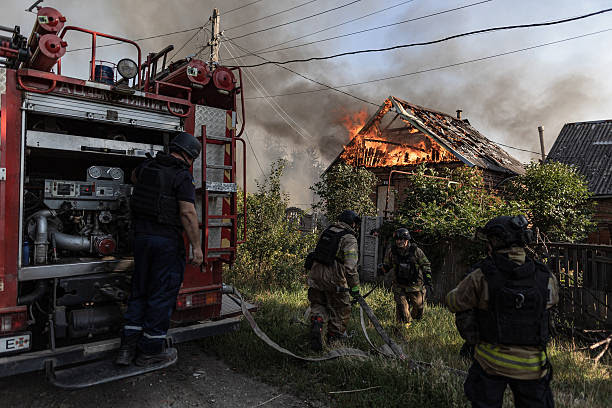
Ukrainian emergency service workers extinguish a fire in three houses after Russian shelling on the city of Kostiantynivka, Donetsk Oblast. (Diego Herrera Carcedo/Anadolu via Getty Images)
Institutional Vandalism: America Guts Its Russia Expertise as War Intensifies
Democratic senators unleashed withering criticism of the State Department during a Foreign Relations Committee hearing, condemning recent mass layoffs that eliminated seasoned intelligence analysts specializing in Russia and Ukraine. The controversy stems from a “reduction in force” that gutted the Bureau of Intelligence and Research (INR), the department’s intelligence arm responsible for guiding US diplomacy.
Senator Jeff Merkley (D-OR) questioned the administration’s priorities, highlighting the abrupt termination of personnel actively engaged in countering Russian propaganda and investigating war crimes in Ukraine. “Promoting Russian propaganda is not a value that our State Department should be promoting,” Merkley declared. “Our value is now that we don’t care about war crimes? I don’t think that’s an American position.”
Senator Chris Coons (D-DE) lamented the loss of approximately 1,300 professionals, specifically “intelligence analysts with decades of experience on Russia and Ukraine.” Coons described the reorganization as “sloppy, rushed,” emphasizing that it has “cost us decades of relevant, critical experience.”
The timing proved particularly damaging, as Senator Jeanne Shaheen (D-NH) noted chaotic examples including staff supporting Secretary Rubio’s overseas trip being cut while he was still en route home. The cuts extended beyond Ukraine expertise to include specialists in consumer fraud prevention, Afghan relocation, money laundering, quantum technology, and artificial intelligence.
Deputy Secretary Michael Rigas defended the reforms while acknowledging a critical limitation: “the caveat being there is a government-wide hiring freeze right now,” which Senator Coons pointed out effectively means no immediate re-employment for dismissed experts.
Terror from Above: 400 Russian Drones Pummel Ukrainian Cities
Russian forces launched their most intensive drone assault in recent weeks, deploying 400 drones against Ukrainian cities overnight, including up to 255 Shahed-type “kamikaze” drones and one Iskander-M ballistic missile. The massive barrage struck twelve locations across the country, demonstrating Moscow’s commitment to terror tactics despite mounting international pressure.
In Kharkiv, at least 17 explosions occurred within just 20 minutes as Russian drones concentrated on a civilian enterprise in the city’s Kyivskyi district. The strikes ignited fires and injured a 54-year-old man, while Shahed drones systematically targeted the facility.
Kryvyi Rih in Dnipropetrovsk Oblast suffered waves of drone attacks that resulted in large-scale power outages and injured a 17-year-old boy. Energy infrastructure bore the brunt of the assault, with restoration efforts continuing throughout the day.
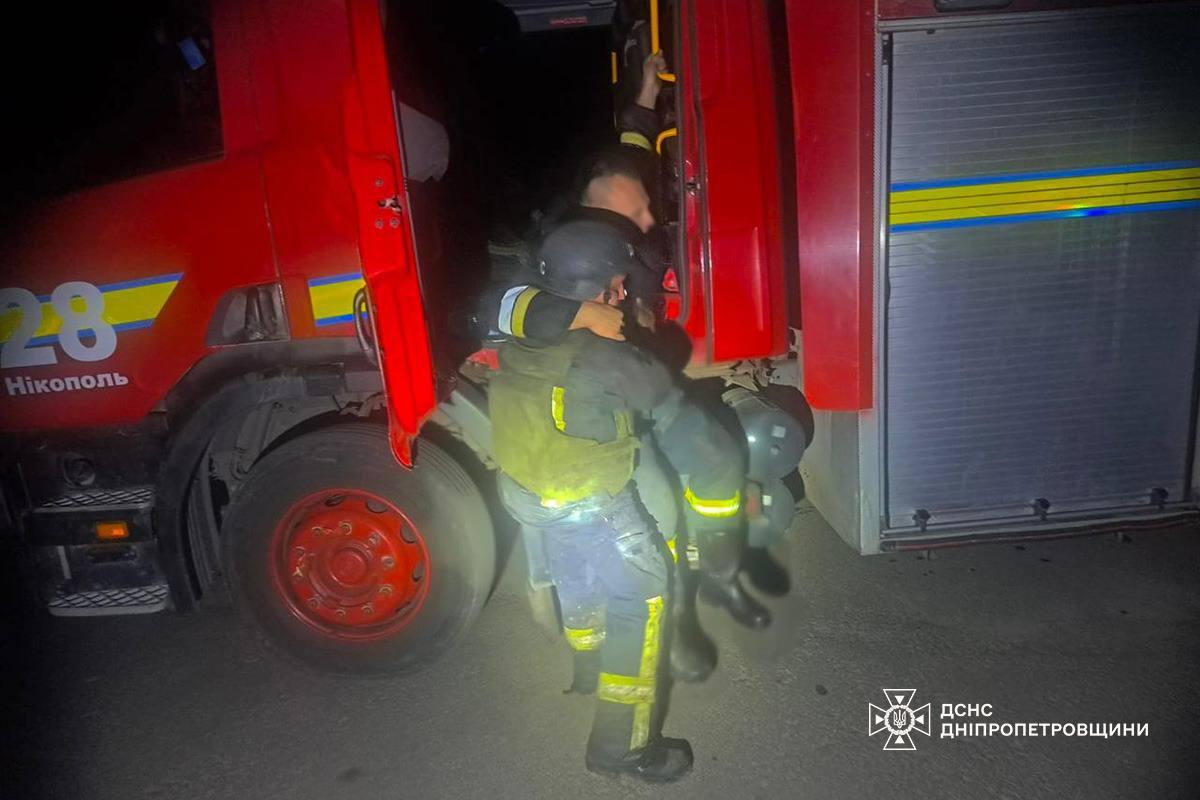
An emergency worker assists an injured colleague amid a Russian double-tap drone attack on the city of Nikopol in Dnipropetrovsk Oblast. (Ukraine’s State Emergency Service)
Vinnytsia Oblast experienced eight injuries as drones struck two industrial facilities, causing large-scale fires and damaging four residential buildings. Polish Foreign Minister Radoslaw Sikorski confirmed that Russian drones had struck the Barlinek Group factory, a Polish-owned facility in the region, noting that “the head of the plant told me a while ago that it was intentional, from three directions.”
Ukrainian air defenses shot down 198 drones, while 145 decoy drones disappeared from radars or were intercepted by electronic warfare systems. The scale of the attack underscored Russia’s strategy of overwhelming Ukrainian defenses through sheer volume rather than precision.
Government in Transition: Parliament Dissolves Cabinet as War Reshapes Leadership
Ukraine’s parliament voted 261 to 4 to dismiss Prime Minister Denys Shmyhal’s government, initiating a major cabinet reshuffle that President Volodymyr Zelensky framed as essential for the war effort. The move came after Shmyhal submitted his resignation amid expectations that he would transition to defense minister, replacing Rustem Umerov, who is expected to become Ukraine’s ambassador to the United States.
First Deputy Prime Minister and Economy Minister Yulia Svyrydenko, 39, emerged as Zelensky’s choice to lead the new government. “I have proposed that Yuliia Svyrydenko lead the Government of Ukraine and significantly renew its work,” Zelensky announced, without providing detailed reasoning for the change.
The reshuffle reflects Ukraine’s need to adapt its leadership structure to the demands of prolonged warfare. Shmyhal, who served as prime minister for over five years and led the government throughout the Russian full-scale invasion, brings extensive experience managing wartime logistics and international coordination to the defense portfolio.
During his evening address on July 16, Zelensky confirmed submitting documents to parliament nominating Shmyhal as Ukraine’s new defense minister. Strategic Industries Minister Herman Smetanin will take over as head of Ukroboronprom, Ukraine’s largest state-owned defense manufacturer.
Zelensky outlined the renewed government’s key priorities: “increasing domestic weapons production in Ukraine, fully contracting the required volumes of all types of drones for Ukraine’s Defense Forces, carrying out substantial deregulation and unlocking our country’s internal economic potential, and ensuring full implementation of social support programs for our people.”
The Machinery of War: Ukrainian Intelligence Strikes Deep Behind Enemy Lines
Ukraine’s Defense Intelligence (HUR) reported the elimination of a Russian drone crew operating a “Skat 350M” unmanned aerial vehicle in the temporarily occupied city of Tokmak in Zaporizhzhia region. A green UAZ-452 minivan exploded on the city’s outskirts early Wednesday, killing two Russian servicemen from an aerial reconnaissance unit who specialized in operating the surveillance drones.
“This enemy UAV was used by Russian forces to detect the positions of Ukraine’s Defense and Security Forces in the Zaporizhzhia region and to adjust artillery fire,” HUR stated. The strike eliminated both operators along with the Skat 350M drone they were transporting inside the vehicle.
The precision strike exemplified Ukraine’s evolving intelligence capabilities, targeting not just equipment but the specialized personnel required to operate sophisticated reconnaissance systems. The attack occurred in a region that remains under constant assault, where Russian forces deploy various weapons from kamikaze drones to guided aerial bombs and missiles.
Extremist Networks: American Terror Group Claims Ukrainian Official’s Assassination
The Ukrainian branch of the American right-wing extremist organization “the Base” claimed responsibility for the assassination of Security Service of Ukraine (SBU) Colonel Ivan Voronych in Kyiv. The group’s local affiliate, known as “White Phoenix,” praised its “comrades” for the July 10 killing of the highest-ranking SBU officer known to have been targeted in the capital since the full-scale invasion began.
Voronych was shot multiple times and died at the scene in Kyiv’s Holosiivskyi district. The SBU later announced that it had killed the alleged Russian assassins—a man and a woman—involved in the murder. According to investigators, the pair had been ordered by Russia’s Federal Security Service (FSB) to surveil Voronych’s movements and were directed to a weapons cache containing a firearm with a silencer.
Founded in 2018 by former Pentagon contractor Rinaldo Nazzaro, the Base promotes white supremacist and neo-Nazi ideology and has been designated a terrorist organization by the US, UK, and Australia. Nazzaro has lived in Russia since 2019, and Western officials suspect connections between the organization and Russian intelligence services.
The Base has used encrypted messaging apps and propaganda networks to recruit globally. Its Ukrainian branch reportedly offers financial incentives for attacks on individuals and critical infrastructure.
Chemical Horror: EU Condemns Russia’s Systematic Use of Banned Weapons
Top EU diplomat Kaja Kallas revealed that Russian forces have carried out over 9,000 chemical attacks against Ukrainian troops since the full-scale war began, citing recent reports by Dutch and German intelligence agencies. The attacks involve chloropicrin, a highly toxic World War I-era agent dropped by drones to flush Ukrainian soldiers from trenches.
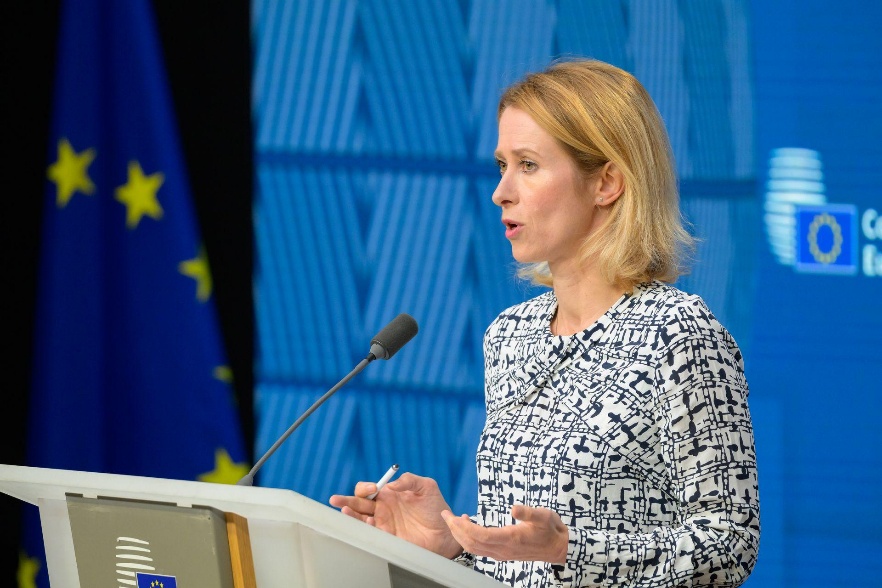
EU Commission Vice-President and High Representative for Foreign Affairs and Security Policy Kaja Kallas gives a press conference prior to the EU Foreign Affairs meeting. Ministers discuss the Russian aggression against Ukraine, and the Council discusses the latest developments in the Middle East, focusing on Gaza, Israel, and Iran, in Brussels, Belgium. (Jonathan Raa/NurPhoto via Getty Images)
“Again, it shows that Russia wants to cause as much pain and suffering as possible so that Ukraine would surrender,” Kallas declared at a press conference during a meeting of EU foreign ministers in Brussels. “It is really unbearable.”
The Netherlands Military Intelligence and Security Service (MIVD) reported that Russian troops increasingly deploy chemical weapons in field operations, leaving exposed Ukrainian soldiers vulnerable to further drone or artillery strikes. At least three Ukrainian soldiers have reportedly died from direct exposure to chemical agents.
The systematic use of banned chemical weapons prompted the EU, US, and UK to impose sanctions on Russia. Last December, Ukraine’s Security Service assassinated Lieutenant General Igor Kirillov, head of the Russian Armed Forces’ radiation, chemical, and biological defense troops, with a bomb in Moscow.
Patriot Pipeline: Trump Announces Air Defense Systems Already Shipping to Ukraine
US President Donald Trump announced that Patriot air defense missiles bound for Ukraine are already en route, confirming rapid implementation of his new NATO-coordinated arms scheme. “They’re already being shipped,” Trump told reporters at Joint Base Andrews, Maryland, explaining that systems are “coming in from Germany and then replaced by Germany. And in all cases, the United States gets paid back in full.”
A German government spokesperson confirmed that European allies are discussing more than three Patriot systems for Ukraine as part of the new arrangement where NATO and EU member states purchase US-made weapons systems, deliver some to Ukraine, and replace them through agreements with Washington.
The shipments represent a significant shift from Trump’s previous reluctance to provide direct US aid, instead pursuing a model where European partners finance American weapons for Ukrainian defense. The president emphasized: “We’re always getting our money back in full. In some cases, we’re going to be paid back by countries of the European Union directly.”
However, European diplomats reported confusion and frustration over the lack of prior consultation. Several officials at NATO countries’ embassies in Washington told Reuters they learned of the plan only as it was being announced publicly, suggesting hasty implementation without traditional alliance coordination.
Putin’s War Plans: Kremlin Sources Say Russia Will Fight Until West Accepts Terms
Russian President Vladimir Putin remains determined to continue the war against Ukraine until the West agrees to peace on his terms, according to three sources close to the Kremlin cited by Reuters. Despite US President Donald Trump’s threats to impose 100% “secondary tariffs” unless Russia agrees to a peace deal within 50 days, Putin reportedly sees no reason to back down.
The sources claim Putin is confident that Russia’s military and economy can withstand additional Western pressure, including sanctions and tariffs, and is even prepared to expand Moscow’s territorial ambitions as Russian forces continue to advance. According to the sources, Putin believes the US and others have not seriously addressed his demands regarding Ukraine.
Putin’s conditions for peace include a binding pledge that NATO will not expand further east, Ukrainian neutrality, limits on its military, recognition of Russia’s territorial gains in Ukraine, and “protection” for Russian-speaking populations. The sources also said Putin is open to discussing international security guarantees for Ukraine, though how that would function remains unclear.
Meanwhile, Russia called for the US and other countries to pressure Ukraine into resuming direct negotiations. “Many statements have been made, many words of disappointment have been spoken, but we want to hope that pressure is being exerted on the Ukrainian side,” Kremlin spokesperson Dmitry Peskov said at a press briefing.
Economic Strain: Moscow Faces Budget Crisis Despite War Economy
Senior Russian lawmaker Anatoly Artamonov warned that Moscow needs to urgently raise more money as shrinking oil and gas revenues strain the federal budget. Russia’s oil and gas revenues fell by 17% in the first half of 2025, while government spending jumped by 20%, creating a 3.7 trillion ruble ($41 billion) deficit—six times larger than last year.
The Kremlin has been drawing from its National Wealth Fund, whose liquid assets have dropped from $120 billion before the invasion to just $52.6 billion as of July 1. Russian economists warn the fund could run out entirely by next year if energy prices remain low.
Artamonov suggested reducing tax exemptions, which currently make up about a third of the federal budget, and criticized the government’s hesitation to move forward with privatization efforts. He also pointed to widespread shadow employment, with undeclared wages totaling around 10 trillion rubles ($112 billion) annually.
European Unity Fractures: France and Italy Reject NATO Arms Plan
France and Italy opted out of Trump’s new NATO-led initiative to finance US weapons deliveries to Ukraine, citing budget constraints and preference for domestic defense industries. Despite being a long-standing supporter of Ukraine, France declined to join the plan because of President Emmanuel Macron’s push for European nations to strengthen their own defense industries.
According to Italian officials, the country ruled out direct purchases of US weapons, citing fiscal limitations and focus on different technological systems, such as the Italian-French-made SAMP/T air defense system already supplied to Ukraine.
Polish Foreign Minister Radoslaw Sikorski argued that the cost of arming Ukraine should not fall on European taxpayers but be covered by Russia’s frozen assets instead. “I asked my fellow foreign ministers: Who should pay for American equipment? Should it be European taxpayers, or, in my opinion, should the aggressor pay for it using its frozen funds?”
Other European countries—including the UK, the Netherlands, and several Nordic nations—have backed the arrangement, with Germany described as “massively” invested in the plan.
Ukrainian Defense Innovation: Record Budget Increase and Robotic Warfare
Ukraine’s parliament approved a Hr 412.4 billion ($9.8 billion) increase in defense spending in the first reading, bringing total security and defense spending in 2025 to around $50 billion, or 26% of Ukraine’s GDP. The Defense Ministry would receive the largest allocation at Hr 311 billion ($7.4 billion), while the Interior Ministry would receive Hr 84 billion ($2 billion).
Other security agencies would receive funding increases totaling $1.5 billion, including military intelligence, the Security Service, and the State Protection Department. To finance the increased spending, Ukraine plans to boost budget revenues by Hr 155.5 billion ($3.7 billion) mainly through higher-than-expected tax collections.
The funding comes as Ukraine achieved a historic milestone in robotic warfare. Ukrainian forces captured Russian troops for the first time using only drones and ground-based robotic systems, without deploying infantry personnel to the battlefield.
Ukraine’s military intelligence released footage showing the Liut robotic platform attacking Russian positions in Sumy Oblast. The system, equipped with a 7.62mm machine gun, has passed combat testing and can identify and engage targets day and night with its quiet electric motor.
“Having reached enemy positions, it destroys the Russian occupiers with dense machine gun fire. The armed and technological fight for Ukraine’s freedom continues,” HUR declared.
Ukraine plans to deliver 15,000 combat robots by the end of 2025 as part of accelerated deployment of unmanned ground vehicles (UGVs).
Tragic Escalation: Dobropillia Market Strike Kills Two
Russian forces dropped a 500-kilogram (1,100-pound) aerial bomb on the city of Dobropillia in Donetsk Oblast, killing at least two people and injuring 28 others. The strike targeted a shopping center in the heart of the city, damaging 54 retail outlets, 304 apartments, and eight vehicles.
A fire broke out following the attack, and emergency crews were dispatched to extinguish it. The attack came just two days after US President Donald Trump’s “major announcement” pledging to impose “severe” tariffs on Russia within 50 days unless a peace deal is reached.
President Volodymyr Zelensky condemned the attack, calling it “horrendous, dumb Russian terror” lacking any “military logic.” He also offered condolences to the families of those affected.
Cross-Border Casualties: Latvian Mayor Wounded During Aid Mission
The mayor of the Latvian town of Ogre, Egils Helmanis, was wounded during a Russian attack in Ukraine while on a humanitarian mission delivering vehicles and other support to the Ukrainian Armed Forces. Helmanis was injured while delivering around 20 cars as part of a long-standing effort to aid Ukraine.
“These types of trips have been part of the mayor’s agenda regularly since 2022,” municipal spokesperson Patriks Griva told Latvian public broadcaster LSM. “Since the beginning of the full-scale war, a significant number of vehicles have been donated and delivered every few months.”
Ukrainian sources told LSM that Helmanis is in stable condition. Helmanis’s social media activity indicates that he frequently travels to Ukraine, visiting areas near the front lines.
Latvia, a NATO and EU member, has consistently advocated for tougher sanctions against Russia and increased support for Ukraine in both military and humanitarian efforts. Earlier this year, the Baltic nation delivered 1,500 combat drones to Ukraine and has pledged to provide military support amounting to 0.25% of its GDP annually.
Anti-Corruption Activist Under Pressure: Shabunin Case Sparks Controversy
Ukraine’s State Bureau of Investigation searched the apartment of late MiG-29 pilot Andrii “Juice” Pilshchykov in connection with a case involving prominent anti-corruption activist Vitaliy Shabunin. The decorated pilot, killed in August 2023 during a collision of two L-39 trainer jets, was posthumously awarded the title of Hero of Ukraine.
Shabunin, co-founder of the Anti-Corruption Action Centre (AntAC) NGO, has been charged with evading military service and fraud, accusations his team rejected as “absurd” and a “vendetta.” The activist currently serves in the Armed Forces, with his unit stationed in eastern Kharkiv Oblast.
Pilshchykov’s mother, Lilia Averianova, told Suspilne broadcaster that investigators came to the Kharkiv apartment on July 11 and demanded entry, threatening to break down the door. “They just called me and told me, ‘we will break down your door, because we are looking for a criminal here,'” she said.
“They drove me to a state of stress. Now I’ve been hospitalized for inpatient treatment,” Averianova told Suspilne. “Many thanks for such ‘honor’ and ‘care’ from those who were supposed to protect me, not barge into my home. Andrii protected this home—he protected millions of homes and gave his life for it.”
Brussels Strikes Back: EU Sanctions Russian Hybrid Warfare Networks
The European Union imposed sanctions on nine individuals and six entities linked to Russia for their involvement in hybrid threats and disinformation campaigns aimed at destabilizing the EU and Ukraine. The new restrictive measures target actors involved in “Foreign Information Manipulation and Interference” (FIMI).
Among the sanctioned entities is the state-owned Russian Television and Radio Broadcasting Network (RTRS), which the EU says plays a key role in replacing Ukrainian broadcasting systems in Russian-occupied territories with state-approved content aimed at suppressing dissent.
Two high-ranking members of the 841st Separate Electronic Warfare Center in Kaliningrad were also sanctioned for their role in GPS signal interference across several European countries, particularly affecting the Baltic states and civil aviation.
The EU also listed three organizations it described as disinformation platforms: the BRICS Journalists Association (BJA), the Foundation to Battle Injustice (R-FBI), both established by deceased Russian oligarch Yevgeny Prigozhin, and the Center for Geopolitical Expertise (CGE), founded by nationalist ideologue Alexander Dugin.
Defense Investment: German Company Acquires Ukrainian Robotics Firm
German defense technology company Quantum Systems acquired a 10% stake in Frontline, a Ukrainian defense robotics firm, with an option to increase ownership to 25% over the next 12 months. The deal represents one of the largest strategic investment agreements in Ukraine’s defense tech sector.
Frontline produces multi-rotor reconnaissance drones nicknamed “Ukrainian Mavics” and counter-drone systems that are in high demand among Ukrainian military units. The company is part of Brave1, Ukraine’s government-backed defense technology cluster.
“Together, we are proud to be the first movers in Euro-Ukrainian defense manufacturing,” said Florian Seibel, co-CEO of Quantum Systems. The companies signed a strategic partnership memorandum in Kyiv in April 2025.
The partnership seeks to boost manufacturing capacity in Ukraine and deepen integration with Europe’s defense industrial base. Frontline has already begun integrating European-sourced components facilitated by Quantum Systems into its robotic systems to enhance battlefield performance.
Looking Forward: The Machinery of Survival
As Ukraine adapts its government structure and accelerates military innovation, the country continues demonstrating remarkable institutional resilience under extreme pressure. The parliament’s swift action on cabinet changes, military intelligence’s successful targeting of enemy specialists, and defense industry partnerships all reflect a nation learning to function effectively under wartime conditions.
The dismantling of American expertise on Russian affairs creates dangerous knowledge gaps precisely when understanding Moscow’s methods becomes most critical. The contradiction between reducing analytical capabilities and increasing military support suggests confusion about the nature of the threat facing both Ukraine and the broader democratic world.
The coming days will test whether Ukraine’s governmental renewal can accelerate weapons production and economic adaptation while managing the continued Russian terror campaign. For now, Ukrainian innovation proceeds despite rather than because of allied institutional support, as the laboratory of modern warfare continues producing solutions born of necessity rather than design.