
A day when accusations flew across borders, drones darkened European skies, and Ukraine’s deep strikes reached into Russia’s industrial heartland while diplomatic tensions erupted within NATO itself
The Story of a Single Day
September 26, 2025, revealed how far the war in Ukraine had transformed the very nature of European security. On this single day, Hungarian reconnaissance drones allegedly violated Ukrainian airspace, mysterious aircraft forced Danish airports to close for the third time in a week, and a massive explosion tore through Russian railway infrastructure hundreds of kilometers from any battlefield. Meanwhile, Ukrainian forces struck deep into Russian territory, hitting oil refineries that supplied Moscow’s war machine, as European Union officials quietly plotted to strip Hungary of its veto power over sanctions.
This was the 1,311th day of a conflict that had begun with tanks rolling across borders but had evolved into something far more complex—a shadow war fought in diplomatic chambers and cyberspace, with drones and accusations, cryptocurrency and constitutional amendments. The battle lines were no longer drawn simply between Russia and Ukraine, but increasingly between competing visions of European solidarity itself.
By day’s end, Ukraine had liberated nearly 169 square kilometers of territory, shot down a Russian Su-34 fighter jet, and struck oil infrastructure 200 kilometers behind enemy lines. But perhaps most significantly, the war had forced Europe’s allies to question each other’s motives in ways that would have been unthinkable just months before.
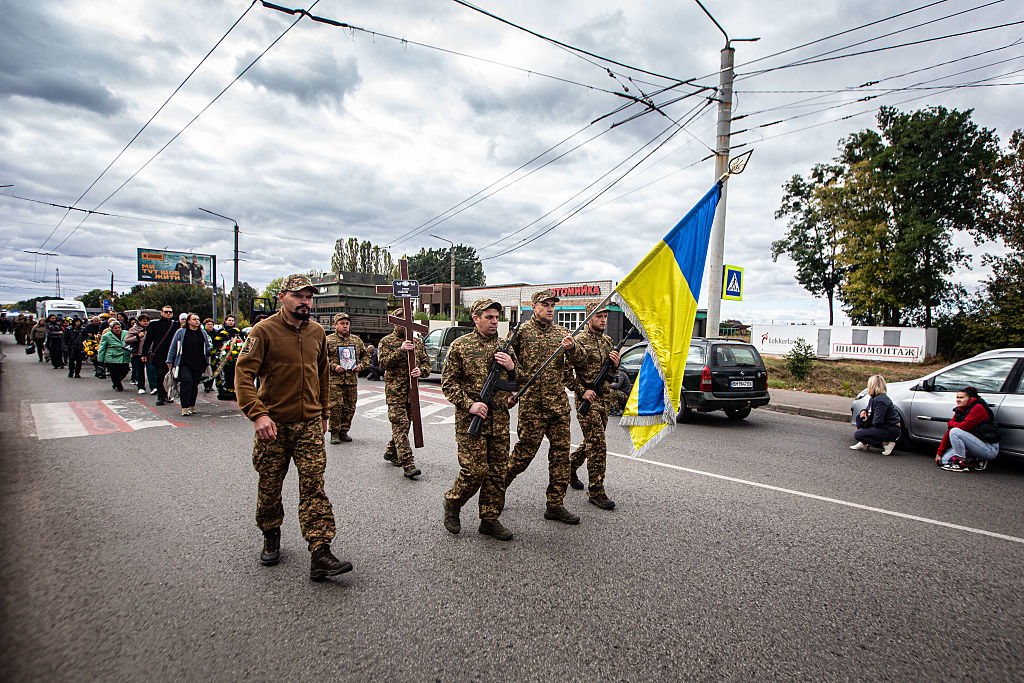
Troops lead a funeral procession in Sumy for a fallen Ukrainian soldier during his funeral. (Francisco Richart Barbeira/NurPhoto via Getty Images)
The Accused Ally: Hungary’s Mysterious Reconnaissance
President Volodymyr Zelensky’s accusation against Hungary on September 26 marked an unprecedented moment in the war’s diplomatic history. Ukrainian forces had detected reconnaissance drones crossing from Hungarian territory, conducting what preliminary assessments suggested was surveillance of Ukraine’s border industrial infrastructure. It was the first such incident between the two neighbors, and it shattered another assumption about wartime alliance behavior.
“I instructed that all available information be verified and that urgent reports be made on each recorded incident,” Zelensky announced, as Ukrainian military officials released flight path images showing aircraft crossing Ukraine’s border twice from Hungary’s direction.
Hungarian Foreign Minister Peter Szijjarto’s response was swift and venomous: “President Zelensky is losing his mind to his anti-Hungarian obsession. He’s now starting to see things that aren’t there.” The denial came with characteristic Hungarian bluntness, but it was Ukrainian Foreign Minister Andrii Sybiha’s retort that captured the broader frustration: “We are starting to see a lot of things, Peter, including your government’s hypocrisy and moral degradation, open and covert work against Ukraine and the rest of Europe, serving as a Kremlin lackey.”
The Hungarian Defense Ministry categorically rejected the allegations, claiming no drone operations had been conducted and insisting they remained in constant contact with Ukrainian forces. Hungary’s Interior Ministry noted that NATO military exercises were ongoing until mid-October, with all allies—including Ukraine—being continuously informed.
But the incident’s timing was particularly suspect. Hungary and Slovakia had been deliberately excluded from September 26’s high-level EU conference on building a “drone wall” along Europe’s eastern border—a symbolic banishment that reflected their consistent resistance to tougher measures against Russia. The countries that had maintained the closest ties with Moscow were now finding themselves isolated from collective defense planning.
The accusation highlighted a fundamental problem: how do you maintain alliance solidarity when some allies are suspected of divided loyalties? Viktor Orbán’s Hungary had repeatedly undermined EU unity on Russia, maintaining energy ties with Moscow while blocking or delaying aid to Kyiv. Now Ukraine was suggesting that Hungarian surveillance activities might serve Russian intelligence purposes.
For European security planners, the implications were disturbing. If NATO allies could not trust each other’s intelligence activities along contested borders, the entire architecture of collective defense faced new vulnerabilities. The war was forcing Europe to question not just external threats, but internal reliability.
The Drone Epidemic: When European Skies Turn Hostile
September 26 witnessed the most concentrated outbreak of mysterious drone activity across NATO territory since the war began. From Denmark’s northern coast to Germany’s Baltic frontier, unidentified aircraft forced airport closures, prompted military scrambles, and left security officials grappling with an invisible enemy that seemed to operate with impunity.
Aalborg Airport in northern Denmark closed for the third time in less than a week after police reported drone sightings at 11:40 p.m. The one-hour suspension forced flight cancellations and diversions, with North Jutland Police Chief Christian Tilsted admitting they had found nothing despite intensive searches. “We have had a massive presence out there all day,” he acknowledged, highlighting the futility of conventional responses to unconventional threats.

An entrance to Aalborg Airport is pictured. (Bo Amstrup / Ritzau Scanpix/AFP via Getty Images)
In Germany’s northern state of Schleswig-Holstein, authorities detected multiple drones overnight near the Danish border. The Interior Ministry in Kiel reinforced drone defense systems while investigations continued, with officials suspecting espionage links. The geographic spread of incidents—from Denmark to Germany to Sweden—indicated a campaign designed to test NATO’s detection capabilities and response times.
Swedish authorities confirmed multiple drone sightings near the Karlstrona naval base, adding another dimension to what appeared to be comprehensive intelligence gathering across Scandinavia’s most sensitive military installations. The timing coincided with NATO’s Eastern Sentry mission, deployed to counter increasing Russian provocations along the alliance’s eastern flank.
Danish Defense Minister Troels Lund Poulsen maintained that the drone origins remained unclear, with no direct evidence linking them to Russia. But the cumulative effect was unmistakable: NATO’s northern frontier was experiencing systematic surveillance and intimidation that followed established patterns of Russian hybrid warfare.
The drone epidemic revealed a fundamental asymmetry in modern conflict. While NATO possessed overwhelming conventional military superiority, small unmanned aircraft could paralyze major transportation hubs, force expensive defensive responses, and create psychological pressure at minimal cost to their operators. The alliance was discovering that protecting open societies against invisible threats required entirely new approaches to collective defense.
Constitutional Warfare: The EU’s Anti-Hungarian Gambit
While drones tested NATO’s physical defenses, European Union officials were quietly preparing a constitutional assault on Hungary’s ability to obstruct collective action against Russia. Internal European Commission documents revealed plans to eliminate unanimity requirements for sanctions renewals, potentially stripping Budapest of its veto power over measures targeting Moscow.
The proposed shift from unanimous approval to qualified majority voting represented one of the most significant changes to EU decision-making procedures since the bloc’s founding. Under current rules, Hungary’s Viktor Orbán could single-handedly block or delay sanctions packages that required renewal every six months. The new system would essentially democratize sanctions policy, removing individual member states’ ability to hold collective action hostage.
The initiative was closely tied to discussions about a planned 140 billion euro loan to Ukraine, financed by profits from frozen Russian assets. German Chancellor Friedrich Merz backed the idea but insisted funds should be used exclusively for military equipment, with repayment only occurring once Russia compensated Ukraine for war damages.
The constitutional warfare reflected deeper frustrations with Hungary’s consistent undermining of EU unity. Orbán had maintained energy ties with Russia, blocked aid to Ukraine, opposed sanctions, and preserved diplomatic relationships with Moscow that other member states considered treasonous. Now Brussels was preparing to render Hungarian opposition irrelevant through procedural changes.
For constitutional scholars, the proposed reform raised profound questions about EU sovereignty and decision-making legitimacy. Eliminating unanimity requirements would strengthen collective action capabilities but potentially undermine the consensual foundation of European integration. The war was forcing the EU to choose between effectiveness and inclusivity in ways that would reshape the union’s fundamental character.
Fire in the Russian Heartland: The Afipsky Strike
Ukrainian forces demonstrated their expanding deep-strike capabilities on September 26 with a precision attack on the Afipsky Oil Refinery in Russia’s Krasnodar Krai, a facility that processed 6.25 million tons of oil annually and supplied crucial fuel to Moscow’s military operations. The strike, conducted by Ukraine’s Unmanned Systems Forces in cooperation with other defense components, targeted a facility 200 kilometers from the front line that represented 2.1% of Russia’s total refining capacity.
The attack hit one of the refinery’s main crude oil processing units with surgical precision, affecting roughly half the facility’s annual processing capacity. Russian authorities claimed drone debris had fallen on the installation, causing a 30-square-meter fire that was quickly extinguished. But the Ukrainian General Staff’s confirmation of successful targeting suggested damage that Russian officials were reluctant to acknowledge publicly.
Ukrainian Commander-in-Chief Oleksandr Syrskyi had announced that the DeepStrike campaign was creating a fuel crisis in Russia that directly affected logistics and military supply lines. In less than two months, Ukrainian forces had struck 85 high-value targets on Russian soil, including 33 military sites and 52 military-industrial facilities. The Afipsky attack exemplified this strategy of targeting dual-use infrastructure that served both civilian and military purposes.
The strike’s location in Krasnodar Krai was particularly significant. The region, situated just east of occupied Crimea and separated by the Kerch Strait, had become an increasingly frequent target as Ukraine sought to disrupt fuel supplies to the peninsula. Around 50% of gas stations in occupied Crimea and Sevastopol had stopped selling gasoline due to supply disruptions, indicating the campaign’s cumulative effectiveness.
Russia’s Defense Ministry claimed to have intercepted 55 Ukrainian drones across eight regions overnight, including three over Krasnodar Krai. But the successful penetration of the refinery’s defenses demonstrated that Ukrainian drone technology was outpacing Russian countermeasures, allowing precision strikes against high-value targets deep inside enemy territory.
The Railroad Bombers: Sabotage in Pskov
An explosion that damaged railway tracks in Russia’s Pskov Oblast overnight on September 26 represented the latest escalation in Ukraine’s systematic campaign against Russian logistics infrastructure. The blast hit the crucial Luga-Pskov line used for both passenger and freight traffic, forcing Russian Railways to modify routes for two passenger trains and disrupting supply lines that supported front-line operations.
Regional Governor Mikhail Vedernikov’s acknowledgment that there were “no casualties” and that “the train did not derail” suggested careful timing designed to maximize infrastructure damage while minimizing civilian harm. The precision indicated professional planning rather than random sabotage, with someone having studied railway schedules and identified vulnerable points for maximum disruption.
The systematic targeting of railway infrastructure reflected Ukraine’s evolving understanding of Russian vulnerabilities. Defense experts had described the campaign as a “death by a thousand cuts” strategy—small but constant strikes that collectively caused significant disruption to Russian supply lines. Each successful attack forced Russia to divert resources from front-line operations to rear-area security.
The psychological impact extended beyond immediate logistics disruption. Russian railway workers and security personnel were discovering that no location was safe from Ukrainian retaliation. The vast network of tracks, bridges, signal stations, and fuel depots created an impossible security challenge for Russian forces already stretched thin across multiple fronts.
The Pskov attack extended this campaign to Russia’s northwest, demonstrating Ukraine’s ability to project force across the entire breadth of Russian territory.
Voices from the Kremlin: Diplomatic Escalation
Russian diplomatic rhetoric continued its escalatory trajectory on September 26, building on statements from the previous day’s G20 Foreign Ministers’ Meeting. Russian Ambassador to France Alexei Meshkov reinforced Moscow’s confrontational messaging, warning that NATO actions against Russian aircraft could amount to “war” against Russia. “Quite a few planes violate our airspace, whether accidentally or not. No one shoots them down,” Meshkov stated, implicitly threatening retaliation if NATO forces engaged Russian military assets over alliance territory.
The rhetorical escalation reflected Russia’s strategic calculation that direct confrontation with NATO was inevitable regardless of immediate Ukrainian battlefield outcomes. By declaring that war already existed, Russian officials were preparing domestic and international audiences for expanded conflict while simultaneously attempting to intimidate Western allies into reducing support for Ukraine.
Kremlin spokesperson Dmitry Peskov had made similar statements recently: “NATO is at war with Russia. It’s evident, and it doesn’t need any additional confirmation.” The consistent messaging suggested coordinated strategy rather than spontaneous diplomatic outbursts.
For Western intelligence analysts, the escalatory rhetoric indicated Russian preparations for broader conflict. By characterizing existing support for Ukraine as acts of war, Moscow was creating justification for targeting NATO infrastructure, alliance member states, or Western military assets directly supporting Ukrainian operations.
The Shopping Center Strike: War Comes to Kharkiv
The Russian drone strike on a shopping center in Kharkiv’s Kyivskyi district on September 26 exemplified the grinding reality of Ukraine’s second-largest city, where civilian infrastructure remained under constant attack despite its distance from active front lines. The “Molniya” drone that hit the furniture store’s roof injured four people and demonstrated Russia’s continued commitment to terrorizing Ukrainian population centers.
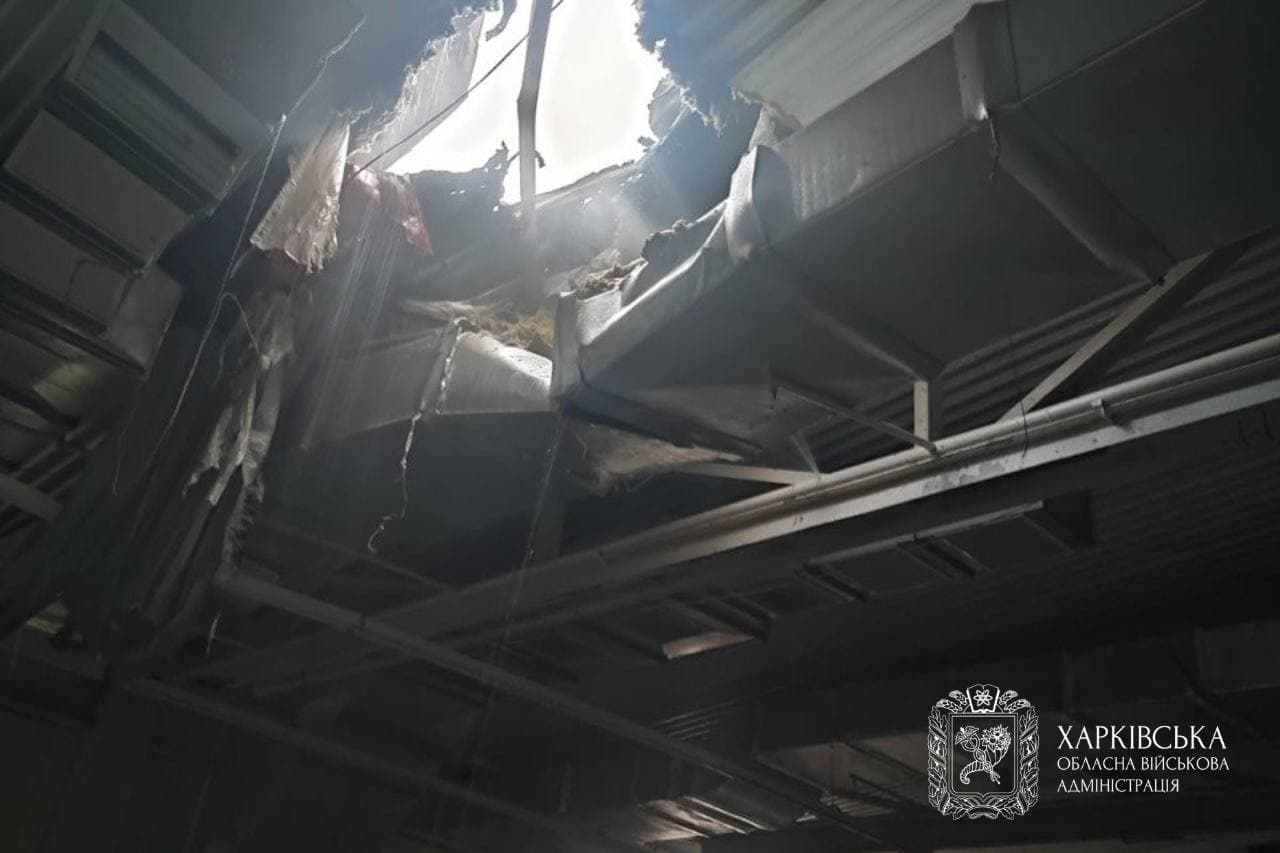
Damage is seen on the roof of a shopping center in Kharkiv, Ukraine after a Russian drone strike. (Oleh Syniehubov/Telegram)
Kharkiv, located just 30 kilometers from the Russian border, had endured nearly three years of systematic bombardment that targeted civilian rather than military infrastructure. The shopping center attack followed established patterns of Russian psychological warfare—strikes designed to demoralize civilians rather than achieve tactical military objectives.
Mayor Ihor Terekhov’s confirmation that Russian drones had also damaged a municipal bus carrying passengers highlighted the indiscriminate nature of these attacks. The fact that no bus passengers were injured represented luck rather than Russian restraint, as Moscow’s forces consistently demonstrated willingness to target civilian transportation and commercial infrastructure.
For Kharkiv residents, the September 26 attack represented another day in a war of attrition that had transformed daily life into a constant calculation of risk versus necessity. Shopping centers, bus stops, residential areas—all had become potential targets in Russia’s campaign to make normal life impossible in Ukrainian cities.
Nuclear Shadows: The South Ukraine Plant Incident
The nuclear incident at South Ukraine Nuclear Power Plant on September 26 created the most dangerous moment at Ukrainian nuclear facilities in recent months. A Russian drone exploded just 800 meters from the plant after being shot down by Ukrainian air defenses, with the International Atomic Energy Agency (IAEA) confirming that debris created a four-meter crater and damaged nearby infrastructure.
IAEA Director General Rafael Grossi’s warning that “next time, we may not be so lucky” captured the precarious balance between operational safety and active warfare. The drone had been successfully intercepted by Ukrainian defenses, but its explosion just 800 meters from operating reactors demonstrated how close the war was coming to creating potential radiological disasters.
The drone attack on nuclear infrastructure demonstrated Russia’s willingness to employ radiological threats as leverage against Ukrainian resistance and international support, using the possibility of nuclear disaster as a form of ultimate hybrid warfare.
The nuclear dimension transformed every tactical decision into a strategic calculation with global implications. Ukrainian air defense operators faced impossible choices—allow Russian drones to approach nuclear facilities unchallenged, or risk creating explosions that could damage critical infrastructure. The psychological pressure was immense, as any miscalculation could result in radiological consequences affecting millions of people.
The Cryptocurrency War: Moldova’s Digital Battlefield
Blockchain firm Elliptic’s revelation on September 26 that pro-Russian Moldovan businessman Ilan Shor had used $8 billion in cryptocurrency to help Russia evade sanctions and meddle in Moldova’s elections exposed the digital dimension of modern hybrid warfare. The findings, based on leaked documents from Shor’s companies, demonstrated how cryptocurrency was becoming the financial infrastructure for Russian influence operations across Eastern Europe.
Wallets tied to Shor’s A7 group and related businesses had received approximately $8 billion in stablecoin transactions since early 2024, according to Elliptic’s analysis. The funds financed everything from server costs to electoral apps to direct payments to political activists, creating a comprehensive infrastructure for undermining Moldovan democracy.
Shor’s operation relied heavily on Tether’s USDT and a ruble-backed stablecoin called A7A5 to move money across borders while avoiding traditional banking systems subject to sanctions. Chat logs revealed detailed discussions about using cryptocurrency for electoral manipulation, including payments to activists and funding for propaganda campaigns.
The timing was particularly significant, as Moldova faced parliamentary elections with Kremlin-backed forces challenging President Maia Sandu’s pro-European PAS party. Shor’s Victory Bloc represented the most visible component of Russian efforts to redirect Moldova away from European integration and back toward Moscow’s sphere of influence.
The digital nature of Russian influence operations created unprecedented challenges for democratic institutions. Unlike traditional espionage or propaganda, cryptocurrency-funded campaigns operated across multiple platforms simultaneously, creating synchronized messaging that appeared organic while being centrally coordinated and financed.
For financial investigators, the Shor case demonstrated cryptocurrency’s evolution from speculative investment to geopolitical weapon. The same technologies that promised financial freedom and decentralization were being weaponized to undermine democratic processes and evade international sanctions designed to constrain authoritarian behavior.
The Tomahawk Request: Ukraine’s Strategic Gambit
President Zelensky’s request to Donald Trump for Tomahawk cruise missiles, as reported by the Telegraph on September 26, represented Ukraine’s most ambitious attempt yet to secure long-range strike capabilities that could fundamentally alter the war’s trajectory. The advanced weapons system, with its 2,500-kilometer range and 450-kilogram warhead, would give Ukraine the capability to strike targets anywhere in European Russia, including Moscow itself.
The request became public through the Telegraph’s September 26 reporting, which indicated that Zelensky framed the Tomahawk as a negotiating tool that could compel Russian diplomatic engagement. The revelation represented more than military procurement—it was diplomatic signaling designed to demonstrate Ukrainian seriousness about achieving victory rather than negotiated compromise.
The Tomahawk request represented a quantum leap beyond any long-range system Ukraine had received from Western allies, effectively extending Ukrainian strike capabilities to match or exceed Russian ranges. By asking for weapons capable of striking the Russian capital, Zelensky was essentially requesting the tools to make Russian territorial gains strategically untenable.
Death of a Propagandist: Keosayan’s Final Act
The death of Russian film director and propagandist Tigran Keosayan at age 59 marked the end of one of the Kremlin’s most visible media figures, a man whose career had evolved from conventional filmmaking to systematic war propaganda. His wife, Russia Today editor-in-chief Margarita Simonyan, announced his death on September 26 after months of deteriorating health following heart problems that had plagued him for years.
Keosayan’s propaganda film “The Crimean Bridge. Made with Love!” had celebrated the construction of infrastructure linking Russian-occupied Crimea to mainland Russia—the same bridge that later became a crucial supply route for Moscow’s invasion forces and a target for Ukrainian strikes. The film represented more than artistic expression; it was cultural warfare designed to normalize Russian territorial conquests.
The EU, UK, and Canadian sanctions imposed on Keosayan after the invasion reflected international recognition of propaganda’s role in enabling war crimes. His addition to Ukraine’s sanctions list acknowledged that information warfare represented a form of direct participation in armed aggression.
Keosayan’s death occurred as his wife Simonyan battled cancer, creating a double blow to Russia’s propaganda infrastructure at a moment when battlefield losses made maintaining domestic support increasingly challenging. The convergence of personal tragedy and professional failure symbolized the broader decay affecting Putin’s information apparatus.
Ukraine’s New Air Defense Innovation
Ukrainian Commander-in-Chief General Oleksandr Syrskyi announced on September 26 the creation of a new Unmanned Air Defense Systems service, subordinate to the Ukrainian Air Force and equipped with interceptor drones to combat Russian Shahed-type drones. The service represented Ukraine’s technological adaptation to evolving threats, deploying specialized units with capabilities that traditional air defense systems could not match.
The announcement reflected Ukraine’s recognition that conventional air defense missiles were too expensive and sometimes ineffective against small, slow-moving drones that cost a fraction of the interceptors used to destroy them. Interceptor drones offered a cost-effective solution that could engage Russian drones at much lower expense while preserving expensive missile systems for more valuable targets.
The command-and-control relationships between these new Air Force drone interceptor units and tactical Ground Forces units with organic air defenses remained unclear, suggesting ongoing integration challenges. But the service’s creation demonstrated Ukraine’s commitment to technological innovation under pressure, developing solutions that traditional military establishments had not anticipated.
The Frontline Reality: Ukrainian Advances and Russian Pressure
President Zelensky reported on September 26 that Ukrainian forces had liberated 168.8 square kilometers in the Dobropillya direction since August, demonstrating sustained momentum in counteroffensive operations. The territorial gains came alongside reports that Ukrainian forces had cleared another 187.7 square kilometers of Russian sabotage groups, indicating systematic efforts to consolidate control over recaptured areas.
Russian forces continued offensive operations across multiple directions, particularly near Pokrovsk, where geolocated footage confirmed recent advances in southeastern Udachne. The grinding nature of the fighting reflected both sides’ attempts to achieve tactical gains while managing severe personnel and equipment losses.
Ukrainian forces successfully shot down a Russian Su-34 fighter jet over Zaporizhzhia, adding to mounting Russian air losses that were constraining Moscow’s ability to provide close air support to ground operations. Each aircraft loss represented not just expensive equipment but experienced pilots who required years to replace.
The battlefield dynamics revealed a war of attrition where both sides sought tactical advantages while preparing for longer-term strategic campaigns. Ukrainian success in liberating territory demonstrated improving capabilities, while Russian persistence in offensive operations showed Moscow’s continued commitment to achieving territorial gains regardless of cost.
Turkey’s Energy Crossroads
Imports of Russian oil to Turkey had fallen due to competition from other suppliers, sanctions, and pressure from the United States, Reuters reported on September 26. The development reflected broader international efforts to constrain Russian energy revenues while highlighting the complex relationships that persisted despite sanctions regimes.
U.S. President Donald Trump had urged allies—including Turkey—to stop purchasing Russian oil and gas, which were key sources of revenue for the Kremlin. After talks with Turkish President Recep Tayyip Erdogan, Trump said he believed Ankara would agree to halt Russian oil imports, though he added that he might lift U.S. sanctions on Turkey.
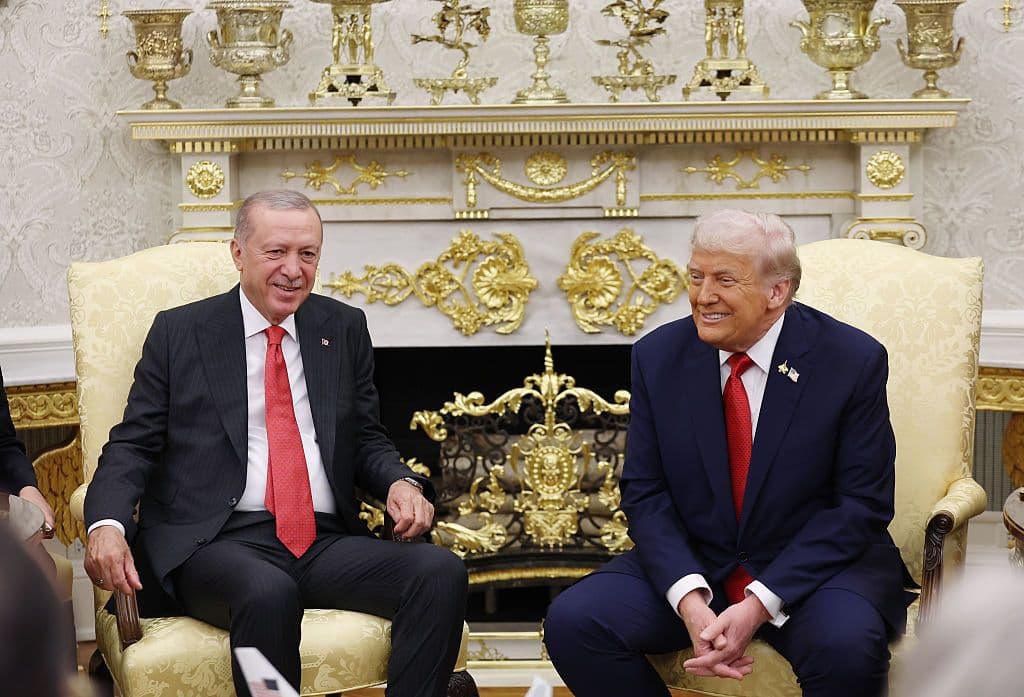
Turkish President Recep Tayyip Erdogan (L) and US President Donald Trump (R) answer questions from the press in the Oval Office of the White House in Washington D.C., United States. (Photo by Tur Presidency/ Murat Cetinmuhurdar/Anadolu via Getty Images)
Turkey’s position remained uncertain. President Erdogan and Russian President Vladimir Putin had developed close ties in recent years, and Turkey had sought to act as a neutral third party, even mediating peace talks between Russia and Ukraine. The country had not joined Western sanctions against Moscow but claimed to comply with international laws and restrictions.
Kremlin spokesman Dmitry Peskov maintained that trade decisions rested solely with Turkey: “Turkey is a sovereign state that decides for itself in which areas to cooperate with us. If certain types of trade in certain goods are deemed advantageous to the Turkish side, then the Turkish side will continue to do so.”
Romania’s Defense Partnerships
Romania was considering partnering with Ukraine to produce drones under a European Union-funded defense initiative, Reuters reported on September 26. The plans reflected growing recognition of Ukraine’s technological capabilities and the need for cost-effective air defense solutions across NATO’s eastern flank.
Romanian government defense sources told Reuters that Bucharest needed “more air defenses” and cited “huge anti-aircraft costs” that “could only be covered on a NATO level.” The country was reportedly in talks with Ukraine to jointly produce drones, drawing on Kyiv’s “battle-tested” technology under the EU’s SAFE rearmament program.
Through the scheme, Romania would receive €16.6 billion, funding that Prime Minister Ilie Bolojan said would cover annual military purchases equal to about 1 percent of the country’s GDP over the next five years. The partnership would leverage Ukraine’s rapid scaling of production capabilities while providing Romania with domestically produced defensive systems.
The initiative reflected NATO’s adaptation to the drone warfare that had become central to the Ukrainian conflict, recognizing that traditional air defense systems were often too expensive to deploy against small, numerous targets that could be effectively countered by purpose-built interceptor drones.
The Day’s Meaning: When Everything Changes at Once
September 26, 2025, exposed the fundamental transformation of the conflict that had begun as a conventional territorial war but evolved into something far more complex and dangerous. Ukrainian forces were striking oil refineries hundreds of kilometers inside Russia while mysterious drones paralyzed European airports. EU officials plotted constitutional changes to bypass Hungarian obstruction while cryptocurrency networks financed electoral manipulation in Moldova. Nuclear facilities operated under constant threat while alliance members accused each other of espionage.
The day’s events revealed a war that had transcended its original boundaries to become a comprehensive confrontation between competing models of international order. Russia’s explicit declaration that NATO and the EU had entered the war through Ukraine abandoned previous pretenses about limited objectives, acknowledging the global scope of the conflict.
Ukraine’s liberation of 169 square kilometers in a single operation while simultaneously conducting precision strikes deep inside Russian territory demonstrated the evolution of military capabilities that had surprised even the conflict’s architects. The systematic campaigns against Russian infrastructure were creating fuel shortages affecting civilian and military operations alike.
The alliance solidarity that had initially strengthened in response to Russian aggression was now showing cracks as members questioned each other’s loyalty and reliability. Hungary’s alleged reconnaissance activities against Ukraine while mysterious drones tested NATO defenses suggested that the war was creating new forms of betrayal and suspicion within previously trusted relationships.
September 26 marked a day when the shadow war became visible, revealing the extent to which the conflict had permeated every aspect of European security, from constitutional procedures to nuclear safety to cryptocurrency regulation. The question was no longer how the war would end, but whether the institutional frameworks that had defined post-war Europe could survive the transformations it was creating.
As the 1,311th day of fighting concluded, the world looked fundamentally different from the one that had existed when the first tanks crossed the border in February 2022. The invaded had become innovators, the defenders had become aggressors, and the local conflict had become a global transformation that touched every aspect of international relations. The shadow war was no longer hidden—it had become the new reality of European security.