
Russia builds for the next war even as Ukraine burns the fuel for this one. Europe feels the hum of an invisible conflict edging into the open.
The Day’s Reckoning
October 11, 2025, revealed two wars unfolding at once. In Nizhny Tagil, leaked Uralvagonzavod documents showed Russia preparing for its next conflict—an 80 percent surge in tank production by 2028, with more than a thousand new T-90M2 “Ryvok-1” tanks planned for deployment. In Ufa, Ukraine answered that future with fire, striking the Bashneft-Novoíl refinery 1,400 kilometers from the front—its third hit on Bashkortostan in a month—cutting Russia’s oil output by 21 percent and triggering fuel shortages.
Across Europe, signs of escalation multiplied. Unidentified drones buzzed NATO airfields in Germany and Estonia, Britain expanded surveillance flights along Russia’s borders, and Belarus ordered combat readiness drills. In Hungary, Viktor Orbán launched a petition against EU aid to Ukraine, giving Moscow propaganda it didn’t have to invent.
On the front lines, Russia pushed near Pokrovsk and Velykomykhailivka, launching a mechanized assault near Dobropillya under heavy rain that grounded Ukrainian drones. It was a day of attrition and ambition—one side grinding forward in mud, the other striking deep into the machinery that fuels its enemy’s war.
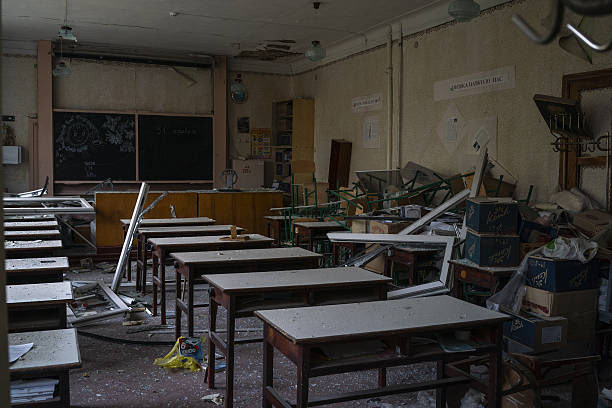
A drone attack in Kramatorsk destroyed a secondary school. (Jose Colon/Anadolu via Getty Images)
Forging the Next War
The papers from Uralvagonzavod did not describe a factory—they described a prophecy. Dated, stamped, and quietly confident, the leaked documents from Russia’s largest tank manufacturer outlined a plan that could redraw Europe’s map by the end of the decade. By 2028, T-90 production would surge eighty percent above prewar levels. The new variant, the T-90M2 Ryvok-1—its name meaning “dash” or “breakthrough”—was designed not for this war, but for the one that would follow.
The blueprint read like a timetable of intent. Ten prototype tanks in 2026, a proving run. Four hundred twenty-eight in 2028—one every twenty hours. Over three years, more than eleven hundred new or modernized T-90s would roll from the same factory floors that once seemed exhausted by sanctions. In 2024, Ukraine’s intelligence analysts believed Uralvagonzavod could build no more than seventy a year. The leak revealed a tripling of that rate within three years.
Inside the plant, the secret wasn’t manpower—it was machinery. The new precision CNC systems, imported through a labyrinth of sanctions-dodging middlemen, were European at their core. Western technology was now cutting the armor plates of Russia’s next war machine. Factory engineers trained day and night on the consoles that made the impossible plausible: a fully automated assembly line humming under sanctions meant to silence it.
By Frontelligence Insight’s estimates, Moscow intended to modernize over two thousand tanks between 2026 and 2036—enough to restore its prewar armored strength and field reserves against NATO, not Ukraine. But perhaps the most chilling revelation wasn’t the speed of production. It was the silence of delivery. A Finnish defense official confirmed that almost none of these new tanks had reached the front. Russia was burning its old steel in Ukraine while stacking its new armor for later.
The war that raged across the Donbas had become a rehearsal. Each destroyed T-62 or T-72 bought time for the next generation waiting under canvas in Nizhny Tagil. The Kremlin wasn’t just fighting a war—it was practicing for one that hasn’t yet begun.
The Ghost Fleet Runs Dry
Across the Urals, in the rusting graveyards of Russia’s armored past, the bones of the Soviet Union are disappearing. Satellite imagery released on October 8 showed what no official report ever would: Moscow’s tank reserves are vanishing. In just four months, storage bases once crowded with relics have thinned from 3,106 tanks to 2,478—six hundred twenty-eight pulled from their slumber since summer began.
The old T-72As were the first to go. Rows that had slept untouched for decades—coated in dust, painted with the red stencils of another era—are now bare concrete. Nine hundred had once sat in reserve; fewer than half remain. The T-64s, too, have become prey to their younger cousins—cannibalized for parts, stripped and abandoned. Even Russia’s famed vastness has limits, and its armored inheritance is running out of bones to borrow from.
What remains is a museum disguised as a military. One hundred forty-one T-54s and T-55s, veterans of the 1950s. Eight hundred eighty-five T-62s that first rolled through Prague when Brezhnev still smiled for cameras. Six hundred eleven T-64s, four hundred ninety-two T-72As, a few hundred late-model T-72Bs and T-80s. Not a single T-90 left in storage. Every modern tank has already been pulled, patched, or destroyed.
Yet on the battlefield, something strange has happened. Russian armor has grown quieter. The great tank columns of 2023 have given way to waves of infantry, motorbikes, and armored personnel carriers moving through smoke and mud. It isn’t mercy—it’s math. Each tank destroyed under the lens of a Ukrainian drone is gone forever. Every Soviet hull burned on the steppe narrows Moscow’s options for tomorrow.
But war is never static, and weather can be a weapon. On October 11, as high winds grounded Ukrainian drones, Russian forces launched their mechanized assault near Dobropillya—thirty-five armored vehicles moving under rain that hid them from the sky. It worked, briefly and brutally. Drones have changed the war, but not the fact that steel still kills when air defense falters.
So, Russia has adapted. The Kremlin refurbishes just enough T-72As to strike when the clouds are low, while hoarding the new T-90s under tarps for a war still to come. Each rainstorm is an opportunity; each clear day, a risk. The Soviet stockpiles that once seemed endless are nearly gone—but Moscow’s faith in armor endures, like a ghost that refuses to learn it’s dead.
The Pokrovsk Crucible
Every inch around Pokrovsk now feels like the center of the war. The fields southwest of the city, once marked only by rows of sunflowers and grain silos, have become a landscape of shattered glass and trenches. Geolocated footage from October 11 showed Russian forces edging forward in three directions at once—into Balahan, the northern edges of Udachne, and the battered outskirts of Krasnyi Lyman. None of these gains could be called breakthroughs. They were measured not in kilometers, but in breaths.
Each movement—a hundred meters here, a treeline there—forced Ukrainian commanders to decide where to stand and where to bend. Russian tactics remained relentless: advance everywhere, overwhelm nowhere, and stretch Ukrainian reserves until the front itself began to blur. By day’s end, assaults had been recorded in nearly a dozen directions—north toward Rodynske, east toward Myrnohrad, and south toward Novoukrainka and Zvirove—each push testing a different seam of Ukraine’s defenses.
High above the fields, drone teams from the Maksym Kryvonos Battalion and the 56th Separate Spetsnaz Battalion mapped every crater and every foxhole, feeding artillery coordinates with grim precision. Moscow’s intent was clear. Pokrovsk was more than a name on a map—it was the artery that carried life into Donetsk and the gate that guarded the roads to Dnipropetrovsk.
President Volodymyr Zelensky said the fiercest fighting in the country now burned here: twenty-six Russian assaults repelled in a single day, eight more still unfolding as darkness fell. The battle had become a cycle of exhaustion—attack, repel, counterattack, repeat. Neither side could break the other, yet neither could stop. Around Pokrovsk, war no longer looked like movement. It looked like endurance measured in meters.
Thunder in the Rain
The storm over Shakhove was more than weather—it was opportunity. When the rain came hard on October 10, the hum of Ukrainian drones vanished from the air, and Russian commanders seized their moment. From the treeline near Ocheretyne, thirty-five tanks and armored vehicles roared forward toward Shakhove, engines echoing like thunder under the clouds. Behind them came forty-one motorcycles—infantry clinging to them like shadows, the old and the new colliding in one desperate charge.
It was the kind of mechanized assault many thought impossible in the drone age, when every armored column seemed doomed before it moved. But on that night, the skies were blind. Ukrainian operators, fighting through wind and static, struggled to keep their drones aloft as Russian armor pushed across the flooded fields.
The 1st Azov National Guard Corps met the assault head-on. By dawn, the battlefield was littered with burning steel—three Russian tanks, sixteen armored vehicles, and every motorcycle destroyed. Twenty Russian troops briefly reached Volodymyrivka across the Kazenyi Torets River, but by morning, they were gone—withdrawn, dead, or buried in the mud.
President Volodymyr Zelensky later described the attack as an attempt to “unblock” Russian positions around Dobropillya, a gamble that ended in ruin. Still, it revealed something unsettling: tanks remain lethal when the air war pauses. Every storm, every gust strong enough to ground Ukraine’s eyes, gives Russia an opening to remind the world that armor still kills when unseen.
The Dobropillya front continued to rumble for two more days—attacks northeast near Kucheriv Yar, east near Shakhove, and southeast toward Zapovidne and Zatyshok. Reconnaissance units like the 80th Sparta Battalion hunted Ukrainian positions around Bilytske, probing for weakness even as wrecked vehicles smoked behind them.
The lesson was unmistakable. Drones may rule clear skies, but rain still belongs to the tank.
The Velykomykhailivka Vise
The land around Velykomykhailivka is flat and cruel—fields of black soil broken only by the occasional windbreak of trees or a sagging barn. It’s the kind of terrain that offers no hiding place, only distance. And in early October, that distance began to close.
Geolocated footage from October 10 revealed Russian forces pressing in from three sides, the same relentless rhythm that has marked their advance across Donetsk: pressure, pause, push again. They crept forward in Stepove to the southeast, clawed into positions south of the town itself, and edged east of Oleksiivka to the southwest. Russian sources boasted of deeper gains, perhaps more than any camera had yet confirmed.
By October 11, the vise had tightened. Attacks came from five directions—northeast near Andriivka-Klevstove, east around Sichneve, southeast near Sosnivka, and south from Verbove and Stepove toward Orestopil. From the southwest, Oleksiivka burned under continuous shelling. Ukrainian defenders were being forced into a terrible calculus: reinforce everywhere and risk collapse everywhere, or abandon ground to survive.
The Ukrainians struck back near Oleksiivka, counterattacking to keep supply lines open and prevent encirclement. They understood what would come next if those roads were lost—a slow choke, the kind of tightening ring that doesn’t announce itself until it’s already closed.
This was not blitzkrieg; it was erosion. The Russian pattern repeated itself—attack from multiple axes, force withdrawal, consolidate, repeat. Each minor gain redrew firing ranges and opened cleaner lines for Russian artillery. Each captured treeline shortened their routes and lengthened Ukraine’s. On a strategist’s map, the movements looked like small ripples. On the ground, they were the sound of walls closing in.
Pressure Without Pause
The eastern front stretched like a single, burning line across Ukraine, but the pressure was everywhere at once. While Pokrovsk, Dobropillya, and Velykomykhailivka drew the headlines, the rest of the front pulsed with smaller, relentless assaults that revealed Moscow’s true advantage—manpower without exhaustion.
In Kharkiv Oblast, Russian units pushed northeast of the city toward Vovchansk, testing defenses along the Vovcha River. Drones from Chechen Zapad-Akhmat and Sheikh Mansur battalions prowled the skies, a reminder that Chechen fighters still haunt the northern front.
To the east, attacks flared near Dovhenke and Odradne, and along the Milove-Khatnie line. Around Kupyansk, the war spread across farmland and riverbanks as Russian forces pressed toward Kolodyazne, Petropavlivka, and Kurylivka, probing for weak seams in Ukraine’s Oskil defenses. The Proryv—literally “Breakthrough”—Tank Battalion lived up to its name near Borova, driving from four directions at once.
Southward, the forests and ruined villages around Lyman shuddered under assault from nearly every compass point—north from Karpivka, east through Torske, south near Yampil. The pattern was unmistakable: attack from all sides until defenders are forced to choose which direction to lose.
Farther along the front, Siversk held under strikes from the 164th Motorized Rifle Brigade, its supply roads hammered by drones that turned every truck convoy into a target. Around Druzhkivka and Kostyantynivka, Russia’s smaller attacks bled into one another, forming a slow tide of fire that refused to recede.
Even in Zaporizhia and Kherson, where the lines have shifted little in months, Russian drones and artillery kept the air alive with noise—testing, mapping, reminding Ukraine that there are no quiet sectors anymore.
The strategy was not elegant, but it was effective: fight everywhere, win somewhere. Every assault forced Ukraine to divide its attention, its men, its ammunition. And in a war of attrition, division is its own kind of victory.
The Northern Shadow
Far from the roaring fronts of Donetsk, the war in the north moved like a ghost—quiet, persistent, and easily overlooked. Along the borderlands of Sumy and Kursk, Russian forces probed the tree lines near Kindrativka and Varachyne, pushing and retreating in a rhythm that felt more like attrition than conquest. Around Oleksiivka, Ukrainian counterattacks cut into their advance, the fighting small in scale but sharp in consequence.
Then came a story whispered through Russian milblogger channels—one that spoke more about Moscow’s methods than its maps. The claim said that companies from the 1st Specialized Motorized Rifle Regiment had relieved airborne troops near Bezsalivka months earlier. The 3rd company, caught in a Ukrainian encirclement back in August, was still trapped there. Two months surrounded. Two months abandoned. Whether the report was true or not, it rang with a familiar note: the expendability of men in a system that measures success by the ground held, not the lives spent.
The same source claimed Russia now rotates its regiments every six months, a bureaucratic mercy disguised as reform. But on the northern front, relief often comes too late. The encircled are not rescued—they are replaced.
In the fields of Kursk, drone units from Russia’s 20th Radiation, Chemical, and Biological Defense Brigade continued their work, sweeping for Ukrainian positions left from the summer raids that shook Russian soil for the first time in generations. For the Kremlin, the mission was about reclaiming security; for Ukraine, it was about keeping the fear alive.
The northern war is not the one people see on television. It has no daily maps, no parades of tanks. It is the war of shadows and signals—each side bleeding just enough to remind the other that nothing along that border is settled, and nothing along it will ever again be quiet.
The Daily Arithmetic of Attrition
On October 11, the Ukrainian General Staff recorded one number that explained the whole war: 198 combat encounters in a single day. Each one a heartbeat—some lasting minutes, others hours. Some ended with a drone strike on an empty trench; others ended with men dragging the wounded through mud while the air cracked with artillery.
To an analyst, “198” is a statistic. To the soldiers along the front, it is exhaustion measured in gunfire. Every engagement drains ammunition, frays nerves, wears down engines and bodies. The map rarely changes, yet the cost always does.
Ukraine wins most of these fights. “Repelled” appears again and again in the daily briefings. But every repelled attack still burns through shells, fuel, and strength. Russia can replace its losses faster—mobilizing men, producing shells, filling gaps with sheer numbers. Ukraine answers with precision, skill, and spirit—but those weapons, too, have limits.
Multiply that one day’s number by the 960 that came before it, and the result is staggering: roughly 190,000 separate clashes since the invasion began. Each one a choice—to stand rather than yield, to endure rather than retreat. It is not just a war of weapons anymore. It is a war of will, counted one encounter at a time.
The Invisible War Begins
What looked like routine maneuvers in Minsk on October 11 was part of something larger. Belarusian leader Alexander Lukashenko ordered combat readiness checks across his armed forces—units deployed to “highest alert,” drills expanded, command posts activated. Officially, it was an inspection. In truth, it was another piece in a growing pattern of Russian-aligned mobilization stretching across Europe’s eastern flank.
The day’s other reports completed the picture. Unidentified drones had been spotted over Czech military facilities, and one had flown directly across the runway of NATO’s Geilenkirchen air base in Germany—home to AWACS surveillance aircraft that watch the skies from the Baltic to the Black Sea. Estonia shut down the Saatse border crossing after unusual Russian troop movements nearby. None of these incidents alone would make headlines; together, they drew the outline of intent.
This shadow war has been unfolding quietly. Britain’s 12-hour reconnaissance patrol on October 9—an RAF Rivet Joint and Poseidon aircraft refueled midair by a U.S. tanker—was both a message and a precaution. In Germany, civilian concern caught up with military reality: airlines demanded legal authority to shoot down threatening drones after repeated airport disruptions. Bavaria granted that power to police within days. Chancellor Friedrich Merz said aloud what many already believed—that Moscow was behind much of it.
These were not isolated provocations but rehearsals. Drone incursions, sabotage of infrastructure, probing of air defenses—all fall under what military analysts call Phase Zero operations: shaping perception and testing responses before open conflict begins.
Russia’s strategy is no longer limited to tanks and trenches. It is building the next war in silence—through drones that appear where radars blink, through inspections that prepare mobilization under the cover of training, through pressure that makes hesitation a habit.
The evidence on October 11 left little doubt. Phase Zero isn’t coming. It’s here.
Orbán’s Petition and the Fracture Within
While NATO scrambled jets and Europe braced for drones over its airfields, Hungary turned inward. On October 11, Prime Minister Viktor Orbán launched a nationwide petition drive against what he called the EU’s “war plan” to fund Ukraine—a campaign designed less to gather opinions than to shape them.
“Europe pays, the Ukrainians fight, and Russia will eventually be exhausted,” Orbán wrote on Facebook. “We don’t want any part of this.” The petition would reach “every city and every village,” echoing the populist rhythm of his past campaigns.
For years, Orbán has perfected this method: letter consultations with leading questions that return predictable answers. They have targeted migration, minority rights, and now Ukraine. His June poll on Ukraine’s EU accession showed 95 percent opposition, though barely one in five voters participated. Still, it gave him the talking point he wanted—a mandate to resist Brussels.
Hungary’s stance has become the alliance’s splinter. Orbán maintains warm ties with Moscow, stalls sanctions, and blocks aid while insisting he’s defending “Hungarian sovereignty.” Yet his timing could not be more symbolic: as Russian drones probed NATO’s borders, one member was echoing Kremlin arguments from within the walls.
Europe’s unity, hard-won through two years of war, now faces an internal test no radar can detect. The battle for Ukraine’s survival is also the battle for Europe’s consensus—and both are being watched closely from the Kremlin.
Fire in Russia’s Oil Heart
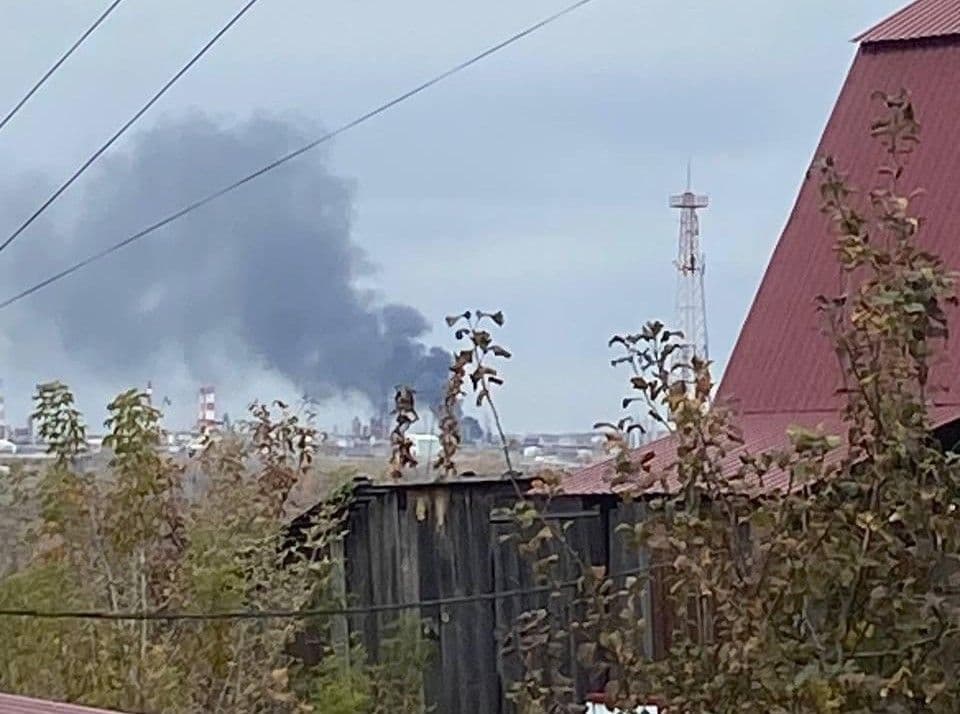
Footage allegedly shows smoke rising near the Bashnafta-UNPZ oil plant in Ufa, Russia, after a Ukrainian drone attack. (SBU source)
At dawn on October 11, the skyline of Ufa burned orange. Ukrainian long-range drones had struck the Bashneft-Novoil refinery—1,400 kilometers from the border—hitting deep inside Russia’s industrial heartland. The drones, operated by Ukraine’s Security Service, targeted the refinery’s ELOU-AVT-6 unit, setting off explosions that sent columns of black smoke twisting above the city.
This was no isolated strike. It marked the third hit on Bashkortostan’s energy facilities in a month, part of a deliberate campaign to cripple the fuel supply feeding Russia’s army. Earlier, Ukrainian drones had struck the Gazprom Neftekhim Salavat plant on September 18 and 24, and the same Ufa refinery on September 12. Together, the attacks cut directly into Moscow’s ability to refine oil—and fund its war.
Commander-in-Chief Oleksandr Syrskyi said Ukraine’s campaign had already reduced Russia’s total refining capacity by 21 percent, forcing fuel rationing in several regions. Even as Moscow claimed to have shot down five Ukrainian drones that day, the silence of regional officials spoke louder than propaganda.
Each strike carries risk—retaliation, escalation, or energy chaos on both sides—but the strategy is clear. Russia turned off Ukraine’s lights; Ukraine is now turning off Russia’s engines. The war for energy dominance has crossed from the battlefield into the very arteries that keep both nations alive.
The War for Power
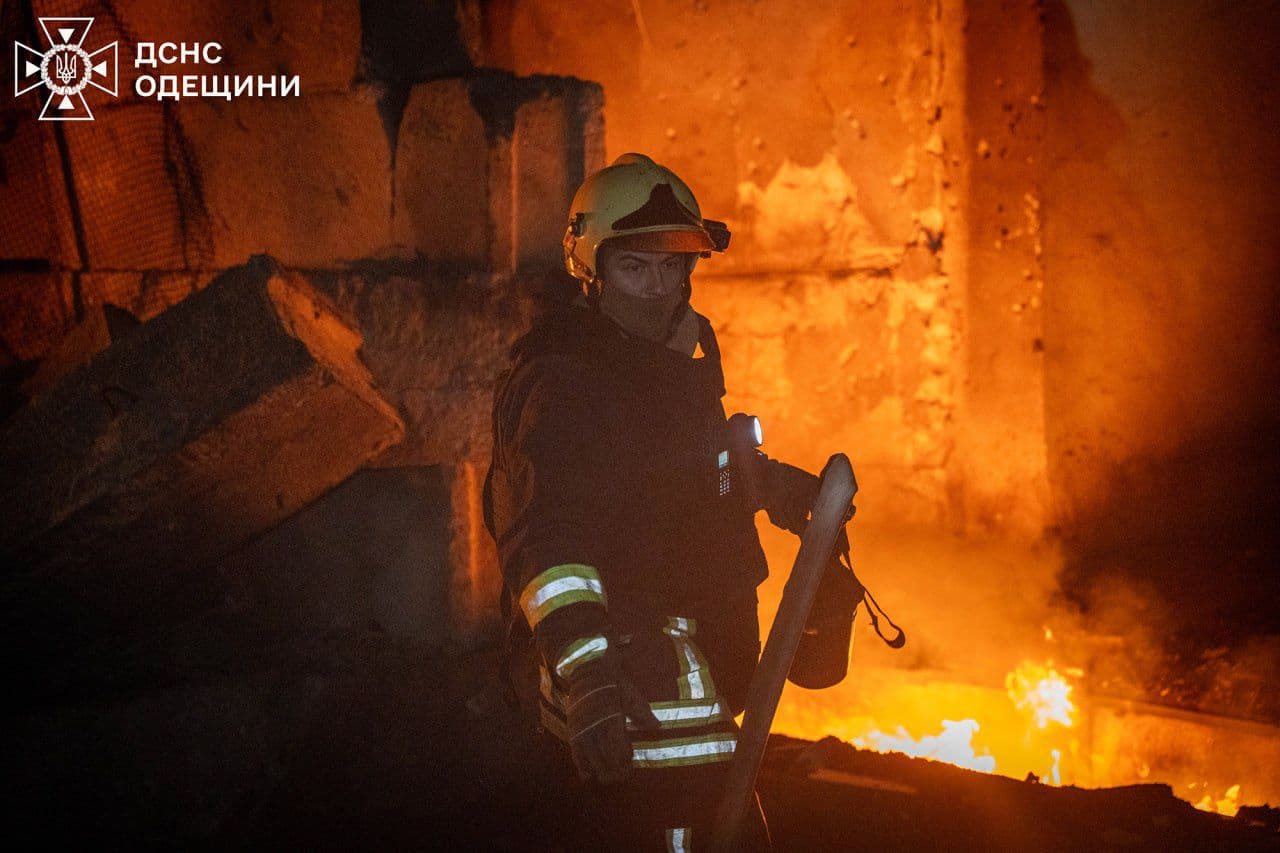
Firefighters extinguish a fire following Russian attacks on Odesa Oblast. (State Emergency Service/Telegram)
The night of October 10 tore through Ukraine’s grid like a storm of iron. Nearly five hundred missiles and drones rained down in Russia’s largest coordinated energy strike of the war, cutting electricity from Kyiv to Kharkiv and plunging cities into silence. Air defenses intercepted most of the assault, but what slipped through hit where it hurt most—power stations, gas facilities, and repair crews already exhausted from two years of bombardment.
By dawn, Prime Minister Yuliia Svyrydenko called it “one of the largest concentrated strikes” since the invasion began. Ukrenergo confirmed outages across nine regions, and firefighters battled blazes in freezing rain. In Chernihiv Oblast, the horror deepened: a drone attack on an energy company truck drew rescuers—then a second strike hit the same spot, killing two and wounding several. The “double tap” had become Moscow’s signature of cruelty, targeting those who came to save.
President Zelensky praised repair teams who restored power to hundreds of thousands overnight, even as the threat of new strikes hung above them. In some areas, workers repaired lines beneath the same sky still buzzing with drones.
This was no longer about the battlefield. It was a war to erase light itself—to break resolve before winter returned. Ukraine fought back not only with weapons but with endurance, turning every repaired circuit into quiet defiance. The front line now ran through the wires that kept a nation alive.
Trump’s Tomahawks
The call came hours after Ukraine’s lights went out. On October 11, President Volodymyr Zelensky spoke with U.S. President Donald Trump—a conversation both described as positive but layered with urgency. Ukraine had just endured one of the largest energy strikes of the war, and Zelensky needed more than sympathy. He needed weapons that could reach back.
He told reporters afterward that the discussion yielded “the necessary signals” about strengthening air defense cooperation. Behind that phrase lay the most striking detail leaked later by Axios: the U.S. was weighing whether to supply Tomahawk cruise missiles to Ukraine. With a range of over 1,600 kilometers, such a step would allow Kyiv to strike deep inside Russia—beyond any range it currently possesses.
Trump, who days earlier said he had “sort of made a decision” on the matter, appeared closer to granting it. The move would mark a dramatic shift from cautious aid to offensive deterrence, redefining how far Washington is willing to go to counter Moscow’s escalation.
Their call also brushed briefly on Trump’s Middle East diplomacy. Zelensky, ever the tactician, praised the U.S.-brokered ceasefire in Gaza and linked it to his own struggle: “If a war can be stopped in one region, surely another can too.” But both men knew the obstacle was not Kyiv’s willingness—it was Moscow’s intent.
For now, Ukraine waits between two signals: one of promise from Washington, and one of menace from the skies above.
From DJs to Drone Commanders
Before the war, they filled Dnipro’s nights with bass and light. Now, they fill the skies with drones. The same hands that once mixed tracks and managed clubs now guide Ukraine’s improvised air force—civilians turned soldiers who traded rhythm for precision.
On October 11, Heorhii Volkov, once a music promoter, led the Yasni Ochi drone unit from the 13th Khartiia Brigade. “You don’t need a military background to make a difference,” he said. “I started flying drones the day after the invasion.” What began as volunteer work evolved into one of Ukraine’s most inventive strike teams.
Many came from Module, an underground club that closed just before the war. Its founders, DJs, and regulars became fundraisers, engineers, and drone pilots—using their old event networks to channel money and materials to the front. One of them, Serhii, a DJ and software developer, now designs 3D-printed mounts that turn off-the-shelf drones into bombers.
Their story mirrors Ukraine’s broader transformation: artists and entrepreneurs reinventing themselves into a wartime innovation engine. These ad-hoc drone teams now fill gaps once covered by artillery, hitting Russian convoys and fuel depots when shells run short. Yet their success also exposes growing pains—too many overlapping designs, too little coordination.
Still, their goal remains simple and human. “My mission,” Volkov said, “is to bring my people home alive.” And when that day comes, the same imagination that turned clubs into war rooms may once again rebuild Dnipro’s culture—one beat at a time.
The LYRA Pact: Britain and Ukraine Build the Future of Defense
At the International Defense Industry Forum on October 11, Britain and Ukraine moved from aid to alliance. The newly signed LYRA partnership established joint development of battlefield technology—marking Ukraine’s transition from weapons recipient to co-creator.
The program’s first initiative, Project Octopus, will develop low-cost interceptor drones capable of shooting down Russian Shaheds at a fraction of the price of traditional missiles. The system could be produced by the thousands each month, offering a sustainable counter to Russia’s mass drone tactics. A parallel agreement expands joint production of artillery systems.
“This isn’t just about weapons—it’s about Europe’s security,” said Ukrainian Defense Minister Denys Shmyhal. Britain’s Defense Ministry called LYRA a model for “shared innovation under fire,” pairing British manufacturing power with Ukrainian battlefield insight.
The deal builds on London’s century-long strategic partnership ratified earlier this year, worth more than $30 billion in aid since 2022. But it represents a deeper shift: Ukraine’s frontline improvisation is shaping how NATO’s future arsenal will fight.
Latvia’s Deadline: When Residence Becomes Resistance
The clock was ticking in Riga. By October 13, 841 Russian citizens will be required to leave Latvia—individuals whose residency, once routine, has become a matter of national security. They are part of the roughly 30,000 Russian nationals affected by the country’s post-invasion immigration laws, a quiet but decisive front in Europe’s response to Moscow’s aggression.
Latvia has hardened its policies gradually since 2022, but 2024 brought a final tightening: Russian residents must now obtain EU long-term status, prove basic Latvian language proficiency, and pass national security screening by June 2025. Most have complied or left voluntarily. Yet for those who ignored the process—or claimed ignorance—October 13 will mark the end of legality.
“Those who haven’t met the requirements must leave by the deadline,” said Madara Puke, spokesperson for Latvia’s Office of Citizenship and Migration Affairs. After that date, they will be considered illegal residents—barred from public services and subject to deportation.
To Latvia, these measures aren’t abstract policy. They are rooted in history and geography—in the memory of Soviet occupation, the shadow of Russia across its border, and the pattern of invasions that followed every Western hesitation. Each new war—Georgia, Crimea, Ukraine—has reinforced the lesson that vigilance is survival.
In that light, the law is less about punishing individuals and more about fortifying the state. The 841 affected people have become symbols of a broader reckoning: how small nations on Russia’s frontier balance humanity with hard security. Some have lived in Latvia for decades. Some have children in Latvian schools. Many insist they’ve simply missed a deadline. But to a country that has lived through occupation, ignorance is no longer an excuse.
Latvia’s policy sends a message to both its citizens and its neighbors: neutrality is a luxury it can no longer afford. In today’s Europe, even residence has become an act of resistance.
Sanctions Synchronization: Ukraine Aligns With Tokyo
On October 11, President Volodymyr Zelensky signed a new sanctions decree—another step in Ukraine’s campaign to close every financial door Moscow still found open. The package targeted eight individuals and fourteen companies tied to Russia’s military machine and sanctions-evasion networks, mirroring measures Japan had imposed a month earlier.
“Since June, Ukraine has already adopted eight sanctions packages and synchronized them with the United States, Canada, the United Kingdom, Japan, and all EU measures,” the President’s Office announced. The new additions brought the totals to 281 individuals and 633 entities—names spanning Russian defense firms, financial institutions, and administrators in occupied Ukrainian territories.
Kyiv’s strategy was clear: isolated sanctions were statements; synchronized ones were pressure. By matching Japan and other partners, Ukraine ensured that Russia’s shadow fleet, shell companies, and child-abduction networks faced global pursuit, not loopholes.
“Synchronization prevents circumvention and strengthens the economic front,” the statement read. In a war fought with missiles and money alike, even distant allies like Tokyo had become essential to Ukraine’s resistance.
The Day’s Reckoning: Building Wars Both Present and Future
October 11 showed a war unfolding on three timelines at once. In the east, Russia pushed forward through rain and mud—advances measured in meters but bought with blood. Around Pokrovsk, Dobropillya, and Velykomykhailivka, Russian forces clawed at Ukrainian lines while exploiting poor weather to launch armor where drones couldn’t fly. These tactical moves revealed Moscow’s enduring advantage in manpower and its readiness to absorb losses that would cripple other armies.
Far from the front, Ukrainian drones struck deep inside Russia again, this time hitting the Bashneft refinery in Bashkortostan—proof that Kyiv’s reach now extended well beyond the battlefield. Commander-in-Chief Syrskyi said Russia’s oil processing capacity had fallen by a fifth. Ukraine’s war of attrition had moved from the trenches to the heart of Russia’s economy, trading territorial losses for industrial degradation.
The day’s leaks from Russia’s Uralvagonzavod tank plant hinted at something darker: Moscow wasn’t only fighting this war—it was preparing for the next. Production lines were being rebuilt for a surge in new T-90 tanks by 2028, most of them held in reserve rather than sent to Ukraine. Russia’s military was refining tactics and rebuilding strength for a confrontation that could come sooner than Western planners expect.
Across Europe, the warning lights multiplied. Unidentified drones over German air bases, Belarusian “readiness checks,” and rising calls in Germany to authorize drone shootdowns—all pointed to what strategists call Phase Zero: the invisible shaping of conditions for future war. Yet while northern Europe braced, Hungary’s Viktor Orbán launched a national campaign against EU support for Ukraine—reminding the continent that division remains Russia’s most reliable weapon.
Even amid those fractures, new partnerships took shape. Britain and Ukraine launched the LYRA defense initiative, jointly developing interceptor drones and artillery systems. Ukraine wasn’t just a recipient of aid anymore—it was teaching its allies how modern war is fought.
The human cost, though, remained constant: five dead, seventeen wounded, and another Ukrainian family burying a child in Zaporizhzhia. These were the quiet tragedies that rarely make global headlines but define the true arithmetic of war.
The question now is not how this war ends, but what comes next. Russia’s factories are building tanks for wars still to come; Europe’s allies are debating whether they believe it. The invisible war is already underway. Whether the West recognizes it before the next one begins will determine not just Ukraine’s fate—but its own.