
A day when the Kremlin escalated threats over American missiles, leaked data revealed catastrophic Russian casualties, and Ukrainian forces demonstrated offensive capabilities from Siberia to Dnipropetrovsk
The Story of Catastrophic Losses
On the 1,322nd day of Russia’s full-scale invasion, the facade of Russian military success crumbled under the weight of leaked casualty data. Documents revealed that Russian forces suffered 281,550 casualties between January and August 2025 alone—an average of 35,193 per month—while sustaining a kill-to-wounded ratio of 1:1.3 instead of the standard 1:3. As the Kremlin frantically threatened “serious escalation” if America provided Tomahawk missiles to Ukraine, Ukrainian forces struck the Tyumen oil refinery over 2,000 kilometers inside Russia, partisan saboteurs derailed military trains near St. Petersburg, and the 141st Mechanized Brigade liberated territory in Sichneve. European allies quietly expanded support despite Moscow’s theatrical warnings, while Ukraine’s Security Service detained a Russian national who had infiltrated the Ukrainian military to spy for Moscow.
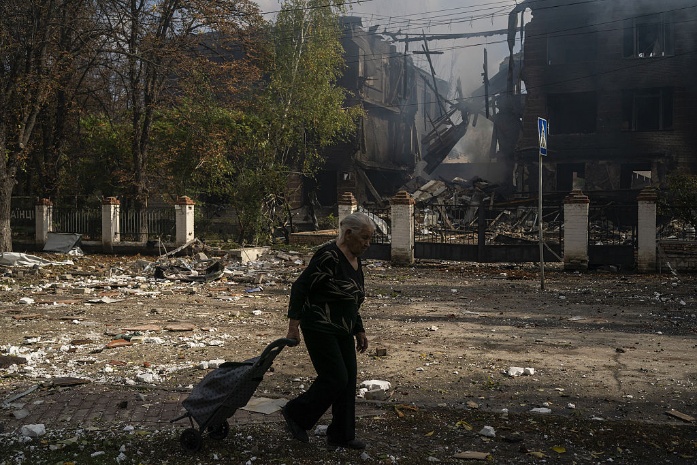
A view of the destruction after the Russian army’s Shahed drone attacks that hit two schools in the city of Sloviansk. (Jose Colon/Anadolu via Getty Images)
The Tomahawk Panic: Kremlin’s Coordinated Threat Campaign
Kremlin Spokesperson Dmitry Peskov opened October 7 with a calculated warning that sent ripples through diplomatic channels. The United States sending Tomahawk missiles to Ukraine would be “a serious escalation” that would not change the battlefield situation, Peskov stated, noting ominously that Tomahawk missiles could carry nuclear warheads. He claimed that President Vladimir Putin had made his position “unequivocally” clear on how Russia would respond to such action, referring to Putin’s October 2 and 5 threats against American provision of the long-range weapons.
But Peskov was just the opening act in a coordinated performance. Russian Security Council Deputy Chairman Dmitry Medvedev absurdly claimed on October 7 that Ukraine would use American-made Tomahawk missiles to strike Paris, Berlin, and Warsaw, adding that President Trump “should understand that.” The threat was so disconnected from military reality—suggesting Ukraine would attack its own allies—that it revealed the desperation underlying the Kremlin’s messaging.
Russian Liberal Democratic Party Head and Duma Deputy Leonid Slutsky escalated further, claiming Trump would “greatly increase the risk of starting a third world war” if the US sold Tomahawks to Ukraine and that Russia would not be responsible for such increased risk. Russian State Duma Deputy Maksim Ivanov and Senator Vladimir Dzhabarov claimed Russia would be forced to launch a “preemptive” strike against Ukraine and that “not only Ukraine will suffer” if the US sent Tomahawk missiles.
The threats followed a familiar pattern. The Kremlin had conducted similar influence operations when the United States discussed sending ATACMS, HIMARS, F-16 fighter jets, and Abrams tanks, routinely delaying Western weapons provisions through such campaigns. Yet previous Western weapons deliveries and Ukrainian strikes using US-provided long-range systems had not triggered escalatory Russian reactions, and the West and Ukraine had repeatedly violated Russia’s alleged “red lines” with no resulting escalation.
The panic over Tomahawks revealed Russia’s actual vulnerability. With ranges up to 2,500 kilometers, these missiles would enable Ukrainian strikes on command centers and supply hubs throughout western Russia, disrupting logistics networks that Russian forces depended on. The coordinated threatening campaign demonstrated that Moscow viewed Tomahawk provision as a genuine threat to its military capabilities—precisely why the threats were so shrill and the warnings so apocalyptic.
The Casualty Catastrophe: Numbers That Tell the Truth
While Kremlin officials threatened the world with escalation, leaked documents published by Ukraine’s “I Want to Live” initiative on October 6 revealed the catastrophic human cost Russia was paying for its territorial ambitions. The data detailing Russian military casualties from January to August 2025 painted a picture of systematic slaughter on an industrial scale.
Russian forces suffered a total of 281,550 casualties during this eight-month period: 86,744 killed in action (including 1,583 officers and 8,633 penal recruits), 33,996 missing in action (including 11,427 penal recruits), 158,529 wounded in action (including 6,356 officers and 16,489 penal recruits), and 2,311 captured. The numbers were similar to Ukrainian Commander-in-Chief General Oleksandr Syrskyi’s September 9 report that Russian forces had suffered 299,210 casualties since January 2025.
But the most shocking revelation was Russia’s casualty ratio: one killed for every 1.3 wounded. The standard military ratio is one killed for every three wounded—meaning Russian forces had an abnormally high kill-to-wounded ratio that defied modern warfare norms. The cause was brutally simple: pervasive tactical-level drone strikes had created kill zones throughout the theater where masses of strike and reconnaissance drones posed elevated risks to any equipment or personnel that entered. These kill zones complicated both sides’ ability to evacuate casualties and triage the wounded.
The Russian military command was struggling to and frequently refusing to recover wounded personnel, likely due to Ukrainian drone strikes that significantly complicated battlefield movement. Wounded soldiers were being left to die in positions where evacuating them would expose rescue teams to drone attacks. The result was a kill rate that approached World War I levels despite 21st-century medical capabilities.
The Geographic Distribution of Death
The leaked estimates revealed where Russia was spending its personnel most freely. The Russian Central Grouping of Forces, responsible for the Pokrovsk direction, suffered the heaviest casualties: 43,709 killed, missing, and captured, plus 52,865 wounded. Russian forces had suffered roughly 34 percent of their casualties in this direction during the first eight months of 2025—a staggering concentration that reflected the Russian military command’s prioritization of Pokrovsk throughout the year.
Within the Central Grouping, the 2nd Combined Arms Army suffered 15,310 killed, missing, and captured plus 16,260 wounded, while the 51st Combined Arms Army suffered 13,000 killed, missing, and captured plus 14,201 wounded—the heaviest casualties among Russia’s combined arms armies. These units had been grinding toward Pokrovsk for months, sustaining catastrophic losses without achieving strategic objectives. Russian forces had failed to seize Pokrovsk, Myrnohrad, Novopavlivka, or Druzhkivka despite these massive casualties.
Russia’s Northern Grouping of Forces, which eliminated much of Ukraine’s Kursk penetration and was pursuing buffer zones in Sumy and Kharkiv oblasts, suffered 53,572 casualties—second only to the Central Grouping. A significant portion of these casualties likely occurred during the intensified effort to retake Kursk Oblast in February and March 2025.
The Western Grouping of Forces, operating in the Kupyansk, Lyman, and Borova directions, suffered 47,410 casualties. The 1st Guards Tank Army, active in Lyman and Kupyansk, suffered 9,987 killed, missing, and captured plus 11,411 wounded—the third-highest figure among Russia’s combined arms armies, underscoring intense fighting in these directions. Yet the Western Grouping had failed to seize any major settlements in its area of responsibility—Kupyansk, Borova, and Lyman—in 2025.
Even in lower-priority areas, casualties mounted relentlessly. The Southern Grouping suffered 32,740 casualties in the Kostyantynivka-Druzhkivka area and Siversk direction, making minimal progress since seizing Toretsk in June. The Eastern Grouping suffered 38,011 casualties advancing toward Dnipropetrovsk Oblast. The Dnieper Grouping suffered 13,243 casualties in relatively desultory fighting in Kherson direction and western Zaporizhia Oblast.
The Grim Mathematics of Attrition
Perhaps most revealing was the comparison between Russian casualties and recruitment. A Russian insider source had reported that the Ministry of Defense recruited 292,000 people between January 1 and September 15, 2025—an average of 31,600 recruits per month. Russian forces lost an estimated 281,550 casualties between January and August—an average of 35,193 per month.
Russian casualty rates thus far in 2025 appeared slightly higher than current monthly recruiting rates, though casualty rates had been decreasing over the last four months. The Russian General Staff may have assumed casualty rates would continue decreasing if Russian forces improved their ability to counter the kill zone—reasoning that may have explained why Russia was reportedly beginning to form a strategic reserve for future deployment.
Russia had proven its ability to recruit enough people to sustain losses over the last three years while possibly beginning to generate a strategic reserve. The Kremlin was unlikely to abandon or decrease the pace of operations so long as Russia could continue to more than sustain such losses. The leaked data revealed not just the cost of Russia’s war but Moscow’s willingness to continue paying that cost indefinitely.
Tyumen Burns: The Deepest Strike Yet
While the Kremlin threatened escalation and leaked data revealed catastrophic losses, Ukrainian forces were demonstrating their capacity to strike deeper into Russia than ever before. A local Telegram channel claimed on October 6 that a powerful explosion occurred at the Tyumen Oil Refinery on the night of October 6 to 7, publishing footage showing emergency services responding.
The Tyumen Oblast Government Information Center claimed Russian authorities destroyed three drones at an unspecified enterprise and denied reports of fire. But Ukrainian Center for Combatting Disinformation Head Lieutenant Andriy Kovalenko confirmed the strike, reporting that the Tyumen oil refinery had an annual crude oil production capacity of nine million tons. Russian opposition outlet ASTRA confirmed on October 7 that at least two drones struck the refinery, damaging a fractionating column and part of the water supply system.
The distance was staggering: the refinery was located over 2,000 kilometers from Ukraine—the farthest Ukrainian strike since Russia’s full-scale invasion. Russian state outlet RBK reported the refinery processed 7.5 million tons of oil annually. Russian state media cited military experts who speculated that Ukrainian forces may have launched drones from trucks on Russian or Kazakh territory, similarly to Ukraine’s June 1 Operation Spiderweb deep strikes. Local news reported that authorities inspected suspicious vehicles in Tyumen City in response to the speculation.
The strike demonstrated Ukrainian capability to reach targets Moscow had assumed were safely beyond Ukrainian reach. Every successful deep strike forced Russia to defend increasingly vast territories, diluting air defense coverage and exposing vulnerabilities in infrastructure networks that Russian forces depended upon.
Sabotage in the North: The St. Petersburg-Pskov Railway
Ukrainian operations extended beyond aerial strikes. Sources in Ukrainian intelligence told Ukrainian broadcaster Suspilne on October 7 that “unknown partisans” detonated a section of the St. Petersburg-Pskov railway between Stroganovo and Mshinskaya in Leningrad Oblast. Russian Railways announced it rerouted trains around the section on October 7 for “technical reasons.”
A source in Ukraine’s military intelligence told the Kyiv Independent that a train carrying military cargo derailed following the explosion early on October 7. The blast occurred on the Stroganovo-Mshinskaya railway section, causing the locomotive and several wagons to derail. The operation was reportedly carried out by local partisans, temporarily paralyzing train traffic between St. Petersburg and Pskov.
Russian emergency services were working to clear the tracks, though access to photos and videos from the site remained restricted due to an internet blackout in the area. “These special operations reduce Russia’s logistical and military capabilities, as Russian Railways form the backbone of the army’s logistics and are a major financial donor to the ‘war budget,'” the intelligence source stated.
The sabotage targeted the same railway section that Ukrainian Special Forces and Main Military Intelligence Directorate units had previously attacked on September 14. The repeated targeting suggested systematic efforts to disrupt Russian military logistics in the northwest, where railways formed the backbone of supply lines supporting forces in Ukraine.
Feodosia Still Burns: The Crimean Inferno Continues
The Ukrainian strike on the Feodosia oil terminal that began overnight on October 6 continued burning on October 7. Pro-Ukrainian Telegram channel Crimean Wind reported that the facility continued to burn with the blaze spreading to oil tanks in the northern part of the depot.
The terminal, located about 250 kilometers from Ukraine-controlled territory, was the largest oil storage facility in Crimea with capacity for 250,000 tons of fuel. It served as a multifunctional facility transferring oil and petroleum products between rail, sea, and road transport, directly supplying Russian forces in occupied territories.
The sustained burning demonstrated both the effectiveness of Ukrainian strikes and the challenge Russian emergency services faced in controlling fires at heavily fueled facilities. Every hour the terminal burned represented fuel that would not reach Russian forces, logistics disrupted, and infrastructure damaged that would require costly repairs.
Sichneve Liberation: The 141st Brigade’s Assault
Ukraine’s 141st Mechanized Brigade carried out a successful assault in Sichneve in eastern Dnipropetrovsk Oblast, liberating territory and inflicting losses on Russian forces, the military reported on October 7.
The Shkval assault unit “eliminated” 50 Russian troops in the battle, while eight others were taken prisoner, the brigade said. The unit published footage of the engagement showing Ukrainian troops advancing to the settlement, clearing out Russian positions with grenades and rifle fire, taking Russian captives, and displaying Ukrainian banners.
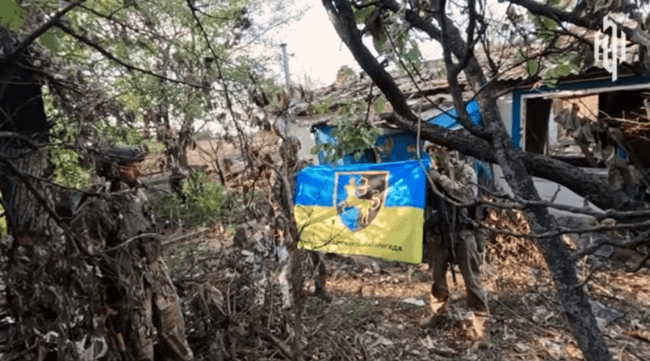
Footage purportedly showing Ukrainian soldiers holding a banner in Sichneve, Dnipropetrovsk Oblast, Ukraine. Footage published. (Ukraine’s 141st Mechanized Brigade/Telegram)
Sichneve lay at Dnipropetrovsk Oblast’s administrative border with Donetsk Oblast, which was the focal point of Russian offensive operations. The Ukrainian monitoring group DeepState indicated that Sichneve, also known in Russian as Yanvarske, was mostly located within the contested “gray zone,” with surrounding areas held by Russian forces.
“Liberating our land, step by step,” the brigade stated. “We are not only holding the defense but confidently moving forward, liberating our territories.”
The success demonstrated that Ukrainian forces retained offensive capabilities despite being generally on the defensive across the eastern front. The operation showed careful planning and execution, with the Shkval unit systematically clearing Russian positions and consolidating control over liberated territory.
The Spy Within: Russian Infiltration of Ukrainian Military
The Security Service of Ukraine detained a Russian national who spied for Moscow’s intelligence while serving in Ukraine’s military, the SBU said on October 7. The man, detained in the western city of Lviv, was suspected of helping Russia’s Federal Security Service coordinate strikes on his unit’s temporary base and nearby positions in Lviv Oblast.

A Russian national serving in Ukraine’s military detained over suspected espionage for the FSB. A photo published. (SBU/Telegram)
The detainee was also transmitting geolocations of armored convoys, transit depots, and vehicle parks near Ukraine’s border regions to his Russian handler through anonymous chat apps. Lviv Oblast lay at Ukraine’s border with Poland and was a key junction of Western military aid flowing into the country.
The suspect, who joined the Ukrainian military “under the guise of a volunteer,” was detained with assistance from Defense Minister Denys Shmyhal and Commander-in-Chief Oleksandr Syrskyi. Ukrainian authorities reportedly detained the suspect while he was heading to an ATM to receive payments from Russia.
The detainee began spying for Russia after joining Ukrainian forces. He was believed to have been recruited through his brother, who resided in Russia. The case highlighted ongoing Russian intelligence efforts to infiltrate Ukrainian military structures and gather information about Western military assistance flows through western Ukraine.
Zaporizhzhia Nuclear Plant: Ukraine Condemns Continued Attacks
Ukraine on October 6 condemned recent attacks near the Russian-occupied Zaporizhzhia Nuclear Power Plant, as it remained disconnected from Ukraine’s grid for the second week. The International Atomic Energy Agency said on October 6 that its team heard “several rounds of incoming and outgoing shelling from near the site.”
After Russian state media blamed Ukraine’s Armed Forces for the attacks, the Ukrainian Foreign Ministry said on October 6 that it was “a deliberate provocation by Russia.” The administration of the occupied plant told the IAEA that “two rounds struck 1.25 kilometers from the site perimeter.” The agency warned that the attacks added to nuclear safety risks at the station, “which has had no off-site power for nearly two weeks.”
Russia “once again demonstrates its complete disregard for international law, the IAEA Statute, and the seven indispensable pillars of nuclear safety,” the Ukrainian Foreign Ministry stated. “The deliberate creation of risks around Europe’s largest nuclear power plant threatens a nuclear disaster on a continental scale.”
Greenpeace nuclear expert Jan Vande Putte told the Kyiv Independent on October 7 that the international NGO could not independently verify the origin of the latest shelling. However, Greenpeace had published an investigation saying there was no evidence of any military strikes around the pylons and power line network at the plant that caused the September 23 disconnection.
“Greenpeace is concerned about the high probability that Russia would further escalate the current crisis, and one of the ways they could do that is by further causing more permanent damage to the electricity lines,” Vande Putte stated.
European Solidarity: Slovakia’s Return and New Partnerships
Despite Russian threats of escalation, European support for Ukraine continued expanding. Ukrainian Defense Minister Denys Shmyhal announced on October 6 that Ukraine would receive several Bozena demining vehicles and additional non-lethal equipment from Slovakia—marking Slovakia’s first military aid package to Kyiv since Prime Minister Robert Fico returned to power in 2023.
The package included engineering and construction equipment, transportation, demining systems, and medical evacuation vehicles. Slovak Defense Minister Robert Kalinak announced the aid at the DFNC3 defense forum in Kyiv, stating Slovakia was working on a new, 15th support package. The announcement was significant given Fico’s pro-Russian positions and his campaign promise to end military assistance to Ukraine.
The Estonian company Milrem Robotics announced on October 7 that it would deliver over 150 THeMIS unmanned ground vehicles to Ukraine, with the Netherlands funding the purchase. Ukrainian Minister of Strategic Industries Herman Smetanin announced on October 7 that Ukroboronprom concluded cooperation agreements for “float and fly” drone concepts with US-based drone manufacturer LeVanta Tech and agreements with Spanish defense firm Escribano Mechanical & Engineering related to air defense and armored vehicles.
Shmyhal announced on October 6 that Ukraine and Denmark signed a memorandum of understanding enabling Ukrainian companies to launch joint production projects in Denmark, create joint capacities, exchange technologies, and attract European Union funding for joint projects. The expanding web of defense-industrial cooperation demonstrated European recognition that supporting Ukraine required not just weapons transfers but sustained development of Ukrainian manufacturing capabilities.
Command Changes: Kisel’s Return from Syria
The Russian military command reportedly appointed former Commander of the Russian Force Grouping in Syria Lieutenant General Sergei Kisel as deputy commander of the Northern Grouping of Forces. A Russian insider source reported on October 6 that Kisel became deputy commander under recently appointed Northern Group of Forces Commander Colonel General Yevgeny Nikiforov.
The Northern Grouping currently oversaw operations in northern Sumy and Kharkiv oblasts. The insider source reported Kisel had been serving in Syria organizing evacuation of Syria’s military-political leadership and military personnel after the fall of the Bashar al-Assad regime before returning to Ukraine.
Kisel’s appointment was notable given his history. He had commanded the 1st Guards Tank Army at the start of Russia’s full-scale invasion, but Russian authorities reportedly suspended him in Spring 2022 for failing to seize Kharkiv City, sending him to serve in Syria. Russian milbloggers claimed in late 2024 that the Ministry of Defense removed Kisel as commander of the Russian Force Grouping in Syria for unspecified reasons.
His return to the Ukrainian theater—and appointment to a senior command position—suggested either rehabilitation or desperate need for experienced commanders willing to accept high-casualty operations. Given the Northern Grouping’s 53,572 casualties between January and August, Kisel was inheriting command of a formation that had already suffered catastrophic losses.
The Eastern Front: October 7 Combat Operations
Across the eastern front on October 7, Russian forces continued grinding offensives that the leaked casualty data suggested were costing far more than they gained.
Northern Sumy: Russian forces attacked in Kursk and Sumy oblasts, including northwest of Sumy City near Volfyne and north of Sumy City near Oleksiivka. Russian milbloggers claimed Ukrainian forces counterattacked near Oleksiivka, Novyi Put, Bezsalivka, Kindrativka, and Yunakivka.
A Russian milblogger reportedly affiliated with the Russian Northern Grouping claimed elements of the 22nd Motorized Rifle Regiment holding positions in Yunakivka had not received water for eight days and had to collect rainwater due to Ukrainian drone interdiction of all Russian ground lines of communication and supply routes. The milblogger refuted claims that Russian forces seized Yunakivka and claimed the Russian military command in the area consisted of recently graduated officers who lacked combat experience, preferred to remain at rear headquarters 20 kilometers behind the line of contact, and refused to evacuate wounded and killed servicemembers.
The milblogger claimed that elements of the 1427th Motorized Rifle Regiment operating in Tetkino were accumulating in preparation to attack Ryzhivka, likely with elements of the 2nd Spetsnaz Brigade.
Northern Kharkiv: Russian forces continued offensive operations but did not make confirmed advances. A Russian milblogger claimed Russian forces advanced south of Hlyboke, along the western shore to the Travyanske Reservoir, and in the Synelnykove forest area. Russian forces attacked northeast of Kharkiv City near Synelnykove, Vovchansk, Vovchanski Khutory, and Tykhe. A Ukrainian brigade published footage and reported that Ukrainian forces repelled a Russian mechanized assault in the Vovchansk direction and destroyed at least five motorcycles and several armored fighting vehicles.
Velykyi Burluk: Russian forces continued offensive operations but did not make confirmed advances. A Russian source claimed Russian forces advanced south of Khatnie. Russian forces attacked northeast of Velykyi Burluk near Ambarne and toward Dovhenke and Khatnie and east of Velykyi Burluk near Odradne.
Kupyansk: Russian forces continued offensive operations but did not make confirmed advances. A Russian milblogger claimed Russian forces advanced in central and southern Kupyansk. Russian forces attacked near Kupyansk itself and in multiple directions around the city.
The spokesperson of a Ukrainian brigade operating in the Kupyansk direction reported that Russian Rubikon Center for Advanced Unmanned Technologies drone operators had intensified activities and deployed more units to the direction in recent months. The spokesperson stated Russian forces were remote mining and using fiber optic FPV drones that Ukrainian forces could not counter along logistics routes. Russian forces continued using sabotage and reconnaissance groups for infiltration efforts and to conduct drone or mortar strikes on rear areas. The spokesperson stated Russian forces were using ATVs and motorcycles to deliver supplies, provisions, and ammunition to front lines and that Russian sabotage and reconnaissance units had resumed efforts to cross the Oskil River using ropes and inflatable boats in fireteams of one to three.
The spokesperson of a Ukrainian artillery brigade operating in the Kupyansk direction reported that Russian forces were unsuccessfully attempting to expand bridgeheads and transport equipment on the western bank of the Oskil River, which was preventing Russian forces from attacking and providing logistics.
Lyman: Russian forces continued offensive operations but did not advance. Russian forces attacked northwest of Lyman near Novoselivka, Drobysheve, Shandryholove, and Serednie; north of Lyman near Ridkodub and toward Stavky; northeast of Lyman near Myrne and Kolodyazi; east of Lyman near Torske and Zarichne; and southeast of Lyman near Yampil. A Russian milblogger claimed Ukrainian forces counterattacked south of Kolodyazi.
The spokesperson of a Ukrainian brigade operating in the Lyman direction stated that Ukrainian forces maintained positions in Torske and Zarichne and that Ukrainian forces were increasingly observing and capturing foreign mercenaries that signed contracts with the Russian Ministry of Defense.
The Ukrainian Unmanned Systems Forces reported on October 6 that Ukrainian forces struck a rare Russian R-330Zh “Zhitel” electronic warfare station in occupied Luhansk Oblast, estimated to be worth roughly $10 million. The USF stated this was the 23rd confirmed Ukrainian strike against a “Zhitel” station since Russia launched its full-scale invasion.
Siversk: Geolocated footage published on October 7 indicated Russian forces recently advanced southeast of Siversk. The Russian Ministry of Defense claimed on October 7 that Russian forces seized Fedorivka southwest of Siversk, though the ministry had previously claimed seizure on September 2, suggesting the settlement remained contested.
Russian forces attacked northwest of Siversk near Dronivka, northeast near Serebryanka and Hryhorivka, and south near Kuzmynivka. A Ukrainian servicemember operating in the direction reported Russian forces continued improving positions near the Siverskyi Donets River and that Russian forces rarely used equipment. The servicemember assessed Russian forces were likely stockpiling equipment for use after weather conditions worsened.
Kostyantynivka-Druzhkivka: Geolocated footage published on October 7 indicated Russian forces recently advanced east of Ivanopillya. Russian milbloggers claimed Russian forces advanced north of Kleban-Byk, north of Oleksandro-Kalynove, northwest of Rusyn Yar, and within central Volodymyrivka.
Russian forces attacked north of Kostyantynivka near Mayske; east of Kostyantynivka near Stupochky; southeast of Kostyantynivka near Oleksandro-Shultyne; south of Kostyantynivka near Katerynivka, Shcherbynivka, and Pleshchiivka; south of Druzhkivka near Rusyn Yar and Poltavka; and southwest of Druzhkivka near Volodymyrivka.
Dobropillya: Russian forces continued offensive operations but did not advance. Russian forces attacked east of Dobropillya near Shakhove and southeast of Dobropillya near Ivanivka, Mayak, and Zapovidne. Russian milbloggers claimed Ukrainian forces counterattacked near the Hruzke-Vesele-Zolotyi Kolodyaz line, northeast of Dorozhnie, and near Zapovidne.
A Russian milblogger claimed Russian assault groups interdicted Ukrainian ground lines of communication between Shakhove and Volodymyrivka and between Dobropillya and Rodynske.
Pokrovsk: Geolocated footage published on October 7 indicated Russian forces recently advanced southwest of Mykolaivka east of Pokrovsk. Russian milbloggers claimed Russian forces seized Shakhtarskyi Microraion in southeastern Pokrovsk and advanced in southeastern Pokrovsk, north of Troyanda, and northwest of Leontovychi.
Russian forces attacked near Pokrovsk itself; north of Pokrovsk near Rodynske; northeast of Pokrovsk near Boykivka, Krasnyi Lyman, Razine, and Novoekonomichne; east of Pokrovsk near Myrnohrad; southeast of Pokrovsk near Lysivka; and southwest of Pokrovsk near Kotlyne, Zvirove, Udachne, and Molodetske. A Russian milblogger claimed Ukrainian forces counterattacked near Rodynske.
An officer of a Ukrainian formation operating in the Pokrovsk direction reported that Russian forces continued relying on small infantry-led infiltration tactics to bypass Ukrainian defenses and were increasingly relying on unmanned ground vehicles to mitigate logistical challenges caused by pervasive Ukrainian drone strikes. A Russian milblogger claimed Russian forces established fire control over the O-0525 Pokrovsk-Hryshyne highway northwest of Pokrovsk.
Novopavlivka: Geolocated footage published on October 6 indicated Ukrainian forces recently advanced in northern Muravka northeast of Novopavlivka. Geolocated footage indicated Russian forces advanced west of Zelenyi Hai southwest of Novopavlivka.
Russian forces attacked toward Novopavlivka itself; northeast of Novopavlivka near Novomykolaivka and toward Marivka and Bilyakivka; east of Novopavlivka near Horikhove; southeast of Novopavlivka near Dachne; south of Novopavlivka near Yalta and Filiya; and southwest of Novopavlivka near Zelenyi Hai.
A non-commissioned officer in a Ukrainian company operating in the Novopavlivka direction reported that Russian forces had insufficient weapons and food supplies but that each soldier had a Russian flag to raise in settlements—likely to claim advances or seizures. The NCO stated Russian forces were taking advantage of foggy weather that limited Ukrainian drone visibility to move toward Ukrainian positions. The NCO stated the front was “dynamic” and that Ukrainian and Russian positions were often interspersed across several tens of meters in forest or within the same house.
Velykomykhailivka: Geolocated footage published on October 7 indicated Ukrainian forces recently advanced in southern Sichneve east of Velykomykhailivka. Russian forces attacked northeast of Velykomykhailivka near Piddubne; east of Velykomykhailivka near Oleksandrohrad, Voskresenka, Sichneve, and Novoselivka; southeast of Velykomykhailivka near Vorone, Sosnivka, Novoheorhiivka, and Zaporizke; south of Velykomykhailivka near Stepove and Kalynivske; and southwest of Velykomykhailivka near Verbove.
Eastern Zaporizhia: Geolocated footage published on October 7 showed Russian forces raising flags in central Novovasylivske northeast of Hulyaipole. The Russian Ministry of Defense and milbloggers claimed Russian forces seized the entirety of Novovasylivske, crediting elements of the 394th Motorized Rifle Regiment. Russian milbloggers claimed Russian forces advanced east of Novomykolaivka, east of Okhotnyche, and southeast of Poltavka.
Russian forces attacked northeast of Hulyaipole near Novohryhorivka, Okhotnyche, and Poltavka and east of Hulyaipole near Malynivka. A Ukrainian source amplified footage on October 7 of a Russian servicemember claiming his unit suffered significant casualties and that only six of 100 troops survived an infantry assault near Novopil northeast of Hulyaipole—a 94 percent casualty rate that illustrated the human cost of Russian tactical gains.
Western Zaporizhia: Russian forces continued offensive operations but did not advance. Russian forces attacked west of Orikhiv near Novoandriivka, Stepove, and Kamyanske and northwest of Orikhiv near Plavni and toward Stepnohirsk and Prymorske.
Russian Strikes: Evolving Tactics Against Ukrainian Air Defenses
Russian forces conducted a series of missile and drone strikes against Ukraine on the night of October 6 to 7. The Ukrainian Air Force reported that Russian forces launched two Iskander-M/KN-23 ballistic missiles from Rostov Oblast and 152 Shahed-type, Gerbera-type, and other drones from multiple directions. Ukrainian forces downed 88 drones. Two missiles and 52 drones struck 10 locations while drone debris fell in two locations. Russian strikes hit residential areas and civilian and energy infrastructure in Chernihiv, Kharkiv, Sumy, and Poltava oblasts.
The deputy general director of a Ukrainian electronic warfare equipment manufacturer, Anatoliy Khrapchinskyi, reported to Ukrainian outlet RBK Ukraine in an article published on October 7 that Russian forces had changed strike tactics, conducting combined drone and missile strikes at increased density. Khrapchinskyi stated Russian forces were launching more missiles and drones from multiple directions simultaneously and focusing on key targets.
Khrapchinskyi stated Russian forces used decoy drones to distract air defenses and flew Shahed drones and missiles over populated areas to complicate Ukraine’s ability to safely intercept projectiles. He reported Russian forces had intelligence about Ukrainian air defense system locations and their reload and preparation times, which helped Russian forces time strikes to maximally overwhelm Ukrainian air defenses.
Hennadiy Ryabtsev, director of the Ukrainian Psychea Scientific-Technical Center analyzing energy markets, noted Russian forces had shifted from targeting Ukrainian state electricity transmission operator Ukrenergo to targeting regional electricity supply companies. Ryabtsev noted the shift was dangerous since local enterprises were typically underfunded and lacked sufficient air defense. He assessed Russian forces may have adapted targeting after gathering intelligence from effective strikes against Sumy and Chernihiv oblasts, with Chernihiv Oblast the most vulnerable. Ryabtsev predicted Russian forces may target Ukrainian gas import and storage facilities, power generation facilities, or Ukrenergo facilities next.
Belarus Prepares: Mobilization Training Announced
The Belarussian Ministry of Defense stated on October 7 that Belarusian regional executive committees would hold annual state-wide mobilization readiness training sessions from October 7 to 10. The ministry stated the training sessions would focus on preparing local government bodies to form territorial troops and people’s militia units in the event of mobilization.
The announcement added to concerns about Belarus’s potential involvement in Russia’s war against Ukraine, though no immediate indicators suggested active preparation for military operations. The mobilization training followed broader patterns of Russian efforts to increase military presence in Belarus and integrate Belarus into Russian-favorable frameworks.
The Day’s Meaning: Numbers Don’t Lie
October 7, 2025, revealed the chasm between Russia’s public threats and private realities. While Kremlin officials issued apocalyptic warnings about American Tomahawk missiles, leaked documents showed Russian forces suffering 35,193 casualties per month with kill-to-wounded ratios that defied modern military norms. While Russia threatened “serious escalation,” Ukrainian drones struck targets over 2,000 kilometers inside Russia, partisans derailed military trains near St. Petersburg, and the 141st Brigade liberated territory in Sichneve.
The leaked casualty data told the truth that Kremlin propaganda could not obscure: Russia was hemorrhaging personnel at rates that approached historical catastrophes. An average of 35,193 casualties per month over eight months represented industrial-scale slaughter sustained for territorial gains measured in individual villages and sometimes portions of villages. The abnormal 1:1.3 kill-to-wounded ratio revealed the lethality of drone-dominated warfare and the Russian military command’s failure to protect its wounded.
Yet Russia appeared willing to sustain these losses indefinitely. With monthly recruitment slightly exceeding monthly casualties and casualty rates potentially decreasing, the Russian General Staff may have calculated that the grinding attrition was sustainable. The formation of potential strategic reserves suggested Moscow believed it could continue the current pace while building capacity for future operations.
The Kremlin’s panic over Tomahawk missiles revealed what truly frightened Russian planners: not the weapons themselves but what they represented. Tomahawks would enable Ukrainian strikes throughout western Russia, disrupting logistics networks and command structures that current Ukrainian capabilities could not reliably reach. The missiles would force Russia to defend even vaster territories with air defense systems already stretched thin by Ukrainian drone operations.
The coordinated threat campaign—featuring Peskov, Medvedev, Slutsky, Ivanov, and Dzhabarov—demonstrated Moscow’s recognition that Tomahawk provision would fundamentally alter the conflict’s strategic balance. The threats were so extreme, so divorced from military reality, precisely because the underlying concern was genuine. Russia feared not escalation but the exposure of its vulnerabilities across thousands of kilometers of territory currently beyond Ukrainian conventional strike range.
European responses demonstrated that Russia’s threats were achieving the opposite of their intended effect. Slovakia, despite its pro-Russian prime minister, resumed military aid to Ukraine. Estonia, Denmark, and the Netherlands expanded support through defense-industrial partnerships. Each new cooperation agreement, each equipment delivery, each joint production project represented European recognition that supporting Ukraine required sustained commitment rather than episodic gestures.
The Ukrainian operations on October 7 illustrated the multidimensional nature of the conflict. The Tyumen strike demonstrated aerial reach exceeding 2,000 kilometers. The railway sabotage near St. Petersburg showed partisan capabilities in Russia’s northwest. The Sichneve liberation proved Ukrainian forces retained offensive capacity despite generally defensive postures. The spy detention in Lviv revealed ongoing Russian intelligence operations against Ukrainian military structures.
The eastern front operations illustrated the grinding nature of the conflict. Russian forces continued attacking across multiple directions, sometimes advancing portions of settlements, other times being repulsed entirely. Ukrainian forces demonstrated limited counteroffensive capabilities while generally maintaining defensive postures. The fighting consumed enormous quantities of personnel and equipment for gains that tactical maps could barely register.
The Russian servicemember’s testimony about only six survivors from 100 troops near Novopil crystallized the human cost that the leaked casualty statistics represented. Behind every number was a person—killed, wounded, captured, or missing. The 86,744 killed in action between January and August each represented families destroyed, communities depleted, and futures erased. The 158,529 wounded represented lives permanently altered, many maimed or disabled. The 33,996 missing represented families left without answers, unable to grieve or move forward.
The Ukrainian condemnation of attacks near Zaporizhzhia Nuclear Power Plant highlighted the nuclear dimension that added catastrophic risk to the conventional conflict. The plant had been without off-site power for two weeks, relying on emergency diesel generators to maintain cooling for shutdown reactors and spent fuel. Every artillery round landing within 1.25 kilometers of the plant increased the probability of a nuclear incident that could affect not just Ukraine but much of Europe.
The question was no longer whether Russia could sustain casualty rates of 35,193 per month—clearly it believed it could. The question was whether Western support for Ukraine would prove more sustainable than Russian willingness to expend its population. On this October day, both sides were demonstrating capacity for sustained effort: Russia through its grim acceptance of catastrophic losses, Ukraine through expanding partnerships, deepening strikes into Russian territory, and successful defensive operations punctuated by limited counterattacks.
The war had become a contest of national wills mediated through industrial-scale violence. October 7 revealed the metrics of that contest: 281,550 Russian casualties in eight months, strikes reaching 2,000 kilometers into Russia, threats that revealed more about Russian vulnerability than Russian strength, and Ukrainian operations spanning from Siberian oil refineries to Dnipropetrovsk Oblast villages. The 1,322nd day of the war showed a conflict that neither side appeared ready to end, regardless of the human cost measured in tens of thousands of casualties per month.