
As President Trump cuts Putin’s deadline to just 10 days and imposes tariffs on India, Ukraine’s parliament races against time to restore anti-corruption agencies while Russia continues its relentless assault with over 10,000 documented chemical attacks
Summary of the Day – July 30, 2025
The diplomatic chess match between Washington and Moscow intensified dramatically as President Donald Trump shortened his ultimatum to Vladimir Putin, demanding meaningful peace negotiations by August 8 or face crushing sanctions. Meanwhile, Ukraine’s political establishment found itself in crisis mode as parliament scrambled to secure enough votes to restore the independence of anti-corruption agencies gutted just a week earlier. The day’s grim military reality emerged through Ukraine’s Security Service documentation of over 10,000 Russian chemical weapons attacks since the invasion began, while Russian forces struck a Ukrainian training facility, killing three soldiers and prompting calls to move military instruction underground.
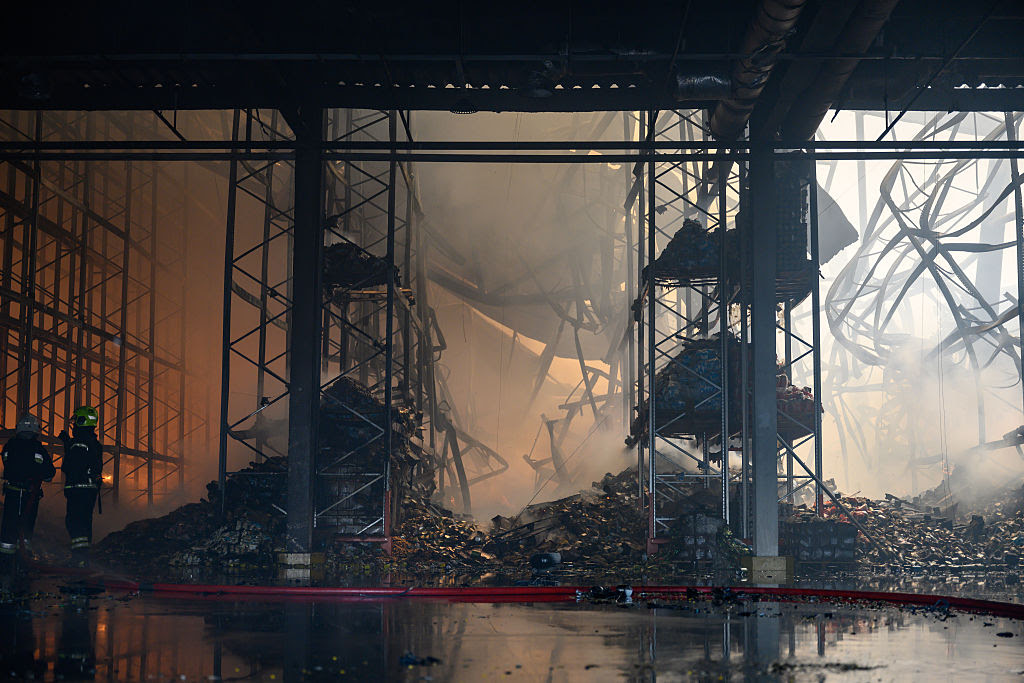
Ukrainian firefighters battle a blaze at a food warehouse caused by two Russian ballistic missiles in a midday strike that killed one security guard in Kharkiv, Ukraine. (Scott Peterson / Getty Images)
The Impatient Deal-Maker: Trump Cuts Putin’s Lifeline to Ten Days
President Donald Trump’s frustration with Vladimir Putin reached a boiling point on July 29, as he abandoned his previous 50-day deadline and gave the Russian leader just ten more days to engage in meaningful negotiations. The ultimatum, now set for August 8, came with stark warnings of tariffs and secondary sanctions against Russia’s economic partners.
“I’m very disappointed in President Putin — very disappointed,” Trump declared, acknowledging he had received “no response” from the Kremlin regarding his earlier deadlines. The American president assessed that Putin aims to seize “the whole” of Ukraine and “probably” wants to “keep the war going.”
US Department of State Spokesperson Tammy Bruce hinted that Trump might act even sooner than August 8, noting that the president “pretty much knows what the situation is.” The threat gained immediate credibility when Trump announced a 25 percent tariff on Indian imports starting Friday, specifically targeting New Delhi’s continued purchases of Russian military equipment and energy.
“Remember, while India is our friend, we have done relatively little business with them because their tariffs are far too high, among the highest in the world,” Trump posted on Truth Social, calling India’s trade barriers “strenuous and obnoxious.”
Moscow’s Defiant Response: Economic Immunity Claims Ring Hollow
Kremlin officials responded to Trump’s pressure with predictable bluster, though their claims of economic resilience increasingly contradicted reality. Kremlin Spokesperson Dmitry Peskov dismissed Trump’s threats, claiming the Russian economy had developed “immunity” to sanctions after operating under them for “quite some time.”
Russian Federation Council Chairperson Valentina Matviyenko insisted Russia’s war could only end after eliminating its “root causes” — a familiar reference to NATO expansion and Ukraine’s alleged discrimination against Russian-speakers. State Duma Deputy Mikhail Sheremet from occupied Crimea declared that Russia would not be “servile” and would not betray its national interests.
Yet these defiant proclamations masked growing economic vulnerability. The International Monetary Fund slashed Russia’s 2025 growth forecast to just 0.9% — more than four times lower than 2024’s 4.3% expansion. The revision represented the steepest downgrade among major economies, with growth projected to remain sluggish at 1% in 2026.
“We are expecting Russia’s economic growth to slow down in 2025, and that is very much due to the policy tightening and lower oil prices,” explained Petya Koeva Brooks, deputy director of the IMF’s research department.
The Information War Intensifies: Kremlin’s Anti-EU Propaganda Campaign
Behind the scenes, Russia launched a sophisticated propaganda offensive aimed at weakening the United States-European Union alliance. Russian opposition outlet Meduza revealed that the Presidential Administration’s Department of Public Projects had issued detailed instructions to state media on how to frame coverage of the July 27 US-EU trade deal.
The manual instructed Russian outlets to portray the agreement as “questionable” and a “defeat” for the EU, with Germany suffering the most. Prominent Russian officials immediately amplified these talking points, with Security Council Deputy Chairperson Dmitry Medvedev, Foreign Minister Sergey Lavrov, and Liberal Democratic Party Head Leonid Slutsky all claiming the deal was detrimental to European interests.
A political strategist reportedly working with the Presidential Administration told Meduza that the Kremlin needed to show Russians how “bad” the European economic situation was to distract from rising domestic prices and economic struggles.
Parliament’s Crucible: The Fight to Restore Anti-Corruption Independence
Ukraine’s political establishment faced its most serious domestic crisis since the war began as parliament prepared for a knife-edge vote to restore the independence of key anti-corruption agencies. The July 22 law that gutted the National Anti-Corruption Bureau (NABU) and Specialized Anti-Corruption Prosecutor’s Office (SAPO) had triggered the first major protests since Russia’s invasion.
“By my estimate, we’re currently in the 220-230 range, but that’s a very risky zone,” a Servant of the People lawmaker told the Kyiv Independent anonymously, referring to the 226 votes needed to pass President Zelensky’s corrective legislation.
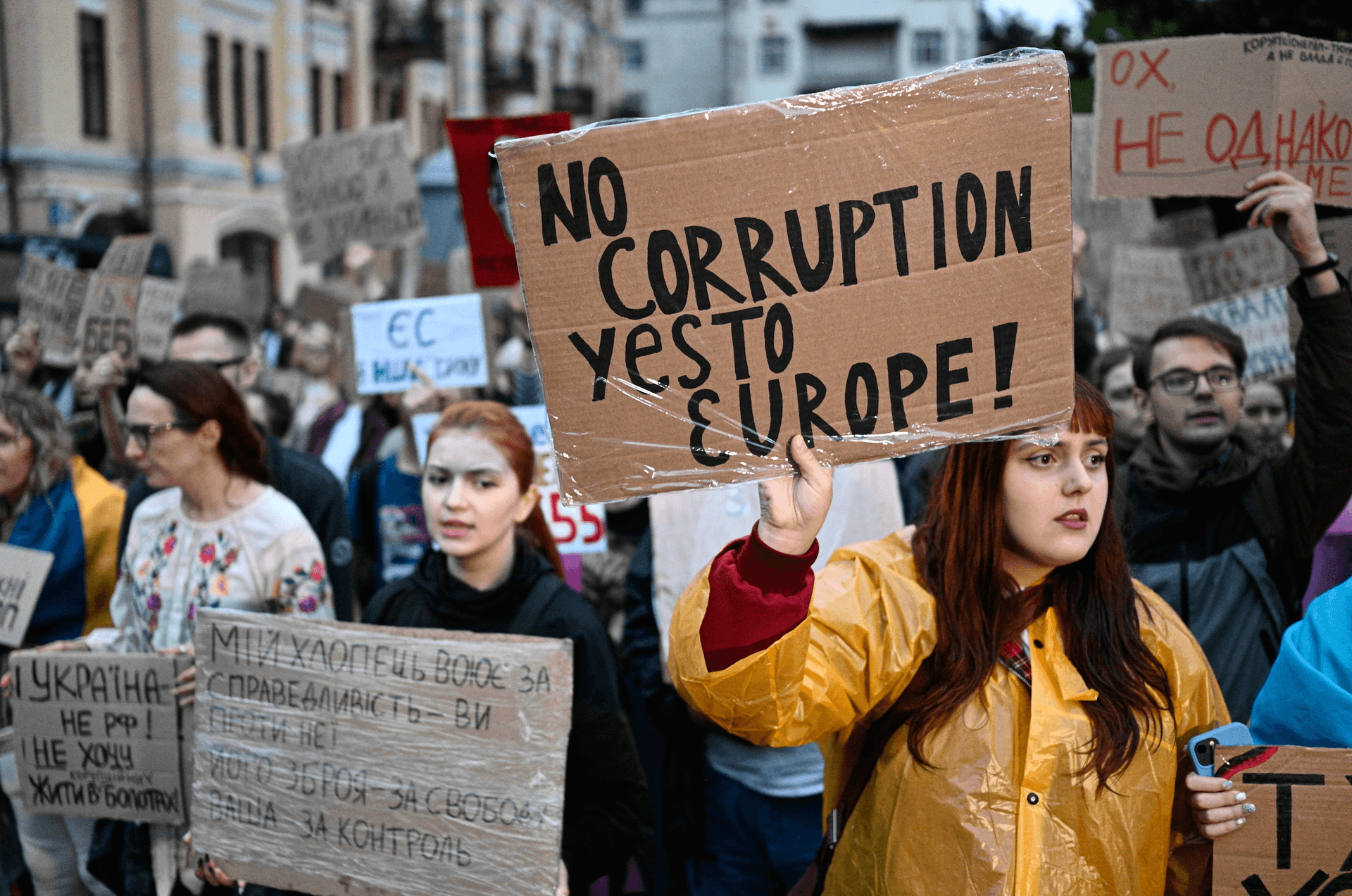
Kyiv residents take part in a rally ahead of a vote that would reinstate the independence of Ukraine’s key anti-corruption agences, in Kyiv, Ukraine. (Danylo Antoniuk/The Kyiv Independent
The crisis exposed the fragility of Zelensky’s governing coalition. Despite holding 231 seats on paper, Servant of the People typically provides fewer than 200 votes due to inconsistent attendance and internal divisions. The party had relied on former members of banned pro-Russian parties to pass the controversial July 22 legislation, raising questions about the nature of these political alliances.
Yulia Tymoshenko’s Batkivshchyna party, which had supported stripping the agencies of their independence, announced it would not back Zelensky’s new bill. The fate of the legislation hung on whether enough lawmakers from the governing party could be persuaded to reverse course.
Underground Imperative: Training Moves Below Ground After Deadly Strike
The war’s brutal reality intruded on Ukraine’s domestic political drama when a Russian missile struck a Ground Forces training facility on July 29, killing three soldiers and wounding 18 others. The attack prompted Commander-in-Chief Oleksandr Syrskyi to announce that military training must move underground wherever possible.
“The entire territory of Ukraine is within range of enemy missiles and drones,” Syrskyi declared after a monthly meeting on troop preparedness. “The training process must be moved underground as much as possible.”
The strike followed a pattern of Russian attacks on Ukrainian military training facilities, including a devastating March 1 Iskander-M missile strike on a formation exercise in Dnipropetrovsk Oblast. Russian reconnaissance drones had allegedly identified the assembled soldiers before that attack, which prompted Syrskyi to suspend two commanders and launch an internal review.
Ukraine has extended its basic combat course to 51 days and added new modules on drone warfare, trench survival, and engineering. Plans are underway to expand underground instruction and build new instructor schools with help from the Come Back Alive charity foundation.
Chemical Warfare’s Staggering Scale: Over 10,000 Documented Attacks
Ukraine’s Security Service revealed the horrifying scope of Russia’s chemical warfare campaign, documenting over 10,000 instances of Russian forces using prohibited chemical agents since the full-scale invasion began. The systematic violations of the Chemical Weapons Convention represented one of the most extensive uses of banned substances in modern warfare.
Russian forces routinely deployed CS (chlorobenzylidene malonitrile) and CN (chloroacetophenone) aerosol grenades — riot control agents prohibited in warfare — as well as ampoules containing the toxic compound chloropicrin. The most common delivery method involved first-person view drones dropping chemical munitions directly onto Ukrainian defensive positions.
“Upon detonation, these agents cause severe irritation to the eyes and respiratory system, often forcing Ukrainian troops to leave protected positions under active fire,” the SBU reported.
The Netherlands Military Intelligence and Security Service had confirmed in July that Russia had escalated from deploying riot control agents to using chloropicrin — a chemical capable of killing in confined spaces. The highest number of attacks was recorded in Nikopol, Dnipropetrovsk Oblast, across the Kakhovka Reservoir from Russian positions in occupied Enerhodar.
The Corruption Fightback: Anti-Graft Agencies Under Siege
The battle over Ukraine’s anti-corruption infrastructure extended beyond parliament as the government again refused to appoint investigator Oleksandr Tsyvinsky as head of the Bureau of Economic Security, despite mounting international pressure. The Cabinet of Ministers failed to raise the issue at its July 30 meeting, breaching the International Monetary Fund’s July 31 deadline.
The selection committee, which included three international experts with final say, had chosen Tsyvinsky on June 30. The government’s rejection citing alleged Russian ties — his estranged father holds Russian citizenship — was widely viewed as pretextual, given that Tsyvinsky holds security clearance and currently serves as a detective unit head at NABU.
“I was really shocked by the extent to which attempts were made to influence our decisions — the use of the Secret Service to influence this election seems not only unacceptable but also dangerous,” said international committee member Donatas Malaskevicius.
In a related development, Olena Duma announced her resignation as head of the Asset Recovery and Management Agency (ARMA) as new reform legislation entered into force. The move followed months of resistance from ARMA leadership to reforms backed by Western partners.
Europe’s Defense Mobilization: €127 Billion in Shared Borrowing
Eighteen EU countries signaled interest in accessing at least €127 billion in loans under the Security Action for Europe (SAFE) funding program, representing a massive mobilization of European defense resources through shared borrowing. Foreign Minister Andrii Sybiha welcomed the development as an opportunity for direct investment in Ukraine’s defense industry.
“This is a welcome mobilization of European defense funding,” Sybiha declared. “Europe is on track to significantly strengthen its defense industry, and Ukraine is an essential element of this effort.”
The SAFE program allows EU countries to access competitively priced long-term loans backed by joint borrowing, aiming to ramp up common defense procurement and reduce dependence on external suppliers. EU Commissioner for Defense and Space Andrius Kubilius called the response “a major step” toward building Europe’s readiness.
The program forms part of the European Commission’s broader ReArm Europe Plan 2030, which aims to unlock over €800 billion in defense spending amid continued Russian aggression.
Battlefield Dynamics: Ukrainian Advances Amid Russian Pressure
Despite the diplomatic and political turbulence, military operations continued across multiple fronts. Ukrainian forces recently advanced in northern Lysivka southeast of Pokrovsk and in western Maliivka, Dnipropetrovsk Oblast. Russian forces made gains southwest of Zelena Dolyna north of Lyman, while continuing offensive operations across the Kharkiv, Luhansk, and Donetsk directions.
A signalman in a Ukrainian drone battalion operating in the Pokrovsk direction reported that Russian forces were changing tactics, employing small groups up to detachment size and using motorcycles for logistics. Russian milbloggers claimed their forces were using tactics similar to those employed in seizing Selydove, attacking in small groups to find holes in Ukrainian defenses.
Ukrainian Southern Defense Forces reported that Russian forces were attempting to establish a “death strip” along the Dnipro River in Zaporizhia and Kherson oblasts, deploying up to 200-250 first-person view drones per day to reduce available defensive positions.
The Shadow Fleet Under Fire: New Sanctions Legislation
President Zelensky signed legislation enabling sanctions against vessels and aircraft involved in covert Russian schemes to transport oil, weapons, and military personnel. The law primarily targets Russia’s “shadow fleet” of aging and poorly insured tankers used to evade sanctions and conduct espionage.
The Security Service of Ukraine and intelligence agencies were empowered to identify and track such vessels, marking a significant expansion of Ukraine’s sanctions capabilities. The move came as Western partners increasingly targeted Russia’s shadow fleet, with the EU’s 18th sanctions package targeting over 100 shadow fleet ships and the UK sanctioning 135 Russian oil tankers.
International Justice: Russian Journalist Sentenced to 12 Years
A Russian court sentenced journalist and former Alexey Navalny volunteer Olga Komleva to 12 years in prison on charges of participating in “extremist” activities and spreading “false information” about the Russian military. The 46-year-old had volunteered for Navalny’s party before it was banned in 2021 and covered Russia’s offensive in Ukraine for independent outlet RusNews.
Komleva was found guilty of participating in the activities of an “extremist community” and spreading “deliberately false information about the actions of the armed forces.” She did not admit guilt on either charge and was seen smiling and waving from the defendants’ box, saying “I love you all” to supporters.
The case exemplified the Kremlin’s escalated crackdown on independent media and anyone deemed to have links to the deceased opposition leader. Press freedom group Reporters Without Borders described her imprisonment as a “symbol of the Kremlin’s repression of independent voices.”
Russia’s attempts to replace Ukrainian satellite dishes with Russian-only broadcasts in occupied territories met growing resistance from local residents. The Ukrainian Resistance Center reported that over 1,000 pieces of equipment providing access to Ukrainian television were confiscated in just one week, replaced with Russian “Russkiy Mir” satellites.
The resistance “irritated” occupation authorities, with Moscow dissatisfied with the project’s pace. Local authorities claimed 25,000 “Russkiy Mir” satellites were installed in Kherson Oblast during 2023 and 2024, but residents largely boycotted voluntary switches to the Russian system.
Financial Victory: PrivatBank Wins £1.9 Billion London Court Case
Ukraine’s largest lender, PrivatBank, won a landmark £1.9 billion victory in London’s High Court against former owners oligarch Ihor Kolomoisky and business partner Hennadii Boholiubov. The court ruled that the pair had misappropriated nearly $2 billion through a “highly complex lending scheme” before the bank’s 2016 nationalization.
“This is a landmark victory for the Bank and its shareholder — the Government of Ukraine,” said Nils Melngailis, chairman of PrivatBank’s supervisory board. The full amount, including interest and legal costs accumulated over more than a decade, will significantly exceed $2 billion.
The ruling represented a significant win for Ukraine’s efforts to combat oligarch influence and clean up its banking sector, closely watched by Western partners as a benchmark of the country’s commitment to anti-corruption reforms.
Looking Ahead: Ten Days to Diplomatic Reckoning
As Trump’s shortened deadline approaches and Ukraine’s parliament prepares for its crucial vote, the convergence of diplomatic pressure, domestic political crisis, and continued military assault creates a pivotal moment in the war’s trajectory. The next ten days will test whether Putin’s calculations about American resolve prove correct, whether Ukraine’s democratic institutions can withstand internal pressure, and whether the country’s defense capabilities can adapt to Russia’s evolving battlefield tactics.
The phantom promises of ceasefires and the documented reality of chemical warfare continue to define this conflict’s cruel paradox: even as diplomats speak of peace, the instruments of war grow ever more sophisticated and deadly. For Ukraine, the challenge remains constant — defending its territory while building the institutions that will define its post-war future.