
As Trump spoke with Putin ahead of meeting Zelensky, Russian artillery hit Kherson and flags rose over contested cities—exposing how peace talks advanced even as the war refused to pause.
The Day’s Reckoning
The phone call came first. In Florida, Donald Trump spoke for more than an hour with Vladimir Putin, calling it “good” and “very productive.” Only afterward did he sit down with Volodymyr Zelensky to talk about ending the war. The sequence mattered. It set the tone before a single document was opened or a single camera clicked.
Thousands of kilometers away, the war ignored the choreography. In Myrnohrad and Hulyaipole, Russian soldiers slipped into shattered neighborhoods to raise flags for the lens—some in holiday costume—then vanished back into contested streets. Control was claimed on video even as gunfire continued block by block. In Kherson, artillery shells tore into the city’s thermal power plant, cutting heat to tens of thousands of apartments as winter tightened its grip. Negotiations talked forward. The front line moved sideways, at gunpoint.
Between these worlds, diplomats assembled abstractions. Working groups. Frameworks. Percentages of agreement. Language careful enough to sound like progress without settling what peace would actually mean—or who would enforce it when the cameras were gone.
This was day 1,404 of the invasion, and the war had entered a strange equilibrium. Military reality and diplomatic theater no longer followed the same script. Videos competed with maps. Calls competed with casualties. Every signal of momentum in conference rooms was offset by smoke rising from cities that were still very much at war.
The question wasn’t whether talks were happening. They clearly were.
The question was whether anything discussed that day had the power to stop what was still happening everywhere else.
Before the Handshake: The Call That Framed the Peace
The call came before the meeting, and that was the point.
More than an hour before Volodymyr Zelensky sat down at Mar-a-Lago, Donald Trump was already on the line with Vladimir Putin. The conversation, initiated by Washington, ranged across security and economics and produced two new working groups—one for defense, one for money. By the time Zelensky’s delegation arrived in Florida, the outlines of the discussion had already been drawn somewhere else.
The order mattered. Consulting Moscow first signaled where gravity lay in the room. Ukrainian officials walking into negotiations could not know what assurances had been offered, what boundaries had been quietly acknowledged, or which arguments Putin had already framed as settled. They entered a process already in motion, without seeing the map.
Trump later said Putin had presented “very detailed arguments” about honoring understandings supposedly reached at the August 2025 Alaska Summit. But Alaska had produced nothing tangible—no signed documents, no public commitments, no verifiable agreement. Still, Moscow had spent months insisting that meeting locked in principles derived from Putin’s June 2024 ultimatum: Ukrainian territorial concessions, limits on Ukraine’s military, and constraints on NATO itself. Now those claims were back on the table, treated not as demands, but as precedent.
That contradiction defined the day. Trump spoke as though he were negotiating peace with Ukraine. Putin spoke as though Washington had already agreed—and Kyiv was merely being brought into compliance. For Zelensky’s team, the talks were framed as partnership. For Moscow, they were implementation.
The structure of the working groups made the imbalance concrete. Ukraine had no role in shaping them. One channel ran Washington to Moscow. Another ran Washington to Kyiv. Parallel tracks, moving at different speeds, carrying the risk of arriving at different destinations.
By the time Zelensky sat down, the most important conversation had already happened—without him.
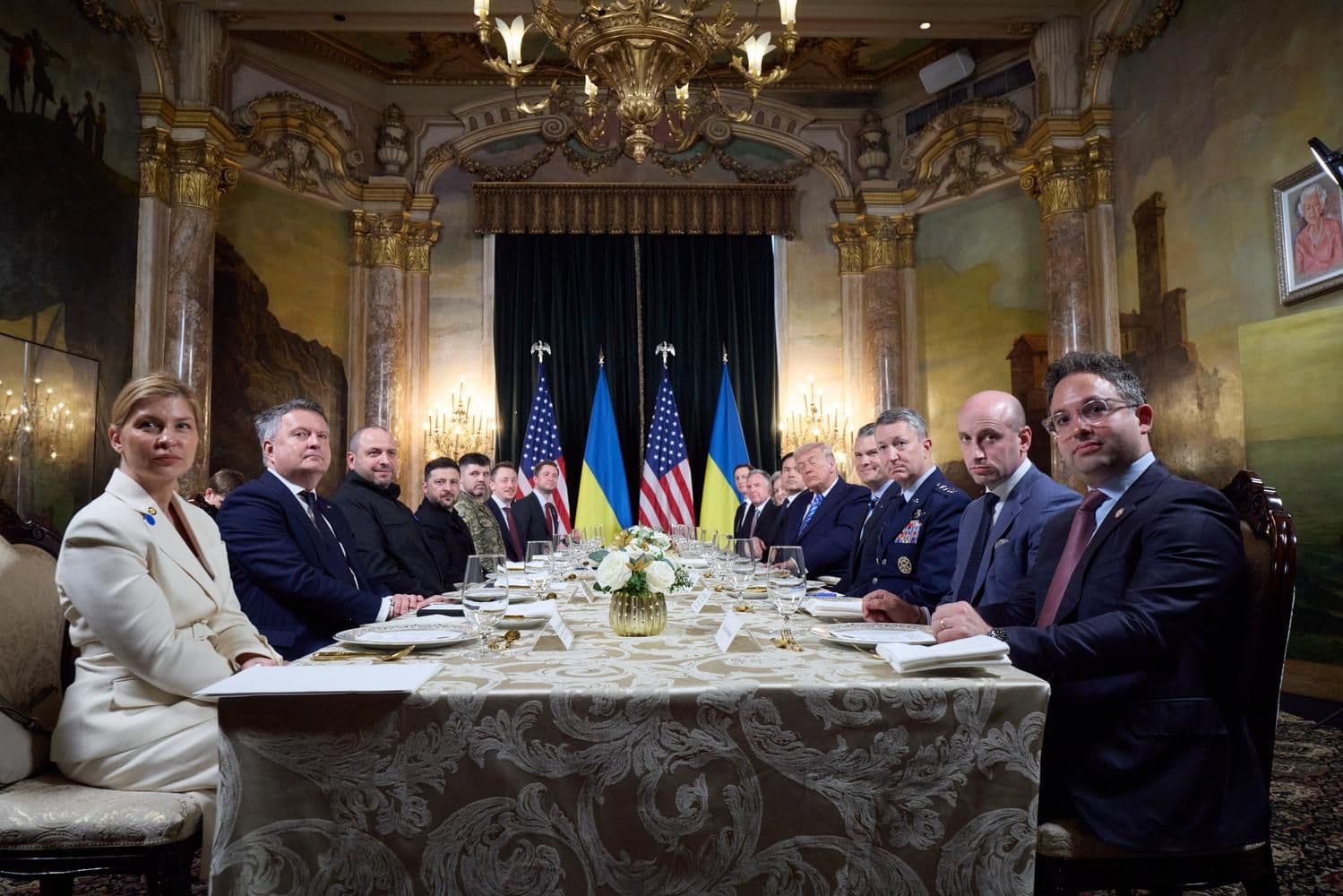
President Volodymyr Zelensky and members of Ukraine’s delegation sit across the table from the U.S. delegation led President Donald Trump at Mar-a-Lago, Florida. (President’s Office)
Across the Table at Mar-a-Lago: When Words Did the Fighting
They sat down beneath chandeliers and palm-framed windows, but the weight in the room had nothing to do with décor.
Volodymyr Zelensky arrived at Mar-a-Lago with a delegation built for seriousness—security, economics, diplomacy all represented. Rustem Umerov. Oleksii Sobolev. Andrii Hnatov. Sergiy Kyslytsya. Oleksandr Bevz. It looked like a team prepared to negotiate the future of a country, not just the optics of a meeting.
Donald Trump spoke first—not to Zelensky, but to reporters.
Asked whether Russian attacks undermined Putin’s sincerity about peace, Trump waved the question away. “No, he’s very serious,” he said, then pivoted—smoothly, deliberately—to Ukraine’s long-range strikes inside Russia. Ukraine, he suggested, was also escalating. “You probably have to,” he added, as if explaining away the contradiction.
The equivalence landed hard. Russian artillery had been hitting civilian infrastructure. Ukrainian drones had been striking military targets hundreds of kilometers inside Russia. Trump spoke of both as comparable acts of destruction—two sides equally fueling the war, two parties equally obligated to concede. Aggressor and defender flattened into moral symmetry.
Then came the aside. “There have been some explosions in various parts of Russia,” Trump said. “I don’t think it came from the Congo. I don’t think it came from the United States of America. It possibly came from Ukraine.” The acknowledgment was half compliment, half warning—recognition of Ukraine’s reach, reframed as a problem to be managed.
Security guarantees fared no better. Asked directly, Trump snapped that the question was “stupid,” before outlining a “strong security agreement” led largely by Europe. American involvement would exist, but the burden—troops, enforcement, deterrence—would belong to others. Peace, in this framing, came with balance sheets attached.
Trump insisted there were “no deadlines.” The statement clashed with months of pressure, ultimatums, and threats to cut aid. It sounded patient. It wasn’t.
What unfolded in Florida wasn’t negotiation yet—it was positioning. Trump wanted the image of peacemaker without ownership of the price. Zelensky came seeking guarantees. What he heard instead was a reminder: peace would be transactional, shared, and—above all—someone else’s responsibility.
When the Math Changed but the Meaning Didn’t
The number shrank. The pressure didn’t.
What began as a 28-point framework quietly collapsed into 20, but the reduction wasn’t cosmetic—it was forced. The original November draft, exposed through leaked recordings, had read less like a peace plan than a list of demands shaped with Kremlin input: caps on Ukraine’s military, abandonment of NATO ambitions, and territorial withdrawals. American envoy Steve Witkoff was caught advising Russian officials on how to soften the language for European audiences. Capitulation, rephrased.
By late December, the plan was nearly “complete.” Florida was supposed to finish it. Three companion documents hovered beside the core text: a trilateral security guarantee involving Ukraine, the United States, and Europe; a bilateral U.S.–Ukraine security agreement; and an economic roadmap promising post-war recovery and investment. On paper, it looked comprehensive. On the ground, the fault lines were obvious.
The problem was never the number of points. It was that Ukraine and Russia were solving different equations. Zelensky kept repeating the same line—territory was not negotiable. Trump’s parallel talks with Putin suggested that line might not matter. Red lines existed, but not everyone in the room acknowledged them.
Everything hinged on security guarantees. Without credible deterrence, any agreement risked becoming a pause—a window for Russia to rearm and return. Trump’s remarks made clear where enforcement would land. Europe would carry the weight. American commitments would remain largely diplomatic and economic. Protection, outsourced.
Then came the phrasing that stripped the issue bare. Trump said a few matters remained unresolved—“territorial issues related to Donbas,” and the possibility of a ceasefire followed by a Ukrainian referendum. Sovereignty reduced to a detail. Borders treated as variables. Citizens asked to vote on terms they had not shaped.
The Zaporizhzhia Nuclear Power Plant exposed the same logic. Trump spoke of Ukraine and Russia “working together” to reopen a facility seized at gunpoint in 2022. The IAEA’s temporary repair ceasefires were recast as cooperation. Joint control was floated as practicality.
Stability, in this framework, came at the price of ownership.
The Agreement That Never Existed—Except in Moscow
In Moscow, the negotiations were already over.
While Donald Trump spoke of talks still unfolding, the Kremlin spoke as if the outcome had been decided months earlier. Putin’s aide Yuri Ushakov said the December 28 call was used to press “very detailed arguments” about honoring agreements supposedly reached at the Alaska Summit. Not ideas. Not frameworks. Agreements.
Those alleged commitments, Russian officials claimed, flowed directly from Putin’s June 2024 speech to the Foreign Ministry—an ultimatum dressed as diplomacy. Ukraine would recognize Russian territorial gains, abandon NATO aspirations, accept limits on its military, and tolerate new restrictions on NATO’s presence in Eastern Europe. Putin had framed these not as bargaining positions, but as prerequisites for peace.
By repeatedly invoking Alaska, the Kremlin constructed a parallel diplomatic reality. Trump spoke of negotiations in progress. Putin spoke of compliance. Trump referenced unresolved questions. Putin demanded implementation of settled terms. Ukraine found itself negotiating against promises it had never made and documents it had never seen.
The demands stretched beyond Ukraine itself. Russian officials insisted that peace must address Moscow’s security concerns with NATO as a whole—requiring the alliance to reorganize its posture across Europe. Ending the war, in this vision, meant reshaping the continent’s security order.
Then came Moscow’s rejection of European-led security guarantees for Ukraine. If Europe’s commitments were unacceptable and American military guarantees remained absent, the question became unavoidable: what would actually deter Russia after a ceasefire?
Diplomats kept drafting. Percentages of completion rose. But beneath the paperwork sat a dangerous assumption—that the deal already existed, and only acknowledgment remained.
Victory on Paper, Not on the Ground
Inside the Kremlin, maps told a story the battlefield could not.
Russian commanders briefed Vladimir Putin with confident claims of sweeping progress. Central Grouping commander Valery Solodchuk said Myrnohrad, Rodynske, and Vilne near Pokrovsk had fallen. Eastern Grouping commander Andrei Ivanaev reported the capture of Hulyaipole in Zaporizhzhia Oblast. The message was clear: momentum was building, victory was approaching, negotiations should reflect that reality.
Outside the briefing room, that reality unraveled.
Ukrainian units and open-source analysts challenged the claims throughout December 28. The 7th Rapid Reaction Corps reported holding positions in northern Pokrovsk. Southern Defense Forces acknowledged Russian presence in parts of Hulyaipole but confirmed Ukrainian forces still defended large sections of the town. Fighting continued street by street.
Geolocated footage filled in the gaps. Analysts assessed Russian forces operated in roughly 49 percent of Myrnohrad and 55 percent of Hulyaipole—not full control, not consolidation. Rodynske remained contested. The proclamations of capture looked less like reporting and more like performance.
The damage from earlier exaggeration still lingered. After the Defense Ministry falsely declared Kupyansk fully seized, Russian milbloggers erupted in rare public fury, accusing commanders of systematic deception. Chief of the General Staff Valery Gerasimov adjusted his tone. His update spoke carefully of “eliminating Ukrainian forces blocked on the east bank of the Oskil River.” No victory declared. No flags planted. Damage control.
Still, the larger illusion persisted. Putin and his generals spoke of the Fortress Belt—Kostyantynivka, Druzhkivka, Kramatorsk, Slovyansk—as if its fall were imminent. Gerasimov claimed control of “more than half” of Kostyantynivka. Open-source data showed Russian troops in roughly five percent of the city.
Small villages like Sofiivka were elevated into strategic breakthroughs. In reality, Russian forces had advanced meters at enormous cost. Independent estimates suggested that at current rates, full seizure of Donetsk Oblast would not come until at least August 2027—if nothing slowed them.
To reinforce the narrative, lower-level commanders joined the briefing by phone. They spoke honestly of gains measured in kilometers over months. Those granular truths were meant to legitimize a strategic story that no longer matched the ground.
Flags for the Camera, Not the Streets
The flags went up fast—too fast.
Russia’s Defense Ministry released a cascade of slickly edited videos showing small groups of soldiers planting tricolors across Myrnohrad and Hulyaipole. Clip after clip, flags appeared on rooftops, inside ruined buildings, along shattered streets. The timing was precise, synchronized with commanders’ briefings to Vladimir Putin. On screen, it looked like momentum. Like conquest.
One image stood out. A soldier dressed as Father Frost—Russia’s Santa Claus—hoisted a flag atop a destroyed building, a holiday costume framed by rubble and winter smoke. The message was unmistakable: confidence, celebration, victory. Multiple flags. Multiple neighborhoods. A city taken—at least on video.
On the ground, the picture fractured.
Ukrainian forces confirmed that Russian units were slipping into central areas during brief infiltration missions, raising flags long enough to film them, then pulling back. Control did not change. Positions were not held. These were not occupations but appearances—reconnaissance wrapped in theater. In many cases, Ukrainian counterattacks cleared the infiltrators within hours of the footage being shot.
The pattern was familiar. Kupyansk had seen the same sequence: flags first, victory claims second, reality later. When Ukrainian forces retook large parts of the city, Russian milbloggers turned openly critical, complaining that flag videos had replaced honest reporting. Symbols had been substituted for ground truth.
What changed this time was polish. The videos were no longer spontaneous clips but coordinated montages, designed to be read as maps. Each flag implied control of a block, then a district, then a city. The strategy leaned on a simple assumption: that audiences—especially outside Ukraine—would equate a visible flag with lasting control.
In this war, a few minutes of footage were meant to outweigh days of fighting. Victory, compressed into pixels, was declared before it could be tested by gunfire.
The Border That Keeps Moving
In Putin’s briefings, the war no longer stopped at the lines Russia claimed to have annexed.
Again and again, he and his commanders spoke of “buffer zones”—belts of territory carved out beyond the four Ukrainian oblasts Russia illegally claimed in 2022. Sumy. Kharkiv. Dnipropetrovsk. Putin said progress was coming at a “good pace.” Central Grouping commander Valery Solodchuk framed operations in Dnipropetrovsk Oblast as defensive necessity, protection for occupied Donetsk.
But the language gave away the shift. These areas had never been part of Russia’s annexation decrees. They were not disputed zones in any peace framework. Negotiations had always assumed Russian withdrawal from them, not permanent occupation under a new label. “Buffer zone” was simply expansion with softer edges.
The doctrine exposed the trap built into any peace that froze Russian forces in place. If Moscow defined its security as requiring depth beyond seized territory, then no line could ever hold. Each annexation demanded buffers. Each buffer demanded new buffers. The logic fed on itself, turning temporary ceasefires into launchpads for the next advance.
Reality resisted the theory. Open-source tracking showed little to support claims of momentum in northern Ukraine. Russian activity in Sumy Oblast remained limited, attacks sporadic rather than sustained. The “good pace” existed largely on slides.
Kharkiv Oblast told the same story. Ukrainian counteroffensives around Kupyansk had undone months of Russian effort, forcing Moscow to divert forces just to stabilize positions it had already claimed secure. Buffer zones there did not expand—they frayed.
What emerged was a familiar pattern. Russian forces could push locally with massed firepower and manpower, but they struggled to hold ground once Ukrainian defenses reformed. The doctrine promised strategic depth. The battlefield delivered constant erosion.
Putin spoke confidently of expanding protection. The front line answered with stubborn resistance, making each new “buffer” thinner than the last.
When the Numbers Refuse to Obey the Narrative
At some point, ambition collides with arithmetic.
Valery Gerasimov assured Vladimir Putin that Russian forces would press on until all of Luhansk, Donetsk, Zaporizhzhia, and Kherson oblasts were taken. On paper, the promise sounded resolute. On a map, it demanded math. Russian advances in 2025 averaged about 14.4 square kilometers per day. At that pace, full seizure of the four oblasts would not arrive until April 1, 2029—another 1,190 days of fighting.
And that calculation was charitable.
It assumed Russian forces could sustain current momentum for more than three years despite rising casualties and equipment losses. It treated rivers as lines on paper, not barriers—ignoring the Dnipro, which Russian troops would still need to cross to push deeper into Zaporizhzhia and Kherson. It brushed aside cities. Zaporizhzhia, pre-war population 710,000. Kherson, nearly 280,000. Urban fortresses, not open fields.
Russia has not demonstrated the ability to take cities of that scale since the chaotic opening months of 2022, when surprise and Ukrainian unpreparedness briefly tilted the balance. Since then, Ukraine has fortified, adapted, and learned how to bleed Russian assault formations in dense terrain designed to punish attackers.
The Fortress Belt exposed the gap between briefing-room confidence and battlefield reality. Commanders spoke of Sofiivka as if its capture unlocked the road to Kostyantynivka, Kramatorsk, and Slovyansk. Gerasimov claimed control of “more than half” of Kostyantynivka. Open-source imagery showed Russian forces in roughly five percent. Progress was described as rapid while measured in streets and tree lines.
The performance betrayed its own anxiety. Russian commanders knew the advances were too slow to match the promises. Admitting that meant admitting failure. So tactical gains were inflated into strategic turning points, incremental movement dressed up as momentum.
The math never changed. The story did.
Seven Hundred Kilometers In: When the War Reached Home
The night did not respect the negotiations.
As diplomats talked in Florida and generals performed for cameras in Moscow, Ukrainian drones flew deep into Russia—far beyond the front, far beyond symbolism. In Samara Oblast, nearly 700 kilometers from Ukraine’s border, explosions ripped through the Syzran Oil Refinery. The ELOU-AVT-5 primary processing unit burned, flames visible across the city, turning a civilian skyline into an industrial firestorm.
The strikes did not stop there. An electrical substation in Syzran went dark, cutting power to parts of the city. Russia’s Defense Ministry claimed air defenses shot down 12 drones over the region—a number that quietly admitted the scale of the attack. Residents posted videos of repeated blasts, sirens, and fire crews racing toward the refinery complex as the night stretched on.
Syzran mattered. The facility processed between 7 and 8.9 million tons of oil a year, feeding directly into Russia’s war economy. This was not a single message strike. It was part of a pattern—persistent pressure on specific, high-value nodes designed to force Moscow to defend everywhere at once.
Further south, Ukrainian forces hit a naval drone storage and maintenance site near occupied Chornomorske in Crimea. Unmanned Systems Forces commander Robert Brovdi reported the destruction of a Valdai radar station, a reconnaissance control point, and the drone base itself. Precision mattered. This was not opportunism; it was targeting.
Closer to the front, strikes landed in occupied Donetsk Oblast. Shahed drone storage in Makiivka. Ammunition depots in Antratsyt. Facilities 47 to 100 kilometers behind Russian lines—places meant to be safe, logistical lungs feeding the front.
Each strike narrowed Russia’s margin. Even when Moscow gained ground meter by meter, its rear was under fire. The message carried through smoke and broken substations: distance no longer meant protection.
A Reactor Under Occupation
The words sounded calm. The reality was anything but.
When Donald Trump said Ukraine and Russia were “working together” to reopen the Zaporizhzhia Nuclear Power Plant, he described cooperation as if it were voluntary. As if Europe’s largest nuclear facility were not under military occupation. As if shared control were a neutral technical choice rather than the outcome of force.
There was cooperation of a kind. The International Atomic Energy Agency had brokered temporary, localized ceasefires so engineers could repair damaged power transmission lines between the ZNPP switchyard and the Zaporizhzhia Thermal Power Plant. These pauses—fragile and closely monitored—were about one thing only: preventing nuclear catastrophe. They were not political settlements. They were emergency measures.
Since March 2022, Russian forces had occupied the plant at gunpoint. The facility became a de facto military base. Ukrainian staff worked under armed guard. IAEA inspectors faced restricted access. Cooling systems for spent nuclear fuel demanded constant attention, not because the plant was operating normally, but because neglect could trigger disaster. This was coercion masquerading as collaboration.
Trump’s language blurred that line. By suggesting joint post-war operation, he floated a framework that would legitimize Russian control through negotiation rather than reverse it. If Russian personnel remained embedded at ZNPP after a peace agreement, Ukrainian sovereignty over its own infrastructure would exist in name only. Occupation would be normalized, not ended.
The proposed arrangement reportedly offered shared operational benefits to Ukraine, the United States, and Russia. Revenues might flow. American firms might participate. But the price would be permanent Russian presence at a strategic site. Every future technical dispute could become a security pretext. Every repair an excuse to stay.
On December 28, the IAEA confirmed it had secured a short “window of silence” to restore power transmission—nothing more. A necessary pause. A narrow fix.
The danger lay in mistaking survival for settlement. What kept the reactors safe today could, if formalized, anchor Russian forces there indefinitely. Stability bought that way would not be peace. It would be occupation with better lighting.
Where Peace Talks Don’t Reach: Pokrovsk at Street Level
While officials spoke in Florida and Moscow, Pokrovsk stayed loud.
A Ukrainian mortar battery commander described the city as a maze where weather, not diplomacy, set the tempo. Fog and rain muted drones and blurred sightlines. Russian infantry used the cover to slip forward in small groups, moving between ruined apartment blocks and storefronts where civilians once lived. Ukrainian and Russian positions overlapped on the same streets, sometimes separated by a single wall.
There were no clean kill zones. Urban terrain swallowed them. Ukrainian crews fought from buildings never meant to be firing positions, while Russian FPV drones hunted supply routes and Russian mortars crept closer, dragged into northern Pokrovsk itself. Still, Ukrainian units kept the city supplied, holding lines that bent but did not break.
The pressure came from everywhere. Russian attacks pushed in from the northwest near Hryshyne, from the north through Sukhetske and Rodynske, from the northeast around Chervonyi Lyman, from the east in Myrnohrad, and from the southwest near Kotlyne and Udachne. It was a ring of force, designed to squeeze a city whose fall would open the road toward the Fortress Belt farther west.
Despite Moscow’s claims, Pokrovsk was not taken. The 7th Rapid Response Corps of the Air Assault Forces still held ground in the north. Ukrainian combat footage showed live firefights, manned positions, and soldiers returning fire. This was not occupation. It was contested space.
Weather favored the attackers. Fog and rain limited Ukrainian drone coverage, and Russian infantry exploited the gaps. Some fighters wore civilian clothes, blurring the line between combatant and resident, turning every movement into a threat.
Pokrovsk revealed the war as it was at the end of 2025. Russia could grind forward by accepting heavy losses, but not break through. Ukraine could hold and counter, but not fully stop the pressure. Progress was counted in buildings, not maps. Peace talks happened elsewhere. Here, the war stayed put.
Morning in Kherson: A City Too Close to the Guns
The shells came with daylight.
On the morning of December 28, Russian artillery opened fire on Kherson, aiming not at trenches but at heat. Rounds struck the Kherson Thermal Power Plant, ripping into the city’s only source of centralized heating just as winter tightened its hold. Tens of thousands of apartments went cold. One plant worker was wounded and rushed to hospital while crews tried to understand what could still be saved.
“This station is hit almost every day,” Naftogaz head Serhii Koretskyi said as emergency plans rolled out to find backup heating for residents. The goal was no longer comfort. It was survival.
The barrage didn’t stop at infrastructure. Multiple-launch rocket systems hammered residential streets in the Korabelnyi district. Houses burned. Apartment blocks took hits meant for battlefields, not bedrooms. At least nine people were injured as fragments tore through walls and windows.
Kherson’s problem is geography. Russian guns sit just across the Dnipro River, close enough that expensive missiles aren’t needed. Standard artillery can reach deep into the city. There is no buffer, no depth, no distance to absorb fire. Ukrainian defenses cannot push the threat far enough away. Every street lives inside the arc of a howitzer.
More than any other major city, Kherson has become a proving ground for terror by proximity. Power, heat, water—systems that keep a city alive—are easier targets than armies. Russia no longer needs to take Kherson to punish it. It only needs to keep firing.
The December 28 attack followed a familiar script from the war’s fourth winter. Unable to retake the city, Russian forces worked to empty it instead—freezing apartments, darkening streets, and reminding residents each morning that the front line is never far away.
After Midnight: When the Sky Wouldn’t Stay Quiet
The drones came after dark, one wave after another.
Overnight on December 28, Russian forces launched 48 unmanned aerial vehicles toward Ukraine. The Ukrainian Air Force tracked them lifting off from Oryol and Kursk, from Primorsko-Akhtarsk on the Black Sea, and from occupied Hvardiiske and Cape Chauda in Crimea. Most were Shahed-type attack drones, with Gerans and other UAVs mixed in to complicate the defense.
Air defenses worked through the night. Thirty drones were shot down. Eighteen were not. They struck nine locations across the country, hitting energy infrastructure in Kyiv and Chernihiv oblasts. By morning, 39,000 households were without power, the damage measured not just in blackout maps but in cold apartments and darkened stairwells.
The raid was not exceptional. It was routine.
Russia’s fourth winter campaign against Ukraine’s power grid has become methodical—generation, transmission, repair, repeat. Each strike forces costly fixes and reminds civilians that air defenses, no matter how effective, cannot stop everything at once. The goal is erosion, not shock.
President Volodymyr Zelensky put the night in context. In the past week alone, Russia had launched more than 2,100 drones, around 800 guided aerial bombs, and 94 missiles at Ukrainian territory. The numbers climbed even as peace frameworks were debated and negotiations advanced on paper.
The scale told its own story. Moscow still had depth—stockpiles, factories, launch sites—to sustain high-tempo attacks despite Ukrainian strikes deep inside Russia. The war in the sky ran on parallel tracks: talks below, engines above.
Peace was discussed in conference rooms. Over Ukraine, it was another night of counting what got through.
No Safe Side in This War: When a Defector Dies Fighting
The drone did not care who he was fighting for.
Denis Kapustin—better known by his nom de guerre, “White Rex”—was killed during a combat mission in Zaporizhzhia Oblast. An FPV drone struck his position on the southern front, according to preliminary reports from his own fighters. The weapon that ended his life was the same one hunting Ukrainian soldiers every day. Allegiance did not matter.
Kapustin was never an easy figure to place. A far-right activist with a history of neo-Nazi views and football hooliganism, he had been banned from the Schengen Area before relocating from Germany to Ukraine in 2017. When Russia launched its full-scale invasion, he helped form early volunteer units that would later grow into Ukraine’s Third Assault Brigade and Third Army Corps.
In August 2022, Kapustin founded the Russian Volunteer Corps with a blunt objective: overthrow Vladimir Putin. His fighters carried the war back across the border, staging high-profile incursions into Russia’s Belgorod and Kursk regions and capturing dozens of Russian soldiers. Ukrainian authorities acknowledged the group’s role within the broader defense effort, while noting it operated independently in its cross-border actions.
“We confronted the common enemy together in the battle for Kyiv,” Ukraine’s Third Army Corps wrote after his death. “He perceived Ukraine as a place of real resistance and freedom.”
Kapustin was part of a growing, uneasy phenomenon—Russians taking up arms against their own state alongside Ukrainian forces. The Russian Volunteer Corps, the Freedom of Russia Legion, the Siberian Battalion. Not symbols. Fighters.
His death underscored the cost of turning dissent into combat. On this battlefield, there are no exemptions. Drones, artillery, and missiles do not distinguish between Ukrainian defenders and Russian defectors. Kapustin’s unit vowed revenge, another thread added to a war that continued to claim lives even as peace was debated elsewhere.
The Day’s Meaning: When Peace Talked and War Answered
December 28 exposed the war’s central contradiction with brutal clarity. Donald Trump spoke to Vladimir Putin before meeting Volodymyr Zelensky. Russian commanders declared cities taken that Ukrainian troops still defended. Peace plans edged toward completion even as artillery cut heat to Kherson. Flags rose on video while casualties mounted off-screen. Two versions of reality competed for authority.
In Florida, the process looked orderly. Working groups formed. Percentages climbed. Frameworks thickened. Yet none of the core questions moved. Would Russia accept peace without ratifying conquest? Would Ukraine accept peace that did? Could any guarantee deter future aggression without real military force behind it? Or would a ceasefire simply become an intermission?
The architecture of the talks offered its own answer. Putin’s call with Trump before Zelensky arrived signaled where leverage lay. Terms would be shaped between Washington and Moscow; Kyiv would respond. The absence of Ukrainian input in forming the working groups was not oversight—it was structure.
Moscow’s battlefield narrative served that structure. Inflated claims from Myrnohrad and Hulyaipole, confident talk of buffer zones, and constant references to an Alaska precedent all pushed the same message: Russian victory was inevitable, resistance temporary. If that premise held, concessions were logical. Whether the premise matched reality mattered less than how it framed negotiation psychology.
On the ground, nothing paused. Russian forces kept grinding forward at high cost. Ukrainian forces held, countered, and struck deep into Russia’s rear. Civilians paid for every mile not taken and every document not signed.
The question hanging over the day was not whether diplomacy would continue—it would. The question was whether it addressed the war’s causes or merely its exhaustion. Trump spoke without deadlines. Putin spoke as if terms were already settled. Zelensky spoke of red lines that could not move.
Between those positions lay a familiar ending: not peace secured, but war managed—paused, frozen, and waiting.