
UKRAINE DAILY BRIEFING
Sunday, October 11, 2026
Donald Trump announced an “energy ceasefire” he said both sides had agreed to — and within hours Russia hit a power plant in Kharkiv, while officials in Kyiv said nobody there had heard of any deal. Zaporizhzhia mourned at least 20 people killed in a single apartment block, as Russian bombs and missiles struck homes from Kharkiv to Sloviansk. And deep inside Russia, a Ukrainian drone knocked out a third Yandex data center in four days, stranding taxi riders as far away as Serbia.
The Day’s Reckoning
It’s Sunday afternoon in Kyiv, and the taps are dry. Russian drones have damaged a high-voltage power line, and the mayor is telling residents what they already know: “The enemy continues to attack energy infrastructure.” Repair crews are still out on the lines when a post from the President of the United States lands, two words of it in capital letters. “Effective immediately, there is an ENERGY CEASEFIRE in the War between Russia and Ukraine. Both parties have agreed.”
One of those parties had never heard of it. A few hours later, Russian bombs found a power plant in Kharkiv.
That gap between announcement and reality runs through everything that follows. Zaporizhzhia held a day of mourning after rescuers hauled the last of 320 metric tons of concrete off a collapsed apartment block. Ukraine’s president told an American television audience that only Ukrainians choose Ukraine’s leaders, and that elections can come the moment Russia gives him 60 quiet days. And 370 miles inside Russia, a drone darkened another data center run by Russia’s answer to Google.
A ceasefire on a phone screen. A power plant on fire. Only one of them could be seen from the ground.
“Do Not Break It!”: The Ceasefire Nobody in Kyiv Had Heard Of
First, a quick explainer. An “energy ceasefire” is a narrow kind of truce: both sides stop hitting each other’s power plants, grids, and oil refineries, while the rest of the war grinds on. Think of two feuding neighbors who agree to stop cutting each other’s power lines while still fighting over the fence.
On Sunday, Donald Trump announced on his Truth Social account that exactly that deal was done. “Both parties have agreed. Do not break it! Thank you for your attention to this matter,” he wrote.
Kyiv was caught flat-footed. A senior Ukrainian official close to President Volodymyr Zelensky said Ukraine had no information about any such agreement — crews were still restoring power and water in the capital when the post went up. “Nobody has heard [of the ceasefire],” the official said. Zelensky himself called the announcement “news” to him, but said Ukraine would support it if Russia did, and met with NATO officials to discuss it. Moscow said nothing at all.
Then the answer arrived in the form it usually takes. Zelensky reported that, just hours after the announcement, Russian forces struck Kharkiv City Thermal Power Plant No. 5 — a plant that supplies both electricity and heat — causing significant power outages.
Even Russia’s military bloggers — pro-war commentators with huge online followings whom the Kremlin watches closely — weren’t buying it. One Kremlin-affiliated blogger found it odd that the news came from Washington rather than Moscow or Kyiv. Another pointed out that Trump announced a similar energy ceasefire on Sept. 14 that never happened. Analysts at the Institute for the Study of War, a Washington think tank, read the bloggers’ skepticism as a sign the Russian state isn’t preparing to honor any such truce. To understand how this announcement came to be, rewind two days.
The Squeeze: Weapons, Intelligence, and a “New President”
On Saturday, Trump turned his fire on Zelensky. Ukraine’s drone strikes on Russian oil refineries, he argued, have helped drive diesel prices sky-high — and Zelensky “better damn well stop.” He went further, saying it was “time for Ukraine to get a new president.”
Behind the scenes, according to European officials who were on the calls or briefed on them, U.S. officials phoned Kyiv and European capitals on Oct. 10 and 11 with a sharper warning: stop striking Russian energy, or Washington could suspend PURL and stop sharing intelligence. PURL — the Prioritized Ukraine Requirements List — is the mechanism that lets U.S. weapons be purchased for Ukraine. The White House declined to confirm or comment on the calls.
Why does intelligence matter? It’s the eyes behind Ukraine’s targeting. Analysts point to March 2025, when a temporary U.S. pause in intelligence sharing helped Russian forces advance in Russia’s Kursk region — and assess that Moscow would like nothing better than a repeat.
Zelensky didn’t budge. “The real cause of the war in Europe is Russia, and Russia alone,” he wrote on social media. “It is already possible today to halt the attacks on our energy sector, but (Vladimir) Putin does not want to do so.” His offer was conditional and plain: Ukraine will stop hitting Russian refineries when Russia stops hitting Ukraine’s power grid. “Any de-escalation measures must be reciprocal and backed by genuine guarantees,” he added — a pointed line, given that Russia has broken ceasefires before.
Here’s the irony underneath it all. Nobody pressures a country to stop doing something that isn’t working. Ukraine’s General Staff estimated in September that its strikes had knocked 45% of Russia’s refining capacity offline. The pressure on Kyiv is, in its own way, a measure of how much those strikes hurt.
What Washington Put on the Table for Moscow
While Kyiv was being squeezed, Moscow was being courted. American negotiators presented the Kremlin with three economic incentives to accept a limited ceasefire — covering either energy or sea lanes — before winter, according to officials familiar with the talks. The package was pitched as a reward up front, not a prize for a finished deal.
The first: unlocking Russian state money frozen in Western countries under sanctions, reviving talk of releasing up to $100 billion. The second: reviving the sale of Russian oil producer Lukoil’s foreign assets to a consortium of Middle Eastern investors — including entities with past business ties to U.S. negotiators Steve Witkoff and Jared Kushner. The third: sanctions relief letting Belarus, Moscow’s closest ally, resume selling potash, a fertilizer ingredient, on world markets.
Ukraine’s negotiators didn’t reject the ideas outright. Instead, sources briefed on the talks said, Kyiv asked for matching releases of frozen money, dollar for dollar, for its own defense and rebuilding — plus ironclad guarantees of fast military aid if Russia breaks any truce.
And how was Moscow responding? After a Trump-Putin phone call on Friday, Kremlin aide Yuri Ushakov said Putin had rejected resuming formal peace talks, vowed to keep fighting until all objectives are met, and told Trump that Russia holds the initiative and Ukrainian resistance is futile. A six-hour session in Miami the same day — Witkoff, Ukrainian negotiators, and representatives of Britain, France, Germany, the European Commission, and NATO — ended without a breakthrough. Trump, for his part, told reporters that Putin strongly wants a settlement.
Ukraine’s Foreign Minister Andrii Sybiha warned that one-sided favors to Moscow look like weakness, and that the Kremlin reads concessions as appeasement, not as a reason to negotiate.
“Give Us 60 Days”: Zelensky Answers Trump
On American television Sunday, Zelensky answered the call for his replacement politely. “First of all, with all respect to President Trump, it’s up to our society, up to our people to choose one or another leader,” he said.
Here’s the thirty-second version of why Ukraine hasn’t voted. Since Russia’s full-scale invasion in 2022, Ukraine has lived under martial law — emergency wartime rule — and Ukraine’s constitution and laws forbid elections while it’s in force. You can’t safely run polling stations while missiles fall every night. So, the only road to an election runs through a ceasefire.
Zelensky put the offer bluntly: he told Trump’s team, “please tell Putin give us two months, 60 days of total ceasefire, 60 days, and we will organize elections.” He said Ukraine was also ready for a narrower ceasefire covering only energy, if Russia agreed — and that he hoped the latest dispute wouldn’t break the “unity” between Europe and the United States. “To stop Putin — and I think this is the main goal… we count on American support,” he said.
Then he laid out the week behind him. “So, they attacked 196 times our energy sector, it’s only electricity, plus 20 times gas and oil, and they killed, for now, 153 civilians.” Over the same seven days, he said, Russia launched around 1,450 aerial bombs, 75 missiles, and more than 1,640 attack drones. Russia, he concluded, doesn’t “feel real pressure” to stop.
Moscow, as if on cue, confirmed the point. Dmitry Medvedev — Russia’s former president, now a top Security Council official and one of its loudest hardliners — said that Russian forces on the battlefield and ballistic weapons are the only tools bringing Russia closer to victory. Not talks. Missiles. Set that beside Zelensky’s 60-day offer.
Diesel, the Midterms, and a Math Problem
Why did refineries become the center of a diplomatic storm? Follow the diesel.
On Friday, Trump announced a deal with Putin: Russia would immediately supply more than 300,000 tons of diesel to the U.S. and global markets, another 500,000 tons in November, and more later, depending on Russia’s refining capacity. The U.S. Treasury issued a temporary general license — a waiver letting companies do business that sanctions normally forbid — covering Russian diesel through April 2027. The administration defended the move as a way to bring down fuel prices before November’s midterm elections.
On Saturday, the Kremlin partly lifted its own diesel export ban, clearing 500,000 tons. That ban tells the real story. Russia imposed it in July after Ukrainian strikes knocked out as much as 45% of its oil-processing capacity and caused gasoline shortages nationwide. In July and August, Russia reportedly imported 176,000 tons of fuel products, mostly diesel, from South Korean ports. That’s a bakery buying bread from the shop next door.
Can Russia actually deliver? Industry experts estimate Russian refineries can make about 5.8 million tons of diesel a month, with 1.2 million to 2 million tons available for export — if the refineries return to normal. Even 500,000 tons in November would cover less than 4% of global demand.
The deal drew backlash from Ukraine, many European allies, and some of Trump’s fellow Republicans. Critics argue that importing Russian diesel breaks U.S. law, and a new bipartisan push in Congress aims to block it. Ukrainian officials also faulted the timing, with talks underway in Miami. Elsewhere in the sanctions fight, Russia, with Uganda’s help, secured a U.N. resolution calling one-country sanctions unlawful, while Ukraine welcomed a Baltic push to ban Russian grain from crossing the European Union.
Three Hundred and Twenty Tons: Zaporizhzhia Counts Its Dead
Three hundred and twenty metric tons of concrete and brick — about 350 U.S. tons. That’s how much rescuers in Zaporizhzhia lifted off the people beneath it before ending the search Sunday morning.
The attack came at dawn on Saturday. Around 5 a.m., Ukraine’s Air Force warned that Russian tactical jets had released guided aerial bombs toward the city. These are KABs — old-fashioned dumb bombs with a cheap kit bolted on, pop-out wings and satellite guidance, released from far enough away that the planes stay clear of Ukraine’s short-range air defenses. Five of them hit one residential neighborhood. One tore away an entire entrance section of an apartment building, collapsing it down to the second floor.
Rescuers worked through shifting debris under the threat of a “double-tap” — the Russian tactic of striking the same spot a second time, timed to catch the first responders. After eight hours of digging, they pulled a woman out alive. Search dogs came from the Donetsk and Dnipropetrovsk regions. The attack, Interior Minister Ivan Vyhivskyi said, was “against ordinary homes, against families with children.”

The final count depends on who is counting. Regional authorities and rescue officials put the dead at 20, including three or four children, depending on the report; Zelensky put the toll at 23, including four children. Reports of the injured range from 17 to 32, among them three children. It’s easy to let numbers like these blur. Don’t.
Zaporizhzhia — a city near the front, capital of a region Russia has partly occupied since 2022 — declared Sunday a day of mourning. It was the second straight day of glide bombs there; a strike Friday had killed one person and injured seven. Zelensky called Saturday’s attack Moscow’s answer to the easing of sanctions on Russian diesel.
Dry Taps and Dark Trams: Kyiv Gets Ready for Winter
Picture the Kyiv subway on Saturday morning — and then picture the trains stopping, escalators frozen, on all three lines at once. Russian jet-powered drones had damaged power facilities around the capital, and the resulting voltage drops shut down the metro. Trams and trolleybuses stopped across four districts. Water pumping stations lost power, leaving taps dry across whole neighborhoods. Falling wreckage damaged an eight-story office building and a 25-story apartment tower. Later in the day, a ballistic missile — the kind that arcs high and falls too fast for most defenses — slammed into a restaurant building in the northern Obolonskyi district, starting a major fire and showering a residential courtyard with fragments, injuring civilians.
Overnight, the drones came back. Russia launched 116 of them — 95 of them jet-powered, plus Parodiya decoys built to soak up Ukraine’s air defenses. Ukraine shot down 94. Power companies imposed emergency blackouts across Kyiv and the surrounding region, where four people were hurt. By Sunday afternoon, Mayor Vitalii Klitschko was reporting a damaged high-voltage line. “Emergency crews are already working,” he said. Large parts of the city still had no running water.
The city government answered with something like a survival manual. Every household, it advised, should be able to last at least three days without water, heat, or electricity. Store about three quarts of drinking water per adult per day, plus 10 to 12 liters — roughly three gallons — of “technical” water for washing and toilets. Keep food that needs no fridge and no stove. Charge every power bank. Stock flashlights, candles, matches, batteries. Seal window cracks and slip foil-backed foam between radiators and walls to bounce the heat back into the room. And at night, with streetlights out, wear reflective strips so drivers can see you.
Winter hasn’t even started.
Sunday in Kharkiv: A Bomb, a Missile, and a Grocery Store
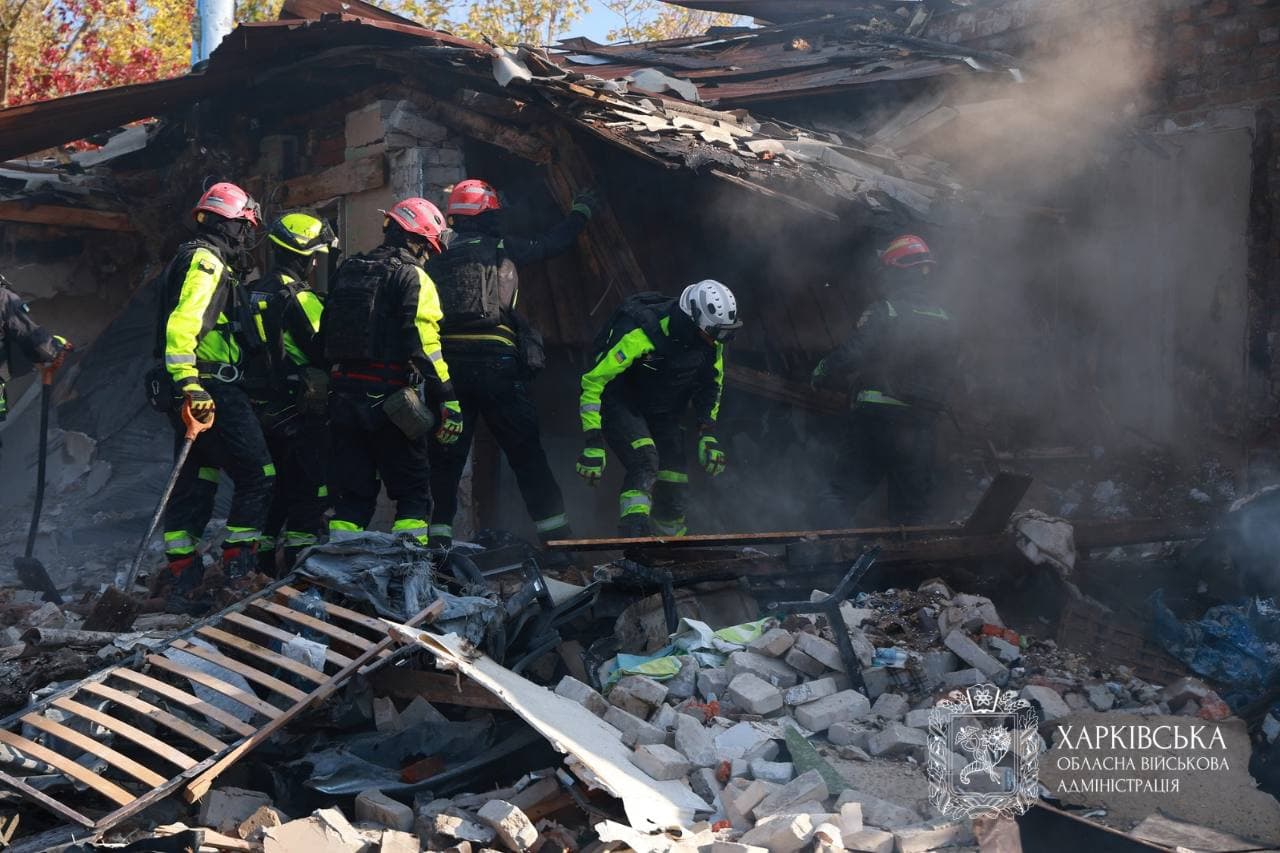
In Kharkiv, Ukraine’s second-largest city, Sunday morning brought with glide bombs falling on the Nemyshlianskyi district — a neighborhood of private homes. Two houses beside an auto repair shop were leveled outright. Medics pulled a woman from the rubble of her home and tried to revive her; she died at the scene. Officials gave her age as 35 or 36 in different reports.
The blast wave shattered windows and caved in roofs up and down the street. Parked cars caught fire. By the end of the day, Mayor Ihor Terekhov counted 10 injured — among them a seven-year-old boy — along with 35 damaged houses and eight damaged cars. “All those injured are receiving highly specialized medical care,” said regional governor Oleh Syniehubov. Elsewhere in the Kharkiv region, Russian munitions had struck a health-care facility on Saturday, and the governor’s daily tally counted six injured across the region, one of them a child.
Then, just outside the city, came something worse. A Russian missile struck a residential area of Pisochyn, landing near a grocery store and several apartment buildings. Three people were killed: a 16-year-old boy, a 19-year-old woman, and a 51-year-old woman. Twenty-five were injured, including two girls, ages 13 and 9.
Think about what a grocery store is on a Sunday. It’s where you go when nothing is wrong — milk, bread, a quick errand before dinner. That is where this missile came down.
Kharkiv’s closeness to the front line makes it a target again and again. Sunday’s strikes came on the same day Russia hit the city’s thermal power plant — and the same day the American president said energy attacks were over.
An Ambulance, an Apartment Block, and an 11-Year-Old Boy
At 5 a.m. Sunday, an ambulance was driving through the Yampil community in Ukraine’s northern Sumy region, heading to an emergency call in Svesa. A loitering drone — one that circles over an area, waiting for a target — found it. The 44-year-old driver and 59-year-old paramedic climbed out with minor injuries. Then, despite the risk of a second strike, another medical crew drove out and evacuated them.
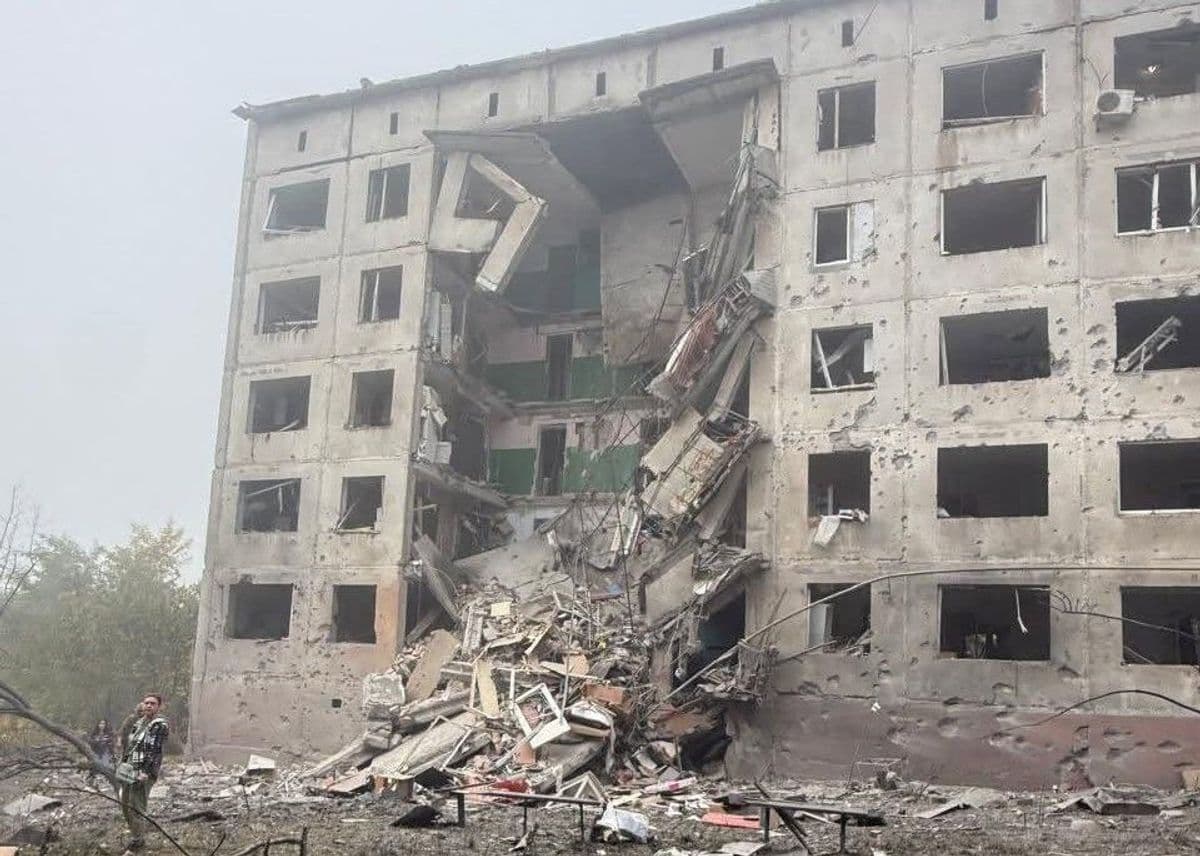
Around 10 a.m., Russia dropped three FAB-250 bombs — each named for its weight, 250 kilograms, about 550 pounds — on a residential area of Sloviansk in the Donetsk region. Two apartment buildings were hit. “The Russians struck a five-story block of flats in Sloviansk — the entrance hall there has been completely destroyed, and there may be people trapped under the rubble,” Zelensky wrote. Mayor Vadym Lyakh counted seven injured, three hospitalized, with another person wounded by shelling elsewhere in the city. “Take care of yourselves. Let’s stay strong. We’re in this together!” he wrote. Across the Donetsk region, the governor reported one person killed and four injured over the past day.
In the Dnipropetrovsk region, Saturday was worse for children. In the Nikopol district, a Russian drone dropped an explosive that killed an 11-year-old boy and wounded a 12-year-old boy and a 10-year-old girl. Late that night in Dnipro, a strike tore into the eighth and ninth floors of a high-rise, injuring four — including two eight-year-old girls, one hospitalized. A gas leak forced crews to cut the building’s gas, water, and power.
And in Kherson, footage showed a Russian drone dropping grenades on a civilian and a car — the “human safari,” in which drone operators deliberately hunt people in the streets. One person was injured in the region, and three people were evacuated from liberated communities.
The War’s Far Edges: Ivano-Frankivsk, Moldova, and Belarus
Ivano-Frankivsk sits in western Ukraine, about as far from the front line as a Ukrainian city can be. On Sunday evening, Ukraine’s Air Force warned that a jet-powered drone was heading its way. Then it struck. Three Ukrainian service members were killed — the regional governor first reported two deaths, then a third when a wounded person died in hospital — and three more were wounded, none of them critically, Mayor Ruslan Martsinkiv said. No civilians were hurt. The strike damaged a building and civilian infrastructure.
It was the city’s third attack in four days. Russian forces hit Ivano-Frankivsk five times on the night of Oct. 9, and on Oct. 8 falling drone debris started a fire there that killed a man born in 1959. The jet drones are the reason distance no longer means safety: around 60% of the drones Russia launched this week, by Zelensky’s count, were jet-powered — faster and harder to catch than the old buzzing propeller models.
Across the border in Moldova, a small country wedged between Ukraine and Romania, an unidentified drone flew over the town of Anenii Noi, about six miles from the Ukrainian border, on Saturday night before crashing in a forest near Germana. Moldova hasn’t blamed anyone. But analysts note it fits a pattern of Russian drones drifting into Moldovan and NATO airspace as Russia strikes deeper into western Ukraine — and an apparent Kremlin effort to make such violations feel normal.
To the north, in Belarus, the Russian-led military alliance known as the CSTO began two exercises: “Indestructible Brotherhood-2026,” a peacekeeping command drill in Vitebsk, and “Barrier-2026,” involving nuclear, biological, and chemical defense troops in Starye Dorogi. Soldiers from Belarus, Kazakhstan, Kyrgyzstan, Russia, and Tajikistan took part.
Russia’s Google Goes Dark — Again
Imagine opening your ride-share app and finding it simply doesn’t work. Not across Russia, not in Serbia, not in Kazakhstan. That was Sunday for users of Yandex Go.
Yandex is Russia’s closest equivalent to Google — search, taxis, cloud computing, smart-home gadgets, all one company. Overnight, a drone struck its data center in Vladimir, about 370 miles inside Russia, causing a fire. The company confirmed the facility was completely shut down, its work shifted into an unstable emergency mode. “There are power interruptions in the ru-central1-a availability zone,” Yandex Cloud posted. Taxi ordering failed across Russia and in Serbia, Kazakhstan, Belarus, and Armenia. The app drivers and couriers use went down. Smart-home services stuttered.
This was the third Yandex data center hit in four days, after Sasovo in the Ryazan region on Oct. 8 and Kaluga on Oct. 9. A Russian opposition outlet reported the strikes likely disabled three of Yandex’s five largest supercomputers. A research group that tracks internet outages found Yandex Cloud has lost about 78% of its ability to answer outside connections since Oct. 8. The company has already rewritten its user agreement to list drone and missile attacks as “force majeure” — the legal fine print that excuses a company from its promises when disaster strikes.
Why data centers? Zelensky has said Ukraine is answering in kind: “We always respond in kind,” he said on Oct. 8, accusing Russia of striking Ukrainian data centers. On Saturday, Ukrainian telecom company TENET reported that a Russian strike had badly damaged its facilities, disrupting internet service; Russia’s own defense ministry acknowledged hitting TENET’s data center in the Odesa region. So far, Russia has kept its wider internet running through the disruptions. Whether Ukraine can sustain the campaign, and whether Russia can defend the next server farm, remains open.
Burning Oil Tanks and an Airport Fire: Ukraine Hits Back
Here’s why Ukraine keeps hitting oil: oil is both Russia’s paycheck and its gas tank. And satellite pictures published Sunday showed what that looks like from space.
The target is the Samara linear production and dispatch station near Prosvet, about 580 miles inside Russia. It’s an oil junction that blends crude from different fields into the standardized Urals oil Russia sells abroad, and it also supplies fuel products to the Russian army. Ukraine hit it on Oct. 7, destroying four giant storage tanks, then came back overnight into Saturday. The new imagery reportedly shows a large fire and damage to every one of the station’s largest class of tanks and about 40% of the next size down.
Other refineries are still counting the cost of earlier visits. A Ukrainian open-source analyst — someone who reads public satellite images and videos — published imagery claiming an Oct. 2 strike seriously damaged the main units of the Lukoil refinery in Volgograd, about 290 miles from the front. The same source said the Syzran refinery, roughly 500 miles away, still hasn’t restarted after repeated strikes since August. The campaign has also reached the Yug Rusi oil terminal in Rostov-on-Don.
On the Black Sea coast, images overnight showed fire at an administrative building at Sochi Airport; regional authorities said drone fragments had struck the airport. Near Adler, geolocated video showed a Ukrainian strike on a Russian air-defense system about 350 miles from the front — part of a steady campaign against the radars Russia uses to see drones coming.
Every tank that burns is fuel Russia can neither use nor sell.
Drones by the Truckload: Ukraine’s Supply Line Speeds Up
Ukraine’s Defense Ministry put out a number on Sunday that would make any factory manager sit up. So far in 2026, its procurement agency — the office that buys weapons for the army — has signed contracts for 5.5 times as many drones as in the same stretch of 2025, and deliveries are up almost 3.7 times. In plain terms, Ukraine has already received far more drones this year than in all of last year.
“The task of the Ministry of Defense is to give the army drones to work effectively at every level,” said Defense Minister Yevhen Khmara. “Technology and the availability of sufficient means increase combat effectiveness and at the same time reduce risks for our soldiers.” That second sentence is the whole philosophy of Ukraine’s war in one line: send a machine where you’d otherwise send a person.
The ministry credited help from abroad alongside Ukraine’s own fast-growing arms industry. Germany has announced aid packages; Britain signed a deal giving its companies access to Ukraine’s battlefield data to build swarms of AI-guided drones; and an EU-Ukraine drone alliance began work in September. The European Union paid out 1.2 billion euros ($1.4 billion) on Oct. 7 and is expected to send another payment before EU leaders meet on Oct. 14. Of the EU defense money available to Kyiv through the end of 2026, 15.4 billion euros ($17.2 billion) still sits unused.
Zelensky spent Sunday on calls with European leaders, chasing air-defense systems and ammunition for Ukraine’s combat aircraft. And Europe’s growing role carries a growing risk: European intelligence agencies have warned defense-industry leaders that Russia is plotting assassinations of European arms executives to undermine military support for Ukraine. The front line, in other words, now runs through European boardrooms too.
Tanks With Bodyguards: The Northern and Eastern Front
On the ground, analysts say the momentum has lately tilted toward Ukraine, and Sunday’s reports showed it in small, telling ways.
Northeast of Velykyi Burluk in the Kharkiv region, video showed three Ukrainian tanks on the main highway near the village of Anyskyne firing on Russian positions — proof Ukraine had pushed up to the highway, even as Russian troops slipped in southwest of the village. The tactic is new: the tanks were traveling with drone escorts — little flying bodyguards that hunt down Russian attack drones before they can reach the armor. Russia’s defense ministry, meanwhile, claimed to have captured the villages of Riznykove and Kupyne north of Velykyi Burluk, crediting the 344th Motorized Rifle Regiment and the 34th Separate Motorized Rifle Brigade.
East of the city of Sumy, even a Russian blogger admitted Ukrainian troops were counterattacking from Mala Rybytsya into the forests near Velykyi Prykil — meaning Ukraine still holds ground Russia claimed. Another Russian source offered a surprisingly seasonal excuse: Russian units are launching fewer assaults in the woods east of Krasnopillya because the leaves are falling, and bare trees leave attackers with nowhere to hide.
Around Kupyansk, Russian bloggers said their troops concentrated attacks near Kupyansk-Vuzlovyi while Ukrainians counterattacked near Radkivka; a Russian source claimed a strike on a bridge over the Oskil River near Petrivka, one of Ukraine’s supply routes. Near Borova, Russia attacked and gained nothing.
Farther south, the fighting closes on what analysts call the Fortress Belt — the chain of fortified cities, Sloviansk, Kramatorsk, Druzhkivka, and Kostyantynivka, that anchors Ukraine’s hold on the Donetsk region. Around Lyman, Russian attacks stalled as Ukrainians counterattacked on both sides of the town, and Russia’s bloggers admitted they were defending in Zarichne. East of Sloviansk, Russian assaults went nowhere as Ukraine pushed back near Rai-Oleksandrivka.
A Flag Raised by Computer: Donetsk and the South
Here’s a new way to take a village: make a video of it.
On Sunday, Russian sources published footage of a soldier raising a flag in Petrivka, northeast of Dobropillya — a village about six miles beyond anywhere Russian troops have actually reached. Russia’s defense ministry then used the video to claim it had captured Petrivka and nearby Novotroitske. Analysts say the footage was altered with artificial intelligence. It’s part of a pattern: Russia has also claimed it has Ukrainian troops surrounded in Dobropillya, against all available evidence. Call it cognitive warfare — announce a victory on television and hope nobody checks the coordinates. Those fake claims aim at two audiences: the outside world, and Russian commanders who need to tell their own bosses good news.
The real fighting looked different. In Kostyantynivka, video showed Ukrainian forces holding or advancing in the western part of the city despite Russian claims. Southwest of Druzhkivka, Russian attacks along the Kazenyi Torets River failed to advance. Near Oleksandrivka, Russian bloggers claimed to have retaken southern Fedorivka and to be clearing Yalta and Myrne, while Ukrainians counterattacked toward Komar.
In the Zaporizhzhia region, Russia attacked around Hulyaipole without gaining ground. South of Orikhiv, Ukrainian forces advanced near Novodanylivka, while Russian units tried to wrap around the town from both sides, aiming for Tavriiske on the highway to Zaporizhzhia City and Yurkivka across the Kinska River. One Russian blogger was unusually candid: the advance near Orikhiv is slow, he complained, because Russia can’t sustain its attacks and is short of men.
Put the two halves of the day side by side. In a Russian video, a computer raises a flag. Near Orikhiv, a Russian blogger admits there aren’t enough soldiers to carry one.
The Closing
By Sunday evening, the repair crews in Kyiv were still on the lines, and the taps in parts of the city were still dry. In Kharkiv, a power plant struck hours after a ceasefire was announced had left homes in the dark, and families in Pisochyn were counting their dead. In Zaporizhzhia, a city in mourning watched crews clear what was left of somebody’s home. A ceasefire was declared today. Nobody on the ground could find it.
A Prayer for Ukraine
1. For the Twenty Beneath the Concrete in Zaporizhzhia
Lord, five bombs fell before sunrise onto ordinary homes. Rescuers lifted three hundred and twenty tons of stone to reach them, and for most it was too late. We do not know all their names; You do. Receive every one of them. Hold the woman who breathed for eight hours under the rubble, and the families who now keep a day of mourning in a city that never stops bracing for the next one.
2. For the Boy in Nikopol
Father, an eleven-year-old boy was killed by an explosive dropped from the sky, and two other children beside him were wounded. A boy that age should never have had to learn the sound of a drone. Gather him to Yourself. Sit with the mother and father who must now learn to live in a house without his voice, and heal the bodies and the fear of the children who survived.
3. For Those Who Must Answer an Announcement
God of wisdom, a ceasefire was declared today that the people of Ukraine had never seen. Give their leaders clear heads under pressure from friends and enemies alike. Grant the powerful in Washington, Moscow, and every European capital the honesty to let their words match what happens on the ground. Let every word spoken about peace be true, and let no people be bargained away.
4. For the Three Soldiers in Ivano-Frankivsk
Lord of hosts, three defenders died tonight in a city far from the front, where they should have been safe. Strengthen the ones who carry their duty forward — the tank crews on the highway, the soldiers in the bare autumn forests, the medics who drove into danger to rescue their own. Shield them in the dark. Bring them home in body and in spirit.
5. For Words That Become Deeds
Righteous God, it is easy to say peace and harder to keep it. Russia’s leaders say only missiles bring victory, and they mean it. Expose every false flag and every hollow promise. Let justice reach the ones who hunt the innocent from the sky, and let truth outlast every lie told about this war. In Your mercy, in Your justice, in Your time — bring this war to its end, and let the ending be worthy of what Ukraine has endured.