
An American president demands Ukrainian elections while calling its leader a con artist comparable to P.T. Barnum, prompting Zelensky to offer a 90-day vote if the West guarantees security—even as his approval rating plummets to 20% and Putin demands Ukraine cede territory Russian forces haven’t captured.
The Day’s Reckoning
The Politico interview aired at precisely the moment Volodymyr Zelensky’s plane touched down in Rome. In Washington, an American president was calling Ukraine’s leader “a great salesman” comparable to P.T. Barnum—a con artist who’d duped “crooked Joe Biden” out of $350 billion. In Italy, that same leader was stepping off the tarmac to meet a pope and a prime minister, carrying an offer that would either salvage Western support or expose its collapse: elections within 90 days, if anyone would guarantee the security to hold them.
December 9, 2025. Day 1,385.
The war had started with tanks. It had evolved into something stranger—a conflict where an American president’s television interview mattered more than any battalion’s advance. Russian forces were still grinding forward, still trading dozens of lives for single square kilometers of rubble. But the real battle was unfolding in diplomatic corridors and TV studios, where politicians calculated not how to win but how long their publics would tolerate paying for someone else’s survival.
Three fault lines converged on this single Monday:
Trump’s patience exhausting, his words signaling that American support now came with conditions—elections, concessions, Zelensky’s resignation if necessary.
Zelensky sprinting across Europe, desperate to secure commitments before Washington’s support evaporated entirely.
Putin’s demands unchanged, insisting Ukraine cede territories Russian forces hadn’t even captured, demonstrating that Moscow would accept nothing less than capitulation regardless of what the battlefield actually showed.
Words spoken in Washington. Responses delivered in Rome. And in Pokrovsk, Russian forces concentrated 155,000 troops to capture a city they were demolishing into rubble.
The war continued. But this day, the battlefield had become secondary.
When the President Chose His Words
The Politico cameras were rolling when Donald Trump decided to say what he’d been thinking for months.
“Zelensky is going to have to get on the ball and start accepting things.” No diplomatic cushioning. No careful phrasing. Just the blunt assessment of a president who’d run out of patience. “Ukraine has lost a lot of land… you certainly wouldn’t say it’s a victory.”
Then came the comparison that would echo through Kyiv’s government quarter: P.T. Barnum. The 19th-century showman. “A great salesman,” Trump said, “who could sell any product at any time.” Translation: Zelensky had conned “crooked Joe Biden” into handing over “$350 billion.”
Trump claimed Ukraine had lost 27,000 soldiers in the past month alone. No evidence provided. He suggested Zelensky should consider stepping down because “Ukraine will lose.” He lingered over maps like a man admiring real estate. “Every time I look at that map, I said, ‘Oh, this Crimea is so beautiful. It’s surrounded on four sides by ocean… It’s got the best weather, best everything.'”
His geography was wrong—Crimea is a peninsula—but his meaning was clear.
When asked which country held the stronger negotiating position, Trump didn’t hesitate. “There can be no question about it. It’s Russia. It’s a much bigger country… They’re much stronger in that sense.” He praised Ukrainian bravery, then delivered the verdict: “At some point size will win.”
Elections? “Yeah, I think so. It’s been a long time. They’re using war not to hold an election… the Ukrainian people should have that choice.” The Ukrainian constitution’s prohibition on elections during martial law? Mere technicality. Zelensky’s continuation in office? Democratic illegitimacy, not constitutional necessity.
Behind the criticism lay Trump’s old conviction: NATO expansion had provoked this war. He repeated the debunked Kremlin narrative about agreements that “long before Putin” promised Ukraine would never join NATO—claims James Baker and Mikhail Gorbachev himself had categorically denied.
In Brussels, Paris, and Berlin, European leaders watched the interview and understood: the president who controlled their alliance’s military backbone was publicly undermining Ukrainian resolve while validating Russian conquest. His words weren’t just criticism.
They were policy.
The Race Against American Patience
Zelensky’s morning began with a briefing about London. Ukrainian negotiators had spent hours with EU national security advisers, revising a peace proposal they’d present to Washington. “The Ukrainian and European components are now more developed,” Zelensky announced, each word carefully chosen. “We are ready to present them to our partners in the U.S.”
The subtext was louder than the statement: Please wait. We’re doing what you asked. Just don’t abandon us yet.
By afternoon, he was in Rome.
Thirty minutes with Pope Leo XIV at Castel Gandolfo. The Vatican’s careful description: discussions on “the need for the continuation of dialogue” and “prisoners of war and the need to assure the return of Ukrainian children.” Vatican diplomacy—supporting Ukraine’s sovereignty while positioning itself as potential mediator. Zelensky extended an invitation: visit Ukraine. “A strong signal of support for our people.”
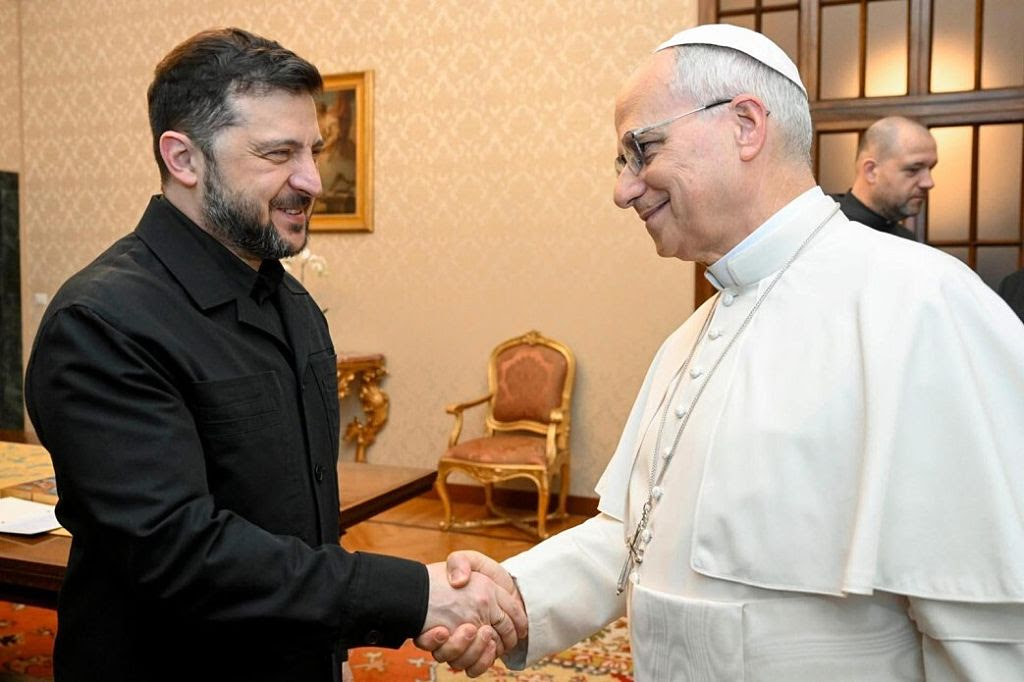
President Volodymyr Zelensky (L) meets with Pope Leo XIV (R) at the Apostolic Palace in Castel Gandolfo, Italy. (Presidential Office/Anadolu via Getty Images)
The meeting with Giorgia Meloni carried more weight. “Excellent and very substantive,” Zelensky reported afterward, the kind of praise that actually meant something got done. “I briefed her on the work of our negotiating team, and we are coordinating our diplomatic efforts.”
Three documents under construction: A framework peace agreement, expanded to 20 points after negotiators stripped eight from the original U.S.-Russian draft. Security guarantees Ukraine was crafting with Washington and European partners. Reconstruction plans for a post-war future nobody could quite envision.
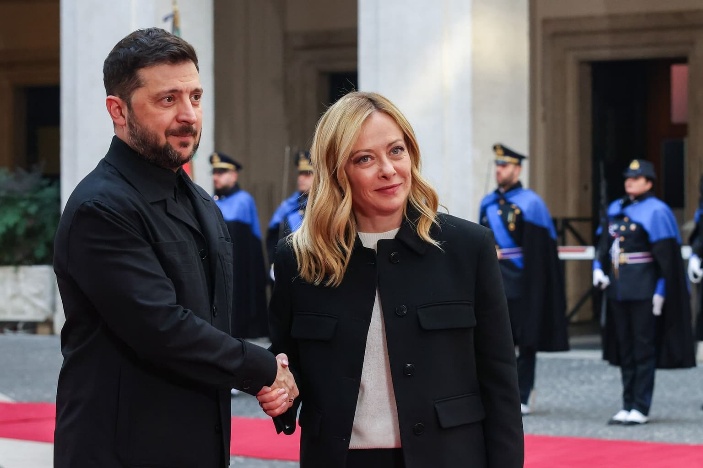
Italian Prime Minister Giorgia Meloni welcomes President Volodymyr Zelensky in Rome, Italy. (Alessia Pierdomenico/Bloomberg via Getty Images)
“The U.S. said they want Ukraine to have realistic security guarantees this time, approved by Congress, so that we can feel them, so that we have weapons,” Zelensky explained to reporters. “If needed, sanctions would be applied, so that we have air defense, and it should be Article 5-like.”
Article 5. NATO’s collective defense provision. Except “the U.S. is not yet ready to see Ukraine in NATO.”
Translation: Kyiv wanted NATO protection without NATO membership. Weapons that could repel future Russian aggression. Congressional approval that would outlast whoever occupied the White House next. The gap between what Ukraine needed and what Washington would provide had never looked wider.
Russia was demanding all of Donetsk Oblast. Proposals had emerged to “exchange” the occupied Zaporizhzhia Nuclear Power Plant for parts of Donetsk that Russian forces didn’t even control yet.
Zelensky kept emphasizing one thing: Ukraine’s negotiating pace depended on whether Russia would take “effective steps to stop the bloodshed and prevent the war from reigniting.”
But first, Ukraine had to survive the current environment.
Where Trump’s patience was exhausting faster than Russian ammunition.
Calling the Bluff
“I’m asking now, and stating this openly, for the U.S. to help me.”
Zelensky stood before reporters in Rome and made an offer that was equal parts concession and challenge. “Together with our European partners, we can ensure the security needed to hold elections. If that happens, Ukraine will be ready to conduct elections in the next 60 to 90 days. I personally have the will and readiness for this.”
Translation: You want elections, Mr. President? Guarantee the security, and we’ll hold them.
The gambit was audacious. Trump demanded Ukrainian elections? Fine. But Russian attacks on polling stations, voter intimidation in occupied territories, soldiers casting ballots from trenches—all would require Western boots on the ground. The kind of European military presence Moscow had declared a red line.
Zelensky’s position had evolved through stages. First: elections only after the war ends. Then: maybe during a ceasefire. Now: elections during active combat—if the West would commit forces to protect them.
The Ukrainian constitution prohibited elections during martial law—the very provision Trump dismissed as excuse-making. Legislative changes would be required. “I’m waiting for proposals from our partners, expecting suggestions from our lawmakers,” Zelensky said, “and I am ready to go to the elections.”
An Info Sapiens poll published that same day revealed why this offer carried such risk.
Zelensky’s approval: 20.3%. Valerii Zaluzhnyi, the general he’d dismissed, now ambassador to Britain: 19.1%. A hypothetical Zaluzhnyi party would win 21.8% in parliamentary elections. Zelensky’s party: 11.5%.
The numbers told the story of a president whose capital had eroded through corruption scandals, territorial losses, and nearly three years of grinding war. The fall survey came after the largest corruption scandal of his presidency. Yet he remained the most popular candidate—testament to wartime leadership and the absence of alternatives.
For Trump, Zelensky’s offer represented potential victory: Ukraine forced toward democratic accountability while America maintained leverage.
For Zelensky, it was desperation disguised as reasonableness: demonstrate Ukrainian flexibility while securing Western commitments that might actually strengthen his hand.
For European leaders, it created an uncomfortable question: Could they provide—should they provide—the security guarantees that would make wartime democracy possible?
Trump had demanded elections.
Zelensky had called his bluff.
Now someone had to ante up.
Thirteen Kilometers of Rubble
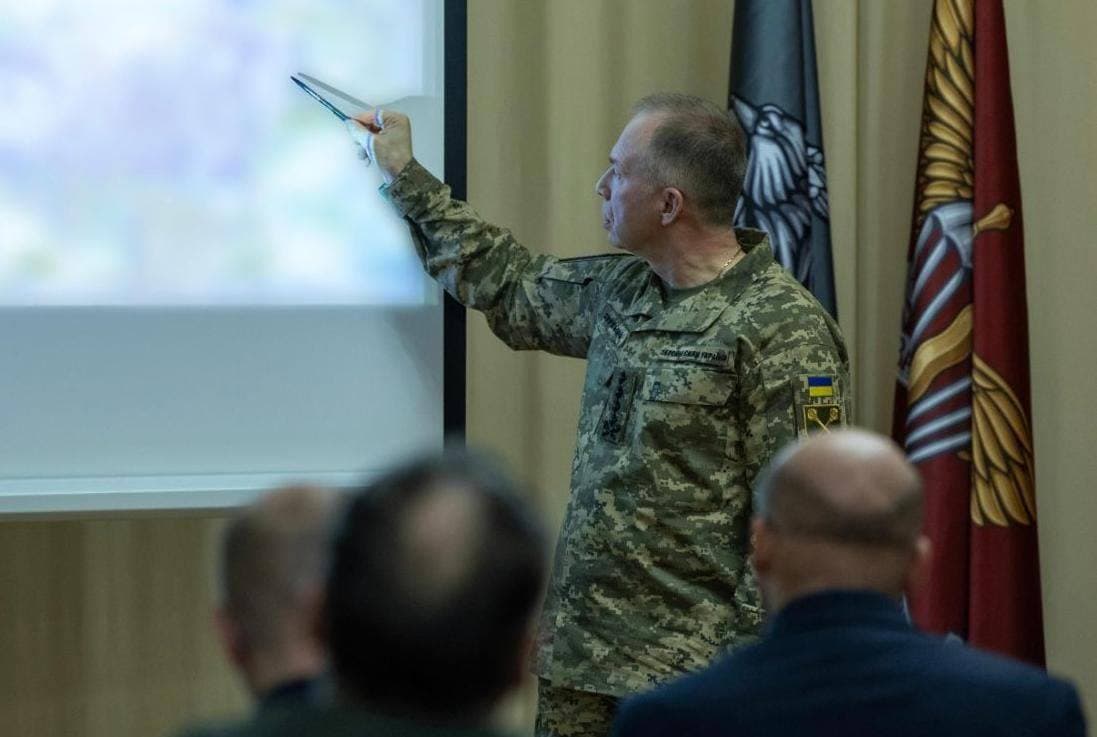
Commander-in-Chief Oleksandr Syrskyi speaks during a press briefing. (Facebook)
Oleksandr Syrskyi stood before cameras and delivered a statistic that required interpretation to understand: Ukrainian forces had reclaimed about 13 square kilometers of Pokrovsk.
The part he didn’t emphasize: they’d had no troops in those areas earlier in the fall.
“The defense of Pokrovsk continues,” the commander-in-chief stated, acknowledging withdrawals from positions 5 to 7 kilometers outside the city where Ukrainian units could no longer hold. The 13 square kilometers reclaimed represented roughly 45% of Pokrovsk’s total 29 square kilometers—a significant tactical recovery in a city that had seemed destined for Russian capture.
But the numbers revealed what “recovery” actually meant.
Russian forces had concentrated 155,000 personnel on this single sector. The Pokrovsk front absorbed 40 to 50 percent of all guided glide bomb strikes Russia used along the entire front. Russian forces were systematically demolishing the city they sought to capture—turning urban terrain into rubble that favored defenders but made eventual reconstruction nearly impossible.
The Ukrainian 7th Rapid Reaction Corps reported Russian forces attacking intensively in southeastern Myrnohrad. Twenty-one glide bomb strikes in the last week alone.
Russian Chief of the General Staff Valery Gerasimov claimed his forces had seized over 30% of Myrnohrad’s buildings, identifying it as the next target after Pokrovsk. Sequential objectives: capture Pokrovsk first, then pivot to Myrnohrad.
Syrskyi’s assessment of Myrnohrad: “Not surrounded, though logistics have become more difficult.”
Translation: Russian forces hadn’t achieved encirclement, but they’d degraded supply routes enough to complicate Ukrainian defense.
The competing narratives captured the war’s essential character. Russian forces advanced by meters through devastated urban terrain. Ukrainian defenders measured success in slowing that advance.
Syrskyi noted that more Ukrainian troops would deploy to Pokrovsk—suggesting military leadership viewed holding the city as strategically essential despite enormous costs. Every soldier committed here was one fewer available elsewhere. But allowing Russian capture would open approaches to deeper Ukrainian territory.
So Ukraine reclaimed 13 square kilometers of a city that was being demolished into rubble as they fought over it.
This was what victory looked like now.
The Demands He Couldn’t Enforce
Vladimir Putin spent December 9 demanding Ukraine cede all of Luhansk and Donetsk oblasts—including territories Russian forces didn’t occupy.
“Historical territory,” he called them. Regions that had “always been part of Russia.” The old narrative: Ukraine was an artificial Soviet creation.
The irony was rich. Russia had recognized Ukraine’s independence and borders multiple times since 1991—the 1994 Budapest Memorandum, the 1997 Russian-Ukrainian Friendship Treaty. But Putin’s statements suggested those commitments meant nothing when Russia possessed military power to seize what it wanted.
The territorial arithmetic explained his preference for negotiations over military campaigns.
Since January 2025: Russian forces seized 0.77% of Ukrainian territory. Cost: 391,270 casualties. Roughly 83 Russian soldiers per square kilometer gained.
At this rate, capturing the heavily fortified remainder of Donetsk Oblast would take years and result in unsustainable losses.
Putin’s cognitive warfare campaign aimed to achieve through intimidation what Russian forces couldn’t accomplish on the battlefield. Present Russian military and economic strength as capable of “inevitably winning a war of attrition.” Push Ukraine and the West into concessions that would avoid the enormous costs of actually fighting for these territories.
Demand everything. Concede nothing. Present inevitability as fact.
Putin kept demanding territory his army couldn’t capture.
That was the negotiation.
The Trap With No Exit
Leonid Slutsky, chairman of the Russian State Duma’s International Affairs Committee, made Moscow’s position clear that day: Ukraine must hold elections to “legitimize” its government before Russia could trust any peace agreement.
Russia needed to be “absolutely certain” that no one could challenge the authority of Ukrainian signatories, Slutsky insisted.
Then he suggested those signatories might already be illegitimate.
The logic was deliberately circular—a trap with no exit. Ukraine couldn’t negotiate credibly without elections. But elections were impossible under the martial law that Russian aggression necessitated. And even if Ukraine somehow held elections that satisfied Slutsky’s standards, the Kremlin’s long-standing claims about Zelensky’s “illegitimacy” suggested Russia might reject the results anyway.
The framework provided Putin a perfect mechanism to renege on any future peace agreement at a time of his choosing.
Sign a deal. Wait for conditions to improve. Then claim the Ukrainian government lacked authority to have signed it.
The blueprint was laid bare for anyone willing to see it.
When Balloons Required Soldiers
Lithuania declared a nationwide emergency over balloons.
Not a drill. Not theater. Actual balloons floating from Belarus, carrying contraband, forcing repeated shutdowns of Vilnius Airport and temporary border closures. Vilnius accused Alexander Lukashenko of weaponizing them as “hybrid attacks.”
President Gitanas Nauseda threatened to freeze or seize Belarusian assets—revealing European patience wearing thin with Minsk’s provocations.
The emergency declaration allowed military involvement in intercepting balloons. What might have seemed like absurdist theater had become genuine security operations requiring armed forces coordination.
“Every evening quite a few units go out together with the police, conduct patrols, monitor the area, and detect shipments,” Interior Minister Vladislav Kondratovic explained.
Lithuanian soldiers. Hunting balloons.
The Baltic NATO country shares borders with Russia’s heavily armed Kaliningrad exclave and Moscow’s ally Belarus. It had been experiencing escalating hybrid operations: Russian aircraft violating NATO airspace, suspicious drone sightings, accusations of sabotage and cyberattacks.
Now balloons required military response.
This was how the war had evolved beyond Ukraine’s borders—into a broader confrontation where anything could become a weapon, any provocation could trigger emergency declarations, and NATO members deployed armed forces to intercept party decorations carrying contraband across borders.
The absurdity was the point. Keep adversaries off-balance. Force them to treat ridiculous threats seriously. Make them look foolish responding to balloons while demonstrating that borders meant nothing.
Lukashenko’s balloons weren’t just carrying contraband.
They were carrying a message.
One Thousand Kilometers From the Front
The drones reached Cheboksary just after midnight on December 9.
Governor Oleg Nikolaev confirmed strikes on the VNIIR-Progress enterprise—a facility producing military satellite receivers and antennas, located over 1,000 kilometers from the front lines. Footage showed large plumes of smoke rising from Russia’s interior. The governor declared a state of emergency.
Months earlier, facilities this deep inside Russia had seemed immune to Ukrainian attack.
Not anymore.
The Cheboksary plant produced military communications equipment—the systems Russian forces used to coordinate operations and maintain battlefield networks. Destroying production meant degrading Russia’s ability to replace damaged equipment, to expand communications capacity, to coordinate increasingly complex operations.
Ukrainian Special Operations Forces struck closer to the front that same night: a Russian drone depot near occupied Donetsk City, 53 kilometers from Ukrainian lines. The 9th Motorized Rifle Brigade’s storage facility—part of Ukraine’s systematic campaign against Russian military logistics in occupied territories.
More strikes hit Russian energy infrastructure. The Krasnodonska substation in occupied Luhansk Oblast, 140 kilometers from the front. Ukrainian officials called it “long-range sanctions”—using drones to accomplish what Western economic measures struggled to achieve.
Reuters reported Russia’s Syzran oil refinery had halted operations after sustaining damage. Repairs: potentially a month. Another node in Ukraine’s persistent campaign against Russian oil infrastructure funding Moscow’s war effort.
The pattern was clear: Ukraine couldn’t match Russia’s industrial capacity or military size. But it could reach deep into Russian territory and destroy what Russia needed to sustain the fight.
One facility at a time.
One thousand kilometers from the front.
When the State Borrows From Itself
Privatbank extended a 5 billion hryvnia loan ($118.6 million) to Naftogaz on December 9 for emergency gas purchases.
This was Privatbank’s second such loan in 2025. The European Bank for Reconstruction and Development had already provided 500 million euros. Oschadbank had loaned 3 billion hryvnia. All emergency measures necessitated by Russia’s October attacks that destroyed over half of Ukraine’s gas production facilities.
Naftogaz needed 4.4 billion cubic meters of gas imports this winter. Cost: 1.9 billion euros ($2.2 billion). Ukraine was now dependent on American liquefied natural gas shipped through Polish pipelines—a supply chain vulnerable to diplomatic shifts and geopolitical calculations.
The financial mechanics revealed the deeper crisis: Ukraine’s largest state-owned entities were borrowing from state-owned banks to purchase energy from international markets. The state lending to itself, accumulating debt that ultimately fell on Ukrainian taxpayers and Western donors.
Every loan to Naftogaz was a loan Ukraine’s government would eventually need to repay or restructure—adding to debts that would shape post-war reconstruction before the war even ended.
The handshake between Naftogaz CEO Serhii Koretskyi and Privatbank board member Yevhen Zaihraiev captured the absurdity: two state entities conducting a transaction that looked like normal banking but was really just moving numbers between government ledgers while the actual bill accumulated for a future nobody could quite imagine.
Russia had destroyed Ukraine’s gas production.
Now Ukraine borrowed from itself to stay warm.
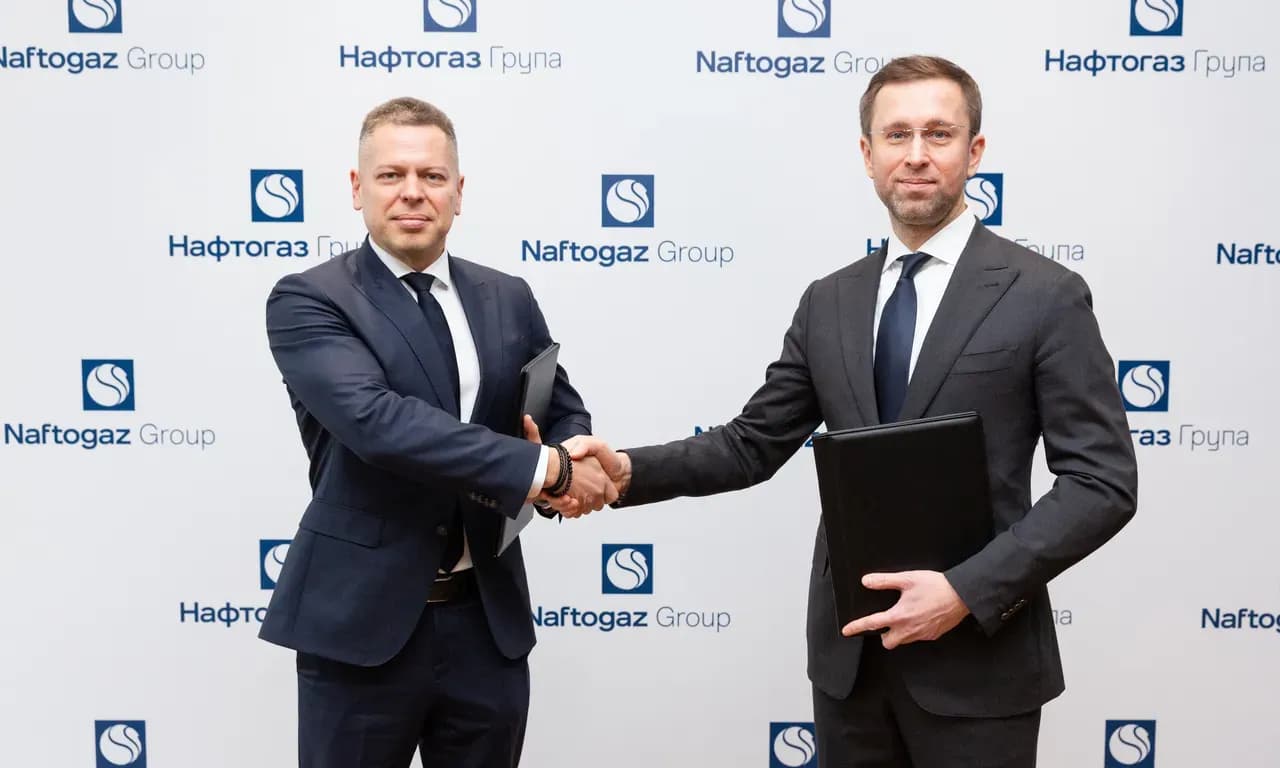
Naftogaz CEO Serhii Koretskyi (R) shakes hands with Yevhen Zaihraiev (L) member of the board of PrivatBank. (Naftogaz)
One Hundred Ten Drones, One Night
The drones launched after dark on December 8, converging on Ukraine from six directions.
Bryansk, Oryol, Kursk. Millerovo in Rostov Oblast. Primorsko-Akhtarsk in Krasnodar Krai. Occupied Donetsk City. Occupied Hvardiiske in Crimea.
One hundred ten drones. Roughly seventy Shaheds among them.
Ukrainian air defenses downed eighty-four. Twenty-four struck nine locations across the country—hitting energy infrastructure, residential buildings, civilian facilities in Sumy, Kharkiv, and Dnipropetrovsk oblasts.
The arithmetic revealed Russia’s strategy. Each Shahed cost roughly $20,000 to produce. The night’s attack: $2.2 million, give or take. Ukrainian air defense missiles cost exponentially more. Force Ukraine to expend expensive interceptors against cheap drones. Maintain constant alert status that exhausted personnel and resources. Sustain drone production despite Western sanctions.
For Ukrainian civilians in targeted regions, the attacks had become grim routine.
Air raid sirens wailing through the night. Explosions echoing across cities. Power failures following successful strikes. Then the waiting to see if heating would return before morning, if electricity would resume before work, if the next night would bring another swarm.
The psychological warfare was as calculated as the physical damage. Keep populations on edge. Disrupt sleep. Demonstrate that Russia could reach Ukrainian cities regardless of air defense improvements.
Break civilian morale through winter by degrading the systems that made life survivable.
One hundred ten drones.
One night.
Repeat until something breaks.
Meters for Bodies
The day’s battlefield updates told a story measured in contradictions: tactical advances in meters, costs calculated in battalions.
Russian forces continued offensive operations across multiple directions. Confirmed advances in three sectors: near Lyman, in northwestern Pokrovsk and eastern Rodynske, in Stepnohirsk west of Orikhiv.
Geolocated footage revealed what “advance” actually meant. South of Zarichne. West of Serednie. Northwestern Pokrovsk. Each location: a few hundred meters of Ukrainian territory seized after sustained bombardment and infantry assaults. Ukrainian counterattacks near Vovchansk, Zakitne, and Rodynske suggested these gains remained contested even after Russian forces claimed them.
The Kremlin claimed Russian forces had seized Ostapivske north of Hulyaipole—if confirmed, the most significant territorial gain. Located at the junction of the Haichur and Yanchur rivers, Ostapivske’s capture could threaten eventual encirclement of Hulyaipole from the northwest.
But only if Russian forces could cross the Haichur River, which had consistently frustrated their westward advances.
In western Zaporizhzhia Oblast, Ukrainian GUR intelligence reported Russian forces intensifying efforts to advance within tube artillery range of Zaporizhzhia City. The terrain prevented use of heavy equipment, forcing small-group infiltration tactics through mud and minefields. Each meter gained came at enormous personnel cost in a sector where the prize—bringing Ukraine’s industrial heartland under artillery fire—justified almost any sacrifice.
Ukrainian advances near Stepove in Dnipropetrovsk Oblast demonstrated that Russian forces didn’t monopolize offensive operations.
But Ukrainian gains, like Russian ones, measured in hundreds of meters rather than kilometers.
Testament to a battlefield where drone surveillance and precision fires had made large-scale maneuver almost impossible.
Meters for bodies.
Bodies for meters.
The mathematics never changed.
What December 9 Revealed
This day crystallized the war’s essential political crisis.
Trump’s interview revealed American patience exhausting. His criticism signaled continued support would require Ukrainian concessions—including elections Ukrainian law prohibited during martial law. Zelensky’s response—offering elections within 90 days if the West guaranteed security—was both desperate acquiescence and calculated challenge.
Putin’s territorial demands demonstrated unchanged maximal aims. His insistence that Ukraine cede all of Luhansk and Donetsk oblasts—including areas Russian forces didn’t occupy—showed Moscow would accept nothing less than capitulation regardless of how many soldiers died gaining meters of rubble.
The political arithmetic told uncomfortable truths. Zelensky’s 20.3% support, barely ahead of Zaluzhnyi’s 19.1%, revealed a leader whose capital had eroded through corruption scandals and territorial losses. Yet he remained the most popular candidate—testament to the absence of alternatives.
Syrskyi’s briefing captured the grinding reality: reclaiming 13 square kilometers of Pokrovsk after having no troops there earlier. Russian forces concentrated 155,000 personnel and 40-50% of all glide bomb strikes to capture a city they were demolishing. Ukrainian forces measured success not in liberation but in slowing the inevitable.
Lithuania declared emergencies over balloons. Privatbank loaned billions for emergency gas. Ukrainian drones struck facilities 1,000 kilometers inside Russia while defensive lines contracted.
The convergence suggested the war had entered a phase where political sustainability mattered more than battlefield advances. American support growing conditional. Ukrainian desperation to satisfy Western demands. Russian inflexibility regardless of costs.
The question was no longer who would win militarily but who would lose politically first: Trump risking Republican credibility if Ukraine collapsed, Zelensky watching approval erode as territory fell, or Putin facing backlash as mobilization revealed the volunteer system’s failure.
On this December day, an American president’s interview reshaped calculations more dramatically than any battalion’s advance.
The battlefield had become secondary to political battles that would determine whether Western resolve could outlast Russian attrition—or whether Trump’s impatience would hand Putin the victory Russian forces couldn’t achieve through combat.