
Ukraine Daily Briefing | July 8, 2026 | Day 1,596 of the Full-Scale Invasion
Prepared by Dayana Bozhyk
President Trump announced at the NATO summit in Ankara that the United States will license Ukraine to produce its own Patriot interceptor missiles, telling reporters “you can’t complain that we are not giving you enough… make them yourself.” NATO allies pledged €70 billion for Ukraine in 2026, though diplomats say roughly 40 percent simply repackages funding already committed. Ukrainian forces struck 19 Russian shadow fleet tankers in 72 hours and hit oil refineries in Tatarstan and Saratov and a fighter jet base in Voronezh, as Russia responded by banning diesel exports until July 31 to fight its own fuel crisis. Russia struck Ukraine three times overnight and through the day, killing at least 10 people nationwide and injuring well over 100, including a Banderol missile strike on a Kharkiv apartment building, a deliberate drone strike on a civilian bus in Kherson, and a third ballistic missile barrage on Kyiv in six days.
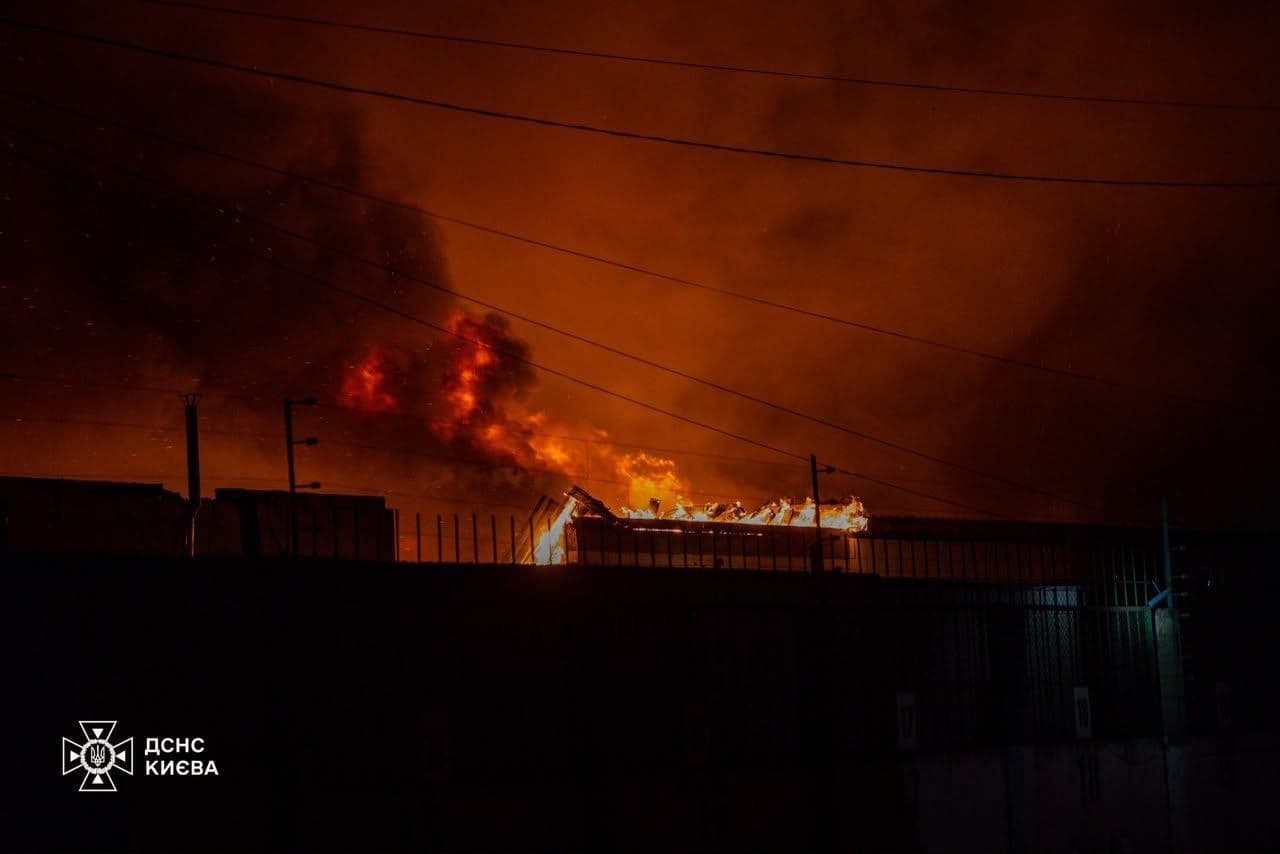
The aftermath of a Russian ballistic missile attack on Kyiv overnight. (State Emergency Service/Telegram)
THE DAY’S RECKONING
Two sentences from Ankara tell you everything about where this war stood on July 8. Donald Trump, standing next to Zelensky: “We’re gonna give a license to you to make Patriots… make them yourself.” And Vladimir Putin’s own deputy prime minister, hours later, explaining why Russia was banning diesel exports until the end of the month: interruptions caused by “changes in logistics” — a bureaucrat’s way of admitting Ukrainian drones have broken something Moscow can’t easily fix.
Between those two sentences, the war did what it does regardless of what summit is happening. A Banderol missile — 800 kilometers an hour, 400 kilograms of explosive — tore into an apartment building in Kharkiv before most people had left for work. A drone operator in Kherson looked at a civilian bus full of morning commuters and flew straight into it anyway. Kyiv took its third ballistic missile attack in six days, then a drone crash at lunchtime, then another strike at 5:30 in the evening, as if the day needed three separate chances to prove the same point. By nightfall, Odesa had its own dead to count too. Nineteen tankers, one refinery in Tatarstan, one in Saratov — all real, all costing Russia something. None of it stopped a single missile aimed at an apartment building that morning.
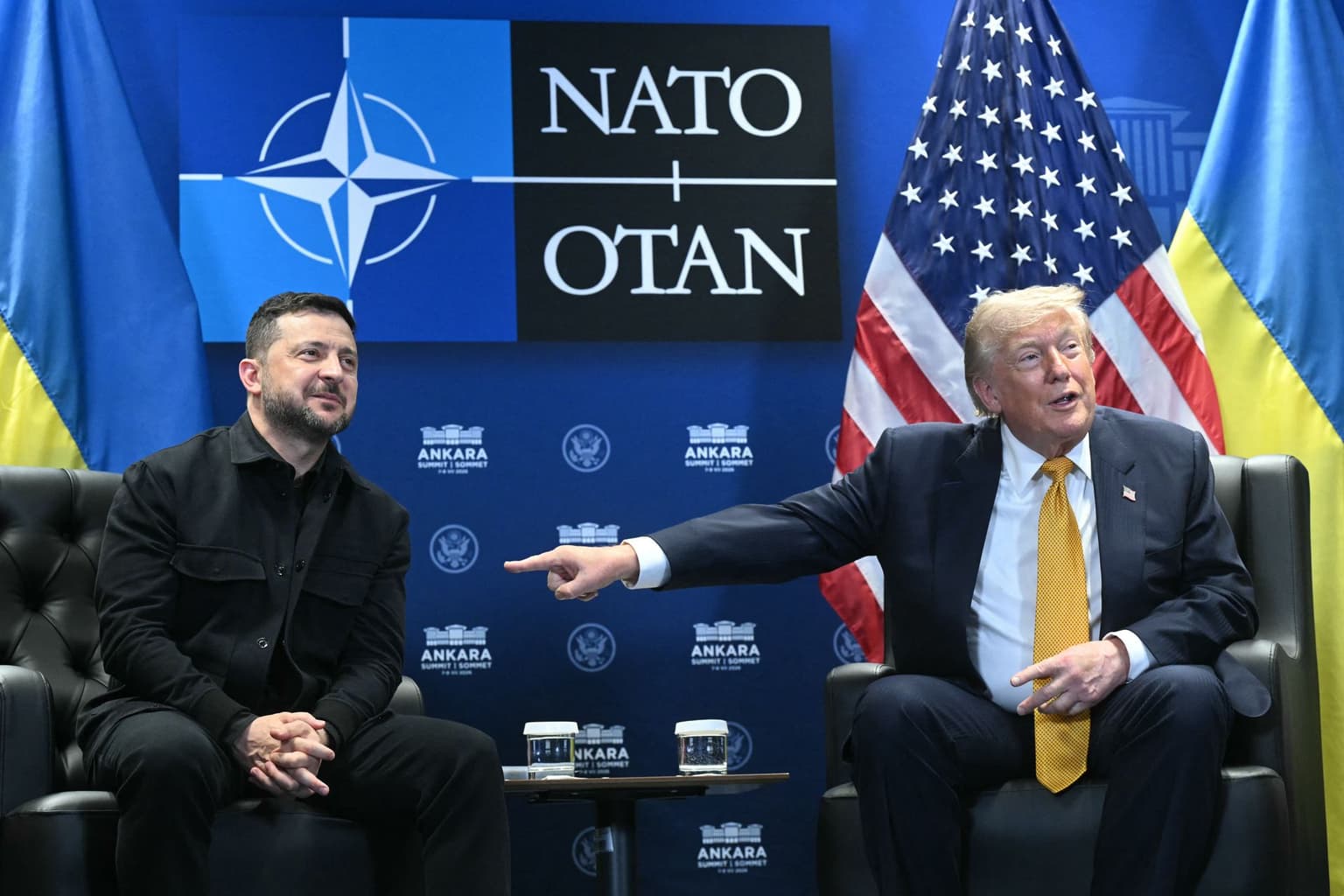
President Volodymyr Zelensky meets with U.S. President Donald Trump on the sidelines of the NATO Summit in Ankara. Photo: Saul Loeb/ AFP via Getty Images.
TRUMP: “MAKE THEM YOURSELF”
Trump told reporters at the NATO summit’s July 8 press conference that the US would license Ukraine to produce Patriot air defense interceptors, a request Zelensky has pressed for months. “We are gonna give a license to you to make Patriots… This way you can’t complain that we are not giving you enough,” Trump said, adding, “Make them yourself.” Trump acknowledged he had not yet informed manufacturer Lockheed Martin of the decision, and it remains unclear whether Ukraine will be licensed for the more capable PAC-3 interceptor or the simpler PAC-2, or how long production will take to actually begin — Ukrainian officials estimate two to three months at the earliest, dependent on supply chains for base components Ukraine does not yet manufacture domestically. GUR Deputy Head Vadym Skibitskyi said the same day that Russia can produce 60 to 65 Iskander ballistic missiles a month, a pace ISW warns Russia may accelerate specifically to exploit the gap before Ukraine’s own production comes online. Trump separately told reporters the US would consider buying Ukrainian-made drones outright, a reversal from his dismissive comments in March, calling Ukraine’s production capacity “amazing.”
NATO’s Ankara summit closed July 8 with a formal declaration pledging €70 billion in military aid for Ukraine in 2026 and a commitment to sustain similar levels in 2027, alongside language recognizing Ukraine as a “contributor to transatlantic security” rather than only an aid recipient. But diplomats told the Kyiv Independent that roughly 28.3 billion of the pledged euros — about 40 percent of the total — simply reclassifies EU funding already committed in April, meaning well under two-thirds of the headline figure is genuinely new. The declaration also noted European allies and Canada increased core defense investment by more than $139 billion in 2025 and now finance “the vast majority” of security assistance to Ukraine, a marked shift in emphasis from Washington. Turkish President Recep Tayyip Erdoğan announced Turkey will join the PURL initiative, funding US-made weapons purchases for Ukraine, while France, Italy, Czechia, Hungary, and Slovakia remain the only NATO members not yet participating; Italy’s defense minister reaffirmed Rome’s refusal outright. Norway pledged €268 million and Spain an additional €57 million for PURL purchases, while Dutch Prime Minister Rob Jetten clarified his defense minister’s earlier comment that the Netherlands had “maxed out” its support was meant to push other allies to do more, not signal Dutch withdrawal; Finland’s defense minister made similar remarks about reaching the limits of what could be pulled from national stockpiles.
ZELENSKY AND NAWROCKI MEET TWICE AS EUROPEAN PARLIAMENT REBUKES KYIV
Zelensky and Polish President Karol Nawrocki met twice on the sidelines of the Ankara summit — their first exchanges since publicly clashing over Ukraine’s decision to name a special forces unit after the UPA. Nawrocki said his position on “bilateral tensions remains unchanged,” but that dialogue continues given the “common threat posed by the Russian Federation.” Zelensky called their second, hour-long conversation “important and necessary,” saying the two countries “need only strong relations.” The same day, the European Parliament voted 592 to 42 to adopt an amendment “regretting” Zelensky’s decision to name the unit after the UPA, calling it “not in line with European values” and urging “de-escalation and renewed efforts in good faith towards reconciliation” — a symbolic but pointed rebuke from Brussels, filed by a Polish lawmaker from Donald Tusk’s own party. Polling shows the controversy has measurably soured Polish public opinion toward Ukraine, and at least one Polish-Ukrainian defense exchange has reportedly stalled as a result.
NINETEEN TANKERS IN SEVENTY-TWO HOURS
USF commander Robert “Magyar” Brovdi reported Ukrainian forces struck nine more Russian shadow fleet tankers in the Sea of Azov overnight — on top of eight struck the previous night — bringing the total to 19 tankers, one cargo ship, and one ferry hit in 72 hours, which Ukrainian officials and independent analysts describe as the most intensive sustained drone campaign against commercial shipping either side has conducted in the war. “Ready to see the next shadow showdown? … Moscow will fall,” Brovdi wrote. Ukraine’s Security Service separately reported striking the Russian Sea Baby naval drone hit the Suezmax-class tanker Blue off occupied Yalta, a vessel the SBU said Russia had used to move sanctioned oil. Rostov Oblast’s governor confirmed two tankers were struck near his region, with one sailor hospitalized and a crew evacuated from a damaged vessel. Analysts note the tankers involved are aging, roughly 7,000-deadweight-ton vessels — small by modern standards — struck with Ukraine’s domestically produced FP-2 drones carrying 50-to-100-kilogram warheads, generally enough to disable but not sink a ship outright.
Brovdi separately reported Ukrainian forces struck 53 military targets across Crimea and southern occupied Ukraine overnight, including six more electrical substations, bringing the total energy facilities hit since July 1 to 50. Ukraine’s Security Service struck the Dzhankoi air base, Kerch port infrastructure, and fuel and ammunition depots near occupied Novohryhorivka and Chervone. A Dzhankoi resident’s Telegram complaint captured the toll on ordinary life: “How long is this going to go on for? … Half the city is out of work. On top of that, mobile coverage is non-existent.” Crimean occupation head Sergei Aksyonov claimed Russian air defense downed 27 drones overnight and reported no casualties.
DEEP STRIKES CONTINUE: TATARSTAN, SARATOV, AND A FIGHTER BASE IN VORONEZH
Ukraine’s General Staff and Special Operations Forces struck the TAIF-NK oil refinery in Nizhnekamsk, Tatarstan — one of Russia’s largest, with more than 8 million tons of annual capacity — roughly 1,115 kilometers from the border, and the Saratov Oil Refinery, about 600 kilometers out, causing fires confirmed by Saratov Oblast Governor Roman Busargin. Ukrainian forces also struck the Borisoglebsk military airfield in Voronezh Oblast, home to Su-34, Su-35S, and Su-30M jets Russia uses to strike Ukraine and train pilots; satellite imagery confirmed heat anomalies at the site. Separately, Ukraine’s Security Service struck the Cherkasy pumping station in Bashkortostan, part of the Transneft-Ural network moving nearly two million tons of fuel a year from the Ufa refinery, and Gazprom claimed drones struck the Krasnodarskaya compressor station feeding the Blue Stream pipeline to Turkey. Zelensky said the overnight campaign was intended to make ordinary Russians feel the war’s cost directly: “Russians must feel that it is their state that is waging this war.” ISW noted Russian milbloggers continue publicly blaming the federal government for failing to build any coherent air-defense system to protect private industry from these strikes.
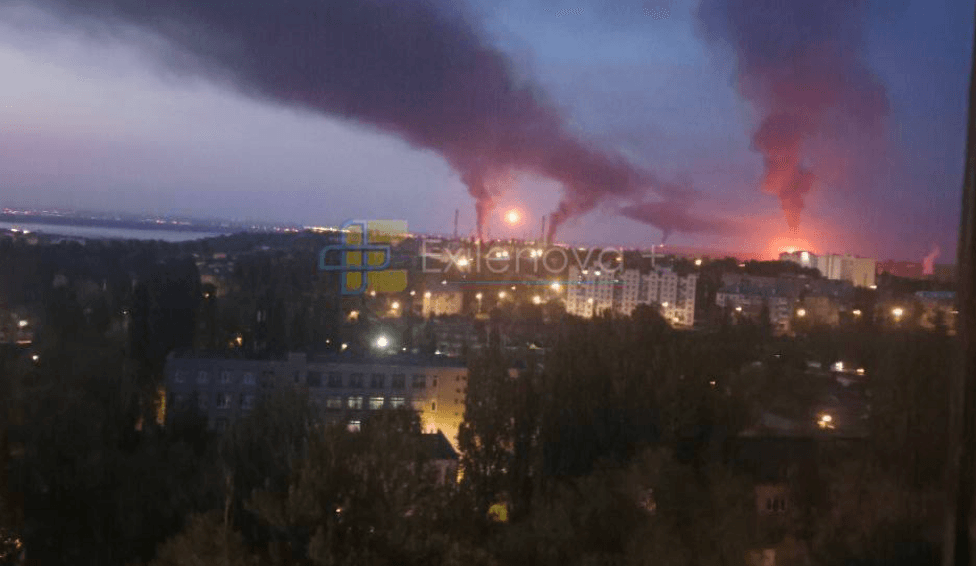
What purports to be the aftermath of Ukrainian strikes on Russia’s Saratov Oil Refinery overnight. (Exilenova Plus/Telegram)
RUSSIA BANS DIESEL EXPORTS AS ITS OWN NUMBERS CONFIRM THE CRISIS
Russia’s government announced a temporary ban on diesel fuel exports effective July 8 through July 31, with Deputy Prime Minister Alexander Novak citing “interruptions in fuel supplies caused by changes in logistics.” More than 90 percent of Russian regions have imposed fuel rationing or shortages since June. Putin, addressing the crisis directly, said Ukraine was trying to “create a nervous situation in society” and “damage Russia’s economy” — calling the goal “unachievable” — while separately ordering officials to prioritize resolving shortages in occupied Crimea, where the situation remains most severe. Kazakhstan responded to a related problem, restricting border crossings to once daily after Russian drivers from Samara, Saratov, Orenburg, and other regions began flooding across the border for gasoline roughly 40 percent cheaper than at home — stopping 61 attempted fuel-smuggling operations in two days alone. Ukraine’s General Staff estimates its campaign has disabled 42.7 percent of Russian refining capacity and inflicted $13.5 billion in industry losses since August 2025.
Former Commander-in-Chief Valerii Zaluzhnyi, now Ukraine’s ambassador to the UK, published an op-ed in the Telegraph warning against Western over-optimism about the state of the war. “Do not assume Russia has lost the war,” he wrote, arguing that both Ukraine’s deep-strike campaign and Russia’s own strikes are “expensive, technologically demanding, and ultimately reciprocal,” with neither able to produce a decisive outcome on its own. “This is no longer a war of swift maneuvers. It is a war of attrition,” Zaluzhnyi wrote, cautioning that Ukraine’s ability to sustain the fight “depends heavily upon continued backing from its allies,” which he suggested shows signs of fraying amid “political changes in Washington and persistent divisions within Europe.”
NO ADVANCES, FRONTLINES HOLD
Neither side made confirmed gains anywhere on July 8, though Russian forces continued pressing north of Kharkiv City and in the Kupyansk, Borova, Dobropillya, Pokrovsk, Oleksandrivka, and Hulyaipole directions without success. The commander of a Ukrainian brigade in the Kostyantynivka-Druzhkivka area reported Russian forces conducted 10 to 15 mechanized assaults over the past three months without a single one succeeding, losing 300 to 400 soldiers in the attempts and roughly 1,200 more fighting specifically for the small settlement of Rusyn Yar, which Russia still has not captured; the commander said Russian forces routinely publish footage of their own soldiers being killed and present it as evidence of an advance. In Zaporizhzhia Oblast, Ukrainian drone operators told Reuters that Russian forces have begun installing “Volna Kupol Garant” jamming systems capable of disrupting Starlink service across 20 square kilometers, part of a broader Russian effort to counter Ukraine’s intermediate-strike campaign by disguising military vehicles as civilian transport and escorting fuel convoys with armed trucks. A Ukrainian officer in the Dnipropetrovsk direction said Russian troops are now carrying ammunition 10 to 11 kilometers on foot to reach infantry positions. Ukraine’s Security Service reported destroying a Russian logistics hub storing drones and ammunition near Pokrovsk, and Ukraine’s Air Force confirmed shooting down a Russian Su-35 fighter jet, bringing Russia’s confirmed wartime aircraft losses to 436, alongside 353 helicopters.
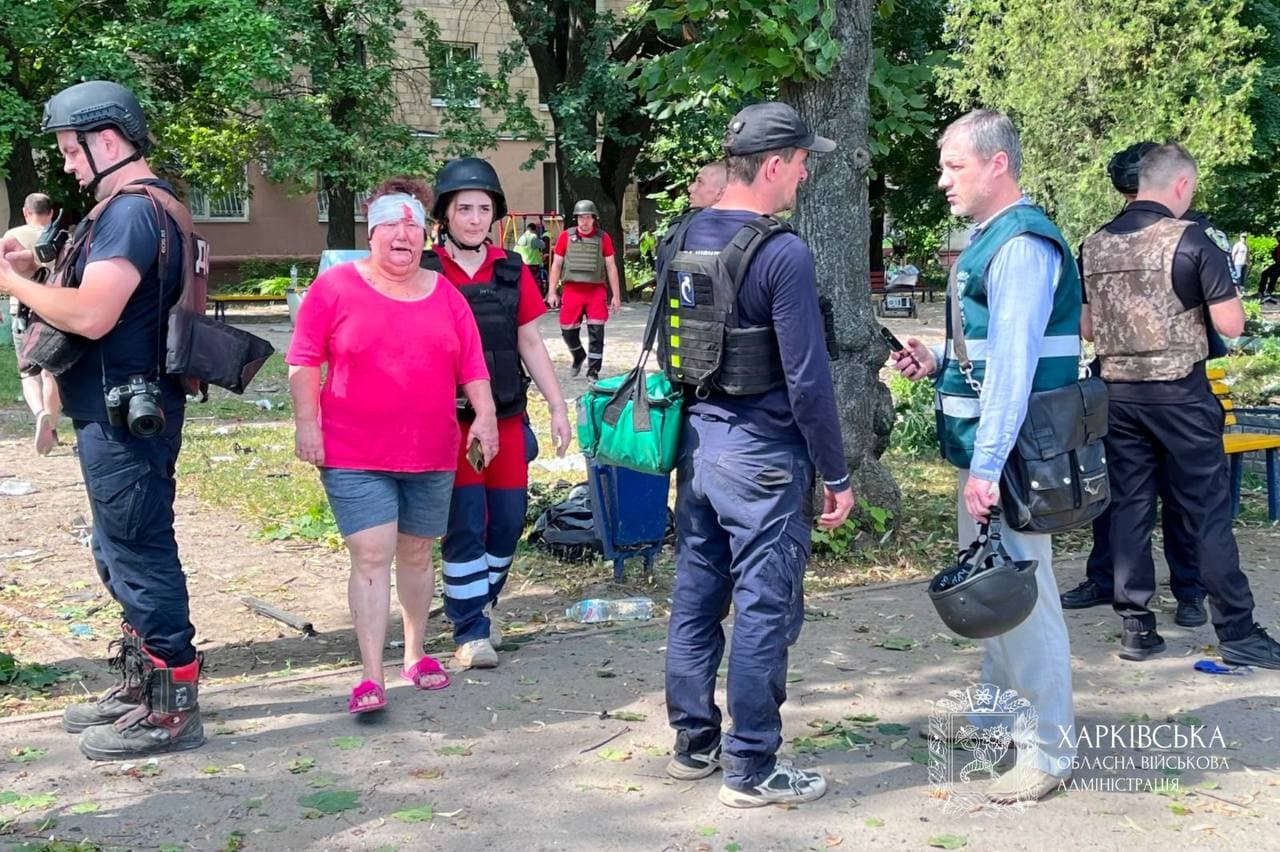
An injured woman in a Russian attack on Kharkiv. ( Oleh Syniehubov / Telegram)
KHARKIV’S BLOODIEST MORNING
A Russian Banderol missile — capable of 800 kilometers an hour and carrying 300 to 400 kilograms of explosives — struck a five-story residential building in Kharkiv’s Nemyshlianskyi district before 8 a.m., killing at least two people and injuring 34, including four children, Governor Oleh Syniehubov said; the toll from the strike alone later rose to 42 injured as rescue crews worked through the day. “The attacks have become much less predictable than they were last summer,” Kharkiv resident Polina Sidletska told the Kyiv Independent. “Now they can happen during the day, in the morning, or several times a day.” A separate drone strike hit a gas station in the city’s Kyivskyi district. Across the rest of Kharkiv Oblast, two more people were killed and 35 injured over the same 24 hours, bringing the oblast’s combined toll to at least four dead and roughly 70 injured for the day.
THE DAY’S TOLL BEYOND KHARKIV
In Kherson, a Russian drone deliberately struck a civilian bus during the morning commute, killing a 72-year-old woman and injuring six; regional governor Oleksandr Prokudin said the drone operator “could not have failed to see” the passengers before flying directly into the cabin. A separate strike on a car in the city killed a 53-year-old man. Kherson Oblast recorded 18 injured in total over the day.
Kyiv absorbed its third ballistic missile attack in six days shortly after midnight, killing one woman and injuring two, according to city military administration head Tymur Tkachenko, with fires breaking out at warehouse facilities in the Desnianskyi district and a non-residential building in Sviatoshynskyi. Russian drones continued targeting the capital through the day: three more people were killed around noon when a drone crashed into a building near a market and gas distribution station in Desnianskyi, and a further 14 people, including a 17-year-old boy, were injured in daytime drone strikes across the city, with a drone hitting a 25-story residential building on its 16th floor in the early evening. Kyiv’s full-day toll stood at four killed and roughly 16 injured. Zaporizhzhia Oblast, hit by 1,016 recorded strikes on 62 settlements over the day, reported 10 injured; Donetsk Oblast, six injured; Sumy Oblast, four injured, including a 21-year-old woman; and Chernihiv Oblast, two injured, including an 18-year-old woman hurt in a daytime strike on Mena and a 46-year-old man injured during a six-hour drone attack on Snovsk. Overnight, Russia launched five Iskander-M/S-400 ballistic missiles, two Kh-31P anti-radar missiles, and 169 Shahed-type drones; Ukraine’s Air Force downed 139 drones, while all five ballistic missiles struck their targets and the two Kh-31Ps failed to reach theirs.
By evening, Russia struck again: a ballistic missile hit Odesa, killing four people and injuring seven, two critically, after hitting an industrial facility and a gas station where a minibus and fuel pump caught fire. “Doctors are doing everything possible to save their lives,” regional governor Oleh Kiper said. Odesa’s city administration declared July 9 a Day of Mourning for the dead. Combined with the day’s other regional tolls, Russian strikes killed at least 10 people and injured well over 130 across Ukraine on July 8.
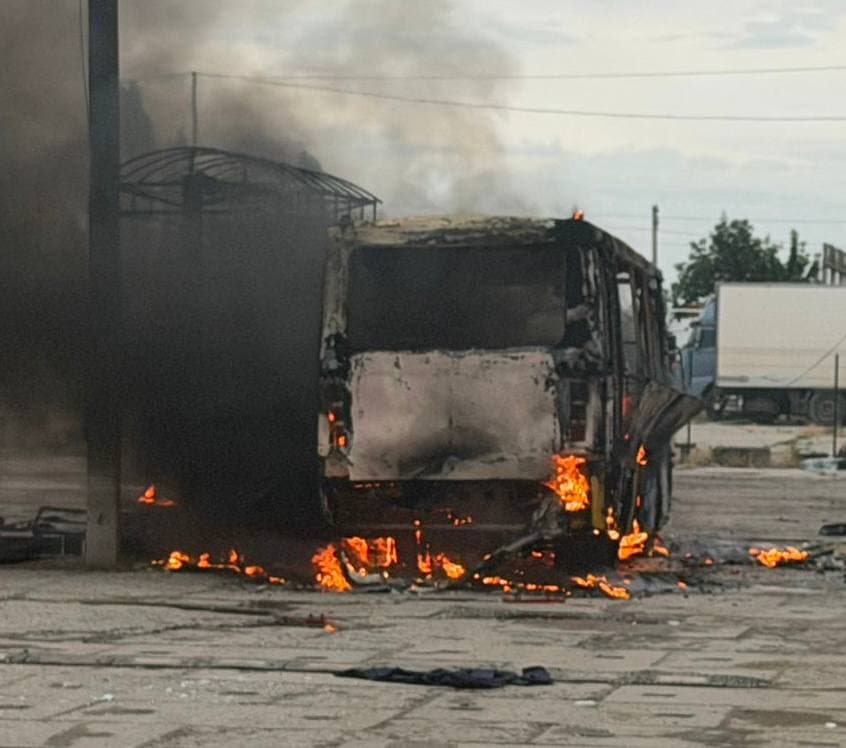
A destroyed bus in flames in Odesa, Ukraine after a Russian ballistic missile attack. (Oleh Kiper / Telegram)
A LAWMAKER’S GENOCIDAL THREAT
Russian State Duma lawmaker Alexei Zhuravlev said in a YouTube interview published this week that it would be acceptable to exterminate up to half of Ukraine’s population to eradicate what he called “Nazism,” claiming without evidence that 20 to 30 percent of Ukrainians are “Nazis.” Asked whether they should all be killed, Zhuravlev said “desirably,” adding: “All Nazis must be exterminated. All of them. You see, even if it’s 50 percent — even 50 percent — they must be exterminated.” Asked how to distinguish a “fascist” from anyone else, he said the presence of a weapon was sufficient: “If you see him, kill him.” The remarks extend rhetoric Kremlin officials, including Putin and Medvedev, have used since 2022 to justify the invasion under the banner of “denazification” — a term investigative outlet Proekt reported the Kremlin quietly deprioritized in its own domestic messaging after internal polling found most Russians didn’t understand or could not pronounce it.
NORTH KOREA’S DEEPENING ROLE IN RUSSIA’S WAR
Ukrainian military intelligence told the Kyiv Post that North Korea now supplies between 25 and 40 percent of Russia’s artillery ammunition needs, calling the military-technical relationship between Pyongyang and Moscow “systemic.” Since June 2023, Russia has received more than 100 KN-23 and KN-24 ballistic missiles from North Korea, at least 80 already used in strikes on Ukraine — including the missile that killed two and injured 62 in Kharkiv on January 2, 2024. North Korea has also supplied more than 600 artillery systems and over 7 million rounds of ammunition, with domestic production capacity of 1 to 2 million shells annually. HUR said it has no evidence Russia is using North Korean components in drone or missile production. More than 15,000 North Korean troops have fought alongside Russian forces, with roughly a third killed or wounded; the arrangement has reportedly earned Pyongyang billions of dollars and fueled a domestic construction boom, with North Korea’s economy growing nearly 4 percent in 2024, its fastest pace in eight years.
SMALL ITEMS: A REVERSED RULING AND RUSSIA’S RETURN TO THE OLYMPICS
A Kazakhstan court overturned an earlier ruling that would have let Ukraine’s Naftogaz recover roughly $1.4 billion from Gazprom within Kazakh territory, part of Naftogaz’s broader $6.9 billion arbitration claim over losses in occupied Crimea — a setback, though not the end, of a years-long legal campaign. And the International Olympic Committee’s decision to provisionally lift Russia’s Olympic suspension drew sharp criticism from Ukrainian tennis star Marta Kostiuk, who became the second Ukrainian woman ever to reach a Wimbledon semifinal the same week. “It’s very, very far from fair play,” Kostiuk said, adding that competing while Kyiv absorbed its worst attacks of the year made it “not easy” to focus on tennis at all: “Another difficult night and a lot of dead people, innocent people, kids.”
By the end of July 8, Ukraine had a license to build its own missile defense and a longer list of Russian refineries no longer fully operating, and Russia had a diesel export ban and a lawmaker on camera arguing for the extermination of half a country’s population. Kharkiv, Kherson, Kyiv, and Odesa each buried or treated their own dead from the same 24 hours. None of the day’s diplomacy changed that math before nightfall.
A PRAYER FOR UKRAINE
1. For the 72-Year-Old Woman on the Kherson Bus
Lord, a woman going about an ordinary morning commute was killed today by a drone operator who saw exactly who was on that bus and struck it anyway. We ask for peace for her family, for the six who were injured beside her, and for every person in Kherson who now has to decide whether it’s safe to take the bus tomorrow.
2. For the Children Hurt in Kharkiv’s Apartment Building
God of the young, four children were among the wounded when a missile hit a home this morning in Kharkiv, in a strike so ordinary for that city that a resident described it as simply less predictable than it used to be. We pray for their healing, and for a city that has stopped being able to predict when the next one will come.
3. For Kyiv, Struck a Third Time in Six Days
Father, this was the third ballistic missile attack on Kyiv in less than a week, followed by a drone crash at noon and another strike at dusk. We pray for the woman killed before dawn, the three killed at midday, and everyone still recovering tonight in a city that keeps having to grieve in installments.
4. For Every Family in Odesa Lighting a Candle Tomorrow
Lord, Odesa declared a Day of Mourning tonight for four people killed hours ago at a gas station that should have been an unremarkable stop on an unremarkable evening. We pray for them, for the two still fighting for their lives in critical condition, and for a city that keeps having to make room for one more day of mourning on its calendar.
5. For a War Measured in Licenses and Bans Instead of Lives
God of nations, today brought a license to build missiles and a ban on selling fuel — the language of bureaucracies trying to out-administrate each other while people keep dying in between. We ask for wisdom for everyone negotiating in Ankara and everyone signing decrees in Moscow, and, in Your mercy, for the day when the paperwork of this war finally matters less than ending it.