
As Trump publicly dismisses Putin’s credibility and Zelensky rotates key commanders, the war presses forward unchanged—marked by stalled fronts, deep strikes inside Russia, and civilians paying the daily cost of a conflict without resolution.
The Day’s Reckoning
Morning broke with decisions rather than breakthroughs.
In Kyiv, President Volodymyr Zelensky signed decrees that quietly reshaped Ukraine’s defenses—dismissing the head of the State Border Guard Service, installing an interim commander, and acknowledging aloud what four years of war had already proven: Ukraine must prepare for two futures at once. Diplomacy, if pressure on Russia holds. Defense, if it does not.
Hours later, sanctions followed. One hundred sixty-five individuals and entities tied to Russia’s military-industrial supply chains were frozen out, another attempt to squeeze the arteries feeding the war even as artillery continued to feed on cities.
Across the Atlantic, a different rupture appeared. Aboard Air Force One, Donald Trump publicly rejected Vladimir Putin’s claim that Ukrainian drones had attacked his residence. The dismissal was blunt. The implication sharper: Russian narratives no longer passed automatically, even with leaders who promised negotiation.
On the battlefield, facts collided with fiction. Ukrainian forces denied Russian claims of capturing Rodynske, while drones reached deep into Russia itself, striking the Energia defense plant in Lipetsk Oblast—far from the front, but firmly inside the war.
Violence answered everywhere else.
A car bomb wounded a Ukrainian soldier in Kyiv, bringing the war into a residential district far from trenches. Russian strikes tore through Kharkiv, Sumy, Donetsk, Zaporizhzhia, Kherson, and Chernihiv oblasts—killing civilians, shattering homes, burning vehicles, and stretching emergency services already conditioned to routine catastrophe.
The events shared no single center. Leadership reshuffles, sanctions, skepticism from Washington, contested towns, deep-strike drones, and civilian deaths unfolded in parallel.
This was day 1,411: a war balanced between diplomacy and destruction, changing shape at the top while grinding forward everywhere else—unfinished, unbroken, and still demanding choices with no safe alternative.

A car belonging to a soldier exploded in Kyiv, Ukraine. (Kyiv City Prosecutor’s Office)
“We Checked”: The Moment Putin’s Story Collapsed at 35,000 Feet
The remark came mid-flight, delivered without ceremony.
Aboard Air Force One, Donald Trump was asked about Vladimir Putin’s claim that Ukrainian drones had attacked his residence. Trump didn’t hedge. He didn’t qualify. He dismissed it outright. “We don’t believe that happened now that we’ve been able to check.”
Then he explained why.
Something had occurred nearby, Trump said—but it wasn’t an attack, and it wasn’t directed at Putin’s home. At the time, nobody knew what it was. Not Russian officials. Not Trump. The story, he implied, grew after the fact. A narrative built to serve a purpose.
For a president who had campaigned on reopening dialogue with Moscow, the rejection mattered. It signaled a break—small, but visible—from Russia’s familiar playbook of manufactured provocations. For Ukrainian officials accustomed to navigating uncertainty from Washington, the moment landed as a cautious reassurance: even now, some lines still held.
Asked how the war might end, Trump offered no roadmap. No deadlines. No leverage. “We just hope that Russia and Ukraine get it settled.”
It was vague, almost passive. But after publicly discarding Putin’s claim, the subtext was clear. Negotiations could continue—but not on the basis of stories that collapsed the moment someone bothered to check.
“Both Futures at Once”: Zelensky Names the Choice No Leader Escapes
The address came at night, when decisions tend to sound heavier.
“Ukraine will prepare for both options,” Volodymyr Zelensky said—his words measured, his meaning unmistakable. Diplomacy, if it works. Defense, if it doesn’t. Peace, if pressure on Russia finally holds. Strength, if it fails.
After 1,411 days of war, the logic no longer needed explanation. Negotiations without leverage were theater. Promises without force were temporary. Any agreement with Moscow would last only as long as Ukraine could punish its violation.
Zelensky said Ukraine sought peace. Then he drew the line that mattered. Ukraine would not surrender its strength to anyone.
The sentence carried the accumulated weight of years—cities leveled, ceasefires broken, talks used as cover for regrouping. The battlefield had taught the lesson repeatedly: diplomacy did not replace military power; it depended on it.
The coming week, Zelensky said, would include meetings in Europe. No cities named. No schedules released. The ambiguity was deliberate. Diplomatic calendars stayed full even as artillery stayed loud. Briefcases moved while drones flew. Both tracks ran in parallel.
Ukraine would talk. Ukraine would prepare. And Ukraine would keep its defenses intact enough to survive the consequences if talks failed—as they so often had before.
It wasn’t indecision. It was realism.
In this war, choosing only one path had never been an option.
The Quiet Hand-Off: When Four Years at the Border Finally Took Its Toll
The decree was brief. The weight behind it was not.
On January 4, President Volodymyr Zelensky signed the order removing Lieutenant General Serhii Deineko as head of the State Border Guard Service, ending a six-year tenure that spanned peace, invasion, and nearly four years of uninterrupted war. First Deputy Valeriy Vavryniuk stepped in as acting chief, the transition executed without ceremony and without pause.
Interior Minister Ihor Klymenko offered the official explanation: doctors had advised Deineko to take “a short recovery period” from active service. The general would not disappear. He would advise. Then, after rehabilitation, return to the front as a Border Guard combat commander.
Translation: the job had consumed what it could.
Klymenko praised Deineko’s management experience and military achievements, acknowledging—carefully—that no one could carry the burden indefinitely. For almost four years, Deineko oversaw a force that ceased to resemble a border service at all. His units became frontline troops, holding defensive positions across thousands of kilometers, regulating refugee flows, and keeping military supply routes open under fire.
The war did not allow exhaustion to be public. But it demanded rotation anyway.
Vavryniuk’s appointment was temporary. Zelensky said a shortlist for the permanent role already existed, with an announcement coming soon. Continuity mattered. Disruption was unacceptable.
The Border Guard Service remains under Armed Forces control, its mission unchanged by leadership names. Borders still require holding. Supplies still require movement. Refugees still require passage.
The hand-off was not about failure. It was about endurance—and the quiet admission that even capable generals are human.
Choking the Supply Lines: Ukraine Tightens the Screws on Russia’s War Industry
The strike didn’t come from the air. It came from a signature.
On January 4, Volodymyr Zelensky approved sanctions aimed at the systems behind Russia’s battlefield power—ninety-five individuals and seventy companies tied to the military-industrial complex that keeps missiles launching and drones flying. The targets weren’t soldiers. They were suppliers: manufacturers of communications gear, electronic warfare systems, and microelectronics embedded deep inside Russian weapons.
Some held Russian citizenship. Others were Chinese nationals. The distinction mattered little. What mattered was function.
The penalties were designed to suffocate quietly. Assets frozen. Property management banned. Trade operations restricted. Transit through Ukrainian territory suspended. State honors stripped away. Each measure closed another channel Russia relied on to sustain its war effort.
The Presidential Office stated the objective plainly: complicate Russia’s ability to produce weapons used against Ukraine. Translation: slow the war by starving the factory floor.
The sanctions reached beyond defense firms. Chemical producers. Mining operations. Metallurgy and energy companies—industrial sectors that rarely make headlines but underpin every missile and armored vehicle—were pulled into the net.
Some of the same firms, officials noted, were already positioned for European sanctions. The pressure was no longer unilateral. Economic warfare was aligning.
No explosion followed the announcement. No immediate battlefield shift.
But wars grind not only at the front. They grind in supply chains, balance sheets, and missing components that never arrive.
Ukraine was tightening those screws.
Who Holds the Town? Rodynske and the War of Competing Truths
The claim landed first. The denial followed fast.
On January 4, Russian sources declared Rodynske captured. Ukrainian Air Assault Forces answered almost immediately: their soldiers were still inside the town, still holding defensive positions, still fighting.
“Control over key positions is maintained,” the statement said, pushing back against what it called another manufactured advance. Russian losses in manpower and equipment, Ukrainian commanders added, were mounting—not signs of a clean takeover.
The 1st Azov Corps reinforced the message with specifics. Units from the 20th and 14th National Guard Brigades and the 132nd Separate Reconnaissance Battalion remained in Rodynske. Names, units, places—details meant to anchor reality against rumor.
The argument itself revealed the deeper problem. Rodynske sits in the modern war’s most confusing category: the grey zone. On Deep State maps, that label means no clean lines. Control shifts by block. Sometimes by stairwell. Ownership changes between floors of the same building.
On January 4, geolocated footage showed Ukrainian forces operating south of Kostyantynivka in areas Russian sources had already claimed as theirs. Other footage showed Russian advances along the H-20 highway northeast of Yablunivka.
Both were true.
Across the Pokrovsk sector, ground was being taken and lost at the same time, often within hours. Statements raced ahead of facts. Maps lagged behind reality.
Rodynske wasn’t a captured town or a liberated one.
It was contested—by infantry, by drones, and by narratives struggling to keep up with a battlefield that refused to stay still.
Sixty Men in the City: How Russia’s War Shrunk into Small Groups and Grey Zones
Colonel Viktor Trehubov’s assessment stripped away the slogans and left the math.
In Kupyansk, he said, fewer than sixty to seventy Russian soldiers remained inside the city. Not battalions. Not waves. Dozens. They couldn’t break in from the north and were trying instead to force Ukrainian defenders off positions along the Oskil River’s left bank—probing, retreating, trying again.
Across Kharkiv Oblast, the pattern repeated. Russian forces had resumed active combat, but the shape of their attacks had changed. Gone were the broad offensives of 2023 and 2024. In their place came small fireteams—constant, persistent, testing Ukrainian lines for weakness. Not designed to win decisively, but to wear defenders down.
The shift revealed both adaptation and limitation. Small groups spread risk. They created multiple pressure points. Occasionally, they slipped through gaps larger formations never could. But they also signaled constraint—less mass, fewer reserves, narrower margins.
In Sumy Oblast, Russian units resumed probing border areas the same way. Small infiltrations. Remote-laid mines around Hrabovske to block Ukrainian counterattacks. One exception stood out: an assault on Hrabovske carried out by a larger group, an anomaly in a war increasingly fought in fragments.
Logistics told their own story. Russian units, Trehubov said, were struggling to supply frontline positions and turning to drones to keep men fed and armed.
Around Lyman, Russian forces tried to bypass Ukrainian positions while pushing directly toward the town. The terrain there dissolved into “grey zones”—streets and buildings neither side fully controlled, spaces that complicated Ukrainian logistics and turned every movement into a risk.
This was not momentum.
It was pressure—measured in small groups, narrow gains, and a war shrinking into contested blocks and exhausted men.
No Breakthrough, No Pause: Pressure Without Progress
The attacks came everywhere at once.
From Sumy in the north to Kherson in the south, Russian forces pushed forward on January 4—not to break through, but to press. Hundreds of kilometers lit up at the same time. The weight was constant. The gains were not.
Testing the Line: Kharkiv’s North Under Drones, Probes, and Sudden Pushback
The pressure came in pieces, not waves.
Northeast of Kharkiv City, Russian forces pressed toward Vovchansk, Vovchanski Khutory, Starytsya, Prylipka, Lyman, and the approaches to Izbytske. The attacks were deliberate and probing—meant to feel for weakness rather than force a collapse. Then came the counterpunch. A Russian milblogger acknowledged Ukrainian counterattacks near Vovchanski Khutory, an admission that Kyiv’s defenders were still capable of striking back despite constant pressure.
Above the ground fight, the air hummed.
FPV drone operators from Russia’s 245th Motorized Rifle Regiment of the 47th Tank Division worked Ukrainian positions near Martynivka, joined by operators from the Chechen Akhmat Spetsnaz Vakha Battalion. Other drone teams—Chechen units, the 552nd Separate Anti-Tank Battalion, the 347th Motorized Rifle Regiment, and the 1472nd Motorized Rifle Regiment—spread across northern Kharkiv Oblast, turning the sky into a contested weapon.
The mix was intentional. Regular Russian units fought alongside Chechen formations, professional soldiers paired with ideologically driven fighters. Conventional tactics blended with irregular methods. The burden was distributed so no single formation would break first.
Further northeast, Russian forces continued pushing near Khatnie and Milove, outside Velykyi Burluk. No confirmed advances followed. That wasn’t the point.
The objective was pressure—keep Ukrainian defenders engaged, searching for seams, forcing responses. In northern Kharkiv, the line bent and answered back, but it did not give way.
Too Many Units, One Objective: Kupyansk Under Relentless Convergence
The pressure around Kupyansk didn’t come from one direction. It came from everywhere.
Russian forces pushed toward the city itself, pressed north near Kutkivka, edged northeast around Synkivka and Fyholivka, probed east near Petropavlivka and Kucherivka, and leaned in from the southeast near Kurylivka. Even Russian military bloggers admitted the situation was “difficult.” Winter weather favored drones, and the sky filled accordingly—both sides flying more, watching more, striking more.
The order of battle told the deeper story. Drone teams from Russia’s 27th Separate Motorized Rifle Brigade of the 1st Guards Tank Army worked the area alongside self-propelled artillery from the 82nd Self-Propelled Artillery Regiment. Infantry elements from the 352nd Motorized Rifle Regiment stayed engaged, while the 79th Motorized Rifle Regiment operated near Dvorichanske northeast of the city.
Moscow, Leningrad—different military districts, different command cultures, now fighting shoulder to shoulder.
It showed how Russia had changed the way it fought. Units once stationed thousands of kilometers apart were now stitched together into integrated operations, their coordination sharpened by nearly four years of war. But seams remained. The fit was never perfect.
The pressure widened. Russian forces continued attacking northeast of Borova near Nova Kruhlyakivka and Bohuslavka, and southeast near Olhivka. No confirmed advances followed, but Ukrainian defenders stayed stretched—forced to hold dozens of settlements at once, unable to mass for counteroffensives.
The fighting spilled outward. Near Lyman, Russian forces attacked around Novoselivka, Drobysheve, Stavky, Kolodyazi, Myrne, Torske, and Zarichne. Toward Siversk, Russian sources claimed advances west and southwest of Svyato-Pokrovske, though confirmation never came. Attacks continued around Siversk itself, from multiple directions.
Kupyansk wasn’t facing a single assault.
It was absorbing the weight of a war increasingly fought by accumulation—units layered, pressure constant, progress measured in strain rather than ground.
A City Surrounded by Armies: Kostyantynivka Under the Weight of Convergence
The city was being pressed from nearly every side.
Geolocated footage on January 4 showed Russian forces edging forward along the H-20 highway northeast of Yablunivka. At the same time, attacks rippled across Kostyantynivka itself—north, northeast, east, southeast, south, and southwest—spilling through dozens of surrounding settlements. This was not a single thrust. It was a tightening ring.
The forces converging on the city told the story of Moscow’s commitment. In eastern Kostyantynivka, elements of Russia’s 72nd Motorized Rifle Brigade struck Ukrainian positions. To the south, units of the 4th Motorized Rifle Brigade targeted Ukrainian vehicles. Each formation brought its own command structure, its own habits, its own expectations of how urban combat should unfold.
Then came the Chechens. Fighters from the 78th Sever-Akhmat Motorized Rifle Regiment and the 1194th Motorized Rifle Regiment joined the fight south of the city. Above them, FPV drone operators from the Okhotnik Spetsnaz detachment hunted targets, while artillery crews from the 238th Artillery Brigade added weight from distance.
Former proxy forces. Regular Russian brigades. Chechen specialized units. Artillery and drones layered together.
The redundancy was deliberate. Russian command no longer relied on a single formation to break a city. Instead, it stacked capabilities—accepting coordination friction in exchange for constant pressure.
The method reflected how urban warfare had changed. There were no massive frontal assaults. Instead, Russian forces probed endlessly from multiple directions, grinding Ukrainian positions with artillery and drones before infantry moved. Progress came slowly, measured not in neighborhoods but in buildings, stairwells, and intersections.
Kostyantynivka wasn’t facing one army.
It was absorbing several at once—each adding weight, each consuming resources, each tightening a fight designed not for speed, but for exhaustion.
Everyone Gets Thrown In: Pokrovsk Under Pressure from Sea Troops and Volunteers
The fighting around Pokrovsk pulled in forces that were never meant to fight there.
Geolocated footage on January 4 showed Ukrainian units pushing forward in central Rodynske and edging ahead in southern Hryshyne. At the same time, Russian forces pressed Pokrovsk from nearly every direction—north, northeast, east, southwest, and west. Even Russian military bloggers acknowledged Ukrainian counterattacks inside the city, a sign that control was still fluid and contested.
Nearby, elements of Russia’s 5th Motorized Rifle Brigade continued operating around Myrnohrad. Above the fight, drones from the Maksim Krivonos Battalion—part of Russia’s Volunteer Corps—struck Ukrainian positions near Pokrovsk. The presence of volunteer formations alongside regular units told its own story. Professional manpower was thin. Irregular forces were filling the gaps.
The pressure spread westward.
In the Dobropillya direction, Russian forces attacked near Shakhove, Kucheriv Yar, and Zapovidne. No confirmed advances followed, but the composition of the attacking force stood out. Elements of Russia’s 61st Separate Naval Infantry Brigade—the Northern Fleet’s marines—were operating near Shakhove.
These were troops trained for amphibious landings and coastal assaults, now fighting in landlocked Donetsk Oblast.
Their presence marked how deeply the war had reached into Russia’s reserves. Specialized units were no longer held back for specialized missions. They were committed wherever pressure was needed, regardless of terrain or doctrine.
Pokrovsk was no longer just a city under attack.
It was a place where Russia’s manpower exhaustion showed in plain sight—volunteers, motorized infantry, and naval troops all thrown into the same grinding fight.
Snow, Drones, and Chechen Claims: Zaporizhzhia’s South Becomes a Test of Endurance
The fighting in southern Zaporizhzhia unfolded under cover of snow and noise.
Russian forces continued pressing in the Hulyaipole and Orikhiv directions, where claims and counterclaims moved almost as fast as the drones overhead. Chechen leader Ramzan Kadyrov declared that fighters from the 270th Akhmat-Kavkaz Regiment had cleared Bilohirya southeast of Orikhiv. No confirmation followed. A Russian milblogger, meanwhile, acknowledged Ukrainian counterattacks near Hulyaipole—another reminder that control in this sector shifted by hour, not headline.
The forces committed here underscored why the ground mattered. Drone operators from Russia’s 35th Radiation, Chemical, and Biological Protection Regiment and the 38th Motorized Rifle Brigade hunted Ukrainian UAVs across the oblast. Russian air force units struck positions near Zaliznychne. GRU Spetsnaz drone teams from the 14th Spetsnaz Brigade targeted Ukrainian vehicles near Verkhnya Tersa.
More units arrived. Chechen Vostok-Akhmat fighters. Airborne troops from the 108th and 247th VDV Regiments. Elements of the 104th VDV Division. Specialized formations layered atop one another, reflecting Moscow’s judgment that Zaporizhzhia required elite forces—even if elite forces produced only incremental gains.
A Ukrainian servicemember near Oleksandrivka described how Russian troops tried to disappear into the snow, advancing in groups of five or six with electronic warfare and anti-drone gear. “Zombie tactics,” he called it—hoping two or three might survive long enough to reach Ukrainian lines. The attacks, he said, never stopped. Reserves kept coming.
To the west, in Kherson Oblast, Russian forces continued limited ground attacks toward the Antonivskyi Bridge—small movements tied to the same logic of constant pressure.
No collapse followed. No breakthrough came.
Zaporizhzhia’s southern front became what so many others had: a grinding test of manpower, patience, and survival—where elite units bled slowly, claims outpaced reality, and progress was measured in exhaustion rather than territory.
Flames Without Comment: Ukraine Reaches Deep into Russia’s Rear
The fire lit the sky before anyone explained it.
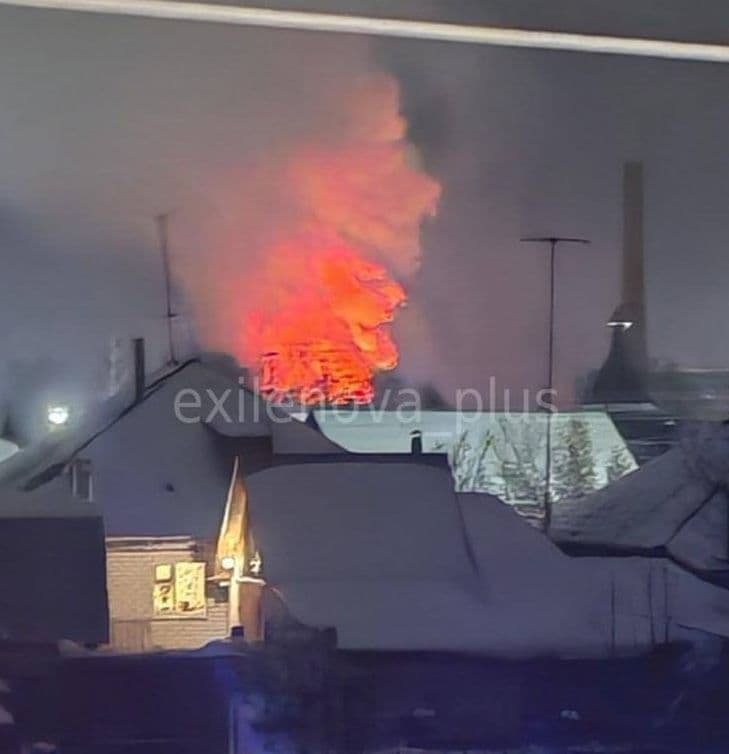
Flame and smoke billows from Russia’s Energia defense factory in Yelets, Lipetsk Oblast, during a reported drone attack. (Exilenova-Plus / Telegram)
On the evening of January 4, flames tore through Russia’s Energia defense plant in Yelets, Lipetsk Oblast. Eyewitnesses filmed smoke climbing above the factory roofs, posting videos that spread faster than any official statement. There wasn’t one.
There rarely is.
Russian authorities said nothing, keeping with a familiar pattern: successful Ukrainian strikes on military infrastructure often pass without acknowledgment, as if silence might contain the damage.
But Energia was not an ordinary factory. It produced batteries for Iskander ballistic missiles, cruise missiles, and other critical weapons—chemical power sources that quietly keep Russia’s arsenal functioning. Its clients read like a map of the Russian state: the Defense Ministry, Interior Ministry, FSB, Roscosmos, Gazprom.
A strike there wasn’t symbolic. It was practical.
Yelets sits roughly 250 kilometers north of Ukraine’s border. The distance mattered. It marked how far Ukrainian drones could now reach, how precisely they could be guided, and how few places inside Russia remained truly out of range.
Russian opposition outlet Astra confirmed the fire by analyzing eyewitness footage. Ukrainian officials offered no immediate comment. The Kyiv Independent noted it could not independently verify the strike at the time of publication.
What remained undeniable was the image itself: fire where production should have been, smoke where components were supposed to ship.
The war had traveled far from the front again—quietly, deliberately—into Russia’s rear, where factories burn and answers do not come.
A Trunk Opens, the War Arrives: Kyiv Hit Far from the Front
The explosion came in daylight, in a quiet part of the city.
At about 10:30 a.m. on January 4, a Ukrainian soldier opened the trunk of his car in Kyiv’s northern Obolon district. The blast followed instantly, tearing through the vehicle and wounding him. A woman standing nearby escaped without injury.
Police moved quickly, sealing the scene and opening a pre-trial investigation. Authorities classified the incident as a terror attack. Beyond that, the city prosecutor’s office offered little—no suspects, no mechanism, no public explanation.
The location was the message.
This wasn’t a convoy on a highway or a checkpoint near the front. It was a personal vehicle in the capital, targeted in a residential area. The strike raised the same question Ukrainian security services had been asking for months: sabotage, or something closer to home?
After 1,411 days of war, the concern had grown sharper. Russian intelligence operations had increasingly focused beyond trenches and barracks—aiming instead at soldiers on leave, defense industry workers, and government officials far from the frontlines. The objective wasn’t territory. It was fear.
Kyiv had learned to live with air raid sirens and missile debris. Car bombs carried a different weight. They turned ordinary moments—unlocking a door, opening a trunk—into acts of risk.
The blast lasted seconds. The uncertainty lingered much longer.
In a war that had already stretched into its fourth year, even the capital could no longer pretend that distance offered safety.
Numbers Without Faces: How Civilian Death Became a Daily Ledger
By the end of the day, the figures were already familiar.
Across Ukraine, regional authorities logged another round of Russian attacks—another accumulation of dead, wounded, and damaged places that no longer surprised anyone reading the reports.
In Kherson Oblast, drones, air strikes, and artillery swept through dozens of settlements. Eight apartment buildings and six private homes were damaged, along with shops, vehicles, and electric transport lines. Two people were killed. Two more were injured. Eighteen residents were evacuated from communities that had only recently been liberated.
Zaporizhzhia Oblast counted its own wounds. A 51-year-old woman was injured as Russian forces launched 569 strikes across twenty-five settlements—air strikes, rockets, drones, artillery. At least twenty homes, vehicles, and outbuildings were damaged. The volume was staggering. The pattern was not new.
In Donetsk Oblast, one civilian died and another was injured. Drone attacks on Kramatorsk set apartments on fire inside a five-story building and tore into the roof of a nine-story block. A later strike hit the private sector, burning an outbuilding behind someone’s home.
Sumy Oblast lost a 52-year-old man to an FPV drone. Nearly sixty attacks followed across the region—artillery, mortars, drones, guided bombs. Four residents were evacuated. Air raid sirens stretched on for more than eleven hours.
In Chernihiv Oblast, shelling hit border areas forty-four times. A civilian car burned after an FPV strike in Semenivka. Geran drones damaged vehicles at an agricultural site while grain was being loaded. Another struck an old farm. A UAV hit a school that no longer held students.
The reports stacked neatly. Numbers. Categories. Durations.
After 1,411 days, civilian suffering had become measurable, sortable—and devastatingly routine.
Loud Words, Careful Steps: Moscow Condemns Washington Without Burning Bridges
The statements were sharp. The response was restrained.
On January 4, Russian officials reacted to the U.S. military operation in Venezuela with familiar language of condemnation. Foreign Minister Sergey Lavrov spoke with Belarusian counterpart Mikhail Ryzhenkov, issuing a joint denunciation of Washington’s actions. Security Council deputy chair Dmitry Medvedev went further, accusing Donald Trump of violating international law while declaring Russia’s support for Nicolás Maduro.
The State Duma followed suit. Deputies framed the operation as an assault on sovereignty, arguing the United States was less interested in legality than in control of Venezuela’s oil reserves. The rhetoric fit a script Moscow had used many times before.
What stood out was what didn’t happen.
Despite the criticism, the Kremlin’s reaction stopped short of escalation. No concrete countermeasures were announced. No dramatic diplomatic rupture followed. The volume remained lower than the language suggested.
The restraint reflected a calculation. Russia needed to preserve its image as a partner to governments facing U.S. pressure—but it also needed to avoid provoking a confrontation with the Trump administration. Ukraine negotiations were ongoing. Missteps carried costs Moscow could not afford.
So the balance held. Condemnation for the cameras. Caution in practice.
Moscow signaled solidarity with Caracas while keeping its options open elsewhere, speaking loudly enough to be heard—but not so loudly that it closed doors it still needed ajar.
“We Need Greenland”: A Different Map of Sovereignty Emerges
The comment came casually, but it landed heavily.
On January 4, Donald Trump again spoke of Greenland as something to be acquired. “We do need Greenland, absolutely,” he said in an interview, later expanding the point aboard Air Force One. National security, he insisted. Strategy. Russian and Chinese ships “all over the place.”
Pressed for justification, Trump didn’t soften it. The United States needed Greenland, he said—and the European Union needed America to have it, whether they admitted it or not.
The words echoed beyond the Arctic.
That same day, the European Union urged restraint and respect for international law in Venezuela, emphasizing sovereignty and dialogue while carefully avoiding direct condemnation of Washington. The contrast was striking: public calls for sovereignty paired with silence when it came to American ambition.
For European officials working through Ukraine peace frameworks, the moment unsettled. Trump’s remarks reopened an old concern—not about Greenland itself, but about principles. Territorial integrity. Sovereignty. The idea that borders are not bargaining chips.
Those principles sit at the heart of Ukraine’s war.
Hearing them bent so easily elsewhere raised a quiet, uncomfortable question in European capitals: if sovereignty is conditional in one place, how firm can it be defended in another?
Trump’s words were not policy. But they were revealing.
In a war defined by who gets to redraw maps—and who doesn’t—Greenland suddenly felt much closer to Kyiv than its distance suggested.
The Day’s Meaning: Everything Moved—Nothing Resolved
By the end of January 4, the pattern was unmistakable.
The war moved in every direction at once. Ukrainian units fought across dozens of sectors while leadership shifted quietly in Kyiv. Sanctions tightened around Russia’s war economy even as Ukrainian drones reached deep into Russian territory. Diplomats prepared meetings while artillery continued killing civilians along Ukraine’s borders. No single thread defined the day. All of them did.
What the twenty-four hours revealed was not momentum toward an ending, but the complexity of what ending the war would actually require. Military success alone was insufficient. Diplomacy without leverage was hollow. Economic pressure mattered—but only if sustained. And leadership decisions, from Kyiv to Washington, carried consequences far beyond their immediate context.
Zelensky’s declaration that Ukraine prepared “for both options” captured the reality plainly. After 1,411 days, survival meant maintaining military strength while pursuing diplomacy—preparing for peace without assuming it would come.
Trump’s rejection of Putin’s drone claims briefly reinforced that reality could still intrude on narrative. But his renewed talk of Greenland exposed something more troubling: that principles of sovereignty and territorial integrity were not always fixed. For Ukraine’s partners, that ambiguity mattered.
The rotation of Ukraine’s border guard leadership underscored another truth. Wars are fought by institutions, but borne by people. Even capable commanders reach limits. Rotation was not weakness—it was sustainability.
At the front, nothing collapsed. Nothing broke through. The war remained what it had become: incremental advances, contested ground, constant pressure, rising casualties.
The car bomb in Kyiv shattered any illusion that distance from the front conferred safety. The strike on Russia’s Energia plant confirmed that Ukraine could still reach far beyond the battlefield—and force Moscow to defend its rear.
As night fell, the war looked exactly as it had that morning: unresolved, exhausting, and unfinished. The machinery of war kept running. So did the machinery of diplomacy. Neither overpowered the other.
January 4 offered no turning point. It offered clarity.
This war would end someday—but not quickly, not cleanly, and not on anyone’s preferred terms.
Five Prayer Requests from the Day
- For civilians living under routine violence
Pray for the families in Kherson, Zaporizhzhia, Donetsk, Sumy, and Chernihiv who ended the day counting losses instead of hours. Ask God to protect those who sleep in damaged homes, to comfort those grieving loved ones, and to strengthen emergency workers who respond again and again to scenes no one should grow used to. - For Ukrainian soldiers holding contested ground
Pray for those defending places like Kupyansk, Rodynske, Kostyantynivka, and Pokrovsk—often outnumbered, exhausted, and fighting in fragments of cities and villages. Ask for endurance, clarity under pressure, protection from drones and artillery, and the will to keep standing when progress feels invisible. - For leaders carrying impossible decisions
Pray for President Zelensky and Ukraine’s military and security leadership as they prepare for “both options”—diplomacy and continued defense. Ask for wisdom that is not reactive, courage that is not reckless, and strength to lead without losing compassion or moral clarity. - For truth to outlast propaganda and manipulation
Pray that false narratives—used to justify violence or erode resolve—would be exposed and lose their power. Ask that truth would matter in Washington, Europe, and beyond, and that decisions affecting millions would be grounded in reality rather than convenience or ambition. - For an end to the war that is just, not merely quiet
Pray not only for the fighting to stop, but for an ending that preserves life, sovereignty, and dignity. Ask that peace, when it comes, would not reward aggression or leave wounds unhealed—but would be strong enough to last and gentle enough to restore.