
October 9, 2026
Prepared by Diana Bozhyk
President Donald Trump announced a deal with Vladimir Putin to let Russian diesel back onto global markets today, and the Treasury issued a license within hours, as Ukrainian, American, and European negotiators met in Miami on ending the war. Zelensky called it “a weak decision by our strong partners,” while Russian glide bombs hit Zaporizhzhia six times and Ukrainian drones struck a missile-fuel plant, an ICBM disposal center, the Ukhta refinery, and a second Yandex data center. Montenegro detained and deported the founder of the Rybar war blog, and the United States imposed financial sanctions on the International Criminal Court.
THE DAY’S RECKONING
The talks in Miami opened on the same day Washington handed Moscow something it had asked for. Trump wrote that Russia would immediately supply more than 300,000 tons of diesel, with more to follow, and thanked Putin. In Kyiv, Zelensky said his negotiators were being used “as a smokescreen.” Witkoff called the Miami discussions “constructive” but announced no agreements, and the Kremlin said it agreed with Washington that the process had reached a stalemate.
On the ground, six guided bombs fell on Zaporizhzhia, and by evening 23 people had been injured and one man killed. Russia struck Dnipropetrovsk Oblast dozens of times and hit the same logistics warehouses twice. Ukraine sent drones deep into Russia, from Tver to Komi, halting flights at Moscow’s airports. Montenegro expelled one of Russia’s best-known war bloggers, Medvedev threatened to seize Westerners in response, and a Ukrainian journalist released in Vienna described being dragged from his car at gunpoint.
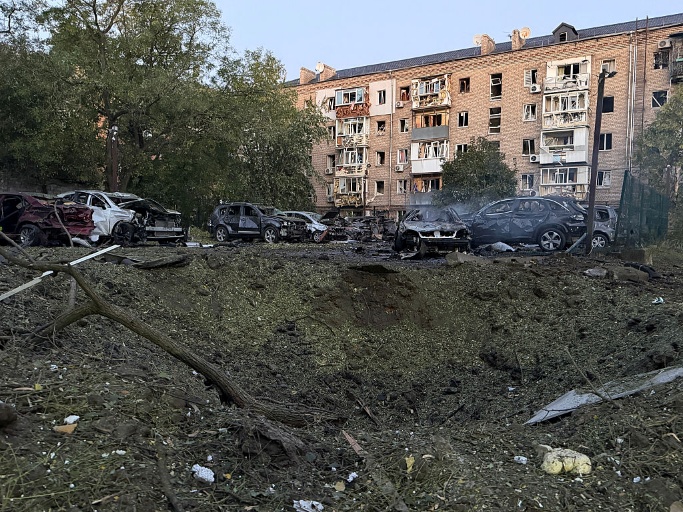
A crater next a residential building damaged following a Russian attack on Zaporizhzhia . (Daria Nazarova/AFP via Getty Images)
TRUMP ANNOUNCES A DIESEL DEAL WITH PUTIN
Trump said that after a call with Putin, Russia had agreed to supply millions of tons of diesel to the United States and world markets. “Russia will immediately supply over 300,000 Tons of Diesel Fuel to the American and Global Marketplace, another 500,000 Tons during the month of November, and 1,000,000 Tons immediately thereafter,” he wrote on Truth Social, adding that Russia could deliver another 3 million tons in a short time, depending on the condition of its refineries. “Lower prices for Americans, especially our Great Farmers, Ranchers, and Truckers, is my Greatest Priority,” he wrote.
The Treasury Department said that, at Trump’s direction, the Office of Foreign Assets Control was “immediately issuing a temporary general license to allow the supply of Russian diesel to the global market.” Kyiv Post reported that it authorizes the sale and import of Russian diesel through April 7, 2027. “We need oil for the world, and this is diesel, which is what we need, so we are happy to get it,” Trump told reporters. “I want to thank President Putin, to be honest with you,” he said, while calling Washington Ukraine’s “strong partner.”
The Kremlin said Russia confirmed during the call its willingness to supply oil and petroleum products to U.S. and global markets. In late September, Kremlin spokesperson Dmitry Peskov had said Russian diesel could flood international markets only without sanctions. Russia has banned nearly all diesel exports since July after Ukrainian drones halted a large share of its refining capacity, and on Sept. 30 it extended the ban through Oct. 31.
The license came three weeks after Trump signed the Lindsey O. Graham Sanctioning Russia and Iran Act on Sept. 18. ISW assessed that the decision is a unilateral U.S. concession that will help fund Russia’s war.
ZELENSKY: “A WEAK DECISION BY OUR STRONG PARTNERS”
Zelensky criticized the decision as soon as it was announced. “This only fuels Putin and enables him to wage more war,” he said. “And at the very moment when we are talking about peace, America is allowing Russia to export diesel. I believe our team is simply being used as a smokescreen. This is certainly not honest, and it is certainly not how partners should act.” Meeting a visiting U.S. congressional delegation, he said “allowing Russia to sell petroleum products is an investment in a war that must be ended, not prolonged,” and listed three conditions for ending the war: enforcing the Graham sanctions law, helping Ukraine protect lives, and sustained pressure on Russia.
Zelensky said Ukraine would halt strikes on Russian refineries if Moscow stopped attacking Ukrainian energy infrastructure, and that U.S. negotiators know this. He said Russian forces are weaker at the front than ever, adding: “Ukraine is ready not only to produce ballistic-missile interceptors for itself, but also to strengthen the United States and its allies through joint production.”
Democratic Senators Jeanne Shaheen, Chuck Schumer, and Elizabeth Warren called the authorization “a total betrayal of Ukraine, our European allies and American national security.” European Commission spokesperson Paula Pinho said that “Europe does not wish to fuel Russia’s war against Ukraine,” and a European diplomat said the deal was “very unlikely to have a real impact on prices but the symbolism will have a real impact.” Ukrainian sanctions official Vladyslav Vlasiuk called it “economically pointless.”
The Kyiv Independent reported, citing U.S. and Ukrainian officials, that Russia is seeking sanctions relief in talks over halting attacks on energy infrastructure and wants to link an energy truce to Black Sea arrangements; a European diplomat said Moscow may also seek the release of frozen assets.
IN MIAMI, “CONSTRUCTIVE” TALKS BUT NO DEAL
U.S., Ukrainian, and European officials met in Miami to discuss ending the war before winter. Special Envoy Steve Witkoff called the talks “constructive.” They covered protecting Ukraine’s energy infrastructure and maintaining grain exports through the winter, security guarantees, and longer-term arrangements to prevent future conflict, as well as reconstruction, economic recovery, and EU accession. In a post on X, Witkoff said the talks helped identify areas for further consideration ahead of Washington’s next engagement with Russia but announced no agreements.
Representatives of France, Germany, and the U.K., the European Commission, and NATO also took part. EU officials told the Kyiv Independent that Bjoern Seibert, Commission President Ursula von der Leyen’s chief of staff, represented the Commission; diplomats from three EU countries said they had not known about his role. Ukraine’s delegation included Kyrylo Budanov, Rustem Umerov, Serhiy Kyslytsya, and Davyd Arakhamia; Kyiv Post reported that military intelligence chief Oleh Ivashchenko also attended. Zelensky said he expects a briefing on Monday.
Axios, citing a U.S. source, reported that the talks aim to produce a unified proposal for Moscow, including a possible partial ceasefire on energy and grain shipments. “They are all nervous about the winter,” the source said. Witkoff and Kushner could travel to Moscow later in October, a source told Axios, though no date has been set.
Peskov said Moscow agreed with Secretary of State Marco Rubio’s assessment that the process had reached a stalemate. He rejected temporary or limited ceasefires, said Russia wants a “comprehensive” settlement, and said there was no immediate prospect of a Trump-Zelensky-Putin summit.
SIX GUIDED BOMBS ON ZAPORIZHZHIA; 136 DRONES OVERNIGHT
Russian forces dropped six guided aerial bombs on Zaporizhzhia early in the day. Acting regional administration head Mykhailo Semikin first reported one man killed and two injured, then five casualties, and the regional Defense Council put the number injured at seven shortly before 8 a.m. “The enemy attacked a residential area. One of the strikes hit near an extracurricular education facility,” Semikin wrote. By evening, the number injured in the day’s attacks had risen to 23, he said. One apartment building was partially destroyed and at least 20 others were damaged, along with vehicles and a children’s educational facility. Ivan Fedorov, co-chair of the regional Defense Council, said a child was among the injured. Across Zaporizhzhia Oblast, Russian attacks killed two people and injured 18 over the past day, Fedorov said, with 1,039 strikes on 51 settlements.
Overnight, Russia launched 136 drones, including 93 jet-powered Shahed-type models, alongside Gerbera strike drones and Parodiya decoys, from the directions of Oryol, Primorsko-Akhtarsk, occupied Donetsk, and occupied Hvardiiske in Crimea, the Air Force said. Air defenses downed or suppressed 114, including 77 jet-powered drones. Drones struck eight locations, and debris fell at seven. Earlier in the night, the Air Force had warned of drones approaching Odesa from the Black Sea and of guided bombs aimed at Kharkiv and Sumy oblasts, and jet-powered drones were reported heading toward Kyiv and surrounding communities, including Hostomel, Bucha, Vyshhorod, and Borodianka.
Zaporizhzhia has come under repeated attack with glide bombs and drones in recent weeks, Kyiv Post reported, as Moscow intensifies strikes on the city and its infrastructure. The city’s bridges over the Dnipro have also been targeted, and ISW has said that Russia’s campaign against bridges has expanded beyond Kyiv to Zaporizhzhia.
DNIPROPETROVSK STRUCK DOZENS OF TIMES; THREE KILLED IN BILENKE
Russian forces struck Dnipropetrovsk Oblast nearly 40 times during the day, using drones, artillery, and a missile, regional administration head Oleksandr Hanzha said. One person was killed in Synelnykove district. Strikes damaged infrastructure in Kryvyi Rih and houses in the Zelenodolsk community; in Nikopol district, which bore the brunt of the strikes, homes, an apartment building, businesses, and an infrastructure facility were damaged. At 8 p.m., Hanzha reported that a strike in Dnipro district had set a logistics company’s warehouses on fire; at 8:50 p.m., he said the same warehouses had been struck again.
In Donetsk Oblast, three people were killed in Bilenke, Governor Vadym Filashkin said. In Sumy Oblast, one person was killed and 14 injured, including two 12-year-old boys hurt in a drone attack; In Kherson Oblast, four people, including a child, were injured, and 12 houses, gas pipelines, and vehicles were damaged. In Kharkiv Oblast, two men aged 51 and 53 were injured in Zolochiv and a 72-year-old woman in Khotimlia, Governor Oleh Syniehubov said. In Chernihiv Oblast, an elderly man was injured when a drone struck a courtyard in the Liubech community, and a Geran-type drone hit a hypermarket on the outskirts of Chernihiv overnight, causing a fire.
In occupied Kharkiv Oblast, Russian forces removed 25 civilians, including children, from an area of active fighting to an unknown destination, Human Rights Ombudsman Dmytro Lubinets said. “Russia calls this an ‘evacuation.’ But when people are taken away against their will, intimidated, and left with no choice, it is not a rescue. It is coercion,” he said. He said occupation authorities had created a Telegram bot to collect residents’ data and that he had appealed to Russia’s human rights commissioner, the Red Cross, and the UN. The circumstances could not be independently verified.
UKRAINE STRIKES A MISSILE-FUEL PLANT AND AN ICBM DISPOSAL CENTER
Ukrainian forces struck three Russian facilities involved in missile launches and fuel production overnight, the General Staff said. In Nizhny Novgorod Oblast, they hit a facility of the V.P. Barmin Research Institute of Launch Complexes near Dalneye Konstantinovo-5, part of the center that develops and operates rocket launch complexes, fueling equipment, and missile control systems, and the Center for the Disposal of Intercontinental Ballistic Missiles near Surovatikha, which specializes in explosives and missile fuel. In Tver Oblast, they struck the Redkino Experimental Plant, which produces components of Decilin-M fuel for Kh-55 and Kh-101 cruise missiles. Governor Vitaly Korolev said the fire was extinguished and no workers were injured. The plant, under U.S. and U.K. sanctions, was previously hit in February 2026.
Zelensky said Ukrainian forces struck the Lukoil-owned Ukhta refinery in Komi, about 1,700 kilometers from the border, using new An-196 RS drones. The refinery processed about 3 million tons of oil in 2025, and flights at Ukhta airport were suspended. The General Staff also reported hitting a Pantsir-S1 air-defense system near Kudepsta in Krasnodar Krai. Near Belgorod, NASA fire data showed a fire at an oil depot; Russian officials said shelling killed two people and injured four in Belgorod district.
Russia’s Defense Ministry claimed it downed 505 Ukrainian drones over 19 regions. Domodedovo, Sheremetyevo, Vnukovo, and Zhukovsky airports halted operations, and an Il-96-300PU government aircraft flying from Turkmenistan was reportedly diverted to St. Petersburg. Mayor Sergei Sobyanin said 15 drones were repelled, and balloons that Russian and Ukrainian channels said were launched by Ukraine appeared in the skies near Moscow. Satellite imagery showed oil tanks burning at the Samara station near Prosvet after earlier strikes, ISW reported.
A SECOND YANDEX DATA CENTER HIT, IN KALUGA
A drone attack damaged a Yandex data center in Kaluga, the second strike on the company’s facilities in two days. “Some Yandex services may experience disruptions as a result,” the company said, adding that several modules were completely disabled and that no one at the site was hurt. Ukrainian drone maker Fire Point said Ukrainian forces struck the largest of Yandex’s five data centers, with a capacity of 63 megawatts, about 290 kilometers from the front line. ISW reported that the facility houses more than 3,800 server racks across 130,000 square meters.
Kaluga Oblast Governor Vladislav Shapsha said nine people were injured in drone attacks across the region, five of whom were hospitalized, and that 26 drones were shot down. Drones targeted four districts and the city of Kaluga, damaging what he called the city’s “infrastructure” and private homes. Ukraine has not officially confirmed responsibility for the Kaluga strike.
The day before, a fire forced Yandex to halt operations at its data center in Sasovo, Ryazan Oblast, which houses two of the company’s three supercomputers used to develop AI models. Yandex said it was still assessing whether the damaged equipment could be restored. Russian strikes on Ukrainian internet providers and data centers in Kyiv in late September disrupted service for around 100,000 households.
ISW said Western export controls will very likely prevent Yandex from quickly replacing damaged advanced chips. It also noted that the strikes could give the Kremlin grounds to nationalize Yandex under an Aug. 24 decree allowing the state to seize critical infrastructure that owners fail to protect or repair, which would hand it control of Russia’s most popular search engine and users’ email and cloud data.
MONTENEGRO DETAINS AND EXPELS RYBAR’S FOUNDER
Montenegrin police and the National Security Agency detained Mikhail Zvinchuk, founder of the pro-war Telegram channel Rybar, in the town of Risan on the Bay of Kotor in the morning, along with his wife Valeria and three associates, reported to be Sergei Belous, Pavel Lekatorchuk, and Kira Doroshenko. According to the newspaper Vijesti, they had arrived less than two days earlier to film a documentary on the negative effects of EU visa policy and were under surveillance. Police seized a drone, cameras, and phones and said the operation, carried out “with the support of international partners,” prevented “potentially harmful actions.” All five were expelled to Russia for reasons of national security.
“Montenegro is protecting its interests, and no one will jeopardize our European future,” Prime Minister Milojko Spajic wrote on X. Rybar, with more than 1.5 million Telegram followers, focuses on the war in Ukraine. Its staff is under U.K. and EU sanctions, and in 2024 the U.S. State Department offered a $10 million reward for information on Zvinchuk and his associates. ISW noted that Zvinchuk reportedly served in a GRU special forces unit, received funding from Russian defense companies including Rostec, and worked closely with the late Wagner financier Yevgeny Prigozhin.
Moscow reacted angrily. Russia’s embassy asked for an explanation, and Peskov said Russian diplomats would protect Zvinchuk’s rights. Dmitry Medvedev wrote: “Now we will quite likely have to replenish our exchange pool with European and American morons to get our own people out.” Duma Defense Committee Deputy Chair Alexei Zhuravlyov suggested applying a new law allowing Putin to use the military to protect Russian citizens facing prosecution abroad. Rybar said its team had been in Montenegro legally.
NEW GERAN ANTENNAS FROM ALABUGA; MORE SU-34S FOR RUSSIA’S AIR FORCE
Russian Geran-type drones that recently struck Kyiv carried 32-element controlled reception pattern antennas, up from the 16-element versions used before, presidential adviser Serhiy “Flash” Beskrestnov said. The upgrade doubles the number of electronic warfare systems Ukraine needs to jam a drone’s satellite guidance, he said. Independent Russian outlet The Insider reported that the new antennas bear engraved “ALB” markings, indicating they were produced or assembled at the Alabuga Special Economic Zone, and that their design closely resembles one by the Chinese company Harxon. An increasing number of components carry Russian-language stickers, The Insider said.
ISW assessed that Russia is likely trying to localize production of key Geran components in cooperation with China, including Chinese-origin Telefly turbojet engines for the jet-powered Geran-4 and Geran-5. A Chinese-owned company supplied an Alabuga facility with 46 tons of carbon fiber precursors earlier this year, and Russia is building underground workshops and passive air defenses there to protect drone production from Ukrainian strikes, the think tank said.
Russia’s air force also received its second batch this year of newly built Su-34 fighter-bombers on Wednesday, the United Aircraft Corporation said. “These aircraft are the basic strike power of our frontline aviation,” said UAC CEO Vadim Badekha, adding that more deliveries would follow this year. The number of aircraft was not disclosed; defense analyst Guy Plopsky said it could be as many as four. Open-source assessments suggest output has nearly doubled since 2022 and could reach about 30 aircraft this year. The upgraded Su-34M variant carries improved avionics and electronic warfare systems and is used heavily to launch glide bombs. A 2025 study of wreckage found in Ukraine identified 221 foreign electronic components in the aircraft from 59 companies in eight countries.
TKACH FREED IN VIENNA AS AUSTRIA ALLEGES ESPIONAGE
Mykhailo Tkach, head of Ukrainska Pravda’s investigations team, was released at 4 a.m. after more than 12 hours in custody in Vienna, Editor-in-Chief Sevhil Musayeva said. Cameraman Yaroslav Bondarenko, injured during the detention and hospitalized, remained in custody. Austrian Interior Minister Gerhard Karner said at a press conference that the two journalists are suspected of espionage, according to Kleine Zeitung. Der Standard reported that two alleged Ukrainian military intelligence employees were also detained.
Tkach said there was no evidence for the allegation that they were spying for Ukrainian military intelligence. He described the arrest: “Suddenly, out of nowhere, about seven armed men wearing masks appeared and immediately smashed the windows of our car.” Shattered glass hit Bondarenko in the face, he said. “They pointed their guns at us and started shouting something in German. I immediately raised my hands and told them we were journalists.” One man put a knee on his neck, he said, and for the first 30 minutes he did not know who they were. “It felt like we were being arrested as terrorists,” he said.
Musayeva said the journalists’ legal status was unclear and their devices had not been returned. “This is the first time they have been held for more than 12 hours,” she wrote. Foreign Ministry spokesperson Heorhii Tykhyi said Ukrainian diplomats were working with Austrian counterparts and trying to establish whether Bondarenko had been released. The International Press Institute and Ukrainian media organizations, including the Institute of Mass Information, called for a transparent investigation. “Austrian authorities must clarify the reason for their arrests, including the legal grounds for the seizure of their reporting equipment,” said IPI Executive Director Scott Griffen. Tkach had been in Vienna to locate former Prosecutor General Ruslan Kravchenko, who left Ukraine in September amid a corruption investigation.
WASHINGTON SANCTIONS THE ICC; EIGHT ALLIES OBJECT
The United States imposed severe financial sanctions on the International Criminal Court, which issued an arrest warrant for Putin in 2023. After a six-month grace period, transactions with the court will be prohibited, and companies that continue doing business with it can be punished by the U.S. government. The Trump administration had already sanctioned many of the court’s judges individually, and Trump has criticized the court’s attempts to investigate alleged crimes by U.S. military personnel and its actions against Israel.
The foreign ministers of Canada, Denmark, Germany, France, Italy, Japan, the Netherlands, and the U.K. issued a joint statement in support of the court. “As committed supporters of the ICC we regret and strongly disagree with the announcement of sanctions to be imposed upon the court by the United States,” they said. They praised the court’s preparations to continue its work but warned that, “if put into effect, these sanctions will have a significant impact on the court’s work, its dedicated staff and their families.” They said they remain committed to dialogue with non-member states ahead of the Assembly of States Parties in December.
The court’s 2023 warrants for Putin and Russian children’s rights commissioner Maria Lvova-Belova concern the “unlawful transfer of population (children) from occupied areas of Ukraine to the Russian Federation.” In March 2026, a UN commission concluded that Russia’s deportation and forcible transfer of Ukrainian children amounted to crimes against humanity. The court also issued warrants in 2024 for Israeli Prime Minister Benjamin Netanyahu and former Defense Minister Yoav Gallant. Based in The Hague since 2002, it investigates genocide, war crimes, and other offenses.
KACHKA HEADS TO BRUSSELS; SYBIHA PRESSES THE WTO
Zelensky appointed Taras Kachka, deputy prime minister for European integration from July 2025 to July 2026, as Ukraine’s representative to the European Union and the European Atomic Energy Community, according to a decree. His move was announced during a July reshuffle in which he swapped roles with the previous ambassador, Vsevolod Chentsov. Under Kachka, Ukraine opened its first two accession clusters, and in December 2025 he and Enlargement Commissioner Marta Kos co-signed a letter listing the 10 most pressing rule-of-law reforms to complete by the end of 2026. “Rule of law, anti-corruption, is really the cornerstone of this trust,” he said in Brussels in September. His appointment comes as parliamentary delays put EU loan installments of €2.1 billion and €3.7 billion at risk.
Foreign Minister Andrii Sybiha urged World Trade Organization Director-General Ngozi Okonjo-Iweala to support efforts to restore safe shipping in the Black Sea, the Foreign Ministry said after a phone call. “Russian attacks on civilian vessels, sailors, and Ukrainian ports in the Black Sea pose a threat to global food supply chains. The security of shipping must be restored without delay,” he said. He briefed her on Russian strikes, including the one on Pryluky.
Sybiha also asked for help building support among WTO members for an international standard on remote audits and inspections of food safety controls, which Ukraine has already agreed to apply with the EU, the U.K., and Canada. Such audits let foreign regulators review a country’s controls without traveling for on-site inspections, which he said could “make global agricultural trade more resilient.” Since February 2022, at least 274 civilian vessels and 1,173 port facilities have been damaged or destroyed, the Infrastructure Ministry reported in September.
A 14-YEAR-OLD GIRL TO STAND TRIAL OVER A SOLDIER’S MURDER
A 14-year-old girl in Rivne Oblast will stand trial on charges of killing a Ukrainian soldier in an operation allegedly directed by Russia’s FSB, police said. Investigators sent an indictment to court accusing her of premeditated murder committed on contract and in conspiracy with others. She remains in pretrial detention.
According to police, the girl met a Russian citizen on Telegram who, acting on instructions from an FSB employee, recruited her to kill a Ukrainian serviceman. Investigators said she developed romantic feelings for the handler, who promised to arrange her travel to Russian-controlled territory once she carried out the task. On Jan. 30, she went to a rented apartment and prepared drinks containing a narcotic substance sent through a delivery company by those commissioning the killing. The 27-year-old soldier, whom she had met through a messaging app 10 days earlier, arrived, drank the mixture of alcohol and methadone, and lost consciousness. Police said she then strangled him while on a video call with the handler. He died of mechanical asphyxia, and officers detained her shortly afterward.
Police said they have also identified the handler and the organizer of the alleged contract killing, and the Security Service of Ukraine (SBU) is handling proceedings against them. Investigators separately accuse the girl of setting fire to an Opel Campo military vehicle in Rivne on Nov. 11 at Russia’s direction, for which she was allegedly promised $1,000 but never paid. A separate SBU case on charges including treason and arson has also been sent to court. The charges carry penalties of up to life imprisonment.
The SBU has warned that Russian intelligence uses “honey traps” against Ukrainian soldiers, including poisoned drinks and meetings arranged through dating platforms.
KLITSCHKO: “TODAY THE ISSUE IS SURVIVAL”
Mounting Russian strikes have pushed Kyiv into survival mode ahead of winter, Mayor Vitali Klitschko told AFP in an interview published on Thursday. “Every day brings new reports of destroyed buildings, of people injured or tragically killed, as the shelling of our city intensifies,” he said. “Today the issue is survival.” Russian attacks have killed at least 534 people in the capital since 2022, according to city health department data obtained by AFP, including 189 so far this year, more than in all of 2025.
Russia has expanded daytime missile and drone attacks on Kyiv in recent weeks, hitting bridges and the city center, and resumed strikes on the grid. “The connection between the left and right banks is one of the key factors in the city’s ability to function,” Klitschko said, adding that the city is building pontoon crossings to ease gridlock in a city with a daytime population of around 3.5 million. He warned that disruption to water infrastructure could cause a “quite large-scale” crisis. “No matter how well we prepare, if air defence does not work, we could end up in a bad scenario,” he said.
Klitschko said residents with friends or relatives outside the city should consider relocating temporarily but insisted he would never call for a full evacuation. “That’s Putin’s goal… the best scenario for Putin is that we all leave and hand over our empty cities and our country to him,” he said. He blamed some shortcomings on the government, which has accused the city of lagging on winter preparations; he called the accusations unfounded. “Finding scapegoats won’t make people warmer,” he said. “When we hear an air-raid alert, I pray to God — and to our air defence, because the life of our city depends on them.”
AFRICAN STATES SEEK THEIR POWS; UKRAINIANS IN THE U.S. FACE A DEADLINE
Kenya is negotiating the return of five nationals held in Ukrainian prisoner-of-war camps, Foreign Minister Musalia Mudavadi told lawmakers, according to Bloomberg, and President William Ruto has contacted Zelensky about their release. Kenya wants the men recognized as victims of human trafficking rather than prisoners of war, saying they were recruited with false promises of jobs; the youngest is 23. About 84 Kenyans have died or are missing, 34 are being treated in Russia, and 62 have been repatriated, Mudavadi said. Botswana is seeking the return of one citizen, and Zimbabwe expressed concern about deceptive recruitment without naming Russia.
Ukraine holds at least 213 foreign prisoners of war, excluding Russians and North Koreans, including 37 Africans, according to Ukrainian documents obtained by Bloomberg. Nearly 29,000 foreign nationals have signed contracts with Russia’s military since 2022, according to Ukraine’s “I Want to Live” project, which said Ukrainian forces captured more foreigners in the first nine months of 2026 than in all of 2025. Amnesty International reported in September that many such recruitments amount to human trafficking.
In Washington, more than 100,000 Ukrainians face an uncertain future as the Trump administration approaches an Oct. 19 deadline on renewing their temporary protected status, Politico reported. Some lawmakers are considering letting the designation expire without formal termination, which could trigger an automatic six-month extension but leave Ukrainians unsure of their right to work and study. Senator Jeanne Shaheen said she was urging renewal, while a bipartisan group of senators, including Republicans Lisa Murkowski and Susan Collins, urged an extension in a Sept. 22 letter. Republican Senator Jim Banks has criticized the program. The White House referred questions to the Department of Homeland Security.
ROBOTS RESCUE 45 SOLDIERS; MEDIAZONA COUNTS 20 OFFICERS KILLED IN ONE STRIKE
Ukrainian ground robots rescued 45 soldiers from under Russian fire and carried more than 41 tons of supplies to front-line positions during the summer, the Artan special unit of Ukraine’s Military Intelligence Directorate (HUR) said, according to RBC-Ukraine. Commander Col. Viktor Torkotiuk, call sign Titan, said the unmanned ground vehicles covered a combined 4,258 kilometers, supporting logistics, evacuating wounded troops, and transporting captured Russian soldiers. “Technology is transforming the combat capabilities of units on the front line,” he said. “Innovative logistics frees up capabilities and forces for active operations and offensive actions.” The unit did not say how many vehicles took part. Artan operates mainly on the Zaporizhzhia front and took part in one stage of Operation Vivaldi near Lyman, which Kyiv Post said recovered at least 125 square kilometers. Zelensky has set a target of providing the military with at least 50,000 ground robotic systems.
Independent Russian outlet Mediazona, which tracks Russian military deaths with the BBC Russian Service, identified 20 Russian officers killed in Ukrainian missile strikes on Aug. 26 on the headquarters of the Central Military District and the 41st Combined Arms Army in occupied Donetsk, more than in any other single attack of the war. The dead included seven colonels, six lieutenant colonels, five majors, a captain, and a senior lieutenant; 18 died immediately. Occupation head Denis Pushilin had confirmed the attack, claiming Storm Shadow missiles were used and eight civilians were injured. Mediazona has counted at least 276,113 Russian soldiers killed since 2022.
Ukraine’s 3rd Army Corps said a large artillery group kept continuous fire on Ridkodub, Zelena Dolyna, and Kolodyazi during Operation Vivaldi, preventing Russian reinforcements, and that HIMARS strikes destroyed more than 20 guns and two Buk systems.
MEANWHILE, AT THE FRONT
Ukrainian forces advanced toward the Zherebets River northeast of Lyman, ISW reported, citing footage of Russian strikes on a Ukrainian position west of Zarichne, and a Russian source described nearby Yampil as a contested “gray zone.” Further evidence emerged that Ukrainian forces have crossed the Siverskyi Donets east of Slovyansk: footage showed Russian shelling of Ukrainian positions south of the river near Pyskunivka, and milbloggers said western Kryva Luka is contested. Military intelligence reported a Russian unmanned systems regiment in the Lyman direction for the first time. East of Oleksandrivka, a Russian milblogger acknowledged that Ukrainian forces liberated Fedorivka.
Near Dobropillya, Zelensky said Ukrainian forces are eliminating Russian infiltrators inside the town, while a Ukrainian brigade officer said Russian forces are increasing assaults before the weather turns. A Kremlin-affiliated milblogger said continued destabilization on the northern flank could make attacks in Dobropillya “practically pointless.” The Russian Defense Ministry repeated its false claim to have seized Kostyantynivka; ISW assessed Russian forces had advanced in less than 40 percent of the city as of early October, and a milblogger acknowledged Ukrainian control of northern Dovha Balka.
In Kharkiv Oblast, a Ukrainian drone company commander said Russian forces are trying to take Kozacha Lopan and Mali Prokhody by the end of October, moving across open ground in daylight; some have entered Kozacha Lopan, which remains under Ukrainian control. Ukraine’s 8th Airborne Assault Corps denied a Russian claim to have captured Kyianytsia in Sumy Oblast. The 7th Rapid Reaction Corps said it has taken over the Hulyaipole direction. Ukrainian HIMARS hit a Russian Irbis counterbattery radar in Belgorod Oblast, Russian milbloggers claimed to have repelled a Ukrainian push at the Troebortnoye border crossing, and ISW found no evidence for Russian claims of encircling Ukrainian troops in northern Orikhiv.
A LICENSE AND A STALEMATE
By evening, the talks in Miami had produced a statement about “constructive” discussions, and the Treasury had produced a license that runs into April 2027. In Kyiv, the president called the timing dishonest; in Moscow, the Kremlin said it agreed the process was stuck.
In Zaporizhzhia, 23 people were being treated for wounds from the morning’s bombs. In Vienna, a cameraman remained in a hospital and in custody. And in Rivne, a court prepared to hear the case of a 14-year-old girl recruited on Telegram.
A PRAYER FOR UKRAINE
1. For Zaporizhzhia
Lord, six bombs fell on Zaporizhzhia this morning, near homes and near a place where children come to learn. We pray for the man who was killed and for the twenty-three wounded, among them a child. Comfort the families whose apartments were torn open, strengthen the rescuers who searched the damaged buildings, and protect this city that wakes again and again to the sound of glide bombs.
2. For the Wounded Across Ukraine
Father, we lift up the dead of Bilenke and Synelnykove district, the two twelve-year-old boys wounded in Sumy region, the elderly man hurt in his own courtyard near Liubech, and every person injured in Kherson and Kharkiv regions today. Heal their wounds, calm their fears, and give strength to the doctors and nurses who care for them through another night of alarms.
3. For the Twenty-Five Taken Away
God of mercy, twenty-five people, among them children, were taken from their homes in Kharkiv region to a place no one will name. Watch over them wherever they are. Keep the children safe, give the elderly strength, and let their families hear their voices again. Bring every deported and detained Ukrainian home, and let those who took them answer for it.
4. For the Young Who Are Lured Into Harm
Lord, we pray for the soldier killed in Rivne and for his family, and we pray for the children and young people targeted by recruiters through their phones. Protect them from lies dressed as love and promises of money. Give parents and teachers wisdom to see the danger in time, and guard the hearts of the young so that no one can turn them into instruments of war.
5. For Those Who Seek Peace and Tell the Truth
God of justice, guide the Ukrainian negotiators in Miami as they speak for a nation under fire. Let no deal be made that rewards the aggressor or forgets the victims. Protect the journalists who seek the truth, heal the cameraman injured in Vienna, and give courage to all who refuse to be silent about this war, so that the truth of what Ukraine endures is never hidden.
In Your mercy, in Your justice, in Your time — bring this war to its end, and let the ending be worthy of what Ukraine has endured.