
Ukraine Daily Briefing | May 1, 2026 | Day 1,528 of the Full-Scale Invasion
Ukrainian drones struck the Tuapse Oil Refinery for the fourth time in April — Russia’s Emergency Situations Ministry had declared the fires extinguished just one day before — while the General Staff confirmed on May 1 that an April 25 strike at Chelyabinsk, 1,676 kilometers from Ukraine’s border, damaged multiple Su-57 stealth fighters and Su-34 fighter-bombers, the highest-value and deepest-reach confirmed aircraft strike of the war. Russia answered with 409 drones overnight and into the afternoon — striking Ternopil in a rare daytime mass attack that injured 12 civilians — while Zelensky declared that Ukrainian strikes have cost Russia’s oil sector at least $7 billion since January and announced the most significant military pay and service reform of the war, including a path to demobilization for soldiers mobilized at the start of the invasion. And the United States announced the withdrawal of 5,000 troops from Germany, on the same day it threatened 25% tariffs on European cars — a single May 1 that told Europe what kind of ally it is dealing with.
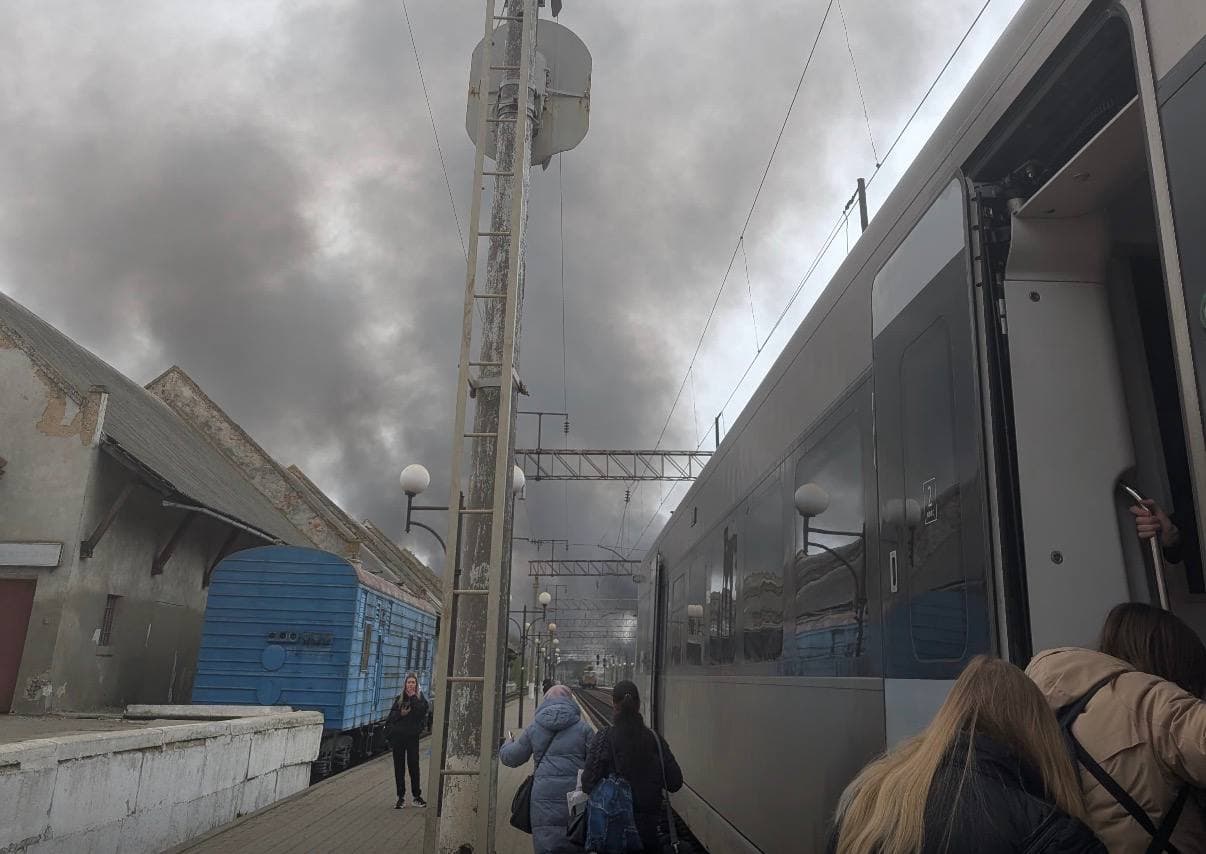
Smoke rises near the main train station in Ternopil, Ukraine, following an explosion amid the ongoing daytime drone assault. (Camille Pajor)
The Day’s Reckoning
Russia’s Emergency Situations Ministry declared on April 29 that it had finally extinguished the fires at the Tuapse Oil Refinery. It had taken thirteen days. On the night of April 30 to May 1, Ukrainian drones found Tuapse again.
Fire broke out in oil tanks at the refinery and the marine terminal. Smoke rose above the Black Sea coast. Local residents reported explosions. Russian air defense was active over the city, claiming dozens of drones downed. Ukrainian satellite imagery showed flames. The SBU confirmed the strike was carried out by Alpha Special Operations Center, in cooperation with military intelligence and the Unmanned Systems Forces. The full battle damage assessment was still being conducted on May 1 — but the fires visible from orbit told most of the story.
On the same May 1, the Ukrainian General Staff confirmed that on April 25, Ukrainian drones had struck the Shagol Airfield in Chelyabinsk Oblast — 1,676 kilometers from the Ukrainian border — damaging multiple aircraft including Su-57 fifth-generation stealth fighters and Su-34 fighter-bombers. Satellite imagery published on May 1 showed the damage. Major Brovdi’s updated account counted four aircraft total: two Su-57s, one Su-34, and one additional unspecified aircraft. Damaged planes were moved to enclosed hangars. The servicemen who maintained them remained at a 1,676-kilometer airfield that was no longer safe.
Russia sent 409 drones that night and into the afternoon. Ternopil — 130 kilometers from the Polish border, deep in western Ukraine — was struck in a mass daytime attack. More than 50 drones targeted the city, 27 were shot down, and 12 people were injured. Industrial sites, infrastructure, and the train station area were hit. Parts of the city lost power.
By evening, Zelensky announced a reform that Ukrainian soldiers have been waiting for since February 24, 2022: a path to demobilization. Clear service terms. Significantly higher pay. The promise that the government would acknowledge, in law, the cost of what soldiers have given.
Tuapse: The Fourth Strike — One Day After the Fire Was Declared Extinguished
The Tuapse Oil Refinery was struck for the fourth time in April on the night of April 30 to May 1. The SBU confirmed the strike was carried out by its Alpha Special Operations Center in cooperation with HUR and the Unmanned Systems Forces. Fire broke out at oil tanks and the marine terminal. The Krasnodar Krai Operational Headquarters acknowledged a drone strike had caused the fire at the port of Tuapse.
Russia’s Emergency Situations Ministry had declared on April 29 that open burning at the refinery had been fully extinguished. That declaration lasted approximately 24 hours. The fourth strike reignited the facility before its damage from the third strike had been repaired.
The cumulative toll of the four strikes on Tuapse: at least 24 storage tanks destroyed, four more damaged, the crude processing unit suspended, the marine terminal repeatedly struck, fires burning almost continuously since April 16. The refinery — which processes approximately 12 million tons of oil annually and supplies diesel, fuel oil, naphtha, kerosene, and gasoline primarily to Turkey and Asian markets — has effectively been shut down. At the Sheskharis marine terminal, oil reached the sea. At the street level in Tuapse, petroleum products continued to coat surfaces. Russia’s tour operators were still advertising the resort season.
Bloomberg reported on April 30 that Ukrainian strikes on Russian oil infrastructure reached a four-month high in April, with at least 21 attacks recorded. Average refinery throughput across Russia fell to 4.69 million barrels per day — the lowest since December 2009. Zelensky stated on May 1 that Ukrainian strikes on Russia’s oil sector have cost Moscow at least $7 billion since the start of 2026 in direct hits, facility downtime, and shipping disruptions.
Chelyabinsk, 1,676 Kilometers Away: Su-57s Struck at Shagol Airfield
The Ukrainian General Staff confirmed on May 1 that Ukrainian forces struck the Shagol Airfield in Chelyabinsk Oblast on April 25 — 1,676 kilometers from Ukraine’s international border, in the Ural Mountains. Satellite imagery published May 1 confirmed damage to multiple aircraft. Major Brovdi’s updated account specified four aircraft struck: two Su-57 fifth-generation stealth fighters, one Su-34 fighter-bomber, and one additional aircraft whose model was not specified. Damaged planes were moved to enclosed hangars after the strike.
The Su-57 is Russia’s most advanced combat aircraft — a stealth fighter designed for air superiority and precision strikes, estimated at $100-120 million per unit. The Su-34 is a twin-seat tactical and long-range bomber, capable of striking targets 1,000 kilometers away with guided bombs and missiles, estimated at $35-50 million per unit. Brovdi stated: “Every Su-34 shot down means fewer airstrikes, more civilian lives saved, and less strain on air defense systems.”
The April 25 strike at Chelyabinsk is the deepest confirmed aircraft strike in the war to date, at 1,676 kilometers. It follows the April 29 confirmation of helicopter strikes in Voronezh Oblast at 150 kilometers. The pattern is clear: as Ukraine’s drone range extends past 2,000 kilometers and Russian air defenses are overstretched, no Russian airfield — however deep — can be considered beyond reach.
The Ukrainian General Staff also confirmed on May 1 that on April 29, Ukrainian forces struck Mi-28 and Mi-17 helicopters at an airfield near Babky, Voronezh Oblast, approximately 150 kilometers from the front line — consistent with Magyar’s Birds’ reporting on the same event.
The Perm Refinery, Second Night: AVT-4 Unit Struck Again
The Ukrainian General Staff confirmed on May 1 that Ukrainian forces struck the Permsky Oil Refinery in Perm Krai on the night of April 30 to May 1, causing a fire and damaging the AVT-4 primary oil refining unit. This follows the April 30 strike that first hit the AVT-4 unit of the Lukoil-Permneftorgsintez refinery and rendered it inoperable. The Transneft Perm Linear Production Dispatch Station — struck on April 29 and again on April 30 — was also confirmed as struck again. Perm Krai has now been hit on three consecutive nights.
The Ukrainian General Staff also confirmed on May 1 that the Orsknefteorgsintez Oil Refinery in Orenburg Oblast was struck on April 29, causing a fire. The Orsk refinery — approximately 1,300 kilometers from Ukraine’s border — has an annual capacity of 6.6 million tons and supplies fuel directly to Russian armed forces.
409 Drones, Ternopil Struck in Daytime, One Killed, 52 Injured
Russian forces launched 409 Shahed, Gerbera, Italmas, and other drones against Ukraine — roughly 388 of them Shahed-type, including jet-powered variants — from multiple directions overnight and into the afternoon of May 1. Ukrainian air defenses downed 388 drones. Sixteen struck six locations; debris fell on eleven more. Russian forces also launched an Iskander-M ballistic missile and 210 drones overnight; 190 of those were intercepted.
The daytime component of the attack concentrated on western Ukraine. More than 50 Shahed-type drones struck Ternopil — a city of 220,000 people, approximately 130 kilometers from the Polish border — in a mass afternoon attack. Twenty-seven were downed by air defenses; 12 people were injured. Industrial sites, infrastructure, and areas around the train station were damaged. Parts of the city lost electricity, though power was restored by evening. Thirty-nine residents were evacuated. In Kharkiv Oblast, Russian forces struck at least three gas stations — likely with AI-equipped V2U drones.
Overnight, Russian drones also targeted port infrastructure in Izmail, Odesa Oblast — Ukraine’s key Danube River port used for agricultural exports. Ukrainian air defenses responded effectively; the Izmail District State Administration reported “practically no destruction” after the attack. No casualties were reported. The port’s survival intact matters beyond the local: Izmail handles a significant share of Ukrainian grain and commodity exports through the Danube, one of the few export corridors that has remained functional throughout the war.
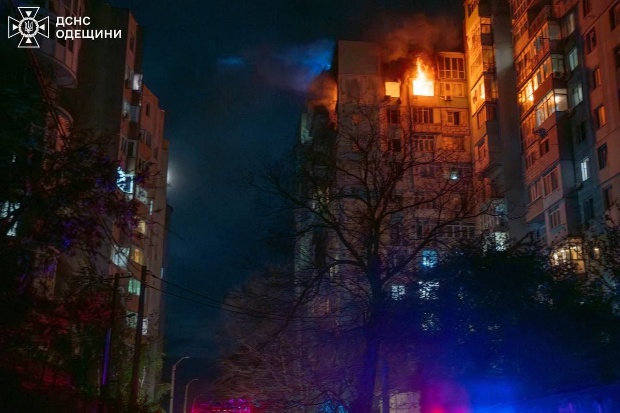
A site of a Russian overnight attack on civilian infrastructure in Odesa, Ukraine. (Local authorities/Telegram)
Across all attacks on May 1, at least one person was killed and 52 were injured. In Kherson Oblast, a 65-year-old man was killed by a drone while riding a bicycle; eight others were injured. Fifteen houses, six residential buildings, an administrative building, and a post office were damaged — firefighters responding to the post office came under a double-tap attack. In Odesa, 25 people including two children were injured; one apartment on the 16th floor was destroyed. In Sumy Oblast, at least 15 civilians were injured, including a woman and a man struck when a drone hit their bus. In Mykolaiv, energy infrastructure was targeted with Shahed drones overnight, with no casualties reported. In Dnipropetrovsk Oblast, one person was injured in drone and artillery attacks on three settlements.
The April drone campaign reached a record: 6,583 long-range drones launched by Russia in April — 2% more than March’s previous record. Ukraine’s Air Force shot down 88% of all incoming drones and missiles across the month. Russia has increasingly shifted toward daytime attacks, a tactic ISW assessed is designed to cause higher civilian casualties as warmer weather brings more Ukrainians outside. Presidential office deputy head Pavlo Palisa said the daytime attacks are a new attempt to “terrorise civilians” now that winter is over, with an additional economic component: mass attacks during the working day “significantly paralyse business.”
Zelensky Announces Military’s Biggest Pay and Demobilization Reform
President Zelensky announced on May 1, in his evening address, the most significant reform of military service conditions since the start of the full-scale invasion. The reform — to be finalized in May and begin taking effect in June — covers three areas: pay, service contracts, and demobilization.
On pay: the minimum salary for rear positions will be set at Hr. 30,000 (approximately $680). Infantry troops will receive Hr. 250,000 to Hr. 400,000 (approximately $5,600-$9,000), depending on combat tasks. “There needs to be greater respect from the government for experienced military leaders,” Zelensky said. “Ukraine must provide real incentives so that people who know how to lead troops directly on the front lines are motivated to serve and feel that their experience is valued.”
On demobilization: the updated contracts will allow previously mobilized soldiers — those who have been serving since the start of the invasion, unable to leave due to the continuous extension of martial law — to leave service, with timelines to be determined. Zelensky called service terms “the most fundamental moral issue” of the reform. Presidential communications adviser Dmytro Lytvyn said the Defense Ministry and General Staff will provide specific discharge timelines, without specifying when.
On recruitment: the reform aims to make service terms clearer and more predictable, expand contract-based service, and create a transparent rotation logic. Defense Minister Fedorov said the government has been working on the transformation since January. Commander-in-Chief Syrskyi had ordered mandatory rotation after two months on the front line on April 30 — the May 1 pay and demobilization announcement is the broader framework within which that order sits.
Su-57 Strike Confirmed; General Staff Reports on Belgorod and Luhansk Strikes
Ukrainian forces struck a Russian drone warehouse near Dalny in Belgorod Oblast — just on the international border northeast of Kupyansk — in an effort to hinder Russian drone strikes in the Velykyi Burluk and Kupyansk directions, the General Staff reported on May 1. Major Brovdi reported that Ukrainian forces also struck a Russian Nebo-M radar in Ukolovo, Belgorod Oblast, approximately 110 kilometers from the border. The Nebo-M is a long-range 3D radar used for air surveillance and target tracking; its destruction degrades Russia’s early warning coverage over a wide arc of Ukrainian airspace.
In occupied Luhansk Oblast, the General Staff reported strikes on a Russian artillery brigade command post in occupied Lysychansk, approximately 35 kilometers from the front line, and an ammunition depot near Rovenky, approximately 125 kilometers from the front line.
In occupied Donetsk Oblast, Ukrainian forces struck a Buk-M3 air defense system near Olkhovatka (55 kilometers from the front line), an ammunition depot near Rozdolne (110 kilometers), drone control points near Shevchenko and Voskresenke, an ammunition depot near Rovenky (120 kilometers), and an equipment cache with over 30 vehicles in Bakhmut (12 kilometers). In Zaporizhzhia Oblast, Ukrainian forces struck a Russian material and technical resource warehouse near occupied Melitopol (80 kilometers from the front line) and a Russian 240mm Tulip self-propelled gun.
Frontlines on May 1: Unmanned Attack, Pipeline Infiltrations, Fake Seizure Claims
Ukrainian forces conducted a fully unmanned attack in Kupyansk in February 2026 — confirmed on May 1 — using UAVs and unmanned ground vehicles to eliminate ten Russian servicemembers without any Ukrainian personnel entering the engagement zone. The operation is a milestone: the first confirmed fully unmanned combat engagement reported by Ukraine, pointing toward where drone warfare is heading as UGV production scales.
Russian forces continued pipeline infiltration missions on May 1 across multiple directions. In Sumy Oblast, six Russian soldiers attempted to infiltrate Ukrainian positions through a gas pipeline — the same tactic used near Kupyansk on April 24 and 27. In Kupyansk, Russian forces continued pipeline infiltration attacks with reported casualties of up to 70 percent. The Ukrainian Kursk Grouping of Forces stated on May 1 that the Russian MoD’s April 30 claim of seizing Korchakivka is false — Russian officers fabricated the claim because they were desperate to report advances by May 1.
In the Lyman and Slovyansk directions, Russian forces are compensating for their inability to penetrate Ukrainian drone defenses by increasing the size and frequency of infantry assaults — a Ukrainian brigade spokesperson reported eliminating a detachment to platoon worth of Russian personnel every day. Russian forces have used at least 100 artillery shells per day in the Slovyansk and Kramatorsk directions for over half a year. In Kramatorsk, Russian forces have increased Molniya and fiber-optic drone strikes against infrastructure, running 375-425 FPV drones daily depending on weather, and recently began intensive reconnaissance drone flights over the city. In the Oleksandrivka direction, Russian assault groups have been reduced from four-to-six soldiers to single infantrymen attacking one at a time. In the Pokrovsk direction, Russian VDV elements attempted to gain a foothold in Hryshyne, northwest of Pokrovsk; Ukrainian forces struck and eliminated elements of the 76th VDV Division in the settlement.
Russian forces struck two bridges across the Vovcha River east of Starokasyanivske, west of Oleksandrivka, approximately 20 kilometers from the front line — targeting Ukrainian logistics and supply routes to front-line units. Neither Russian nor Ukrainian forces made confirmed net advances across any axis on May 1.
$7 Billion Lost, Russia Bans Starlink, Western Components Still Found in Drones
Presidential Commissioner for Sanctions Policy Vladyslav Vlasiuk reported on May 1 that components manufactured in Germany, Japan, Switzerland, the United States, Taiwan, and the United Kingdom — all produced in 2025 — have again been found in Russian drones that struck Ukraine last week. A previously unrecorded component, a Transit Brd activation module, was identified for the first time. STMicroelectronics components from Switzerland continue to appear in Russian weapons systems despite repeated calls to tighten export oversight. One positive indicator: Dutch components have become rare in newer Russian drone models, suggesting that coordinated pressure with the Netherlands has been effective.
Vlasiuk confirmed that Ukraine is expanding “long-range sanctions” — coordinated measures targeting the supply chain for Russian oil refinery and pumping station equipment — which he estimated have contributed to the $7 billion in losses to Russia’s oil sector cited by Zelensky. Ukraine is working with partners to identify and block the specific equipment categories that Russian refineries and pipeline stations depend on for operation and repair.
Russia separately announced a ban on Starlink satellite internet imports on May 1 — a move Ukrainian analysts assessed as part of broader efforts to tighten control over communications within Russia and occupied territories, likely related to the use of Starlink terminals by Russian soldiers and civilians to access uncensored information.
Witkoff and Kushner Still Have Not Come to Kyiv
U.S. special envoys Steve Witkoff and Jared Kushner are not rushing to visit Kyiv, the Kyiv Independent reported on May 1, citing senior Ukrainian officials. The envoys have traveled to Moscow multiple times and met Putin in January. They have not visited Ukraine. The planned sequence — Kyiv first, then Moscow — has not materialized.
“They’ve promised (to visit Kyiv) many times, but so far they haven’t followed through even once,” a senior Ukrainian official said. A White House official told the Kyiv Independent the visit “has not yet been scheduled.” Factors cited include the envoys’ deep involvement in U.S.-Iran negotiations, which dominate Washington’s foreign policy attention, and the logistical reality of wartime Kyiv: Ukrainian airspace is closed, the only route into the capital is by train, and “it’s difficult for Witkoff,” according to one person familiar with the discussions.
The deeper issue is substance. Peace talks have been frozen since February 16. Russia continues to demand Ukrainian withdrawal from Donbas; Ukraine continues to offer a ceasefire along the current front line. “There is no substance yet,” a Ukrainian official said. Without new proposals, a Kyiv visit risks becoming symbolic rather than substantive — which neither side wants to model publicly.
US Withdraws 5,000 Troops From Germany; Threatens 25% EU Car Tariffs
The U.S. Department of Defense announced on May 1 that approximately 5,000 troops will be withdrawn from Germany over the next six to twelve months, reducing the American military presence there — currently around 35,000 — back to pre-2022 levels. The withdrawal follows a public exchange between Trump and German Chancellor Merz after Merz criticized Washington’s handling of the Iran war, calling it humiliating for the United States. Trump called Merz “totally ineffective.” A senior Pentagon official described German remarks as “inappropriate and unhelpful.”
On the same day, Trump announced that the United States will impose 25% tariffs on cars and trucks from the European Union starting the following week — exempting only vehicles manufactured at U.S. plants. Germany, the EU’s largest car exporter, will be hardest hit. The tariff threat follows a previously agreed trade framework in which the EU accepted a 15% cap on U.S. tariffs; EU lawmakers have not fully ratified the deal, which Trump cited as grounds for escalation.
The May 1 combination — troop withdrawal from NATO’s largest European hub and tariff escalation against its largest EU member — delivered in a single day, signals clearly what European security planners have been calculating for months: the relationship with Washington cannot be assumed to hold its previous form.
Fico’s Moscow Trip; Butyagin Returns; Estonia Expands Military Powers
Czechia confirmed on May 1 that it has granted Slovak Prime Minister Robert Fico permission to fly over its airspace en route to Moscow for the May 9 Victory Day parade — contradicting Russian media claims that Czechia had blocked the flight. Lithuania, Latvia, Estonia, and Poland have denied Fico airspace access. Fico attended last year’s Moscow parade and is widely regarded as one of Moscow’s closest allies within the EU.
Russian archaeologist Alexander Butyagin — released in the April 28 U.S.-brokered prisoner exchange despite a Polish court having approved his extradition to Ukraine — told Russian state-controlled media on April 30 that he will “for sure” return to Crimea this summer to continue the excavations Ukraine says caused nearly $5 million in cultural heritage damages. Butyagin thanked the FSB and other Russian government agencies for securing his release. Ukraine said it will continue to pursue all available legal mechanisms to bring him to justice.
Estonia’s government approved on May 1 a bill expanding the Estonian military’s law-enforcement powers to address hybrid threats, including “little green men” — unmarked soldiers, a term originating from Russia’s 2014 Crimea occupation. The legislation, still requiring parliamentary approval, would allow NATO troops under Estonian command to be deployed against hybrid threats on land and at sea even without a direct military attack. Roughly 2,000 UK-led allied troops are permanently stationed at Tapa base.
General Cherry’s Khmarynka Drone; eRecovery Housing for Veterans; Fire Point Scandal Continues
Ukrainian defense company General Cherry unveiled its first mid-range strike drone on May 1 — the Khmarynka, meaning “cloud” in Ukrainian. The fixed-wing drone has a wingspan of 196 centimeters, a range of up to 50 kilometers, a flight time of up to 60 minutes, and a top speed of 140 kilometers per hour. It can carry seven times the payload of a standard FPV drone. The company said it is providing an initial batch of 150 drones free of charge to gather combat feedback. The Khmarynka is Ukraine’s domestically-developed equivalent of Russia’s Molniya — designed for mass deployment, low cost, and rapid scaling. General Cherry signed a deal in March to produce drones in New Hampshire with U.S. manufacturer Wilcox Industries.
Ukraine’s Ministry for Communities and Territories Development launched a new phase of the eRecovery housing program on May 1, allowing internally displaced veterans and persons with war-related disabilities to reserve government housing vouchers worth up to Hr. 2 million ($45,500). The government has allocated Hr. 6.6 billion ($146.67 million) for the program, sufficient for approximately 3,300 families who lost homes in occupied territories. Reservations are made through the Diia app; recipients have 60 days to finalize a purchase.
The Fire Point corruption scandal deepened on May 1 as the Kyiv Independent published a detailed account of the Mindich tapes — alleged recorded conversations between sanctioned businessman Tymur Mindich and then-Defense Minister Rustem Umerov discussing Fire Point’s funding and contracts, with Mindich apparently operating as a de facto beneficiary. Fire Point denied all accusations, calling them “a targeted information attack.” Former Naftogaz head Andriy Kobolyev warned that nationalization of the company would “simply kill it” by driving out management. The Defense Ministry and President’s Office declined comment. No state authorities had publicly responded to the allegations as of May 1.
IMF Tax Reform Still Unresolved; Russia Launches Soyuz-5 Rocket
Ukraine’s Finance Ministry is seeking to convince parliament to pass unpopular IMF-required tax reforms — including changes to the simplified tax regime for self-employed entrepreneurs (FOP) — by pairing them with bureaucracy-reducing IT improvements that would eliminate the need for small businesses to hire accountants. The changes are in “concept stage” and require IMF approval before implementation. The IMF team is scheduled to visit in May to assess Ukraine’s reform progress; the next $685 million tranche is contingent on Ukraine meeting three tax benchmarks missed in March. The EU’s new 90-billion-euro support loan to Kyiv will also be partially conditional on the same IMF-required taxes being implemented.
Russia conducted the first successful test launch of its Soyuz-5 rocket from the Baikonur Cosmodrome in Kazakhstan on April 30, Roscosmos announced. The rocket is designed to carry up to 17 metric tons to low Earth orbit and is intended to reduce Russia’s satellite launch costs. The test came amid mounting Western sanctions pressure on Russia’s space sector and its broader economy.
The Weight of the Day
Russia said the fire in Tuapse was out. The next night, drones found it again. Russia said it had seized Korchakivka. Ukrainian forces confirmed they still hold it. Russia said it is winning the war. The data from Bloomberg says its refineries are producing at their lowest rate since 2009.
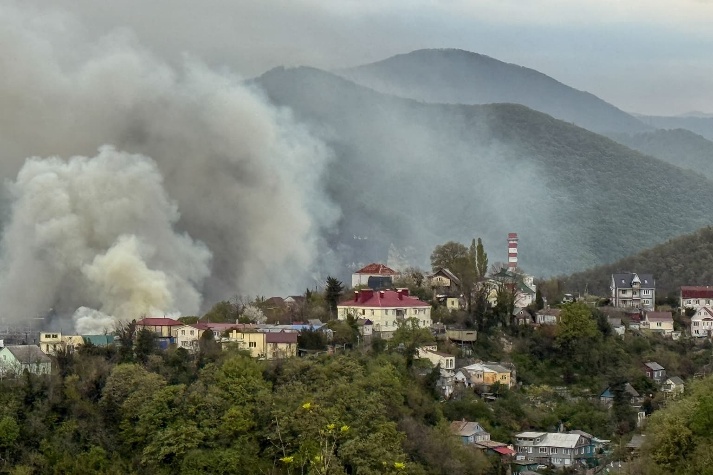
Smoke rises above buildings following a recent drone attack on the Tuapse oil refinery in Tuapse, Krasnodar Krai, amid the ongoing Russian war against Ukraine. (AFP via Getty Images)
Two Su-57 stealth fighters — the most advanced aircraft in Russia’s inventory, worth $100-120 million each — were damaged at an airfield 1,676 kilometers from Ukraine’s border, on April 25, confirmed on May 1. No airfield is safe. No range is sufficient. The gap between what Russia claims and what actually happened keeps widening.
A 65-year-old man was riding a bicycle in Kherson Oblast when a drone found him. Twenty-five people including two children were injured in Odesa. Ternopil, 130 kilometers from Poland, was struck in the middle of the afternoon. Twelve people in the emergency room. The calendar read May 1 — Labour Day in most of Europe. In Ukraine it was the 1,528th day of the full-scale war.
In his evening address, Zelensky said soldiers deserve to know when they can come home. He said the government must put that into law. He said it is the most fundamental moral issue of the reform. He is right. It has taken 1,528 days to say it officially.
A Prayer for Ukraine
1. For the Man on the Bicycle in Kherson
Lord, a 65-year-old man was riding a bicycle on May 1 when a drone struck him. That is the entirety of what we know about what he was doing when his life ended. He was not at the front. He was not in a shelter. He was outside, on a bicycle, in a city that has been under fire since the first weeks of the invasion. We do not know where he was going. We know he did not arrive. Receive him with the fullness of your mercy. And hold the eight others injured in Kherson Oblast that day, the firefighters who went to a burning post office and came under a second strike, the communities that have learned that nowhere is safe enough.
2. For the People of Ternopil — and the Question of Why
Father, Ternopil is 130 kilometers from the Polish border. It is not a military target by any reasonable definition. On May 1, more than 50 drones found it in the middle of the afternoon — during the working day, during daylight, when people are outside and businesses are open. Twelve people were injured. The train station area burned. Parts of the city lost power. We do not ask you why a city this far west is being struck — we know why. We ask instead that you be present with the people who now understand that the war has no rear, no safe distance, no latitude that exempts a city from being chosen. Be with them in the fear that follows. Be with the 39 evacuated from damaged areas. Be with those whose windows face the direction the drones came from.
3. For the Soldiers Waiting for the Reform to Be Real
God of the promised and the delayed, Zelensky said on May 1 that soldiers will be able to come home — that the government will put service terms into law, that demobilization will be possible, that May will finalize the details and June will bring the first changes. There are soldiers in positions tonight who have been there for more than a year. They have heard promises before. We ask that you be near them in the space between the announcement and the implementation — the weeks when the reform is being finalized and they are still in the dirt. Sustain them. And hold those making decisions accountable to the speed this requires.
4. For the Engineers of the Khmarynka and the Octopus
Lord, in the fifth year of this war, Ukrainian engineers designed a drone called Cloud, modeled on a weapon Russia used to terrorize them. They built it for $1,000. They priced it to scale. They gave the first 150 away for free to gather combat data. This is how this war is being fought: not only in trenches, but in workshops and software repositories and test corridors where people are trying to out-engineer an adversary that has more of everything except ingenuity. Hold those workers. They are not soldiers but they are in the war. Their success keeps people alive.
5. For the First Month of the Fifth Year
God of time, May 1 is also the last day of April 2026 being counted — the month in which Russia launched 6,583 drones against Ukraine, a record. In which Tuapse burned four times. In which Su-57s were struck at a range no one thought possible. In which 15 million Ukrainians were assessed as needing psychological support. In which a grain ship left a harbor empty because Ukraine refused to stop asking. In which a commander-in-chief ordered rotation and a president announced demobilization and a parliament ratified the claims commission and a country kept going. In Your mercy, in Your justice, in Your time — bring this war to its end, and let the ending be worthy of what Ukraine has endured.