
Washington reportedly agreed to Moscow’s demand that Ukraine cede territory before receiving security guarantees—while the Kremlin made clear it has no intention of accepting the protections that would make such a deal survivable.
The Day’s Reckoning
In Washington, negotiators quietly accepted a sequence Moscow had demanded for months.
Territory first. Security later.
Western reporting revealed that the United States agreed Ukraine would cede territory to Russia before receiving formal US or European security guarantees. No finalized security agreement until after a peace deal. Concessions now. Protection—maybe—someday. The target: Summer 2026.
In Moscow, the Kremlin framed territory as the last unresolved issue. The remainder of Donetsk Oblast. Southern Ukraine. Russian officials portrayed Kyiv as stubborn for refusing to surrender land Russian forces have failed to seize outright.
But Ukraine had signaled willingness to consider withdrawing from the rest of Donetsk Oblast—without recognizing Russian sovereignty—in exchange for meaningful Western security guarantees. A significant concession.
The Kremlin rejected the guarantees.
Senior Russian officials objected repeatedly to Western troops, military assets, or enforceable peacekeeping mechanisms during recent talks in Abu Dhabi. Territorial debate became theater. The real refusal was protection.
On the battlefield, Ukrainian forces advanced near Hulyaipole and Oleksandrivka, liberating Dobropillya, Pryluky, and Olenokostyantynivka. Russian troops pushed forward near Slovyansk and Lyman. The line shifted in meters, not breakthroughs.
In Moscow, the Central Bank lowered its key rate from 16 to 15.5 percent. Fifth cut in twelve months. External debt surpassed $60 billion for the first time since 2006. Total debt climbed to $319.8 billion—up $30 billion in a year.
In Brussels and other European capitals, partners pledged $38 billion for 2026—billions for drones, air defense, artillery, and US-made weapons.
Money flowed. Frontlines moved.
But the diplomatic sequence changed everything.
Ukraine would withdraw before receiving protection. Moscow would decide later whether protection existed at all.
The order of events became the story.
Fortress Before Freedom: The Deal That Trades Ukraine’s Shield for Promises
In Washington, the order was agreed to before the outcome was secured.
Concessions first. Guarantees later.
Western reporting indicated the United States would not finalize a security agreement with Ukraine until Kyiv and Moscow reached a peace deal. The pressure was clear: make the necessary territorial concessions, close the war by Summer 2026, and trust that protection would follow.
It was the sequence the Kremlin had insisted on from the start.
Ukraine had repeatedly offered to freeze the current frontline as a basis for negotiations. That offer came even as Putin continued demanding more territory—land Russian forces had failed to seize in over a decade of war and nearly four years of full-scale invasion.
At the heart of it stood the Fortress Belt in Donetsk Oblast. Concrete, trenches, hardened positions—Ukraine’s defensive spine since 2014. Russia had tried for years to break it. At the pace of advance seen by November 2025—slowed further in January 2026—it could take Russian forces another two or three years to seize it outright.
A negotiated withdrawal would hand it over in weeks.
And once surrendered, those fortifications would face the opposite direction. Toward southwestern and central Ukraine.
Under the reported framework, territorial stipulations would take effect before any US-Ukrainian security guarantees were in place—and with no assurance Moscow would ever accept meaningful guarantees at all.
That meant Ukrainian forces could be ordered to pull back under the shadow of renewed Russian assault. No binding shield. No enforcement mechanism.
Just exposed ground.
The risk was simple and stark: territory ceded, defenses dismantled, and no guaranteed deterrent against the next offensive.
The sequence was not procedural.
It was strategic vulnerability by design.
Peace Without Protection: The Guarantee Moscow Refuses
In every public statement, the Kremlin pointed to territory.
Donetsk. Zaporizhia. Kherson. Luhansk.
But the real line in the sand was not drawn on a map. It was drawn around security guarantees.
Putin’s rejection of meaningful Western guarantees for Ukraine remained the central obstacle to any workable peace deal—far more than Kyiv’s position on territory. Moscow repeatedly portrayed Ukraine as the spoiler, accusing it of refusing compromise. Yet behind the rhetoric, the Kremlin refused to move from its original war aims.
Those demands were sweeping and unchanged: Ukraine must withdraw entirely from Luhansk, Donetsk, Zaporizhia, and Kherson oblasts. Kyiv must abandon NATO ambitions and declare neutrality. The Ukrainian military must be limited so it cannot defend itself. “Denazification” must replace the current government with one acceptable to Moscow. The world must recognize Russia’s annexations, including Crimea. Western sanctions must be lifted.
In other words: capitulation wrapped in diplomatic language.
Ukraine had signaled willingness to make painful concessions—ceding territory, adjusting laws, even holding elections during wartime—if it received enforceable security guarantees that would prevent renewed Russian aggression.
Moscow refused those guarantees outright.
Russian officials consistently rejected Western troop deployments, monitoring missions, or binding enforcement mechanisms. They demanded Ukrainian withdrawal from the remainder of Donetsk Oblast without preconditions and rejected even a ceasefire to negotiate.
The pattern was clear. Stall negotiations. Blame Kyiv. Keep maximalist demands intact.
The Kremlin sought to manipulate the US-led process into another path toward the same objective it had failed to secure militarily in nearly four years: a weakened, neutralized, compliant Ukraine.
Territory was the headline.
Security guarantees were the threat Moscow would not tolerate.
Beneath the Facade: Russia’s War Economy Shows Its Cracks
In Moscow, the number changed by half a point.
Sixteen to 15.5 percent.
On February 13, the Russian Central Bank cut its key interest rate for the first time in 2026—the fifth reduction in twelve months. Chairperson Elvira Nabiullina insisted unemployment was at a historic low. Wages were rising faster than productivity. Inflation, she said, had spiked in January but was only a “one-off.” The peak had already passed in December and January.
But the numbers told a different story.
Russia’s labor market was tight not because of prosperity, but because of shortages—men mobilized, factories straining, defense plants desperate for workers. Wage growth fed inflation. Inflation squeezed households.
The rate cuts were not generosity. They were oxygen for a war machine starved of liquidity.
Since June 2025, the Central Bank had slashed rates from 21 percent in four steps before this latest cut. Cheaper borrowing meant more capital for defense enterprises propped up through the Industrial Development Fund, off-budget subsidies, and quiet pressure on banks to lend on favorable terms.
Meanwhile, the Ministry of Finance acknowledged external government debt had surpassed $60 billion for the first time since 2006. Total external debt—public and private—reached $319.8 billion as of January 1, 2026, a $30 billion increase in one year.
To sustain spending, Russia drained its sovereign wealth fund, sold physical gold reserves in November 2025, and raised VAT from 20 to 22 percent on January 1, 2026.
The facade held.
But beneath it, wartime spending, sanctions, and mounting debt were eroding stability—leaving an economy more brittle than the Kremlin’s messaging suggested, and more vulnerable to sustained Western pressure.
Europe Arms Ukraine While Guarantees Drift
On February 13, Ukrainian Defense Minister Mykhailo Fedorov delivered a number meant to steady nerves: $38 billion.
That is what Ukraine’s Western partners committed for 2026—money for drones, air defense, artillery, and other military aid.
More than $6 billion is already designated. Over $2.5 billion for Ukrainian drones. Nearly $2 billion for air defense systems. More than $500 million to purchase US weapons through the Prioritized Ukraine Requirements List, allowing NATO states to buy American-made arms for Kyiv.
In Oslo and Paris, defense officials signed a new agreement the same day. Norway and France will provide surveillance, situational awareness, and air-to-ground capabilities. The first stage includes a Norwegian loan of about 365 million euros ($433 million) and a French loan of 260 million euros ($309 million) to procure French-made guided aerial bombs.
In Stockholm, Swedish Defense Minister Pål Jonson announced that the EU will provide a 90-billion-euro loan (roughly $106.8 billion) to support purchases of Swedish Gripen fighter jets and unspecified air defenses.
Through the Ramstein format, European allies continued coordinating substantial military assistance, reinforcing Ukraine’s defense capacity even as American security guarantees remained uncertain.
The signal was unmistakable.
Europe is funding Ukraine’s ability to fight—drones to launch, bombs to guide, jets to patrol—while Washington weighs a negotiating framework that could require Ukraine to surrender strategic positions before any binding protection is secured.
Material support flows.
Guarantees remain unsettled.
A Drone Takes Flight in Munich: Ukraine’s War Tech Goes European
On February 13, ahead of the Munich Security Conference, President Volodymyr Zelensky stood inside a production facility in Germany and watched a drone lift off the line.
Not a prototype. Not a promise. A finished weapon.
“Today, I received the first jointly made attack drone,” Zelensky wrote on X. “We saw the production line and the first flight of the drone. This is modern Ukrainian technology. Battle-tested. Powered by AI. It will strike, it will scout, it will protect our soldiers.”
Beside him stood German Defense Minister Boris Pistorius at Quantum Frontline Industries—a joint venture between Germany’s Quantum Systems and Ukraine’s Frontline Robotics. There, the Linza 3.0 multi-purpose drone was demonstrated and formally handed over.
The facility is expected to produce up to 10,000 drones within a year, all destined for the Ukrainian Armed Forces. The Linza 3.0 carries up to 4 kilograms of payload, operates at ranges up to 15 kilometers, stays airborne for up to 60 minutes, and uses AI-enabled visual-inertial navigation.
This marked the first Ukrainian drone production line in Germany, expanding Kyiv’s push to manufacture weapons across Europe. Joint production began in December 2025, and Ukraine plans to open ten additional ventures by the end of 2026, though host countries remain unspecified.
The initiative builds on broader December agreements in which Germany committed 1.2 billion euros ($1.4 billion) for Patriot sustainment, Ukrainian drone procurement, and co-production programs.
Steel, circuitry, and code now cross borders.
Even as security guarantees remain unresolved, production lines are becoming their own kind of commitment.
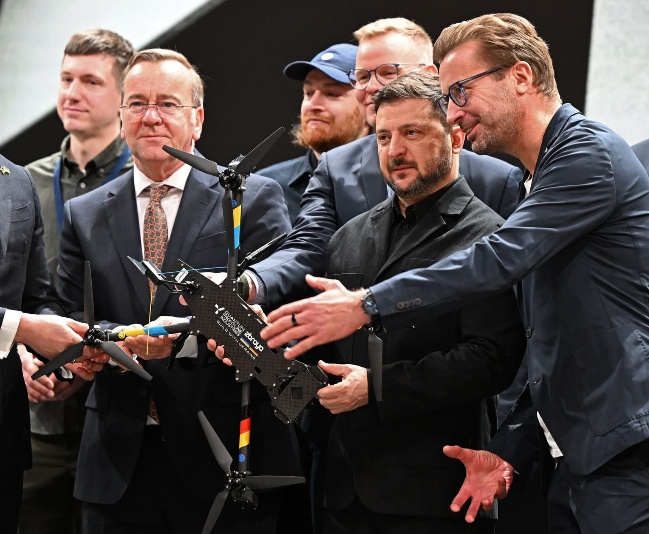
Ukraine’s President Volodymyr Zelensky and German Defense Minister Boris Pistorius visited the drone manufacturer Quantum Frontline Industries before the start of the Munich Security Conference. (Sven Hoppe/picture alliance via Getty Images)
Breaking the Line at Hulyaipole
The push began along the T-0401 Pokrovske-Hulyaipole highway.
Ukrainian units moved forward and Russian troops fell back east.
In the Hulyaipole direction, Ukrainian forces liberated Dobropillya north of the town, along with Pryluky and Olenokostyantynivka northwest of Hulyaipole. The gains forced Russian elements to retreat across the highway, giving Kyiv’s forces ground they had been contesting for months.
The timing mattered. Russian units in the sector were grappling with communications disruptions tied to Starlink outages and Telegram restrictions. Ukrainian commanders exploited the confusion—pressing temporary command-and-control vulnerabilities, restoring defensive lines, and reclaiming positions Russian troops had previously bypassed during infiltration efforts.
The fighting remained intense across the arc. Russian forces attacked near Hulyaipole itself; northwest around Ternuvate, Kosivtseve, and Tsvitkove; north near Dobropillya and Zelene; northeast near Rybne and Zlahoda; south near Dorozhnyanka; southwest near Zahirne; and west near Staroukrainka and Zaliznychne. Russian milbloggers claimed Ukrainian counterattacks near Varvarivka north of Hulyaipole and Rybne northeast of Hulyaipole.
Further east, Ukrainian forces also advanced in the Oleksandrivka direction. Geolocated footage published February 13 showed Russian drone operators striking Ukrainian positions in central Vidradne south of Oleksandrivka—evidence that Ukrainian troops had pushed forward into the area.
Overnight February 12-13, the Ukrainian General Staff reported a strike on a Russian equipment concentration near occupied Komyshuvakha in Donetsk Oblast, roughly eight kilometers from the frontline southeast of Oleksandrivka.
Meters gained. Positions reclaimed.
In a war defined by attrition, even a forced retreat across a highway can redraw the map.
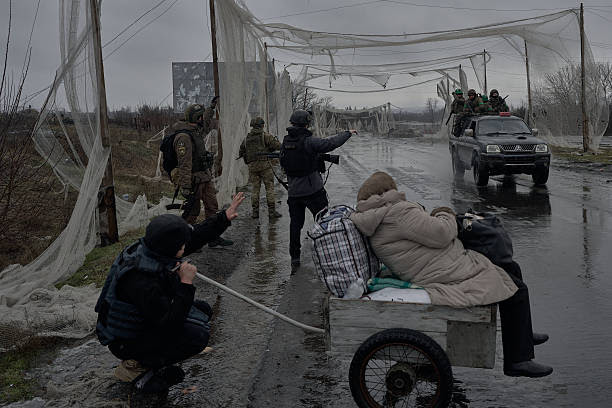
Volunteers transport an elderly woman alongside Ukrainian servicemen as a military pickup truck approaches them on the road along the Kostyantynivka frontline in Donetsk Oblast, where evacuations and resupply missions take place under the threat of Russian artillery and FPV drone attacks. (Kostiantyn Liberov/Libkos/Getty Images)
Grinding Toward Slovyansk: Advances Measured in Blood and Static
The movement is slow. Relentless. Costly.
Russian forces pushed forward in the Slovyansk direction, gaining ground despite high casualties and strained logistics. Geolocated footage published February 12 and 13 showed advances northeast of Lyman and in northern Drobysheve northwest of Lyman.
The assaults spread outward in a widening arc. Fighting raged near and inside Lyman; northwest near Drobysheve; north near Stavky; southeast near Yampil; northeast of Slovyansk near Platonivka and Zakitne; east near Svyato-Pokrovske and toward Kryva Luka and Rai-Oleksandrivka; southeast near Nykyforivka and Riznykivka, and toward Lypivka and Fedorivka Druha.
At the same time, geolocated footage published February 13 showed Ukrainian forces operating along the T-0504 highway in eastern Kostyantynivka—an area Russian sources had previously claimed to control. The imagery suggested Ukrainian troops still held ground Moscow portrayed as taken.
Behind the line, communications faltered. A Ukrainian brigade spokesperson in the Kupyansk direction reported February 13 that Starlink outages were hindering Russian assaults. A Russian milblogger affiliated with the Western Grouping of Forces admitted Russian troops in central Kupyansk were operating without food, medicine, or water and criticized command for neglecting their situation.
In the Pokrovsk direction, a Ukrainian servicemember said Russian assault intensity fluctuated with weather and periodic Starlink outages. Recent frosts slowed infantry movement, yet Russian forces continued heavy drone use—Molniya fixed-wing systems and other FPV drones. Reconnaissance remained effective, though slightly degraded by internet disruptions.
The advance continued.
But it moved through shortages, cold air, and broken signals.
Beyond the Frontline: Ukraine Reaches Into Russia’s Rear
The explosions did not happen at the trenches.
They happened deep behind them.
Overnight February 12-13, Ukrainian Unmanned Systems Forces struck the Kirova electrical substation in occupied Luhansk City—roughly 100 kilometers from the frontline. Power infrastructure, far from artillery range, suddenly became part of the battlefield.
The strikes continued across occupied territory.
Between February 11 and 13, the Ukrainian General Staff reported attacks on Russian manpower concentrations near Solodkovodne (about 37 kilometers from the frontline) and Lyubimivka (roughly 46 kilometers). Drone operator deployment points were targeted near Tokmak (approximately 27 kilometers) and Mykhailivka (around 20 kilometers) in Zaporizhia Oblast.
On February 11, Ukrainian forces struck an ammunition depot in occupied Rozivka, about 61 kilometers from the line. The next day, they hit a data center in occupied Prymorsk, roughly 90 kilometers back. Geolocated footage published February 13 showed a damaged building in Prymorsk—confirmation that rear areas were no longer safe zones.
Crimea was not spared. On February 12, Ukrainian forces struck the Hvardiiske military airfield, approximately 185 kilometers from the frontline. Overnight February 12-13, they targeted a Russian 55Zh6U Nebo-U radar station near occupied Yevpatoria, about 153 kilometers from the line.
The pattern was deliberate.
Logistics nodes. Command posts. Drone operators. Air defense systems.
Each strike forced Russia to disperse assets, reinforce rear security, and stretch already strained logistics. The objective was not spectacle—it was erosion.
Frontlines move in meters.
Rear areas, once considered untouchable, are now measured in kilometers from impact.
The Helmet and the Lawyer: Yermak Steps Back Into the Fight
The protest was etched in carbon fiber.
A helmet covered in the faces of Ukrainian athletes killed by Russia.
When 27-year-old skeleton racer Vladyslav Herashkevych refused to replace it with a black armband, the International Olympic Committee pulled his accreditation and disqualified him from the Winter Olympics. The IOC said he had been given a final chance to reconsider. He did not.
On February 13, reporting revealed a new name had joined his legal defense team: Andriy Yermak, President Zelensky’s former chief of staff.
Yermak resigned November 28 after the National Anti-Corruption Bureau searched his premises in a case involving the state nuclear power monopoly Energoatom—the largest corruption investigation of Zelensky’s presidency. He has not been charged. After suspending his legal career in 2020 when he became chief of staff, Yermak officially resumed practice January 23, 2026.
According to Mustafa Nayyem, founder of the Ukrainian law firm Miller, lawyers reached out after a social media post about assembling expertise. “After that, Andriy Yermak called me and said that he has some experience in cases like this and offered to get involved. We discussed that we need to analyze the scope of work and determine in which part help will be needed—and he will join in accordingly,” Nayyem told Ukrainska Pravda.
Yermak had said he intended to go to the front line after resigning, though the Defense Ministry stated in January he had not enlisted. Ukrainian outlet Dzerkalo Tyzhnya reported he continued communicating regularly with Zelensky and retained political influence.
Now he returns in a different arena.
The courtroom replaces the cabinet office.
But the argument is the same: who gets to honor Ukraine’s dead—and who decides when memory becomes “political.”
Night of Fire: Russia Targets Ukraine’s Power and Cities
The sirens began after dark. Then the drones.
Overnight February 12-13, Russian forces launched one Iskander-M ballistic missile from Kursk Oblast and 154 drones—Shahed-type, Gerbera-type, Italmas-type, and others. Roughly 100 were Shaheds. They flew from Oryol and Bryansk; Primorsko-Akhtarsk in Krasnodar Krai; occupied Donetsk City; and Hvardiiske and Cape Chauda in occupied Crimea.
Ukrainian air defenses shot down 111 drones. Still, the missile and 22 drones struck 18 locations. Drone debris fell at two additional sites.
The targets were not confined to the front.
Strikes hit civilian, residential, commercial, port, railway, and energy infrastructure in Rivne, Odesa, and Mykolaiv oblasts. In Odesa City, DTEK reported significant damage to one of its energy facilities—another blow to Ukraine’s grid.
The pattern is deliberate. Damage energy capacity. Disrupt transport. Strain repair crews. Wear down morale during winter months.
Russia continues calibrating its attacks—broad enough to pressure society, restrained enough to avoid provoking sharper Western escalation.
One missile. One hundred fifty-four drones.
Another night when air defenses held most of the sky—but not all of it.
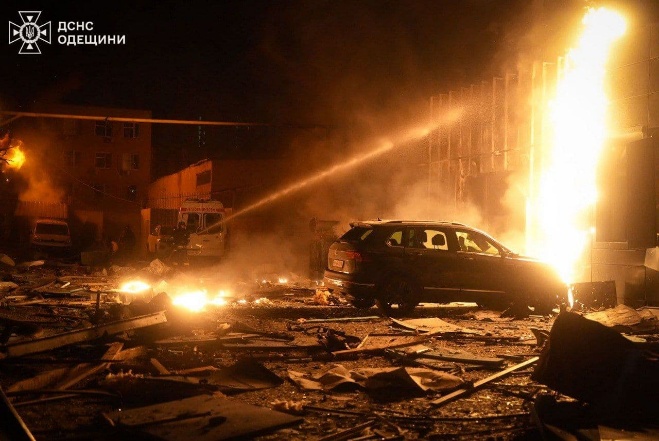
Aftermath of a Russian strike on Odesa Oblast, Ukraine, overnight. (Ukraine’s Emergency Service)
The Day’s Meaning
Territory first. Guarantees later.
That was the quiet shift beneath the headlines.
Washington reportedly accepted Russia’s sequencing—Ukrainian concessions before binding protection—while Moscow continued rejecting the very guarantees that would make those concessions survivable. Europe funded drones, air defense, and fighter jets. Germany launched joint production lines. Ukrainian forces advanced near Hulyaipole and struck deep into occupied territory. Russian troops ground forward near Slovyansk despite shortages and communications disruptions.
Two tracks moved in parallel.
On the battlefield, Ukraine demonstrated adaptability—exploiting Starlink outages, targeting logistics hubs, forcing retreats measured in kilometers. In Moscow, rate cuts and rising debt hinted at an economy straining beneath war spending. In European capitals, loans and aid packages signaled commitment to sustaining Ukraine’s military capacity.
But the diplomatic framework overshadowed everything.
If territory changes hands before guarantees are secured—and if Russia never intends to accept meaningful enforcement mechanisms—then withdrawals risk becoming vulnerabilities. The Kremlin’s consistent rejection of Western troops, monitoring missions, or binding security structures suggests its objection is not where the line sits, but whether Ukraine is protected after it moves.
The question is no longer whether Ukraine can fight. It is whether any negotiated peace would prevent the next war.
Money can buy drones. Production lines can scale. Frontlines can shift.
But without enforceable guarantees, sequencing becomes destiny.
And destiny, in this war, has rarely favored the unprotected.
Prayer For Ukraine
- For Protection Over Civilians
Pray for families in Rivne, Odesa, and Mykolaiv who endured another night of drones and missile strikes. Ask God to shield homes, protect children, and strengthen emergency workers and repair crews restoring power and safety. - For Wisdom in Negotiations
Pray for Ukrainian leaders and international partners as diplomatic frameworks take shape. Ask for discernment, courage, and clarity so that any peace pursued protects Ukraine’s future rather than exposing it to renewed aggression. - For Soldiers on the Frontline
Lift up Ukrainian forces advancing near Hulyaipole and defending near Slovyansk and Lyman. Pray for endurance, protection from drone attacks and artillery, and wise command decisions in difficult terrain and weather. - For Justice and Integrity in Global Institutions
Pray for fairness in international bodies and courts, including cases like that of Vladyslav Herashkevych. Ask that truth prevail and that Ukraine’s sacrifices be honored rather than silenced. - For Economic Pressure to Lead to Peace
Pray that sustained economic strain on Russia’s war system would reduce its capacity to continue aggression, and that leaders there would choose peace over prolonged destruction.