
In the Pokrovsk direction, Ukrainian drones wiped out six Russian Grad rocket launchers in a single strike — part of a doctrine shift that has destroyed 80 Russian air defense systems since winter and quadrupled deep strikes behind the frontline. In Brussels, Hungary’s Viktor Orbán held €90 billion in Ukrainian aid hostage over an oil pipeline that Russia itself bombed, while in St. Petersburg, a pro-Kremlin blogger who called Putin a “war criminal” was committed to a psychiatric hospital within hours. Day 1,484 — when the battlefield began shifting faster than the politics could follow.
The Day’s Reckoning
Six Russian Grad multiple launch rocket systems sat sixteen kilometers behind the frontline near Zhuravka — an entire battery capable of saturating a square kilometer with explosives in seconds. A Ukrainian drone unit found them all. Geolocated footage confirmed the kills. The battery ceased to exist.
This wasn’t luck. This was a new doctrine taking hold across the entire front.
Since January, Ukrainian drone battalions have stopped hunting individual Russian soldiers and shifted their crosshairs to what makes Russian offensives possible: artillery, drone operators, supply lines, staging areas. On the Lyman front, a drone battalion planning head reported the results — fewer Russian assaults, Ukrainian local gains, Russian communications antennas destroyed so frequently that entire units were losing contact with their commanders. Eighty Russian air defense systems destroyed since winter. Mid-range strikes quadrupled. An explosives precursor plant burning in Stavropol Krai. The repair facility for Russia’s S-400s hit in Sevastopol. Ukraine was dismantling Russia’s spring offensive before it could launch.
In Brussels, Viktor Orbán blocked €90 billion Ukraine needed to survive — holding it hostage over an oil pipeline Russia itself had bombed. In Washington, Ukrainian negotiators packed for Saturday talks with American officials, trying to restart diplomacy that a Middle Eastern war had frozen since February. In St. Petersburg, a pro-Kremlin blogger sat in a psychiatric hospital — committed within hours of calling Putin a “war criminal” on Telegram.
And across a 100-kilometer front between Rodynske and Hulyaipole, over 900 Russian soldiers had been killed or wounded in thirty-six hours after fog-covered assaults met Ukrainian drone operators who could see through the weather they couldn’t.
Day 1,484. The battlefield was transforming. The politics hadn’t caught up.
Killing the Umbrella: How Ukraine Is Blinding Russia From the Inside Out
Somewhere in occupied Ukraine, a Russian radar operator watches his screen go dark. His S-400 battery just lost its eyes. Fifty kilometers away, a Ukrainian drone operator already has the next target queued — an ammunition depot that the dead radar was supposed to protect.
This scene played out dozens of times since November, and the numbers tell you how fast it’s accelerating. Monthly Ukrainian mid-range strikes — reaching 50 to 250 kilometers behind the frontline — quadrupled from an average of 11 between March and October 2025 to 45 since November. One-third of all 365 strikes conducted over the past year landed in just the last three months. The acceleration isn’t incremental. It’s exponential.
Nearly half those strikes targeted one thing: Russia’s air defense network. The radar stations, missile launchers, and command nodes that form the protective umbrella over everything behind the front. BBC’s Ukraine Service reported 55 Russian air defense systems struck during Winter 2025-2026. Commander “Magyar” Brovdi added 23 more in March’s first sixteen days — 80 systems destroyed since winter began. Dutch open-source project Oryx visually confirmed 77 Russian SAM systems and 23 radar stations destroyed in 2025 alone.
The logic is sequential and ruthless. Kill a radar, and a corridor opens. Through that corridor, Ukrainian-manufactured drones with 250-kilometer ranges — cheaper than HIMARS, harder to intercept, built domestically — reach ammunition depots, fuel storage, command posts. FP-2 long-range drones have surged in usage over five months.
Russia’s Spring-Summer 2026 offensive depends on months of careful preparation happening safely behind air defense coverage. That coverage is disappearing, radar by radar, launcher by launcher. The preparation is happening under constant bombardment.
The umbrella has holes. And they’re widening.
The Kill Chain That Starves an Offensive
A drone battalion planning head on the Lyman front described the new doctrine with clinical precision: stop hunting Russian infantry. Start killing what makes Russian infantry dangerous.
Artillery batteries. Drone operators. Supply routes. Staging areas. Destroy those, and the cascade begins. Without artillery, assault troops cross open ground against intact defenses. Without drone operators, they advance blind. Without supply routes, ammunition runs dry mid-attack. The six Grads burning near Zhuravka were one link in that chain — and the results were already measurable: fewer Russian assaults, Ukrainian local gains that would have been impossible months ago.
Then came the psychological layer. Ukrainian strikes against Russian communications antennas were severing frontline troops from their commanders. Crouching in a trench, watching your own drone operators get hunted overhead, unable to reach anyone on the radio, unsure whether orders will come or whether you’ve been forgotten — that isolation erodes cohesion faster than casualties do.
Overnight on March 18-19, the General Staff demonstrated how deep the doctrine reaches. Ammunition depots hit in Donetsk City, 50 kilometers from the front. A personnel concentration struck near Yalta, 100 kilometers back. A supply warehouse near Vesele. In occupied Kherson Oblast, ammunition depots near Kalanchak at 57 kilometers and fuel depots near Novotroitske at 80 — all in a single night.
Every depot burning in the rear was one less truckload reaching the front. Every antenna destroyed, one more Russian unit fighting deaf and alone.
Too Many Fronts, Not Enough Army
Picture a Russian general staring at a map of eastern and southern Ukraine, trying to solve a problem that doesn’t have a solution. He needs to seize Orikhiv in western Zaporizhia. He needs to push toward Zaporizhzhia City from the south. He needs to hold the Fortress Belt, sustain operations around Dobropillya and Kupyansk, and maintain buffer zones in northern Kharkiv and Sumy oblasts. He doesn’t have enough troops for all of it.
Ukrainian military observer Kostyantyn Mashovets laid out this structural diagnosis on March 19. The Ukrainian defensive line along the Kinska River through Orikhiv, combined with Ukrainian advances in the Oleksandrivka direction, were pulling Russian forces away from their western Zaporizhia approach. Reinforcements would have to come from the Kherson direction — stripping another front to feed this one.
A push toward Dobropillya would drain the exhausted 51st and 2nd Combined Arms Armies from the Fortress Belt. And Mashovets added the critical constraint: even hypothetical mobilization couldn’t fix this, because Russia lacked time to train recruits for a summer offensive.
The Kramatorsk direction confirmed the picture was real, not theoretical. A Ukrainian brigade spokesperson reported attack intensity there remained low. Russian forces had missed their own fabricated deadlines — March 10 to wedge between Mayske and Markove, March 15 to seize the Siverskyi Donets-Donbas Canal. Both passed without even tactical advances. No large accumulation of heavy equipment had been observed. The starting positions Russia needed for its Spring-Summer 2026 offensive against the Fortress Belt simply hadn’t materialized.
Every front Russia reinforced was a front it weakened somewhere else. Every deadline it missed was a summer offensive slipping further from reach.
The Fog That Killed Them
The fog rolled in on March 17, and Russian commanders saw their chance. They launched coordinated assaults — infantry, armored vehicles, motorcycles — across a 100-kilometer front between Rodynske and Hulyaipole, pushing through more than a dozen sectors under the grey blanket they believed would hide them.
It hid the Ukrainian drones too.
Russian troops advancing through limited visibility discovered something fatal: fog that blinds human eyes doesn’t blind FPV drones. Commander “Magyar” Brovdi’s operators were waiting. Over 500 Russians fell before the assault waves reached Ukrainian positions — 292 killed, the rest wounded. By midday March 18, another 277: 141 killed, 136 wounded. Over 900 in thirty-six hours on a single axis.
The casualty reporting told the broader story. Russian losses hit 1,710 on March 18 and 1,520 on March 19 — roughly double the 760-810 daily figures that had ground through winter. These weren’t desperate gambles. They were coordinated opening moves of the spring campaign, launched across a massive front. They’d been shredded.
Brovdi warned that “the remainder of March will be a heavy and prolonged fight.” Defense Minister Fedorov had previously stated the goal: 50,000 Russian losses per month to degrade Moscow’s offensive capacity. On this axis alone, thirty-six hours delivered nearly a thousand.
The weather advantage Russian commanders waited weeks for became their most expensive mistake of 2026.
The Ground Russia Is Losing While Nobody Watches
While the world tracked Pokrovsk and Kramatorsk, Ukrainian forces were quietly reclaiming territory few headlines mentioned. A Ukrainian artillery brigade spokesperson reported over 285 square kilometers liberated around Oleksandrivka in roughly one month since February 19. Even ISW’s conservative mapping — which acknowledges underestimating gains — confirmed 126 square kilometers. The most significant Ukrainian territorial recovery in months.
Russia noticed. Attacks nearly tripled in the past week, from two or three daily to six to nine. Personnel numbers climbed. Heavy armored vehicles appeared. Molniya drone deployments surged. Moscow was pouring resources into stopping an advance that wasn’t supposed to be happening.
It wasn’t working. Ukrainian drone and artillery strikes kept Russian equipment five to ten kilometers from Ukrainian positions — close enough to see the front, too far to reach it alive. Russian airborne forces arrived well trained and well equipped. Ukrainian FPV drones destroyed them before they reached the line.
Spring foliage would soon give Russian forces concealment they currently lacked. But for now, the initiative belonged to Ukraine — and every failed counterattack confirmed it.
Where Russia’s Explosives Begin — and Burned
Four strikes hit the Nevinnomyssk Azot chemical plant in Stavropol Krai overnight. NASA thermal data confirmed the fires. Governor Vladimirov admitted buildings sustained damage while claiming the strike was “repelled” — the language officials reach for when something important is burning.
This wasn’t another oil refinery or ammunition depot. Azot produces mineral fertilizers — precursors for the ammonium nitrate that fills Russian artillery shells and manufactures mines. Ukrainian drones had reached into the defense industrial supply chain itself, targeting not the weapons but the raw chemistry that makes them possible.
Destroying the Machines — and the Shop That Fixes Them
At least five Ukrainian drones found the Granit Innovation Center in occupied Sevastopol — the Almaz-Antey facility that repairs and maintains Russia’s S-400, S-300PM2, Buk-M2/M3, and Tor-M2 air defense systems and their 92N6E and 96L6E radars. Geolocated footage confirmed damage near the Fiolentovske Highway. The Crimean Wind channel reported the impacts.
Follow the logic. Ukraine was destroying Russian air defense systems at the front — 80 since winter — while simultaneously hitting the facility that repairs them. Every damaged Buk or S-400 now faced a longer, more uncertain road back to operational status, if it got there at all.
Sevastopol wasn’t the only target that night. Ukraine’s Special Operations Forces struck a logistics warehouse at Khersones airfield and electronic warfare equipment. A manpower concentration near Striletska Bay took hits. Another near Ovrazhky. Occupation governor Razvozhayev claimed 27 drones downed while acknowledging one killed and two injured — the math suggesting more reached their targets than he admitted.
Across occupied Zaporizhia Oblast, a Ukrainian unmanned systems battalion struck two Buk-M1 air defense systems, two military energy facilities, two fuel and ammunition warehouses, two mesh network antenna towers used to control Shahed drones, and satellite communications infrastructure. Geolocated footage confirmed hits on communications towers in Enerhodar and energy infrastructure in Tokmak. Separately, footage confirmed strikes against a Shahed drone repeater antenna northwest of Olenivka during early March.
The repair shop was burning. The systems it was supposed to fix were still being destroyed. And the communications network guiding Russia’s own drone swarms was being dismantled tower by tower.
133 Drones, Six Launch Points, and the People Who Couldn’t Sleep
They came from six directions. Oryol. Bryansk. Shatalovo in Smolensk Oblast. Millerovo in Rostov. Primorsko-Akhtarsk in Krasnodar Krai. Occupied Hvardiiske in Crimea. One hundred thirty-three drones — roughly 70 of them Shaheds — converging on Ukrainian cities while their residents slept.
Ukrainian air defenses downed 109. Twenty got through, striking 11 locations. The debris itself became a weapon — fragments falling on the Ukrainian Security Service building in Lviv, hundreds of kilometers from any frontline.
The targets weren’t dramatic. Educational facilities. Residential buildings. Energy infrastructure in Chernihiv, Odesa, Volyn, Zaporizhia, and Dnipropetrovsk oblasts. Power went dark in Zaporizhzhia, Kharkiv, and Sumy. A Kremlin-affiliated milblogger explained the logic openly: target “low-level” infrastructure that doesn’t make headlines but systematically bleeds the Ukrainian economy. Death by a thousand cuts.
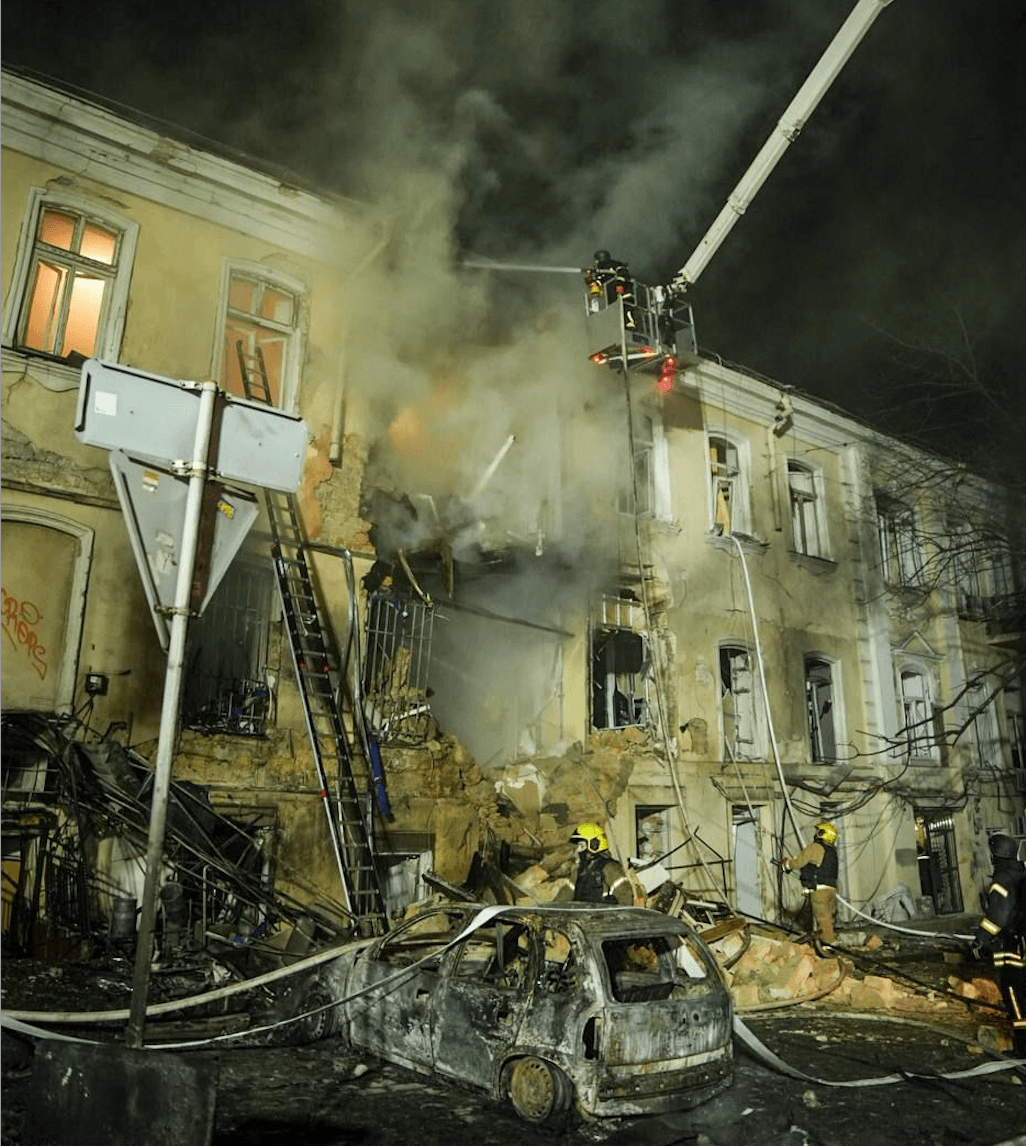
Rescue workers at the scene of a Russian attack on Odesa Oblast (DSNS/Telegram)
A technical evolution made the strikes harder to stop. Russian drones now used mesh networks — wireless systems allowing swarms to maintain signal among themselves rather than relying on ground stations — enabling more effective attacks in frontline areas where interception was already difficult.
The human cost accumulated across the country. In Zaporizhzhia Oblast, one killed, two injured — with 864 strikes hitting 41 settlements. In Kharkiv, one man killed, five injured including a child. In Donetsk, one killed in the Kramatorsk district. In Odesa, three injured. In Dnipropetrovsk, two injured. In Sumy, four civilians wounded including a 16-year-old boy, with over 50 attacks on settlements. In Kherson, two wounded.
Three dead. Eighteen injured. Another night where air defense crews saved dozens of targets knowing they couldn’t save them all.
Blood for Meters: A Thousand Kilometers of Grinding War
Russian forces attacked across every major axis on March 19. From Sumy to Kherson, the pattern repeated — assaults launched, positions contested, advances claimed but unconfirmed. The line bent. Nowhere did it break. But the details revealed more than the pattern.
In northern Kharkiv, Russian forces scrambled after losing Starlink access, installing antennas closer to the border and rigging Wi-Fi bridges as substitutes. Ukrainian forces found and destroyed both the antennas, and the drone takeoff points they supported. Springtime mud was grinding Russian infiltrations to a halt — though their FPV drone strikes against Ukrainian logistics had intensified.
Near Kupyansk, Ukrainian forces struck drone control points and supply storage of the Russian 1843rd Motorized Rifle Regiment near Holubivka and Radkivka. The Russians’ mistake: they hadn’t removed their white winter camouflage. The season had changed. Their concealment hadn’t.
In the Kramatorsk direction, a revealing shortage surfaced. Russian forces were using heavy bomber drones only for rear-area logistics — never near the front — apparently preserving them because replacements weren’t coming. Frontline resupply now moved on foot, by FPV drone, or by unmanned ground vehicle.
Near Pokrovsk, the spring offensive showed its teeth. Ukraine’s 7th Rapid Reaction Corps reported the first mechanized assault in Hryshyne since December — three armored vehicles, platoon strength. Elsewhere, up to 10 Russian naval infantry and Spetsnaz lay blocked and wounded near an unspecified settlement, unevacuable. The brigade assessed Russia might commit Ethiopian and Moroccan foreign recruits — still in training — as an “extreme” reserve to unblock them. In Bilytske, another brigade found only two or three Russian soldiers in a settlement Russian commanders claimed they controlled.
In Hulyaipole, Ukrainian forces advanced. In Richne, they raided a Russian-held building and took prisoners. At Sumy, Russian Defense Minister Belousov inspected the Northern Grouping, where 3D printers now manufactured drone components at the tactical edge.
When Irregular Becomes Regular: Russia’s Army Absorbs Its Own Improvisation
The Russian MoD announced on March 18 that the BARS-22 detachment — one of the Combat Army Reserve units hastily assembled during 2022’s mobilization chaos — was now formally subordinated to the 55th Naval Infantry Division. Irregular had become regular. Ad hoc had become official.
The 55th itself told the story of an army stretching to cover its commitments. Newly formed from the 155th Naval Infantry Brigade on December 1, 2025, the division was already split between Dobropillya and Hulyaipole — two sectors, one division, now absorbing reserve units to fill ranks that organic manning couldn’t.
This was the military restructuring that then-Defense Minister Shoigu announced in December 2022 finally grinding into reality: brigades becoming divisions, informal units folding into the regular order of battle. Russia building the larger army it needed for the war it was actually fighting — three years after discovering the one it had wasn’t enough.
The Human Safari: When Batteries Run Low, Civilians Die
A Ukrainian brigade officer in the Kupyansk direction described something that crossed the line from tactical to criminal. Since March 13, Russian FPV drone and glide bomb strikes against civilian targets had intensified sharply. Ambulances hit near Oleksandrivka and Prosyanka. Civilian cars struck near Novoosynove, Borivske. Critical infrastructure attacked in Hrushkivka.
The officer’s explanation was chilling in its banality. Russian drone operators who hadn’t found military targets before their batteries ran low were spending remaining power on whatever moved — including ambulances. Ukrainian forces confirmed the pattern by recovering fallen Molniya-2 fixed-wing FPV drones with dead batteries scattered across civilian areas.
They call it the “human safari.” It started in Kherson Oblast. Now it spans the entire theater. Russian forces aren’t just tolerating the deliberate targeting of civilians — they’re institutionalizing it.
Orbán Holds €90 Billion Hostage Over a Pipeline Russia Bombed
Follow the logic and try not to laugh. Russian air strikes damaged the Druzhba pipeline in late January — the pipeline carrying Russian oil through Ukraine to Hungary and Slovakia. Hungary blamed Ukraine for slow repairs. Then Hungary held hostage €90 billion in EU funding that Ukraine needed to keep its state functioning — money all 27 EU countries had unanimously approved in December. And alongside Slovakia, Hungary simultaneously blocked the EU’s 20th sanctions package against Russia.
Russia bombed it. Hungary punished Ukraine for it.
Slovak Prime Minister Fico piled on, claiming the disruption triggered a state of emergency in Slovakia’s oil sector and questioning whether Kyiv was deliberately cutting off Hungarian and Slovak supplies. A European delegation arrived in Kyiv to inspect the damage. Naftogaz CEO Koretskiy presented a reconstruction plan. The evidence pointed one direction. The politics pointed another.
The patience was running out. Diplomats told Politico that Orbán had “crossed a red line.” German Foreign Minister Wadephul warned Hungary’s obstruction “can no longer be tolerated.” European Council President Costa warned in writing that Orbán had violated the EU’s principle of sincere cooperation.
But Brussels held back. Hungary’s upcoming election — where Orbán trails challenger Péter Magyar in some polls — made EU leaders wary of action that might feed Orbán’s foreign-interference narrative. The reckoning would come after the vote.
For Ukraine, the arithmetic was existential. Without the €90 billion, Kyiv could run out of cash by spring’s end. Options to replace the funds ranged from limited to nonexistent.
The Deal That Rewards Moscow Through Minsk
While Orbán blocked Ukraine’s money in Brussels, a quieter exchange unfolded in Minsk. US Special Envoy John Coale met Belarusian President Lukashenko on March 19. Lukashenko released 250 political prisoners. In return, the United States would lift sanctions from two Belarusian state banks, the Finance Ministry, and top potash producers. Release all remaining prisoners by end of 2026, and every sanction imposed over the crushed 2020 protests disappears.
The prisoners were real people gaining real freedom. That mattered.
But so did the structural reality underneath. ISW has long assessed that Russia has de facto annexed Belarus — the two states share a combined defense industrial base. Belarusian banks can facilitate Russian financial transactions. Belarusian potash exports generate revenue that flows through an integrated economy. Sanctions on Belarus were never purely about political prisoners. They constrained a state functioning as a Russian military appendage.
That constraint was being lifted. Every dollar of economic relief reaching Minsk partially reached Moscow — and Moscow’s war machine with it.
The Talks Nobody Believes In — But Nobody Can Abandon
Zelensky announced on March 19 that a heavyweight delegation — Umierov, Budanov, Arakhamia, Kyslytsia — was heading to Washington for Saturday talks. “There has been a pause,” he said, “and it is time to resume them.”
The pause had lasted a month. The last trilateral session between Kyiv, Moscow, and Washington took place in Geneva on February 17-18. A March 5 follow-up in Abu Dhabi was postponed after US-Israeli strikes on Iran and never rescheduled. The Middle East had swallowed the diplomatic bandwidth whole.
Moscow wasn’t rushing back. Kremlin spokesperson Peskov acknowledged a “situational pause” — language suggesting Russia might not show up. European officials warned that US military support, particularly air defense systems, could face delays as Washington prioritized the Middle East. The war Ukraine was fighting was competing for attention with the war Iran was fighting.
The intelligence community’s assessment, published March 18 in the DNI’s Annual Threat Assessment, framed the backdrop starkly. Moscow “almost certainly remains confident that it will prevail on the battlefield” and sees little reason to stop fighting while gaining ground. A settlement could improve US-Russia relations — but the longer the war continued, the greater the risk of escalation into direct NATO-Russia conflict. North Korean troops were gaining battlefield experience. Chinese economic support was reducing Moscow’s incentive to negotiate. Russia’s economic resilience had surprised Western analysts.
One line stood apart: Ukraine had demonstrated “for the first time that a nation without its own space infrastructure can integrate commercial and partner space services” to fight an adversary with decades of military space capability. The war was rewriting more than borders.
Russia’s Oil Fleet: Too Hunted to Sail Alone
Kremlin aide Nikolai Patrushev said something on March 18 that would have been unthinkable two years ago: Russia was considering sending naval warships to escort its own merchant ships.
The shadow fleet — aging tankers with opaque ownership, Russia’s primary tool for circumventing oil sanctions — was being hunted. France, Germany, Italy, and most recently Sweden had seized or detained suspected vessels. Patrushev called the attack on the LNG tanker Arctic Metagas in the Mediterranean “an act of international terrorism.” His proposed solutions — mobile fire teams aboard ships, protective equipment, naval convoy escorts — read like the measures of a country whose sanctions evasion network was being dismantled ship by ship.
While Patrushev talked about protecting the fleet, the fleet was probing new routes. The Hong Kong-flagged Sea Horse, carrying 27,000 tons of Russian gas, was expected in Cuba on March 23 — violating the US embargo. The Russian-flagged Anatoly Kolodkin, with roughly 100,000 metric tons of crude, would follow April 4. Both would be the first Russian arrivals in Cuba in three months.
Russia’s oil export lifeline was simultaneously under siege in European waters and reaching for the Caribbean. Moscow was running out of oceans to hide in.
Five Reasons, One Psychiatric Ward
Ilya Remeslo had built his career as one of the Kremlin’s attack dogs — filing complaints against Alexei Navalny, pursuing his allies through courts, doing the legal dirty work that earned him a following among Russia’s pro-war faithful. On the evening of March 17, he published a Telegram post titled “Five Reasons Why I No Longer Support Vladimir Putin.”
The war was “absolutely a dead end.” Putin “does not respect his voters.” “Absolute power corrupts absolutely — especially when it is endless.” The president was “not legitimate” and should face trial as a “war criminal and thief.”
Some assumed his account was hacked. Remeslo posted a video confirming every word and urging followers to “think about it until morning.”
They didn’t get long. By the next day, Remeslo was in Psychiatric Hospital No. 3 in St. Petersburg. Staff confirmed a patient bearing his name had been admitted. Vladimir Solovyov, Russia’s leading propagandist, diagnosed the situation from his television studio: a “psychological breakdown.” Ivan Zhdanov, former head of Navalny’s Anti-Corruption Foundation, was more concise: “That was fast.”
Soviet authorities perfected punitive psychiatry against dissidents in the 1960s. In 2026, the playbook apparently still worked. Remeslo had told journalists before his disappearance that he was prepared for “any development” and possessed information he could reveal in court.
Whether he would ever see a courtroom was the question nobody in Moscow wanted to answer.
The Firewall With Holes
While Remeslo sat in a psychiatric ward for criticizing the system, the system was proving it couldn’t even control the internet he’d used to criticize it.
A source at a Russian telecommunications operator said Roskomnadzor had “completely lost control” of its blocking efforts. Users were periodically accessing banned websites and apps. A backbone internet service provider confirmed the core problem: Roskomnadzor simply lacked the bandwidth to filter all RuNet traffic. The censor denied it. The leaking firewall said otherwise.
The Kremlin’s attempt to slowly throttle Telegram had backfired particularly badly — neither the technical infrastructure nor the public messaging had been prepared for increasingly restrictive measures. Pro-war figures were leading the backlash, not liberals. The Liberal Democratic Party expelled State Duma Deputy Andrei Svintsov for “discrediting” the party with his statements about blocking Telegram, VPNs, and internet access.
Russia’s information control apparatus was overreaching what its technology could deliver — and losing the argument even among its own supporters.
A Party Without a Country
Ilya Yashin announced from exile on March 19 that he was launching a political party to unite Russians opposed to Putin. No team. No platform. No path to power inside a system that jails its critics and commits dissenters to psychiatric wards.
“We are raising the banner and openly declaring that there is a political and organized coalition of people whose goal is to come to power in Russia,” Yashin said.
He reached for historical precedent — 19th-century exile parties that entered politics only after the Russian Empire collapsed. The implication required no translation.
The reality was harder. Russia’s opposition remained fractured, with Navalny-linked groups, independent activists, and other figures refusing to cooperate. Yashin’s announcement drew little support. The Council of Europe’s Parliamentary Assembly had recently launched its own dialogue platform with exiled opposition — whether Yashin would join or compete remained unclear.
The founding convention was set for summer 2026. Whether it would amount to more than a press release depended on a unity Russia’s opposition has never achieved.
Sixty Seconds Over Estonia
A Russian Su-30 crossed into Estonian airspace over the Gulf of Finland near Vaindloo Island on March 18 — 81 kilometers southeast of Helsinki. No flight plan. No radio contact. Sixty seconds inside NATO territory, then gone.
Brief enough to deny. Provocative enough that every Baltic air defense officer noticed. The same pattern Russia has repeated for years — too small for Article 5, too deliberate to be accidental.
The Mole Inside Ukraine’s Drone War
The SBU announced on March 19 that it had caught a double agent — a servicemember spying for both Russia and Belarus from inside Ukraine’s Unmanned Systems Forces, the organization whose drone campaigns were destroying Russian artillery batteries and air defense systems.
The suspect allegedly passed intelligence on the movement, types, and numbers of Ukrainian drones near the northeastern border. After transferring to a ground robotic systems unit, he collected data on deployment plans along the Izium axis and technical characteristics of Ukrainian robotic systems. Two phones with evidence were seized.
Consider what a spy in that position could compromise: operational patterns, drone specifications, the tactical doctrine that quadrupled strike rates and killed an entire Grad battery in a single mission. Ukraine’s asymmetric advantage had been reporting to Moscow and Minsk.
Life sentence under martial law. The damage already done was the harder question.
Moscow’s Fingerprints in Delhi
Six Ukrainian citizens and one American were detained at airports in Delhi, Lucknow, and Kolkata on March 13. India’s National Investigation Agency accused them of entering Myanmar without permits, training anti-junta armed groups in drone warfare, and transferring drones from Europe through India.
Ukraine’s embassy fired back on March 19, stating the case “may have been initiated based on information provided by Russia.” The embassy rejected any link to terrorism and warned that using the case to “discredit Ukraine” could damage bilateral relations. Russia, the embassy added, “seeks under every circumstance to drive a wedge between friendly countries — Ukraine and India.”
The case exposed a new front in Russia’s information war. Ukraine’s drone expertise — the capability destroying Russian artillery and air defenses — was being repackaged as evidence of Ukrainian terrorism, weaponized diplomatically thousands of kilometers from the nearest frontline.
The War in Iran That Finances the War in Ukraine
Ukraine’s central bank held its key rate at 15% on March 19 — a decision driven not by Donbas but by the Strait of Hormuz.
US-Israeli strikes on Iran in late February triggered retaliation against regional oil and gas infrastructure. Iran hit tankers. Sea traffic collapsed. Global energy prices surged. Ukrainian retail gas prices spiked in early March. Headline inflation, which had been falling from 15.9% in May 2025 to 7.4% in January, reversed to 7.6% in February.
The National Bank of Ukraine joined the Fed, the ECB, the Bank of Japan, and the Bank of England in holding rates steady. But Ukraine’s central bankers faced an irony none of the others did: a prolonged Middle East war would push Ukrainian inflation higher while simultaneously boosting Russia’s oil revenues — making Russian barrels more attractive on global markets, financing the very invasion destroying Ukrainian infrastructure.
One war feeding another, eight time zones apart.
$11,300 and a Fence: Ukraine’s Corruption War Within the War
The High Anti-Corruption Court sentenced Lyudmila Marchenko — formerly of Zelensky’s Servant of the People party — to two years for taking an $11,300 bribe to help military-age men get abroad. Her aide got the same. NABU had published recordings of Marchenko negotiating the bribe and footage of her throwing cash over her fence to destroy evidence.
She wasn’t alone. Forty-one sitting parliamentarians faced corruption charges. Five Servant of the People lawmakers were charged in December with selling votes. Opposition leader Tymoshenko was charged in January with bribing lawmakers.
The prosecutions carried double weight. Ukraine’s war effort ran on Western money. Western money ran on proof that Kyiv was cleaning house. Every conviction was simultaneously justice and survival strategy.
12:38 PM
The Government That Kills Its Sons and Psychoanalyzes Its Daughters
New Russian health ministry guidelines instructed doctors to ask women how many children they wanted. If the answer was zero, refer the patient to a psychologist “with the goal of forming a positive attitude towards having children.”
Russia’s birth rate sat at 1.4 per woman — a 200-year low deepened by hundreds of thousands of casualties in Ukraine. The Kremlin had already tightened abortion rules, criminalized “child-free propaganda,” and declared large families national heroes. Now childlessness itself was being treated as a condition requiring psychological intervention.
The government sending young men to die in Ukraine was sending their sisters to therapists for not wanting to replace them.
Making Russians Out of Ukrainian Children
A seven-year-old in occupied Zaporizhia Oblast can now join Zarnitsa 2.0 — a revived Soviet-era war game where children compete in squad-sized detachments practicing tactical drills, combat medicine, drone operation, and Russian military history. At least 2,000 children from the oblast were expected for the third season. In occupied Mariupol, Rosgvardia SOBR members taught school cadets to pilot drones. In Melitopol, “Yug Molodoy” ran weapon assembly workshops. Military recruiters addressed teenagers about Russian academy admissions.
The pipeline started younger and ran deeper. Over 500 children from occupied territories “vacationed” at Ingushetia sanatoriums in 2025. Another 3,500 from occupied Luhansk would visit Russia in 2026 under the Cultural Map 4 + 85 program. Rosatom — Russia’s state nuclear corporation — planned to send 1,600 Enerhodar schoolchildren to camps in summer 2026, cultivating future nuclear operators while erasing their Ukrainian identity.
Tactical drills at seven. Drone piloting at twelve. Academy recruitment at sixteen. Russia wasn’t occupying territory. It was manufacturing the next generation of Russians from Ukrainian children.
Making Russians Out of Ukrainian Children
A seven-year-old in occupied Zaporizhia can now join Zarnitsa 2.0 — a revived Soviet war game with squad-sized detachments practicing tactical drills, combat medicine, drone operation, and Russian military history. Two thousand children expected this season. In Mariupol, Rosgvardia SOBR members taught cadets to fly drones. In Melitopol, “Yug Molodoy” ran weapon assembly workshops. Military recruiters addressed teenagers about Russian academy admissions.
The pipeline ran deeper. Over 500 children “vacationed” at Ingushetia sanatoriums in 2025. Another 3,500 from occupied Luhansk would visit Russia in 2026 under the Cultural Map 4 + 85 program. Rosatom planned to send 1,600 Enerhodar schoolchildren to summer camps — cultivating future nuclear operators while erasing their Ukrainian identity.
Tactical drills at seven. Drone piloting at twelve. Academy recruitment at sixteen.
Stealing Homes, Jailing Grandmothers: Occupation by Paperwork
The legal machinery was accelerating. In Shakhtarsk, administrators identified over 1,000 “abandoned” apartments, filed lawsuits for 300, gained court control over 250. Kherson occupation head Saldo ordered all “abandoned” property registered by month’s end — only 569 of 2,435 processed. On March 12, Luhansk’s occupation administration adopted the first law moving beyond seizure into formal redistribution of “ownerless” housing to Russian citizens.
The Kremlin was making ownership itself impossible to prove. Real estate transactions now required personal appearance before a Russian notary on Russian territory. Powers of attorney issued before December 29, 2025, were invalidated. Displaced Ukrainians who fled Russian bombs were watching their homes become legally “ownerless” — available for Russian settlers.
In Mariupol, 140 apartments went to residents over 80. Deputy PM Khusnullin declared housing reconstruction would finish by year’s end. Independent reports said tens of thousands remained homeless.
The courts handled the human resistance. Elena Nishanova, 47, received ten years in a Kherson penal colony for allegedly sharing Russian force locations. Halyna Bekhter, 68, got 11 years in Zaporizhia for allegedly sending funds to Ukraine’s military. In Crimea, a 45-year-old Feodosia resident was arrested for photographing Russian helicopters — the 11th such arrest in 2026.
The persecution fell heaviest on Crimean Tatars. Four women arrested in October 2025 over alleged Hizb ut-Tahrir involvement had their detention extended to June. Of 286 persecuted Ukrainians in Crimea, 159 were Tatars. Women accounted for 53 percent of “discrediting the Armed Forces” cases.
Steal the homes. Jail the resisters. Erase the identity. Occupation by paperwork, proceeding on schedule.
Twelve Years of Stolen Ground: Crimea’s Anniversary Nobody Recognized
Maria Zakharova took the podium on March 16 — twelve years since Russia’s sham Crimean referendum — to celebrate. Bridges. Pipelines. Airports. Highways. “Hundreds” of social facilities. Crimea, the MFA declared, was “fully integrated into Russia’s political, legal, and economic space.” They even boasted of a “fully-fledged Crimean Tatar national and cultural autonomy” — while Crimean Tatar women sat in occupation prisons and 159 of 286 persecuted Ukrainians in Crimea were Tatars.
Putin followed on March 18 with a video conference marking the formal annexation anniversary: 1.3 trillion rubles — $16 billion — invested since 2014. A children’s rehabilitation center planned for Yevpatoria in 2026. The numbers sounded generous.
They were strategic. Every bridge, road, and housing block created physical dependency on Russia, making de-occupation economically devastating for residents woven into Russian systems over twelve years. Moscow was now replicating the pattern across territories annexed since 2022.
Infrastructure as occupation. Dependency as permanence.
Need a Doctor? Download the Kremlin’s App
In occupied Sevastopol, every apartment building management chat now runs on MAX — Russia’s state-controlled messenger. In Mariupol, a clinic announced residents need a MAX account to schedule doctor appointments or call an ambulance. Across Russia and occupied Ukraine, 10.8 million users have migrated.
No MAX account, no plumbing repair. No MAX, no medical care. No MAX, no emergency services. Russia was converting the digital infrastructure of daily life into a surveillance tool — one download at a time.
What March 19th Revealed
The battlefield and the political terrain were moving in opposite directions.
On the ground, Ukraine’s new doctrine was delivering results that would have seemed impossible a year ago. Eighty air defense systems destroyed since winter. Mid-range strikes quadrupled. An entire Grad battery eliminated in a single mission. The facility that repaired Russia’s air defenses burning in Sevastopol. The chemical plant that made their explosive precursors burning in Stavropol. 285 square kilometers liberated around Oleksandrivka. 900 Russians killed or wounded in thirty-six hours on a single axis. The spring offensive Russia had been preparing was being degraded before it could launch.
The politics told a different story. Hungary froze €90 billion Ukraine needed to survive. The Middle East war consumed diplomatic bandwidth and threatened to boost Russian oil revenues. Belarus received sanctions relief that partially benefited Moscow’s war machine. Peace talks resumed with Russia’s attendance uncertain.
Russia’s own contradictions deepened in parallel. A censorship system that couldn’t block websites. A loyalist blogger psychiatrically committed within hours of dissenting. Women referred to psychologists for childlessness while the state sent their brothers to die. An occupation planning to resettle 114,000 Russians while jailing elderly Ukrainian women for a decade. Mashovets’s battlefield diagnosis — Russia unable to advance everywhere simultaneously — had its mirror in Moscow: Russia couldn’t win the war, control its population, sustain its economy, and replace its dead all at once.
Ukraine’s question was the inverse. Could tactical innovation outrun the political fatigue eroding Western support?
The Grads near Zhuravka were gone. The Granit Center was burning. The Oleksandrivka front was advancing. But the €90 billion sat frozen in Brussels, and the spring campaign was only beginning.
Day 1,484. The doctrine was working. The politics remained the weakest link.
Prayer For Ukraine
- Shield Over the Drone Operators Who Changed the War
Lord, we lift up the Ukrainian drone operators whose skill and courage are reshaping this battlefield — the crews who destroyed an entire artillery battery near Zhuravka, who hunt radar stations and supply lines so that fewer soldiers face Russian fire. Protect their hands, sharpen their eyes, and guard their lives as they carry out missions that save so many others. Keep them hidden from the enemy who hunts them in return and sustain the doctrine that is giving Ukraine a fighting chance against overwhelming numbers.
- Comfort for the Targets of the Human Safari
Father, we cry out for the civilians in the Kupyansk direction — the ambulance crews struck by drones, the drivers hit on roads near Prosyanka and Borivske, the families in Kharkiv where a child was wounded and a man killed. We pray for the 16-year-old boy injured in Sumy, for the three dead and eighteen wounded across Ukraine on this single day. Hold those who grieve. Heal those who bleed. And let the world see what is being done to people whose only crime is living in their own country.
- Wisdom Where Politics Fails Courage
God of nations, we ask for wisdom as Zelensky’s delegation travels to Washington for talks whose outcome no one can predict. Grant clarity to leaders in Brussels paralyzed by Orbán’s obstruction, courage to those who know €90 billion in frozen aid could mean Ukraine’s survival or collapse. Where the Middle East consumes attention that Ukraine cannot afford to lose, redirect the eyes of the powerful toward the people still dying every night under Russian drones.
- Justice for Those Silenced Under Occupation
Righteous Judge, we pray for Elena Nishanova, sentenced to ten years for reporting Russian positions. For Halyna Bekhter, 68 years old, given eleven years for supporting her own country’s army. For the Crimean Tatar women held in Simferopol on fabricated charges. For the children taken to Russian camps and taught to forget who they are. Where occupation courts dispense punishment disguised as law, let true justice endure. Where homes are stolen through paperwork, let ownership be remembered. Where identity is erased, let it be preserved in the hearts of those who carry it.
- Endurance for a Nation Rewriting the Rules of Survival
Almighty God, we thank You for the resilience visible in 285 square kilometers liberated around Oleksandrivka, in the drone doctrine that is degrading Russia’s offensive before it launches, in the anti-corruption prosecutions that prove Ukraine fights for its integrity even while fighting for its life. Sustain this endurance through the heavy weeks ahead that Commander Brovdi has warned are coming. Strengthen the hands that build and the hearts that refuse to break. Bring justice to this war, peace to this land, and an end to the suffering that has lasted 1,484 days too long. Amen.