
As diplomats unveiled a revised peace framework, Russian drones darkened Ukrainian cities and Kremlin insiders exposed how Moscow was demanding territory its army never controlled.
The Day’s Reckoning
The drones came first, before dawn, their engines buzzing low over darkened cities as Ukrainians slept through Christmas Eve. By morning, President Volodymyr Zelensky was standing in Kyiv, outlining a revised U.S.–Ukrainian–European peace plan meant to chart a path out of the war. By nightfall, 131 Russian drones had crossed Ukrainian airspace, power grids lay damaged, and tens of thousands of people sat in the cold and dark.
It was a day built on collision.
In Miami conference rooms, diplomats debated language about demilitarized zones, nuclear plant management, and future economic arrangements. They spoke in paragraphs and clauses, searching for wording that might unlock compromise. At the same time, Russian forces sent wave after wave of drones into Ukraine’s energy infrastructure, striking nineteen locations in Chernihiv Oblast alone. Negotiation unfolded under fluorescent lights; war unfolded under missile alerts.
Elsewhere, another truth surfaced. Russian military bloggers—usually reliable amplifiers of Kremlin narratives—began dismantling their own army’s claims. They admitted that commanders had been “blatantly lying” upward about battlefield successes near Kupyansk, reporting victories that never existed and territory that had already been retaken by Ukrainian counterattacks. The fiction had collapsed in public.
The contrast was absolute. American officials described the twenty-point framework as progress. The Kremlin dismissed it while demanding Ukrainian withdrawal from territory Russian troops had failed to seize. Russian forces pressed attacks along multiple fronts even as Moscow’s diplomats rejected compromise outright.
This was diplomacy in parallel with destruction. Peace plans moved forward on paper while cities burned, power failed, and soldiers fought for meters of ground. December 24 revealed a war being discussed in one reality and lived in another—and the distance between those realities had never felt wider.
The Twenty Points of Compromise (That Russia Rejected Anyway)
President Zelensky unveiled details of the revised US-Ukrainian-European peace plan that had been released the previous day. The twenty-point proposal summarized months of trilateral negotiations, though Zelensky noted that two critical provisions—concerning the Zaporizhzhia Nuclear Power Plant and mechanisms for creating economic zones in Donetsk Oblast—remained unresolved.
The document marked significant evolution from the twenty-eight-point plan floated in November. Gone were demands for Ukraine to withdraw from unoccupied Donbas, for caps limiting Ukraine’s peacetime military to 600,000 personnel, and for explicit abandonment of NATO membership aspirations. The new plan proposed freezing the war along current frontlines in Luhansk, Donetsk, Zaporizhzhia, and Kherson oblasts—wherever troops stood when signatures were applied—and allowed Ukraine a peacetime force of 800,000.
“The ball is currently in their court,” US Ambassador to NATO Matt Whitaker stated on Fox News, referring to Russia’s need to respond to the four documents emerging from recent talks. Whitaker noted that high casualties Russia was taking for “very small” gains hadn’t pushed the Kremlin toward ending the fighting.
They wouldn’t. Russian Presidential Aide Yuriy Ushakov had already signaled Moscow’s position even before the twenty-point plan’s publication, stating he was “certain” that Ukrainian and European proposals would be “rather unconstructive” and wouldn’t “improve” any settlement agreement. Translation: Russia wasn’t interested in compromise.
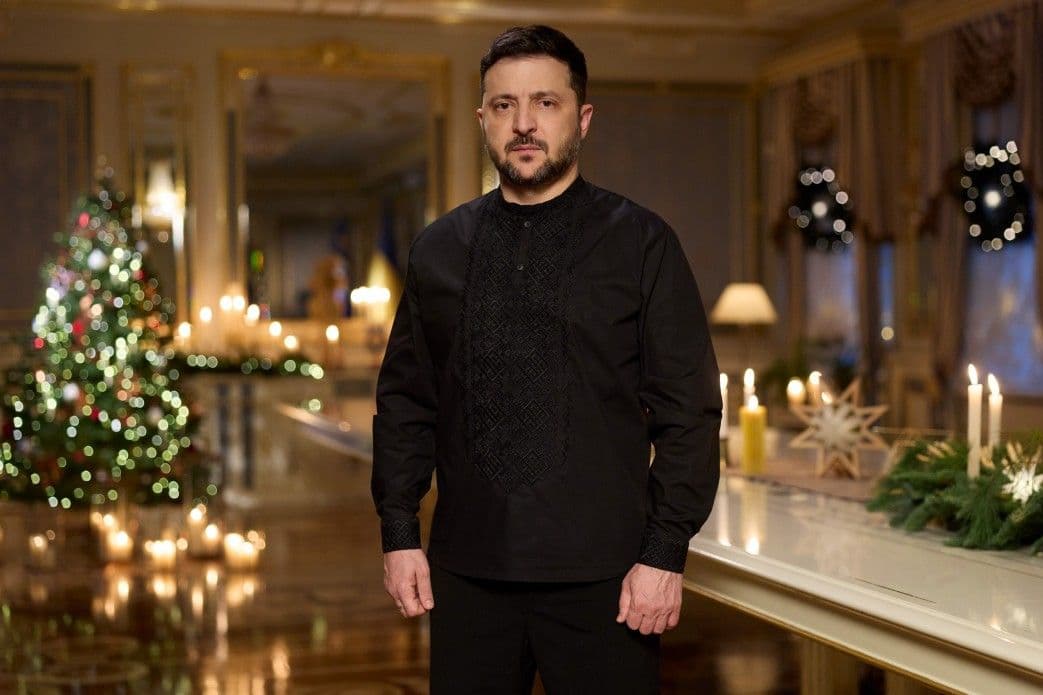
President Volodymyr Zelensky address the nation on Christmas Eve in Kyiv, (President Volodymyr Zelensky)
Putin’s demands remained unchanged from his June 2024 speech to the Foreign Ministry—the same maximalist position he’d maintained since February 2022. Ukraine’s complete withdrawal from all of Luhansk, Donetsk, Zaporizhzhia, and Kherson oblasts. Ukraine’s NATO membership aspirations abandoned and neutrality guaranteed. Ukraine’s demilitarization to the point it couldn’t defend itself. Ukraine’s “denazification”—Kremlin code for regime change and installation of a puppet government. International recognition of Russia’s illegal annexations. Lifting of all Western sanctions.
These demands were incompatible not just with the twenty-point plan but with the November twenty-eight-point plan that had already made significant concessions. The Kremlin’s negotiating position assumed Ukrainian surrender, Russian territorial conquest, and Western capitulation. Nothing in the latest proposal approached these expectations.
Russian State Duma International Affairs Committee First Deputy Head Alexei Chepa made this explicit, criticizing the plan’s lack of provisions prohibiting Ukrainian NATO membership and rejecting proposals about Ukrainian participation in ZNPP management. The plan’s territorial clauses, Chepa stated, would not satisfy the Kremlin—Russia would demand “significant adjustments.”
Bloomberg reported that a Kremlin source outlined Moscow’s additional concerns: no guarantees against NATO expansion, insufficient limits on Ukraine’s military, lack of provisions ensuring Ukrainian neutrality if it joined the EU, no assurances about Russian language status in Ukraine, and nothing addressing frozen assets or sanctions removal. The source made clear the Kremlin wanted provisions on “root causes”—their euphemism for demands that NATO cease existing as a meaningful alliance and that Ukraine abandon its sovereignty.
The peace plan, in other words, changed nothing. It was a well-crafted document detailing areas of Ukrainian-American-European agreement while Russia maintained positions incompatible with compromise. The diplomatic theater continued while the war ground forward.
A Reactor Held at Gunpoint
Provision twelve read like a compromise until you pictured the place itself. The Zaporizhzhia Nuclear Power Plant—Europe’s largest reactor complex, once supplying a fifth of Ukraine’s electricity—still sat behind concrete barriers and Russian weapons. On paper, the proposal called for joint operation by Ukraine, the United States, and Russia, with profits shared three ways. On the ground, it meant asking an occupying army to politely co-manage the prize it had seized by force.
Zelensky did not pretend otherwise. Moscow, he warned, fully expected to remain in charge. Russia could dress its control in humanitarian language—keeping lights on, restoring water to occupied territories—but the outcome would be the same: legitimizing a takeover carried out at gunpoint.
Kyiv offered a different vision. Strip Russia of operational authority entirely. Create a joint Ukrainian–American enterprise with equal control. Power would be split—half stabilizing Ukraine’s grid, half allocated at Washington’s discretion, even to occupied areas if necessary. Electricity without occupation. Assistance without surrender.
But the reactor could not be separated from the landscape around it. The Kakhovka dam—destroyed by Russian forces in June 2023—had once regulated water essential for safe reactor cooling. Rebuilding it was non-negotiable. Zelensky proposed turning Kakhovka into a shared reconstruction project, mirroring the nuclear plant framework. Russia would not pay. It never intended to.
Most crucially, Ukraine drew a red line. Enerhodar. The plant. The surrounding infrastructure. All of it had to be demilitarized. Russian troops out. Completely.
That was the moment the proposal collapsed under its own weight. Russia had spent years fortifying the site, using a nuclear facility as both shield and base while insisting it was “protecting” it. No occupying force relinquishes such leverage voluntarily.
The reactor exposed the truth behind the negotiations. Ukraine was searching for mechanisms to end occupation without erasing sovereignty. Russia was searching for legal language to freeze conquest in place. No clause could reconcile those goals. The plant was never meant to be shared—only held.
Maps Drawn by Demand, Not by War
Provision fourteen was the moment the negotiations stopped pretending. This was the hardest issue, Zelensky said—the future of territory in Donetsk, Luhansk, Zaporizhzhia, and Kherson—and the language showed why. The proposal suggested freezing the war along current troop lines, turning where soldiers stood into a temporary border.
But the lines on the map didn’t match Russia’s demands.
“The Russians want us to withdraw from Donetsk Oblast,” Zelensky explained, “while the Americans are trying to find a way for us not to withdraw—because we are against withdrawal.” It was a rare moment of blunt clarity. Ukraine’s position—“option A”—was simple: stay where Ukrainian forces already stood. Russia’s demand was not. Moscow wanted Ukrainian troops to leave areas Russian forces had never captured.
This wasn’t a dispute over conquered land. It was a demand for surrender by paperwork.
American negotiators searched for escape hatches—demilitarized zones, free economic zones, formulas that might allow both sides to claim progress. Zelensky pushed back hard, insisting that any such language remain strictly “potential.” No automatic triggers. No quiet handovers. Any real decision would require Ukrainian law, parliamentary approval, possibly a referendum.
Even then, Kyiv set conditions. Russian troops would have to withdraw first. Zelensky pointed to Enerhodar as a theoretical test case: demilitarize the city, return it to Ukrainian administration, pull Russian forces out—then, maybe, talk about economic arrangements.
Referendums were the last door, not the first. “Some people live in occupied territories and cannot vote,” Zelensky warned. Sixty days minimum. No shortcuts.
The talks revealed the core absurdity. Russia was asking negotiators to give it what its army couldn’t take—territory measured not in victories but in meters, paid for with staggering casualties. While diplomats debated phrasing, Russian forces showed what “security guarantees” meant on the ground: continued attacks, continued pressure, continued war.
The maps Russia wanted drawn in conference rooms didn’t exist on the battlefield.
When the Map Finally Told the Truth
The lie collapsed with a map.
A Kremlin-aligned military blogger quietly redrew the front near Kupyansk, and in doing so erased weeks of official Russian claims. Ukrainian forces, he admitted, still held—or had retaken—ground north and east of the city: Dovhenke, areas near Zapadne and Kindrashivka, the approaches around Holubivka, Petropavlivka, and Kucherivka, stretches of Pishchane and Kurylivka, even positions northwest of Kolisnykivka. The story Moscow had been telling no longer fit the terrain.
On the west bank of the Oskil River, Russian bridgeheads had shrunk. Ukrainian counterattacks pushed Russian units out of Kindrashivka, Radkivka, and the outskirts of Myrove—three settlements that turned out to be the only ones Russian forces had actually controlled, despite official claims of eleven. Since mid-month, the blogger calculated, Russia had lost 182.64 square kilometers.
But the ground lost wasn’t the shock. The deception was.
Another Kremlin-affiliated blogger said it outright: commanders had been “blatantly lying to the very, very top.” Reports were polished to please superiors, not to reflect reality. Victories were inflated. Advances were invented. Orders followed fiction. Reserves were redeployed too early. Positions were never consolidated.
A retired colonel writing for state media noted how coverage suddenly thinned. Where Kupyansk had once filled broadcasts, it was now reduced to “dry statistical reports.” The silence spoke louder than the numbers.
The consequences rippled outward. Russian units failed to meet objectives across the sector. Multi-pronged offensives bled manpower without breaking Ukraine’s defenses. Troops remained fixed near Kupyansk, unable to push toward the Fortress Belt cities—Slovyansk, Kramatorsk, Kostyantynivka—that still blocked Russia’s ambitions.
This was why Moscow’s negotiators demanded territory their soldiers couldn’t take. The lies had reached the ceiling. And once exposed, they revealed a deeper truth: a war directed by reports no one believed anymore, while Ukrainian forces reclaimed real ground beneath the noise.
Darkness as a Negotiating Position
The night began with a familiar sound—the low mechanical buzz of drones cutting through winter air. By morning, the numbers told the scale of it: 131 Russian drones launched, 106 intercepted. The rest slipped through. Twenty-two strikes landed across fifteen locations, aimed not at trenches or troop columns, but at the systems that kept daily life running.
Chernihiv Oblast absorbed the brunt. Forty-eight drones hit nineteen sites before breakfast. Substations flared. Lines went dead. Tens of thousands lost power as the city woke into cold apartments and silent elevators.
Across the country, the outages spread. Ukrenergo confirmed disruptions in Sumy, Dnipropetrovsk, Kherson, Kharkiv, and Chernihiv oblasts—a chain reaction rippling through a grid already under strain. In Chernihiv city, an apartment building took a direct hit alongside two other sites, likely struck by jet-propelled Shahed drones. Glass shattered into stairwells. Families counted the floors by flashlight.
In Kharkiv’s suburbs, a thermal power plant was struck. One person was killed. Thirteen were wounded. The blast damaged a nearby transport facility and forced the city into emergency “energy island” mode—isolated power pockets stitched together just enough to keep heat flowing. Mayor Ihor Terekhov said the strike crippled electricity, heating, and transport in a single blow.
Kherson did not escape. Critical and residential infrastructure were hit again, killing at least one person and injuring another, according to city officials.
This was not random. The strikes followed earlier waves targeting western Ukraine and extended the same logic eastward—an effort to split the grid, fracture recovery, and exhaust civilians. Hospitals, heating systems, and transit networks were the targets. Comfort was collateral.
This was Moscow’s response to peace talk language. While diplomats discussed demilitarization and security guarantees, Russia made its position visible from the air: negotiations on paper, darkness on the ground.
The War Came Home
Far from the front lines, the night broke open in Tula Oblast with fire. At the Efremov Synthetic Rubber Plant—an industrial node that quietly fed Russia’s weapons supply chain—explosions lit the sky. Flames spread through facilities that produced components for explosives and solid rocket fuel, the kind of dual-use materials that rarely make headlines but keep wars running. Ukraine’s General Staff reported large-scale fires. Russia did not deny the damage.
Moscow’s response came wrapped in numbers. The Defense Ministry announced that air defenses had intercepted 132 Ukrainian drones across multiple regions—forty-six over Belgorod, forty-two over Bryansk, fifteen over Kaluga. Mayor Sergei Sobyanin added that another drone heading toward the capital had been shot down, pushing his tally to sixteen threats neutralized near Moscow itself. The statistics piled up quickly, precise and reassuring, even as smoke rose from an industrial site deep inside Russia.
The reach extended farther. Ukrainian strikes also hit a storage and maintenance site for Russian naval drones near occupied Myrnyi in Crimea—another quiet piece of the machinery that sustained attacks on Ukrainian cities.
The contrast could not have been sharper. While Russia sent waves of drones toward apartment blocks, power plants, and heating systems, Ukraine aimed at factories, depots, and supply hubs. One side sought darkness. The other targeted production.
This was not symbolic retaliation. It was strategic geography shifting in real time. Facilities once considered safely beyond the war’s edge were no longer insulated by distance. The message was unmistakable: the infrastructure that fuels the war is now within reach.
For Russia’s civilians, the strikes were distant flashes on screens. For the Kremlin, they were something else entirely—a reminder that the war it exported outward could travel back along the same routes, carrying consequences with it.
Nineteen Years for Choosing the Wrong Side
He stood behind metal bars, hands at his sides, face unreadable as the sentence was delivered. Oscar Mauricio Blanco Lopez—forty-two, Colombian—was not treated as a prisoner of war. He was treated as a criminal. A Russian-backed court in occupied eastern Ukraine condemned him to nineteen years in prison for one offense: fighting for Ukraine.
Moscow called him a mercenary. That single word stripped him of the protections the Geneva Convention guarantees to captured soldiers. Blanco Lopez had traveled to Ukraine to enlist, was taken prisoner by Russian forces, and disappeared into a legal system designed to punish rather than protect. The court released video of the verdict: steel bars, a flat voice, no acknowledgment that a war existed at all.
The ruling was not an exception. Days earlier, the same court handed a British volunteer thirteen years for the same reason. The pattern was clear. Foreign fighters were not POWs in Russia’s view; they were examples.
This legal fiction mirrored a broader reality. Ukrainian officials have documented systematic torture of Ukrainian prisoners—beatings, electric shocks, mock executions—violations so routine they no longer provoke official denials. International law, in Moscow’s hands, became optional.
That impunity echoed far beyond the courtroom. In Moscow, an explosion ripped through a police vehicle near a station, killing two officers and wounding two more. Ukrainian intelligence sources said the officers had previously served in occupied Ukraine and were implicated in abuse of prisoners. The attacker, they said, acted in protest against the Kremlin’s war.
Russia’s message was consistent. Those who fought for Ukraine would be erased as soldiers and punished as criminals. Those who abused captives would be shielded—until they weren’t.
Peace agreements require shared rules. This day showed how easily Russia stepped outside them.
A Missile Seen Only in Statements
The warning arrived without pictures.
Ukraine’s foreign intelligence chief said his service had obtained new information about Russia’s Oreshnik intermediate-range ballistic missile being deployed to Belarus. Almost simultaneously, Belarus’s defense minister claimed he had briefed President Aleksandr Lukashenko on the missile’s arrival, its activation, and expanded military cooperation with Moscow. The words landed heavily—and then hung in the air, unsupported.
No satellite images followed. No coordinates. No launch sites. No confirmation that the missile was operational. Just declarations.
For weeks, analysts had been watching for exactly this move. The Oreshnik, Russia’s newest intermediate-range system, would place Poland and Lithuania closer to the firing arc, tightening pressure on NATO’s eastern flank. Its presence in Belarus would mark another step in Moscow’s strategy of intimidation wrapped in ambiguity—threatening enough to unsettle, vague enough to deny.
Belarus has become the perfect stage for that performance. Russian troops train there. Equipment flows through. Missiles may or may not arrive. Lukashenko insists on neutrality while offering his territory as a forward platform. The contradiction is deliberate.
If the deployment is real, it signals escalation without announcement—another weapon pushed westward under cover of allied sovereignty. If it is not, the effect is still achieved. NATO planners must assume it could be. Civil defense officials must factor it in. Diplomatic channels must respond to a threat that exists only as a possibility.
This is how pressure is applied without crossing lines. A missile implied but unseen. A deployment asserted but unverified. Belarus absorbs the risk. Russia preserves deniability.
In this war, even weapons can exist in parallel realities—real enough to shape decisions, intangible enough to avoid accountability.
Meters, Not Breakthroughs
Far from conference tables and peace frameworks, the war kept moving the only way it now knew how—by meters. City blocks. Rubble lines measured one ruined building at a time.
Near Pokrovsk, geolocated footage showed Ukrainian units pushing back into the city’s northwestern edge, reclaiming positions Russian forces had been grinding toward for months. It wasn’t a sweeping counteroffensive. It was proof of breath—localized resistance holding under pressure, pushing when openings appeared.
East of there, in Myrnohrad, Ukrainian troops still controlled parts of the town despite Russian claims of encirclement. Small Russian groups—sometimes dozens, sometimes a few hundred—slipped in when weather grounded Ukrainian drones. When clouds rolled in, movement followed. When skies cleared, everything froze again. Rotations had to be planned down to the hour. Every road, every step, carried risk. Russian drone operators made sure of that.
Farther south, the picture tilted the other way. Footage showed Russian advances in southern Hulyaipole and movement toward the T-0401 highway near Varvarivka. Russian milbloggers claimed gains in the north as well, though evidence suggested infiltration rather than control. Claims of seized villages surfaced, then stalled, unconfirmed and contested.
Around Kostyantynivka and Kramatorsk, the war became almost intimate. Russian unmanned ground vehicles failed at long range, forcing soldiers to walk them forward on foot—targets waiting to happen for Ukrainian drones. Small Russian assault groups probed constantly, using fog and rain as cover, inching forward without momentum.
Even Russian voices admitted the strain. Kupyansk was “difficult.” Novopavlivka was “unfavorable.” Southern Kostyantynivka was bogged down. No breakthroughs. No collapse. Just pressure.
This was the real battlefield rhythm: attrition without drama, progress without triumph. While diplomats talked in Miami, soldiers fought for stairwells and intersections. Twenty-point plans existed somewhere else entirely.
The Day’s Meaning: When Paper Wars Meet Real Ones
By the end of the day, the contradiction was no longer subtle. It was structural.
On one track, diplomacy moved forward as if momentum itself were success—frameworks refined, clauses narrowed, unresolved issues parked for later. On the other, the war behaved exactly as it had learned to behave: punishing civilians, grinding soldiers down, exposing the lies required to sustain it. These were not parallel efforts working toward convergence. They were parallel realities moving farther apart.
What the day revealed was not failure of wording but failure of premise. Negotiations assumed that battlefield reality could be paused, abstracted, or softened by process. Instead, battlefield reality intruded everywhere—into energy grids, into troop deployments, into Russia’s own information space. When commanders lied upward and policy followed fiction, even Moscow’s internal logic fractured.
The Kupyansk exposure mattered less for the kilometers lost than for what it showed about decision-making. A state that plans war from false reports cannot negotiate honestly. A leadership that demands territory it cannot seize is not bargaining—it is stalling.
The infrastructure strikes clarified the same truth from another angle. This was how Russia interpreted diplomacy: as cover, not constraint. Destruction was not leverage applied reluctantly; it was policy running on schedule.
The day stripped away illusions. Peace talks did not fail because they were premature or incomplete. They failed because one side treated negotiation as theater and violence as strategy, while the other treated negotiation as survival.
Documents will keep circulating. Meetings will continue. But the war will not slow for them.
Not yet.