
A day when Ukrainian drones struck four Russian regions simultaneously, President Zelensky visited troops defending Pokrovsk, and Putin signed laws preparing for total war while a GUR heliborne assault opened impossible corridors
The Story of a Single Day
On this morning, Ukraine revealed the results of one of its most ambitious long-range strike campaigns of the war—targeting four separate Russian regions simultaneously while Russian forces struggled to intercept swarms of over 50 drones converging on critical infrastructure. By daybreak, fires burned at an oil refinery supplying Moscow, a petrochemical plant producing aviation fuel, electrical substations hundreds of kilometers inside Russia, and a Russian Navy corvette sat aflame at its Sevastopol pier.
This was Day 1350 of a war that had evolved into something neither side had anticipated when tanks first rolled across borders. While Russian forces methodically established presence in Pokrovsk through infiltration tactics refined over 21 months, President Volodymyr Zelensky traveled to the front lines to meet Ukrainian defenders holding the city. Ukrainian forces demonstrated they could strike anywhere in western Russia with precision that Russian air defenses increasingly failed to counter. Russian guided bomb strikes reached their highest monthly total of the war—5,328 in October alone—while Ukrainian drones penetrated deep into Russian territory and GUR special forces conducted heliborne assaults that opened ground corridors through terrain Russian commanders thought impassable.
As President Vladimir Putin signed laws transforming Russia’s military mobilization system for protracted conflict, and Ukrainian forces raised their flag on contested Dnipro islands, the day captured the war’s dual character: grinding Russian advances on land meeting Ukrainian innovation in the air, tactical gains meeting strategic vulnerabilities, presidential visits to embattled defenders meeting long-range punishment that reached even Russia’s Black Sea Fleet.
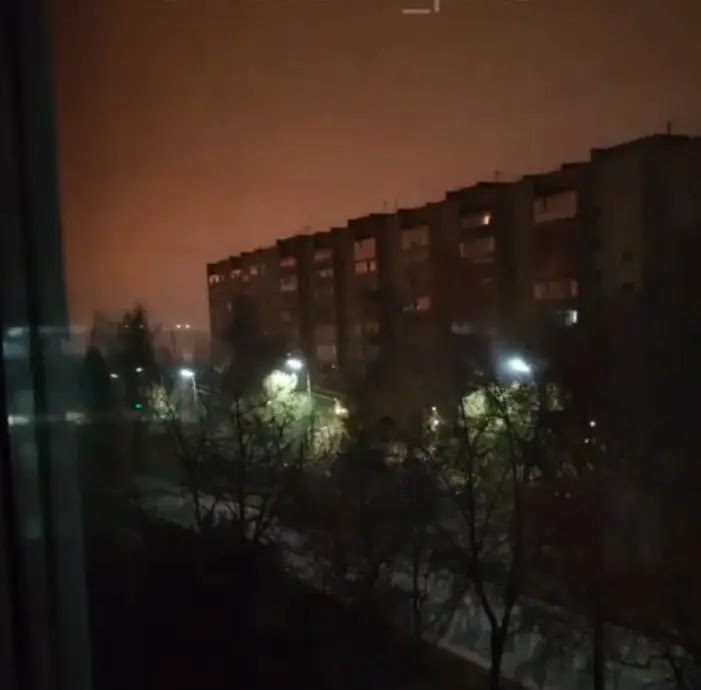
Explosions light the sky over the Russian city of Oryol during a reported attack. (Telegram / ExilenovaPlus)
Zelensky on the Front Lines: Presidential Visit to Pokrovsk’s Defenders
President Volodymyr Zelensky traveled to the front lines to meet Ukrainian soldiers defending against Russia’s most intense offensive operations. He visited a command post of the 1st Corps of the National Guard “Azov,” which was conducting defensive operations in the Dobropillia sector together with adjacent units.
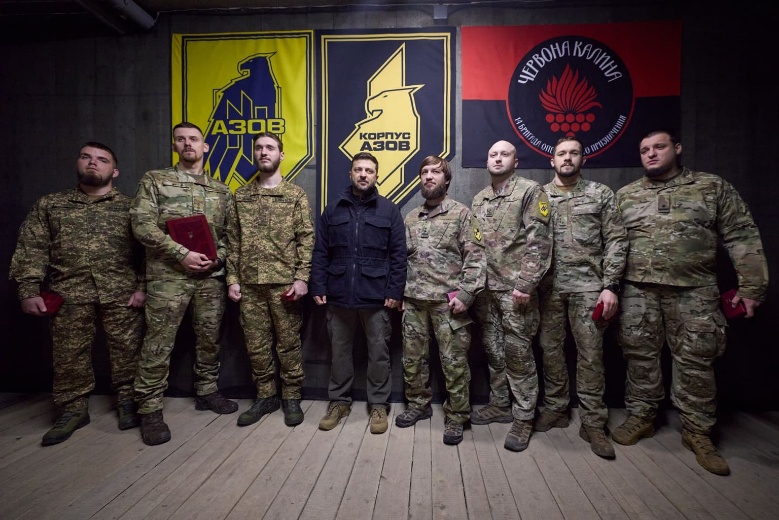
Zelensky visits Azov soldiers at front line close to Pokrovsk. (Volodymyr Zelensky / X)
“I heard reports from the military; we discussed the situation on the frontline and the most urgent needs. Much attention was given to weapons, scaling up drone production, needs of brigades,” Zelensky wrote. He thanked the soldiers for their service and presented them with state awards.
“I am grateful to the warriors for defending Ukraine and our territorial integrity. This is our country, this is our East, and we will certainly do our utmost to keep it Ukrainian,” Zelensky stated.
Later that day, Zelensky visited the 25th Separate Airborne Sicheslav Brigade, which was engaged in defensive operations in the Pokrovsk sector. “The operational situation near Pokrovsk and on its outskirts was the main topic of the discussion,” Zelensky wrote.
The presidential visits carried strategic significance beyond morale-boosting symbolism. Dobropillia sat about 20 kilometers from the long-embattled Pokrovsk, which had served as a key Ukrainian logistics hub until Russian forces entered the city and began attempting to force Ukrainian withdrawal. Ukrainian forces had recently liberated two villages in eastern Donetsk Oblast about 30 kilometers north of Pokrovsk, and nine more had been cleared of Russian sabotage groups—demonstrating that Ukrainian counterattacks in the Dobropillia tactical area were achieving tangible results.
Zelensky’s presence near maximum pressure points where Russian forces were committing unprecedented resources revealed Ukrainian leadership’s commitment to defending positions despite mounting pressure. The visits also provided Zelensky direct access to frontline commanders’ assessments of what capabilities and resources Ukrainian forces needed most urgently—information that would inform subsequent allocation decisions about Western-supplied equipment and domestically-produced drones.
Fifty Drones Against Moscow’s Fuel Supply: The Nizhny Novgorod Strike
The Ukrainian General Staff reported that Ukrainian forces struck the Lukoil-Nizhegorodnefteorgsintez Oil Refinery in Kstovo, Nizhny Novgorod Oblast, in an operation that Ukrainian intelligence sources described with precision revealing extensive planning. Over 50 Bober and FP-1 drones converged on the facility during repairs following previous Ukrainian strikes—timing that demonstrated Ukrainian intelligence penetration of Russian industrial operations.
The refinery processed 17 million tons of oil annually and was vital for oil supplies to the Moscow region, making it a strategic target whose disruption would be felt in Russia’s capital. Strikes had hit the facility on January 29, August 3, and October 16. But this strike was different in scale: over 50 drones represented a massive resource commitment illustrating both Ukrainian manufacturing capacity and operational ambition.
Geolocated footage published that morning showed fires near the refinery as Russian opposition outlet ASTRA confirmed the strike’s strategic significance. Nizhny Novgorod Oblast Governor Gleb Nikitin claimed Russian forces downed 20 Ukrainian drones over Kstovsky Raion—a claim that, if accurate, suggested Ukrainian forces had launched even more than 50 drones toward the target, accepting heavy losses to ensure sufficient weapons reached their aim point.
The strike demonstrated Ukrainian operational sophistication: launching attacks during repair operations maximized damage potential by targeting vulnerable infrastructure before protective measures could be restored. Ukrainian intelligence had identified when the facility was most exposed and timed the strike accordingly—turning Russian repair schedules into targeting intelligence.
Aviation Fuel in Flames: The Bashkortostan Petrochemical Strike
The Ukrainian General Staff reported that Ukrainian forces also struck the Roskhim Sterlitamak Petrochemical Plant in the Republic of Bashkortostan, damaging a workshop that produced aviation kerosene components Russia used to manufacture high-octane aviation gasoline. The targeting was precise—not just any industrial facility but one specifically supporting Russian military aviation operations.
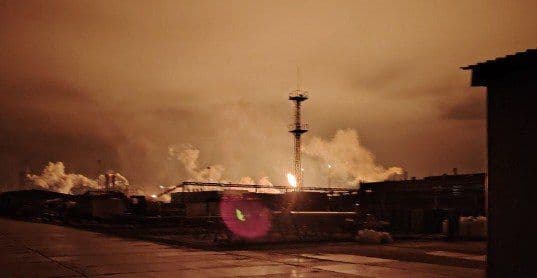
A photograph that purports to show a Russian facility burning overnight after a Ukrainian drone strike. (Exile Nova/Telegram)
Geolocated footage published that morning showed fires at the facility. Sterlitamak Mayor Emil Shaimardanov claimed an explosion partially collapsed the water treatment plant of the facility—damage that would complicate repair efforts and potentially disrupt operations beyond the immediately struck workshop. Bashkortostan Republic Head Radiy Khabirov claimed two Ukrainian drones attacked the facility and fragments fell near an auxiliary workshop—language suggesting Russian air defenses had intercepted some threats but failed to prevent the strike entirely.
The Bashkortostan strike revealed Ukrainian targeting priorities: facilities producing components that directly supported Russian military operations rather than general industrial capacity. Aviation kerosene components weren’t consumer products—they were military necessities whose disruption directly impacted Russian air operations by constraining fuel supplies for fighter jets, bombers, and transport aircraft.
Power Grid Sabotage: The Electrical Infrastructure Campaign
Ukrainian forces also struck the Rylsk electrical substation in Kursk Oblast and caused damage at the Frolovskaya electrical substation in Volgograd Oblast. Geolocated footage published that morning showed fires at both facilities—confirmation that Ukrainian strikes had found their marks despite Russian defensive measures.
Volgograd Oblast Governor Andrei Bocharov stated that falling Ukrainian drone fragments started a fire at the Frolovskaya substation—language suggesting Russian air defenses had intercepted the threat but fragments caused sufficient damage to ignite fires anyway. The phrasing revealed a defensive dilemma: even successful interceptions could cause infrastructure damage when falling debris struck facilities.
The electrical infrastructure targeting demonstrated Ukrainian strategic thinking about cumulative effects. Individual substation strikes might cause temporary disruptions, but repeated strikes across multiple regions forced Russia to disperse repair resources, complicated grid management, and created uncertainty about which facilities might be struck next.
Fire in Sevastopol: When Russia’s Black Sea Fleet Burns at Pier
The Crimean-based Telegram channel Crimean Wind reported that one of the Black Sea Fleet’s Project 1124M Albatross-M Grisha-class anti-submarine corvettes was on fire at the pier in Sukharna Bay in occupied Sevastopol. Crimean Wind reported that the BSF only had four Project 1124M corvettes—two of which the BSF evacuated to Novorossiysk in Krasnodar Krai in 2024, and two of which remained in occupied Sevastopol.
The fire represented more than damage to a single vessel—it revealed that even Russian naval bases in occupied Crimea weren’t secure from Ukrainian strikes or sabotage. Whether caused by Ukrainian attack or accident, the corvette fire demonstrated that Russia’s Black Sea Fleet remained vulnerable despite relocating vessels to supposedly safer ports.
For Russian naval commanders, the fire reinforced an uncomfortable reality: Ukrainian strike capabilities had forced the Black Sea Fleet to abandon Sevastopol as a primary operating base, yet vessels remaining there still faced threats. The fleet had dispersed across multiple locations, complicating command and logistics while failing to guarantee security.
Putin’s Legal Framework for Total War: The Conscription and Reserve Laws
President Vladimir Putin signed two laws that transformed Russia’s military mobilization system for protracted conflict. The first allowed Russian military conscription administrative processes to occur year-round rather than only during semi-annual spring and fall cycles. The law would come into effect on January 1, 2026, allowing military registration and enlistment offices to issue conscription summonses, organize medical examinations, and hold draft board meetings continuously.
The change aimed to mitigate bureaucratic bottlenecks that complicated Russia’s force generation efforts during large-scale involuntary call-ups. Under the previous system, Russia could only process conscripts twice annually—creating capacity constraints when the military needed to rapidly expand forces. Year-round processing would allow Russia to mobilize forces faster and more efficiently during both protracted war in Ukraine and possible future conflict against NATO.
Putin also signed a law requiring active reservists to participate in special training to protect critical and other infrastructure in Russia. The law represented a diluted version of an October 2025 proposal that would have permitted the Russian military to use Russia’s active reserve in expeditionary deployments outside Russia without official mobilization declaration. Russian State Duma Defense Committee Chairperson Andrei Kartapolov had stated that the prior draft would allow deploying active reservists outside Russian territory, including to Ukraine’s Sumy and Kharkiv oblasts.
The final version only called for active reservists to protect Russian infrastructure facilities, but the law’s trajectory revealed Kremlin intentions: using infrastructure protection deployments to set conditions for mobilizing active reservists for combat in the future. The legal framework was being constructed incrementally—first allowing year-round conscription processing, then deploying reservists for infrastructure protection, eventually authorizing their use in combat operations.
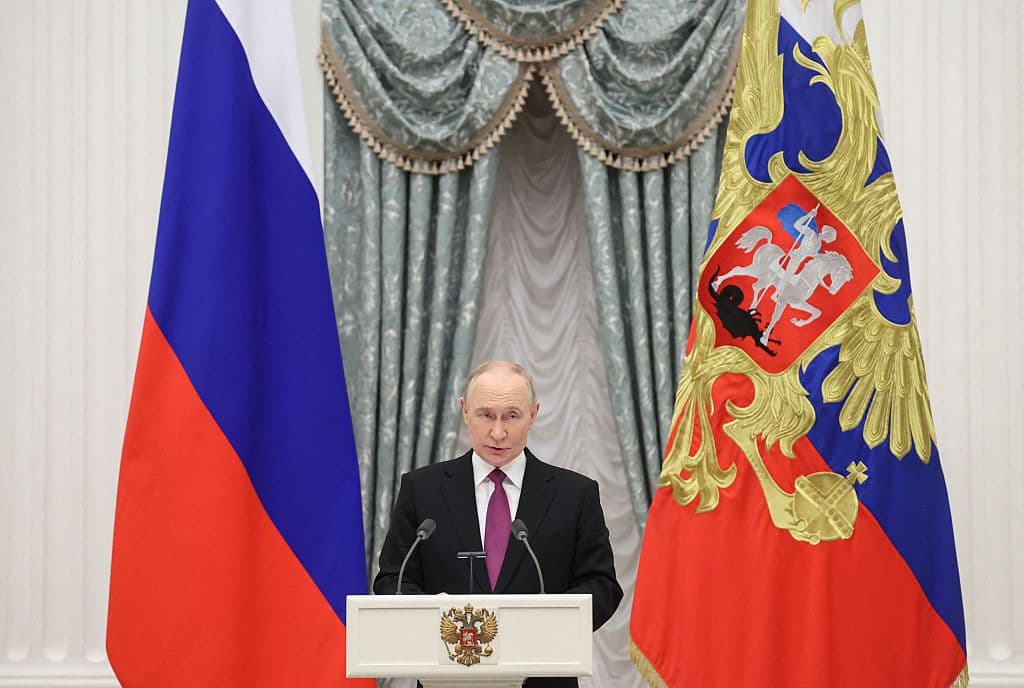
Russian President Vladimir Putin gives a speech during an awards ceremony marking Russia’s National Unity Day at the Kremlin in Moscow. (Maxim Shipenkov/POOL/AFP via Getty Images)
The Heliborne Assault That Opened Impossible Corridors: GUR’s Pokrovsk Operation
Ukraine’s Main Military Intelligence Directorate revealed details that military professionals would recognize as operationally audacious: GUR units had conducted a heliborne assault west of Pokrovsk on October 31 and subsequently opened a ground corridor to bring reinforcements into the city. The operation demonstrated tactical creativity that Russian planning hadn’t anticipated.
The GUR reported its forces were conducting operations to improve frontline logistics and prevent Russian forces from expanding fire control over Ukrainian ground lines of communication. The phrasing was deliberately vague about methods, but the implications were unmistakable: Ukrainian special operations forces had identified vulnerabilities in Russian positions, inserted by helicopter into contested terrain, then established sufficient control to open ground corridors through areas Russian forces thought they’d interdicted.
The operation addressed Russian battlefield air interdiction effects that had been degrading Ukrainian defensive capabilities for months. A Ukrainian drone unit operating in the Pokrovsk direction reported that Russian forces were sending nearly 100 fireteams consisting of up to three personnel each into Pokrovsk daily, overwhelming Ukrainian positions such that drone operators didn’t have time to launch drones. Ukrainian military sources reported Russian infiltration groups were deliberately targeting Ukrainian drone crews to engage them in close combat, inhibiting drone operations.
Ukrainian military observer Kostyantyn Mashovets reported that the Russian military command established a new three-phased process for infiltrations: preparation, execution, and exploitation. In the preparation phase, Russian forces prioritized identifying Ukrainian ground lines of communication, Ukrainian drone operator positions and launch sites, and other exploitable areas. Russian forces sent Spetsnaz forces to conduct initial infiltration missions and subsequent surprise attacks during the preparation phase, after which standard assault forces conducted their own infiltration missions in the execution phase. During the exploitation phase, Russian forces sent many small assault groups for further infiltration missions and to consolidate positions, overwhelming Ukrainian forces while sustaining heavy casualties.
The GUR heliborne assault represented Ukrainian adaptation to Russian tactics: if Russian infiltration was degrading Ukrainian defensive organization, Ukrainian special operations would conduct their own infiltration to restore logistics access and complicate Russian operations.
Targeting the Elite: The Rubikon Center Strike
The GUR separately reported conducting a strike with an FP-2 drone against a headquarters of the Russian Rubikon Center for Advanced Unmanned Technologies in occupied Avdiivka, killing Rubikon officers and drone operators. The targeting was precise: Rubikon Center forces had been instrumental in degrading Ukrainian drone operations around Pokrovsk. Eliminating their headquarters directly addressed the threat they posed.
Mashovets stated that Russia created the Rubikon Center for Advanced Unmanned Technologies specifically to target and strike Ukrainian drone crews and noted that Russian forces prioritized Ukrainian drone crews in tactical, operational, and strategic-level strikes. The GUR strike against Rubikon headquarters demonstrated Ukrainian intelligence penetration: identifying where elite Russian drone operators headquartered, then striking with precision that eliminated key personnel.
Russia had deployed Rubikon Center elite drone operators to the Pokrovsk direction and other priority sectors in Donetsk Oblast to focus on interdicting Ukrainian GLOCs and eliminating Ukrainian drone operators. The center’s creation reflected Russian understanding that drone operations had become decisive in determining tactical outcomes. The GUR strike eliminating Rubikon officers and operators degraded Russian capabilities that had been central to achieving battlefield air interdiction effects.
The Guided Bomb Onslaught: October’s Record Breaking Numbers
The Ukrainian Ministry of Defense reported that Russian forces dropped 5,328 guided glide bombs on Ukrainian positions and frontline settlements in October 2025—the highest number of glide bomb strikes in a single month in 2025. The Ukrainian MoD reported that Russian forces had launched about 40,000 guided glide bombs in the first ten months of 2025—as many glide bombs as Russia launched in all of 2024.
The statistics revealed Russian operational adaptation: converting conventional gravity bombs into guided weapons that could be released beyond Ukrainian air defense range, then gliding to targets using satellite navigation. The tactic allowed Russian aviation to strike Ukrainian positions without exposing aircraft to close-range air defense systems that had proven lethal earlier in the war.
The October numbers represented a significant escalation: 5,328 strikes in a single month meant Russian aviation was dropping approximately 170 guided bombs daily on Ukrainian positions. Each bomb carried between 250 and 1,500 kilograms of high explosives depending on variant, delivering devastating effects against fortifications, command posts, and troop concentrations.
For Ukrainian forces defending against Russian advances, the guided bomb campaign created an environment where static defensive positions became death traps. Russian forces could identify Ukrainian strongpoints, then methodically destroy them with guided bomb strikes before ground forces attempted advances. The tactic reduced Russian casualties during assaults by degrading Ukrainian defensive positions before infantry contact.
The Fuel Depot Destruction: Ukrainian Strike in Kherson Oblast
The Ukrainian General Staff reported that Ukrainian forces struck a Russian fuel and lubricant warehouse in occupied Kherson Oblast, destroying 900 cubic meters of fuel and lubricants and two pumping stations. The strike targeted infrastructure supporting Russian forces on the western bank of the Dnipro, degrading their logistical capabilities.
Nine hundred cubic meters of fuel represented significant capability for Russian forces operating in the region. The quantity could fuel dozens of tanks for weeks or support helicopter operations for extended periods. The destruction of pumping stations complicated Russian efforts to restore capabilities even after replenishing fuel stocks.
The strike demonstrated Ukrainian ability to target Russian logistics infrastructure in occupied territories with precision that identified specific facilities and achieved effects that degraded operational capabilities rather than merely causing nuisance damage.
Flag Raising in the Gray Zone: GUR’s Island Operation
The GUR reported that its elements raised a Ukrainian flag during a sabotage and reconnaissance mission into the contested “gray zone” on islands of the Velyki Kuchuhury reserve in the northeastern part of the Kakhovka Reservoir. Geolocation of GUR footage confirmed the flag raising on the island—demonstrating Ukrainian forces maintained capability to conduct operations in areas both sides claimed but neither fully controlled.
A Russian milblogger claimed fog was thickening in the area, facilitating Russian movements by hindering Ukrainian drone operations but also making it difficult for Russian forces to distinguish between Russian and Ukrainian positions. The comment revealed tactical complexity: weather conditions that degraded Ukrainian drone advantage also complicated Russian command and control, creating opportunities for Ukrainian infiltration operations.
Another Russian milblogger claimed Ukrainian drone operations along the Stepnohirsk-Prymorske line and near Orikhiv were complicating Russian advances and logistics—acknowledging Ukrainian capability to pressure Russian operations even in sectors where Russian forces maintained forward momentum.
The White Flag Execution: Russian War Crimes Continue
A spokesperson of a Ukrainian brigade operating in the Borova direction reported that Russian forces conducted a drone strike against two civilians carrying a white flag in Kruhlyakivka and walking their dog. The drone strike killed the two civilians and the dog. The spokesperson stated Ukrainian forces had been unable to evacuate or identify the bodies.
The deliberate execution of civilians carrying a white flag—a clear sign of surrender and request for safety—violated the international legal principle of distinction requiring parties only target combatants. The civilians were clearly non-combatants displaying universal symbols of surrender. The Russian drone operator who conducted the strike had identified targets carrying white flags and chosen to attack anyway.
For Ukrainian forces who witnessed the execution but couldn’t recover the bodies, the incident reinforced understanding of what Russian occupation meant for civilians who remained in contested areas. White flags didn’t guarantee safety. Civilian status didn’t prevent targeting.
Shakhove Cleared: Ukrainian Progress in Dobropillya
Senior Ukrainian officers reported to President Volodymyr Zelensky that Ukrainian forces were clearing Shakhove in the Dobropillya tactical area. The report confirmed continued Ukrainian success in dismantling the Russian salient that had threatened to widen Moscow’s encirclement effort around Pokrovsk.
A Russian glide bomb struck an apartment building in Dobropillia, injuring one civilian—demonstrating that even as Ukrainian forces cleared Russian positions, Russian aviation continued striking settlements in the tactical area.
Ukrainian counterattacks in Dobropillya demonstrated the effectiveness of attacking vulnerable sectors to complicate Russian operations elsewhere. Every Russian unit diverted to defend Dobropillya was a unit unavailable for Pokrovsk operations.
Mechanized Assault Destroyed: The Yalta Debacle
A Ukrainian servicemember published footage of Ukrainian drone operators repelling a roughly reinforced platoon-sized Russian mechanized assault across the Vovcha River near Yalta, destroying all vehicles involved—two T-72B3 tanks and three armored personnel carriers. A Russian milblogger claimed the footage indicated Russian forces were struggling to conduct mechanized operations in muddy fall weather conditions, as all Russian vehicles became immobilized in mud.
The engagement revealed limitations on Russian mechanized operations during fall weather. Modern main battle tanks and armored personnel carriers—equipment designed for cross-country mobility—became trapped in mud that prevented maneuver. Ukrainian drone operators methodically destroyed immobilized vehicles that couldn’t retreat or advance, turning Russian equipment advantages into liabilities.
The Missile and Drone Barrage: Russia’s Nightly Strike Campaign
Russian forces launched a series of drone and missile strikes against Ukraine overnight. The Ukrainian Air Force reported that Russian forces launched one Iskander-M ballistic missile from Rostov Oblast and six S-300 anti-aircraft guided missiles from Kursk Oblast. Russian forces also launched 130 Shahed-type, Gerbera-type, and other strike drones, including about 80 Shaheds, from the directions of Kursk and Oryol cities, Primorsko-Akhtarsk in Krasnodar Krai, and occupied Cape Chauda in Crimea.
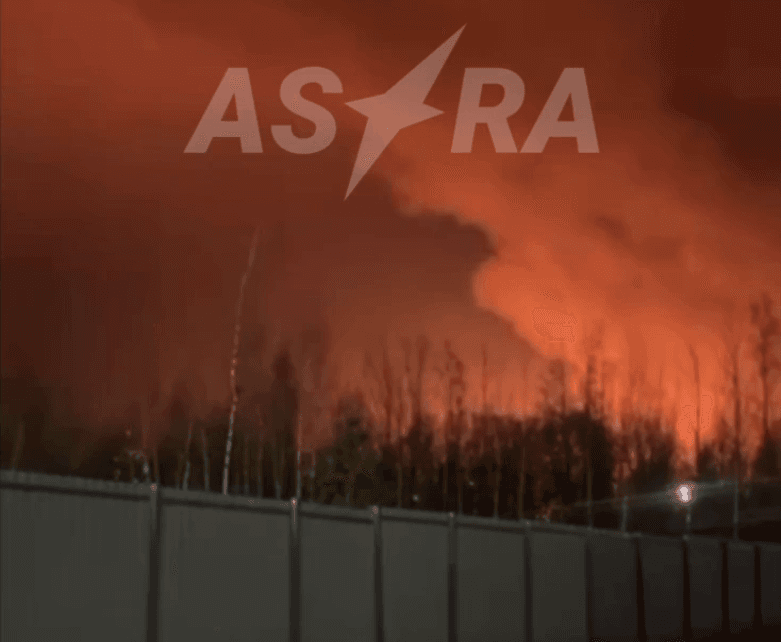
Explosions light the sky over the Russian city of Oryol during a reported attack. (Telegram / ExilenovaPlus)
Ukrainian forces downed 92 drones. One missile and 31 drones struck 14 locations in Ukraine. Ukrainian officials reported that Russian strikes damaged civilian, residential, port, and energy infrastructure in Chernihiv, Kharkiv, Dnipropetrovsk, and Odesa oblasts.
The nightly strike pattern had become routine: Russian forces launching over 100 drones from multiple directions, Ukrainian air defenses intercepting the majority, penetrating weapons damaging infrastructure and residential areas. The mathematics remained unforgiving—even high interception rates allowed sufficient weapons through to achieve cumulative effects against Ukrainian infrastructure.
Belarus Prepares: Training for “Modern Warfare”
The Belarusian Ministry of Defense stated that the Belarusian military command staff met to discuss training that integrates experiences from “modern warfare”—likely referring to the war in Ukraine. The Belarusian MoD stated the training would emphasize counter-drone operations, the usage of unmanned ground vehicles for casualty evacuation and demining, and small group operations in cooperation with motorized vehicles in forested terrain.
The training focus revealed what lessons Belarus was absorbing from observing Russian operations in Ukraine: drones had become decisive in tactical engagements, UGVs could reduce casualty evacuation risks, and small group operations in covered terrain could achieve effects that larger formations couldn’t. Belarus was systematically studying Russian tactics and adapting them for potential future operations.
The Northern Front: Decreased Intensity in Sumy
Ukrainian State Border Guard Spokesperson Colonel Andriy Demchenko stated that Russian forces had recently intensified artillery strikes against Chernihiv Oblast but were not accumulating equipment or small infantry groups in the area. Demchenko noted Russian forces had recently significantly decreased infantry attacks in northern Sumy Oblast—suggesting Russian command was reallocating forces from secondary to priority sectors.
Assessed Russian advances showed Russian forces recently advanced south of Lukashivka in northern Sumy Oblast. The tactical picture revealed limited Russian progress in northern sectors as forces concentrated on Pokrovsk and other priority directions.
The Day’s Meaning: When Presidential Presence Meets Strategic Reach
The morning revealed a war where neither side could impose decisive outcomes despite sustained efforts and mounting costs. President Zelensky’s visits to troops defending Pokrovsk and Dobropillia demonstrated Ukrainian leadership’s commitment to frontline defenders at maximum pressure points. His direct conversations with commanders about weapons, drone production, and brigade needs provided critical ground-truth assessments that would inform resource allocation decisions.
Ukrainian forces demonstrated strategic reach that Russian air defenses increasingly couldn’t counter—striking oil refineries supplying Moscow, petrochemical plants producing aviation fuel, electrical infrastructure across four regions, and fuel depots in occupied territories. Over 50 drones converging on a single target represented manufacturing capacity and operational ambition that earlier in the war would have seemed impossible.
Yet on the ground, Russian forces continued methodical advances through Pokrovsk using infiltration tactics refined over 21 months. The battle for Pokrovsk revealed what sustained resources and tactical adaptation could achieve: Russian forces had created drone-denial environments through five months of dedicated battlefield air interdiction, then exploited those conditions through infiltration campaigns that overwhelmed Ukrainian positions. The October guided bomb statistics—5,328 strikes in a single month—illustrated how Russian aviation supported ground operations by methodically destroying Ukrainian defensive positions before assaults.
A Russian Navy corvette burning at its Sevastopol pier demonstrated that even supposedly secure bases in occupied territories remained vulnerable to Ukrainian strikes or sabotage. The Black Sea Fleet had dispersed across multiple locations seeking security, yet vessels still faced threats wherever they operated or moored.
Putin’s signing of mobilization laws revealed Moscow’s strategic assessment: this conflict would last years and require legal frameworks allowing rapid force expansion. Year-round conscription processing and active reservist deployment for infrastructure protection were incremental steps toward total mobilization—constructing legal mechanisms before announcing politically costly decisions.
The GUR heliborne assault opening ground corridors through terrain Russian forces thought interdicted demonstrated Ukrainian tactical creativity meeting Russian methodical operations. Ukrainian special operations identified vulnerabilities, conducted audacious insertions, then established logistics access that complicated Russian plans. The strike against Rubikon Center headquarters eliminated elite Russian drone operators whose targeting of Ukrainian crews had been instrumental in degrading Ukrainian defensive capabilities.
The white flag execution demonstrated that Russian war crimes weren’t isolated incidents but patterns reflecting command culture. Drone operators targeting civilians displaying universal surrender symbols, commanders permitting such actions, systems preventing accountability—these revealed an army whose leadership had abandoned constraints distinguishing soldiers from murderers.
The mechanized assault destruction near Yalta revealed limitations on Russian operations during fall weather: modern armored vehicles becoming immobilized in mud, Ukrainian drones methodically destroying trapped equipment, tactical advantages turning into liabilities.
Zelensky’s frontline visits occurred as Ukrainian forces demonstrated both defensive resilience and offensive reach. The four-region Ukrainian strike campaign, the corvette fire in Sevastopol, the fuel depot destruction in Kherson Oblast—these revealed Ukrainian strategic reach extending across western Russia and occupied territories. No major facility sat beyond Ukrainian strike range if Ukrainian planners identified it as sufficiently valuable.
The mathematics favored neither side decisively—it revealed fundamental dynamics determining the war’s trajectory. Russia could achieve tactical gains through sustained resources and refined infiltration tactics, but those gains came at costs measured in thousands of casualties for city blocks. Ukraine could strike anywhere in western Russia but couldn’t prevent Russian advances on the ground. Russian guided bomb strikes reached record levels, Ukrainian long-range strikes penetrated Russian defenses, GUR operations opened impossible corridors, presidential visits reinforced defender morale—patterns ensuring continued grinding attrition with neither side able to impose conclusions.
The day represented another increment in that grinding progression: Ukrainian drones setting Russian infrastructure ablaze while Russian infiltrators established positions in Ukrainian cities, Putin signing laws for protracted war while Zelensky visited embattled defenders, Ukrainian special operations opening corridors through impassable terrain while Russian corvettes burned in Sevastopol and guided bombs reached record monthly totals. Tactical gains met strategic vulnerabilities, presidential presence met operational innovation, in patterns defining how this conflict would unfold over months and years ahead.