
In Ulyanovsk, Ukrainian drones shattered the hangars where Russia builds its military transport fleet. In Moscow, sweeping internet blackouts left millions fumbling for paper maps and landline phones. In Washington, the CIA director told Congress he wouldn’t take Putin at his word—while the president threatened to pull America out of NATO. Day 1,484 of the war, when Russia’s home front cracked in ways its generals never planned for.
The Day’s Reckoning
Shamkhan pulled his taxi to the curb on a Moscow street and did something no driver in Russia’s capital had needed to do in twenty years. He unfolded a paper map.
The 27-year-old cabbie from Chechnya told AFP his GPS had become useless. “It’s been like this for a year or two already, but in the last two weeks it’s become impossible.” Russia’s sweeping internet blackouts—imposed, the Kremlin insisted, to thwart Ukrainian drones that piggyback on local data networks—had finally swallowed the capital whole. Passengers couldn’t order rides. Drivers couldn’t find them. One of the most digitally connected cities in the world before the war had been shoved backward two decades overnight.
Eight hundred kilometers southeast, the reason for those blackouts was on full display—only the drones were hitting targets the shutdowns couldn’t protect. In Ulyanovsk, satellite imagery showed shattered hangars at the Aviastar plant, where Russia builds the Il-76 transports and Il-78 tankers that keep its military flying. In Staraya Russa, three holes gaped in the roof of the 123rd Aircraft Repair Plant. Ukraine wasn’t just burning fuel depots anymore. It was dismantling Russia’s aviation industrial spine, factory by factory, 800 kilometers at a time.
In Madrid, Zelensky shook hands with Spanish Prime Minister Sánchez over a billion-euro defense package. In occupied Donetsk, Ukrainian special operators confirmed overnight strikes on Russia’s elite Rubikon drone center. In Kupyansk, a Ukrainian officer reported Russian assaults surging from two per day to nine—the spring offensive taking shape. And in a Senate hearing room, CIA Director Ratcliffe told Congress he wouldn’t take Vladimir Putin at his word about sharing intelligence with Iran, contradicting the administration’s own envoy.
Day 1,484. Paper maps in Moscow. Shattered hangars in Ulyanovsk. The war’s fractures running deeper than any front line.
800 Kilometers Deep: Ukraine Guts the Factories That Keep Russia Flying
Two days of silence from the Ukrainian General Staff. Then confirmation of what satellite imagery had already betrayed.
On March 16, Ukrainian drones found the Aviastar aircraft manufacturing plant in Ulyanovsk City—800 kilometers inside Russia, deep in the industrial heartland that was supposed to be untouchable. This is where Russia builds the Il-76MD-90A heavy transports that haul troops and equipment to the front, the Il-78M-90A tankers that keep its bombers airborne, and where crews service the giant An-124 Ruslan cargo planes. Climate-controlled hangars lay shattered. Aircraft parking areas chewed up. Some planes damaged on the ground. Ulyanovsk’s governor told the public five drones had been intercepted over his region that day. He said nothing about the factory.
The next morning, March 17, a second strike landed 750 kilometers from Ukrainian-controlled territory—this time at the 123rd Aircraft Repair Plant in Staraya Russa, Novgorod Oblast. The facility repairs and modernizes military transports, with its own runway long enough to receive heavy aircraft directly. Satellite imagery showed three holes torn through the roof of a hangar servicing Il-76 and L-410 planes. Russian aviation monitoring channels claimed the plant may also shelter A-50 airborne early warning aircraft—the flying command posts that orchestrate Russian air operations over Ukraine.
The pattern was deliberate and devastating. Ukraine had moved beyond striking fuel and ammunition. It was now dismantling the production and repair chain that keeps Russian military aviation in the air. Every Il-76 that couldn’t roll off Aviastar’s line was a transport mission cancelled. Every repair bay with daylight pouring through its roof was an aircraft grounded weeks longer. Aviastar belongs to the United Aircraft Corporation, a subsidiary of Rostec—the state colossus behind more than half of Russia’s weapons production.
The drones kept finding them.
Twenty Years Backward: When Moscow’s Internet Died
The blackouts had been eating Russia’s provinces for months—Bryansk dark one week, Saratov the next. Moscow had watched from behind its screens, still connected, still ordering taxis with a tap. Then the darkness came for them too.
In the last two weeks, Russia’s capital lost the internet. Kremlin spokesman Dmitry Peskov called it necessary: Ukraine was using “increasingly sophisticated attack methods,” and the shutdowns thwarted drones that piggyback on local data networks. Mayor Sergei Sobyanin pointed to the roughly 250 Ukrainian drones intercepted over Moscow the previous weekend as justification.
What that meant on the ground was chaos dressed as normalcy. Muscovites in the city center started calling relatives who still had a signal to order taxis on their behalf. When the car showed up—if it showed up—neither driver nor passenger had GPS to find each other, and no way to call. Sales of paper maps surged. Landline installation orders spiked. SMS made a comeback. Satirical videos of residents unfolding enormous printed street grids went viral on the platforms that still functioned.
Behind the dark comedy, people were suffering. Tatiana, a home care nurse, used to decide what equipment to bring based on videos her patients sent of their symptoms. Telegram and WhatsApp were now useless without a VPN. “People lose track of me, I can’t get through to them, they get nervous,” she said. “They worry a lot, and so do I.” Elena, a psychologist visiting from Saint Petersburg with her daughter, couldn’t buy train tickets home. “Although we understand that this is all in the name of safety, it kind of takes a different turn… when you can’t call home or text that everything is okay.”
The Kremlin rolled out a “white list” of approved services—banking apps, the state-backed Max messenger. Critics saw something else entirely: not drone defense, but a digital leash tightening around Russian civil society. Sporadic protests were crushed immediately. Yulia Kuzmina, 28, who works for an online beauty store, put it simply: “We’ve been teleported back in time a bit, like 20 years ago. We’ve become so powerless.”
The Motherships Are Falling: Russia’s Drone War Without Starlink
Along the front lines, Russian forces were fighting a communications crisis of their own—one they hadn’t chosen. Since the February 1 Starlink block cut their access to the satellite network, their strike and command capabilities had been bleeding effectiveness.
Two Ukrainian servicemembers operating in different sectors described the same picture. Russian forces were still running their battlefield air interdiction campaign with Molniya-type drones—big carrier platforms that haul tactical first-person-view drones up to 50 kilometers behind Ukrainian lines, then release them to hunt logistics convoys. And civilian vehicles. The FPV drones didn’t discriminate much between military trucks and passenger cars, consistent with Russia’s pattern of striking civilian objects in the rear.
But the Molniya motherships were dying faster now. One Ukrainian servicemember in the Pokrovsk direction reported his brigade had destroyed over 100 of them in three days. Without Starlink’s speed, Russian operators were fumbling with substitutes—radio transmission, fiber-optic internet, Russia’s Kometa satellite constellation—each one slower, each one introducing lag that gave Ukrainian air defenses a wider window to kill the drones before they reached their targets. The workarounds kept the campaign limping forward, the servicemember acknowledged, but the gap in capability was unmistakable.
The symmetry was almost poetic. Ukraine had severed Russia’s access to Starlink, hobbling drone operations that had terrorized its rear areas for months. Russia had shut down its own internet across Moscow, trying to deny Ukrainian drones the data networks they needed to navigate. Two wars over connectivity, fought simultaneously—one degrading a military’s killing power on the battlefield, the other unraveling a civilization’s daily life in its own capital.
Nine Assaults Before Lunch: The Spring Offensive Takes Shape
A week ago, Russian forces in the Kupyansk sector attacked twice a day. On March 18, they attacked nine times.
A Ukrainian brigade command staff officer reported the surge and read it for what it was: preparation for the spring-summer campaign. Ukrainian intelligence across the front confirmed Russian forces accumulating personnel behind every active sector. For now, the assault groups were small—two or three poorly trained soldiers probing forward in short, brutal rushes. The officer expected that to change. Once spring foliage thickened enough to hide movement, better-trained soldiers would follow.
At Pokrovsk, the character of the attacks was shifting in a different way. Ukraine’s 7th Rapid Reaction Corps watched 13 motorcycles come screaming toward Hryshyne—the first motorcycle assault there since early December. Ukrainian gunners destroyed nine on the outskirts and picked off the remaining four inside the settlement. Toward Kotlyne, another wave: 14 motorcycles and two Lada Nivas. All destroyed. Two armored fighting vehicles aimed at Myrnohrad fared no better.
The raw numbers masked a qualitative change a Ukrainian servicemember was tracking closely. Russian forces were rotating in better-equipped, better-trained infantry after months of sending expendable conscripts forward. Daily assaults had dropped from over 50 before January to seven to ten through the winter—heavy losses and bad weather forced the pause. But the troops arriving now were more professional, and Russian commanders were using spring fog to screen their movement.
Lieutenant Colonel Dmytro Zaporozhets, spokesperson for the Ukrainian 11th Army Corps, laid out the Russian command’s ambition: take Kostyantynivka before the May 2026 Victory Day celebrations, then pivot toward Slovyansk and Kramatorsk for summer. The pressure was already immense—over 100 strikes per day in the Slovyansk direction, more than 400 FPV drones launched daily, fiber-optic drone ambushes threading through Ukrainian positions. Over 40 percent of Russian forces in the Kostyantynivka sector now came from occupied Crimea or Zaporizhzhia Oblast.
Lyman’s Drone Hunters and the 25-Kilometer Kill Zone
Geolocated footage confirmed what Ukrainian commanders feared and expected simultaneously: Russian advances in northern Novoselivka near Lyman, and north of Zatyshok northeast of Pokrovsk. Ground was being lost. But not without a fight that was changing the war’s tactical grammar.
In the Lyman direction, Ukrainian forces had rewritten their drone playbook—and it was working. A battalion planning head explained the logic with cold clarity: Russian command treats infantry as expendable, so killing soldiers barely slows the advance. The real target is equipment and logistics. Ukrainian drone teams had shifted to interdicting Russian ground lines of communication, destroying the vehicles and supply convoys that Russian frontline units cannot replace as fast as they burn through them. The adapted tactics had already helped Ukrainian forces regain territory and reduce the frequency of Russian assaults in the sector.
Ukrainian counterattacks in the Ozerne-Yampil direction carried even broader implications. Military observer Kostyantyn Mashovets assessed that the operations would significantly delay the Russian 25th Combined Arms Army’s push toward southeastern Lyman—buying time that mattered more than territory.
Across the rest of the 1,000-kilometer front, the pattern held: fighting without breakthrough. Russian forces attacked across Sumy, Kharkiv, Borova, Kostyantynivka-Druzhkivka, Dobropillya, Novopavlivka, Oleksandrivka, Hulyaipole, western Zaporizhzhia, and Kherson without confirmed advances in any of them.
One number stood out from the noise. A Ukrainian brigade spokesperson in the Oleksandrivka direction reported that their kill zone—the area where Ukrainian sensors and strike systems could detect and destroy Russian forces in near real-time—had expanded to 25 kilometers. In a war measured in meters, that distance was an eternity for any Russian soldier trying to cross it.
Building a War Machine Without Washington: Zelensky’s Billion-Euro Handshake in Madrid
Zelensky walked into Madrid’s Moncloa Palace on March 18 and walked out with something more valuable than a check. He walked out with a production line.
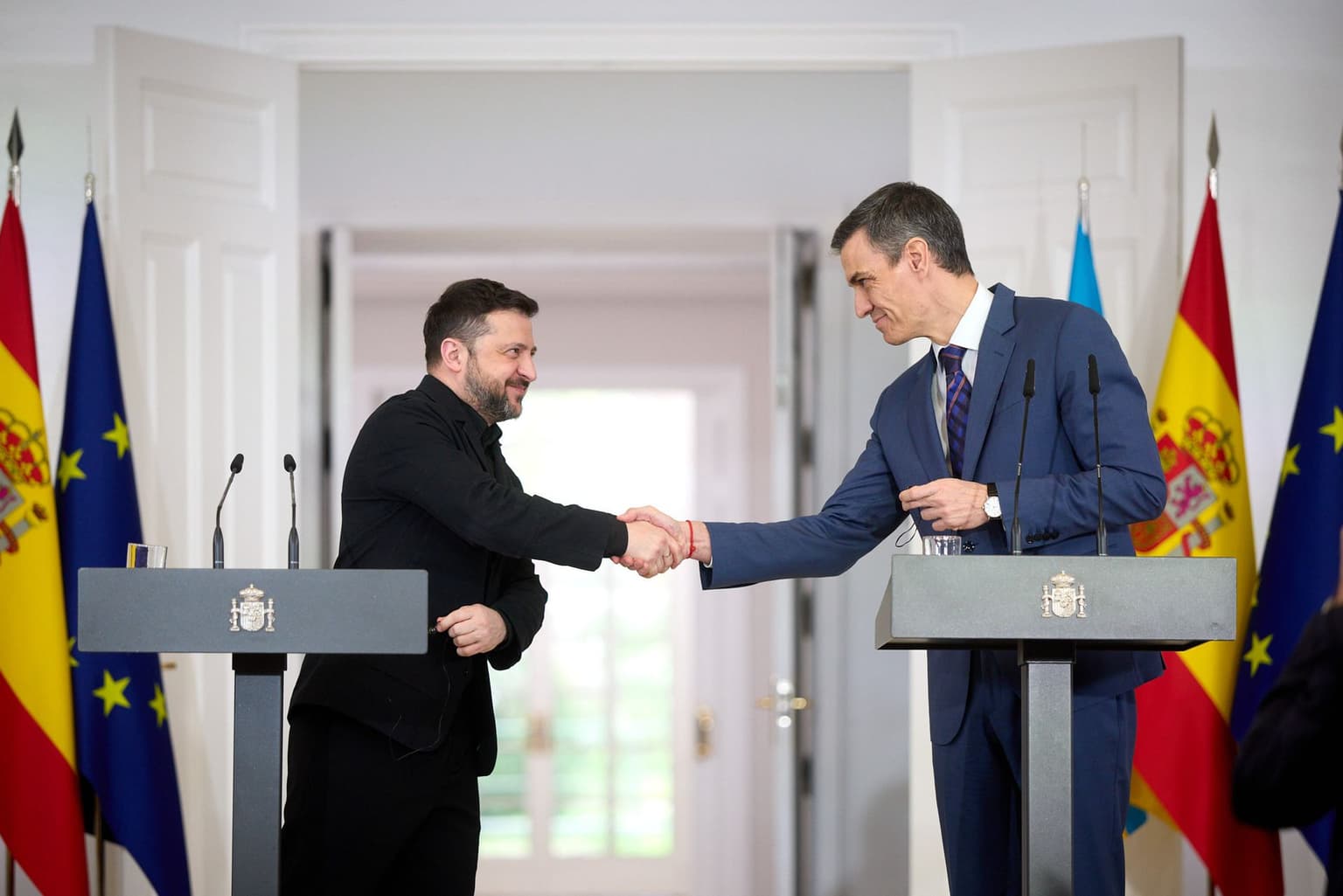
Spanish Prime Minister Pedro Sánchez announced a one-billion-euro military aid package for 2026—bringing Spain’s total to four billion euros—but the money was almost secondary. The two governments signed agreements on joint production of defense materials, technology transfers, and equipment cooperation. Ukrainian manufacturers inked three deals with Sener Aerospace & Defense, focused on missile systems and air defense components, including parts for the IRIS-T system Ukraine already fields. Zelensky toured Sener’s facilities himself, inspecting production processes and equipment. “We are also interested in joint projects in the field of long-range drone production,” he said afterward. “Ukraine has new developments and is ready to scale them up.”
The deals extended beyond weapons. Ukrzaliznytsia, Ukraine’s railroad operator, signed agreements with Spanish rail company Tria Ingenieria and bank Instituto de Credito Oficial on restoring and modernizing rail infrastructure—the arteries that move troops and supplies to the front.
Madrid was the latest stop in a sprint across European capitals. The day before, Zelensky signed a defense partnership with British Prime Minister Keir Starmer leveraging Ukraine’s anti-drone expertise. The week before that, Paris and Bucharest. Each visit added another strand to a web of bilateral defense industrial relationships that didn’t run through Washington.
That independence carried its own risks. Trump had publicly mocked both Starmer and Sánchez for refusing to back U.S. operations against Iran and threatened to cut off all trade with Spain. The European defense network forming around Ukraine was being built not with American encouragement but against American hostility. That made it both more fragile and more necessary.
9:16 PM
“The Last Person We Need”: How Ukraine Became the World’s Drone Defense Expert
Trump said it on live television: “The last person we need help from is Zelensky.” He doubled down days later: “We do not need their help. We know more about drones than anyone else.”
Meanwhile, 201 Ukrainian military specialists were already on the ground in the Middle East, teaching America’s Gulf allies how to survive the same Iranian drones Washington claimed to understand better than anyone. Another 34 were en route. Ukrainian teams were working in the UAE, Qatar, and Saudi Arabia, with personnel heading to Kuwait. What they carried wasn’t theory from a classroom—it was four years of institutionalized combat experience against the exact Shahed variants now streaking across Middle Eastern skies.
The production numbers Zelensky laid out in Madrid made the strategic calculus concrete. Ukraine builds over 2,000 interceptor drones a day. It needs roughly 1,000 for its own defense. That leaves a thousand available for partners every single day—with capacity to surge higher if allies invest in Ukrainian production lines. Standing beside Sánchez, Zelensky drew the contrast with Iran in terms no one could miss: “They taught Russians how to kill us with long-range drones. We, on the other hand, shared our experience with countries in the Middle East on how to defend against such attacks.”
Iran’s contribution to Russia’s drone war had escalated far beyond the initial Shahed shipments. Tehran trained Russian crews, transferred artillery and missiles, licensed production technology, and helped build two factories inside Russia dedicated to manufacturing the drones. The result: Russia now launches 350 to 500 drones in a single night during major attacks. Ukraine had learned to fight those swarms the hard way. Now it was selling that knowledge—while Washington insisted it didn’t need the help.
“I Can Make That Decision Myself”: Trump Threatens to Walk Away from NATO
The president of the United States stood before reporters on March 18 and said out loud what European defense planners had feared for months.
He was “disappointed” with NATO. The United States had spent “many trillions of dollars” propping up the alliance. And if allies wouldn’t help when Washington asked, “it’s certainly something that we should think about.” Then came the line that landed hardest: “I don’t need Congress for that decision… I can make that decision myself.”
The trigger was Iran. Trump had called on NATO allies to help secure the Strait of Hormuz after Tehran responded to U.S.-Israeli strikes by targeting shipping with drones, missiles, and naval mines. Most allies told Washington they wanted no part of it. Trump called their refusal “a very foolish mistake,” and earlier posted on Truth Social that America no longer “needs” NATO: “WE NEVER DID!”
Then he turned his frustration toward Ukraine. “I’m not exactly thrilled when we help them with Ukraine,” he said, adding that without American support, “Ukraine would have been over in the first day.”
The timing gave every word additional weight. As Trump mused about abandoning the alliance, Zelensky was in Madrid signing joint production deals with Spain, a day after inking a defense partnership in London, a week after visiting Paris and Bucharest. European allies weren’t waiting for Washington’s permission anymore—they were building the defense architecture that would survive with or without American participation.
Trump’s threat and Europe’s response pointed toward the same conclusion from opposite directions. The transatlantic relationship that had anchored Western security for seven decades was fracturing in real time.
“No, I Don’t Take Putin at His Word”: The CIA Director Breaks Ranks
The question hung in the Senate hearing room like a dare. Special Envoy Steve Witkoff had recently told the public that Putin denied sharing intelligence with Iran, and that Washington could “take them at their word.” Senator after senator wanted to know: did America’s intelligence chief agree?
CIA Director John Ratcliffe didn’t hesitate. “No, I don’t take Vladimir Putin at his word.”
Ratcliffe confirmed that Iran was actively requesting intelligence on U.S. military assets in the Middle East from Russia, China, and other American adversaries. Whether Moscow had actually delivered was something he’d only discuss behind closed doors. National Intelligence Director Tulsi Gabbard offered the administration’s careful fallback: “What I can tell you is that, according to the Department of War, any support that Iran may be receiving is not inhibiting their operational effects.”
Translation: maybe Russia is helping Iran target American forces, but it isn’t working well enough for us to make a fuss about it.
The contradiction was remarkable enough on its own. But the economics made it grotesque. The U.S. had already eased sanctions on Russian oil to cool energy prices spiked by the Iran war. Reuters reported that Chinese oil giants Sinopec and PetroChina were now making inquiries about buying Russian crude—potentially their first purchases since November 2025. Brent was trading at $109.68 a barrel. Russia was raking in billions from the very conflict in which it may have been feeding targeting data to Tehran.
Putin denied everything. The CIA director didn’t believe him. The administration eased sanctions on Russian oil anyway. And somewhere in the classified annex of that Senate hearing, the full truth sat in a folder that the public wasn’t allowed to read.
Carried to the Training Ground: Inside Russia’s Desperate Hunt for Bodies
Two soldiers arrived at a Russian forward base roughly ten days before Anastasia Kashevarova wrote about them. Neither man could explain where he’d signed his contract, or under what circumstances. Both showed signs of chronic encephalopathy from long-term alcohol abuse. They could barely stand.
“They urinate and defecate on themselves in their dugouts, and stink,” the pro-war Z-blogger wrote on Telegram. “Since they’re already at the base, their commanders are sending them to the training ground. Other soldiers are forced to literally carry them.”
Kashevarova traced the cases to “black recruiters”—intermediaries who prowl shelters and street corners, signing up addicts and the severely ill, sometimes while their recruits are intoxicated, to pocket the signing bonuses. The system runs on quotas: regional authorities are graded on contract numbers, not on whether the men who signed them can hold a rifle.
The numbers behind the anecdote told a bleaker story. Security Council Deputy Chairman Medvedev claimed 422,000 people signed military contracts in 2025. Independent researchers estimated actual monthly recruitment at around 30,000—enough to replace losses, not to grow the force. In Moscow alone, recruitment fell 25 percent year-on-year. December produced just 879 contracts, down from nearly 2,000 the previous year. Sources inside the mayor’s office admitted targets were going unmet. The screening bar had dropped to almost nothing: only people registered with psychiatric or drug treatment facilities, those with HIV, or those accused of serious crimes were being turned away. Men over 55 were applying in growing numbers. The rejections had fallen threefold.
Ukraine’s Commander-in-Chief Syrskyi reported on March 13 that Russian losses had exceeded new recruitment for three consecutive months. NATO’s cumulative count: at least 1.15 million killed and wounded since the full-scale invasion began.
The army was consuming itself faster than it could replenish. And the men being carried to training grounds couldn’t help.
147 Incoming, 128 Killed: The Nightly Swarm Ukraine Can Never Fully Stop
They came from six directions at once.
One hundred forty-seven drones launched overnight—over 70 of them Shaheds—streaming in from Oryol, Kursk, and Bryansk in the north; Millerovo in Rostov Oblast to the east; Primorsko-Akhtarsk in Krasnodar Krai to the southeast; and occupied Hvardiiske in Crimea to the south. Ukrainian air defense crews tracked them across hundreds of kilometers of sky and killed 128. Fifteen found their targets across twelve locations. Debris from the intercepts rained down on three more.
The damage reports filled the morning dispatches. In Chernihiv Oblast, drones hit railway infrastructure and a diesel locomotive. Energy and critical systems were struck in Mykolaiv and Odesa oblasts. In Lviv—70 kilometers from the Polish border, a city that still feels far from the war—drones hit the regional headquarters of the SBU, Ukraine’s Security Service, damaging the building but causing no casualties. Air defense batteries fired over the city as alerts spread across Ternopil and Ivano-Frankivsk.
Across the country, the day’s toll came into focus: at least two dead, twenty wounded. In Donetsk Oblast, four people hurt. In Kharkiv, six wounded by drones and aerial guided bombs, with one killed and three more injured in strikes on the city’s western districts. In Zaporizhzhia Oblast, one dead and one wounded near the front line. In Kherson, three wounded. In Sumy, a drone slammed into an administrative building and sent a 16-year-old boy to the hospital. In Chernihiv Oblast, FPV drones wounded a 19-year-old and a 37-year-old railway worker.
Nineteen drones got through. Two people didn’t survive them. The math of Ukrainian air defense: extraordinary success measured against the lives it couldn’t save.
Hunting the Hunters: Ukraine Hits Russia’s Elite Drone-Killing Unit Where It Sleeps
Rubikon’s specialty is finding and killing Ukrainian drone pilots. On the night of March 17, Ukrainian drones found Rubikon instead.
Ukraine’s Special Operations Forces confirmed that long-range strikes hit a command post of the Rubikon Center for Unmanned Technologies in occupied Donetsk City—the elite unit at the core of Russia’s effort to neutralize Ukraine’s drone advantage. The same overnight campaign struck a coordination center for Russian unmanned systems units, ammunition depots, equipment stores, and a supply site near Vilne, roughly 70 kilometers from the front. Geolocated footage confirmed impacts in northern Donetsk City and just south of Vilne.
The SSO credited “underground members” of the Resistance Movement—Ukrainian partisans operating inside occupied territory—with helping guide the strikes to their targets. Someone inside Russian-held Donetsk had watched the Rubikon facility, noted what mattered, and passed the coordinates to operators hundreds of kilometers away.
The target selection carried its own message. Rubikon exists to hunt Ukrainian drone pilots and shoot their aircraft from the sky. Destroying its command infrastructure didn’t just damage equipment—it degraded the decision-making nerve center that coordinates Russia’s counter-drone operations across the theater. The hunters had become the hunted, and the partisans who helped make it happen were still inside the wire.
Fake Voices, Real Threats: Russia’s Phone Campaign to Tear Ukraine and Hungary Apart
The calls came to ethnic Hungarian households in Zakarpattia Oblast from numbers that looked Ukrainian. The voices on the other end posed as law enforcement officers or nationalist thugs. The message was the same: leave the country, or face violence.
The Security Service of Ukraine revealed the calls originated from Russia, using number spoofing to disguise their true source. The operation targeted the 70,000-80,000 ethnic Hungarians living in Ukraine’s westernmost region—a community Moscow saw as a pressure point it could squeeze to fracture Kyiv’s relationship with Budapest.
The timing was precise. Hungarian Prime Minister Viktor Orbán was locked in a heated election campaign ahead of April 12 parliamentary elections, and he’d been escalating against Ukraine for weeks. Budapest had blocked the EU’s 20th sanctions package against Russia and a 90-billion-euro financial assistance package for Ukraine, demanding the resumption of Russian oil through the Druzhba pipeline as the price. Orbán had threatened to use “force” over the dispute. Every spoofed phone call into Zakarpattia fed that narrative—Ukrainian nationalists terrorizing Hungarians—whether or not a single recipient believed the caller was real.
A Gradus Research survey confirmed the relationship was already poisoned: half of Ukrainians now viewed Hungary as a hostile nation, ranking it alongside Iran at 52%, North Korea at 57%, and Belarus at 72%.
The Druzhba dispute that fueled the tensions remained unresolved. Ukraine’s Foreign Ministry said it had no information about a reported EU inspection mission. Zelensky had accepted Brussels’ offer of technical support and estimated repairs to the damaged pumping station in Lviv Oblast would take six weeks.
Six weeks of repairs. Four weeks until Hungary’s election. Moscow’s operatives were dialing as fast as they could.
Death by a Thousand Cuts: Partisans and Drones Bleed Crimea’s War Machine
Between March 1 and 14, Ukraine’s military intelligence directorate methodically worked through a target list in occupied Crimea that read like an anatomy lesson in how Russia projects power from the peninsula.
Two BK-16 high-speed landing craft—destroyed. A Valdai radar station 275 kilometers from the front line—hit. Infrastructure for a satellite calibration station 150 kilometers behind the lines—struck. A Russian jamming station vehicle 270 kilometers from the front—knocked out. Geolocated footage confirmed each impact. Every target served a different function in Russia’s military architecture: naval mobility, air surveillance, space-based positioning, electronic warfare. Each one gone or degraded.
Then came the partisans. On the night of March 17-18, agents from the Atesh resistance network—Ukrainian operatives embedded inside occupied Crimea—disabled a diesel train carrying supplies to Russian forces fighting in the Zaporizhzhia direction. No drones required. No satellite imagery needed. Just hands on the machinery that keeps the occupation fed and armed.
The pattern was deliberate: drones hitting high-value military systems from range, partisans severing logistics from the inside. Every destroyed radar forced Russian commanders to fly blind over a wider arc of sky. Every disabled train meant ammunition and fuel arriving late, or not at all, to units already stretched along the Zaporizhzhia front. Each cut was survivable on its own. Together, they were bleeding Crimea’s usefulness as a staging base one system at a time.
Shadow Ships and $110 Oil: How Russia Is Cashing In While Sanctions Crumble
Somewhere in the Atlantic, the Hong Kong-flagged vessel Sea Horse was running dark—transponder off, location spoofed—carrying 27,000 tonnes of Russian fuel toward Cuba. Expected arrival: March 23. Behind it, a Russian-flagged ship hauling 100,000 metric tons of crude oil was due by April 4. Both shipments directly defied Trump’s energy embargo on the island.
The deceptive tactics were textbook shadow fleet: automatic identification systems switched off, positions falsified to evade tracking. Cuba, buckling under nationwide blackouts and fuel shortages made worse by the American embargo, needed the oil desperately. Moscow was happy to deliver. After Trump mused publicly about “taking” Cuba, Kremlin spokesman Peskov responded that Russia was “ready to provide all possible assistance.” The fuel shipments were that assistance in liquid form.
Halfway around the world, another crack in the sanctions wall was widening. Chinese oil giants Sinopec and PetroChina had begun making inquiries about buying Russian crude—potentially their first purchases since November 2025—seizing the opening created by Washington’s decision to temporarily lift sanctions on Russian oil stranded at sea. The move was meant to cool energy prices spiked by the Iran war. What it actually did was hand Moscow a fire hose of revenue.
Brent crude was trading at $109.68 per barrel. Russia had already pocketed an additional $6.9 billion in oil revenues during the first two weeks of the Iran conflict alone. Washington was easing sanctions on Moscow’s oil to fight a war in which Moscow might be feeding targeting data to Tehran.
The sanctions architecture built to punish Russia for invading Ukraine was being dismantled by a different war entirely.
A Projectile Hits Iran’s Only Nuclear Plant—With 480 Russian Workers Still Inside
An “enemy projectile” struck the grounds of the Bushehr nuclear power plant on the evening of March 17. Iran’s only operational nuclear power station. On the shores of the Persian Gulf. With 480 Russian Rosatom employees still working inside.
Iranian state media reported no damage or casualties, but the implications needed no amplification. Rosatom CEO Alexey Likhachev condemned the strike as “a flagrant disregard for key rules and principles of international security” and confirmed a third wave of evacuations was being prepared. Construction on two additional reactors had already been suspended. The IAEA said it had been informed and Director General Rafael Grossi reiterated calls for maximum restraint.
The threads connecting this strike to Ukraine’s war ran in every direction. Rosatom—Russia’s state nuclear agency—had its personnel under fire at a facility built through a strategic partnership cemented in 2025. The conflict driving those projectiles toward Bushehr had already spiked global oil prices, handed Moscow billions in windfall revenue, and given Washington reason to ease the very sanctions designed to punish Russia’s invasion of Ukraine.
Iran supplied the Shahed drones that Russia launches nightly at Ukrainian cities. Russia stationed its nuclear engineers at Iran’s most sensitive facility. And now both partnerships were caught in the same blast radius—a war whose consequences were ricocheting across continents in ways nobody fully controlled.
The Oscar He Didn’t Collect: Sean Penn Trades Hollywood for the Front Line
On Sunday night in Los Angeles, Sean Penn’s name was called for Best Supporting Actor. His chair was empty. The 65-year-old was already in Ukraine.
Photos published by the 157th Separate Mechanized Brigade showed Penn near Sloviansk—20 kilometers from the front line in Donetsk Oblast—shaking hands with soldiers, signing autographs, standing in body armor beside troops who’d been fighting for years while Hollywood debated seating charts. He’d won the award for his role in the dystopian comedy “One Battle After Another.” The dystopia he chose to visit was real.
Penn was accompanied by Andriy Yermak, Zelensky’s former chief of staff, who resigned in November 2025 amid a corruption investigation by the National Anti-Corruption Bureau. The brigade’s social media post made no mention of Yermak. It focused on what Penn’s presence meant to soldiers who measure their days in incoming fire and shifting front lines.
“Such meetings are inspiring and remind us that even in the most difficult times we are not alone,” the brigade wrote, “and our courage will not go unnoticed.”
Penn has visited Ukraine multiple times since Russia’s full-scale invasion, co-directing a documentary about Zelensky, presenting one of his Oscars to the Ukrainian president, and channeling humanitarian aid through his organization CORE Response. This time he skipped the ceremony that honored him to stand with the people his advocacy was about.
Alexander the Great’s Gold Coins and the Archaeologist Who Kept Digging After the Invasion
Alexander Butyagin had been excavating the ancient Greek city of Myrmekion on the Crimean coast since 1999. For fifteen years, he dug with Ukraine’s permission. After Russia’s illegal annexation in 2014, he kept digging—with Moscow’s permission instead. He never stopped.
That decision caught up with him in Poland. Detained in mid-December while traveling from a lecture in the Netherlands, Butyagin now faced a Polish court ruling approving his extradition to Ukraine. The charges: conducting illegal excavations in occupied territory that caused damages exceeding 200 million hryvnias—roughly $4.5 million. His lawyer plans to appeal.
Butyagin, an archaeologist with Russia’s Hermitage Museum, insisted science should transcend politics. “Political changes should not affect scientific research,” he told the BBC, arguing his work served global scholarship, not any government. He denied artifacts were being shipped to Russia, claiming that if Ukraine considered Crimea its own territory, the items hadn’t left—they remained in a museum on the peninsula.
The legal argument was clever. The facts underneath it were damning. His 2022 expedition allegedly uncovered 30 gold coins—26 bearing the name of Alexander the Great, four from the reign of his brother Philip III Arrhidaeus—that were seized on behalf of Russia. Conducting excavations in occupied territory violates the Second Protocol to the Hague Convention for the Protection of Cultural Property, regardless of the excavator’s intentions.
Butyagin’s case was a single thread in a larger tapestry of looting. Since the full-scale invasion, Ukraine has recorded over 2,300 stolen cultural heritage objects from occupied territories. More than 1,200 came from the Kherson Regional Art Museum alone. Science, it turned out, made excellent cover for appropriation.
The Rebound: Why Ukrainians Are Rallying Behind Zelensky Again
In February, Zelensky’s approval had slipped to 53 percent—a nine-point drop from January that set off quiet alarm in Kyiv. By early March, the Kyiv International Institute of Sociology measured him back at 62 percent, with 32 percent disapproving.
The timing mapped neatly onto his European sprint. London, Paris, Bucharest, Madrid—each visit producing defense deals, joint production agreements, and images of a wartime president treated as an equal by European leaders. His assertion that Ukraine could supply a thousand interceptor drones daily to Middle Eastern allies projected strength at a moment when Washington was dismissing Ukrainian expertise. Ukrainians, it appeared, were watching their president build alternatives to American support and approving of what they saw.
Promoted for Failure: The General Whose Own Troops Called Him a Liar
The Russian military command needed a new deputy commander for the 11th Army Corps in Sumy Oblast. They chose Major General Zulfat Nigmatzyanov.
His record preceded him. When Nigmatzyanov commanded the 67th Motorized Rifle Division in late 2024, his own subordinates filed complaints accusing him of fabricating reports of advances that never happened. They described a commander who denied them artillery support and sent infantry forward in attritional assaults that consumed men for nothing. He was moved to command the 71st Motorized Rifle Division. Now he’d been elevated again—to a position overseeing an entire army corps.
In most militaries, a commander whose troops accuse him of lying about battlefield results faces investigation. In Russia’s army in 2026, he gets promoted. The pattern told Ukrainian intelligence analysts everything they needed to know about how the Russian command rewards obedience over competence—and what the soldiers under Nigmatzyanov’s new authority could expect.
What March 18th Revealed
The war’s geography expanded again on Day 1,484. Ukrainian drones dismantled aircraft factories 800 kilometers inside Russia while Moscow’s own citizens lost the internet. A billion euros materialized in Madrid while the president of the United States mused about abandoning the alliance that underpins European security. The CIA director contradicted his own administration’s envoy on live television while Russian oil flowed toward Cuba, China, and $110-a-barrel windfalls that funded the very war Washington claimed to oppose.
None of these threads ran in isolation. The spring offensive taking shape along the front—Kupyansk assaults surging ninefold, better-trained troops rotating into Pokrovsk, 400 FPV drones a day in the Slovyansk direction—depended on the recruitment pipeline Kashevarova exposed as broken and the logistics lines Atesh partisans were severing in Crimea. Zelensky’s European defense network was being built precisely because Trump’s NATO threats made it necessary. Russia’s internet shutdowns were a response to the same deep-strike drone capability that was gutting its aviation industry.
The contradictions weren’t contradictions at all. They were the same war, fought simultaneously across dimensions that no longer had boundaries between them. A spoofed phone call to a Hungarian grandmother in Zakarpattia connected to Orbán’s election, which connected to blocked EU sanctions, which connected to Russian oil revenue, which connected to Iranian drones over Ukrainian cities. Pull any thread and the whole fabric moved.
The spring offensive hadn’t announced itself with a single dramatic thrust. It was arriving the way this war delivered everything—gradually, across every front at once, in ways that made it impossible to separate the battlefield from the economy, the diplomacy from the drone strike, the home front from the killing ground.
The season had turned. The war was turning with it.
Prayer For Ukraine
- Protection Over Ukraine’s Skies and Defenders
Almighty God, we lift up the Ukrainian air defense crews who stood watch through another night as 147 drones descended from six directions. We pray for the soldiers in Kupyansk facing nine assaults in a single day, for the gunners who destroyed every motorcycle and vehicle racing toward Hryshyne and Kotlyne, and for the drone operators in Lyman who are finding new ways to shield their brothers and sisters. Lord, be their shield where technology falls short, and sustain their courage as the spring offensive builds around them.
- Comfort for the Wounded and the Frightened
Merciful Father, we pray for the 16-year-old boy in Sumy pulled from the rubble of a building that should never have been a target. We pray for the railway worker in Chernihiv wounded while keeping trains running through a war zone, and for every one of the twenty people injured across Ukraine on this single day. We ask Your healing hand upon them, and Your presence beside every family waiting in a hospital corridor for news they are afraid to hear.
- Wisdom for Leaders Navigating a Fracturing World
Lord, we ask for wisdom for President Zelensky as he builds defense partnerships across Europe in the face of American uncertainty. We pray for the European leaders choosing solidarity with Ukraine even as they are threatened with trade wars and abandonment. Guide those in Washington whose decisions carry consequences for millions they will never meet, and grant discernment to all who hold power over the fate of nations caught between alliance and self-interest.
- Justice for the Exploited and the Silenced
God of justice, we bring before You the broken men carried to Russian training grounds—recruited through deception, too ill to stand, sent forward to die in a war they cannot comprehend. We pray for the ethnic Hungarians in Zakarpattia terrorized by spoofed phone calls designed to drive them from their homes. We ask for accountability for those who loot Ukraine’s cultural heritage and for those who exploit the desperate to fill the ranks of an army consuming its own people. Let truth outlast every lie.
- Endurance for Those Living in Darkness—on Both Sides
Heavenly Father, we pray for the Ukrainian cities enduring nightly drone swarms, for the families in Lviv startled awake by explosions 70 kilometers from the Polish border, and for every community rebuilding what Russia destroys. We also lift up the ordinary people of Moscow—the nurse who cannot reach her patients, the mother who cannot call home, the taxi driver navigating without a map—caught in a darkness imposed by their own government. Sustain all who suffer under this war, Lord. Bring justice where it is owed, mercy where it is needed, and bring this war to an end.