
Ukraine Daily Briefing | May 20, 2026 | Day 1,547 of the Full-Scale Invasion
Prepared by Dayana Bozhyk
Reuters confirmed that all major central Russian refineries — Kirishi, Moscow, Ryazan, Yaroslavl, and Nizhny Novgorod — have halted or rolled back production after Ukrainian strikes, accounting for 30% of Russia’s gasoline output, 25% of its diesel, and a quarter of total refining capacity. Lithuania issued its first-ever air raid alert after a drone from Belarus crossed its border, the President and Prime Minister sheltered during the parliamentary session, and Vilnius Airport was closed. Putin left Beijing without a Power of Siberia 2 agreement; Ukraine’s SBU found depleted uranium in a Russian drone from April; and NATO Secretary-General Rutte warned that a Russian nuclear strike would bring a “devastating” response.

A view of destruction caused by a Russian air strike carried out on May 14 is seen, as Kyiv is heavily affected by Russia’s war against Ukraine. (Arif Murat Kayacan/Anadolu via Getty Images)
The Day’s Reckoning
The numbers from Reuters were striking in their specificity. All major refineries in central Russia — Kirishi (shut since May 5), Moscow, Ryazan, Yaroslavl, and the Lukoil-Nizhegorodnefteorgsintez plant in Kstovo, struck again overnight May 19–20 — have halted or reduced operations. The impacted facilities account for 238,000 tons per day in combined capacity, or 83 million metric tons per year — a quarter of Russia’s total refining capacity, 30 percent of its gasoline output, and 25 percent of its diesel. Six refineries have been forced to halt operations since May 1 alone, USF Commander Brovdi confirmed. Ten major refineries have been struck this month. These are not targets on the periphery. These are the fuel infrastructure of a country at war.
In Lithuania, the first-ever national air raid alert sounded at 9:40 a.m. after a drone crossed from Belarus into Lithuanian territory. Vilnius Airport shut down. Schools and daycare centers moved children to shelters. President Gitanas Nausėda, Prime Minister Inga Ruginėne, and the parliament Speaker Jozas Olekas took shelter mid-session. NATO Baltic Air Policing scrambled a fighter jet. The drone disappeared from radar at approximately 11 a.m.; its origin remains officially undetermined, though Russian electronic warfare is the strongly suspected cause. It was the first time in the country’s postwar history that its air raid system has been activated for an airborne threat.
In Beijing, Putin and Xi Jinping signed a joint statement on “strategic cooperation,” 40 bilateral documents, and issued a 47-page declaration on “a multipolar world.” What they did not sign was the Power of Siberia 2 pipeline agreement — the priority item Kremlin aide Ushakov had named in advance. China is using its leverage to extract price concessions Russia cannot afford to give. The summit produced statements; it did not produce the gas deal Moscow needed. ISW assessed this as a demonstration of the current limits of Russo-Chinese cooperation.
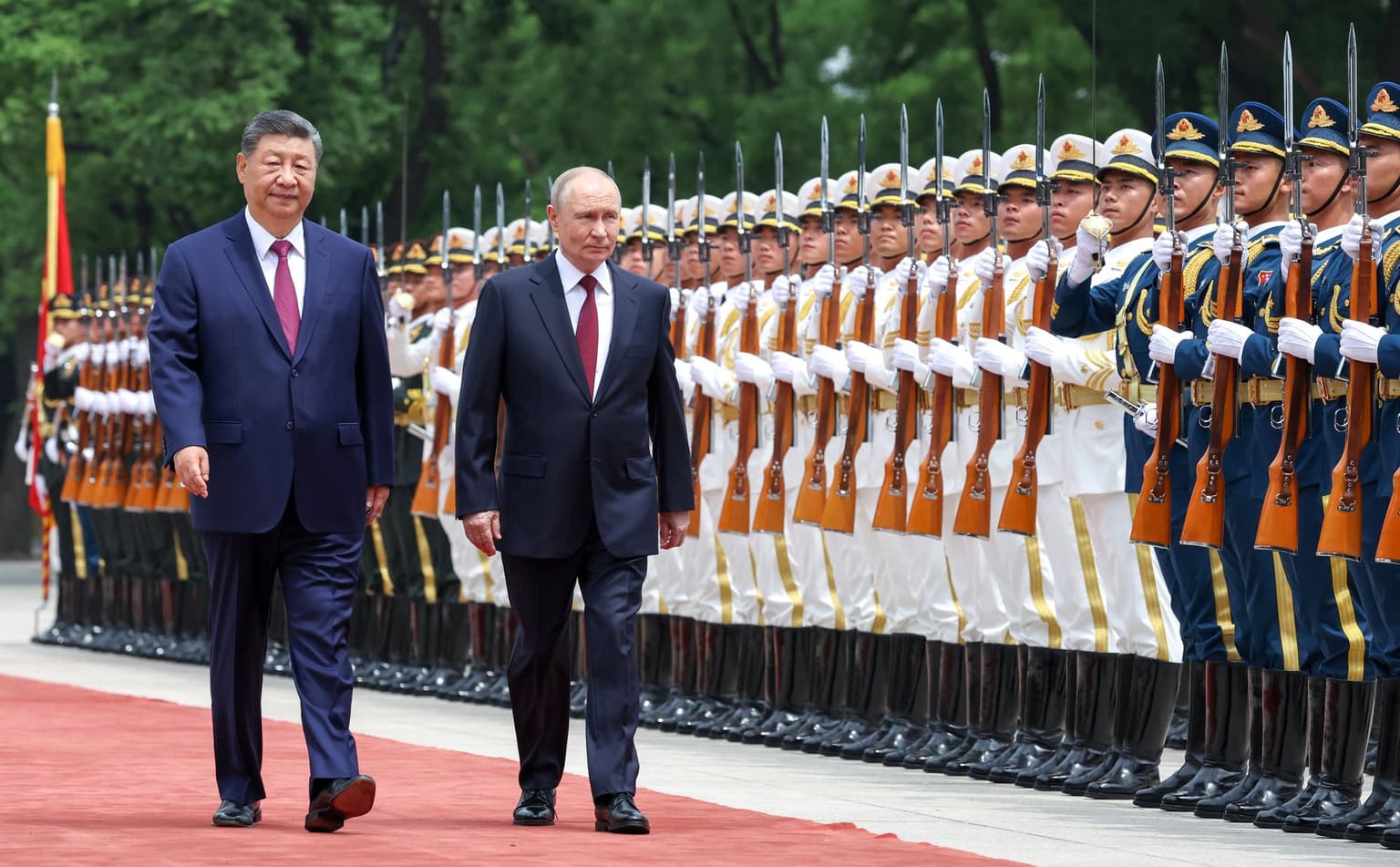
Russia’s President Vladimir Putin (C) and China’s President Xi Jinping (L) in Beijing. (Alexander Kazakov/AFP via Getty Images)
Ukraine’s SBU announced that a Geran-2 drone shot down over Chernihiv Oblast on April 7 contained an R-60 air-to-air missile with depleted uranium elements — uranium-235 and uranium-238. Radiation of 12 microsieverts per hour was recorded, significantly above the natural background level. The SBU warned citizens not to approach drone debris. The warhead has been secured and transported to radioactive waste storage. This is the first confirmed instance of Russian forces using depleted uranium components in drone-launched munitions in Ukraine.
A Quarter of Russia’s Refining Capacity Offline: Reuters’ Full Assessment
Reuters reported on May 20, citing industry sources, that all major oil refineries in central Russia have halted or significantly rolled back production following Ukrainian drone strikes. The Kirishi refinery in Leningrad Oblast — 20–21 million tons per year — has been shut down since May 5. The Moscow Oil Refinery in Kapotnya halted operations after the May 17 strike to “mitigate risks,” with restart expected to take several days. The Ryazan oil refinery halted operations after the May 15 strike. The Yaroslavl Slavneft-YANOS refinery suspended the AVT primary processing unit after a May 15 strike and was struck at the Yaroslavl-3 pumping station on May 19. The Lukoil-Nizhegorodnefteorgsintez refinery in Kstovo, Nizhny Novgorod Oblast — 17 million tons per year — was struck again overnight May 19–20, hitting the AVT-6 processing unit; fires broke out and Nizhny Novgorod Governor Nikitin confirmed the strike on two industrial facilities in Kstovskyi Raion.
The combined capacity of the impacted refineries: 238,000 tons per day, or 83 million metric tons per year — approximately 25 percent of Russia’s total refining capacity. The facilities account for 30 percent of Russia’s gasoline output and 25 percent of its diesel output. USF Commander Brovdi confirmed May 20 that Ukraine has struck 10 major Russian refineries this month, with 6 forced to halt operations. Zelensky confirmed he is “preparing an expansion of the geography” of long-range strikes. The Ukrainian General Staff also confirmed the May 19 strike on the Yaroslavl-3 station damaged four storage tanks holding up to 140,000 cubic meters of petroleum products. Russian Astra outlet also reported a second strike on the Nevinnomyssk Azot plant in Stavropol Krai overnight May 19–20, with fires and smoke visible.
Lithuania’s First Air Alert: Drone from Belarus, President in Shelter, Vilnius Airport Closed
Lithuania’s National Defense Ministry confirmed on May 20 that a drone crossed from Belarus into Lithuanian territory at approximately 9:40 a.m., triggering Lithuania’s first-ever national air raid alert. The alert spread from the eastern border regions to include Vilnius and surrounding areas. Residents received emergency warnings instructing them to seek shelter immediately. Vilnius Airport temporarily suspended operations. NATO Baltic Air Policing deployed a fighter jet in response. Schools and daycare centers received instructions from the National Crisis Management Center to move children to shelters. Estonian media outlet Delfi confirmed that President Gitanas Nausėda, Prime Minister Inga Ruginėne, and parliament Speaker Jozas Olekas were in shelter during the alert; a Foreign Affairs Committee meeting was held in the shelter. Radar contact with the drone was lost at approximately 11 a.m.; its exact location and origin remain under investigation. Lithuanian State Security Director Bridikis told reporters after the incident that Lithuania’s security situation is “sharpening.”
Lithuanian FM Budrys: “Russia is deliberately redirecting Ukrainian drones into Baltic airspace. It’s a transparent act of desperation — an attempt to sow chaos and distract from a simple reality: Ukraine is hitting the Russian military machine hard.” The incident follows Estonia’s May 19 drone interception by a Romanian NATO jet, Latvia’s multiple drone alerts in May, and Finland’s Helsinki-Vantaa Airport closure on May 15. Fifteen Baltic MEPs wrote an open letter to EU leadership calling for solidarity with the three countries against Russia’s unfounded accusations and military threats. European Commission President von der Leyen: Russia’s threats are “unacceptable.” EC spokesperson: “Without Russia’s war of aggression, there’d be no drones crashing into EU space. Responsibility for everything is with Russia.”
Putin and Xi: 40 Documents, No Gas Pipeline
Putin and Xi Jinping met in Beijing on May 20 for the second day of Putin’s state visit, signing a joint statement on “further strengthening comprehensive partnership and strategic interaction,” a declaration on “establishment of a multipolar world and a new type of international relations,” and approximately 40 intergovernmental, interagency, and corporate documents focused on deepening economic cooperation. The joint statement included language about “combating the glorification of Nazism, fascism, and militarism,” a formulation Russia uses to characterize Ukraine’s government. Putin last visited China in late August 2025.
What was not signed: the Power of Siberia 2 gas pipeline agreement. Russia had identified PS-2 as a priority for the visit. Kremlin aide Ushakov stated Russia and China reached agreements on energy projects and “something else very important” but declined to specify. ISW assessed the failure to sign PS-2 demonstrates the current limits of Russo-Chinese cooperation: Beijing is using its upper hand — Russia needs China far more than China needs Russia under current sanctions — to extract concessions Moscow cannot afford, including gas prices close to Russia’s own domestic subsidized rates. The visit came one week after Trump’s Beijing summit; Putin’s key agenda item was gauging how much of the Sino-Russian relationship survived Trump-Xi intact.
Depleted Uranium Found in Russian Drone; 155 Drones and a Missile Overnight
Ukraine’s SBU reported on May 20 that authorities detected depleted uranium-235 and uranium-238 in the wreckage of a Russian Geran-2 drone armed with an R-60 air-to-air missile, shot down in Chernihiv Oblast on April 7. A gamma radiation level of 12 microsieverts per hour was recorded — significantly above the natural background level and a threat to human health. Depleted uranium is approximately 2.5 times denser than steel, making it effective for penetrating armor. The SBU secured the warhead and transported it to a radioactive waste storage facility. The SBU warned citizens to exercise extreme caution near any drone or missile debris, as damaged or burnt munitions can release radioactive dust. Investigators opened a war crimes investigation under Article 438 of Ukraine’s Criminal Code.
Russian forces launched one Iskander-M ballistic missile from Rostov Oblast and 154 drones overnight May 19–20. Ukrainian forces downed 131 drones; the Iskander-M and 23 drones struck 20 locations; debris fell on six more. Russian forces also launched 84 additional drones during the day on May 20; 75 were downed; six struck targets. Russian strikes damaged energy and residential infrastructure in Odesa and Sumy oblasts. In Dnipro, Russian forces struck food warehouses and residential areas with an Iskander-M, killing two civilians and injuring six. Russian forces also struck Dnipro again in the early hours of May 21 with a jet-powered UAV, injuring a 58-year-old woman and damaging a fifth-floor apartment.
NATO Secretary-General: Nuclear Strike Would Bring ‘Devastating’ Response
NATO Secretary-General Mark Rutte stated on May 20, at a pre-ministerial press conference at the Foreign Ministers Meeting of NATO, that if Russia uses nuclear weapons against Ukraine, “the reaction is devastating.” Rutte was asked directly about Russia’s ongoing strategic nuclear exercises — the largest since the Cold War, involving 64,000 personnel and 8 ballistic missile submarines — and made clear NATO is monitoring the exercises closely. “They know if that happens, the reaction is devastating,” Rutte said. The statement represents the clearest public articulation by a sitting NATO Secretary-General of the alliance’s response to Russian nuclear use, issued while Russia’s nuclear exercises are still ongoing.
Zelensky Warns of Five Russian Northern Scenarios; Orders Defense Buildup
Zelensky convened a Staff of the Supreme Commander-in-Chief meeting on May 20 focused on the Belarus-Bryansk direction. Ukraine’s military and intelligence services briefed him on Russian planning for “scenarios for additional attacks against Ukraine — targeting our northern regions, our Chernihiv-Kyiv direction.” Zelensky stated Ukraine has identified five specific Russian scenarios for expanding the war through northern Ukraine and is preparing responses to each. He issued military instructions to strengthen the Chernihiv-Kyiv defensive direction and ordered Ukraine’s Foreign Ministry to prepare diplomatic pressure measures specifically targeting Belarus. “They must understand there: consequences for them will follow and be significant,” Zelensky said.
Zelensky noted that Russia currently lacks the troop capacity to sustain a renewed full-scale Belarus front, but could opt for “political decisions of a different format” — including moves analogous to the Transnistria passportization path. He separately confirmed Ukraine is preparing to expand the geography of long-range strikes. Syrskyi reported at the Ukraine-NATO Council meeting at NATO Headquarters in Brussels on May 20 that since the beginning of 2026, Russia’s total losses have exceeded 141,500 military personnel, of whom more than 83,000 were killed. “Every day, the Russian army loses at least a thousand soldiers killed and wounded,” Syrskyi said. Ukraine’s drone systems alone struck 19,203 Russian personnel in the first 19 days of May; Brovdi forecasted over 34,000 total drone-inflicted casualties by month end.
Kupyansk Cleared; Pokrovsk Consolidation; Ukrainian Advances in Zaporizhzhia
A Ukrainian company commander confirmed on May 19 that Ukrainian forces killed or captured the remaining Russian sabotage and reconnaissance elements operating within Kupyansk as of May 18. Russian forces continue to infiltrate into the city in groups of one to three personnel, largely through underground gas pipelines, and still hold some positions on the city’s outskirts. ISW adjusted its control-of-terrain assessment to depict Kupyansk as Ukrainian counterattack territory — no longer mapping an active Russian infiltration zone pending additional verification. Russian forces are now attacking toward Kupyansk-Vuzlovyi south of the city and toward the western Oskil riverbank, largely to generate flag-raising footage for informational effect. The Russian military command is reportedly transferring elements of the 272nd MRR, 26th Tank Regiment, and 153rd Tank Regiment (all 47th Tank Division, 1st GTA) from Kupyansk to the Lyman direction to compensate for heavy losses — which would indicate Russia may have abandoned active Kupyansk seizure efforts.
In western Zaporizhzhia Oblast, Ukrainian forces liberated Mala Tokmachka and Bilohirya southeast of Orikhiv; pushed Russian forces from the southern tip of the Uspenivka Balka south of Novodanylivka and from southern Prymorske; and advanced east of Plavni along the E-105 highway, per Mashovets. Reports — with some uncertainty noted by Mashovets — indicate Ukrainian forces liberated Mali Shcherbaky and Shcherbaky west of Orikhiv. These counterattacks have effectively halted Russian advances toward Orikhiv and Zaporizhzhia City. New OOB: elements of Russia’s 7th Military Base (49th CAA), 56th VDV Regiment (7th VDV Division), and 166th Separate MRR (19th MRD, 58th CAA) are operating in western Zaporizhzhia. Ukrainian forces advanced south of Kostyantynivka in central Illinivka and have maintained positions in western Kostyantynivka contrary to Russian claims. The Ukrainian General Staff confirmed Piddubne northeast of Oleksandrivka as Russian-seized after a Ukrainian drone control point strike near the settlement confirmed Russian positions.
North of Pokrovsk, the Ukrainian 7th Rapid Reaction Corps confirmed Russian forces are operating along the Hryshynka River channel attempting to advance toward Myrne, Hulive, Shylivka, Yurivka, and Krutoyarivka — indicating Russian forces have consolidated in Hryshyne northwest of Pokrovsk and advanced north. The corps also assessed that Russian forces have seized all of Pokrovsk and consolidated within the town, using drone operators and elevation advantage in Pokrovsk and Myrnohrad to dominate the surrounding area. In Sumy Oblast, Russian forces advanced northeast of Sadky; a source reporting on the Northern Grouping confirmed Russian forces are operating in forested areas northeast of Sadky, south of Oleshnya, and west of Guyevo. Russian forces struck the Novokramatorsk Machine-Building Plant near Kramatorsk. Ukrainian mid-range strikes: repair unit in occupied Severodonetsk (39 km); command post in occupied Soledar (15 km); command and observation post near Ivanivske (6 km); drone control point near Perebudova (3 km); drone control point near Yelizavetovka, Kursk Oblast; drone control point near Piddubne; command and observation post near Lyubimivka, Kherson Oblast.
UK Suspends Russian Oil Licenses; EU Loan Conditions; Mindich Sues Zelensky
UK Trade Minister Chris Bryant apologized on May 20 for the “clumsily” handled rollout of the May 19 Russian oil and LNG licenses, saying the measure would be suspended as soon as possible. Prime Minister Starmer spoke with Zelensky on May 20, reaffirming steadfast support and outlining a new sanctions package aimed at reducing Russia’s oil presence on global markets. Zelensky and Starmer “stressed the importance of maintaining this pressure” in their call. The reversal came after backlash from Kyiv, European partners, and domestic critics including John Foreman, former UK defense attaché, who called the May 19 licenses incompatible with leading the Coalition of the Willing.
The European Commission announced on May 20 that the first €3.2 billion tranche of the €90 billion Ukraine support loan will be disbursed in June 2026, conditional on Ukraine implementing reforms including taxing digital platform income (such as Uber), adopting public investment strategies, and updating the customs code. Further tranches totaling more than €8 billion require revenue collection improvements and spending efficiency gains — closely echoing IMF conditions Ukraine has been slow to implement. The EC announcement comes as Ukraine has missed approximately 20 EU reform deadlines since 2024. Separately, Timur Mindich — the alleged ringleader of the $100 million Energoatom corruption scheme — filed a lawsuit with Ukraine’s Cassation Administrative Court seeking to overturn the presidential sanctions Zelensky imposed on him in November. Mindich fled to Israel before being charged. Ukraine has requested extradition from Israel, which Abakumov, the lead investigator, described as a rare and difficult process.
OUN Leader’s Remains Exhumed in Luxembourg; Fourth Mariupol Anniversary
The ashes of Andrii Melnyk — a key leader of the Organization of Ukrainian Nationalists (OUN) who died in Luxembourg in 1964 — were exhumed on May 19 during an official ceremony attended by Ukrainian state representatives. The remains were transported to Ukraine for reburial on May 24 at the National War Memorial Cemetery near Kyiv. Memorial liturgies are scheduled for May 22–23. Melnyk was a veteran of the war for Ukrainian independence (1917–1920s), a close associate of OUN founder Yevhen Konovalets, and a prisoner in Sachsenhausen during World War II. He led the OUN-M faction after the 1940 split with Bandera’s OUN-B. The reburial takes place in the midst of active war.
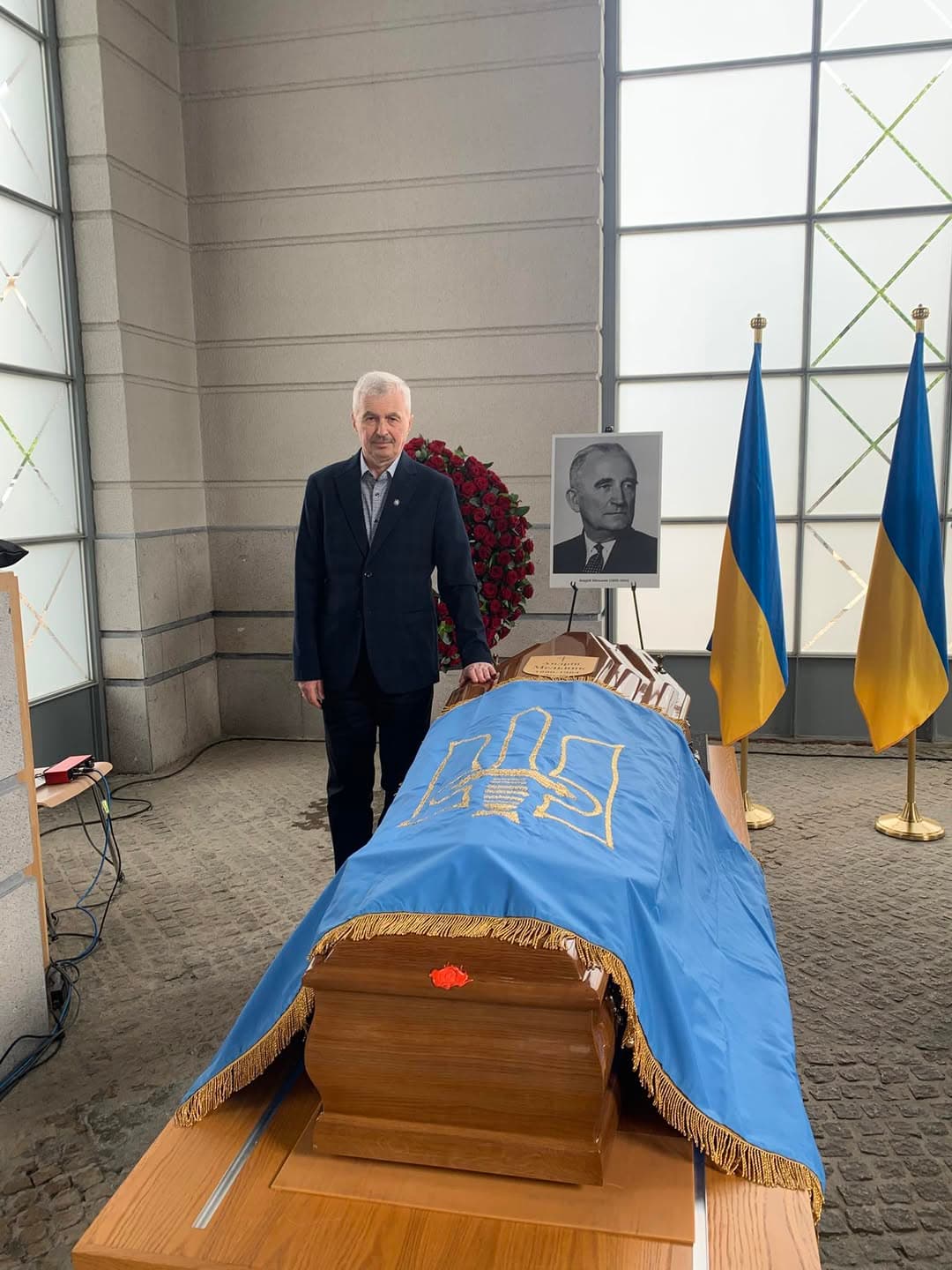
Bohdan Chervak, the current head of the OUN, at a ceremony in Luxembourg where former leader Andrii Melnyk’s ashes were exhumed (Facebook / Chervak)
May 18–20 marked the fourth anniversary of the end of the defense of Mariupol in 2022, when the remaining defenders of the Azovstal steel plant — 3,500–4,000 Ukrainian soldiers against 20,000 Russian troops — were ordered to preserve their lives and enter Russian captivity under a preliminary agreement. An estimated 20,000–40,000 Mariupol civilians were killed by Russian bombardment during the siege. The defenders’ survivors remain symbols of the war’s opening months; many of those taken prisoner in May 2022 were included in the 205 returned on May 15.
The Weight of May 20
A quarter of Russia’s refining capacity is offline. Lithuania issued its first air alert. The President and Prime Minister sheltered during a parliamentary session. Vilnius Airport closed. Russia’s drone landed somewhere in Lithuania from Belarus and disappeared from radar.
Putin left Beijing without the gas pipeline he came for. Ukraine’s SBU found depleted uranium in a Russian drone. NATO’s Secretary-General said a Russian nuclear strike would bring a devastating response while Russia’s nuclear submarines were still at sea. Syrskyi said Russia has lost 141,500 soldiers since January.
Kupyansk is cleared. Ukrainian forces liberated Mala Tokmachka and three more settlements in Zaporizhzhia. The EU loan’s first tranche arrives in June. The UK suspended its Russian oil licenses after one day. The fourth anniversary of Mariupol’s fall passed.
A Prayer for Ukraine
1. For the Two Killed in Dnipro
Lord, an Iskander-M ballistic missile struck food warehouses and residential buildings in Dnipro on the night of May 19–20. Two civilians were killed. Six were injured. A separate jet-powered drone struck again in the early hours of May 21, injuring a 58-year-old woman in her apartment. This is the daily condition of a city that Russia has been targeting for years. Receive the two who died. Hold the injured. And hold the emergency workers who have responded to these attacks so many times that the city has a practiced protocol for rubble and residential strikes that has nothing to do with warfare and everything to do with survival.
2. For Lithuania and the Countries Sheltering Their Governments
Father, Lithuania’s President, Prime Minister, and parliament Speaker took shelter this morning while a drone from Belarus flew over their country. Schools moved children to shelters. The airport closed. The drone disappeared. This is what Russia has done to the neighborhood: it has made air raid shelters a normal part of political meetings on a Tuesday in May. We pray for Lithuania, Latvia, Estonia, Finland, and Poland — for their defense ministers and air defense commanders and school principals who receive the instruction to move children underground. Let the EU’s drone defense initiative and air shield be built before the next drone. Let NATO’s deterrence be credible enough that the question of the next drone is not left to luck.
3. For the Defenders of Mariupol, Four Years Later
God of memory, four years ago this week, the last defenders of the Azovstal steel plant entered Russian captivity. Three thousand five hundred Ukrainian soldiers held a city against 20,000 Russian troops for nearly three months. Twenty thousand civilians were killed. The city was bombed flat. The defenders held. And when they were ordered to stop, they did, because a soldier follows orders even when the order is surrender. Many of them were in the 205 who crossed the border on May 15. Many are still in captivity. We pray for the ones who came back — for the treatment they are receiving, for the sleep they have not yet found. And for the ones who have not come back. Let them come home.
4. For the Depleted Uranium Discovery
Lord, Russia equipped a drone with a missile containing depleted uranium and fired it at Chernihiv Oblast. Twelve microsieverts per hour of radiation were recorded. The SBU warned citizens not to approach drone debris — as if the war’s ordinary debris were not already dangerous enough. Depleted uranium is a radiological weapon whose long-term effects on soil and populations last decades. We pray for the specialists who secured the warhead. For the citizens of Chernihiv Oblast who may have encountered debris from the April 7 strike without knowing what was in it. And for the investigators building the war crimes file that will include this alongside the 17,400 confirmed dead civilians, the 238 killed in April alone, and the 3,000 attacks on hospitals. Let the evidence survive. Let the accountability follow.
5. For the Geography of the Long-Range Sanctions
God of justice, a quarter of Russia’s refining capacity is offline. Zelensky says the geography of strikes will expand. Brovdi confirmed 10 refineries struck this month, 6 halted. The fuel that runs Russian tanks and jets and supply trucks is becoming harder to produce at home. We pray not for destruction for its own sake but for the pressure that changes a calculation. Russia is fighting a war it is funding with oil. Ukraine is shutting down the plants that process that oil. If the pressure mounts to a threshold Russia cannot sustain, then the strikes are not just damage — they are leverage. Let the leverage be enough. Let it be used wisely. In Your mercy, in Your justice, in Your time — bring this war to its end.